Archives for October 2019

S&P 500 vs. International Stock Funds: Revenue Breakdown By World Region

One of the common reasons given for only investing the S&P 500 or only US-based companies is that the businesses operate globally. “McDonald’s and Coca-Cola sell burgers and soda everywhere. Disney is everywhere. ExxonMobil sells energy around the world.” I understand the sentiment, but how about some real numbers? The Morningstar article Investing Close to Home Is Overrated breaks down the revenue by region for some popular ETFs that track broad US and International stock indexes.

A few quick takeaways:

  • Companies in the S&P 500 or Total US index get about 65% of their revenue from the United States and 35% from the rest of the world.
  • Companies in a Total World ex-US index only get about 15% of their revenue from the United States and 85% from the rest of the world.

The S&P 500 does derive a decent chunk of its profits from international sources. However, you’re still missing a lot of exposure from the rest of the world.

Now, I happen to agree that you don’t “need” to own an international index fund. The Dow Jones index has taught us that even a poorly-constructed funky index that tracks 30 human-picked companies based on the numerical price of a single share (not total market value) can work out over the long run. By extension, if you only own the S&P 500 and hold on for 30 years, you’ll probably turn out fine as well.

However, I still choose to add international stocks to my portfolio. Why? The holding on part. I expect international stocks again outperform US stocks for years in a row. From a previous post US vs. International Stocks: Historical Cycles of Outperformance:
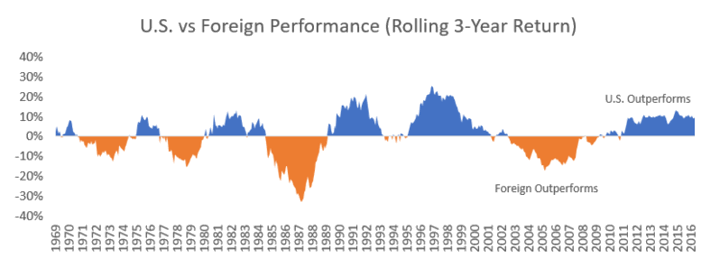
us_intl_cycle

Nobody knows the future, and so there is no single “right” answer. From No Consensus on International Stocks: Make Any Decision, Just Stick With It:

international3

Bottom line. Owning just US stocks might work out just fine, but it’s still not the same as owning international stocks. The world will change in many unexpected ways during next 50 years and my investing life is easier when I own the entire haystack.

Amazon Fresh Grocery Delivery Now Free for Prime Members

Grocery delivery via Amazon Fresh and Whole Foods (Prime Now) is now free for Amazon Prime members (previously $14.99 per month). If you are an existing Amazon Fresh member, your price drop applies immediately. Newly interested members should register for an invite now to get on their waiting list.

It’s not just Whole Foods, they work with other local grocery stores as well. You can buy meat, seafood, produce, snacks and household essentials, often delivered within a 1-2 hour window. They are not available everywhere, but Amazon says they now cover 2,000+ cities. For most areas, the minimum order amount will be $35 ($50 in New York City).

Chart: Will Your Kids Earn a Higher Income Than You?

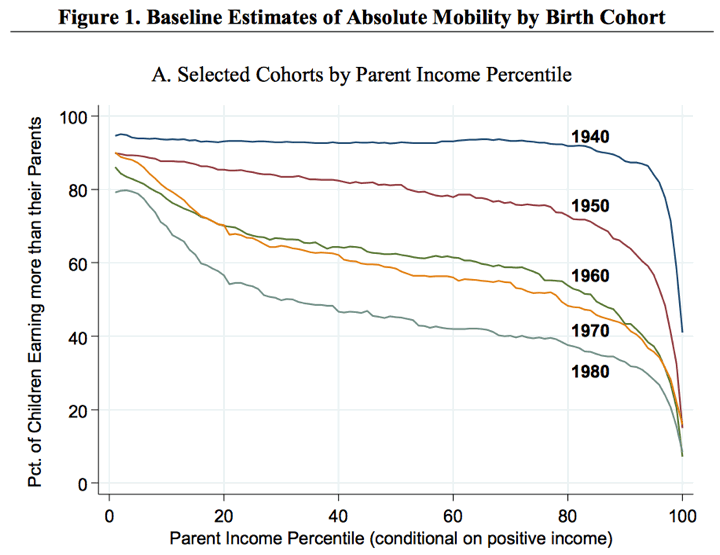
Parents want their children to have a better life than their own. We want our kids to eat more healthily, accumulate more knowledge, enjoy closer relationships, live longer, and – if we’re honest – make more money. However, the academic paper The Fading American Dream: Trends in Absolute Income Mobility Since 1940 by Chetty et al. shows us that earning more money than your parents has gone from nearly a sure thing to no better than a 50/50 coin flip. Via WSJ Daily Shot.

Here is a chart where each line shows the percentage of children born in the indicated year that earned more than their parents, as a function of their parent’s income percentile.

Every decade, the numbers get consistently worse. In terms of overall percentages:

  • For children born in 1940, over 90% grew up to earn more than their parents.
  • For children born in 1980, only 50% grew up to earn more than their parents.

What does that mean? Even if you as parents today earn an above-average income, there is no guarantee that your kids will grow up to earn more than you on an inflation-adjusted basis. In fact, if the trend holds, the odds are that they will end up earning less.

Very few parents have the kind of wealth that guarantees financial security for their offspring. This creates increasing stress about gifted programs, private schools, magnet schools, sports teams, test prep, and any other opportunities that can give them an edge.

We took our kids to a local pumpkin patch this weekend, and in between choosing your own pumpkin and feeding farm animals, our oldest started complaining about not having $5 lemonade. This reminded me of a simple rule:

Happiness equals reality minus expectations.

My kids should not expect to have a certain lifestyle. I hope (!) to teach them gratitude for the many advantages that they have been given, a strong work ethic for obtaining what they want to achieve, and tempered expectations of what makes a good life (not just money). Now, how do I pull that off?

Serious Eater: The Financial Details Behind Food Blog SeriousEats.com

If comparing this blog to the restaurant world, I like to think of it as the stubborn Mom & Pop hole-in-the-wall with one location. It’s been around for a long time, but there are no second locations, no franchises, no frozen food line. It was never sold to a private equity firm or some publicly-traded corporation. It owns the building and the land underneath, so it can just keep on doing its own thing.

When I first saw the book Serious Eater: A Food Lover’s Perilous Quest for Pizza and Redemption, I had no idea who Ed Levine was. I originally thought that Serious Eats was a little food blog run by J. Kenji Lopez-Alt as a side gig outside of his day job, just as I started MyMoneyBlog.com. I don’t live in New York and had read a few posts like their viral posts like the In-N-Out Menu Survival Guide and now use their reversed-sear prime rib recipe every year.

The truth is actually very different, and I quickly became engrossed in the story behind Serious Eats.

  • Instead of a young blogger working out of their tiny studio and a $10/month web-hosting package, Ed Levine was a former advertising executive in his 50s who started out immediately with a salary for himself, a salaried team, and an office space. This was possible due to a $500,000 loan from his older brother.
  • Instead of running lean and looking for profitability quickly, Serious Eats never made a profit from 2006 to 2015. It grew in viewership and gross revenue, but my understanding is that even when it was eventually sold, the advertising revenue never exceeded the running costs (salaries, office space, other overhead).

Ed Levine was obsessed with food and the stores behind it. You can get a taste of his energetic personality in this 1997 NYT Times article “On an Odyssey With the Homer Of Rugelach” by Ruth Reichl.

Her story in the Times called me the “missionary of the delicious.” Ruth described what I did better than I ever could: “Mr. Levine is on a crusade to see that the people who make food get the recognition they deserve. He sees them as creative artists waging a losing battle against mechanization, and he cheers them on.”

Serious Eats was definitely a passion project. However, Mr. Levine never excelled at the financial side. In fact, this was his first true business venture.

But that was before I understood a fundamental truth about individual investors: just because someone has made enough money to invest in a speculative venture like Serious Eats doesn’t mean they won’t be upset if they lose it. That goes double if they are family. People who have made money usually didn’t make it with a casual attitude about money in general.

However, he did raise a million dollars of startup money from family and friends, so you have to give him that. He had the charisma and infectious optimism that convinced people to bet on him:

And just like the folks at a victory party, we really felt we were on a mission: to change and democratize the food culture through food media without dumbing it down or pandering. Maybe art and commerce could coexist peacefully. Maybe they could even complement each other. Maybe my belief that creating good content could and would lead to financial success wasn’t as ridiculous as the money guys seemed to think.

Serious Eats grew in popularity. If you are at all interested in food, you’ve probably heard of it.

Back at Serious Eats World HQ some of our posts were going viral. Kenji chronicled in words and pictures the “In-N-Out Burger Survival Guide,” in which he ate every single item on its twenty-eight-item secret menu. That one post attracted 3.5 million unique visitors in the first year it was up.

However, they never really stopped burning through money. They missed the boom time of website sales before the Great Financial Crisis of 2008. They later tried to sell to a variety of different buyers in 2010 to 2011, but that was a slow period in media acquisitions.

Ed Levine went back and begged and borrowed money from every source imaginable. He borrowed even more money from his older brother, eventually making the total owed somewhere over $600,000 (I lost count). He accumulated $650,000 in personal debt that was straining his marriage, as it was backed by the New York apartment jointly owned with his wife. His wife Vicki later took on a margin loan backed by her personal stock holdings. Multiple close friends lent him $100,000 each. In other words, he was risking all of his closest personal relationships.

In fact, the most harrowing details I’ve had to relive in writing this book have nothing to do with financial security, only the terrifying knowledge of how close I came to doing real damage to the relationship that made it all possible.

You could feel the desperation at this point. It’s all about timing, as if you’re selling an unprofitable growth business, you need buyers with loose money and an appetite for risk. (Look up the current status of WeWork.) Somehow, he finally sold Serious Eats to Fexy Media in 2015. The details are blurry, but it seems that the investors were mostly made whole and Levine was able to pay back all his debts with a small bit of profit. He’s now an employee, not the owner, but perhaps that is for the best.

But thankfully, it’s not quite so personal. Most everyone who works at Serious Eats these days thinks of it as a business first and then, perhaps, a calling. Some people who work at the company may just think of their job as a really good gig. I’m okay with that. Maybe that’s why Serious Eats is doing so much better as a business. Serious Eats is growing up. And that’s okay. So have I.

In the end, this amazing story was powered solely by the energy of Ed Levine (and the equally-amazing support of his wife Vicki). I feel like it really shouldn’t have worked out at all. The climax felt a bit like the ending of the movie The Gambler. You don’t know much about running a website (or any startup), you burn through over a million dollars of money, and your passion is eating and sharing about food. However, he made it out intact and helped establish other talented food writers like J. Kenji Lopez-Alt, Max Falkowitz, and Stella Parks.

This reminded of these tweets about taking asymmetrical risks that have been stuck in my head:

Maybe you can try to make the risk asymmetric, but in the end there is no easy formula. I could not have taken the risks that Ed Levine did with Serious Eats. It would have been a foolish risk for me, as I could never tolerate the financial risk nor the relationship risks. However, when I read about others it seems they are compelled to take such big risks, and somehow it their boldness it can all work out. Of course, I suppose there wouldn’t have been a book about Serious Eats to read if it didn’t.

Capital One Spark Miles For Business: 50,000 Bonus Miles, Worth $500 Towards Travel

card_name

The card_name is a rewards business card offering a big early spend bonus offer in addition to ongoing 2 Miles per $1 on every purchase. Here are the highlights:

  • Unlimited 2 Miles per $1 on every purchase, everywhere.
  • 50,000 bonus miles – equal to $500 towards any travel-related purchases – when you spend $4,500 in purchases within the first 3 months.
  • Unlimited 5 Miles per $1 on hotels, vacation rentals and rental cars booked through Capital One’s travel booking site.
  • Annual fee: $0 intro for first year; $95 after that.
  • Transfer your miles to 15+ travel loyalty programs.
  • Redeem your miles instantly for any travel-related purchases, from flights and hotels to ride-sharing services.
  • Up to a $120 credit for Global Entry or TSA PreCheck(R).
  • Miles never expire as long as your account is open.
  • No foreign transaction fees.
  • Free additional employee cards.

Consider that if you meet the $4,500 spending requirement within 3 months, you will end up with 50,000 miles + 9,000 miles from 2X rewards = 59,000 miles = $590 towards travel purchases on $4,500 spending (13% cash back!).

Note that “Existing or previous Accountholders may not be eligible for this one-time bonus.” For comparison, there is also a Spark Select for Business and Spark Classic that are different cards with lower sign-up bonuses but no annual fee.

The 2 miles per dollar spent for all purchases is a strong rewards structure, and the annual fee is waived for the first year as well. From the second year onward, you’ll have to weigh that against the $95 annual fee after the first year. The math says that you would have to spend more than $19,000 every year ($1,583 a month) to make the 2X miles and $95 annual fee (Spark Miles)pay out more rewards than 1.5X miles and no annual fee (Spark Miles Select).

The travel can be booked directly through airlines and hotels, and there are no blackout dates or award seat limits to worry about.

Miles transfer options. Capital One now allows you to transfer your “miles” into select airline miles programs as well. Here are the airline transfer partners:

  • Aeromexico
  • Air France/KLM
  • Air Canada Aeroplan
  • Cathay Pacific Asia Miles
  • Avianca Lifemiles
  • British Airways Avios
  • Emirates Skywards
  • Etihad
  • EVA
  • Finnair
  • Qantas
  • Singapore Airlines Krisflyer
  • TAP Air Portugal
  • Turkish Airlines
  • Virgin Red

Hotel partners

  • Accor Live Limitless
  • Choice Hotels

If you know how to leverage one of these international airline miles programs, this can be a very valuable option. Otherwise, it’s nice to know you can always get a certain level of value by redeeming against any travel purchase.

Application link: card_name

If you are looking for a comparison with other strong business cards, check out my updated list of Top 10 Best Small Business Credit Card Bonus Offers.

Free Google Mini for Spotify Premium Users ($9.99/Month)

Spotify Premium paid subscribers (both new and existing) can get a free Google Mini smart speaker. New subscribers can join Individual for $9.99 a month or Family for $14.99 per month and get a free promo code. There is no minimum monthly commitment required.
Existing subscribers can register here to get their promo code for a free Google mini.

The music streaming wars continue. This comes right after the 99 cent Amazon Echo Dot + Music Unlimited promo.

Mental Model For Expenses: Past, Present, and Future (With Animated GIFs!)

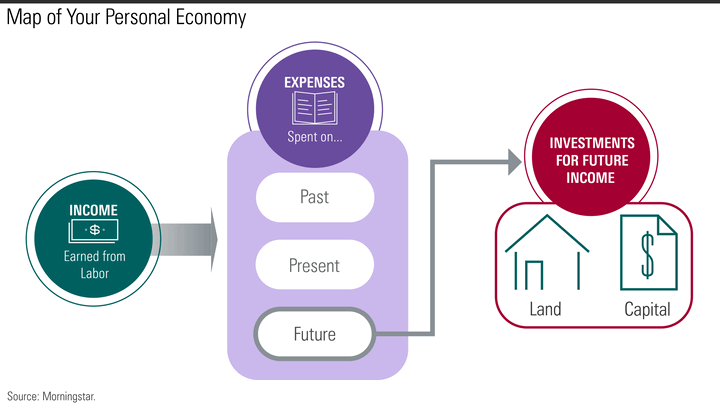
The theory behind financial independence is simple. Spend less, save more, invest it into income-producing assets. The reality is complex, full of daily decisions about balancing income and spending. The Morningstar article (yes, M* is writing about early retirement too now) A Simple Plan for Financial Independence presents this simplified graphic of your “personal economy”.

Income can come from labor, capital, or land. Expenses can be put toward your past (debt), present, or future (investing in capital or land).

I’ve been thinking about this “past, present, and future” mental model for expenses, it meshes will with the simple rules that I want to teach my children: Avoid debt whenever possible, and seek out income-producing assets.

Present. There is countless advice to save money on current expenses. Call it prioritizing, call it frugality, call it whatever. These are important, but I’d rather focus on the added ideas of past and future.

Past. While debt is an important part of the economy, I hate that going into debt for non-essentials is so readily accepted in today’s society. Using home equity lines of credit for a kitchen remodels. Credit cards for vacations. The entire microloans trend where you buy a $100 pair of jeans for $10 a month times 12 months ($120) is a dangerous mind game. Debt is having compound interest work against you, and thus making someone else rich. Debt should not be normalized. Debt is an emergency!

via GIPHY

Future. If you look at people who have really achieved financial freedom, where they truly spend the day doing whatever they want and without money worries, they have all have collected a big pile of income-producing assets. It could be rental property, commercial real estate, a laundromat/car wash/business, dividend-paying stocks, municipal bonds, a pension, Social Security or even just bank CDs if you have enough. In most cases, they collected them with purpose. They didn’t just put the minimum into their 401(k) and call it a day. They would shovel whatever extra money they had into their favorite money-making machine. When I buy more stocks, I see a future income stream:

via GIPHY

When you buy one of these income-producing assets, it should get you excited!

via GIPHY

I’m still not sure exactly how to create this distaste for debt and this desire for money factories, but I’m working on it. If you have these two in place, that should help with everything else – earning more income with labor, spending less on the present.

Oh, and here’s a funny-but-sad representation of the paycheck-to-paycheck lifestyle.

via GIPHY

Super Simple Portfolio Rebalancing: Check Once A Year, Rebalance Every 6 Years On Average!

All this talk about portfolio rebalancing is to improve your risk-adjusted return, not to maximize absolute returns. You are trying to squeeze the most return out of a given degree of risk. Otherwise, if you do nothing eventually whatever has a higher return (historically always stocks) will outperform and take over the portfolio.

Here’s another take on the proper frequency of rebalancing your portfolio to your target asset allocation. Vanguard Research has a new paper called Getting back on track: A guide to smart rebalancing [pdf]. The chart below shows the results of various combinations of time and threshold rebalancing strategies on a traditional 60/40 portfolio from 1926-2018.

I added the yellow highlights, which focus on the two extremes:

  • If you rebalanced every single month for 93 years straight (1,116 times!), your result would have been a 8.20% annualized tax-adjusted return and 11.7% volatility. Sharpe ratio 0.50.
  • If you checked in your portfolio only once per year, and then only actually took actions if your target percentage was off by 10% of more (i.e. 50/50 or 70/30), you would have rebalanced only 14 times over 93 years. That an average of once every 6.6 years! Your result would have been a 8.20% tax-adjusted return and 11.6% volatility. Sharpe ratio 0.50.

My kids like to dance to a popular kids YouTube channel called Super Simple Songs. I think the last method should be called Super Simple Rebalancing. You just need to make sure you’re taking action on those rare trigger dates.

Historically, your risk-adjusted return was a bit better if you rebalanced at a 5% threshold with quarterly checkups (8.31% with 11.6% volatility), but there is no guarantee that this small edge will apply in the future. However, this does explain why Vanguard uses the 5%/quarterly method in their paid portfolio management program Vanguard Personal Advisor Services. Historically, this has worked out to rebalancing once every two years on average, which isn’t so bad either.

This last sentence in the paper is a good summary of tax-aware investing:

Investors may also be able to improve portfolio performance, without sacrificing risk control, by practicing tax-efficient rebalancing through the use of tax-advantaged accounts, rebalancing with portfolio income, incorporating tax- and cost-sensitivity awareness into their rebalancing decision, and gifting overweighted and highly appreciated securities.

Bottom line. You could have rebalanced 1,000+ times from 1926-2018, or you could have just done it 14 times and it really wouldn’t have made much difference. The key is to pick a simple, consistent rebalancing rule and stick with it!

How to Recover Lost US Savings Bonds

sb_poster

Here’s a drawback to US savings bonds that you might not have considered: Savings Bonds are easy to forget about. Paper savings bonds are often left in safe deposit boxes and forgotten. Electronic savings bonds do not generate a paper trail either – no monthly statements, no annual tax forms, nothing. There is not even a reminder when they mature and stop earning interest. If something unexpected happens to the owner, it’s quite possible nobody else will realize the savings bonds are still there, perhaps still compounding away.

How many have been forgotten? The US Treasury is currently sitting on over $25 billion in matured, unclaimed U.S. savings bonds. This is according to the WSJ article States Battle Treasury Over Billions in Unclaimed Savings Bonds (paywall?).

Three Missouri sisters from a Russian immigrant family—Bessie, Anna and Mary Segal—socked away money into U.S. savings bonds for decades starting in the 1940s, investing $25 or $50 at a time.

They never married and by 1998, all three had died, with little money to their names. What the sisters didn’t realize was that those bonds, stored and forgotten in a Kansas bank, had turned into more than $670,000.

Most of that article is about how individual states are fighting with the federal government over who gets the manage the forgotten savings bonds. Both sides talk about fighting for us “little guys”, but the another incentive is that the winner also gets to keep whatever is left over as unclaimed property… again, billions of dollars.

Here’s how to recover lost savings bonds for you and or your relatives, including those gifted to you in the past. Do it as soon as possible, as there may soon be a countdown after which the state will eventually take the money for themselves as unclaimed property.

  • Click here and download Form FS Form 1048 (PDF direct link), “Claim for Lost, Stolen, or Destroyed United States Savings Bonds”. This used to be called Public Debt Form 1048.
  • You will need to fill it out to the best of your ability to help them in a manual search. Ideally you would have the serial numbers, but include all of the information that you can gather. Your name and Social Security Number, the giver’s name and SSN (parent? aunt/uncle? grandparent?), addresses, former addresses, middle initials, etc. If you don’t know something, just leave it blank.
  • Indicate whether you would like a replacement savings bond or direct deposit of the value into your bank account.
  • Obtain a medallion signature guarantee from a financial institution in order to verify your identity.
  • Mail it to the specific PO Box address listed at the bottom of the form. There is no fee.

Kathryn Davenport Bernard was surprised to learn in 2017 from a Kentucky law firm that she could collect on bonds found in the name of her uncle, Roger Lovelace, who died during World War II when she was a girl.

After several months of paperwork, Ms. Bernard and her twin sister each got a $1,300 check. “I just squirreled it away,” she said of the unexpected funds.

If you have existing savings bonds, be sure to create a backup list of all your bonds including purchase date, amount, owner info, and serial numbers. Here is the TreasuryDirect page on what happens upon the Death of a Savings Bond Owner, which applies to paper bonds only.

If you have electronic savings bonds in a TreasuryDirect account, be sure to keep a record of those as well. The TreasuryDirect website directs you to contact the Bureau of Fiscal Service directly if you know of someone with an online account that has died. They will put a hold on the account and give specific instructions for the situation.

Pre-emptive selling? While putting together my other estate documents, I realized that this complexity may not only be a hassle to my loved ones, but if they forget they may lose access to the money completely. Therefore, if I find myself in a year with relatively low income (and thus a lower tax bracket), I will probably sell off all my paper savings bonds and possibly my electronic ones as well. Savings bonds have been a useful tool in building up my investment portfolio, but they are not the best fit if you don’t keep detailed records and/or your family is not adept in navigating bureaucracy.

Best Brokerage and IRA Transfer Bonuses – October 2019

Fidelity, Schwab, TD Ameritrade, E-Trade, Interactive Brokers, Ally Invest all now offer free stock trades. Vanguard offers free trades on all ETFs, not just their own. The new differentiators are things like user interface, customer service, and interest on cash sweep accounts. How about some cash in my pocket too?

The recent shake-up is a reminder brokers are transitioning to maximizing assets under management, as opposed to attracting traders that rack up those commissions. You can often get a cash bonus for switching teams, based on the size of assets that you move over. This usually involves an ACAT transfer of your securities, including tax cost basis history. Here’s a current list of the top brokerage transfer bonuses, along with some additional commentary on Fidelity and Vanguard.

Schwab

  • Link: Up to $2,500 bonus offer
  • $200 bonus for $50k, $300 for $100k, $600 for $250k, $1,200 for $500k, $2,500 for $1m+.
  • New or existing customers moving over new assets. Valid for retail brokerage accounts.
  • Make a qualifying net deposit of cash or securities within 45 days.
  • Maintain net deposit amount (less any market losses) for one year.

TD Ameritrade

  • Link: Up to $1,000 bonus offer
  • Note this matches or is better than their standard up to $600 offer.
  • $100 bonus for $25k, $200 for $50k, $500 for $100k, $1,000 for $250k+.
  • Valid for new taxable or IRA accounts.
  • Open by 1/30/20, funded with new funds or securities within 60 days.
  • Maintain net deposit amount (less any market losses) for 12 months.

Chase YouInvest + Sapphire Banking

  • Link: $1,000 Sapphire offer / Standard offer
  • Sapphire offer: New or existing customers. Brokerage and/or IRA. Must transfer a total of $75,000 or more in new money or securities into eligible Chase checking, savings and/or investment accounts. You must open a new Sapphire banking account by 11/19/2019, complete the $75k transfer within 45 days of opening, and maintain that balance for at least 90 days from the date of funding. Get $1,000 bonus.
  • Standard offer: $200 for $25k, $300 for $100k, $625 for $250k. Transfer within 45 days, maintain for 90 days.

Merrill Edge

  • Link: Up to $1,000 bonus offer / $900 Preferred Rewards offer / $600 Standard offer
  • $100 bonus for $20k, $250 for $50k, $500 for $100k, $1,000 for $200k+ in new assets to BofA/Merrill. If you have a lot more than $200k, you can call them at 888-637-3343 for a custom offer.
  • Expires October 17, 2019. This is a special link that is more than the standard offer. The page says “This limited time offer is valid only for MoneyShow attendees.” but reports of enforcement vary. If they do enforce, you may have to provide proof of attendance to San Francisco Money Show or accept the standard bonus amount.
  • Up to 100 free trades per month with Bank of America Preferred Rewards program.
  • Valid for new IRA or retail brokerage accounts (CMA).
  • Make a qualifying net deposit of cash or securities within 45 days.
  • Maintain net deposit amount (less any market losses) for 180 days.

E-Trade

  • Link: Up to $2,500 bonus offer
  • $200 bonus for $25k, $300 for $100k, $600 for $250k, $1,200 for $500k, $2,500 for $1m+.
  • New non-retirement brokerage accounts only.
  • Open by 12/31/19, funded with new funds or securities within 60 days.
  • Maintain net deposit amount (less any market losses) for 6 months.

Ally Invest

  • Link: Up to $3,500 bonus offer
  • $50 bonus for $10k, $200 for $25k, $300 for $100k, $600 for $250k, $1,200 for $500k, $2,500 for $1m, $3,500 for $2m+.
  • New non-retirement brokerage accounts only. (You must not have closed an account within the last 90 days.)
  • Open by 12/31/19, funded with new funds or securities within 60 days.
  • Maintain net deposit amount (less any market losses) for 300 days past bonus deposit (~370 days after opening).

Fidelity

  • Fidelity used to offer a variety of transfer bonuses, but they didn’t do a good job of curbing abuse and some folks got multiple bonuses without actually bringing in new money. Right now, I can’t find any transfer bonus links. Instead, here are a few reasons why you might want to move your money to Fidelity anyway (you can try out the other brokers above and take their money for doing so first).
  • Fidelity does not sell equity order flow to market makers and high-frequency traders.
  • Fidelity offers a relatively competitive default cash sweep option. As of 10/10/19, the Vanguard Federal Money Market fund pays 1.90% SEC yield, the Fidelity Government Money Market fund pays 1.58% SEC yield, Schwab pays 0.12%, TD Ameritrade pays 0.01%, and E-Trade pays 0.01%.
  • Fidelity has a variety of in-house stock and bond mutual fund options, which trade with no transaction fee at Fidelity and now have no minimum purchase amounts.
  • In my experience, Fidelity has had the most knowledgable customer service reps.

Vanguard

  • Vanguard has never offered a transfer bonus, to my knowledge. Instead, here are a few reasons why you might want to move your money to Vanguard anyway (you can try out the other brokers above and take their money for doing so first).
  • Vanguard has the most competitive default cash sweep option. As of 10/10/19, the Vanguard Federal Money Market fund pays 1.90% SEC yield, the Fidelity Government Money Market fund pays 1.58% SEC yield, Schwab pays 0.12%, TD Ameritrade pays 0.01%, and E-Trade pays 0.01%. This may or may not matter to you, depending on your idle cash balances.
  • Vanguard does not offer free trades on all stocks, but they do offer free trades on 1,700+ ETFs from any provider. Vanguard is not really built for heavy traders of individual stocks.
  • Vanguard has a variety of in-house stock and bond mutual fund options, which trade with no transaction fee at Vanguard.

Transfer notes.

  • Many brokers will charge an “Outgoing ACAT fee” of $50 to $150 when you leave them. I recommend contacting your destination broker and asking them to reimburse you for this fee. If you qualify for one of these bonuses, your account is probably big enough for them to consider it. You may have to send them a statement showing the fee.
  • Before moving, I would download all your old statements and tax cost basis information to make sure it transfers over correctly.
  • An ACAT transfer can take a week or so to complete, so you won’t be able to make any sell transactions during that time.
  • Consider performing a “partial” ACAT transfer where you only move over specifically designated shares (ex. only all 455 shares of BRKB) if you wish to keep some of your original brokerage account open. I would still transfer over all shares of any specific ticker, so that the tax cost basis carries over neatly.

Financial Freedom and New Car Loans Don’t Mix Well

Apparently, my rule of thumb about affording cars isn’t exactly going viral. If you are serious about financial freedom, you shouldn’t be taking out loans for luxury items. A new car is a luxury item! Basic transportation will cost you under $10,000 and you can usually get a loan with the best interest rate from a credit union. Here are some surprising statistics from the WSJ article The Seven-Year Auto Loan: America’s Middle Class Can’t Afford Its Cars (paywall?).

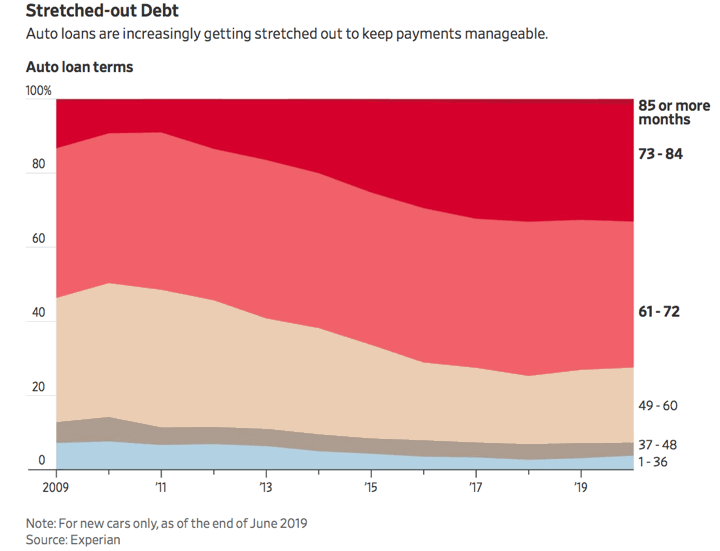
The average new car auto loan is now $32,000 over 69 months. 1 out of 3 people are rolling over debt from their previous car. 90% of new car loans are for longer than 4 years. 70% of new car loans are for longer than 5 years. This is crazy. Soon we’ll have a 15-year mortgage for cars.

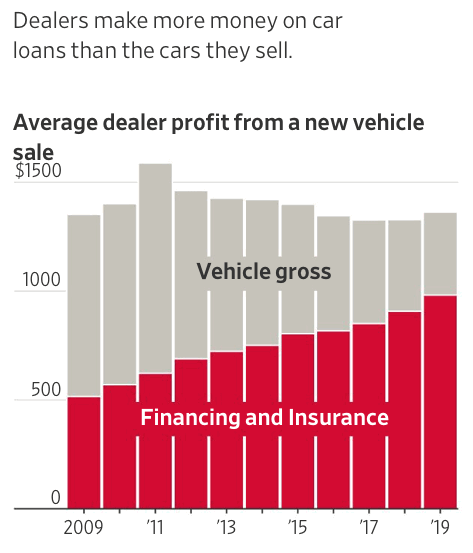
Dealerships now make more money from car loans (and add-on insurance junk) than the purchase price. They are getting a cut of all the interest you’re paying.

So far this year, dealerships made an average of $982 per new vehicle on finance and insurance versus $381 on the actual sale, according to J.D. Power, a data and analytics company. A decade earlier, financing brought in $516 per car and the sale made dealers $837.

This is why I support the FIRE movement. It may not be perfect, but it can inspire a change in mentality where you would never consider going into debt for heated leather seats. Instead of a $32,000 car loan, you could spend $8,000 on a used 2012 Toyota Corolla and put $24,000 towards owning a $120,000 investment rental property with positive cashflow. Or you could put that $24,000 into maxing our your 401(k) or IRA. Or you could start building a compounding stream of dividend payments from owning high quality businesses. Or seed your own new small business. The idea of owning income-producing assets is what should get you excited!!

I’m not saying you should never buy a new car. If you have your financial ducks in a row, then sure buy whatever car you want… with cash! The debt industry wants you to have your dessert NOW, and pay for it later. They want a direct cut of every future paycheck. If it’s a luxury, you should have to save up for it first, and then buy it. I know, such a quaint idea.

Getting far enough ahead to pay cash for your next car can seem impossible. Consider taking out a loan for minimalist basic transportation from all the major credit unions (NavyFed, PenFed, Alliant CU) as well as your local credit union. It’ll work at used car dealerships and even on a car off Craigslist. $10,000 financed at 3.5% APR for 3 years is under $300 a month. After 3 years, instead of starting another new lease or facing another 4 years of car payments, you can now use that $300/month to buy your next income-producing asset.

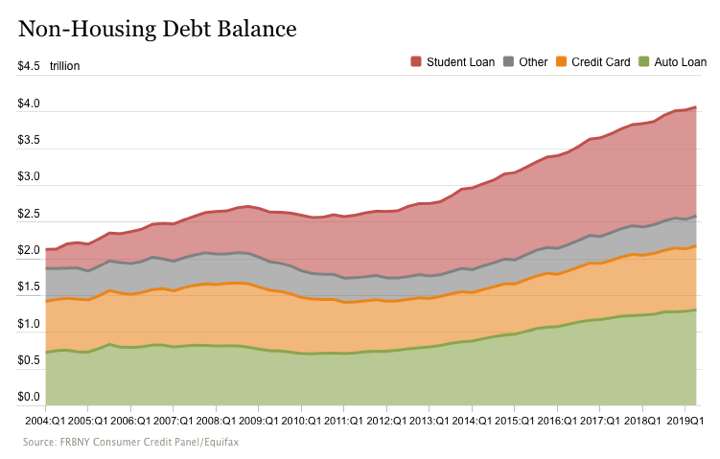
Here is a chart tracking non-housing debt from the New York Fed. The slight decrease from 2009 to 2013 made me optimistic about the future. Since then, the debt has shot back up and my optimism has gone down:

Have you noticed that half of all TV commercials are about new cars? It takes a lot of effort to convince you to buy something you don’t really need.

Robinhood’s New Savings Account is FDIC-Insured! 2.05% APY

Robinhood brokerage has finally re-launched the high-interest cash sweep option after their failed (and illegal?) 2018 mash-up of checking accounts and SIPC-insurance. Robinhood Cash Management is basically what many other places like Betterment Savings have implemented, a FDIC-insured sweep account backed by a mix of different partner banks. The interest rate is variable and currently 2.05% APY as of 10/8/19. This is a pretty competitive rate when compared to other cash alternatives. Debit card has no fees on the Allpoint ATM network. Unfortunately, as is usual with Robinhood, you’ll have to join a long waitlist first.

This was an important move for Robinhood, as many of the established giants have joined the free stock trades party – Schwab, TD Ameritrade, E-Trade, Interactive Brokers, Ally Invest. However, not all of them offer competitive rates on idle cash. Schwab is notably bad in this regard. However, Schwab does offer well-trained humans and instant customer service via phone call. Robinhood has a slick app and user interface, but they don’t readily offer a phone number. Instead, you must wait around for a reply on their online messaging service. If I put a huge chunk of my net worth in a broker, I want a phone number.

So basically, there are free trades, high interest on idle cash, and good customer service. Which are the most important to you?