Archives for October 2018

Infographic: Where Did Housing Prices Crash the Most and the Least?

The Washington Post had an article looking back 10 years later: How the housing market has changed since the crash. Inside was an interesting map of where the home prices crashed the most and the least (click to enlarge):

I wish they had a similar map that shows how much each individual state has also rebounded from the bottoms. According to this NYT article, the national median price is up 44% over the last 6 years:

When the housing bubble burst a decade ago, property values dropped by as much as 60 percent in some areas. Millions of Americans lost their homes to foreclosure. Nationally, the median price of existing homes today is $269,600 — up 44 percent in the past six years.

There are so many local variations. The house that we bought in 2007 was supposedly near the market top, but today the market value is still probably worth 50% higher. That’s far behind stock market returns, but you also have to consider that we could have bought that house with a tiny downpayment. If you put $40,000 down on a $400,000 house and it goes up to $600,000, then you roughly quadrupled your money (after fees). This goes right along into the conclusion of the WaPo article:

Among the lasting fundamental changes brought about by housing crisis, says Sharga, is that people today look at a home as place to live, not as an investment.

“It’s important to realize that homeownership is something to aspire to, but it’s also important to be ready for it,” he says. “It can be a wealth builder, but, as we saw, it can also be the quickest path to financial devastation if you’re not prepared.”

You can still buy a house with zero to 3.5% down payment these days, and that’s big leverage. Leverage goes both ways. It can make you rich much more quickly, but it can also make you broke much more quickly.

Ally Bank Payback Time Promotion: 1% Additional Cash Bonus (~6% APY 3-month CD)

Ally Bank has a new promotion called Ally Payback Time that is offering a 1% cash bonus (up to $1,000) on new deposits on top of their existing interest rates. Valid for both new and existing customers. Given the holding period, this roughly equates to the same total interest paid as a 3-month bank CD at 6% APY. Here’s how it works:
  • Enroll by 10/21/18 at ally.com/payback. You must enroll or you won’t get the bonus. Existing customers must enroll with the same e-mail as linked to their Ally bank account.
  • Fund account by 10/31/18. This means your account has to be approved, opened and funded by this date. Technically the terms state that the funds must arrive by 11/5/18, but that is likely just a grace period and you should initiate any fund transfers by 10/31/18.
  • Maintain funds through 1/15/19. You must keep your new funds there through 1/15/19. This is really only a 2.5 month period if you waited until the last moment. Withdrawals may lower your bonus.
  • Get cash bonus on 2/15/19. After another 30 days, they will deposit your cash bonus into your Ally account.

To be clear, the bonus applies to new funds added to an eligible Ally bank account, not your total balance. Eligible accounts include Ally Online Savings, Money Market, Interest Checking, and CD accounts.

Rough math. The current rate on the Ally Online Savings account is 1.90% APY, and the 11-month No Penalty CD is 2.10% APY on $25k+ balances (as of 10/15/18). Given that you can an additional 1% bonus in a bit under 3 months, the bonus itself works out to the equivalent of a 4% annualized yield. 2% plus 4% = 6%, so you’re looking at the equivalent of a 3-month CD at 6% APY for new money deposits between $1,000 and $100,000. At such a high yield, this promo is a “no-brainer” when compared to other liquid savings accounts for the next 3 months.

The promo page has a calculator to show you your total cash earned over a year. If you move over $10,000 at 1.90% APY, you’d get $190 of interest in a year plus a $100 bonus = $290 total. That would work out to a total of 2.9% APY if you were lazy and just kept it all there for a year. Still not too shabby.

Should I move money out of Ally and back in to qualify? No, it won’t make any difference as Ally has already thought of that. All new funds added after 10/8/18 will count as new money for this promotion. They’ve already set the start date in the past, so you gain nothing by delaying your enrollment.

Existing customers. As a longtime Ally accountholder, I’m happy to see that this offer includes existing customers, even if it has to be new money. The promotion should be called the “Ally Money Comeback Time” as lots of people are probably bringing back funds that in the past year or so.

Payback Time? This YouTube ad explains the meaning behind “Payback Time”, basically the megabanks pay you no interest and keep it for themselves:

Bottom line. Ally Bank has a new promotion to attract new money (or bring back old money). You get a 1% cash bonus (up to $1,000) on new deposits on top of their existing interest rates. For their savings account, this works out to a 3-month holding period paying roughly 6% annualized interest. You must enroll soon by 10/21 and your account must be opened and fully funded by 11/5/18 at the very latest.

Citi Simplicity® Card Review: 0% Intro APR for 21 months on Balance Transfers, No Late Fees, No Penalty Rates

Interest rates are rising, and that applies to credit cards as well. The Citi Simplicity® Card comes with an extended 0% intro period for balance transfers while also offering some “accident forgiveness insurance”. Do you have a balance that you are finally ready to pay off? The highlights:

  • No Late Fees, No Penalty Rate, and No Annual Fee… Ever
  • 0% Intro APR for 21 months on balance transfers from date of first transfer and 0% Intro APR for 12 months on purchases from date of account opening. After that the variable APR will be 18.99% – 29.74%, based on your creditworthiness. Balance transfers must be completed within 4 months of account opening. There is an introductory balance transfer fee of $5 or 3% of the amount of the transfer, whichever is greater for balances transfers completed within 4 months of account opening.
  • Stay protected with Citi® Quick Lock
  • Simplicity = No Late Fees, No Penalty Rate, and No Annual Fee.
  • Simplicity = When you want to speak to a human, just call and say “representative”

No late fees, no penalty rate details. On most other credit cards, if you make a late payment, you’ll first be charged a late payment fee of about $35. On top of that, your super-low interest rate disappears and instead gets jacked up to something called their “default rate” or “penalty rate”. This could be over 30% APR! This card adds a bit of flex in that they do not charge penalty rates or late fees.

Note that if you are 30 days late on this or any credit card, Citi will still report this activity to the credit bureaus. This card may be forgiving but you should still keep your credit score as high as possible.

The strongest part of this card is the long 21 month period, so you can spread out payments over 1.75 years and ideally pay it all off by the end. There is a 5% balance transfer fee ($5 min). 5% works out to under 4 months of interest at 18% APR. Transferring a balance to this card from a 18% APR card would be the equivalent of under 4 months interest at 18% APR and then having 17 months with 0% interest. Once the intro period on all 0% cards expire, the rates will go right back up. You’ll either need to pay it off or transfer your balance again if you need more time. With this card, you’ll have a full 21 months to spread your payments out.

Alternatively, if you are certain that you will pay it off within a shorter time period, look for a card with no balance transfer fee. Compare with other low fee 0% APR balance transfer offers.

This card does not earn any cash back, points, or airline miles. Many times, rewards cards are bad deals for those carrying balances. I’d open a separate card for rewards after your balances are paid off and you join the “Paid in full every month” club.

Bottom line. The Citi Simplicity® Card is best for folks that are serious about paying off their balances. You get a long 0% introductory period of 21 months on balance transfers along with consumer-friendly features that help ensure your low rates don’t get hiked with a single late payment. If you do the math and can make adequate payments to pay down your balance over a 21 month (1.75 years) span, this card may help get you debt-free with minimal gotchas. No annual fee.

Total Bond ETF Review: iShares Aggregate Bond ETF (AGG) or Vanguard Total Bond ETF (BND)

One of the major building blocks of your portfolio is probably a bond mutual fund or ETF. The most popular bond benchmark is the Bloomberg Barclays Aggregate Bond Index (AGG), which basically tracks all U.S. taxable investment-grade bonds. These popular index funds all track some variation of this index:

  • Vanguard Total Bond Market Fund (VBTLX/VBMFX) and ETF (BND). The biggest bond mutual fund. This fund is also inside all Vanguard Target Retirement 20XX or LifeStrategy All-In-One funds.
  • iShares Core U.S. Aggregate Bond ETF (AGG). The biggest bond ETF.
  • Schwab U.S. Aggregate Bond ETF (SCHZ).

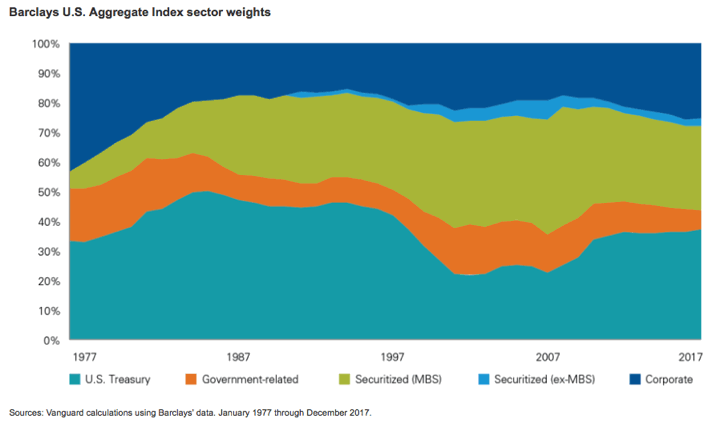
What’s inside a Total Bond fund? A recent Vanguard Blog post provides some insight into the components that make up the Barclays U.S. Aggregate Index from 1977 to 2017:

  • US Treasury. Bonds issued and backed by the US government, including Treasury notes and bonds. (Nominal only, TIPS are not included.)
  • US Government-related. Securities issued by a Federal Agency or a government-sponsored enterprise like Fannie Mae or Freddie Mac. These are either explicitly or implicitly backed by the US government.
  • Securitized (MBS). Mortgage-backed securities, backed by residential mortgages and packaged by Ginnie Mae, Fannie Mae, Freddie Mac, and others including private issuers.
  • Securitized (ex-MBS). Asset-backed Securities, backed by things such as consumer auto loans, credit card debt, and home equity loans.
  • US Corporate. Securities issued by corporations with investment-grade ratings from the major ratings agencies.

The first thing to note is that the bottom three layers are essentially all backed by the US government. When considered in this chart format, you can see that these bottom three layers consistently make up about 60% to 80% of the AGG. Thus, historically you can estimate that roughly 2/3rds of the index is backed by the US government and 1/3rd is privately-backed by securitized assets or corporations.

How much more does a Total Bond fund yield than a Treasury Index fund? Here’s how much the AGG Total Bond index yields above a Treasury index historically:

So the ingredients are little riskier overall than 100% US Treasury bonds, but you also earn a little higher yield.

Which is better? For the most part, I agree with this William Bernstein list of what kinds of bonds should be in an individual portfolio. I slightly prefer either 100% Treasuries, municipal bonds, or bank CDs – all depending on the after-tax yield. The idea is to pick the safest bonds that are hopefully the least correlated with your stocks. For example, the expectation is that Treasuries are more likely to go up when stocks are dropping.

But for the most part, I think a total bond fund is just fine as well. You can see it’s still pretty safe and you get extra interest in exchange for the extra risk that the market has decided is the proper compensation.

First things first – Buying a low-cost total bond index fund is very likely to return more over the long run than an expensive actively-managed bond fund. Choosing between Treasuries and a Total Bond fund is a secondary decision.

Bottom line. Lots of people own bond funds and ETFs that track the US Aggregate Index (AGG). These charts help show you what’s held inside such Total US Bond funds and how much more they yield than 100% Treasury bonds.

Citibank $500 Checking Account Bonus 2018

Citibank has $500 bonus offer when you open a new eligible Citi checking account 10/1/18 through 12/31/18 and complete qualifying activities. This offer is restricted to those who have not had a Citibank checking account within the last 180 calendar days.

Here are the bonus requirements, condensed from their full terms and conditions:

  • You must first enroll at citi.com/checkingrewards (or in-branch).
  • You must open a new Citibank Checking and Citi Savings Account in “The Citibank Account Package”.
  • You must make a deposit of $15,000 or more (multiple deposits okay) in “new-to-Citibank” funds within 30 days of account opening.
  • For the $400 bonus, you must maintain a minimum balance of $15,000 for 60 consecutive calendar days after deposit. The $15,000 can be spread between checking and savings.
  • For an additional $100 bonus, you must also complete a “Qualifying Direct Deposit” into the Checking Account for two consecutive months within 60 days of account opening. Payroll works but any ACH transfer accounts (i.e. interbank ACH counts).
  • The $400 or $500 bonus which will be credited within 90 calendar days from the date you complete all required activities.
  • Note that accounts with a zero balance for 90 days are subject to automatic closure and closed accounts can’t get the bonus. Therefore, always keep at least $5 in each account until you see the bonus.

Here’s how to avoid monthly account fees. You must maintain a combined average monthly balance of $10,000+ in eligible linked deposit, retirement and investment accounts. A monthly service fee of $25 and a $2.50 non-Citibank ATM fee applies to the checking account in The Citibank Account Package if a combined average monthly balance of $10,000 or more is not maintained. You can view your state-specific fee schedule at citi.com/compareaccounts. Scroll down to “The Citibank Account package”.

Bonus net value calculations. I like this bonus because it doesn’t require too much attention. You open the accounts and deposit $15,000, which you can spread between checking and savings (be sure to maintain a non-zero amount in both). Simply leave it there for 60 days. The direct deposit requirement is easy because there is no minimum amount and you can simply initiate an ACH transfer from another bank:

A “Qualifying Direct Deposit” is an Automated Clearing House (ACH) credit, which may include payroll, pension or government payments (such as Social Security) by your employer, or an outside agency.

However, there are a few noteworthy wrinkles! The main “catch” is that even though you “qualify” for the bonus after 60 days, you may have to wait another 90 days to actually get the bonus. Meanwhile, you need to keep both Citibank accounts open and in good standing, which either requires a minimum monthly balance of $10,000 or a $25 monthly fee. If you moved the $15,000 to a 2% APY savings account after 60 days, you would earn $25 in interest each month but also have to pay a $25 monthly fee.

Earning $500 of interest on $15,000 in 60 days works out to the equivalent of about 20% APY. However, earning $500 of interest on $15,000 in 150 days is a less impressive 8% APY. You could take out $5,000 after 60 days (maintaining only the $10k minimum) to boost your effective rate back up 10% APY. Even after you account for this, you still net $375 over a 2% APY savings account over 5 months. Bonus will be reported on 1099-INT (as should be expected).

If you were interested in a Citibank checking account anyway, you can always do the bonus now and downgrade to their “Account Account Package” which has no monthly fee if you make one direct deposit, one bill pay, or a $1,500 minimum balance each month ($10 otherwise).

ThankYou points. It’s not a lot, but The Citibank Account Package also earns ThankYou points for certain activities. For just having a savings and checking together, you can earn 150 points per month. For adding more things like an auto-save transaction or a linked Citi mortgage, you can get up to 450 points per month. Details here. Combine with the Citi ThankYou Premier Card which lets you redeem points for travel at a 25% bonus (1 ThankYou point = 1.25 cents towards travel).

Finally, I have done Citibank bank bonuses in the past and haven’t had any issues. However, others have reported having to call them up and ask for the bonus. I would simply be sure to keep track of your promotion details and transaction dates in a Google Doc or other spreadsheet, which you should always do anyway.

Bottom line. Citibank has a $500 bonus for opening a new checking + savings account and keeping $15,000 in there for 2-5 months, along with a few other requirements like making two ACH deposits. The bonus works out to roughly 10% APY when you keep the minimum required cash there. As compared to a 2% APY savings account, the net gain is about $375.

Owning Businesses Around the World: Global Market Cap Breakdown 1990-2018

When you’re deciding where to invest your money, a good starting point is to consider every single business that you can invest in around the world. I still find it amazing that with a few clicks, you can own a share of Alibaba in China, Nestle from Switzerland, and Apple in the US.
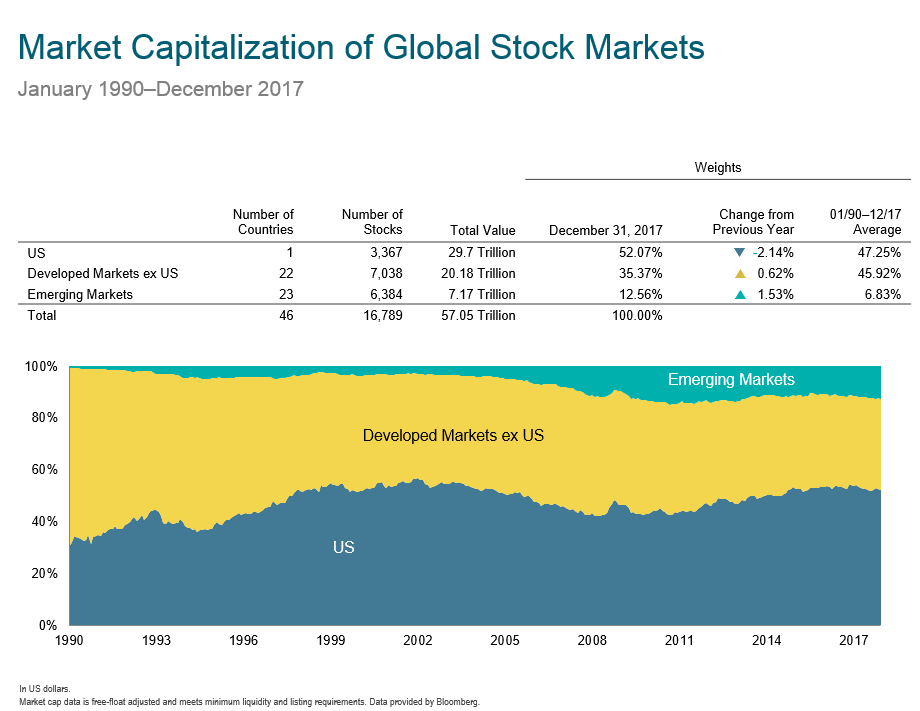
Inside a post about investing in Emerging Markets stocks at Bps & Pieces, I came across this chart that tracks how all the investable stocks in the world could be broken down by total value (“market cap”) between the US, non-US Developed Markets, and Emerging Markets since 1990 (click to enlarge):

How much international stocks should you own? There is not a consensus amongst “experts” as to the optimal ratio, but I personally don’t deviate from this breakdown very much. My portfolio stock allocation has been set at 50% US and 50% non-US (including both Developed and Emerging Markets) for a while. Vanguard and Fidelity, which manage huge retirement funds, have settled on something closer to 70% US and the rest international.

Keep in mind that investable value is not the same as gross domestic product (GDP). China’s GDP is roughly 60% that of the US, but the total investable business value in China only makes up about 5.5% that of the US (about the same as Canada). Foreigners can’t invest in every public business in every country, and many countries don’t have stable public markets in the first place. In many ways, 50% US might even be too little if you really wanted to track the world’s business value.

Again, I go back to the classic Jack Bogle quote: “Don’t look for the needle in the haystack. Just buy the haystack.” I don’t know which companies will be the most successful in the future, or in which country they will be located. If it’s in the US, I will own them. If it’s not, I will hopefully own them as well. I hope that stable and transparent equity markets spread across the globe over time. I just want to sit back as a part-owner and earn a share of the profits.

If you care about valuations, you are probably aware that right now the US is “expensive” based on historical prices. Emerging Markets and Developed non-US are “cheaper”. But as usual, that is because US businesses are making lots of money (especially after tax cuts) and look strong, while the rest of the world has struggled on relative basis. Cheaper valuations could be taken as another reason to at least invest some of your holdings into international stocks.

Best Interest Rates on Cash – October 2018

Here’s my monthly roundup of the best interest rates on cash, roughly sorted from shortest to longest maturities. Check out my Ultimate Rate-Chaser Calculator to get an idea of how much extra interest you’d earn if you are moving money between accounts. Rates listed are available to everyone nationwide. Rates checked as of 10/1/18.

High-yield savings accounts
While the huge megabanks like to get away with 0.01% APY, getting higher rates is as easy as transferring money electronically from your checking account to an online savings account. The interest rates on savings accounts can drop at any time, so I prioritize banks with a history of competitive rates. Some banks will bait you and then lower the rates in the hopes that you are too lazy to leave.

Money market mutual funds + Ultra-short bond ETFs
If you like to keep cash in a brokerage account, you should know that money market and short-term Treasury rates have been rising. The following money market and ultra-short bond funds are not FDIC-insured, but may be a good option if you have idle cash and cheap/free commissions.

  • Vanguard Prime Money Market Fund currently pays an 2.13% SEC yield. The default sweep option is the Vanguard Federal Money Market Fund, which has an SEC yield of 2.00%. You can manually move the money over to Prime if you meet the $3,000 minimum investment.
  • Vanguard Ultra-Short-Term Bond Fund currently pays 2.46% SEC Yield ($3,000 min) and 2.56% SEC Yield ($50,000 min). The average duration is ~1 year.
  • The PIMCO Enhanced Short Maturity Active Bond ETF (MINT) has a 2.44% SEC yield and the iShares Short Maturity Bond ETF (NEAR) has a 2.56% SEC yield while holding a portfolio of investment-grade bonds with an average duration of ~6 months.

Short-term guaranteed rates (1 year and under)
I am often asked what to do with a big wad of cash that you’re waiting to deploy shortly (just sold your house, just sold your business, legal settlement, inheritance). My usual advice is to keep things simple. If not a savings account, then put it in a flexible short-term CD under the FDIC limits until you have a plan.

  • Customers Bank has a liquid savings account at 2.25% APY guaranteed until 6/30/19, but with a minimum balance of $25k.
  • The Ally Bank 11-month No Penalty CD is at 2.10% APY ($25k minimum) and the CIT Bank 11-Month No-Penalty CD is at 2.05% APY with a lower $1,000 minimum. The lack of early withdrawal penalty means that your interest rate can never go down for 11 months, but you keep full liquidity. You can open multiple CDs in smaller $1,000 increments to get even more flexibility.
  • USALLIANCE Financial Credit Union has a 1-year CD at 2.75% APY ($500 minimum new money) with an early withdrawal penalty of 6 months interest. You must join the credit union first, but anyone can join via American Consumer Council (ACC).

US Savings Bonds
Series I Savings Bonds offer rates that are linked to inflation and backed by the US government. You must hold them for at least a year. There are annual purchase limits. If you redeem them within 5 years there is a penalty of the last 3 months of interest.

  • “I Bonds” bought between May 2018 and October 2018 will earn a 2.52% rate for the first six months. The rate of the subsequent 6-month period will be based on inflation again. More info here.
  • In mid-October 2018, the CPI will be announced and you will have a short period where you will have a very close estimate of the rate for the next 12 months. I will have another post up at that time.

Prepaid Cards with Attached Savings Accounts
A small subset of prepaid debit cards have an “attached” FDIC-insured savings account with exceptionally high interest rates. The negatives are that balances are capped, and there are many fees that you must be careful to avoid (lest they eat up your interest). Some folks don’t mind the extra work and attention required, while others do. There is a long list of previous offers that have already disappeared with little notice.

  • The only notable card left in this category is Mango Money at 6% APY on up to $5,000, but there are many hoops to jump through. There is a $3 monthly fee and you need to maintain a minimum $800 net direct deposit each month. This means you can’t direct deposit $800 and also take out $800 via online transfer. Checks and ATM withdrawals have additional fees. This means you have to spend the money via the Visa debit card (and miss out on flat 2% cash back on all purchases).

Rewards checking accounts
These unique checking accounts pay above-average interest rates, but with unique risks. You have to jump through certain hoops, and if you make a mistake you won’t earn any interest for that month. Some folks don’t mind the extra work and attention required, while others do. Rates can also drop to near-zero quickly, leaving a “bait-and-switch” feeling. That’s just how it goes with these types of accounts.

  • Consumers Credit Union recently announced changes starting 10/1/18, including lower balance limits ($10k down from $20k) and more restrictive requirements, but also higher interest rates in some tiers. Free Rewards Checking now offers 3.09% to 5.09% APY on up to a $10k balance depending on your qualifying activity. The highest tier requires their credit card in addition to their debit card (other credit cards offer $500+ in sign-up bonuses). Keep your 12 debit purchases just above the $100 requirement, as for every $500 in monthly purchases you may be losing out on 2% cash back elsewhere (or $10 a month after-tax). Thanks to reader Jonathan for the heads up. Find a local rewards checking account at DepositAccounts.
  • If you’re looking for a non-rewards high-yield checking account, MemoryBank has a checking account with no debit card requirements at 1.60% APY.

Certificates of deposit (greater than 1 year)
You might have larger balances, either because you are using CDs instead of bonds or you simply want a large cash reserves. By finding a bank CD with a reasonable early withdrawal penalty, you can enjoy higher rates but maintain access in a true emergency. Alternatively, consider building a CD ladder of different maturity lengths such that you have access to part of the ladder each year, but your blended interest rate is higher than a savings account.

  • Luther Burbank Savings has an 18-month Step Up CD that pays a blended 2.83% APY ($1,000 min). 6 month early withdrawal penalty.
  • Ally Bank has a 5-year CD at 3.00% APY ($25k min) with a relatively short 150-day early withdrawal penalty. For example, if you closed this CD after 2 years you’d still get a 2.39% effective APY even after accounting for the penalty. 2.61% at 3 years.
  • United States Senate Federal Credit Union has a 5-year Share Certificate at 3.63% APY ($60k min), 3.51% APY ($20k min), or 3.45% APY ($1k min). Note that the early withdrawal penalty is a full year of interest. Anyone can join this credit union via American Consumer Council.
  • You can buy certificates of deposit via the bond desks of Vanguard and Fidelity. These “brokered CDs” offer FDIC insurance, but they don’t come with predictable fixed early withdrawal penalties. As of this writing, Vanguard is showing a 3-year non-callable CD at 3.10% APY and a 5-year non-callable CD at 3.40% APY. Watch out for higher rates from callable CDs listed by Fidelity.

Longer-term Instruments
I’d use these with caution due to increased interest rate risk, but I still track them to see the rest of the current yield curve.

  • Willing to lock up your money for 10+ years? You can buy long-term certificates of deposit via the bond desks of Vanguard and Fidelity. These “brokered CDs” offer FDIC insurance, but they don’t come with predictable fixed early withdrawal penalties. As of this writing, Vanguard is showing a 10-year non-callable CD at 3.50% APY. Watch out for higher rates from callable CDs from Fidelity. Matching the overall yield curve, current CD rates do not rise much higher as you extend beyond a 5-year maturity.
  • How about two decades? Series EE Savings Bonds are not indexed to inflation, but they have a guarantee that the value will double in value in 20 years, which equals a guaranteed return of 3.5% a year. However, if you don’t hold for that long, you’ll be stuck with the normal rate which is quite low (currently a sad 0.10% rate). I view this as a huge early withdrawal penalty. You could also view it as long-term bond and thus a hedge against deflation, but only if you can hold on for 20 years.

All rates were checked as of 10/1/18.