Archives for July 2018

Are You Worried About Investing at an All-Time Market High?

Maybe folks are worried about the yield curve, maybe it’s the political drama, or maybe they just feel it in their bones – I’ve been getting more questions about if I think now is still a good time to invest.

Well, here are some articles that may help you feel better:

What if You Only Invested at Market Peaks? by Ben Carlson. What if you were so unlucky as to invest only at the following market peaks (and suffering the subsequent drops)? As long as you kept on saving your money (putting it in cash when not at a market peak), and not selling at all, you would have actually done fine.

Meet Bob.
Bob is the world’s worst market timer.
What follows is Bob’s tale of terrible timing of his stock purchases.

Should You Invest (Or Wait) When The Stock Market Is At An All-Time-High? at Engaging-Data.com. Here is another interesting interactive tool that lets you pick any subsequent time period and see how the distribution of future returns compared if you invested at an all-time high (ATH) during that period. The market tends to spend a lot of time near all-time highs.

The key takeaway is that in the past several generations of investing, the market has done well and most of the time, the market is within 5% of its ATH. If you waited for a large dip to invest, you could be waiting for a long time and you would have missed out on a large amount of the gains.

Finally, here’s an older post to consider: The Only Two States of Your Portfolio: Happy All-Time High or Sad Drawdown.

Atom Movie Tickets Promo Code: Buy One Get One Free

Atom is a “social movie ticketing” app and website. Sign up and enter the promo code WEGOTYOU in the mobile app checkout to get two tickets for the price of one (“Buy 1 Get 1 Free”). US only. Offer valid from July 31, 2018 (8:00 am PT) through August 5, 2018 (11:59 pm PT), while supplies last.

I don’t know if this counts as 1 or 2 tickets with their “Watch 4, Get 1 Free” rewards system. It would seem like it would count as two according this FAQ text:

Discounted orders count towards earning a Free Reward Ticket, but orders containing only free movie tickets do not apply. Concessions purchases do not count towards earning a Free Reward Ticket.

Finally, if you tweet them a photo of your cut-up MoviePass card, you’ll be entered in a sweepstakes for 365 free movies. (I don’t like these contests where the taxable value of the prize is so much higher than the actual value I could get out of it.) Gee, who would’ve guessed that MoviePass would run out of money?…

American Airlines AAdvantage® Mile Up® Card Review

The American Airlines AAdvantage® Mile Up® Card is the no annual fee co-branded American Airlines credit card. It replaces the former and not-very-publicized Citi/AAdvantage Bronze card and adds a few new features. Here are the card highlights:

  • 10,000 bonus American Airlines miles plus a $50 statement credit after $500 in purchases within the first 3 months.
  • 2 AAdvantage® miles per $1 spent at grocery stores, including grocery delivery services
  • 2 AAdvantage® miles per $1 spent on eligible American Airlines purchases
  • 1 AAdvantage® mile per $1 spent on other purchases
  • Earn 1 Loyalty Point for every 1 eligible AAdvantage(R) mile earned from purchases.
  • Save 25% on inflight food and beverage purchases when you use your card on American Airlines flights.
  • No annual fee.

I view this is a niche card for those that want to earn American Airlines, but don’t fly or spend enough to justify the annual fee of the other cards. Some folks just aren’t willing to pay an annual fee, no matter how good the perks are.

Bonus details. If you find the spending requirement too high on many cards, note that this one only requires $500 in purchases to earn the account opening bonus. Note the following language:

Statement credit and American Airlines AAdvantage® bonus miles are not available if you have received a statement credit or American Airlines AAdvantage® bonus miles for a new AAdvantage MileUpSM account in the past 48 months.

This means that yes, you can still get the bonus on this card if you’ve had another co-branded American Airlines card from Citi in the last 24 months like the Citi® / AAdvantage® Platinum Select® World Elite™ Mastercard or the CitiBusiness® version designed for businesses.

No waived baggage fees. As you might expect, being the no annual fee version also means less perks. Notably, this card does not include any baggage fee waivers, which was a big potential source of savings from the other cards mentioned above (with annual fees). Also missing are priority boarding and the ability to book discounted award tickets (“Reduced Mileage Awards”).

Redemption tips. American Airlines MileSAAver awards are still 25,000 miles for a round-trip ticket within the contiguous 48 states. Their online system is pretty good for looking for domestic AA awards. If the trip is less than 500 miles, then it is only 15,000 miles round-trip within the contiguous 48 states. Under-500 miles routes include Las Vegas to/from Los Angeles, Charleston to/from Miami, New York to/from Washington DC, Philadelphia to Boston, and many others.

Bottom-line.  The American Airlines AAdvantage® Mile Up® Card is the no annual fee credit card from Citi and American Airlines. This card is a good fit for folks that don’t want to pay an annual fee for extra features, but still want to earn American miles on purchases (and keep their miles from expiring from inactivity). As such, you may consider “downgrading” your other Citi/American cards to this card if you stop wanting to pay the annual fee. Note that if you downgrade you don’t get the sign-up bonus, and getting the bonus from this card is independent of the bonuses from other Citi/American cards anyway.

Zero to $1 Million in 14 Years: Maxing Out 401k and IRAs from 2004-2017

Like many others, I had a vague goal of $1 million net worth in my 20s. It’s easy to find a theoretical path a million. For example, $750 per month earning 8% returns for 30 years with get you there. Doing the actual earning, saving and investing is the hard part. It gets even harder during a bear market when your money feels like it is burning up in flames.
On the list of “Things I Would Tell My Younger Self”, I would include “Be patient and keep saving. You’ll get there.” Or by changing up the phrase “Always Be Closing” popularized in Glengarry Glen Ross – “Always Be Contributing” (ABC). One of the major benefits of writing this blog was keeping my focus on this path.

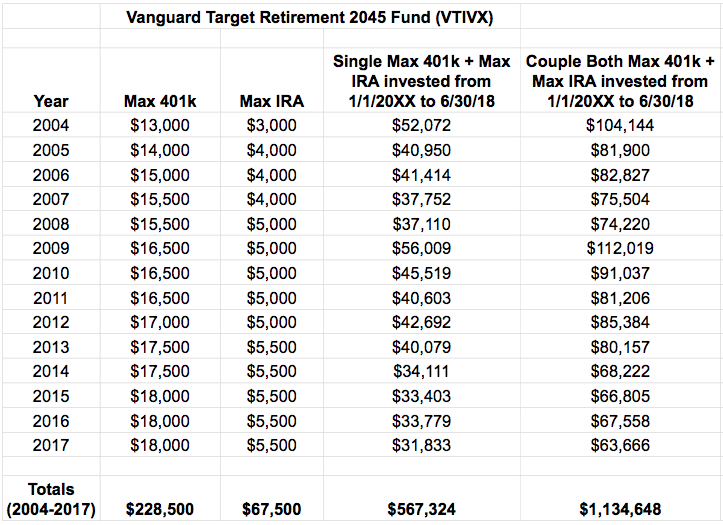
This is how a real couple could have gone from zero to $1 million from 2004 to 2017. My spouse and I both had our first full year of full-time jobs in 2004. From 2004 to 2017, we contributed the maximum allowable limit to both of our 401k and IRAs each year. The contribution limits rose gradually over the years. (Company match is not included here.) We invested our money in low-cost index Vanguard funds – mostly stocks with a little bonds – which can be closely approximated by the Vanguard Target Retirement 2045 fund (ticker VTIVX). This fund had its share of ups and downs with the market. It crashed a lot in 2008 and 2009. It went back up a lot afterward. We just kept contributing and buying each year.

Using Morningstar tools, I found the final amount today if the limit was invested on January 1st of each year. For example, if both of us invested $16,000 in Vanguard Target Retirement 2045 at the beginning of 2004 ($13k + $3k), that investment would now be worth $104,144 as of June 30, 2018. And so on for each subsequent year. As you can see, if you add all the years up, you would reach over $500,000 for an individual and over $1,000,000 for a couple:

These numbers won’t be the same across other time periods, but they do represent a real-world experience. I’ve done a variation of this before in What If You Invested $10,000 Every Year For the Last 10 Years? 2008-2017 Edition.

According to Vanguard, 13% of their plan participants maxed out their 401k plans in 2017. 58% of participants had their entire account balance invested in a single target-date fund or similar managed allocation.

Bottom line. A real couple that started saving as 26-year-olds in 2004 and maxing out both their 401k and IRA plans each year could have reached $1 million by age 40 in 2018. All with a simple Vanguard Target Retirement index fund. This requires a lot of steady saving, but the important part is that it required no special investment skill. You didn’t need to recognize bubbles. You didn’t need to time bottoms. You didn’t need a fancy asset allocation, estimate future cashflows, understand price/book ratios, or even rebalance. Always be contributing.

LastPass Premium Discount: 12-Month Subscription for $6

lastpass0If your password manager of choice is Lastpass, right now HumbleBundle is selling a 12-month subscription of LastPass Premium for $6. (You do have a password manager, right?) This works out to $0.50 a month as opposed to the regular price of $2/month. According to SD, the keys are redeemable for both new and existing customers, and you can even buy two codes to stack (per payment type) for multiple years. I am not sure of the exact differences between Free and Premium, as Lastpass seems to hide those in order to push Premium. I am a 1Password user, which is $3 to $5 per month for cloud users.

Deal ends July 30th. Codes redeemable until September 1, 2018. 12 months subscription starts from the date of activation.

My Money Blog Portfolio Asset Allocation, July 2018

portpie_blank200

Here’s my quarterly portfolio update for Q2 2018. These are my real-world holdings and includes 401k/403b/IRAs and taxable brokerage accounts but excludes our house, cash reserves, and a few side investments. The goal of this portfolio is to create enough income to cover our regular household expenses. As of 2018, we are “semi-retired” and spending some of the dividends and interest from this portfolio.

Actual Asset Allocation and Holdings

I use both Personal Capital and a custom Google Spreadsheet to track my investment holdings. The Personal Capital financial tracking app (free, my review) automatically logs into my accounts, tracks my balances, calculates my performance, and gives me a rough asset allocation. I still use my custom Rebalancing Spreadsheet (free, instructions) because it tells me where and how much I need to direct new money to rebalance back towards my target asset allocation.

Here is my portfolio performance for the year and rough asset allocation (real estate is under alternatives), according to Personal Capital:

Here is my more specific asset allocation, according to my custom spreadsheet:

Stock Holdings
Vanguard Total Stock Market Fund (VTI, VTSMX, VTSAX)
Vanguard Total International Stock Market Fund (VXUS, VGTSX, VTIAX)
WisdomTree SmallCap Dividend ETF (DES)
Vanguard Small Value ETF (VBR)
Vanguard Emerging Markets ETF (VWO)
Vanguard REIT Index Fund (VNQ, VGSIX, VGSLX)

Bond Holdings
Vanguard Limited-Term Tax-Exempt Fund (VMLTX, VMLUX)
Vanguard Intermediate-Term Tax-Exempt Fund (VWITX, VWIUX)
Vanguard High-Yield Tax-Exempt Fund (VWAHX, VWALX)
Vanguard Inflation-Protected Securities Fund (VIPSX, VAIPX)
iShares Barclays TIPS Bond ETF (TIP)
Individual TIPS securities
U.S. Savings Bonds (Series I)

Target Asset Allocation. Our overall goal is to include asset classes that will provide long-term returns above inflation, distribute income via dividends and interest, and finally offer some historical tendencies to balance each other out. I personally believe that US Small Value and Emerging Markets will have higher future long-term returns (along with some higher volatility) than US Large/Total and International Large/Total, although I could be wrong. I don’t hold commodities, gold, or bitcoin as they don’t provide any income and I don’t believe they’ll outpace inflation significantly.

I think it’s important to imagine an asset class doing poorly for a long time, with bad news constantly surround it, and only hold the ones where you still think you can maintain faith.

Stocks Breakdown

  • 38% US Total Market
  • 7% US Small-Cap Value
  • 38% International Total Market
  • 7% Emerging Markets
  • 10% US Real Estate (REIT)

Bonds Breakdown

  • 50% High-quality, Intermediate-Term Bonds
  • 50% US Treasury Inflation-Protected Bonds

I have settled into a long-term target ratio of 67% stocks and 33% bonds (2:1 ratio) within our investment strategy of buy, hold, and occasionally rebalance. With a self-managed, simple portfolio of low-cost funds, we minimize management fees, commissions, and taxes.

Real-world asset allocation details. No major changes from the last quarterly update. For both simplicity and cost reasons, I am no longer buying DES/DGS and will be phasing them out whenever there are tax-loss harvesting opportunities. New money is going into the more “vanilla” Vanguard versions: Vanguard Small Value ETF (VBR) and Vanguard Emerging Markets ETF (VWO).

My taxable muni bonds are split roughly evenly between the three Vanguard muni funds with an average duration of 4.5 years. I am still pondering going back to US Treasuries due to changes in relative interest rates and our marginal income tax rate. Issues with high-quality muni bonds are unlikely, but still a bit more likely than US Treasuries.

The stock/bond split is currently at 70% stocks/30% bonds. Once a quarter, I reinvest any accumulated dividends and interest that were not spent. I don’t use automatic dividend reinvestment. Looks like we need to buy more bonds and emerging markets stocks.

Performance and commentary. According to Personal Capital, my portfolio has basically broken even so far in 2018 (+1.5% YTD). I see that during the same period the S&P 500 has gained 6.5% (excludes dividends) and the US Aggregate bond index lost 1.7%. My portfolio is relatively heavy in international stocks which have done worse than US stocks so far this year.

An alternative benchmark for my portfolio is 50% Vanguard LifeStrategy Growth Fund (VASGX) and 50% Vanguard LifeStrategy Moderate Growth Fund (VSMGX), one is 60/40 and one is 80/20 so it also works out to 70% stocks and 30% bonds. That benchmark would have a total return of +2.8% YTD (as of 7/25/18).

As usual, I’ll share about more about the income aspect in a separate post.

The Greatest Fear of Newt Scamander

Harry Potter fans will remember boggarts, shape-shifters that take on the form of the viewer’s greatest fear. This will be different for everyone – perhaps snakes or public speaking. If you’re reading this site, you might relate to Newt Scamander’s greatest fear as revealed in the latest trailer from the movie Fantastic Beasts: The Crimes of Grindelwald.

Now, there’s nothing universally wrong with working in an office. Some people work well in an office environment, while others can’t stand it. I don’t have hard statistics on this, but my hunch is that those that really hate the office environment are more likely to seek early financial independence. You have to motivated to think outside the figurative box (to get out of the literal cubicle).

Citi® / AAdvantage® Executive World Elite Mastercard® Review: 50,000 Bonus Miles

The Citi® / AAdvantage® Executive World Elite Mastercard® is the premium American Airlines co-branded card that includes Admirals Club lounge access and the ability to earn Elite Qualifying Miles if you spend enough on the card. Here are the full details.

  • Earn 50,000 American Airlines AAdvantage(R) bonus miles after making $5,000 in purchases in the first 3 months of account opening
  • Admirals Club(R) membership for you and access for up to two guests or immediate family members traveling with you.
  • First checked bag is free on domestic American Airlines itineraries for you and up to 8 companions traveling with you on the same reservation
  • Priority check-in, airport screening (where available) and early boarding when flying American Airlines.
  • Earn 10,000 additional Loyalty Points after you spend $40,000 in purchases during the qualifying status year.
  • No Foreign Transaction Fees on purchases.
  • Up to $100 statement credit every 5 years, as reimbursement for your application fee for Global Entry or The TSA PreCheck®.
  • Earn 1 Loyalty Point for every 1 eligible AAdvantage(R) mile earned from purchases.
  • $450 annual fee.

Note the following fine print:

American Airlines AAdvantage® bonus miles are not available if you have received a new account bonus for a Citi® / AAdvantage® Executive account in the past 48 months. The card offer referenced in this communication is only available to individuals who reside in the United States and its territories, excluding Puerto Rico and U.S. Virgin Islands.

As mentioned, this is the highest level Citi/American Airlines card, designed to make the frequent American Airlines customer as comfortable as possible. The primary reasons for the higher $450 annual fee are the Admirals Club lounge membership and the opportunity to earn more Loyalty Points towards status.

Admirals Club lounge membership value and details. Admirals Club membership usually costs $550+ a year on its own, and this is now the only card that gives it to you as a complimentary feature. Here’s the full cost chart:

This membership allows both you and your immediate family (or up to two traveling guests that accompany you) to access over 50 Admirals Club locations worldwide. Your immediate family includes spouse, domestic partner and/or children under 18 years of age. You don’t even need to be on an American Airlines flight! You can even give your spouse or trusted friend/family an authorized user card and they’ll get lounge access too, even while traveling separately from you. (Authorized user cards have no additional fee.)

You can be flying on any airline, and if that airport has an Admirals Club you and your family can go inside. Lounge access might save you money on certain things like comfortable seats, free food/drink, WiFi, and sometimes hot showers. Mostly it just makes the overall flying experience more pleasant. I’ve been to Admiral’s Clubs with special kids rooms; perfect for families during delays or layovers.

Bottom line. Bonus miles are always nice, but this card is mostly about the Admiral Club lounge access and the help in achieving/maintaining elite status on American. If you don’t fly on American enough to value these perks, I would consider the Citi® AAdvantage® Platinum Select® World Elite Mastercard instead.

Vanguard How America Saves 2018: How Does Your 401k Compare?

Vanguard recently released How America Saves 2018 report [PDF], which looks at the nearly 5 million 401k, 403b, and other defined-contribution retirement plans that they service. If you are curious about how your 401k stats compare with others, there is a great deal of information in this report. Here are a few quick stats based on 2017 data:

  • Average aggregate contribution rate amongst participants was 10.3% (employer and employee total).
  • Average maximum “employer match” contribution was 7% of income. Nearly 2/3rds of participants received the maximum employer match.
  • Average employee contribution was 6.8% of income.
  • Maxing out. 13% of participants saved the maximum annual amount of $18,000 ($24,000 age 50+) for 2017.
  • Average account balance was $103,866; the median balance was $26,331. A small number of plans with very high balances skews this often-quoted average upward.
  • Target-date funds. 58% of participants had their entire account balance invested in a single target-date fund or similar managed allocation. In other words, 58% let someone else pick their portfolio.
  • Automatic enrollment. Plans with automatic enrollment have a 92% participation rate.
  • Withdrawals and rollovers. About 1/3rd of participants could have cashed out their balance (with taxes and penalties) because they switched jobs. 84% of those folks kept their money in retirement plans. In terms of assets, 98% of all plan assets available for distribution were preserved and only 2% were taken in cash.
  • Loans. 15% of participants had a loan outstanding at year-end 2017.

These numbers don’t tell the entire story, as the average includes workers across different age groups, income levels, job tenures, and so on.

Longleaf Partners Funds: Reasons To Buy Higher-Cost, Concentrated, Actively-Managed Mutual Funds

I can’t recall the exact source or quote, but I read something along the lines of this in a forum recently:

We don’t really want to hear other people’s opinions. We want to hear our own opinions out of other people’s mouths.

In other words, confirmation bias:


(source: Chainsawsuit.com)

The majority of my portfolio is in low-cost, diversified, passive-managed mutual funds. In order to hear a different take, I read the shareholder letters of Longleaf Partners Funds (Southeastern Asset Management), which are respectable examples of higher-cost, concentrated, actively-managed mutual funds. The managers “eat their own cooking”, meaning they put a substantial portion of their personal net worth into the funds. They have a limited number of holdings, try to avoid asset bloat, and try to outline their positions in shareholder letters.

In their most recent 2nd Quarter 2018 letter [pdf], they share a presentation that explains their position:

Why We Believe Active Long-Term Value Investing in Common Stocks Will Actually Work
Active investing is out of favor; long-term investing (or really, long-term anything) is out of favor; value investing as we practice it is out of favor; and, investing in common stocks is out of favor compared to private equity. Doing all four of these things really makes us the skunk at the party.

Many have given up on active, long-term, engaged value investing in public equities just at the point when we believe it offers the best risk/reward proposition. Indexing’s multi-year momentum has pushed more assets into fewer stocks because they have gone up and left behind an expanding universe of highly competitive, well-governed and managed businesses with unique advantages that are materially underpriced in their publicly traded securities.

They make several interesting points, including the high amount of “closet indexers” out there. (Haven’t there always been a lot of closet indexers though?) I tried to see things from their perspective, but in the end I think their 1% expense ratio is just too high to overcome. It will definitely take a bear market for their performance gap to narrow.

In the meantime, their real problem is that poor relative performance. For every $10,000 invested in their flagship Partners fund 10 years ago, you would have about $18,000 today. If you had put it in a low-cost S&P 500 index fund, you would have about $27,000 today. That’s the difference between 6% and 10% annualized returns over the last 10 years. The extra drag from their ~1% expense ratio accounts for about a quarter of the performance gap.

Longleaf Partners Fund very well might turn things back around. I have no position in any of their funds, but I’ll keep reading their free shareholder letters and watch them try their best to play a very difficult game.

2018 IRS Federal Income Tax Brackets Example (Married No Kids)

The Tax Cuts and Jobs Act (TCJA) changed up the personal income tax brackets, exemptions, and deductions. Here is an updated graphical breakdown of a simple scenario for a married filing joint couple with no children in Tax Year 2018. I’ll also try to illustrate the relationship between gross income, taxable income, marginal tax rate, and effective tax rates. See also:

2018 federal income tax rates for married joint filers. Taken from the official IRS tax tables (source):

The following changes also apply for Tax Year 2018:

  • The personal exemption deduction is now gone ($0), from $4,050 in 2017.
  • The standard deduction for single taxpayers and married taxpayers filing separately rises to $12,000 from $6,350.
  • The standard deduction for married taxpayers filing joint returns rises to $24,000 from $12,700.
  • The standard deduction for heads of household rises to $18,000 from $9,350.
  • The Child Tax Credit was expanded with higher income phaseout limits and is now worth up to $2,000 per qualifying child.

Let’s say your household combined gross income is $100,000 a year. You are a married couple with no children, and both earn $50,000 gross income. You are both employees that receive W-2 income only (i.e. neither are self-employed). You don’t have any additional income sources like interest, capital gains, rents, etc. You don’t have any deductions like IRA/401k contributions or mortgage interest that will allow you to itemize deductions. We will ignore any state or local income taxes.

Gross income. Let’s start with your annual $100,000 gross household income. There are no personal exemptions. Instead, you get the larger standard deduction which is $24,000 for married joint filers in 2018. Since you don’t have a lot of itemized deductions, you fall back onto the standard deduction.

The first 24,000 of your gross income is not taxable. Without doing anything special at all, your $100,000 in gross income is now only $76,000 in taxable income after personal exemptions and the standard deductions.

The first $19,050 of taxable income is subject to a 10% tax rate. Shave off 10% of $19,050 and put that on your tax bill ($1,905). The remaining $56,950 of taxable income is moved onto the next tax bracket.

The next $58,350 in taxable income is subject to a 12% tax rate. However, we only have $56,950 left. So we shave off 12% of $56,950 ($6,834) and add that to the existing $1,905. The total tax bill is now $8,739.

In this example, this 12% is your marginal tax bracket. If you earned another $1, it would be taxed at this marginal rate of 12%. Even with a six-figure income, a married couple can still land in the 12% marginal tax bracket (pre-tax 401k or IRA contributions would reduce taxable income even more).

(Have kids? See this example for married with children.)

Payroll taxes. These aren’t technically federal income taxes, but you must each pay a Social Security tax (OASDI) of 6.2% and Medicare payroll tax (HI) of 1.45% of your gross income. That’s $3,100 a year for Social Security and $725 a year for Medicare. You both earn $50,000 gross and don’t exceed the income caps. (Your respective employers pay the same amount.)

Overall effective tax rate. You paid $8,739 in federal income taxes on $100,000 of gross income, for an overall effective tax rate of 8.7%. You also paid 7.65% in payroll taxes.

For comparison, the same married couple with no kids in 2017 would have paid $11,278 in federal income taxes on $100,000 of gross income, for an overall effective tax rate of 11.3%. Payroll taxes would be the same.

Amazon Prime Day 2018: Big List of Deals and Discounts

A few more hours… Amazon Prime Day 2018 is here. I’ll try to keep this post updated with the most recent offers (and remove the expired ones). There are usually many opportunities to save some money without buying stuff you don’t need (and thus offset a chunk of that membership fee). In fact, if you have any things you’ve been looking for on your Wish List, you should just look them up and see if they are on sale today.

As the name suggests, most deals require a Prime membership. New members can sign up for a 30-day free trial (6-month free trial + 50% off afterward with student .edu address).

Site-wide

Specific deals

Amazon Deals

Whole Foods Deals

Targeted deals