Archives for April 2018

My Money Blog Portfolio Asset Allocation, March 2018

portpie_blank200

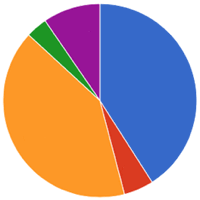
Here is a First Quarter 2018 update for my primary investment portfolio. These are my real-world holdings, not a recommendation. It includes tax-deferred 401k/403b/IRAs and taxable brokerage accounts and excludes our primary home, cash reserves, and a few side investments. The goal of this portfolio is to create enough income to cover our regular household expenses. As of 2018, we have started the phase of “early retirement” where we are spending some of the dividends and interest from this portfolio.

Actual Asset Allocation and Holdings

I use both Personal Capital and a custom Google Spreadsheet to track my investment holdings. The Personal Capital financial tracking app (free, my review) automatically logs into my accounts, tracks my balances, calculates my performance, and gives me a rough asset allocation. I still use my custom Rebalancing Spreadsheet (free, instructions) because it tells me where and how much I need to direct new money to rebalance back towards my target asset allocation.

Here is my portfolio performance for the year and rough asset allocation (real estate is under alternatives), according to Personal Capital:

1803_pc1b

1803_pc2b

Here is my more specific asset allocation, according to my custom spreadsheet:

1803_spread1

Stock Holdings
Vanguard Total Stock Market Fund (VTI, VTSMX, VTSAX)
Vanguard Total International Stock Market Fund (VXUS, VGTSX, VTIAX)
WisdomTree SmallCap Dividend ETF (DES)
WisdomTree Emerging Markets SmallCap Dividend ETF (DGS)
Vanguard Small Value ETF (VBR)
Vanguard Emerging Markets ETF (VWO)
Vanguard REIT Index Fund (VNQ, VGSIX, VGSLX)

Bond Holdings
Vanguard Limited-Term Tax-Exempt Fund (VMLTX, VMLUX)
Vanguard Intermediate-Term Tax-Exempt Fund (VWITX, VWIUX)
Vanguard High-Yield Tax-Exempt Fund (VWAHX, VWALX)
Vanguard Inflation-Protected Securities Fund (VIPSX, VAIPX)
iShares Barclays TIPS Bond ETF (TIP)
Individual TIPS securities
U.S. Savings Bonds (Series I)

Target Asset Allocation. Our overall goal is to include asset classes that will provide long-term returns above inflation, distribute income via dividends and interest, and finally offer some historical tendencies to balance each other out. I personally believe that US Small Value and Emerging Market will have higher future long-term returns (along with some higher volatility) than US Large/Total and International Large/Total, although I could be wrong. I don’t hold commodities futures or gold (or bitcoin) as they don’t provide any income and I don’t believe they’ll outpace inflation significantly. I also try to imagine each asset class doing poorly for a long time, and only hold the ones where I think I can maintain faith.

Stocks Breakdown

  • 38% US Total Market
  • 7% US Small-Cap Value
  • 38% International Total Market
  • 7% Emerging Markets
  • 10% US Real Estate (REIT)

Bonds Breakdown

  • 50% High-quality, Intermediate-Term Bonds
  • 50% US Treasury Inflation-Protected Bonds

I have settled into a long-term target ratio is 67% stocks and 33% bonds (2:1 ratio) within our investment strategy of buy, hold, and rebalance. With a self-managed, simple portfolio of low-cost funds, we minimize management fees, commissions, and income taxes.

Real-world asset allocation details. For both simplicity and cost reasons, I am no longer buying DES/DGS and will be phasing them out whenever there are tax-loss harvesting opportunities. New money is going into the more “vanilla” Vanguard versions: Vanguard Small Value ETF (VBR) and Vanguard Emerging Markets ETF (VWO).

I’m still a bit underweight in TIPS and REITs mostly due to limited tax-deferred space as I don’t want to hold them in a taxable account. My taxable muni bonds are split roughly evenly between the three Vanguard muni funds with an average duration of 4.5 years. I have been seriously thinking of going back to US Treasuries due to changes in relative interest rates and our marginal income tax rate.

My stock/bond split is currently at 69% stocks/31% bonds. I continue to invest new money on a monthly basis in order to maintain the target ratios. Once a quarter, I also reinvest any accumulated dividends and interest that we did not spend. I don’t use automatic dividend reinvestment. First of all, we spend some of our dividends now. In addition, I can usually avoid creating any taxable transactions unless markets are really volatile.

Performance and commentary. According to Personal Capital, my portfolio has basically broken even so far in 2018 (-0.70% YTD). I see that during the same period the S&P 500 has lost 0.63% (excludes dividends) and the US Aggregate bond index has actually lost 1.55%.

An alternative benchmark for my portfolio is 50% Vanguard LifeStrategy Growth Fund (VASGX) and 50% Vanguard LifeStrategy Moderate Growth Fund (VSMGX), one is 60/40 and one is 80/20 so it also works out to 70% stocks and 30% bonds. That benchmark would have a total return of -0.98% YTD (as of 4/9/18).

In a separate post, I’ll share about more about the income aspect.

SaverLife Review: Starting Saving $20 a Month, Get Another $10 a Month Boost

saverlife0The importance of an emergency fund is often mentioned, but often the hardest thing is to get started. SaverLife.org is a program run by the nonprofit EARN to help working families by encouraging savings. Their idea here, essentially, is to kickstart a savings habit by paying a cash incentive for saving a least $20 each month for 6 months.

How it works. First, make sure you are age 18+ and have a US bank or credit union account. Taken from their FAQ:

  1. Join now by clicking the “Join Now” button at the top right corner of this page.
  2. Enter your name and email address.
  3. Connect your bank account to SaverLife by entering your online credentials so we can track how much you save.
  4. Save at least $20 each month for 6 months in your own bank account. We don’t touch your money, so you’ll need to move money to your linked account yourself.
  5. Earn $10 in rewards each month that you save at least $20.
  6. After 6 months, you can claim your rewards ($60 max) by completing an exit survey and entering your bank’s routing number and your account number.

You can set a goal higher than $20 a month if you’d like, they just set the bar to be encouraging to as many people as possible to start saving. You’ll receive weekly savings tips as well. SaverLife is not a bank or savings account. The money paid is not interest. If you sign up by April 13th, they promise additional “prizes”. Here’s an example of the motivation behind the nonprofit EARN:

saverlife1

Ideally, you should connect a savings account as they will basically take a snapshot every 30 days to see if your balance is $20 higher than the previous month. For example, if you join on April 10th, then they will check your balance again on May 9th. If you have a savings account, it will be easier to make sure you qualify by simply adding $20 to the account. Having a separate high-yield savings account is a better way to encourage savings anyway.

Bottom line. SaverLife is a free program designed to encourage household savings for working households. Link a bank account and earn $10 cash for every month that you save at least $20 (up to $60 total). I think this is a worthy effort, although I hope they perform some honest, long-term tracking and share if it really helps to develop a regular savings habit.

50 State Infographic: How Much Income Do You Need to Afford the Average Home?

50state_homeafford

HowMuch.net compiled an infographic about the income you need to afford the average home in every US state. The key is that “afford” means that the total cost of housing take up no more than 30% of gross income. The highest income required is in Hawaii ($153,520 for a house worth $610,000) and the lowest is in West Virginia (West Virginia: $38,320 for a house worth $149,500).

I suppose the next level analysis would be to divide by the actual median income in each state to measure relative affordability. The same job can pay different salaries in different areas, so it can still make sense to move to a place with higher incomes and high real estate prices.

Graphic: The Fall of Pensions, The “Rise” of 401ks and IRAs

pension401kIRA

Above is a historical chart of US household retirement assets that helps visualize the shift from mostly pensions to mostly a combination of defined contribution plans (401k, 403b, etc) and IRAs. Pension share has gone from nearly 80% of total assets in the 1980s to about 40% today. The blips upwards in 2001 and 2009 are more a function of stock market drops than anything else. I find it interesting that annuity use is not increasing at all, i.e. people are not creating more “DIY pensions”. Found via WSJ Daily Shot.

Below is a graphic of the percentage of households who have any retirement plan at all, grouped by income percentile. This means it counts any family with one person with any retirement plan of any type with any amount saved. Via Bloomberg article about state-mandated Roth IRAs.

ira_bloomberg

My big-picture concern is – What happens when those who started jobs in the 1980s and 1990s retire in the 2030s and 2040s with no pensions? As shown above, the majority of the lowest-income workers have no retirement plan at all. If you include the highest-paid workers, the average 401(k) at retirement age is currently about $100,000. In contrast, I ran an annuity quote and a pension that pays $50,000 a year inflation-adjusted is roughly the equivalent of having $1,000,000 saved in a 401(k).

More individuals are finding themselves in charge of their own retirement every day, whether they like it or not. This is a very serious responsibility. Warren Buffett has a plaque in his office with the following saying on it:

A fool and his money are soon invited everywhere.

Lots of money floating around means lots of “helpers” will pop up. Big banks. Start-up smartphone apps. Even Overstock.com now wants to help you with investing. Read the Gotrocks parable and beware high-fee helpers.

H&R Block Desktop Tax Software 2017: Fed + State $17.99 (Flash Sale)

hrb2016

Deal of the Day again 4/4/18. The benefit of “old-school” desktop tax software is that it doesn’t require your Social Security Number and financial details to be stored in the cloud (third-party server where it can be sold or hacked). Here’s a limited-time deal on H&R Block Tax Software 2017 (PC/Mac download or physical CD).

Amazon has H&R Block Deluxe Federal + State for $17.99, the lowest price of the year per CamelCamelCamel. There is also a discount on Premium & Business at $39.99. It looks like the rest are not on sale as Federal only is $20, and Premium is $50. This is a 24-hour “Deal of of the Day” (sorry I don’t get advance notice) and close to the lowest prices ever from last year. If it is out of stock, you can still buy it and lock in the price.

H&R Block Deluxe includes guidance for stock gains and losses, home mortgage interest deduction, and other itemized deductions. Compare that against TurboTax Deluxe Download which makes you upgrade to TurboTax Premier to get guidance for stock sales and dividends. H&R Block Premium includes rental properties and self-employment. All flavors include “Refund Bonus” where you can a 5% bonus if you take your refund in the form of an Amazon gift card.

Keep in mind that for these products 5 Federal e-Files are included but State e-File is extra ($19.95 per state). I would personally just print the (usually shorter) state return out and snail mail it in if you don’t have a free State e-File option.

This might be the last flash sale for this tax year, as the April 15th deadline (17th this year) is nearing.

Chase Freedom & 5% Back on PayPal: Use on Federal Income Tax Payments?

The Chase Freedom Visa card has updated its quarterly 5% cash back categories for April 1st to June 30th, 2018. One of the eligible cash back categories is PayPal. April is also the time to make both income tax payments along with 2017 tax returns and also quarterly estimated taxes for 2018. PayUSATax.com is an IRS-approved payment processor and accepts PayPal as a payment with a 1.97% transaction fee.

Here is the fine print:

Includes transactions made using your Chase Freedom card with PayPal for purchases or sending money. Eligible transactions only qualify for a total of 5% Cash Back rewards. Purchases made using PayPal at other current 5% quarterly categories will be awarded a total of 5% Cash Back rewards on up to $1,500 in combined purchases. When you send money to Friends & Family via PayPal using your Chase Freedom card, standard transaction fees apply. See PayPal’s fees. Websites and other information provided by PayPal are not within Chase’s control and may not be available in Spanish. Must have/open a PayPal account to send and receive money.

Technically the Chase Freedom earns 5x Ultimate Rewards points, which might actually get you more than 1 cent per Ultimate Rewards point value if you have a Chase Sapphire Preferred or Chase Sapphire Reserve card.

Bottom line. From April 1st to June 30th, 2018, you can make a tax payment of up to $1,500 using PayPal with Chase Freedom as the funding source and get earn 5% cash back while paying only ~2% fee, for a net ~3% profit. You must go through PayUSATax.com. That’s a max profit of about $45, which you could think of as covering your tax prep software.

Book Sale: A Random Walk Down Wall Street + The Intelligent Investor

(Update 4/7: Random Walk is no longer on sale, but Intelligent Investor is still $2.99.)

randomwalk2018Amazon has the Kindle version of two investment classics on sale for $2.99 each at the moment. These are savings of over $10 from the usual price.

A Random Walk Down Wall Street was the first investment book I ever read that dealt with passive investing. My short-but-sweet December 2004 review was one of the first posts on this site – nearly 14 years ago! (I had read some previous books on DRIP plans and individual stock investing.) I should probably re-read it and see if it holds up now that I have read probably 20+ more books on passive investing.

Another coincidence is that I am currently reading the Buffett biography by Roger Lowenstein, and am at the part where Buffett studied under Benjamin Graham at Columbia University.

p.s. If you are a Texas-style brisket aficionado like me, Franklin Barbecue: A Meat-Smoking Manifesto is also on sale for $2.99.

Popular Direct Exclusive Savings Account Review

(Update 5/18/18: Looks like the available rate to new applicants is now down to 1.85% APY. This is why I don’t like switching savings accounts nearly as much as locking in a good CD rate.)

popdirectThe Popular Direct Exclusive Savings account, offered under the FDIC certificate of Banco Popular North America (BPNA), is the first liquid savings account to reach 2% APY in several years. This is a big psychological threshold, so let’s take a look to see if it’s worth the hype.

Note for existing customers. This account appears to be a “new” flavor of savings account, so if you are an existing Popular Direct customer, you may need to open up a new “Exclusive Savings” account to get the higher interest rate. You might also want to leave $500 in that old account if it’s new to avoid the early closure fee… but also close that account to avoid inactivity (see fees below). Banks always be trying to take advantage of your inaction…

Piggyback-style account. This accounts follows the many other barebones online savings accounts with a higher interest rate but limited features. Deposits are only permitted through a single designated “External Account” which can’t be changed within the first 60 days, internal transfers from other Popular Direct accounts, ACH, or via Mobile Check Deposit through the Popular Direct mobile app. This is why it is good to have a “hub” bank with fast transfers and multiple linked banks allowed in order to move funds around. I use Ally Bank as my hub since it has 1-day transfers available and allows you to link up to 20 different banks.

Notable fees. This account has a few annoying “nickel-and-dime” fees that you don’t always find elsewhere, so please take a look at their fee list:

  • Minimum to open: $5,000
  • Minimum daily balance: $500, otherwise $4 monthly service fee applies.
  • Early closure fee: $25 if account closed within 180 days.
  • Inactivity fee: $5 per month if no activity for 12 months.

Many other online savings accounts have no minimum opening balance, no minimum balance requirement, no early closure fee, and/or no inactivity fee.

Smartphone app. It’s amazing how much I bank from my phone these days, from checking balances to mobile check deposit. Based on the app store screenshots, it looks like Popular Direct also outsourced their back-end software to Fidelity National Information Services (subdomain ibanking-services.com). In my experience, the app is basic but functional. Mobile check deposit and Touch ID are supported.

popdirect2

Bottom line. Popular Direct Exclusive Savings Account is notable as the first liquid savings account (back) at 2% APY. For the most part, it is like many other copycat online savings accounts, but they did add some minor niggles including a $500 minimum balance and an inactivity fee. Check out my Ultimate Rate-Chaser Calculator to estimate how much additional interest you’d earn if you switched over and make an informed decision. I believe that other banks will soon follow at 2% APY, so it may not be worth the effort for a non-guaranteed rate.

Best Interest Rates on Cash – April 2018

percentage2This WSJ article had a chart that illustrates why I run this update every month. Deposit rates at the big banks will stay low for as long as enough people don’t move their funds elsewhere. The rising Fed rate changes nothing by itself. However, if you had a top online bank account, you would have earned consistently more than the Fed rate. You need to take action. Many businesses are built to profit from your inaction.

fallingbehind

Here is my monthly roundup of the best safe rates available, roughly sorted from shortest to longest maturities. Check out my Ultimate Rate-Chaser Calculator to get an idea of how much additional interest you’d earn if you switched over. Rates listed are available to everyone nationwide. Rates checked as of 4/1/18.

High-yield savings accounts
While the huge brick-and-mortar banks rarely offer good yields, there are a number of online savings accounts offering much higher rates. Keep in mind that with savings accounts, the interest rates can change at any time.

  • SalemFiveDirect is at 1.85% APY (no min, $100 to open, new money only/not valid for existing customers). DollarSavingsDirect is at 1.80% APY (no min). CIT Bank Money Market is at 1.75% APY (no min, $100 to open).
  • My “hub” bank account is the Ally Bank Savings + Checking combo due to their history of competitive rates, 1-day external bank transfers, and overall user experience. I then move money elsewhere if the rate is significantly higher (and preferably locked in via CD rate). The free overdraft transfers from savings allows to me to keep my checking balance at a minimum. Ally Savings has been raising their rates, but it still lags a bit at 1.45% APY.

Money market mutual funds + Ultra-short bond ETFs
If you like to keep cash in a brokerage account, you should know that money market and short-term Treasury rates have been rising. The following money market and ultra-short bond funds are not FDIC-insured, but may be a good option if you have idle cash and cheap/free commissions.

  • Vanguard Prime Money Market Fund currently pays an 1.68% SEC yield. The default sweep option is the Vanguard Federal Money Market Fund, which has an SEC yield of 1.50%. You can manually move the money over to Prime if you meet the $3,000 minimum investment.
  • Vanguard Ultra-Short-Term Bond Fund currently pays 2.15% SEC Yield ($3,000 min) and 2.25% SEC Yield ($50,000 min). The average duration is ~1 year.
  • The PIMCO Enhanced Short Maturity Active Bond ETF (MINT) has a 1.89% SEC yield and the iShares Short Maturity Bond ETF (NEAR) has a 2.11% SEC yield while holding a portfolio of investment-grade bonds with an average duration of ~6 months.

Short-term guaranteed rates (1 year and under)
I am often asked what to do with a big wad of cash that you’re waiting to deploy shortly (just sold your house, just sold your business, legal settlement, inheritance). My usual advice is to keep things simple. If not a savings account, then put it in a short-term CD under the FDIC limits until you have a plan.

  • CIT Bank 11-Month No-Penalty CD is at 1.85% APY with a $1,000 minimum deposit and no withdrawal penalty seven days or later after funds have been received. The lack of early withdrawal penalty means that your interest rate can never go down for 11 months, but you can always jump ship if rates rise. Full review. You can open multiple CDs in smaller increments if you want more flexibility.
  • NASA Federal Credit Union has a promotional 11-month CD at 2.25% APY ($20,000 minimum). However, you should be sure to keep it in there the entire term as the Early withdrawal penalty is 182 days of interest. Ally Bank has a 12-month CD at 2.00% APY again, but with $25,000 minimum deposit and early withdrawal penalty of 60 days interest.

US Savings Bonds
Series I Savings Bonds offer rates that are linked to inflation and backed by the US government. You must hold them for at least a year. There are annual purchase limits. If you redeem them within 5 years there is a penalty of the last 3 months of interest.

  • “I Bonds” bought between November 2017 and April 2018 will earn a 2.58% rate for the first six months. The rate of the subsequent 6-month period will be based on inflation again. At the very minimum, the total yield after 12 months will be 1.29% with additional upside potential. More info here.
  • In mid-April 2018, the CPI will be announced and you will have a short period where you will have a very close estimate of the rate for the next 12 months. I will have another post up at that time.

Prepaid Cards with Attached Savings Accounts
A small subset of prepaid debit cards have an “attached” FDIC-insured savings account with exceptionally high interest rates. The negatives are that balances are capped, and there are many fees that you must be careful to avoid (lest they eat up your interest). The offers also tend to disappear with little notice. Some folks don’t mind the extra work and attention required, while others do.

  • Insight Card is one of the best remaining cards with 5% APY on up to $5,000 as of this writing. Fees to avoid include the $1 per purchase fee, $2.50 for each ATM withdrawal, and the $3.95 inactivity fee if there is no activity within 90 days. If you can navigate it carefully (basically only use ACH transfers and keep up your activity regularly) you can still end up with more interest than other options. Earning 4% extra interest on $5,000 is $200 a year.

Rewards checking accounts
These unique checking accounts pay above-average interest rates, but with some risk. You have to jump through certain hoops, and if you make a mistake you won’t earn any interest for that month. Some folks don’t mind the extra work and attention required, while others do. Rates can also drop quickly, leaving a “bait-and-switch” feeling. For example, Northpointe Bank was mentioned for several months here but recently stopped accepting new applications and a few months later dropped to 1% APY for existing customers. That’s just how it goes with these types of accounts.

  • Consumers Credit Union offers up to 4.59% APY on up to a $20k balance, although getting 3.09% APY on a $10k balance has a much shorter list of requirements. The 4.59% APY requires you to apply for a credit card through them (other credit cards offer $500+ in sign-up bonuses). Keep your 12 debit purchases small as well, as for every $500 in monthly purchases you may be losing out on 2% cashback (or $10 a month after-tax). Find a local rewards checking account at DepositAccounts.

Certificates of deposit (greater than 1 year)
You might have larger balances, either because you are using CDs instead of bonds or you simply want a large cash reserves. By finding a bank CD with a reasonable early withdrawal penalty, you can enjoy higher rates but maintain access in a true emergency. Alternatively, consider a custom CD ladder of different maturity lengths such that you have access to part of the ladder each year, but your blended interest rate is higher than a savings account.

  • Live Oak Bank has an 18-month CD at 2.40% APY and a 24-month CD at 2.55% APY ($2,500 min). Early withdrawal penalty is 90 days of interest.
  • Ally Bank has a 5-year CD at 2.50% APY ($25,000 minimum) with a relatively short 150-day early withdrawal penalty and no credit union membership hoops. For example, if you closed this CD after 2 years you’d still get an 1.99% effective APY even after accounting for the penalty.
  • Mountain America Credit Union has a 5-year Share Certificate at 3.00% APY (minimum deposit varies). Anyone can join via a partner organization for a one-time $5 fee, usually right on the online application. However, note the early of withdrawal penalty of 365 days of interest. I previously ran a Ally vs. Connexus 5-year CD comparison to show the effect of a larger early withdrawal penalty. Rates may have changed since that post was published.
  • I just wanted to mention that for one week in March, I posted that there was a 64-month CD at 4% APY at Sharonview Federal Credit Union. As forewarned, the offer was only available for a limited window of time. I hope you got in if you were interested. I opened a CD, and I felt that everything was run quite professionally. I’ll post about exceptional rates like these outside of these monthly summaries.

Longer-term Instruments
I’d use these with caution due to increased interest rate risk, but I still track them to see the rest of the current yield curve.

  • Willing to lock up your money for 10+ years? You can buy certificates of deposit via the bond desks of Vanguard and Fidelity. These “brokered CDs” offer FDIC insurance, but they don’t come with predictable fixed early withdrawal penalties. As of this writing, Vanguard is showing a 10-year non-callable CD at 3.15% APY (Watch out for higher rates from callable CDs from Fidelity.) Unfortunately, current CD rates do not rise much higher even as you extend beyond a 5-year maturity.
  • How about two decades? Series EE Savings Bonds are not indexed to inflation, but they have a guarantee that the value will double in value in 20 years, which equals a guaranteed return of 3.5% a year. However, if you don’t hold for that long, you’ll be stuck with the normal rate which is quite low (currently a sad 0.10% rate). I view this as a huge early withdrawal penalty. You could also view it as long-term bond and thus a hedge against deflation, but only if you can hold on for 20 years.

All rates were checked as of 4/1/18.


CIT Bank No-Penalty CD