Archives for January 2026

Best Interest Rates Survey: Bank Accounts, Treasury Bills, Money Markets, ETFs – January 2026

Here’s my monthly survey of the best interest rates on cash as of January 2026, roughly sorted from shortest to longest maturities. Banks and brokerages love taking advantage of idle cash, and you can often earn more money while keeping the same level of safety by moving to another FDIC-insured bank or NCUA-insured credit union. Check out my Ultimate Rate-Chaser Calculator to see how much extra interest you could earn from switching. Rates listed are available to everyone nationwide. Rates checked as of 1/11/26.

TL;DR: Savings account interest rates have dropped slightly overall, moving with the Fed rate cut. You can still get 4.6% if you accept some hoops/restrictions, but most are under 4% now. Short-term T-Bill rates have fallen, now ~3.6%. Top 5-year CD rates are ~4% APY, while 5-year Treasury rate is ~3.7%.

High-yield savings accounts*
Since the huge megabanks still pay essentially zero interest, everyone should at least have a separate, no-fee online savings account to piggy-back onto your existing checking account. The interest rates on savings accounts can drop at any time, so I list the top rates as well as competitive rates from banks with a history of competitive rates and solid user experience. Some banks will bait you with a temporary top rate and then lower the rates in the hopes that you are too lazy to leave.

  • The top saving rate at the moment: Pibank at 4.60% APY (no min), but they have some weird restrictions; like you can only use wire/Plaid to deposit and wire transfers to withdraw funds?! OnPath FCU is at 4.40% APY with $25,000 minimum balance. CIT Platinum Savings is now at 3.75% APY with $5,000+ balance and is offering an up to $300 deposit bonus which increases your effective APY for a while. There are many banks in between.
  • SoFi Bank is at 3.30% APY + up to 4.00% APY for 6 months + $325 new account bonus with qualifying direct deposit. You must maintain a direct deposit of any amount (even $1) each month for the higher ongoing APY. SoFi has historically competitive rates and full banking features.
  • Here is a limited survey of high-yield savings accounts. They aren’t the top rates, but a group that have historically kept it relatively competitive such that I like to track their history. This month they start at 3.30% APY on up.

Short-term guaranteed rates (1 year and under)
A common question is what to do with a big pile of cash that you’re waiting to deploy shortly (plan to buy a house soon, just sold your house, just sold your business, legal settlement, inheritance). My usual advice is to keep things simple and take your time. If not a savings account, then put it in a flexible short-term CD under the FDIC limits until you have a plan.

  • No Penalty CDs offer a fixed interest rate that can never go down, but you can still take out your money (once) without any fees if you want to use it elsewhere. Marcus has a 13-month No Penalty CD at 3.95% APY ($500 minimum deposit). Farmer’s Insurance FCU has a 9-month No Penalty CD at 4.00% APY ($1,000 minimum deposit). USALLIANCE Financial CU has a 11-month No Penalty CD at 3.90% APY ($500 minimum deposit). CIT Bank has a 11-month No Penalty CD at 3.75% APY ($1,000 minimum deposit).
  • Genisys CU has a 13-month certificate at 4.16% APY ($500 min). Early withdrawal penalty is a clearly-disclosed 90 days of interest (many places hide this info now). Anyone can join this credit union via partner organization Arthritis Foundation or Paint Creek Center for the Arts (one-time $5 fee).

Money market mutual funds
Many brokerage firms that pay out very little interest on their default cash sweep funds (and keep the difference for themselves). Note: Money market mutual funds are highly-regulated, but ultimately not FDIC-insured, so I would still stick with highly reputable firms.

  • Vanguard Federal Money Market Fund (VMFXX) is the default sweep option for Vanguard brokerage accounts, which has a 7-day SEC yield of 3.64% (changes daily, but also works out to a compound yield of 3.70%, which is better for comparing against APY). Odds are this is much higher than your own broker’s default cash sweep interest rate.
  • Vanguard Treasury Money Market Fund (VUSXX) is an alternative money market fund which you must manually purchase, but the interest will be mostly (100% for 2024 tax year) exempt from state and local income taxes because it comes from qualifying US government obligations. Current 7-day SEC yield of 3.66% (compound yield of 3.72%).

Treasury Bills and Ultra-short Treasury ETFs
Another option is to buy individual Treasury bills which come in a variety of maturities from 4-weeks to 52-weeks and are fully backed by the US government. You can also invest in ETFs that hold a rotating basket of short-term Treasury Bills for you, while charging a small management fee for doing so. T-bill interest is exempt from state and local income taxes, which can make a significant difference in your effective yield.

  • You can build your own T-Bill ladder at TreasuryDirect.gov or via a brokerage account with a bond desk like Vanguard and Fidelity. Here are the current Treasury Bill rates. As of 1/9/26, a new 4-week T-Bill had the equivalent of 3.62% annualized interest and a 52-week T-Bill had the equivalent of 3.51% annualized interest.
  • The iShares 0-3 Month Treasury Bond ETF (SGOV) has a 3.70% 30-day SEC yield (0.09% expense ratio) and effective duration of 0.10 years. SPDR Bloomberg Barclays 1-3 Month T-Bill ETF (BIL) has a 3.59% 30-day SEC yield (0.136% expense ratio) and effective duration of 0.15 years. The new Vanguard 0-3 Month Treasury Bill ETF (VBIL) has a 3.72% 30-day SEC yield (0.07% expense ratio) and effective duration of 0.10 years.

US Savings Bonds
Series I Savings Bonds offer rates that are linked to inflation and backed by the US government. You must hold them for at least a year. If you redeem them within 5 years there is a penalty of the last 3 months of interest. The annual purchase limit for electronic I bonds is $10,000 per Social Security Number, available online at TreasuryDirect.gov.

  • “I Bonds” bought between November 2025 and April 2026 will earn a 4.03% rate for the first six months. The rate of the subsequent 6-month period will be based on inflation again. More on Savings Bonds here.
  • In mid-April 2026, the CPI will be announced and you will have a short period where you will have a very close estimate of the rate for the next 12 months. I will post another update at that time.

Rewards checking accounts
These unique checking accounts pay above-average interest rates, but with unique risks. You have to jump through certain hoops which usually involve 10+ debit card purchases each cycle, a certain number of ACH/direct deposits, and/or a certain number of logins per month. If you make a mistake (or they judge that you did) you risk earning zero interest for that month. Some folks don’t mind the extra work and attention required, while others would rather not bother. Rates can also drop suddenly, leaving a “bait-and-switch” feeling.

  • La Capitol Federal Credit Union pays 6.50% APY (increased) on up to $10,000 if you make 15 debit card purchases of at least $5 each per statement cycle. Anyone can join this credit union via partner organization, Louisiana Association for Personal Financial Achievement ($20).
  • OnPath Federal Credit Union (my review) pays 6.00% APY on up to $10,000 if you make 15 debit card purchases, opt into online statements, and login to online or mobile banking once per statement cycle. Anyone can join this credit union via $5 membership fee to join partner organization. You can also get a $150 Visa Reward card when you open a new account and make qualifying transactions.
  • Genisys Credit Union pays 6.75% APY on up to $7,500 if you make 10 debit card purchases of $5+ each per statement cycle, and opt into online statements. Anyone can join this credit union via $5 membership fee to join partner organization.
  • Oklahoma Central Credit Union pays 6.00% APY on up to $10,000 if you make 15 debit card purchases (non-ATM) per statement cycle. Anyone can join this credit union if they are “affiliated with another credit union”.
  • First Southern Bank pays 5.50% APY on up to $25,000 if you make at least 15 debit card purchases, 1 ACH credit or payment transaction, and enroll in online statements.
  • Credit Union of New Jersey pays 6.00% APY on up to $25,000 if you make 12 debit card purchases, opt into online statements, and make at least 1 direct deposit, online bill payment, or automatic payment (ACH) per statement cycle. Anyone can join this credit union via $5 membership fee to join partner organization.
  • Andrews Federal Credit Union pays 5.25% APY (decreased) on up to $25,000 if you make 15 debit card purchases, opt into online statements, and make at least 1 direct deposit or ACH transaction per statement cycle. Anyone can join this credit union via partner organization.
  • Capitol Credit Union pays 6.00% APY on up to $15,000 if you make 12 debit card purchases, opt into online statements, and make at least 1 direct deposit or ACH transaction per statement cycle. Anyone can join this credit union via partner organization ($5 to Wild Basin Wilderness).
  • Find a locally-restricted rewards checking account at DepositAccounts.

Certificates of deposit (greater than 1 year)
CDs offer higher rates, but come with an early withdrawal penalty. By finding a bank CD with a reasonable early withdrawal penalty, you can enjoy higher rates but maintain access in a true emergency. Alternatively, consider building a CD ladder of different maturity lengths (ex. 1/2/3/4/5-years) such that you have access to part of the ladder each year, but your blended interest rate is higher than a savings account. When one CD matures, use that money to buy another 5-year CD to keep the ladder going. Some CDs also offer “add-ons” where you can deposit more funds if rates drop.

  • ClearPath FCU has a limited-time 5-year “Flex” certificate at 4.25% APY ($5,000 minimum of new money), which has a unique feature of having no penalty after 12 months (must withdraw it all; partial withdrawals are subject to penalties). Available as regular or IRA. Anyone can join this credit union via partner organization ($5.00 donation to Clear Giving Charitable Association). Hat tip to Deposit Quest.
  • United Fidelity Bank has a 5-year certificate at 4.15% APY ($1,000 minimum), 4-year at 4.10% APY, 3-year at 4.10% APY, 2-year at 4.15% APY, and 1.5-year at 4.05% APY. Early withdrawal penalties are not disclosed clearly online.
  • Mountain America Credit Union (MACU) has a 5-year certificate at 4.00% APY ($500 minimum), 4-year at 4.00% APY, 3-year at 4.05% APY, 2-year at 4.20% APY, and 1-year at 3.80% APY. Early withdrawal penalty for the 4-year and 5-year is 365 days of interest. Anyone can join this credit union via partner organization American Consumer Council (use promo code “consumer” when joining).
  • You can buy certificates of deposit via the bond desks of Vanguard and Fidelity. You may need an account to see the rates. These “brokered CDs” offer FDIC insurance and easy laddering, but they don’t come with predictable early withdrawal penalties. Right now, I see a 5-year non-callable brokered CD at 3.75% APY (callable: no, call protection: yes). Be warned that both Vanguard and Fidelity will list higher rates from callable CDs, which importantly means they can (and will!) call back your CD if rates drop significantly later.

Longer-term Instruments
I’d use these with caution due to increased interest rate risk (tbh, I don’t use them at all), but I still track them to see the rest of the current yield curve.

  • Willing to lock up your money for 10 years? You can buy long-term certificates of deposit via the bond desks of Vanguard and Fidelity. These “brokered CDs” offer FDIC insurance, but they don’t come with predictable early withdrawal penalties. You might find something that pays more than your other brokerage cash and Treasury options. Right now, I see a 10-year CDs at 3.65% (non-callable) vs. 4.15% for a 10-year Treasury. Watch out for higher rates from callable CDs where they can call your CD back if interest rates drop.

All rates were checked as of 1/11/26.

* I no longer recommend fintech companies due to the possibility of significant loss due to poor recordkeeping and the lack of government protection in such scenarios. The point of cash is absolute safety of principal.

Photo by Giorgio Trovato on Unsplash

MMB Portfolio Asset Allocation & Performance – 2025 Year End Update

Here is my 2025 Year-End portfolio update that includes all our combined 401k/403b/IRAs and taxable brokerage accounts but excludes our house and small side portfolio of self-directed investments. Following the concept of skin in the game, the following is not a recommendation, but a sharing of our actual, imperfect DIY portfolio.

“Never ask anyone for their opinion, forecast, or recommendation. Just ask them what they have in their portfolio.” – Nassim Taleb

How I Track My Portfolio
Here’s how I track my portfolio across multiple brokers and account types:

  • The Empower Personal Dashboard real-time portfolio tracking tools (free) automatically logs into my different accounts, adds up my various balances, tracks my performance, and calculates my overall asset allocation daily. Formerly known as Personal Capital.
  • Once a quarter, I also update my manual Google Spreadsheet (free to copy, instructions) because it helps me calculate how much I need in each asset class to rebalance back towards my target asset allocation. I also create a new sheet each quarter, so I have a personal archive of my portfolio dating back many years.

2025 Year-End Asset Allocation and YTD Performance
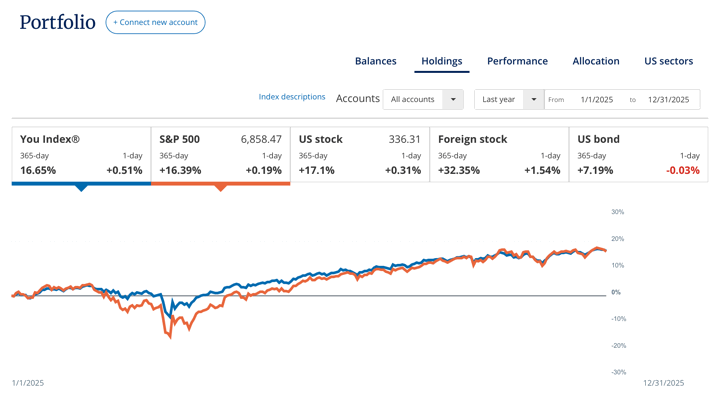
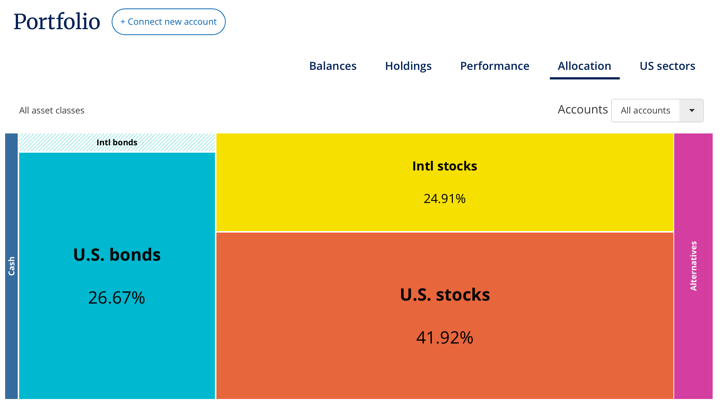
Here are updated performance and asset allocation charts, per the “Holdings” and “Allocation” tabs of my Empower Personal Dashboard.

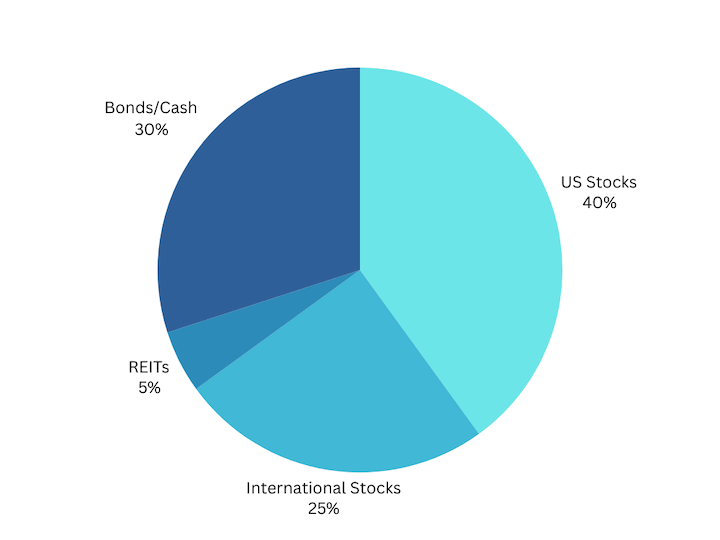
The major components of my portfolio are broad index ETFs. I do mix it up a bit around the edges, but not very much. Here is a model version of my target asset allocation with sample ETF holdings for each asset class.

  • 35% US Total Market (VTI)
  • 5% US Small-Cap Value (AVUV)
  • 20% International Total Market (VXUS)
  • 5% International Small-Cap Value (AVDV)
  • 5% US Real Estate (REIT) (VNQ)
  • 20% US “Regular” Treasury Bonds and/or FDIC-insured deposits (VGSH)
  • 10% US Treasury Inflation-Protected Bonds (SCHP)

Big picture, it is 70% businesses and 30% very safe bonds/cash:

By paying minimal costs including management fees, transaction spreads, and tax drag, I am trying to essentially guarantee myself above-average net performance over time.

I do not spend a lot of time backtesting various model portfolios. You’ll usually find that whatever model portfolio is popular at the moment just happens to hold the asset class that has been the hottest recently.

The portfolio that you can hold onto through the tough times is the best one for you. I’ve been pretty much holding this same portfolio for 20 years. Check out these ancient posts from 2004 and 2005. Every asset class will eventually have a low period, and you must have strong faith during these periods to earn those historically high returns. You have to keep owning and buying more stocks through the stock market crashes. You have to maintain and even buy more rental properties during a housing crunch, etc. A good sign is that if prices drop, you’ll want to buy more of that asset instead of less. I don’t have strong faith in the long-term results of commodities, gold, or bitcoin – so I don’t own them.

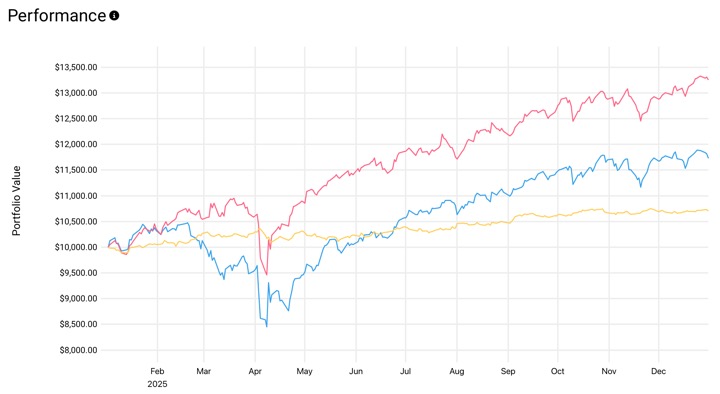
Performance details. Here’s an updated YTD Growth of $10,000 chart courtesy of Testfolio for some of the major ETFs that shows the difference in performance in the broad indexes:

Nearly everything went up in 2025. I doubt 2026 will be boring. I’ll share about more about the income aspect in a separate post.

Webull ACAT Transfer Bonus: 3% to 4% of Assets ($2k/100k Minimum)

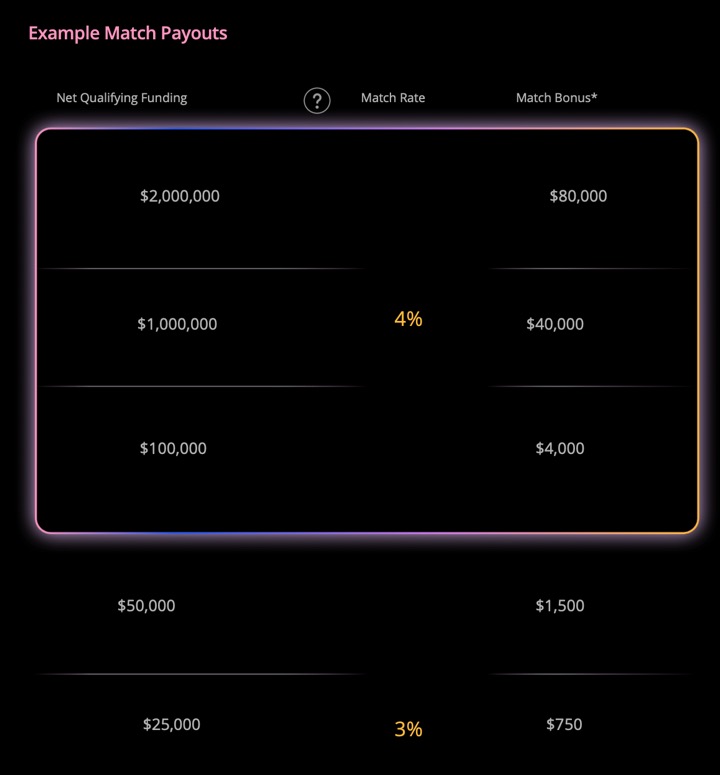
Updated with new offer. The Webull brokerage app is offering an updated ACAT Transfer bonus of up to 4% of assets transferred plus up to $100 in outgoing fee reimbursements on your first transfer of at least $2,000. This specific offer ends March 31, 2026. This is for individual taxable brokerage accounts. Joint, Crypto, and IRA accounts are excluded.

You must transfer at least $100,000 in assets to get a 4% match, with a minimum hold of 5 years to get the full payout (they break it up into installments with the last one being paid March 2031). Max funding is $2,000,000. You must transfer at least $2,000 in assets to get a 3% match, also with a minimum hold of 5 years. 4% is a very high bonus, but it is a long hold period. Be sure to read all the terms and conditions.

Prime Visa Review: $250 Instant Gift Card, 5% Back at Amazon + Whole Foods

Limited-time offer now scheduled to expire 1/8. If you have an Amazon Prime membership, you probably spend a good chunk at Amazon and should at least consider the Prime Visa, a credit card (not store card) available only to Amazon Prime members. During the holiday season, the bonus has boosted to a high of $250 but is going to expire 1/8. Highlights:

  • $259 Amazon Gift Card *instantly* upon approval exclusively for Prime members. No spending requirement.
  • 5% back at Amazon.com, Amazon Fresh, Whole Foods Market with an eligible Prime membership.
  • 5% back on Chase Travel(SM) purchases with an eligible Prime membership.
  • 10% back or more on a rotating selection of items and categories
    on Amazon.com with an eligible Prime membership.
  • 2% Back at gas stations, restaurants, and on local transit and commuting
    (including rideshare).
  • 1% Back on all other purchases.
  • No foreign transaction fees.
  • No annual fee.

Rewards can be redeemed easily either on your next Amazon.com purchase or as a statement credit on your bill. But since you get 5% back on your Amazon purchases on this card… it’s slightly better to take the statement credit, even though it is also slightly more hassle.

I have this card set up as my default credit card at Amazon, and that’s its primary purpose in life, to absorb all my Amazon and Whole Foods purchases. (Which is still a lot, unfortunately…)

If you do this, remember that there are also the following extra protections built into the card:

  • Extended warranty protection. Extends the time period for the U.S. manufacturer’s warranty by an additional year, on eligible warranties of three years or less.
  • Purchase Protection. Covers your new purchases for 120 days against damage or theft up to $500 per claim and $50,000 per account.

Bottom line. If you are a Prime member that spends a lot of money at Amazon and/or Whole Foods and prefer simplicity, using the Prime Visa can add up with minimal extra effort. Be sure to make it your default card for your Amazon account. You can then track all your Amazon spending on one card, and also be sure you remember that you get extended warranty protection and purchase protection on those items.

E-Trade from Morgan Stanley: Savings and Checking Account Bonuses

Savings offer improved. E*Trade (Morgan Stanley Private Bank) is running promotions for new customers on both their savings and checking accounts:

Hat tip to reader Greg on this one.

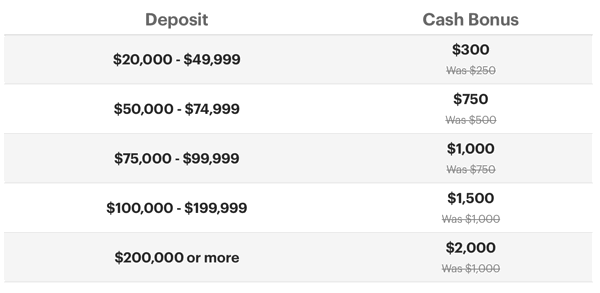
Up to $2,000 Savings promo details (deposit bonus).

  • Open a new Premium Savings Account on etrade.com by February 28, 2026 using promo code SAVE26.
  • Deposit qualifying new money (see tiers below) within the first 30 days after account opening.
  • Maintain your balance for 45 additional days after the 30-day funding period ends to earn your bonus.

If your deposit meets the minimum of a tier exactly then it works out to up a 1.5% bonus. Note that on some tiers it might be as low as 1%. If let’s say you hold for 60 days for some wiggle room, 1.5% for 60 days works out to a 9% bonus on an annualized basis. Add on the current 3.50% APY on the Premium Savings account for a total of 12.50% APY.

Even on the 1% bonus for 60 days, that works out to a 6% bonus on an annualized basis. Add on the current 3.50% APY on the Premium Savings account for a total of 9.50% APY. Not bad.

$300 Checking promo details (direct deposit required).

    CHECKING25. You are not eligible if you have or had owned or co-owned (joint) a Checking or Max-Rate Checking Account within the last 12 months from when you enroll in this offer.
  • Make at least 2 direct deposits, each of $1,500 or more, within 90 days of opening your new account.
  • Your bonus should arrive around 120 days from account opening.

As of 1/5/26, Max-Rate Checking Account pays 2.00% APY. You must maintain a $5,000 average monthly balance, otherwise there is a $15 monthly fee. The basic Checking Account only pays 0.05% APY (basically nothing), but has no minimum balance. This is notable since you’ll need to maintain an open account for at least a few extra months to get the bonus, so the basic Checking might be better.

Capital One 360 Checking Bonuses: $250 w/o Direct Deposit, $300 w/ Direct Deposit

Updated. Capital One has two different checking bonuses for new customers right now, one that requires direct deposit and another that requires 20 debit card transactions. You’ll have to pick one.

$250 bonus w/o Direct Deposit requirement:

  • Open a 360 Checking account using promotional code DEBIT250.
  • Use your 360 Checking debit card for qualifying transactions at least 20 of $10 or more within 75 days of account opening.

What is “new”? If you have or had an open 360 Checking, Simply Checking, or Total Control Checking account as a primary or secondary account holder with Capital One on or after January 1, 2024, you will be ineligible for the bonus. Hat tip to DoC.

$300 bonus w/ Direct Deposit requirement:

  • Open a 360 Checking account using my referral link. They should fill in the promo code for you.
  • Set up and receive at least 2 Qualifying Direct Deposits each of $500 or more to your 360 Checking account within 75 days of account opening.

For this one, if you have or had an open 360 Checking, Simply Checking, or Total Control Checking account as a primary or secondary account holder with Capital One on or after January 1, 2024, you will be ineligible for the bonus.

The 360 Checking account offers a rather disappointing 0.10% APY interest rate, and nothing exceptional other than the ability to link easily with 360 Savings. Highlights:

  • No monthly fees, no minimum balance required.
  • 0.10% APY on all balance tiers.
  • Remote check deposit via app.
  • Paper checks will cost you $20 for 50 checks, or $25 for 100 checks.
  • In addition to their own ATMs, Capital One uses the Allpoint ATM network for fee-free ATM access.
  • You can use your 360 Savings as the overdraft backup source of funds.

A pretty generous checking bonus if you are eligible, but not that attractive long-term unless you already prefer using CapOne 360 Savings. Capital One does seem to keep offering these bonuses regularly each year, making it a good idea to close any idle Capital One 360 accounts.

2025 Year-End Review: Asset Class & Target Date Fund Returns

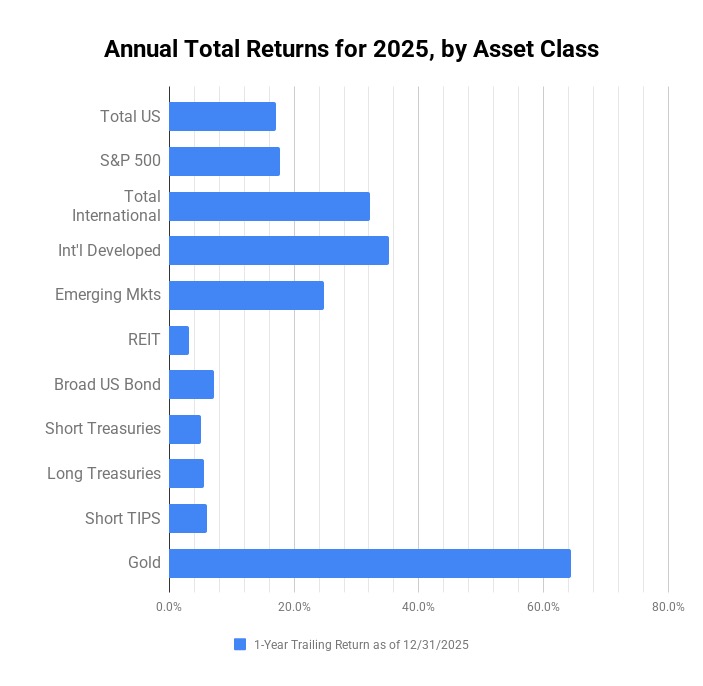
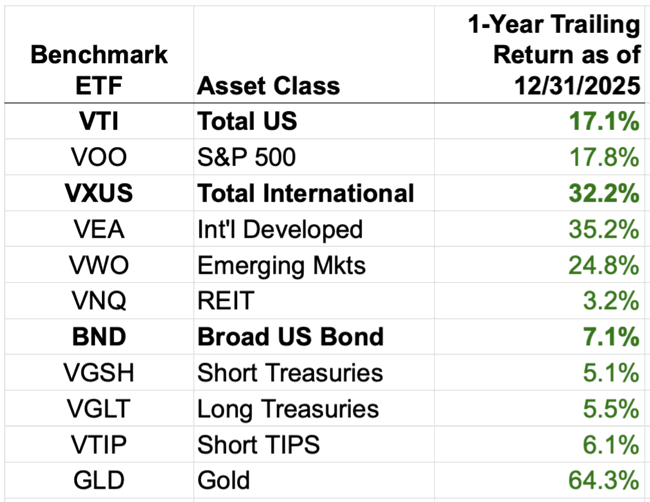
2025 saw positive returns for every broad asset class that I track. Per Morningstar, here are the total annual returns (includes price appreciation and dividends/interest) for select asset classes as benchmarked by popular ETFs after market close 12/31/25.

I didn’t include Bitcoin or any other crypto because I don’t track them as a long-term asset, only own small amounts temporarily, and would not advise my family to own it. However, I do acknowledge that it went down slightly this year.

Meanwhile, Gold went up by a lot this year, which indicates to me that Gold and Bitcoin have some very different characteristics. Very few developed countries are buying large amounts of Bitcoin to store in their central bank vaults.

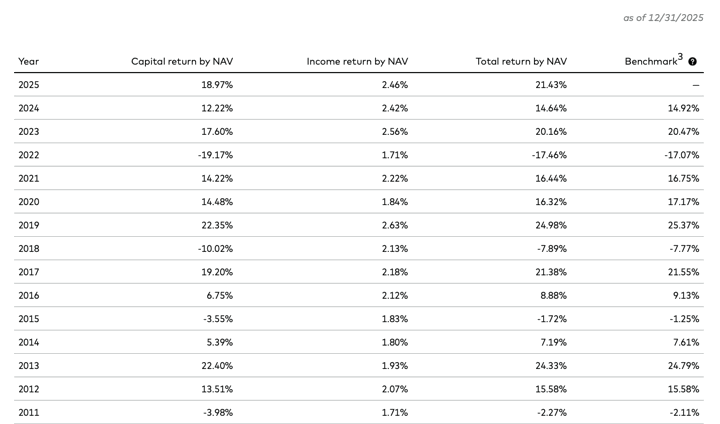
The “set and forget” Vanguard Target Retirement 2055 fund (VFFVX), currently consisting of roughly 90% diversified stocks and 10% bonds, was up 21.4% in 2025.

Commentary. 2024 yet again shows that you want to stay in the game. There are always going to be reasons to be afraid: because US stocks continue to have historically high valuations, because you’re worried about an AI bubble, or worried that AI will instead take your job…

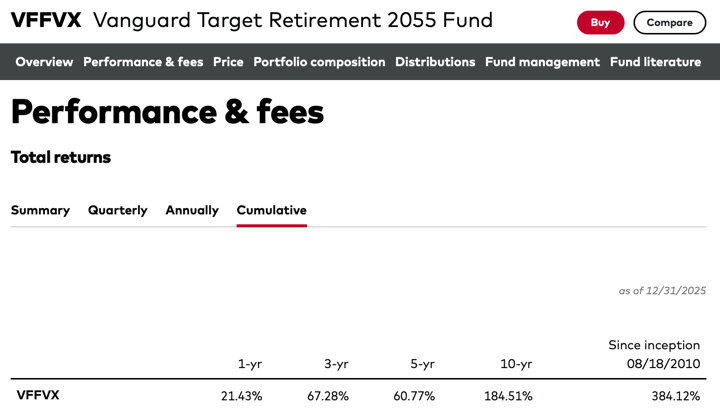
Here are your cumulative returns through the end of 2025 if you had been a steady investor in the Vanguard Target Retirement 2055 for many years despite the many, many problems of the world:

(These work great inside 401ks and IRAs. I’d avoid buying Target Retirement mutual funds in a taxable account.)

I feel the need to promote slow compounding over all the short-term madness around us. Sports gambling. Risky options trading. Crypto joke coins. Buy Now Pay Later. I tell my kids that it’s perfectly okay to avoid some stuff completely. You don’t need to try it to know it’s a bad idea.

Free Credit Monitoring Alerts From All 3 Major Credit Bureaus

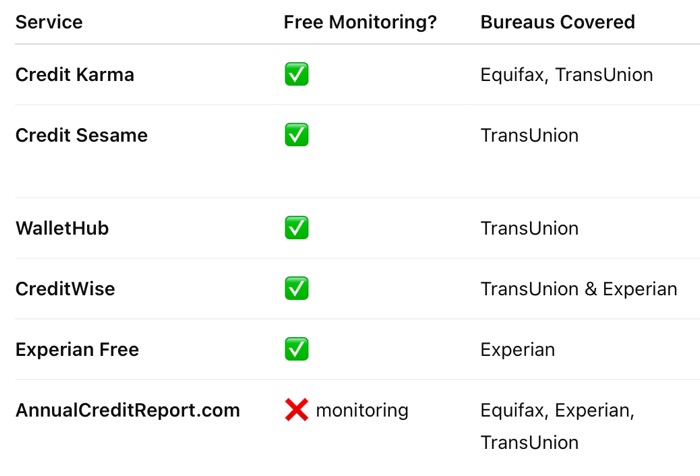
Updated. Happy New Year! 🎉 🥳 In terms of keeping my finances in order, what I’ve been finding most useful recently are credit monitoring alerts. The last time I applied for a credit card, I received multiple e-mails within minutes alerting me that someone had checked my credit report. I’m also told if a new account is added. This makes me feel more comfortable knowing that I’ll be alerted quickly if someone does try to steal my identity. The following third-party services listed below provide you a free credit score (of various algorithms) and/or free continuous credit monitoring from select credit bureaus.

Credit Karma

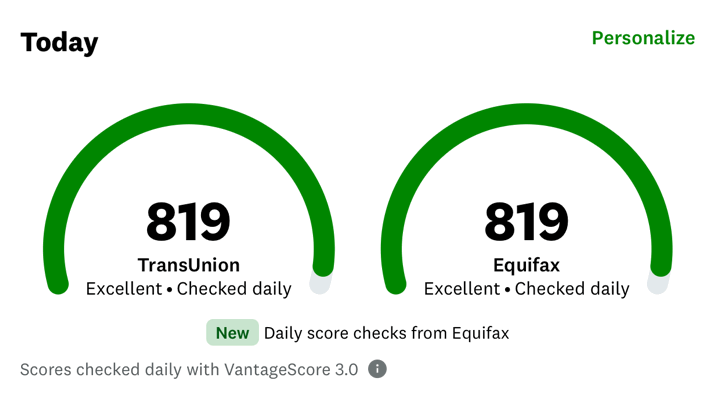
  • Free credit score (VantageScore 3.0) from both Transunion and Equifax.
  • Free credit monitoring from both Transunion and Equifax. Via e-mail alerts or app notification. Will let you know about things like a new credit check or a new account added.
  • Limited identity theft monitoring. Credit Karma uses your email address to search and notify you if they are listed in public data breaches.

Credit Sesame

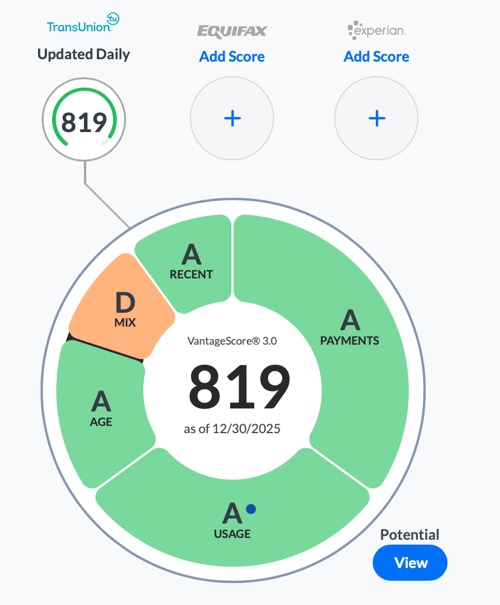
  • Free credit score (VantageScore 3.0) from Transunion. Daily credit score updates and weekly credit report profile updates.
  • Free credit monitoring from Transunion. Via e-mail alert. Will let you know about things like a new credit check or a new account added.

Experian.com (Free Tier)

  • Free credit score (FICO 8) from Experian. Daily credit score updates and daily credit report profile, refreshed upon login.
  • Free credit monitoring from Experian. Free e-mail alerts.
  • Warning that Experian will regularly try to upsell you to a paid membership tier. Simply click “No, keep my membership” to stay on the free tier. I’ve been on it for years.
  • Improve your credit score by adding utility payments. Experian Boost is a free option that can potentially improve your Experian-based credit score by adding on-time utility and phone bill payments.

WalletHub

  • Free credit score (VantageScore 3.0) from Transunion. Daily credit score updates and free daily full credit reports.
  • Free credit monitoring from Transunion. Via e-mail alert. Will let you know about things like a new credit check or a new account added.

CreditWise from Capital One

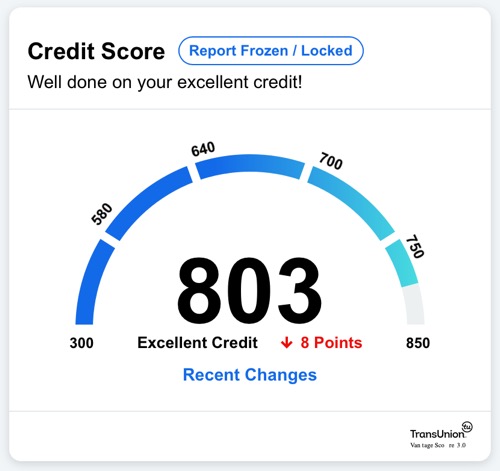
  • Free credit score (FICO 8) from Transunion. You do not need to be a Capital One customer to sign up.
  • Free credit monitoring from both Transunion and Experian.

None of the services above require a trial or credit card number to sign up for their free tiers. They may ask for the last 4 digits of your SSN for verification. These are all ad-supported (they will pitch you stuff) and usually have a paid upgrade option (but you can stay on the free tier forever).

The government requires the credit bureaus to provide you a free credit report at least once every 12 months (now actually weekly since the pandemic). However, the site will not provide you credit scores or pro-active alerts if anything changes on those reports.

Note that some of the scores above are not FICO scores because Fair Isaac might charge more money in licensing fees. If you really want a FICO number, nearly every major credit card issuer now includes a monthly FICO score with their cards: Chase, Citi, Bank of America, Discover, Barclaycard, and American Express.

Bottom line. Used in combination, I use the services above to keep track of changes to my credit reports across all three credit bureaus for free. None of them require my credit card number, and they quickly alert me to things like new accounts, new credit check inquiries, and high credit line usage. I just ignore the generic ads and upsells.