Archives for May 2023

Why a Your Portfolio Should Contain (At Least Some) International Stocks

If you own a target retirement fund, you probably own a decent chunk of international stocks. However, these days it’s harder to find people telling you to own international stocks when you build your own portfolio, mostly because of the outperformance of US stocks over non-US stocks for long time now. The article International Diversification – Still Not Crazy after All These Years does a good job of reminding us why owning some international stocks is still a good idea. Here’s the brief summary:

International diversification has hurt US-based investors for over 30 years, but the long-run case for it remains relevant. Both financial theory and common sense favor international diversification, which is buttressed by empirical evidence that is very supportive at longer horizons and for active strategies. Finally, it would be dangerous to extrapolate the post-1990 outperformance of US equities, as it mainly reflects rising relative valuations. If anything, the current richness of US equities may point to prospective underperformance.

For one, the diversification benefits in times of market crashes are still there… as long as you expand your time horizon. The major risk for a US-only portfolio is a prolonged recession in the US, while the rest of the world recovers more quickly. The “insurance” analogy still applies as historically there has definitely been a cushioning effect over time from spreading your bets.

Exhibit 1 shows that over short horizons, global portfolios (dashed) can suffer almost as much as an average local portfolio (dot- ted); but once you look out a couple years or so, global portfolios fare much better.

Exhibit 2 tracks the Shiller CAPE ratio (Cyclically-Adjusted Price/Earnings ratio) of US stocks and EAFE developed international stocks. The red line represents ratio between the US and EAFE valuations. Much of the historical outperformance of the US over EAFA stocks since 1990 was not earnings growth itself, but expansion of the P/E ratio (how much you pay for those earnings).
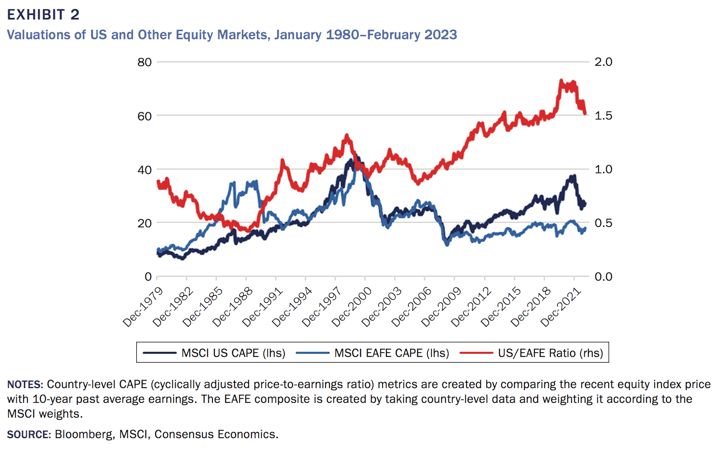
Will US stocks permanently maintain a P/E ratio that is 50% higher than international stocks? I have no idea, but it’s definitely not a sure thing. I let my portfolio asset allocation float with the market weightings (with a slight US tilt since I live here), so I don’t really worry about it because if US stocks keep growing faster than international stocks, then I’ll just gradually end up owning more US stocks while paying a sort of insurance premium hit for owning the international stocks. But if international stocks end up making even a minor improvement like a return to valuation ratios pre-2010, my portfolio can still benefit.

SaveBetter No-Penalty CD Review: How To Cancel No-Penalty CDs

No-Penalty CDs try to offer the best of both worlds – the liquidity of a savings account, and the higher fixed interest rate of a term CD. If rates go up, you can still move to the new higher rate. If rates drop, you are covered because the interest rate you earn can never go down during your term (usually around a year). When a financial crisis and/or recession hits, interest rates can drop quite quickly. Below is a historical chart of the Fed Funds rate since 1990. (Other times, a bank may just decide for any reason to drop their rate on a savings account.)

SaveBetter consistently offers some of the top interest rates on No-Penalty CDs. See my full SaveBetter review for more details on SaveBetter overall. Here are some details on the No Penalty CD specifically; their product is a bit unique in both good and bad ways.

  1. You cannot make any withdrawal within the first 30 days of opening a No Penalty CD, which is longer than usual. At CIT Bank, you can withdraw after 7 days. At Ally Bank, it’s six days.
  2. However, the minimum opening amount is only $1, which is much smaller than usual. At CIT Bank, it is $1,000. Ally also has no minimum. This means you can open multiple No-Penalty CDs in whatever amount you want, and only “break” the ones you need to. If, for example, the minimum at a competitor bank was $5,000, then you’d have to break an entire $5,000 CD even if you only needed $500.

Finally, I noticed that the website does not offer details about the actual process of how to make an early withdrawal from SaveBetter No-Penalty CD. I asked the Live Chat feature and this was the official reply provided:

Please email service@savebetter.com using the email address that you use to log into SaveBetter.com

In your email be sure to include the bank or credit union’s name and the current balance of the CD. If you have more than one CD from the same institution with the same balance, please specify the number of CDs you would like us to cancel.

Once we have processed your cancellation you will receive a note from the team letting you know the process has been completed.

If you have any questions please call Customer Service at (844) 994-3276. The team is available weekdays 9AM-4PM Eastern Time (excluding holidays).

So I sent them the following simple e-mail late on a Friday night:

Hello,

This is a request to close my No Penalty CD from Sallie Mae Bank with a current balance of $XXXX.XX.

Thank you,

Jonathan

On Saturday morning, I received the following reply:

Your cancellation request has been processed.

All available funds will be transferred to your linked bank account within 3 business days.

Please reach out if we can be of further service.
Regards,

Mio
SaveBetter Customer Service
service@savebetter.com

The withdrawal amount arrived in my linked bank account on the third business day (Wednesday), but they did credit me with at least one additional day of interest because the final amount was higher than my Friday closing balance (I figure they initiated on the next business day of Monday, cash came out Tuesday).

I was still satisfied that a simple 100% online-only option exists. I just sent a single e-mail. I did not have to call in, go through a complicated confirmation process, or answer any “Are you sure?” type of questions.

With SaveBetter, all deposits and withdrawals have to go in and out through your linked external bank account. You can’t just transfer the money internally directly into another type of account at another partner bank. That means that if you wanted to cancel one No Penalty CD and immediately open another “new” No Penalty CD at a higher rate, you might lose a business day or two of interest on the way out to your linked account before transferring the money back in to purchase the new CD.

This contrasts with CIT Bank, where I you can directly fund a new No-Penalty CD (at higher rate) with an existing No-Penalty CD. Of course, if you were to move funds between two different banks, you’d also have to deal with some days of lost interest in transition.

Their No-Penalty CD rates are currently above 5% APY, but the specific rates and the banks offering them change all the time, so I won’t list it in this review. Click here to see current No-Penalty CD rates at SaveBetter.

AllAmerica and Redneck Bank: 4.40% APY Money Market (up to $100k), 4.65% APY Rewards Checking (up to $15k)

Update 10/14/24: Rates dropped to 4.40% APY on up to $100,000 for Mega Money Market and 4.65% APY on up to $15,000 for Rewards Checking (debit card usage and other requirements apply). Details below.

Update 7/9/24: Rates dropped to 4.75% APY on up to $100,000 for Mega Money Market and 5.00% APY on up to $15,000 for Rewards Checking (debit card usage and other requirements apply). Details below.

All America Bank and Redneck Bank are sister internet banks that offer the same types of accounts (with different marketing shtick). Looking back in my archives, I actually opened an account with them way back in 2009 (later closed), as they offer a simple product lineup and have intermittent periods where they are very competitive with interest rates. (There are also some periods where they choose to lag.) Looks like they are looking to attract deposits again, recently raising both their interest rates and their balance caps.

Mega Money Market

  • 4.75% APY on up to $100,000. Amounts over $100,000 earn 0.50% APY.
  • No debit card transactions required.
  • $500 minimum to open an account. No ongoing minimum balance requirement.
  • Must agree to receive online statements only.
  • Limit of one Mega Money market account allowed per individual. (I believe you can have one account at each bank, though.)
  • Technically a money market checking account which means it includes a debit card (you can pay for checks too) but is still limited to six withdrawals per month. This limits its functionality to more like a savings account.

Rewards Checking

  • 5.00% APY on up to $15,000. Amounts over $15,000 earn 0.50% APY.
  • 10 debit card transactions required per monthly statement cycle. Monthly statement cycle ends on the 20th of each month. If the 20th falls on a Saturday, the cycle will end on Friday the 19th. If the 20th falls on a Sunday, the cycle will end on Monday the 21st. ATM and ACH transfers don’t count.
  • $500 minimum to open an account online. No ongoing minimum balance requirement.
  • Must agree to receive online statements only.
  • Limit of two (2) Rewards Checking Accounts allowed per individual. (I believe you can have two accounts at each bank.)
  • A full-featured checking account with online billpay, ATM rebates (up to $25 per month), and mobile check deposit abilities.

Note that both are under the FDIC insurance certificate of All America Bank (#20093), so you should be careful not to exceed the $250,000 limit across both banks (a reminder that the $250k limit is per depositor, per insured bank, for each account ownership category).

List of 529 Day (5/29) College Savings Plan Promotions 2023

Updated for 2023. 5/29 is “National 529 College Savings Plan Day” and every year a few state plan offer promotions and/or giveaways. Most offers end by May 31st. Some offers require in-state residency, but some don’t. 529 plans can now also pay for K-12 tuition and other educational expenses beyond college tuition and room/board.
I find that having an open 529 plan is a great way to redirect various cash gifts from friends and family (like grandparents) so that the money doesn’t just get spent mindlessly and then forgotten. Finally, opening a plan and making any contribution also starts the 15-year clock on potential future 529-to-Roth IRA rollovers.

Here’s a list of what I could find, please let me know if you find more. I’m listing the state, but you do not have to be a resident of that state to open a 529 account there. You can have multiple 529s from different states. However, you may need to be a resident to qualify for a specific bonus, or there may be an age restriction on the beneficiary, etc.

How to Choose Your Career: Venn Diagram

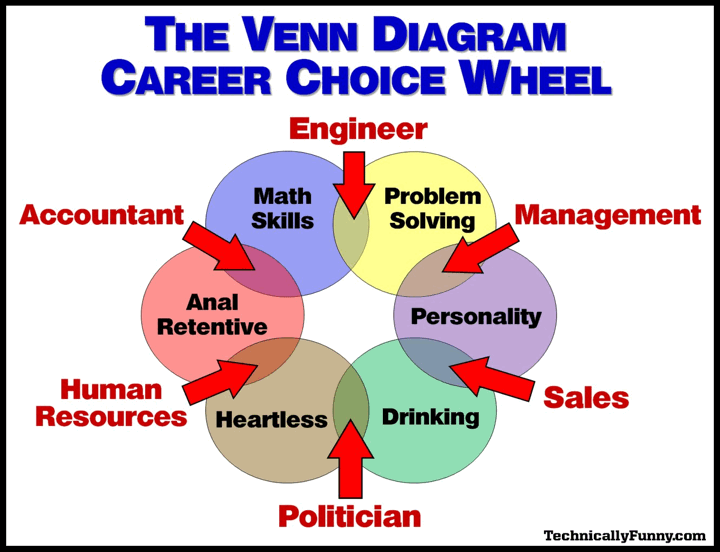
Despite my great affinity for Venn diagrams, I don’t recall seeing this one about how to choose a career by engineer/comedian Don McMillan. I found the routine through a random YouTube video recommendation:

Here is the slightly-less-likely-to-offend version from @donmcmillan, which swaps “OCD” for “anal retentive” and “lawyer” for “politician”:

Definitely some truth in his humor. I’ve definitely cycled through enough jobs to know that I am not a good fit. I could fake it for a while, but it just gets exhausting. You definitely want to choose a career that fits your personality:

caddell620

p.s. Here’s a random bonus Venn Diagram of three vegetarian recipes from the NY Times:

Keep Airline Miles and Hotel Points Active With Short Paid Surveys

Worried about keeping all your airline miles and hotel points active? Another trick to keep in your toolbox is that many loyalty programs have a partner survey company that can be a relatively easy way to earn a few miles and extend any impending expiration dates. I don’t enjoy doing them otherwise, and they can send way too many e-mails (set up a filter), but I am happy they exist. Even if you don’t qualify for the full survey, they’ll give you something like 5 miles for trying, and that’s all I really need. This is often expressly mentioned as a perk:

You can also use them in a pinch if you only need a few miles to reach a specific award amount. They all seem to be run by the same backend company, but while some post the points nearly instantly, while others can take a few weeks at times. I usually only sign up for a specific program when I need to generate activity, but many do offer a small bonus on your first survey. I recently just did a couple of surveys to extend the expiration of my Alaska and Hilton points.

Here’s a quick list of programs expiration policies and their companion survey sites.

Alaska Airlines – The Opinion Terminal

  • 400 miles for first survey.
  • Alaska miles accounts get locked after 24 months of inactivity, permanently lost after 36 months of inactivity.

American Airlines – Miles For Opinions

  • 250 miles for first survey.
  • American miles expire after 24 months of inactivity.

British Airways – Avios For Thoughts

  • 100 + 500 Avios for first survey.
  • Avios expire after 36 months of inactivity.

Hawaiian Airlines – Opinions Take Flight

  • 350 miles for first survey.
  • As of April 2021, Hawaiian miles no longer expire (used to be 18 months).

Hilton Honors – Guest Opinion Rewards

  • Hilton points expire after 24 months of inactivity.

JetBlue – Points For Surveys

  • 400 points for first survey.
  • JetBlue points do not expire.

Southwest Airlines – Rewards For Opinions

  • 500 miles for first survey.
  • Southwest points do not expire.

Spirit Airlines – Points For Thoughts

  • 400 points for first survey.
  • Spirit miles expire after 12 months.

United Airlines – Opinion Miles Club

  • As of 2019, United miles no longer expire (used to be 18 months).

Wyndham Rewards – Opinion Rewards Panel

  • 500 points for first survey.
  • Wyndham Rewards points expire after 18 months of inactivity, OR after four years after being earned regardless of account activity.

Reader Questions: Worried About Debt Limit? Worried About Smaller Banks?

I’m probably dating myself using the image above. How old do you have to be to remember when MAD magazine was popular? In retrospect, the magazine served a very important purpose, which was basically to show kids the many tricks out there and how to be less gullible. From Robert Boyd of the LA Times (source):

The magazine instilled in me a habit of mind, a way of thinking about a world rife with false fronts, small print, deceptive ads, booby traps, treacherous language, double standards, half truths, subliminal pitches and product placements; it warned me that I was often merely the target of people who claimed to be my friend; it prompted me to mistrust authority, to read between the lines, to take nothing at face value, to see patterns in the often shoddy construction of movies and TV shows; and it got me to think critically in a way that few actual humans charged with my care ever bothered to.

As I’m old and a bit under the weather this week – though temporarily lucid thanks to behind-the-counter pseudoephedrine – if I end up rambling… that’s my excuse. Anyhow, I’ve been getting emails from two different camps in the past few months:

  • Don’t put your money in US Treasury bills, that’s risky. Haven’t you heard about the debt limit crisis?
  • Don’t put your money in non-huge banks, that’s risky. Haven’t you heard of those bank failures? You should keep your money in US Treasury bills.

Am I worried about the US debt limit?

No and yes. No, I am not worried that my Treasury bonds (and money market funds based on Treasury bonds) will fail to be paid back with interest. In fact, I’ve thought about buying some of those affected short-term T-Bills, but it wouldn’t be much additional benefit for my small amounts.

Yes, I am worried that this signals a high level of disfunction between our elected officials. Imagine my partner and I already previously agreed to a mortgage for the house, an auto loan for both our cars, and put shared household bills on the credit card. Is the best way to make ourselves more financially responsible to threaten not to pay the debt that we have already agreed to take on? We should certainly examine our future expenses closely, and government spending is an important topic. But what is the point of threatening to ruin our collective credit score by not paying our existing bills? Is it honorable to openly consider defaulting on your debts? The US enjoys a lot of benefits from its top credit rating. I’m disappointed.

Am I worried about having my personal money deposited at non-huge banks?

No. As long as they are under the covered FDIC-insurance limits of $250,000 per depositor, per insured bank, for each account ownership category. Both of these things (NCUA/FDIC-insured bank deposits and US Treasury bonds) are backed by the US government, which has the power to create as much fiat currency as it likes. The FDIC is quite good at transitioning if a bank failure does occur. So I’m personally not worried about either thing. I just opened a relatively large 5-year CD at 5.00% APY at a small, friendly credit union in Oxnard, CA with only a few physical branches (deal expired). I hope they in turn lend it out to some small businesses in their area.

If you can get past the paywall, read this interesting Bloomberg article (close alternative) about the smallest bank in the US. One full-time employee (the CEO), a part-time teller, no ATM, no website. I kind of want to open an account.

The thing is, for a business with a huge cash balance that is over the FDIC-insured limits, then it indeed might be rational to move that money into the safest possible bank. You’d think that these sorts of problems would be solved by now. Berkshire Hathaway rolls billions of Treasury bills every month. But that’s how it works sometimes. Problems are only faced after it becomes a painful issue. I believe they’ll figure it out.

Do US Stock Dividends Grow Faster Than Inflation? (1927-2021)

The hard problem of retirement planning continues to be how to turn a pile of assets (like in a 401k plan) into the maximum reliable income stream for decades without running out of money. Historically, companies that pay a high-yet-reliable dividend have been referred to as “widow and orphan” stocks. The academic paper Why Dividends Matter by Paul Schultz explores the underpinnings of this practice, including the “implicit contract” between the company and shareholders that “you can consume at the level of the dividend for the foreseeable future without fear of running out of money.” The debate about investing based on dividends will not be resolved by this paper, but here are a few quotes:

It is not necessary to think that a practice of consuming only from dividends is a result of limited rationality, biases, or mental accounting. When firms establish a quarterly dividend, they implicitly tell investors that they can consume at the level of the dividend for the foreseeable future. So, investors who want to smooth consumption can do so by consuming dividends.

As a whole, the investors in this survey are far more concerned about the danger of depleting assets by selling stock, than by spending dividends. This is why investors like dividends. They allow to investors to smooth consumption by indicating how much they can consume without depleting assets.

Now that we have many ways to backtest historical stocks returns, the popular counter-argument is that we have other ways to decide how much is “safe” to withdraw, and that amount is often more that the current dividend yield available. We can simply some stock shares as needed if the dividend is not enough. Which is the better way to decide how much is safe to withdraw?

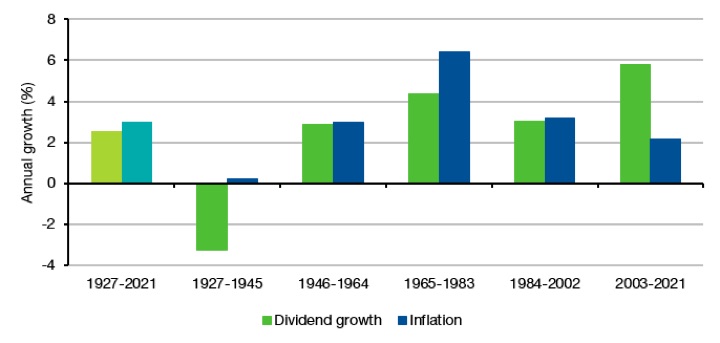
Historically, do dividend payouts keep up with inflation? This would seem to be important if investors are only spending the dividends every year. Otherwise, they would eventually need to sell shares of stock anyway. Table I of the paper “Changes in Dividends and Inflation” covers this using CRSP data for all US stocks. Hat tip to Klement on Investing, who converted Table I into a nice visual chart:

Over the past nearly 100 years, the dividend growth rate has mostly matched inflation. Dividend growth did fall behind inflation during the period of 1970s high inflation. In turn, dividends have grown much faster than (historically low) inflation in the last 20 years.

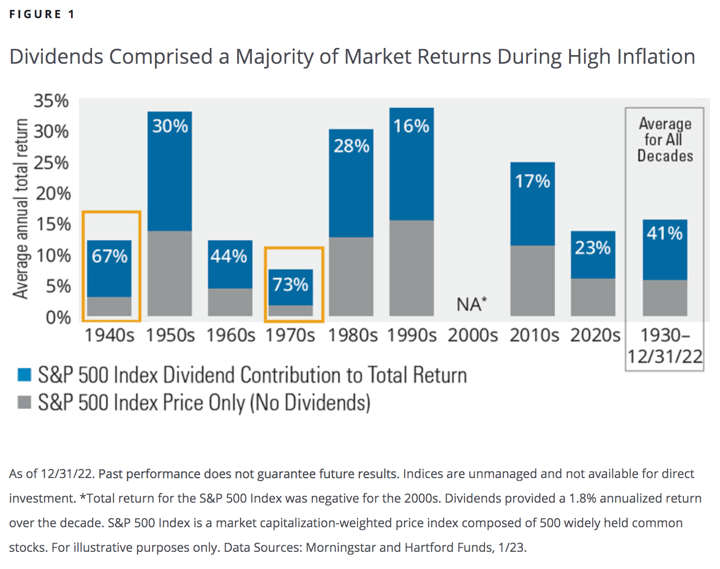
Here’s another chart from Hartford Funds which separates the portion of S&P 500 total market returns into share price appreciation and dividends.

I would note that these charts cover the broad US stock market, not just a subset of high-dividend stocks nor international stocks. I certainly don’t think we can get away with buying only the highest dividend-yielding stocks and calling it a day. However, I do believe that dividend payouts are is a useful data point to consider, amongst many others. I tend to pay attention to the dividend yield on the S&P 500 and also certain indexes like those tracked by the Vanguard Value Index Fund ETF. I also expect the dividends on both to grow more or less with inflation over the long run.

Even Vanguard’s founder Jack Bogle had the following to say (source):

But you ought to think about all sources of your retirement income. Having said that, when you own an equity portfolio, don’t get into it for market reasons, get into it for income reasons. Oversimplifying, what you want to do when you retire is walk out to the mailbox on Social Security day and on dividend payment day for the funds—assuming they’re the same day—and make sure you have two envelopes out there. One is your fund dividend and the other is your Social Security check. The Social Security will keep up with inflation year after year, and dividends are likely to increase year after year. They have been going up. Every once in a while there is an interruption, such as the Great Depression of the early 1930s. And many bank stocks eliminated their dividends in 2008, so there was obviously a drop. But it has long since recovered, and then some.

Bet on the dividends, and not on the market price. You’ve got those two envelopes and that’s your retirement. If you have a pension plan (one that is not likely to go bankrupt—and a lot of them are likely to) that is a third envelope. You want to be concerned about whether you have enough income to pay utility bills, pay for your food, pay your rent or your mortgage, whatever it might be, every month. You want income to help you pay those bills. And in the retirement stage, that’s what investing should be about—regular checks from dividends and/or from Social Security and/or from a pension account.

2023 Berkshire Hathaway Annual Shareholder Meeting Video, Transcript, and Notes

The 2023 Berkshire Hathaway Annual Shareholder Meeting occurred on May, 6 2023, and while there are articles offering highlights (including this one), it’s never the same feeling as watching/listening to the actual thing. I always find a few things that mean something to me, even if just a small side remark, that don’t make it into the financial news headlines. Warren Buffet (92) and Charlie Munger (99) continue to impress with their amazing mental acuity and stamina.

CNBC again has the rights to record and host the full video and transcripts (morning session, afternoon session) and they did a nice job with syncing the text and sound on the afternoon session (the morning one didn’t work for me). Here are a few personal takeaways and notes.

Overall, I am reminded that Buffett regards Berkshire Hathaway as his life’s work and masterpiece. He may not have much time left to paint, but it is already beautifully constructed. It is built to prosper in the long-term, but also to withstand anything thrown at it in the short-term. This is how I wish to build up my family’s finances as well. A large engine of productive investments that create growing profits and cashflow. Always having a sizable cash holding as well, never having worry about market crashes or liquidity needs. Berkshire sells insurance to cover the rare events, and I buy them to protect us from those types of events (life, home, auto liability, umbrella).

Autopilot. Buffett points out that it will be hard to judge how well his successors are doing, as by design, Berkshire will operate very well even mostly on auto-pilot. The subsidiary companies all have their own managers. The stocks are bought with the intention of holding for a long time if not forever. This reminds me that I should make our finances more auto-pilot as well. I may enjoy the micro-management now, but I worry that I am making things too complicated in a situation where I’m not around.

The benefits of being financially independent. No boss above telling you what to do, but also no direct customers to please.

[Warren Buffett speaking about Charlier Munger] He didn’t want to sell his time, maybe at 20 bucks an hour or something, to people he thought were making the wrong the decisions. And he knew more about it than they did. And that just did not strike him as a good way to go through life. And I think he’s probably right on that.

I think he’d have really gotten to be miserable if he had to keep doing that. It’s just no fun. It’d be like me giving investment advice to somebody that — or taking it from somebody. I just wouldn’t want to do it. And Charlie figured that out. And so, we decided to work for ourselves. And this worked. Been happy, happily ever after.

Charlie Munger was a successful lawyer, but he didn’t want to give advice to people who often wouldn’t take it. Warren Buffett could have been a investment manager or financial advisor, but he also didn’t want to give advice to people who often wouldn’t take it. I have thought about becoming a financial advisor of some sort, but I think it would be very difficult to spend your time carefully crafting advice and then seeing someone just do the opposite. As a self-directed investor, I enjoy the fact that I can do my own research, make my own decisions, and implement them as I wish. It takes a while to build up your first $100,000, but there is a reason why his biography is called The Snowball.

Berkshire shareholders as the frugal millionaires. I have to admit, I enjoy the stereotype that Berkshire Hathaway shareholders tend to be frugal, practical, and not focused on outward appearances. Here’s a funny anecdote that speaks to that (even though Munger now flies NetJets, a Berkshire subsidiary).

CHARLIE MUNGER: I used to come to the Berkshire annual meetings on coach from Los Angeles. And it was full of rich stockholders. And they would clap when I came into the coach section. I really liked that. (LAUGHTER) (APPLAUSE)

How to live a good and successful life. Buffett has said this quote before, but it’s a good one:

…you should write your obituary and then try and figure out how to live up to it.

Charlie Munger expands:

CHARLIE MUNGER: Well, it’s so simple to spend less than you earn, and invest shrewdly, and avoid toxic people and toxic activities, and try and keep learning all your life, et cetera, et cetera, and do a lot of deferred gratification because you prefer life that way. And if you do all those things, you are almost certain to succeed. And if you don’t, you’re going to need a lot of luck. And you don’t want to need a lot of luck. You want to go into a game where you’re very likely to win without having any unusual luck.

… the toxic people who are trying to fool you or lie to you or aren’t reliable in meeting their commitments. A great lesson of life is get them the hell out of your life. […] And do it fast. […] I don’t mind a little tact. Or even a little financial cost. But the question is getting them the hell out of your life.

Again, my favorite way is to listen to the audio track of the CNBC or YouTube videos in the car like a podcast over multiple days. If you’d rather read more detailed notes, check out the CNBC Liveblog, Kingswell and Rational Walk.

Swagbucks Review: Unique Bank, Broker, Crypto, and Finance App Bonuses

Swagbucks is a loyalty rewards site where users can earn “Swagbucks” points (SB) for activities like shopping online, taking surveys, scanning grocery receipts, playing games, watching videos, or even searching the web. Many of these activities tend to be low on the “hourly-wage equivalent” scale, but you can also earn bigger (and more time-efficient) bounties for opening financial accounts like banks and brokerages. Existing members can go to the “Discover” section, then click on “Finance”, and you’ll see offers like these:

There are a few things to be aware of (that also make them difficult to write about):

  • The bonus values can vary widely and quickly for any specific institution. They may go up and down without warning from one day to the next.
  • The bonus values can also vary per user. The offer amounts that you see and what I see in my account could be completely different.

Is Swagbucks legit? Will I get paid? I do view Swagbucks as a legitimate company, BUT you have to understand the inherent limitations of their business model. Swagbucks operates by skimming off a fraction of the bounty that they receive from partner companies. The margins are thin and there are multiple moving parts.

Let’s say Bank A will pay Swagbucks $60 for a new customer, and then Swagbucks promises you $50 of that. That means both Swagbucks has to track that you opened the account, and Bank A has to track that someone from Swagbucks opened the account, and they both have to agree that Swagbucks user was you specifically.

As a result, Swagbucks is not going to want to pay you the $50 until they themselves get their own $60. Swagbucks doesn’t have full control over this because Bank A will have their own tracking system that isn’t 100% accurate. If Swagbucks gets caught making too many payments before they get paid on their own, they run the chance of going bankrupt. So if Bank A is late in either tracking or paying out, Swagbucks will most likely be late in paying you as well. Swagbucks will have to work with the Bank A to resolve any tracking issue discrepancies, so I don’t view them as reliable as a direct bonus.

This is why I prefer to only use Swagbucks when they offer a bonus that is stacked on top of another bonus, and not instead of another bonus. For example, with Plynk they may only offer 3500 SB right now (worth ~$35), but at least it is on top of the standard $50 bonus. That way, it’s just gravy on top, instead of a possible net loss by making you miss out on an alternative bonus if the tracking goes awry. I usually avoid Swagbucks if they tell me I’ll be disqualified from the standard bonus.

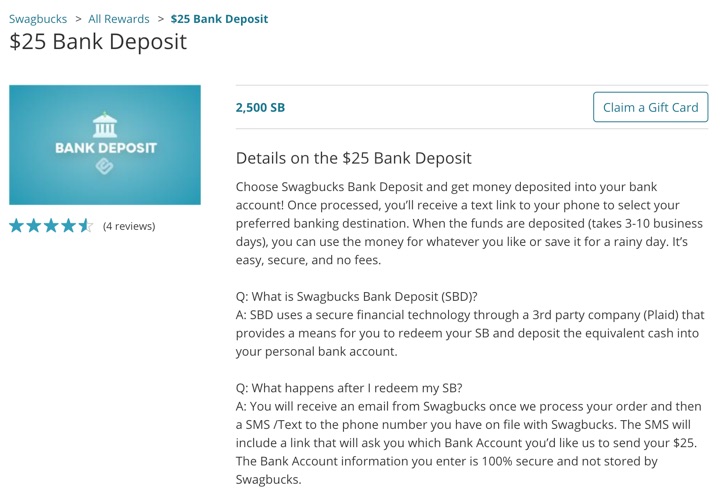
How much are Swagbucks worth? Thankfully, their redemption options are relatively easy to understand. 2500 SB is worth approximately $25 via various options. 2500 SB = $25 cash deposited directly into your bank account or brokerage account, no fees, uses Plaid service:

2500 SB = $25 PayPal transfer. 2500 SB = $25 Amazon gift card (although the first one per month is only 2200 SB). 2500 SB = $25 Walmart gift card. There are discounted redemptions from time to time. For example, right now I see a $25 virtual prepaid credit card for 2450 SB (2% discount from cash).

I don’t consider myself a heavy Swagbucks user, but usually go for the 10% discounted Amazon gift card at the beginning of each month. I have not had any problems cashing out my Swagbucks once they have been earned.

Swagbucks $10 referral bonus. If you sign up using my Swagbucks referral link, you can get a $10 bonus after spending $25 in their shopping portal. It’s similar to other shopping portals such as Rakuten/eBates or TopCashBack, where you get rebated back a percentage of your purchase. Make a $25+ purchase at Walmart, eBay, Amazon (select categories only), Home Depot, Lowe’s, or Best Buy to trigger the bonus. If you trigger the bonus, I will get $10 (1,000 SB) as well. Thanks if you use it. Here’s the fine print:

*Member must “Activate” the Bonus in the Swag Ups section of your account. Bonus value is earned in the form of points, called SB. Get a 1000 SB bonus, which is equivalent to $10 in value, when you spend at least $25 at a store featured in Swagbucks.com/Shop. You must receive a minimum of 25 SB for this purchase, which you must complete within 30 days of registration. MyGiftCardsPlus.com and travel purchases do not qualify.

Another site that is similar to SwagBucks is MyPoints ($10 bonus referral link as well). MyPoints has been around even longer than Swagbucks and also offers some finance-related bonuses which are worth a quick comparison check, although you should note that their redemption options are a little more complicated (you might get more points, but 1 MyPoint usually gets you less rewards than than 1 Swagbuck).

Fidelity Money Transfer Lockdown: Block Fraudulent ACAT Transfer Brokerage Scams

For the average person, the most valuable information may be knowing how to identify and avoid the most current financial scams. Nearly everyone I know has either been targeted or has become a victim of one of these scams, and I am betting many people who lost money are too embarrassed to admit it publicly. (Literally in the middle of writing this post, I received another scam call.)

One scam that you may not have heard of is the ACAT Transfer scam. A thief will obtain enough of your personal information to open a new E*Trade brokerage account, and then they will request an ACAT transfer of the entire contents of your existing brokerage account (ex. Fidelity) to that new fake E*Trade account which they control. At this point, they can quickly liquidate the account and send the money elsewhere. The key here is that they just need to be able to open an empty, new brokerage account in your name plus find your Fidelity account numbers from a statement. They don’t need your Fidelity username and password (or pass two-factor authentication).

Even more importantly, you won’t notice unless you log into your account. Opening a new E*Trade or other brokerage account will not trigger a credit alert or most identity protection services. Many brokers (see below) will process an outgoing ACAT transfer without confirming with you or even notifying you in any way. If you don’t look at your statements closely, it may be months or longer before you notice.

You can read about the experiences of multiple victims in this Reddit thread. Here’s a partial quote in case the thread is deleted.

Lost around 150k worth of stock from my fidelity brokerage account to an online scam (ACATS Transfer)

My husband has a fidelity brokerage account and last month all his shares were transferred out of his account. Upon calling the customer care, we were told that his stocks were transferred by him to an account with eTrade.

We communicated that we don’t have any e-trade account and the transfer was not initiated by us. We were shocked that no notification/intimation was sent to us before completing the transfer and no authorization was required!!

It looks like a fake account was created in his name with eTrade which initiated an account transfer. He did not receive any request/emails/text from Fidelity that the stocks are being moved. The etrade account has been frozen but the stocks are already sold and proceeds are transferred to another account.

The good news is that the original poster was eventually able to get back their funds, although it must have been a very stressful two months. It is not clear if Fidelity reimbursed them out of their own pockets or were able to reverse the transactions.

We were able to recover the stocks after waiting and following up for 2 months. Fidelity reps were able able to help us.

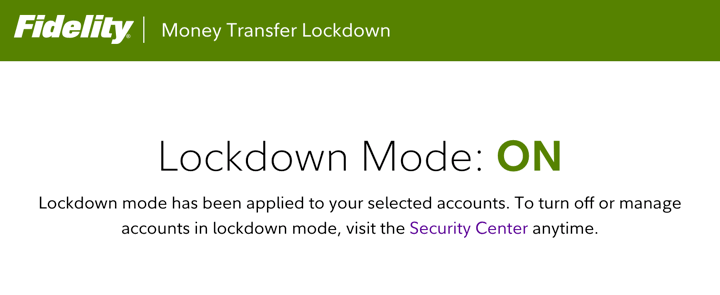
The discussion pointed out the potential usefulness of a relatively unique Fidelity feature called Money Transfer Lockdown (Fidelity login required). Here is a summary of the features and how to activate it per Fidelity:

Money Transfer Lockdown, an additional security measure Fidelity provides to its customers, may affect or disallow certain types of transactions. In order to transfer between two of your Fidelity accounts (In your example brokerage and CMA) when Money Transfer Lockdown is enabled, you will need to temporarily disable the feature prior to making the transaction. Once you have successfully made the transfer, you can enable the lockdown again by logging in into your Fidelity.com account anytime and visit “Security Center” from your “Profile” page.

Protected Transactions:

  • Outbound money transfers
  • Transfers between Fidelity accounts
  • Transfer of shares and assets to other institutions
  • Individual withdrawals (previously scheduled EFT transfers from an account might still be processed)

Unaffected Transactions:

  • Deposits or transfers into a Fidelity account
  • Checkwriting and direct debits
  • Debit/ATM transactions
  • Trading
  • Scheduled Required Minimum Distribution (RMD) or Personal Automatic Withdrawal plan
  • BillPay

A member of the Bogleheads forum helpfully tested out this service by attempting various transfers out of their “locked” Fidelity account. The Money Transfer Lockdown service did successfully block a legitimate ACAT transfer request from another brokerage. However, ACH pulls went through for those accounts that have routing and account numbers like a traditional bank account. Here are their brief conclusions:

Fidelity’s account lockdown blocks fraudulent ACATS pulls. It is an excellent, differential feature that Schwab and Vanguard don’t have. However, it has some limitations and vulnerabilities. It provides no extra security against fraudulent push of assets and doesn’t block fraudulent ACH pulls. To deal with ACH limitations, using CMA as an intermediary account from brokerage to the external world may be prudent.

As a result, I have taken to using the Money Transfer Lockdown service on all available account types (doesn’t work on 401k accounts, for example). It’s a little extra hassle, but definitely worth the added peace of mind. I hope that Vanguard and other brokers will add a similar feature to make it harder to perform an ACAT transfer without notice. I also believe that Fidelity would do a much better job of working to restore my assets than any other broker, especially the smaller brokers.

Now, if someone gains full access to your Fidelity account (username + password + 2FA), they can simply turn off the Lockdown feature. However, every time I do that I get both a text and an e-mail, so hopefully that will provide early enough notice to block any fraudulent transfers, or at least make the clawback faster. In addition, I feel that most people need to make sure they have a difficult PIN number on their phone, as login security is quickly coming down to having your phone as a type of physical “key”.

The quiet nature of ACAT transfer is what makes this scam possible! They are taking advantage of standard industry practice that is a weak point in financial security. The scammers all know this. We need to change this process to increase security. First, I’ve never had a brokerage account opening trigger any credit alert or identity theft monitoring service. Second, I recently transferred a significant amount of assets to Fidelity from Public using ACAT, and Public did not send me a single email, text, or phone call. My Public account was simply zero one day. I did legitimately request this transfer, but what if I didn’t?!?

Worried About Unused 529 Funds? New 529 to Roth IRA Rollover Option

One of the concerns about contributing to 529 plan for college savings is that you won’t end up using all the money and end up being hit with additional taxes (at ordinary income rates) and penalties on an non-qualified withdrawal. The funds potentially would have been better off simply invested in a taxable brokerage account (and long-term capital gains rates).

This was partially addressed within the SECURE 2.0 Act of 2022, part of the Consolidated Appropriations Act (CAA) of 2023. Specifically, Section 126 [PDF link], “Special Rules for Certain Distributions from Long-term Qualified Tuition Programs to Roth IRAs”, which adds the ability to roll your 529 funds into a Roth IRA both tax-free and penalty-free starting in 2024. Kitces.com covers many of the major points. Here is a quick summary of the rollover requirements:

  • The Roth IRA receiving the rollover money must be owned by the beneficiary of the 529 plan. (Unless the beneficiary is also the owner, the money can’t go to the owner’s Roth IRA.)
  • The 529 plan must have been open for at least 15 years.
  • The rollover amount must have been in the 529 account for at least 5 years before your distribution date (contributions and attached earnings).
  • The annual rollover amount is limited to annual IRA contribution limits, and is reduced by any “regular” Roth IRA contributions made during the tax year. (You are not able to exceed the usual max contribution limits. However, the income (MAGI) limits that usually lower the contribution limits due to high income do not apply.)
  • The Roth IRA owner still needs to earn taxable income, at least equal to the amount of the rollover.
  • The maximum lifetime amount that can be moved from a 529 plan to a Roth IRA is $35,000 per person. (This may not be as much in 15+ years if they don’t increase it with inflation.)

In general, this seems like a reasonable way to alleviate the over-contribution concerns, although the money must still technically go to the beneficiary (usually the kid) and not the owner (usually the parent or grandparent). Previously, options for leftover money included graduate school, changing the beneficiary to another family member or future grandchild, or paying back up to $10,000 in qualified student loans.

There are a few interesting, potential wrinkles that a few readers have pointed out:

  • Making yourself both owner and beneficiary to fund future Roth IRA contributions for yourself (even with no kids). As you aren’t really increasing the total amount you are able to stuff into a Roth IRA in the future, the primary benefit is basically to access the tax-deferral benefit early. For example, you could put in $2,000 today and expect to roll over $6,000 in 15 years (7.6% annualized return). The exception may be if you expect not to be able to do Roth IRA contributions in the future because your income is too high AND the Backdoor Roth IRA method is not available to you. Still, 15 years is a long time to wait, and the law may change in the future to restrict this type of move. In such a case, it may backfire and subject you to taxes and penalties.
  • Planning to change the beneficiary from kid to yourself later on. Maybe you don’t want your kid to have the unspent funds, and plan to simply change the beneficiary to yourself later on. However, it’s not 100% clear if beneficiary changes will reset the 15-year clock or otherwise affect rollover eligibility. The law specifically restricted the rollover
  • Contributing extra money for the specific purpose of early funding for your children’s Roth IRAs. This might spur higher-income parents to put even more money into their 529s on purpose, as you are essentially indirectly able to fund a Roth IRA with tax-deferred growth for your kid way before they have earned income. When they eventually do have any form of earned income from a part-time or entry-level job in their teens or early 20s, the money can just roll into their Roth IRA officially (up to the limits).

I don’t have any immediate plans to take advantage of any of these potential scenarios, but taken together it does make me feel better about the 529 contributions that I have already made. Which I suppose is the overall idea?

In terms of other actionable advice, it may be worth it to start a 529 for each child immediately or as soon as possible, even if only putting in $25 or whatever is the minimum amount, just to start the 15 year clock in case you do want to take advantage of this feature down the road. There are countless examples out there of the benefit of starting the compounding early, especially when it can keep growing tax-free forever.