Archives for April 2023

Discover Bank Deposit Bonus: $150/$200 ($15,000/$25,000 Required)

disc_osaBonus still available in 2023. Discover Bank has an ongoing deposit bonus for new customers for their online savings account. If you open a new account through this link (currently shows promo code SAVE323W2 with expiration date 5/31/23) or this link (currently shows promo code GOBP223 with expiration date 6/15/23), you can receive one of the following bonuses:

  • Deposit at least $15,000 within 30 days of opening to earn a $150 bonus, or
  • Deposit at least $25,000 within 30 days of opening to earn a $200 bonus.

This offer has been available off and on for over 5 years and is always only for first-time Discover Savings account customers, but if you haven’t grabbed it yet it’s a solid bonus.

*To get your $150 or $200 Bonus: What to do: Apply for your first Discover Online Savings Account, online, in the Discover App or by phone. Enter Offer Code GOBP223 when applying. Deposit into your account a total of at least $15,000 to earn a $150 Bonus or deposit a total of at least $25,000 to earn a $200 Bonus. Deposit must be posted to account within 30 days of account open date. Maximum bonus eligibility is $200.

What to know: Offer not valid for existing or prior Discover savings customers or existing or prior customers with savings accounts that are co-branded, or affinity accounts provided by Discover. Eligibility is based on primary account owner. Account must be open when bonus is credited. Bonus will be credited to the account within 60 days of the account qualifying for the bonus. Bonus is interest and subject to reporting on Form 1099-INT. Offer ends 6/15/2023, 11:59 PM ET. Offer may be modified or withdrawn without notice.

The Discover Online Savings Account has a current interest rate of 3.60% APY as of 4/11/23, which is sort of a competitive rate although not the highest available. There are no minimum balance requirements and no monthly fees. Interest is compounded daily and paid monthly.

If you deposit the minimum amount of $15k, the $150 bonus is effectively another 1% of your initial deposit. The $200 bonus on $25,000 deposited is a lower percentage, but if you have the extra cash then it may still be a good rate. There is no fixed minimum time period where you have to keep the money there after getting the bonus, so your effective ROI can be quite high since the bonus should post shortly after you complete the required deposits. Keep in mind that you must still have an open account for the bonus to post.

I did not experience a hard credit pull when opening my Discover bank account on a previous bonus. Historically, their rates are competitive but not the rate leaders. Their overall feature set is not exceptional (average speed transfers), so it is not my primary savings account at this time. Maybe it is convenient if your primary card is the Discover It credit card?

Bottom line. The Discover Savings account is a simple, barebones piggy-back savings account with no minimum balance and no monthly fees. The rates are historically competitive but rarely the highest. With no monthly fees, this is a solid low-risk bonus if you have the funds available and have never had a Discover bank account before.

Examples and Stories of Working Less on Purpose (to Live More)

My philosophy on financial freedom essentially boils down to believing you have the power to make choices that affect your life. Do not accept that the world is against you and that there is no point in trying. Everyone is dealt different cards, but it’s how you play them that matters. Your job title, your employer, the number of hours per week, where you live, the size of your home, your commute time, how you spend the 4 hours each day that most people spend watching TV – these are all variables that you can change. Be different. Or don’t. But choose them consciously.

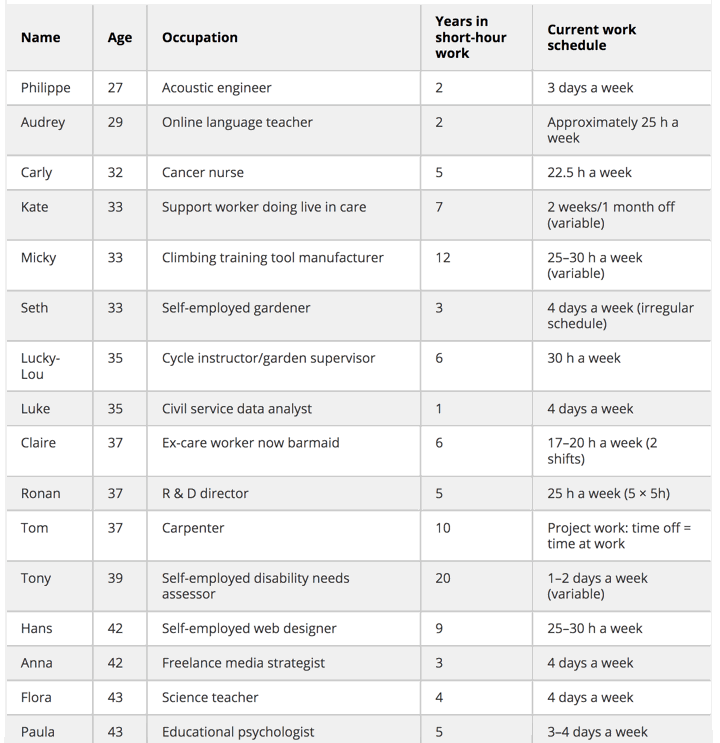
The WSJ article Would Life Be Better if You Worked Less? (gift article, should bypass paywall) shares the stories of several Americans trying to “live more” by shifting to part-time hours or four-day workweeks and accepting the accompanying lower income.

Granted, I don’t know if I would have used a “part-time” neurosurgeon still working 40+ hour weeks as my first example. Of course, if you have a high income, then you are ideally suited to cut back your working hours and still maintain a comfortable lifestyle. For others, a few years of high savings rates may be required first to help you build up that financial base so that you can eventually cut back hours or otherwise take more risks to improve your life.

I found this quote interesting about how a little work is good to provide us with a feeling of purpose and value, but you don’t need a lot. This would support the concept of assuming you’ll work a little forever, which should lower the savings requirement to reach that point. It doesn’t have to be all or nothing.

Humans need work to give structure to our days, to bestow purpose and self-esteem, he says. But we don’t need that much of it. A 2019 paper from Prof. Burchell and several co-authors found that people performing one to eight hours of paid work a week got the same mental health boost—less anxiety, less depression—as those who work 44 to 48 hours a week.

The referenced 2019 paper appears to be this one: An exploration of the multiple motivations for spending less time at work, which includes many more stories and quotes from people tinkering with the amount of time that they work.

The paper separates negative “push” factors like long hours, work intensity, and low job satisfaction and “pull” factors like realizing your life is short and time is limited, the attraction of leisure activities, the desire for freedom in general, family concerns, and the ability to varied and more fulfilling work.

The main purpose of sharing all of these examples is to show you that there isn’t just one path. There are many other people who are purposefully working less than full-time, making less income than they could make, and getting something they value in return (the time to do something else). You may be inspired.

It would be nice if these articles dived more deeply into the sacrifices made before and during the switch to such part-time status. How did they negotiate a 4-day workweek with their employer? How do they plan to compensate for the added risks like cut hours during a recession, or the lack of benefits like health insurance? How long did they have to save to get there? In our case, I was only comfortable downshifting after first working 40 to 80 hours weeks and saving 50%+ of net income every year for a decade. We didn’t retire completely from paid work into an ultra-frugal minimalist lifestyle, nor did we go for dual full-time high-powered careers with lots of outside childcare help, but gradually found an in-between path that worked for us.

Chime Fintech App Review: $100 Simple Bonus

Simple $100 bonus. Chime is a popular fintech app with a simple $100 cash bonus (up from $50) after a single direct deposit of $200+ within the first 45 days of new account opening. To get this offer, you must be referred by an existing user. Here is a Chime $100 referral link. Here is a screenshot of my bonus (when it was only $50) appearing nine minutes after my initial deposit:

Here is the fine print:

In order for the referring Chime member (“Referrer”) to qualify and receive the $100.00 referral reward and $10.00 temporary SpotMe Bonus Limit increase, and for the referred person (“Referred”) to qualify and receive the $100.00 referral reward, all of the following conditions must be satisfied: (1) Referrer meets SpotMe eligibility requirements and is part of the SpotMe Referral Incentive referral reward campaign; (2) Referred has not previously opened a Chime Checking Account (“Account”); (3) Referred opened a new Account between January 1, 2022 and December 31, 2022; (4) Referred opened the new Account using the Referrer’s unique referral link; (5) Referred received in the new Account a Qualifying Direct Deposit within 45 calendar days of opening the Account; and 6) Referred activated their physical Chime Visa Debit Card within 14 days of receiving a Qualifying Direct Deposit. A Qualifying Direct Deposit is a deposit of $200.00 or more by Automated Clearing House (“ACH”) that comes from your employer, payroll provider, gig economy payer, or benefits payer OR a deposit by Original Credit Transaction (OCT) from your gig economy payer. Bank ACH transfers, Pay Anyone transfers, verification or trial deposits from financial institutions, peer to peer transfers from services such as PayPal, Cash App, or Venmo, mobile check deposits, cash loads or deposits, one-time direct deposits, such as tax refunds and other similar transactions, and any deposit to which Chime deems to not be legitimate are not Qualifying Direct Deposits.

Chime is a financial technology company, not a bank. Banking services provided by, and debit card issued by, The Bancorp Bank or Stride Bank, N.A.; Members FDIC.

Why is Chime so popular? Chime is the second-most popular online-only bank in the US (only behind Ally) with over 13 million customers and a recent valuation of $25 billion as of September 2021. I learned that Chime is very attractive to those who are “unbanked” or underbanked”, those people who don’t like traditional banks due to their monthly fees and $35-a-pop overdraft charges. Instead, Chime offers:

  • No monthly fees. No minimum balance. No minimum opening deposit.
  • No credit check. No Chexsystems check.
  • Access to paycheck 2 days early. If you usually get paid on Friday, you can spend the money on Wednesday.
  • No overdraft fees, and they may even “spot” you up to $100 until you pay them back.
  • Free ATM withdrawals at 38,000+ MoneyPass and Visa Plus Alliance ATMs.
  • No foreign transaction fees.

For many folks that have a lot of activity but maintain a low balance, this fee structure is better getting 4% APY or even 10% APY. The key is avoiding those crazy overdraft charges from the big banks and also the various $2 fees hidden inside many prepaid cards. Chime’s only major fee is a $2.50 fee if you make a cash withdrawal at an out-of-network ATM. Chime earns revenue via interchange fees when you buy things on your debit card.

As I opened an account, I noticed that Chime treats you like have never had a checking account before. The sign-up is easily done completely on your phone in a few minutes. You don’t need to deposit a single cent to open. They send basic “Chime 101” emails explaining the effect of bank holidays and how to set up direct deposit.

There is no credit check, so you can have bad credit and even a bad Chexsystems record (meaning you probably left another bank with a negative balance). Nearly every major bank uses Chexsystems to screen new customers. Otherwise, they are referred to as a “second chance” bank account. Chime might have the lowest fees of all such “second chance” banks.

Savings account at 2.00% APY. Once you open the main Chime checking account, you can also open a separate savings account. No minimum balance and no monthly fees on the savings account, either.

Chime has the most of other bank stuff as well. Debit card. Paper check deposit via mobile app. FDIC-insured via partner banks, either Stride Bank or The Bancorp Bank. The only major thing missing besides bank branches is that they don’t provide paper checks. Depositing cash is available, but the third-party physical stores may charge a fee.

In terms of working with my other accounts, I am able to deposit and withdraw fund via Ally Bank push/pull. Your routing number and account number is available openly in the app under “Move Money > Direct Deposit”. My routing number is 103100195, which ABA.com confirms as Stride Bank, NA. based in Enid, Oklahoma.

Bottom line. Chime is an interesting bank startup that targets the underbanked and unbanked by offering a much better fee structure to those with access to direct deposit. No overdraft fees, no credit checks, no Chexsystems. Currently, there is a $100 bonus available via referral link.

Best Interest Rates on Cash – April 2023

Here’s my monthly roundup of the best interest rates on cash as of April 2023, roughly sorted from shortest to longest maturities. We all need some safe assets for cash reserves or portfolio stability, and there are often lesser-known opportunities available to individual investors. Check out my Ultimate Rate-Chaser Calculator to see how much extra interest you could earn. Rates listed are available to everyone nationwide. Rates checked as of 4/5/2023.

TL;DR: 5% APY available on liquid savings, with some wrinkles. 5% APY available on multiple short-term CDs. Compare against Treasury bills and bonds at every maturity. 6.89% Savings I Bonds can be bought with 2023 annual limits now.

Fintech accounts
Available only to individual investors, fintech companies often pay higher-than-market rates in order to achieve fast short-term growth (often using venture capital). “Fintech” is usually a software layer on top of a partner bank’s FDIC insurance.

  • 4.85% APY ($1 minimum). SaveBetter lets you switch between different FDIC-insured banks and NCUA-insured credit unions easily without opening a new account every time, and their liquid savings rates currently top out at 4.85%. This fintech makes it easier for you to maintain a top rate even if one bank decides to drop out of the “rate race”. 😉 SaveBetter does not charge a fee to switch between banks.
  • 5% APY (before fees). MaxMyInterest is another service that allows you to access and switch between different FDIC-insured banks. You can view their current banks and APYs here. As of 4/5/23, the highest rate is from BrioDirect (Webster Bank) at 5.06% APY. However, note that they charge a membership fee of 0.04% per quarter, or 0.16% per year (subject to $20 minimum per quarter, or $80 per year). That means if you have a $10,000 balance, then $80 a year = 0.80% per year. You are allowed to cancel the service and keep the bank accounts, but then you may lose their specially-negotiated rates and cannot switch between banks anymore.
  • 5% on up to $25,000, then 4% up to $250k. Juno now pays 5% on all cash deposits up to $25,000 and 4% on cash deposits from $25,001 up to $250,000. No direct deposits required. This fintech has crypto exposure, please see my Juno review for details.
  • 4.00% APY on $6,000. Current offers 4% APY on up to $6,000 total ($2,000 each on three savings pods). Must maintain a direct deposit of $200+ every 35 days. $50 referral bonus for new members with $200+ direct deposit with promo code JONATHAP228. Please see my Current app review for details.

High-yield savings accounts
Since the huge megabanks STILL pay essentially no interest, everyone should have a separate, no-fee online savings account to piggy-back onto your existing checking account. The interest rates on savings accounts can drop at any time, so I list the top rates as well as competitive rates from banks with a history of competitive rates. Some banks will bait you with a temporary top rate and then lower the rates in the hopes that you are too lazy to leave.

  • The leapfrogging to be the temporary “top” rate continues. UFB Direct at 5.02% APY, although note their incoming ACH hold times. CIT Platinum Savings at 4.75% APY with $5,000+ balance.
  • SoFi Bank is now up to 4.00% APY + up to $275 new account bonus with direct deposit. You must maintain a direct deposit of any amount each month for the higher APY. SoFi has their own bank charter now so no longer a fintech by my definition. See details at $25 + $250 SoFi Money new account and deposit bonus.
  • There are several other established high-yield savings accounts at 3.75%+ APY that aren’t the absolute top rate, but historically do keep it relatively competitive for those that don’t want to keep switching banks.

Short-term guaranteed rates (1 year and under)
A common question is what to do with a big pile of cash that you’re waiting to deploy shortly (plan to buy a house soon, just sold your house, just sold your business, legal settlement, inheritance). My usual advice is to keep things simple and take your time. If not a savings account, then put it in a flexible short-term CD under the FDIC limits until you have a plan.

  • No Penalty CDs offer a fixed interest rate that can never go down, but you can still take out your money (once) without any fees if you want to use it elsewhere. CIT Bank has a 11-month No Penalty CD at 4.80% APY with a $1,000 minimum deposit. Ally Bank has a 11-month No Penalty CD at 4.35% APY for all balance tiers. Marcus has a 13-month No Penalty CD at 3.85% APY with a $500 minimum deposit. You may wish to open multiple CDs in smaller increments for more flexibility.
  • Marcus has a special 10-month CD at 5.05% APY with a $500 minimum deposit. Early withdrawal penalty is 90 days of interest.
  • BrioDirect has a 12-month certificate at 5.25% APY. $500 minimum. Early withdrawal penalty is 90 days of interest.
  • Western Alliance Bank via SaveBetter has a 12-month certificate at 5.01% APY. $1 minimum. Early withdrawal penalty is 270 days of interest.

Money market mutual funds + Ultra-short bond ETFs*
Many brokerage firms that pay out very little interest on their default cash sweep funds (and keep the difference for themselves). * Money market mutual funds are regulated, but ultimately not FDIC-insured, so I would still stick with highly reputable firms. I am including a few ultra-short bond ETFs as they may be your best cash alternative in a brokerage account, but they may experience losses.

  • Vanguard Federal Money Market Fund is the default sweep option for Vanguard brokerage accounts, which has an SEC yield of 4.77%. Odds are this is much higher than your own broker’s default cash sweep interest rate.
  • Vanguard Ultra-Short-Term Bond Fund currently pays 4.72% SEC yield ($3,000 min) and 4.82% SEC Yield ($50,000 min). The average duration is ~1 year, so there is some term interest rate risk.
  • The PIMCO Enhanced Short Maturity Active Bond ETF (MINT) has a 5.00% SEC yield and the iShares Short Maturity Bond ETF (NEAR) has a 4.98% SEC yield while holding a portfolio of investment-grade bonds with an average duration of ~6 months.

Treasury Bills and Ultra-short Treasury ETFs
Another option is to buy individual Treasury bills which come in a variety of maturities from 4-weeks to 52-weeks and are fully backed by the US government. You can also invest in ETFs that hold a rotating basket of short-term Treasury Bills for you, while charging a small management fee for doing so. T-bill interest is exempt from state and local income taxes.

  • You can build your own T-Bill ladder at TreasuryDirect.gov or via a brokerage account with a bond desk like Vanguard and Fidelity. Here are the current Treasury Bill rates. As of 4/5/23, a new 4-week T-Bill had the equivalent of 4.61% annualized interest and a 52-week T-Bill had the equivalent of 4.53% annualized interest.
  • The iShares 0-3 Month Treasury Bond ETF (SGOV) has a 4.60% SEC yield and effective duration of 0.10 years. SPDR Bloomberg Barclays 1-3 Month T-Bill ETF (BIL) has a 4.52% SEC yield and effective duration of 0.08 years.

US Savings Bonds
Series I Savings Bonds offer rates that are linked to inflation and backed by the US government. You must hold them for at least a year. If you redeem them within 5 years there is a penalty of the last 3 months of interest. The annual purchase limit for electronic I bonds is $10,000 per Social Security Number, available online at TreasuryDirect.gov. You can also buy an additional $5,000 in paper I bonds using your tax refund with IRS Form 8888.

  • “I Bonds” bought between November 2022 and April 2023 will earn a 6.89% rate for the first six months. The rate of the subsequent 6-month period will be based on inflation again. More on Savings Bonds here.
  • In mid-April 2023, the CPI will be announced and you will have a short period where you will have a very close estimate of the rate for the next 12 months. I will have another post up at that time.
  • See below about EE Bonds as a potential long-term bond alternative.

Rewards checking accounts
These unique checking accounts pay above-average interest rates, but with unique risks. You have to jump through certain hoops which usually involve 10+ debit card purchases each cycle, a certain number of ACH/direct deposits, and/or a certain number of logins per month. If you make a mistake (or they judge that you did) you risk earning zero interest for that month. Some folks don’t mind the extra work and attention required, while others would rather not bother. Rates can also drop suddenly, leaving a “bait-and-switch” feeling.

  • Genisys Credit Union pays 5.25% APY on up to $7,500 if you make 10 debit card purchases of $5+ each, and opt into receive only online statements. Anyone can join this credit union via $5 membership fee to join partner organization.
  • Pelican State Credit Union pays 5.11% APY on up to $10,000 if you make 15 debit card purchases, opt into receive only online statements, and make at least 1 direct deposit, online bill payment, or automatic payment (ACH) per statement cycle. Anyone can join this credit union via partner organization membership.
  • The Bank of Denver pays 5.00% APY on up to $15,000 if you make 12 debit card purchases of $5+ each, receive only online statements, and make at least 1 ACH credit or debit transaction per statement cycle. Thanks to reader Bill for the updated info.
  • All America/Redneck Bank pays 4.80% APY on up to $15,000 if you make 10 debit card purchases each monthly cycle with online statements.
  • Presidential Bank pays 4.625% APY on balances between $500 and up to $25,000 (3.625% APY above that) if you maintain a $500+ direct deposit and at least 7 electronic withdrawals per month (ATM, POS, ACH and Billpay counts).
  • Find a locally-restricted rewards checking account at DepositAccounts.

Certificates of deposit (greater than 1 year)
CDs offer higher rates, but come with an early withdrawal penalty. By finding a bank CD with a reasonable early withdrawal penalty, you can enjoy higher rates but maintain access in a true emergency. Alternatively, consider building a CD ladder of different maturity lengths (ex. 1/2/3/4/5-years) such that you have access to part of the ladder each year, but your blended interest rate is higher than a savings account. When one CD matures, use that money to buy another 5-year CD to keep the ladder going. Some CDs also offer “add-ons” where you can deposit more funds if rates drop.

  • Credit Human has 24-month to 35-month CDs at 5.50% APY. $500 minimum to open. The early withdrawal penalty is 365 days of interest. Anyone can join this credit union via partner organization (no fee).
  • Sallie Mae Bank via SaveBetter has a 27-month CD at 5.15% APY. $1 minimum. Early withdrawal penalty is 180 days of simple interest.
  • Lafayette Federal Credit Union has a 5-year certificate at 4.68% APY ($500 min), 4-year at 4.73% APY, 3-year at 4.84% APY, 2-year at 4.89% APY, and 1-year at 4.99% APY. They also have jumbo certificates with $100,000 minimums at even higher rates. The early withdrawal penalty for the 5-year is very high at 600 days of interest. Anyone can join this credit union via partner organization ($10 one-time fee).
  • You can buy certificates of deposit via the bond desks of Vanguard and Fidelity. You may need an account to see the rates. These “brokered CDs” offer FDIC insurance and easy laddering, but they don’t come with predictable early withdrawal penalties. Right now, I see a 5-year non-callable CD at 4.40% APY (callable: no, call protection: yes). Be wary of higher rates from callable CDs, which means they can call back your CD if rates drop later.

Longer-term Instruments
I’d use these with caution due to increased interest rate risk, but I still track them to see the rest of the current yield curve.

  • Willing to lock up your money for 10 years? You can buy long-term certificates of deposit via the bond desks of Vanguard and Fidelity. These “brokered CDs” offer FDIC insurance, but they don’t come with predictable early withdrawal penalties. You might find something that pays more than your other brokerage cash and Treasury options. Right now, I see a 10-year CDs at (none available, non-callable) vs. 3.67% for a 10-year Treasury. Watch out for higher rates from callable CDs where they can call your CD back if interest rates drop.
  • How about two decades? Series EE Savings Bonds are not indexed to inflation, but they have a unique guarantee that the value will double in value in 20 years, which equals a guaranteed return of 3.5% a year. However, if you don’t hold for that long, you’ll be stuck with the normal rate, currently 2.10% for EE bonds issued November 1, 2022 to April 30, 2023. As of 4/5/23, the 20-year Treasury Bond rate was 3.72%.

All rates were checked as of 4/5/2023.

MMB Portfolio 2023 First Quarter Update: Dividend & Interest Income

Here’s my 2023 Q1 income update for my Humble Portfolio. I prefer to track the income produced as an alternative metric for performance. The total income goes up much more gradually and consistently than the number shown on brokerage statements (price), which helps encourage consistent investing. I imagine my portfolio as a factory that churns out dollar bills, a tree that gives dividend fruit.
Background about why I track dividends. Stock dividends are a portion of profits that businesses have decided to distribute directly to shareholders, as opposed to reinvesting into their business, paying back debt, or buying back shares. The dividends may suffer some short-term drops, but over the long run they have grown faster than inflation.

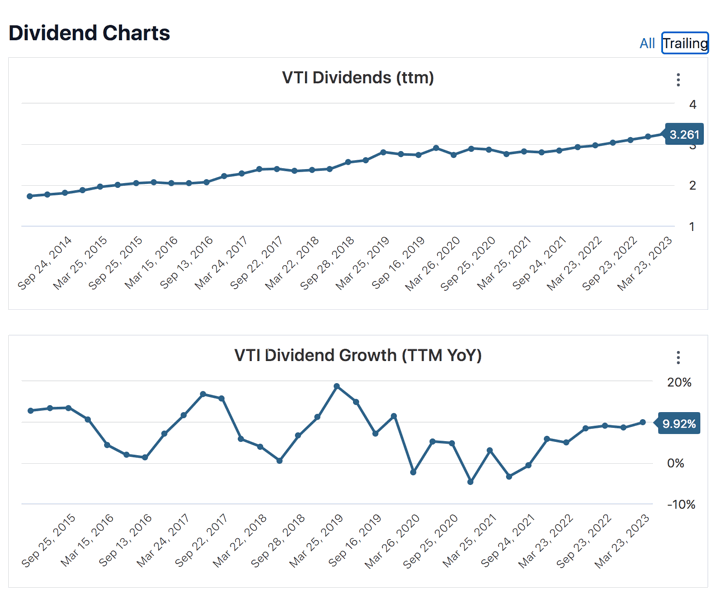
In the US, the dividend culture is somewhat conservative in that shareholders expect dividends to be stable and only go up. Thus the starting yield is lower, but grows more steadily with smaller cuts during hard times. Here is the historical growth of the trailing 12-month (ttm) dividend paid by the Vanguard Total US Stock ETF (VTI), courtesy of StockAnalysis.com.

European corporate culture tends to encourage paying out a higher (sometimes fixed) percentage of earnings as dividends, but that also means the dividends move up and down with earnings. Thus the starting yield is higher but may not grow as reliably. Here is the historical growth of the trailing 12-month (ttm) dividend paid by the Vanguard Total International Stock ETF (VXUS).

The dividend yield (dividends divided by price) also serve as a rough valuation metric. When stock prices drop, this percentage metric usually goes up – which makes me feel better in a bear market. When stock prices go up, this percentage metric usually goes down, which keeps me from getting too euphoric during a bull market. Here’s a related quote from Jack Bogle (source):

The true investor will do better if he forgets about the stock market and pays attention to his dividend returns and to the operating results of his companies. – Jack Bogle

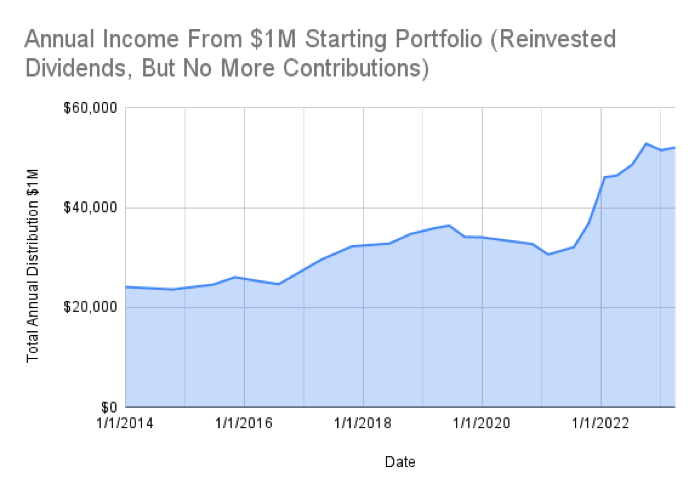
My personal portfolio income history. I started tracking the income from my portfolio in 2014. Here’s what the annual distributions from my portfolio look like over time:

  • $1,000,000 invested in my portfolio as of January 2014 would started out paying ~$24,000 in annual income over the previous 12 months. (2.4% starting yield)
  • If I reinvested the dividends/interest every quarter but added no other contributions, as of April 2023 it would have generated ~$52,000 in annual income over the previous 12 months.
  • Even if I SPENT all the dividends/interest every quarter and added no other contributions, as of April 2023 it would have generated ~$40,000 in annual income over the previous 12 months.

This chart shows how the annual income generated by my portfolio has increased over time and with dividend reinvestment.

I’m using simple numbers to illustrate things, but isn’t that a nicer, gentler way to track your progress?

TTM income yield. To estimate the income from my portfolio, I use the weighted “TTM” or “12-Month Yield” from Morningstar (checked 4/2/23), which is the sum of the trailing 12 months of interest and dividend payments divided by the last month’s ending share price (NAV) plus any capital gains distributed (usually zero for index funds) over the same period. The trailing income yield for this quarter was 3.33%, as calculated below. Then I multiply by the current balance from my brokerage statements to get the total income.

Asset Class / Fund % of Portfolio Trailing 12-Month Yield Yield Contribution
US Total Stock (VTI) 30% 1.60% 0.48%
US Small Value (VBR) 5% 2.20% 0.11%
Int’l Total Stock (VXUS) 20% 2.94% 0.59%
Int’l Small Value (AVDV/EYLD) 5% 4.23% 0.21%
US Real Estate (VNQ) 10% 4.11% 0.41%
Inter-Term US Treasury Bonds (VGIT) 15% 1.89% 0.28%
Inflation-Linked Treasury Bonds (TIP) 15% 6.12% 0.92%
Totals 100% 3.00%


My ttm portfolio yield is now roughly 3.00%, a bit lower than last quarter’s value. That means if my portfolio had a value of $1,000,000 today, I would have received $30,000 in dividends and interest over the last 12 months. (This is not the same as the dividend yield commonly reported in stock quotes, which just multiplies the last quarterly dividend by four.) US dividend rate went down a bit, international dividend rate went down a bit, Treasury bond yield is catching up, TIPS yield is still high from tracking CPI inflation.

What about the 4% rule? For goal planning purposes, I support the simple 4% or 3% rule of thumb, which equates to a target of accumulating roughly 25 to 33 times your annual expenses. I would lean towards a 3% withdrawal rate if you want to retire young (closer to age 50) and a 4% withdrawal rate if retiring at a more traditional age (closer to 65). It’s just a quick and dirty target, not a number sent down from the heavens. During the accumulation stage, your time is better spent focusing on earning potential via better career moves, improving in your skillset, and/or looking for entrepreneurial opportunities where you can have an ownership interest.

As a semi-retired investor that has been partially supported by portfolio income for a while, I find that tracking income makes more tangible sense in my mind and is more useful for those who aren’t looking for a traditional retirement. Our dividends and interest income are not automatically reinvested. They are another “paycheck”. Then, as with a traditional paycheck, we can choose to either spend it or invest it again to compound things more quickly. Even if we spend the dividends, this portfolio paycheck will still grow over time (see real numbers above). You could use this money to cut back working hours, pursue a different career path, start a new business, take a sabbatical, perform charity or volunteer work, and so on.

Right now, I am trying to fully appreciate the “my kids still think I’m cool and want to spend time with me” period of my life. It won’t last much longer. I am consciously choosing to work when they are at school but also consciously turning down work that doesn’t fit my priorities and goals. This portfolio income helps me do that.

MMB Humble Portfolio 2023 First Quarter Update: Asset Allocation & Performance

Here’s my quarterly update on my current investment holdings at the end of 2023 Q1, including our 401k/403b/IRAs and taxable brokerage accounts but excluding our residence and side portfolio of self-directed investments. Following the concept of skin in the game, the following is not a recommendation, but a sharing of our real, imperfect, low-cost, diversified DIY portfolio. Wouldn’t it be nice if everyone else did the same? (Many people do track the 13F filings of well-known investors.)

“Never ask anyone for their opinion, forecast, or recommendation. Just ask them what they have in their portfolio.” – Nassim Taleb

How I Track My Portfolio
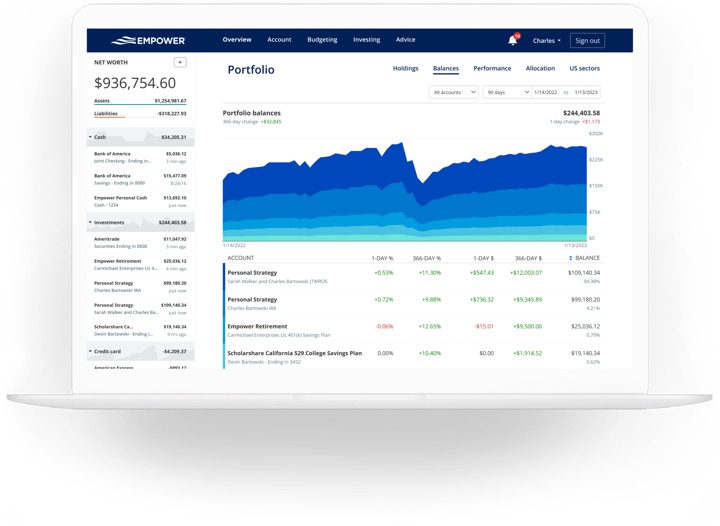
Here’s how I track my portfolio across multiple brokers and account types. There are limited free options after Morningstar discontinued free access to their portfolio tracker. I use both Empower Personal Dashboard and a custom Google Spreadsheet to track my investment holdings:

  • The Empower Personal Dashboard real-time portfolio tracking tools (free) automatically logs into my different accounts, adds up my various balances, tracks my performance, and calculates my overall asset allocation daily.
  • Once a quarter, I also update my manual Google Spreadsheet (free to copy, instructions) because it helps me calculate how much I need in each asset class to rebalance back towards my target asset allocation. I also create a new tab each quarter, so I have an archive of my holdings dating back many years.

2023 Q1 Asset Allocation and YTD Performance
Here are updated performance and asset allocation charts, per the “Allocation” and “Holdings” tabs of my Personal Capital account.

Humble Portfolio Background. I call this my “Humble Portfolio” because it accepts the repeated findings that individuals cannot reliably time the market, and that persistence in above-average stock-picking and/or sector-picking is exceedingly rare. Charlie Munger believes that only 5% of professional money managers have the skill required to consistently beat the index averages after costs.

Costs matter and nearly everyone who sells outperformance, for some reason keeps charging even if they provide zero outperformance! By paying minimal costs including management fees, transaction spreads, and tax drag, you can essentially guarantee yourself above-average net performance over time.

I own broad, low-cost exposure to productive assets that will provide long-term returns above inflation, distribute income via dividends and interest, and finally offer some historical tendencies to balance each other out. I have faith in the long-term benefit of owning businesses worldwide, as well as the stability of high-quality US Treasury debt. My stock holdings roughly follow the total world market cap breakdown at roughly 60% US and 40% ex-US. I add just a little “spice” to the vanilla funds with the inclusion of “small value” ETFs for US, Developed International, and Emerging Markets stocks as well as additional real estate exposure through US REITs.

I strongly believe in the importance of knowing WHY you own something. Every asset class will eventually have a low period, and you must have strong faith during these periods to truly make your money. You have to keep owning and buying more stocks through the stock market crashes. You have to maintain and even buy more rental properties during a housing crunch, etc. A good sign is that if prices drop, you’ll want to buy more of that asset instead of less. I don’t have strong faith in the long-term results of commodities, gold, or bitcoin – so I don’t own them.

I do not spend a lot of time backtesting various model portfolios, as I don’t think picking through the details of the recent past will necessarily create superior future returns. You’ll find that whatever model portfolio is popular in the moment just happens to hold the asset class that has been the hottest recently as well.

Find productive assets that you believe in and understand, and just keep buying them through the ups and downs. Mine may be different than yours.

I have settled into a long-term target ratio of roughly 70% stocks and 30% bonds (or 2:1 ratio) within our investment strategy of buy, hold, and occasionally rebalance. My goal is more “perpetual income portfolio” as opposed to the more common “build up a big stash and hope it lasts until I die” portfolio. My target withdrawal rate is 3% or less. Here is a round-number breakdown of my target asset allocation.

  • 30% US Total Market
  • 5% US Small-Cap Value
  • 20% International Total Market
  • 5% International Small-Cap Value
  • 10% US Real Estate (REIT)
  • 15% US Treasury Nominal Bonds or FDIC-insured deposits
  • 15% US Treasury Inflation-Protected Bonds (or I Savings Bonds)

Commentary. The goal of this “Humble Portfolio” is to create sustainable income that keeps up with inflation to cover our household expenses. According to Empower, my portfolio went up about 4.9% YTD to 4/3/2023. There was only minor rebalancing with cashflows done this quarter.

Due to the rising real yield on TIPS and rising yields on nominal Treasuries and CDs, there is more incentive to micro-managed the bond side a little bit. When the real yields on individual long-term TIPS go above 1.5% and I have cash to reinvest into bonds, that is what I am buying. As usual, I am trying to maintain high yields across a 1 to 5 year ladder horizon by picking between savings accounts, no-penalty CD, longer-term 5-year CDs, and longer-term Treasuries. However, I am also balancing between the extra yield from opening a new account or just staying with an existing bank where I already have a relationship.

I’ll share about more about the income aspect in a separate post.

Credit Suisse Global Investment Returns Yearbook 2023: The Equity Premium

The 15th edition of the Credit Suisse Global Investment Returns Yearbook is available for free download in a 54-page PDF Summary Edition version on the Credit Suisse website. This publication provides a nice “big picture” overview of the long-term performance of global financial assets:
The Credit Suisse Global Investment Returns Yearbook is based on a unique database that offers a historical record of the real returns from equities, bonds, cash and currencies for 35 countries. The data spans developed and emerging markets, and stretches back to 1900. As well as being an important source of rich data on long-term investment returns, the 2023 edition contains analysis on topical issues that investors face today.

(You may be more familiar with the collapse of Credit Suisse and it’s government-brokered rescue and takeover, but this is more of a collaboration with market historians than investment bankers. I do hope that they keep publishing it in the future.)

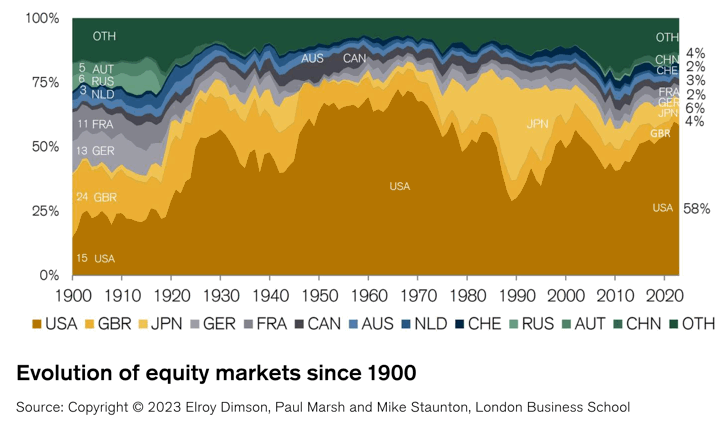
I recommend scrolling through just to look at the cool charts with data from 1900. Here are just a few quick examples. Here is a chart that tracks the relative market capitalizations of world equity markets since 1900.

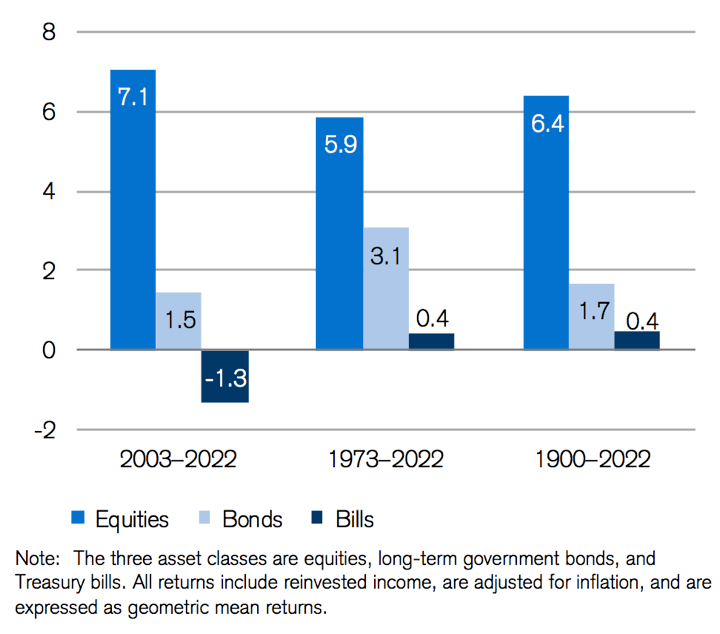
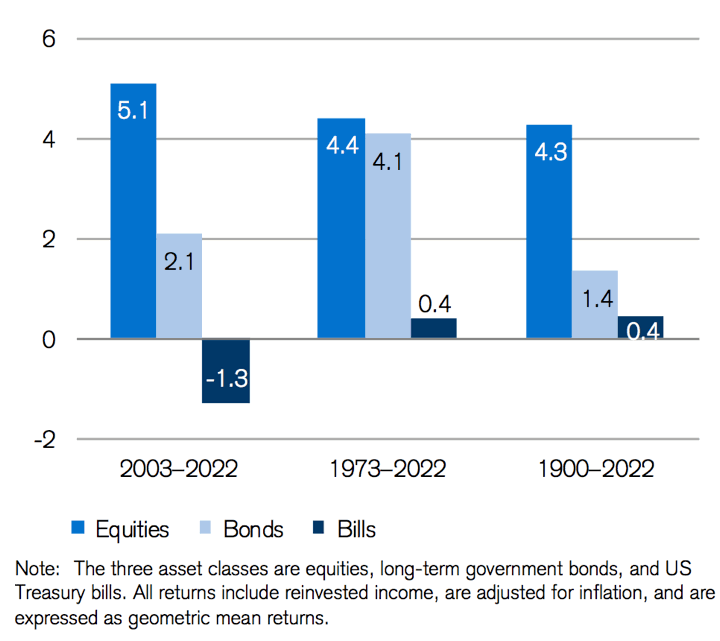
Then there the differences in the historical annualized real returns for equities, long-term government bonds, and US Treasury bills (very short-term government bonds).

Here are the annualized real returns of those three asset classes over three different periods for the United States:

Here are the annualized real returns (in USD) of those three asset classes over three different periods for the rest of the world (World ex-US):

You can see that the “equity premium” is very significant (on average) worldwide over the history that we have available, and of course that is why most of us invest at least partially in stocks today.