Archives for March 2020

CARES Act: Stimulus Checks, Unemployment, Student Loan, IRA/401k, HSA/FSA Changes

In response to the coronavirus outbreak, the federal government approved a third round of economic relief. There is plenty of media coverage, but after reading multiple articles I noticed that nearly all of them miss at least one thing that another covered. Here’s my own mixtape of highlights so that you can research further if it applies to your situation.

$1,200 for each adult + $500 per child 16 or under. You may want to wait to file. Individuals under $75,000 adjusted gross income get the full amount, and married filing joint under $150,000 get the full amount. Fully phased out at $99,000/$198,000. You can find AGI on Line 8b on 2019 Form 1040 2019, Line 7 on 2018 Form 1040. Based on 2018 tax filing if you haven’t filed for 2019, and 2019 tax filing if you did file. So if got a big raise in 2019, you should delay filing. If your income went down in 2019 or you didn’t file before, you should file now. Finally, if you made a lot in 2019 and expect to make less in 2020, you may still be able to get the money eventually when filing your 2020 taxes.
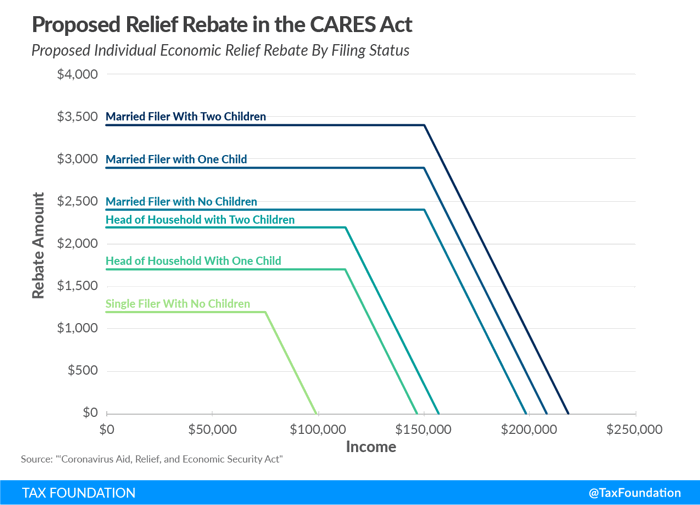
There is no clawback provision on overpayments, so it doesn’t matter if you end up making more than the income limits in 2020. If you listed a bank account for direct deposit of tax refund, they will try to send your money that way (and then send you a snail mail confirmation). The target date is April 17th. Otherwise, you will likely have to wait longer for a physical check. The money is not taxable.

Unemployment benefits expanded again. The bill has expanded eligibility for unemployment benefits to self-employed and part-time workers. Eligibility also expanded to cover those unable to work due to the coronavirus outbreak. The eligible period is also extended by 13 weeks. There will also be an increased benefit amount (up to $600 per week) on top of your state benefits for up to 4 months.

401(k) and IRA early withdrawal penalties waived up to $100,000. You can now take up to $100,000 out of your IRAs and you have 3 years to put it back into your IRA again without penalty or tax. It’s kind of like a really long rollover window. However, you will owe income tax on whatever partial amount is not put back within 3 years. This is called a coronavirus-related distribution (CRD) and is limited to those affected by the coronavirus.

Instead of a hardship withdrawal, you may wish to take a 401k loan instead. The retirement plan loan limit is also raised to the smaller of $100,000 or up to the full amount vested. Anything that can permanently damage your retirement savings should all be avoided if possible, of course.

Required minimum distributions are waived for 2020. This applies to everyone, even if not affected by the coronavirus. If you don’t need to make the distribution, this can save you on taxes.

Extended student loan relief. Loan and interest payments will be deferred through September 30th without penalty for all federally owned student loans.

Expanded use of Health Savings Accounts (HSAs) and Flexible Spending Accounts (FSAs). Tele-medicine services can now be used before meeting the plan deductible. You can again buy over-the-counter drugs without a prescription. Certain menstrual care products, such as tampons and pads, are also now eligible medical expenses.

Sources: NYT, Tax Foundation, NPR, Accounting Today, SHRM, SGR Law

The Hype Cycle of DIY Investor Self-Confidence

In an article about the challenges of autonomous vehicles, I came across a chart of the Hype Cycle from the consulting firm Gartner that supposedly models the life cycle of new technology:

Maybe it’s just me, but I found this curve to also describe my self-confidence in investing over time.

  • Trigger. One day, something makes you want to learn about investing. For me, it was finally leaving broke academia and getting a “real job” that had triple the salary and this 401(k) match thing.
  • Peak of inflated expectations. Read some books! 8% annual returns… double my money every 9 years… yes! Asset allocation… backtesting… of course! 4% withdrawal rate… just accumulate 25x expenses… simple!
  • Trough of Disillusionment. I get laid off at the same time that my nest egg drops in half? No way. After an entire decade, which is 1/3rd of my lifetime so far, I could actually end up with less money than I put in? No way. Multiple countries will shut down completely for 3+ months at a time, one after another? No way.
  • Slope of Enlightenment. After some time, that advice about diversification, liquidity, understanding true risk, and knowing your temperament starts to feel a bit different. There is still more to learn.
  • Plateau of Productivity. Wow, that last crisis wasn’t as bad. I have a plan and have enough assets and liquidity to implement that plan. My overall vision has changed and it includes working for longer but at something that I enjoy and without short-sighted corporate metrics.

Of course, maybe I’m still be overconfident, and I haven’t truly hit that big trough yet. Good thing I stocked up on the antacid.

Good Time to Convert Traditional IRAs to Roth IRAs?

It might be a little painful, but it may be worthwhile to check on your pre-tax IRAs during this dip. If you have been thinking of converting your “Traditional” IRAs over to Roth IRAs, your shrunken gains will lead to a smaller tax bill now, while your (hopefully) future gains from this point onward will be tax-free after 5 years and age 59.5.

Roth IRAs have a few unique benefits like a lack of minimum required distributions, but the primary consideration regarding conversions is still whether you think your tax rate will be lower today or when you withdraw. This is outlined in greater detail in the WSJ article A Strategy for Taking Advantage of the Market Meltdown (paywall?). One interesting suggestion is to convert just enough money from a traditional IRA to make full use of your current income-tax bracket. Here are the 2020 IRS marginal tax brackets (source) – remember the left column is adjusted gross income so it comes after subtracting the standard deduction of $12,400 (single) and $24,800 (joint).

Depending on your income situation for 2020, you might have a good amount of room to convert and pay a 10%, 12%, or 22% rate. For example, a married couple could make up to $105,050 in gross income (before the standard deduction) and still be in the 12% bracket. You get the most tax-deferred benefit if you can pay for your tax bill with external funds as opposed to the IRA balance itself.

Backdoor Roth IRAs. In case you aren’t already aware, you can make a “backdoor” Roth IRA contribution even if you exceed the standard income limits on Roth IRA contributions. This is primarily because there are no longer any income limitations on Roth IRA conversions. There are some finer points that experts debate, but the general idea is that you first contribute to a non-deductible traditional IRA and then quickly convert that to a Roth IRA (ideally with no gains and thus tax owed). One catch is that if you already have other deductible pre-tax IRA balances, then these would mix together and you’d have to pay tax on a pro-rated basis.

Given the recent stock market drop, if you made non-deductible IRA contributions in the past few years, but your “Backdoor Roth” was complicated by also having some other pre-tax IRA balances mixed in (say, from a 401k rollover), then this might be a chance to convert everything over to a Roth IRA with much smaller tax consequences.

Amazon & Target Buy 2 Get 1 Free Board & Video Games, Targeted $5 eBook Credit

Amazon and Target have a few sales on video games and board games to help with that cabin fever.

Sprint Unlimited Kickstart: Unlimited Talk, Text, Data For $35/Month

Sprint has an Unlimited Kickstart plan with unlimited talk/text/data for $35 per month, per line. No annual contracts. You can bring over your own compatible phone, or buy one from them. Online orders only. New customers only. Requires port-in of your existing number.

Pros of Kickstart Unlimited:

  • Unlimited talk, text, and data for $35 a month, per line.
  • You can bring over any compatible phone, or buy one from Sprint. Use their phone IMEI/MEID checker.
  • You can come over from ANY outside provider, Verizon/AT&T/T-Mobile or even another cheap MVNO.
  • No expiration date. Price will not go up after a year.
  • No annual contracts.
  • No family plan or minimum number of lines required.

Cons of Kickstart Unlimited:

  • New customers only.
  • Online orders only. You won’t see this offer in stores.
  • No mobile hotspot.
  • Unlimited video in standard definition. Video streams up to 480p, music up to 500 Kbps, gaming up to 2 Mbps.
  • Data deprioritization during congestion.
  • Autopay required.

Sprint Unlimited Kickstart is best for those that want to lock in unlimited data direct from a major provider at a low $35/month price. Verizon, AT&T, and T-Mobile Unlimited may have slightly better networks but they are also significantly more expensive.

I am not a huge data user, but it was still nice when I was on Sprint Unlimited. I could stream videos without worry and switched all my settings to “use cellular data whenever the heck you want!” instead of having to wait to sync or download things like podcasts over WiFi. There is also (slightly) better customer service at a major provider as compared to an MVNO. However, I would also consider the these MVNO alternatives as they can offer some significant savings.

Mint Mobile is another low-cost competitor with data caps. This is what I use. They are an MVNO that runs on the T-Mobile GSM network. You can get:

(Disclosure: I am a Mint affiliate and if you purchase a Mint plan through one of the links above, I may earn a commission. I am also a paying Mint customer. Thanks for supporting this individually-owned site.)

The thing about Mint Mobile is that you have to “buy in bulk”. Initially you have to buy at least 3 months upfront, and then after that you have to buy 12 months at a time to get their lowest price. After your LTE data runs out, you still get data included at slower 2G data speeds until your month resets. They do offer a 7-Day Money Back Guarantee (starts upon SIM activation) so you can test them out before making any commitment.

Tiny Beautiful Things: Knowing The Right Path But Afraid

My favorite non-financial genre is nonfiction travel books, and after finishing the bestseller Wild: From Lost to Found on the Pacific Crest Trail by Cheryl Strayed, I quickly moved on to her compilation of life advice columns called Tiny Beautiful Things. As they were initially written anonymously, they were brutally honest yet compassionate.

Most people wrote to her in times of personal crisis, usually more emotional than financial, although money was often involved. Here are just a few of her insights and wisdom that I felt could be helpful:

Your assumptions about the lives of others are in direct relation to your naïve pomposity. Many people you believe to be rich are not rich. Many people you think have it easy worked hard for what they got. Many people who seem to be gliding right along have suffered and are suffering. Many people who appear to you to be old and stupidly saddled down with kids and cars and houses were once every bit as hip and pompous as you.

Every mother has a different story, though we tend to group them together. We like to think that partnered moms have it good and single moms have it rough, but the truth is that we’re a diverse bunch. Some single mothers have lots of child-free time because their kids are regularly in the custody of their fathers. Some seldom get a break. Some partnered mothers split child-care duties with their spouses in egalitarian ways; others might as well be alone. Some mothers of both varieties have parents, siblings, and friends who play active roles in their children’s lives in ways that significantly lighten the load. Others have to pay for every hour another person looks after their kids. Some mothers, single or partnered, can’t afford to pay anyone for anything. Some can and do. Others can and won’t. Some are aided financially by parents, or trust funds, or inheritances; others are entirely on their own. The reality is that, regardless of the circumstances, most moms are alternately blissed out by their love for their children and utterly overwhelmed by the spectacular amount of sacrifice they require.

You need to stop feeling sorry for yourself. I don’t say this as a condemnation—I need regular reminders to stop feeling sorry for myself too. I’m going to address you bluntly, but it’s a directness that rises from my compassion for you, not my judgment of you. Nobody’s going to do your life for you. You have to do it yourself, whether you’re rich or poor, out of money or raking it in, the beneficiary of ridiculous fortune or terrible injustice. And you have to do it no matter what is true. No matter what is hard. No matter what unjust, sad, sucky things have befallen you. Self-pity is a dead-end road. You make the choice to drive down it. It’s up to you to decide to stay parked there or to turn around and drive out.

There is no why. You don’t have a right to the cards you believe you should have been dealt. You have an obligation to play the hell out of the ones you’re holding. And, dear one, you and I both were granted a mighty generous hand.

I could put most of the letters I receive into two piles: those from people who are afraid to do what they know in their hearts they need to do, and those from people who have genuinely lost their way.

Don’t judge others. Don’t feel sorry for yourself. Somehow this last quote keeps coming back to me. When we ask for advice, often we know the right path but are afraid to take it.

“This is a Temporary Setback – I’m a Long-Term Investor!”

When the market sell-off first started in February, there were several articles proudly pointing out how few 401k investors made any changes to their accounts. Nobody panicked! Yay! I remember thinking that such a declaration of victory was rather premature. If you have held onto your stocks so far according to your formal investment plan, then I applaud your conviction (or ability to not check your 401k balance). However, I also think it’s important to realize that the ride may be far from over.

This chart made the rounds in 2007 during the Great Financial Crisis, and has been copied so many times (you can tell by the blurriness) that I have no idea the original source. However, I still come back to it time and again.

Based on my own experiences, I can show you comments which gradually change from “This is just a temporary setback. I’m a long-term investor!” to “I can’t handle any more losses. I am selling and waiting this out!”.

My wild guess is that we are past the Anxiety stage and are somewhere in the Fear stage. There is still room for Desperation, Panic, and Capitulation. It’s like the awful seven dwarfs… I feel these emotions too, even if I don’t act on them. We are living through a historic moment. However, I see no permanent impairment in the power of productive businesses.

You won’t see a lot of market commentary on this site, as I don’t think adding to the noise is helpful. Thanks to the scientists and healthcare workers that will get us through this one, thanks to the other essential workers that have to stay out and about, and thanks to those that are helping by staying at home. Onwards (good movie BTW) to Hope and Relief!

Special Coronavirus Relief: Paid Leave, Mortgage Payments, Student Loans, Credit Cards, and Unemployment

Wow. I thought that I was prepared, but I must admit that I was still shaken by last week. For those facing severe financial emergencies right now, so I have tried to collect information and links to where you can hopefully find some help. Be prepared advocate for yourself; many of these will only be given to those who ask and are persistent. Everything is in flux as well, so if you don’t find success try again later. There will be more government stimulus coming.

Paid leave for small/mid-sized business employees, including part-time workers and self-employed. Eligible employees can receive up to 80 hours of paid sick leave and expanded paid child care leave for 12 weeks when employees’ children’s schools are closed or child care providers are unavailable. Business must have less than 500 employees (52% of workforce). This is done via refundable payroll tax credits. DOL press release. NYT article.

The act provided paid sick leave and expanded family and medical leave for COVID-19 related reasons and created the refundable paid sick leave credit and the paid child-care leave credit for eligible employers. Eligible employers are businesses and tax-exempt organizations with fewer than 500 employees that are required to provide emergency paid sick leave and emergency paid family and medical leave under the act. Eligible employers will be able to claim these credits based on qualifying leave they provide between the effective date and Dec. 31, 2020. Equivalent credits are available to self-employed individuals based on similar circumstances.

Unemployment insurance. Many states are expanding their eligibility rules for unemployment benefits. You might be eligible if you have to stay at home to care for children. You may not have to officially quit your current job (i.e. your employer temporarily shuts down). You might be eligible if you are under quarantine or have to take care of someone under quarantine or infected. Please visit the Department of Labor for your specific state. CNBC article. DOL.gov/coronavirus.

Mortgage payments. Contact your mortgage or home-equity loan servicer directly to ask about mortgage payment deferral options. Fannie and Freddie Mac have instructed their loan servicers to suspend mortgage payments for up to 12 months if borrowers suffer hardship. In New York, the impacted can defer mortgage payments from any servicer for 90 days. Bank of America is allowing deferrals on a case-by-case basis, with the waived payments being added to the end of their loan term. CNBC article.

Student loans. President Trump announced that federally-held student loans would be set to 0% interest for at least 60 days in addition to being able to request forbearance for 60 days, but there has been a lot of difficulty in actually making the requests with loan servicers as they have cut back on call center hours. There will also be an automatic suspension of payments for any borrower more than 31 days delinquent as of March 13, 2020, or who becomes more than 31 days delinquent. Press release. ED.gov. Studentaid.gov.

Credit cards and auto loans. Chase, Citibank, American Express, US Bank, Discover, Ally Bank, and Apple have all announced some sort of accommodation for coronavirus. The offers are often vague, but it can’t hurt to call and ask for details. For example, Discover says it won’t report late payment to credit bureaus, but what about late fees and penalty APRs? Chase says they might waive fees or extend payment due dates, but only on a case-by-case basis. Apple (if approved) will allow you to skip your March credit card payment without incurring interest charges. Ally Bank will allow deferral of auto loan payments for 120 days, but finance charges will still accrue. Some of these are rather lame, like offering up credit line increases that were always available anyway.

Federal and State Tax Payment Deadline Extensions Due to Coronavirus

Updated March 20th. The US Treasury has announced taxpayer relief for federal tax in response to COVID-19. Here is the Treasury press release, official IRS notice, and a CNBC article. On March 20th, the filing deadline was also changed. Below is my brief summary for most taxpayers.

  • The standard deadline for filing your individual federal income tax returns is now July 15, 2020. This is a change as of 3/20.
  • If you’re getting a tax refund, you should try to file right away. Might as well get your money sooner, as this relief won’t help you if you don’t owe money.
  • The deadline for tax payments if you owe money has been postponed by 90 days. If you owe money on your return, instead of April 15, 2020, you now have until July 15th, 2020. Penalties and interest that you would otherwise have accrued will be waived. This applies on up to $1 million in tax owed.
  • Filing a tax extension can still help. If you can’t make the filing deadline of 4/15, you should file for a free automatic online extension by 4/15. This extends your tax filing deadline all the way to October 15th. Late filing penalties are quite significant.
  • 2020 1st quarter estimated tax payments due April 15th are also now due July 15th. This can be confusing as the 2nd quarter deadline is still currently June 15th. This may help many self-employed workers whose income is hard to predict right now.

Check your state tax situation as well. The American Institute of CPAs has a handy list of state-specific coronavirus taxpayer relief.

List of Free Educational Resources (and Free High-Speed Data)

Here is a list of newly-available resources to help folks manage having their kids home all day long for weeks at a time! From getting free data to free lesson plans and materials.

Free Data Access

  • All four major US carriers — AT&T, Sprint, T-Mobile, and Verizon agreed to waive late fees and will not disconnect anyone due to missed payments. In addition, their WiFi hotspots will be opened to all. Everyone can also connect to xFinity WiFi hotspots and other broadband WiFi hotspots for free.
  • AT&T, Sprint, and T-Mobile (including Metro by T-Mobile) customers will get unlimited data for the next 60 days, even if that is not part of their plan. This should be automatic. They also promise an extra 20 GB of free hotspot data “soon”.
  • Mint Mobile is also offering free unlimited data. See site for details, you can manually purchase unlimited “add-on data” for free through April 12th.
  • Comcast is increasing the speed of their Internet Essentials package for free. In addition, new customers of their $10/month service will receive two months of free service.

Free Educational Materials

The trickier part is finding engaging non-screen activities. Our next project is to make homemade giant bubbles (with honey instead of having to find glycerine?).

Ally Bank New Deposit Promo 2020: Up to $250 Cash Bonus

Ally Bank has a new cash deposit bonus that is offering a 1% cash bonus (up to $250) on new deposits on top of their existing interest rates. Valid for both new and existing customers. Given the holding period, this roughly equates to the same total interest paid as a 3-month bank CD at 5%+ APY. Here’s how it works:

  • Enroll by 3/20/20. You must enroll or you won’t get the bonus. Existing customers must enroll with the same e-mail as linked to their Ally bank account.
  • Fund account by 3/31/20. This means your account has to be approved, opened and funded by this date. Move at least $1,000 from another financial institution to a new or existing eligible Ally Bank account. Remember, transfers can take up to 3 business days.
  • Maintain funds through 6/30/20. Your funds need to remain in an eligible Ally Bank account through 6/30/20. Any withdrawals made during this time may reduce your bonus.
  • Get cash bonus on 7/30/20. Get a 1% cash bonus back on the money you moved, up to $250. That means $25,000 would max out this bonus.

Ally had a similar bonus in 2018, but with higher deposit limits. Note the following regarding which are eligible Ally accounts:

What accounts are eligible?
New or existing Ally Bank Online Savings Accounts, Money Market Accounts, and CDs are eligible for the cash bonus. If you have more than one of these accounts, we’ll consider all of them when calculating your bonus. Remember, the total maximum bonus you can receive is $250.

What accounts are not eligible?
Interest Checking accounts, Individual Retirement Accounts (IRAs), accounts owned by a trust, custodial accounts, Uniform Gift to Minors Act (UGMA) accounts, and Uniform Transfers to Minors Act (UTMA) accounts aren’t eligible for the cash bonus. New money you add to these accounts, or money you move from these accounts to your eligible accounts, won’t qualify for the bonus.

Rough math. The current rate on the Ally Online Savings account is 1.50% APY, and the 11-month No Penalty CD is 1.75% APY on $25k+ balances (as of 3/15/20). Given that you can an additional 1% bonus in 3 months, the bonus itself works out to the equivalent of a 4% annualized yield. 1.5% plus 4% = 5.5%, but given the recent market volatility, the savings rate may be cut down to 1% in the coming months. However, the No Penalty CD at 1.75% would be locked in. So you’re looking at the equivalent of a 3-month CD at roughly 5% – 5.75% APY for new money deposits between $1,000 and $25,000.

Should I move money out of Ally and back in to qualify? No, it won’t make any difference as Ally has already thought of that. All new funds added after 3/13/20 will count as new money for this promotion. They’ve already set the start date in the past, so you gain nothing by delaying your enrollment.

Existing customers. As a longtime Ally accountholder, I’m happy again to see that this offer includes existing customers, even if it has to be new money.

Bottom line. Ally Bank has a new promotion to attract new money (or bring back old money). You get a 1% cash bonus (up to $250) on new deposits on top of their existing interest rates. For their savings account, this works out to a 3-month holding period paying roughly 5% annualized interest. You must enroll soon by 3/20/20 and your account must be opened and fully funded by 3/31/20 at the very latest.

Early Action, Long-Term Thinking, and Exponential Growth

I’ve been sitting on this post for a week, but I’ll feel better just letting it out. When we talk about investing, a lot of it is about long-term thinking and exponential growth. There are many charts showing that the person who starts saving early and stops completely after 10/15 years does better than the person who waits around but eventually saves twice as much per year. Once the ball starts rolling, it’s hard to stop. Here is one example from ForUsAll.com:

This is the power that comes from forced savings (pensions) and automated savings with default contributions (401k/403bs). Along the same lines, here’s a chart of Warren Buffet’s net worth over time from ValueWalk. Most of his money came very late in life. Look at that compound interest.

This understanding of exponential growth and the importance of early intervention applies to viral pandemics as well. If you act early and aggressively, you can stop the exponential growth. St. Louis acted aggressively during the 1918 Flu Pandemic, shut down the city early, and saved many lives. It was unpopular, but it worked. Taiwan has been aggressively screening, testing, and tracking since December 2019 and despite its proximity to China has only 45 coronavirus cases. Singapore acted similarly.

Meanwhile, Italy went from only 3 confirmed cases to 15,000 confirmed cases in a span of 5 weeks. (February 6th to March 12th. Source.) The other option is to take a slow, reactionary stance. You let the exponential grow happen. The result is that you will need to shut down the entire country and do it more extremely and for a longer time. You picked the “Save more later” option. Unfortunately, here it means a lot more dying people and overwhelmed hospitals. It also means bankrupt businesses, less hours available, less jobs available, and huge childcare problems.

Do you think the US will be closer to Italy or Taiwan? The US has only tested 5,000 people total, ever. South Korea has tested 200,000 and is 1/6th the size. That’s 240x the testing rate. If you don’t test, you can’t get a “confirmed” case and they remain invisible. If you don’t track the infected people down and isolate them, you can’t stop the spreading. This is bad!

I’m not saying the world is going to end. I have not sold any stocks and am following my established investment plan. I believe that we will eventually get through this together. Mostly, I am greatly saddened that our local, state, and federal leaders have collectively decided to choose to the option of deferred, greater pain.

Bottom line. Each day that we delay widespread testing and tracking, the longer we will have to shut down our lives to get back to normal. It’s coming. Be ready. Think about how you are going to manage childcare when schools are shut down. Make sure you’ve built up that emergency fund in case your job hours are cut. If you’ve been meaning to lower your interest rate on debt, now may be a good time to transfer it to 0% APR. If your financial situation is stable, try to refinance your mortgage and lower your monthly expenses.