Archives for August 2019

Capital One 360 Money Market – $500 Cash Bonus on $50,000 Deposit

Capital One is running a $500 cash bonus promotion for new 360 Money Market accountholders. Note that if you have or had an open savings product (excludes CDs) with Capital One on or after January 1, 2016, you’re ineligible for the bonus. Here are the details:

  • Open a new 360 Money Market account by 8/31/19 using promo code CASH500.
  • Deposit $50,000 or more into the account with new money from an external bank within 10 days and maintain it for the next 90 days.
  • Capital One will deposit the bonus into your account within 60 days following the 90-day period. If your account is in default, closed, or suspended, or otherwise not in good standing, you will not receive the bonus.
  • You’ll also earn their current interest rate of 2.00% APY on $10,000+ balances. No monthly fees or minimum balance requirements.

(Tip via reader Bill: The 90-day “maintain balance” period is AFTER the end of the 10-day “initial funding period”. So if you are counting from the opening day, that is a total of *100* days. You may wish to chat with Capital One to confirm the exact date.)

In terms of APY, you are getting 1% of your $50,000 deposit with a minimum holding period of 90 days. (If you deposit your money near the 10th day, then the minimum time you would have to keep your money there is still technically 90 days, but you’ll probably go over by a few days.) This works out to the equivalent of a 4% annualized yield. 2% + 4% = 6%, so you’re looking at the equivalent of a 3-month CD at 6% APY for a new money deposit of exactly $50,000. In terms of cash, your $50,000 would earn about $250 interest + $500 bonus = $750 total over 90 days.

As there is ongoing no minimum balance requirement, you can move out your money after you’ve safely cleared this 90-day holding period. Just make sure to keep your account open, perhaps with at least $10 in there to make sure they don’t close it on you. If you were lazy and left it in there for a year, that $50,000 would earn about $1,000 interest + $500 bonus = $1,500 total, or roughly 3% APY.

Bottom line. Capital One 360 Bank has a new promotion to attract new deposits – a $500 cash bonus (1%) on a $50,000 deposit for 90 to 100 days, on top of their usual interest rate (currently 2% APY). The primary drawback is that you must deposit a minimum of $50,000. If you have or had an open savings product (excludes CDs) with Capital One on or after January 1, 2016, you’re ineligible for the bonus.

The Power of Being Open-Minded About Cutting Your Household Expenses

Here’s the short version of this depressing WSJ article Families Go Deep in Debt to Stay in the Middle Class (paywall?). Household incomes have gone nowhere. Meanwhile, housing prices are up, healthcare costs are up, and college tuition has skyrocketed. Ouch. However, you can’t control that things are worse for you than if you lived in another time period. You can only control your response, and that is why I try to focus on actionable ideas instead of dwelling on “the way it should be”.

“Make more money” advice is hard to pin down. Of course I want everyone to have a high income. I like the idea of spending money on improving your marketable skills, “investing in your yourself”. However, everyone has a different combination of what they are good at, what they enjoy, and what others will pay them to do:

caddell620

Meanwhile, I find that spending advice applies much more broadly. My most general spending advice is that you need to expand what you think is an option. Most people hang out with people around their own income level, look around, and then spend the same money on the same things. The trick is that net worth shoots up when you earn a good income, but spend like someone who earns about 1/2 or 2/3rds of what you make. It may not feel natural, but you have to trick yourself into picking from a wider menu of options. Here are some quick examples.

  • Housing. You could buy a 4,000 sf house with a 3-car garage. A family of four could live in a 1,000 sf apartment (mine did). You could share an apartment with roommates. You could rent a room inside a large house. You could buy a duplex and live in one side, rent the other. You could buy a 4-plex and live in one unit and rent out the rest.
  • Transportation. You could lease a $60,000 SUV and pay about $8,000 year in lease payments – after 3 years and $24,000, you’d have to start all over again. Alternatively, you could buy an entire car for $8,000 and own it for another 10 years. You could downsize from a 2-car to a 1-car household. Many urban residents don’t own a car at all.
  • Food. A single person could eat out at every meal, never touch their stove, and easily spend $1,000 or more per month on food and alcohol. A family of four can cook all meals at home and spend under $600 a month. These days, food has become the ultimate convenience item, but it’ll cost you.

I can be hard to stay open-minded about your expenses. In fact, many quickly become defensive. You’ll often hear a straw-man argument like “I don’t want to sit around sorting coupons, eating lentils every meal, or living in poverty”. I wonder if they have seriously considered all of the options above.

You don’t have to pick the cheapest option in every category. You probably know someone in an expensive house but drives a 20-year-old Toyota. I know someone who makes over $250,000 a year but rents a cheap, single room in a large house (while eating out every night). I know someone who owns a beautiful beachfront house, but AirBNBs the majority of it.

I’ve been looking for over 15 years, and there is no single path to financial independence or early retirement. Even if you don’t want to embrace frugality as the cure for everything, the cold reality is that it’s hard to live at life true to yourself unless you first reach at least $10,000 in savings to ride out the bumps.

Safe Deposit Boxes: A Perfect Place to Store Copies Of Important Documents

The NY Times recently published an article stating Safe Deposit Boxes Aren’t Safe. I was a little disappointed in the article because it was a bit sensational, but I suppose the takeaway is important for folks that made other assumptions. A more accurate headline would be “Safe Deposit Box Contents Aren’t Insured”.

No federal laws require banks to compensate customers for lost property from a safe deposit box. Usually, you have agreed in the rental contract that that maximum liability is on the order of $1,000. Unfortunately, there have been rare cases where folks have lost the contents of your safe deposit box. Natural disasters like fire, flood, or even a movie-style bank robbery have occurred. The NYT article told the story of a man who stored $10 million of rare watches in a safe deposit box and lost them when the bank mistakenly emptied it because it thought the owner stopped paying the rental fees.

If you think about it, why would a bank agree to charge you maybe $100 a year in rental fees, but be responsible for $10 million of property? What if it was $100 million? That doesn’t sound like a good business model. How do they know what you put in there? You could put in a silver Casio and say it was a Patek Philippe. This is the domain of insurance and personal articles policies. Your homeowner’s policy may offer limited coverage on safe deposit box contents, but you can bet they won’t cover $10 million without asking a lot more questions.

Despite this lack of insurance, having access to a small box inside a bank’s vault for $30 a year can still be a great deal. Why not just store copies of valuable documents and photos? The odds of losing the contents are still quite low. Although they have little monetary value on the open market, these items are still quite valuable to me:

  • Copies of identity documents (birth certificates, marriage licenses, Social Security cards, passports)
  • Copies of real estate deeds and auto titles
  • Copies of paper savings bonds
  • Copies of mortgage and other loan documents
  • Copies of insurance policies
  • Copies of your home inventory (paper and digital)
  • Additional digital scans of above?
  • Copies of personal photos on flash drive

The idea is that the important contents of my house are consumed in a fire, I can still rebuild my life. Sometimes things get lost, and most recovery procedures work much more smoothly with a copy of the original. I like having physical documents because flash drives can fail as well.

Some people might argue to keep the original in the safe deposit box and the copies at home. That is certainly debatable. You might even keep some originals in one and the rest in the other. However, I would first make sure you have copies of all important documents in two different, secure locations.

Bottom line. The stuff in your safe deposit box isn’t insured against loss by your bank. If something has a high market value, make sure you insure it independently. Safe deposit box can still be useful for keeping copies of important documents.

Refinance Watch: Mortgage Rates May Drop Even Further

If you have a mortgage rate above 4%, you should keep an eye on mortgage rates during August to see if there is an opportunity to refinance and save money. (Potential buyers should obviously also take notice, but they were probably paying attention already.) In November 2018, the average 30-year mortgage rate was nearly 5%. In July, the average 30-year mortgage rate was only 3.75%. There are a LOT of outstanding mortgages that become good opportunities for a refinance with even small drops from here. See this chart via @lenkeifer:

Today, the 10-year Treasury bond yield went down to 1.74%, the lowest value since November 2016. According to CNBC, the rate drop at this longer maturity was a result of both the recent Fed rate cut and trade war concerns.

Why is this important? The 10-year rate and 30-year fixed mortgage rates tend to move together. The average 30-year mortgage in mid-2016 was closer to 3.5% (chart source).

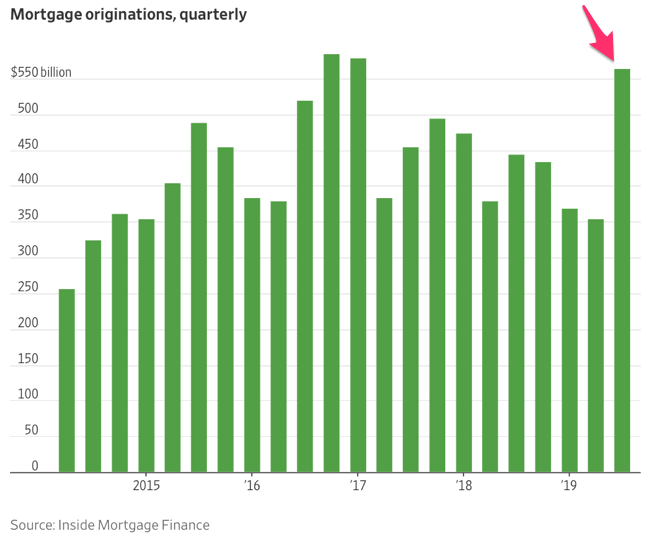
Even before this most recent rate drop, mortgage originations had already spiked, per the WSJ). A swing from 5% back down to 3.5% will create even more.

Bottom line. If you got a 30-year mortgage between late 2016 and mid-2019, there is a good chance that you may be able to lower your mortgage rate via a refinance. Get an accurate full quote with all the costs involved with a online comparison site like LendingTree (tip: don’t enter a phone number if you don’t want them to call you) or go local and call up your neighborhood broker. You might also try an “instant quote” below that doesn’t require any personal information. If you can save money, lock in the rate as they can pop back up quickly.

Best Interest Rates on Cash – August 2019

Here’s my monthly roundup of the best interest rates on cash for August 2019, roughly sorted from shortest to longest maturities. The target for the Fed Funds Rate was just cut by 0.25% as of 8/1/19, so look out for small rate drops this month (probably right after I publish this post). Check out my Ultimate Rate-Chaser Calculator to get an idea of how much extra interest you’d earn if you are moving money between accounts. Rates listed are available to everyone nationwide. Rates checked as of 8/4/19.

High-yield savings accounts
While the huge megabanks like to get away with 0.01% APY, it’s easy to open a new “piggy-back” savings account and simply move some funds over from your existing checking account. The interest rates on savings accounts can drop at any time, so I prioritize banks with a history of competitive rates. Some banks will bait you and then lower the rates in the hopes that you are too lazy to leave.

  • Popular Direct is at 2.55% APY with $5,000 minimum. I don’t like this bank because they always create a “new” account instead of giving old customers the higher rate automatically, but it’s the top rate. Betterment Everyday Savings just dropped to 2.44% APY with a no minimum balance requirement ($10 min to open). There are several other established high-yield savings accounts at 2% APY and up, although some have had small drops recently too.

Short-term guaranteed rates (1 year and under)
A common question is what to do with a big pile of cash that you’re waiting to deploy shortly (just sold your house, just sold your business, legal settlement, inheritance). My usual advice is to keep things simple and take your time. If not a savings account, then put it in a flexible short-term CD under the FDIC limits until you have a plan.

  • No Penalty CDs offer a fixed interest rate that can never go down, but you can still take out your money (once) without any fees if you want to use it elsewhere. Marcus Bank has a 13-month No Penalty CD at 2.35% APY with a $500 minimum deposit. Ally Bank has a 11-month No Penalty CD at 2.30% APY with a $25,000 minimum deposit. You may wish to open multiple CDs in smaller increments for more flexibility.
  • Quontic Bank has a 12-month CD at 2.70% APY and $1,000 minimum with an early withdrawal penalty of 12 months (!) of interest. Andrews Federal Credit Union has a 8-month special at 2.86% APY and $1,000 minimum – anyone can join via partner organization for a small fee.

Money market mutual funds + Ultra-short bond ETFs
If you like to keep cash in a brokerage account, beware that many brokers pay out very little interest on their default cash sweep funds (and keep the difference for themselves). The following money market and ultra-short bond funds are not FDIC-insured, but may be a good option if you have idle cash and cheap/free commissions.

  • Vanguard Prime Money Market Fund currently pays an 2.24% SEC yield. The default sweep option is the Vanguard Federal Money Market Fund, which has an SEC yield of 2.21%. You can manually move the money over to Prime if you meet the $3,000 minimum investment.
  • Vanguard Ultra-Short-Term Bond Fund currently pays 2.40% SEC yield ($3,000 min) and 2.50% SEC Yield ($50,000 min). The average duration is ~1 year, so there is more interest rate risk.
  • The PIMCO Enhanced Short Maturity Active Bond ETF (MINT) has a 2.52% SEC yield and the iShares Short Maturity Bond ETF (NEAR) has a 2.53% SEC yield while holding a portfolio of investment-grade bonds with an average duration of ~6 months.

Treasury Bills and Ultra-short Treasury ETFs
Another option is to buy individual Treasury bills which come in a variety of maturities from 4-weeks to 52-weeks. You can also invest in ETFs that hold a rotating basket of short-term Treasury Bills for you, while charging a small management fee for doing so. T-bill interest is exempt from state and local income taxes.

  • You can build your own T-Bill ladder at TreasuryDirect.gov or via a brokerage account with a bond desk like Vanguard and Fidelity. Here are the current Treasury Bill rates. As of 8/1/19, a 4-week T-Bill had the equivalent of 2.11% annualized interest and a 52-week T-Bill had the equivalent of 1.89% annualized interest (!).
  • The Goldman Sachs Access Treasury 0-1 Year ETF (GBIL) has a 2.27% SEC yield and the SPDR Bloomberg Barclays 1-3 Month T-Bill ETF (BIL) has a 2.04% SEC yield. GBIL appears to have a slightly longer average maturity than BIL.

US Savings Bonds
Series I Savings Bonds offer rates that are linked to inflation and backed by the US government. You must hold them for at least a year. There are annual purchase limits. If you redeem them within 5 years there is a penalty of the last 3 months of interest.

  • “I Bonds” bought between May 2019 and October 2019 will earn a 1.90% rate for the first six months. The rate of the subsequent 6-month period will be based on inflation again. More info here.
  • In mid-October 2019, the CPI will be announced and you will have a short period where you will have a very close estimate of the rate for the next 12 months. I will have another post up at that time.

Prepaid Cards with Attached Savings Accounts
A small subset of prepaid debit cards have an “attached” FDIC-insured savings account with exceptionally high interest rates. The negatives are that balances are capped, and there are many fees that you must be careful to avoid (lest they eat up your interest). Some folks don’t mind the extra work and attention required, while others do. There is a long list of previous offers that have already disappeared with little notice. I don’t personally recommend nor use any of these anymore.

  • The only notable card left in this category is Mango Money at 6% APY on up to $2,500, but there are many hoops to jump through. Requirements include $1,500+ in “signature” purchases and a minimum balance of $25.00 at the end of the month.

Rewards checking accounts
These unique checking accounts pay above-average interest rates, but with unique risks. You have to jump through certain hoops, and if you make a mistake you won’t earn any interest for that month. Some folks don’t mind the extra work and attention required, while others do. Rates can also drop to near-zero quickly, leaving a “bait-and-switch” feeling. I don’t use any of these anymore, either.

  • The best one right now is Orion FCU Premium Checking at 4.00% APY on balances up to $30,000 if you meet make $500+ in direct deposits and 8 debit card “signature” purchases each month. The APY goes down to 0.05% APY and they charge you a $5 monthly fee if you miss out on the requirements. There is also the TAB Bank 4% APY Checking, which I don’t like due its vague terms. Find a locally-restricted rewards checking account at DepositAccounts.
  • If you’re looking for a high-interest checking account without debit card transaction requirements then the rate won’t be as high, but take a look at MemoryBank at 1.60% APY.

Certificates of deposit (greater than 1 year)
CDs offer higher rates, but come with an early withdrawal penalty. By finding a bank CD with a reasonable early withdrawal penalty, you can enjoy higher rates but maintain access in a true emergency. Some CDs offer an “add-on” features that gives you the option of adding funds if rates drop. Alternatively, consider building a CD ladder of different maturity lengths (ex. 1/2/3/4/5-years) such that you have access to part of the ladder each year, but your blended interest rate is higher than a savings account. When one CD matures, use that money to buy another 5-year CD to keep the ladder going.

  • You could build a CD ladder at First National Bank of America at 2.90% APY for 5-year, 2.80% APY for 4-year, 2.75% APY for 3-year, 2.70% APY for 2-year, and 2.60% APY for 1-year.
  • 5-year CD rates have been dropping at many banks and credit unions, following the overall interest rate curve. A good rate is now about 3.00% APY, with Hiway Federal Credit Union offering 3.20% APY ($25,000 min) or 3.00% APY ($500 min) on a 5-year CD with an early withdrawal penalty of 12 months of interest. Anyone can join this credit union via partner organization Minnesota Recreation and Park Foundation ($10 fee).
  • Navy Federal Credit Union has a special 5-year CD at 3.50% APY ($1,000), but you must have a military affiliation to join (includes being a relative of a veteran). NavyFed also has an 18-month CD at 3.00% APY.
  • GTE Financial Credit Union has a promotional add-on CD that allows unlimited additional funds after CD opening. You can open a 5-year CD with $500 minimum at 3.04% APY.
  • You can buy certificates of deposit via the bond desks of Vanguard and Fidelity. You may need an account to see the rates. These “brokered CDs” offer FDIC insurance and easy laddering, but they don’t come with predictable fixed early withdrawal penalties. Nothing special right now. As of this writing, Vanguard is showing a 2-year non-callable CD at 2.10% APY and a 5-year non-callable CD at 2.25% APY. Watch out for higher rates from callable CDs listed by Fidelity.

Longer-term Instruments
I’d use these with caution due to increased interest rate risk, but I still track them to see the rest of the current yield curve.

  • Willing to lock up your money for 10+ years? You can buy long-term certificates of deposit via the bond desks of Vanguard and Fidelity. These “brokered CDs” offer FDIC insurance, but they don’t come with predictable fixed early withdrawal penalties. As of this writing, I am seeing no inventory on 7-year and 10-year CDs. Watch out for higher rates from callable CDs from Fidelity. Matching the overall yield curve, current CD rates do not rise much higher as you extend beyond a 5-year maturity.
  • How about two decades? Series EE Savings Bonds are not indexed to inflation, but they have a unique guarantee that the value will double in value in 20 years, which equals a guaranteed return of 3.5% a year. However, if you don’t hold for that long, you’ll be stuck with the normal rate which is quite low (currently a sad 0.10% rate). I view this as a huge early withdrawal penalty. However, you could also view it as a hedge against deflation, but only if you can hold on for 20 years. As of 8/1/19, the 20-year Treasury Bond rate was 2.21%.

All rates were checked as of 8/4/19.


Betterment Everyday Cash Reserve Review: 0.40% APY (Tied to Fed Funds Rate)

Betterment, best known for their automated portfolio management software, has added a high-yield savings product called Betterment Everyday Cash Reserve. An additional checking product is “coming soon”. This product has several unique features that makes it unlike many other savings accounts. Here are the highlights, followed by both the important pros and cons of this account.

Betterment Everyday Cash Reserve (Available Now)

  • Promotional rate of 0.40% APY as of 2/1/2021 (EFFR + 0.25%) if you sign up for the Everyday Checking waitlist (free)
  • Base rate of Effective Federal Funds Rate (EFFR)
  • FDIC insurance up to $1,000,000
  • No minimum balance. Minimum opening deposit is $10.
  • No monthly fees

If you are an existing Betterment client with Smart Saver, that is going away. You can move over immediately or wait to be transitioned over to this product.

Betterment Everyday Checking (Coming “Later This Year”)

  • No interest paid
  • No minimum balance
  • No monthly or maintenance fees.
  • No overdraft fees.
  • ATM fees reimbursed worldwide
  • FDIC insurance covering up to $250,000†

$1,000,000 FDIC insurance through partner banks. They can offer up to $1,000,000 in FDIC coverage because they use multiple partner banks, currently including:

  • Barclays Bank Delaware
  • Citibank, N.A.
  • Georgia Banking Company
  • Seaside National Bank & Trust
  • Valley National Bank
  • BankUnited, National Association
  • ConnectOne Bank
  • East West Bank
  • Third Coast Bank SSB

You can manually opt-out of one of these banks, for example if you already have cash with them, as to not exceed the $250,000 FDIC insurance limits at any single bank.

Interest rate is directly linked to the Effective Fed Funds Rate. The rate on Everyday Cash Reserve is variable, and will move with the effective federal funds rate (EFFR). As long as you are on the Everyday Checking waitlist, you will get the EFFR + 0.25%.

I view this as a good thing overall, as it’s guaranteed to be quite competitive against most non-promotional rates. It also provides more transparency and lowers the chance of a bait-and-switch to some really sad rate. However, the 0.25% boost above the EFFR is currently a waiver of their 0.25% management fee good through 2019. Being on the waitlist is free and comes with no obligation to open the account, so that’s not a big deal. However, it’s not clear if or how they will extend the waiver after that. You might need an active and open Everyday Checking account, set up direct deposit, or jump through a similar hoop.

Everyday Cash Reserve isn’t your normal bank savings account. There are some quirky things that you should know about.

  • No joint accounts.
  • No routing number or account number, so no direct deposit or linking via other banks.
  • You can only initiate ACH transfers through Betterment, and you can only link one external bank account.
  • It’s not a “real” savings account, so there is no limit of 6 withdrawals per month.

Everyday Checking plans to offer things like direct deposit (and thus real routing and account numbers).

Bottom line. Betterment, a “robo-advisor” best known for their automated investing service, has added a high-yield savings product called Betterment Everyday Cash Reserve. There are some limitations with external bank transfers, but I do like that it has a transparent structure that links the interest rate to the Fed Funds Rate. If you sign-up on their EveryDay Checking waitlist, you can get a competitive rate on liquid savings.