Archives for August 2019

Rewards Dining Programs and Avoiding Airline Miles Expiration Policies

stopwatch2

Updated + United Airlines miles no longer expire. I don’t fly as much anymore, and part of my routine to keep my various miles from expiring is to use dining rewards programs that give me miles for eating at participating restaurants. You link your existing credit card first, then pay with that credit card, that’s it – their system figures it out with no coupons, apps, or membership card required. Not all the food spots are great (this is basically paid advertising and the best places don’t need to advertise) but there is usually a small overlap between participating merchants and places I eat at anyway.

My $10 lunch fills the stomach and resets the clock on my mileage balance (although you could buy something as little as a $1 bottle of water). Most of the time, I don’t even have to think about it, but I also write the name of the restaurant and the airline on the card so I remember. Miles usually post within a few weeks. However, to be safe I try to make sure to make a purchase at least 2 months before the expiration date. (If it’s an emergency, I will do a transfer from Chase Ultimate Rewards, AmEx Membership Rewards, etc.)

Here are all the airline mileage and hotel programs along with their expiration policies. Most also offer a new member bonus. You can join each program and grab every bonus (one by one or simultaneously, if you have enough credit card numbers).

Alaska Airlines Mileage Plan

American Airlines AAdvantage

Delta SkyMiles

JetBlue TrueBlue

Southwest Airlines Rapid Rewards

Spirit Airlines

United Airlines MileagePlus

Hilton HHonors

International Hotel Group (IHG)

Each separately branded program can have multiple credit cards linked to it, but any single credit card can only be linked with one program. (In other words, you can’t earn miles on two airlines on the same purchase.) However, you can change the linked cards as often as you like via website. Delta, United, and JetBlue now all have points that don’t expire, so you can skip them if you wish.

Public App Review (Matador): Free Dollar-Based Stock Trades, Free Stock Slice

Updated. Public, formerly known as Matador, is a new brokerage app that combines several different features that you might have seen separately elsewhere:

  • Free dollar-based stock trades with no minimum balance. Not only can you trade any stock for free, you can also choose to trade fractional shares in real-time for free as well. For example, Google stock may trade at over $1,000 a share, but you can buy just $50 worth if you want with no commission.
  • Free stock slice via referral. Details below.
  • Social investing. You can “follow” other investors and see their portfolio holdings and recent trade activity.

Referral bonus details. Here is my Public referral link for a free slice of stock. Thanks if you use it! The updated terms of this detail are a bit vague – my app just says a “free slice of stock”. Here is their link with full terms. Sounds like the value varies, up to $50. Note that you are not allowed to withdraw the value of the free stock received for up to 90 days after the free promotional stock is received.

Interest on cash sweep. You may have seen that Public used to offer 2.5% interest on idle cash up to $10,000. This was a pretty high interest rate at the time, but as after the Fed rate drops in early 2020, it was apparently unsustainable. As of March 30th, 2020, Public stopped paying interest on idle cash.

Other inner details. Public (formerly Matador) is part of T3 Securities, which is a broker-dealer member of FINRA and SIPC. The clearing firm is Apex Clearing, as with many other similar apps. Public uses Plaid to link your external bank accounts for ACH transfers, which is a widely-used third-party service. The default setting is free paperless trade confirmations and statements, otherwise a physical trade confirmation is $2 a pop and a paper statement is $5 a pop.

Inflation-Adjusted (Real) US Treasury Bond Yield, 1955-2019

I was looking for a historical chart of the 30-year US Treasury yield that adjusted for inflation, as the yields were much higher in the 1970s and 1980s but inflation was quite high as well. The closest I could find was this chart of the inflation-adjusted (real) 10-year US Treasury yield. (Please let me know if you have something better.)

Taken from Bonds Are Frickin’ Expensive, Cliff Asness of AQR takes the nominal 10-year Treasury yield and subtracts the 3-year trailing annualized CPI inflation. I prefer the use of hard numbers over a forecast.

You can see that in the past, the inflation-adjusted yield has varied quite widely. There have been zero and negative real yields, and there have been really high positive real yields. From a historical perspective, right now bonds do not yield very much and the overall curve is rather flat. The article concludes:

So, the bottom line is, as measured by real bond yield, U.S. Treasury bonds are really frickin’ expensive. Measured by the slope of the yield curve they are really frickin’ expensive. But, measured by the average of these two simple variables, they are 60+ year just about record-low frickin’ expensive. This result is not caused by, but is certainly exacerbated by, the (perhaps) surprisingly uncorrelated nature of slope and real bond yield, thus making both so low and at the same time considerably more surprising.

The usual disclaimer against timing bond rates is thrown in there, but it felt only half-hearted.

I have no plans to sell my high-quality bonds because they have historically been a reliable buffer against stock drops:

Still, it would sure be nice if they actually gave me some positive real return…

Andrew Luck is Doing Early Retirement Perfectly

The big news in sports yesterday was the retirement of Andrew Luck from professional football at the age of 29. Here are two takes from The Ringer: Andrew Luck and the Afterburn of Early Retirement and Andrew Luck Gave Up Fame, Riches, and Football Because He Is Unapologetically Himself. He seems like a stand-up guy. The thing that struck me was the chorus of boos from Colts fans (some burning his jersey) and a few snarky remarks from some (supposedly) professional sports commentators.

That’s how I knew that Andrew Luck was doing justice to my definition of “retirement”. To me, retirement means:

  • You are NOT optimizing your time for money. Elite quarterbacks rarely retire early because they can make tens of millions of dollars just holding a clipboard as a backup until they are 40 years old. Luck is walking away from anywhere from $10 million to hundreds of millions.
  • You are NOT following other people’s expectations, and definitely not what random angry internet people think. I’m sure many Colts fans are disappointed, and even he admitted that the boos hurt. But Luck only gets one life and one body. The fans won’t be there when you can’t walk right for the rest of your life.
  • You may NOT be doing what you are most talented at. Sometimes things come easier to you than others, but that doesn’t mean you find joy in the act. I think it can be noble to keep working at something to support your family, but this is retirement. Retirement means that if you want, you can do the thing you are least talented at. He could switch to painting with boxing gloves.

That’s why I call myself “semi-retired”. Am I talented at raising small children? No. Probably below average. Am I good at it? No. Nobody would ever hire me to watch their kids. If I wanted to optimize for money, I would never have done this. If we both kept working full-time and paying for full-time daycare, we could have earned at least a million dollars more during their childhoods. I am spending half my time doing something that doesn’t make much sense, so I call that half-retired even though I am still exhausted at the end of every day. At the same time, I am grateful because I know that it took a lot of luck and the gracious support of my wife and family to even have this choice.

Let’s not forget why this is all possible. Luck combined his unique talents, hard work, family support, and some luck to earn over $100 million in his career. He is financially free, even if he hits a few bumps along the way. We don’t know all his struggles, and he never needs to explain it to us.

The Other Side: Reasons Why You Might Not Want To Retire at 40

Previously, I wrote about how you might consider retiring earlier if you have adequate flexibility to decrease your spending temporarily and/or earning additional money. If you have early good luck with market returns, you will gain many more years of freedom.

Now I’d like to present the other side of that argument. If you retire in your 40s or 50s, there are hopefully many years of fun times ahead of you. However, there is also a higher chance for events that significantly increase your expenses and decrease your ability to earn more money.

Let’s say you and your spouse/life partner are both 40 years old and have saved up $2 million and are pretty confident that you can live off of $60,000 to $80,000 per year. That’s may seem like a lot of money. However, here are some things that can throw a wrench into your plans.

Yourself

  • You may become disabled and become unable to work. Your daily healthcare expenses may also rise significantly.
  • Your spouse may have a health event or pass away prematurely, which will affect your household finances.
  • You may be the subject of a liability lawsuit.
  • There may be an expensive accident – Home fire, theft, fraud.

Many of these situations can be offset by proper insurance. Disability, life, homeowners, long-term car, and/or umbrella liability insurance.

Your spouse (Divorce)

A divorce can be devastating, both emotionally and financially. There are many articles about increasing divorce rates amongst those aged 40+ and 50+. Even if you split your assets equally into two parts, a couple can usually live more efficiently than two individual households. In addition, you may no longer be eligible for the full spousal portion of a pension, healthcare package, and/or Social Security.

Parents, Elderly Relatives and/or Siblings

  • You may have a perfect financial situation, but your parents (or other close family members) may not.
  • You can’t control your parents (or siblings) and their decisions. They may develop dementia, fall for fraud, have substance abuse issues, or simply be bad with money.
  • Some people may be able to easily separate themselves from the responsibility of taking care of their relatives, but many will find it very difficult. Every person’s sense of familial duty is different.
  • Fulfilling what you believe is your responsibility may require great deals of time, energy, and money.
  • Your parents’ ongoing health issues may permanently change your life for decades. See NYT: At 75, Taking Care of Mom, 99: ‘We Did Not Think She Would Live This Long’

Children

  • If you are in your 40s, your kid status is not set in stone. If you don’t have kids, you still might have some. If you already have some, you might have more. Even if you don’t want kids now, you might change your mind. I know of many friends who had at least one kid well into their 40s.
  • Even though kids don’t necessarily need everything they seem to get these days, kids do require significant time, energy, and money.
  • Your child may have special needs. Imagine a multiple of that time, energy, and money.
  • Your child’s special needs may permanently change your life. It may not stop after 18 years.
  • Your child’s special needs may not become apparent until they are 5 months old, 5 years old, or 15 years old.

I may be wrong, but my impression is that early retirees are more likely to be childless than the general population. Perhaps knowing that you have less people to be responsible for makes it easier to take the retirement leap. I strongly believe that you should only have kids if you want to have kids, not because your parents or society wants you to have them. I can’t imagine how I would get through a single day with my kids if I didn’t want to be a parent.

It may be my own personal situation coloring my view, but the 30s, 40s, and 50s feels like the “sandwich decades” where you are most likely to be responsible for both parents and children. Retiring very early may permanently impair your ability to earn any more money, which in turn may be a source of future regret. You can (and should) insure against certain things, but not everything.

My take. Retirement timing is a form of regret minimization. You want to minimize the regret of “I should have retired earlier and had more freedom time”, but also minimize the regret of “I wish I made more money so my limited freedom time is more enjoyable”. It’s hard to find that happy medium where you give yourself enough financial wiggle room while keeping an eye on your mortality.

I started down the path of “semi-retirement” in 2012 with the birth of our first child. “Semi-retirement” is a rather generous take on our reworking of the traditional one full-time working spouse and one full-time parent arrangement so that we were both 50/50. Since then, we have both had the urge to try to live solely off our investments, but we are also keenly aware of the large number of people that we are responsible for caring for. In the end, we’re still both working part-time as that seems to be the solution with most optionality for now.

The Case Against REITs as a Separate Asset Class Holding

Morningstar has another educational article about investing in REITs as a separate asset class (free registration may be required). The entire article is worth a read, as it does a good job of summarizing the basic arguments for either carving out a special place in your portfolio for REITs, or simply leaving it at the ~4% market weighting that exists in most broad US index funds. For those already familiar with that, the historical charts add additional depth.

Historical correlations. This M* chart tracks the rolling 36-month correlation between the Vanguard Real Estate Index Fund (VGSIX) and Vanguard Total stock Market Index Fund (VTSMX), Vanguard Total International Stock Index Fund (VGTSX), and Vanguard Total Bond Market Index Fund (VBMFX). Note that the popular Vanguard Real Estate ETF (VNQ) has the same underlying holdings as VGSIX.

Sometimes the correlation between REITs and the overall stock market is very high, close to 1, but at other times it is closer to 0.5.

Historical return vs. volatility. Here’s a good stat: From 1972 to 2018, REITs have had a slightly higher average total annual return than the US Total Stock Market (11.4% vs. 10.3%), but also a higher average standard deviation (16.9% vs. 15.5%).

My take. I agree that REITs are not an “alternative” asset class on the level of fine art, music royalties, or Bitcoin. I think common sense would predict that publicly-traded corporations that own commercial property would be at least moderately correlated with the overall stock market. Historically, REITs provided a slightly higher return than stocks but also slightly higher price volatility. Using a broad REIT fund instead of a stock fund (or vice versa) is only going move the needle a relatively small amount.

However, I do see real estate as “different”. It has the limited availability of a commodity like gold or silver, yet it is productive like a factory. Land can produce rent, timber, or food (farmland). I could own single family rentals or farmland, but personal experiences have taught me that the higher potential returns also come with higher potential headaches. I’m willing to give up some of the return and simply hold REITs which don’t have be dealing with chasing late rent, fixing damages, civil lawsuits, and governmental bureaucracy.

Thus, I do hold a dedicated REIT portfolio allocation via the Vanguard REIT ETF and mutual funds. If I’m lucky they will add a bit of diversification and/or extra return, but even if they just offer more of the same, that’s good enough. (I noticed that the M* article author also discloses that he holds VNQ.) If you are interested in something closer to direct real estate ownership, see my Fundrise vs. Vanguard ETF experiment where I track my small side investment.

Employee or Student Discounts for AT&T, Verizon, Sprint, and T-Mobile

celldiscount

Updated 2019. Each of the four major cell phone providers offer discounts for certain large groups, even applied to an existing personal line. You could qualify through your employer, educational institution, or even affiliation with certain organizations like AAA or credit unions. Many also have discounts for military and/or first responders. So grab your work or school-affiliated e-mails, check out these links, and find out what discounts are available to you.

You may still find a better deal with a lesser-known prepaid or MVNO plan (especially if you don’t need data), but sometimes a major carrier with a discount can be very competitive.

AT&T Wireless. AT&T Signature Program

It’s easy to find out if you’re eligible for savings for your qualified AT&T wireless service through your employer, school, or other association. Just enter and submit your work or school email address and we’ll show you whether you qualify for applicable discounts and benefits on wireless services, devices and more.

Don’t have a work or school email? If you don’t have a work or school email, bring your student or employee ID to an AT&T store to find out if you’re eligible for the AT&T Signature Program.

Verizon Wireless. Employee Discount Program

We offer great monthly discounts for corporate, government and education employees, as well as valued service members and veterans. If your organization has an agreement with us, you may be eligible. Sign in below to register for a new discount or renew an existing discount.

T-Mobile. In 2014, T-Mobile changed their corporate discount program for consumer lines. Existing corporate discounts were mostly left grandfathered in. The T-Mobile Advantage Program now gives a $25 gift card per device instead. If you have a work phone directly paid for by your employer, you may qualify for Business Family Discounts. Keep in mind that T-Mobile also has special discounted plans for the military and those age 55+. The ability to stack discounts varies.

The T-Mobile Advantage™ Program lets you receive additional benefits or rewards based on your affiliation with your military branch of service, company, organization, or government agency. Check your organization’s eligibility.

If you have a company-provided business line with T-Mobile, you can now add your family to your account and save up to 50% off the first two lines on a family plan. Already have your family on a Simple Choice plan or T-Mobile ONE? You can get in on the BFD too!

Sprint. Sprint Works Program.

The Sprint Works? Program extends exclusive savings and special offers to employees, students and members of organizations. Please complete the form to see if you qualify.

LoveMyCreditUnion.org also offers credit union members Sprint monthly plan discounts and waived activation and upgrade fees. I’m not sure how these would stack with the Sprint Unlimited Kickstart $25/month plan.

Business Idea: On-Demand Garage Rental + DIY Car Repair Lessons

The NY Times has a new article They Supply the Garage, You Bring the Elbow Grease where you rent space hourly or daily for DIY car repairs. The article referenced GarageTime as a place to search for a residential or commercial garage space in your area. Most commercial spaces include lifts, while others are essentially listing their large driveway with an electrical connection and perhaps an air compressor. Be prepared to sign a liability waiver.

My related business idea is to use the space to teach people basic car repair skills like how to change your oil, replace brake pads, replace headlights, repair dents, or perform common after-market modifications like LED headlight swaps. YouTube has tons of how-to content, but I think there is still a market for someone to be walked through the process the first time. For example, someone could list their space and also upcharge for some lessons. The next time, the customer could just do it themselves.

I’m a bit surprised at the timing of this article, as isn’t the stereotypical Millennial is supposed to just stare at their phones and not do anything dirty with their hands? I also keep hearing that cars are becoming more and more like computers on wheels. I suppose it’s a nice little reminder that DIY is still alive, and some people still like to save a few bucks and do things for themselves.

You don’t even need a garage for many basic maintenance tasks that can save you money. For example, here’s a Youtube video I found the other day that shows you how easy it is to change both the engine air filter and cabin air filter on my 2015 Toyota Sienna. Your dealership shop will charge you at least $100 an hour for this knowledge. You’ll also probably be charged more than the $12 for the cabin air filter and $11 for the engine air filter that Amazon is asking. (These seem to have good reviews, but OEM parts are also available online.)

There Is No 100% Safe Portfolio: The Future May Not Look Like The Past

Last week, the yield on the 30-year US Treasury bond dropped below 2% for the first time in history. Many other articles will try to explain why this happened, and what this means for the future. Not me. I have no clue what’s coming and don’t think anyone else does either. Here’s the historical yield chart via Financial Times:

Reader skg recently shared that the original 1992 edition of Your Money or Your Life by Vicki Robin and Joe Dominguez is now available online (partially to promote the new 2018 edition).

I rate this book a “must read” for those interested in a philosophical inspiration behind financial independence. However, the specific investing advice inside was to put all of your money into a ladder of 30-year US treasury bonds. Here an excerpt from the book on what they were looking for:

1. Your capital must produce income.
2. Your capital must be absolutely safe.
3. Your capital must be in a totally liquid investment. You must be able to convert it into cash at a moment’s notice, to handle emergencies.
4. Your capital must not be diminished at the time of investment by unnecessary commissions, “loads,” “promotional” or “distribution” expenses (often called “12b- 1 fees”), management fees or expense fees.
5. Your income must be absolutely safe.
6. Your income must not fluctuate. You must know exactly what your income will be next month, next year and twenty years from now.
7. Your income must be payable to you, in cash, at regular intervals; it must not be accrued, deferred, automatically reinvested, etc. You want complete control.
8. Your income must not be diminished by charges, management fees, redemption fees, etc.
9. The investment must produce this regular, fixed, known income without any further involvement or expense on your part. It must not require maintenance, management, geographic presence or attention due to “acts of God.”

That sounds pretty good, right? But then you have to remember that Joe retired about 1970 and this book was written about 1990. Look again at rates from 1970-1990 in the chart above. Another excerpt:

For most of this century, up until the late 1960s, interest rates were under 5 percent. Since their peak in 1981, long-term interest rates have been wending their way back down toward their historical norms. You did not need to catch the bond market at those abnormal highs in order to reach FI. Even at 5 or 6 percent, this program will work.

In 1969, when Joe reached FI, his capital was invested in bonds with interest averaging 6.85 percent and maturities extending into the 1990s. Through a few judicious bond swaps, and with no income other than the income from the bonds, his portfolio now has an average yield of 9.85 percent and maturities extending to the year 2007 on average.

Note that bolded quote “Even at 5 or 6 percent, this program will work”. Well, what about 2%? It probably wasn’t even on his radar as a possibility at that time. I’m sure something else will happen in the next 30 years that isn’t on my radar now.

Even buying the safest bonds in the world and locking them in for the longest period possible is not free from risk. Long-term bonds can still be one component of a diversified portfolio, assuming you understand when it will do well and when it won’t. However, it is important to realize that owning 100% long-term bonds at 2% leaves you very vulnerable to future inflation.

This is only a small part of the book, and there is additional discussion about being flexible in your own spending:

Your choices, attitudes, beliefs, habits, tastes, fears and desires have the ultimate effect on your bottom line.

Bottom line. Every time I see the line “for the first time in history”, I am reminded that no portfolio is 100% safe. We can look back at history as guide, but also accept its limitations. Even buying the safest bonds in the world and locking them in for the longest period possible is not free from risk. Preparing for retirement isn’t just about your investment portfolio, but also having adequte insurance coverage and your ability to be flexible in both spending and earning.

Museum Day: Free Tickets Nationwide On Saturday, September 21, 2019

Now live for 2019. Museum Day is an annual event hosted by Smithsonian magazine in which participating museums across the country open their doors to anyone presenting a Museum Day Ticket for free. This is in following the spirit of Smithsonian Museums, which offer free admission every day.

Registration is now open for Saturday, September 21, 2019. Find participating museums and request your ticket here. One ticket per valid email address. Each ticket provides general admission for ticketholder plus one guest. You must pick the specific museum during the ticket request process. Some museums will require you to print out the PDF ticket.

There are some cool museums around us that now cost $25 for adults and $10 for children, so this can be a significant savings depending on the size of your family.

Don’t forget to add the event to your calendar! I’ve probably forgotten about this half the times that I’ve registered.

Also see: Bank of America’s Museums on Us Program 2019.

Maximizing Retirement Time: Being Flexible in Both Work Income and Spending

When it comes to Financial Independence Retire Early (FIRE), many people get turned off because they define retirement as “never, ever working again for money”. Financial independence fits better with my goal of spending the most of your limited time on Earth aligned with your values.

If the idea is to maximize your independent time, then you have to accept that luck matters. This chart from Michael Kitces explores equally likely scenarios from someone spending down a $1,000,000 portfolio of 60% stocks and 40% bonds.

Equally likely:

  • Ending up broke or feel alarmingly like you are headed towards broke.
  • Ending up with many, many times more money than you started with.

Is retiring as soon as you reach the 4% rule too risky because you might run out of money? Or is working longer for 3% too risky because you might have wasted years of your life working when you didn’t need to?

Let’s look again at some charts from Engaging Data. Here are sample results for the early retirement scenario at 4% withdrawal rate at age 40 ($40k from a $1m 65/35/5 portfolio, retirement horizon 50 years, female longevity table).

  • Red – Alive, but ran out of money.
  • Light green – Alive, with less money than you started with.
  • Green – Alive, with between 100% and 200% of what you started with.
  • Dark green – Alive, with over 200% of what you started with.
  • Grey – Dead.

Here is retired at 40 with a lower 3% withdrawal rate ($30k from a $1m 65/35/5 portfolio, retirement horizon 50 years, female longevity table):

Notice at even with the riskier 4% withdrawal rate, you have roughly a 60% chance that your portfolio never goes below the starting balance for as long as you are alive. That means you just spend your 4% every year and it just replenishes itself over and over. Sure, the 3% chart looks safer as there is no red “failure” area. But is that chance of failure worth working maybe another 10 years to go from 25x expenses (4%) to 33x expenses (3%)?

If your portfolio value drops early in retirement, flexible withdrawals are one important tool to improve your portfolio survival odds. However, what about flexible income as well?

What if you retired earlier so that if things go well, you get more retirement years, but if things go bad, then you fall back on some part-time back-up work? Your main risk is of poor returns in the first 10 years of retirement or so. You would accept the chance that you might have to do a little work again to prop your portfolio up during that time. A good part-time job would have the following characteristics:

  • Scales up and down easily. Ideally, you could spend 10 hours a week, 20 hours a week, or 40 hours a week on it as necessary. This could mean hourly shift work or flexible self-employment.
  • Higher-paid skilled work that is at least partially satisfying. Unskilled work will be the easiest to obtain, but the pay will be low. Uber/Lyft driver, food delivery, home health aide, retail, warehouse, etc. You want something where your special skills are compensated accordingly.
  • Minimal maintenance. For some jobs, if you aren’t constantly putting in hours, you’ll become obsolete and won’t be able to start back up again. There may be professional licenses to maintain, etc.

Here’s a brief list of ideas:

  • Healthcare. Many positions in the healthcare field can be part-time and hourly, from doctor to nurses to technician positions.
  • Elder care. This may be related to healthcare, but the overall aging population is another trend to consider.
  • Accounting. An accountant or someone with similar skills can usually find work during tax season, assisting other accountants.
  • Tech. There is often consulting or project work available, if you keep your contacts and skills up-to-date.
  • Passion work. Turn your hobbies into work. You could be a travel guide, taking people on hikes, tours, kayaking, etc. Carpentry projects could turn into an Etsy store. If you like to fix things, become the neighborhood handyperson.
  • Real estate. I tend to break up residential real estate investing into two parts – the actual ownership and the property management. Property management is basically a part-time job which you can do yourself, and the effective wage can be quite high if you are skilled at managing tenants. (The catch is that you can also lose money if you are unskilled at it.)
  • Teaching and kid-related. People are having fewer kids, but spending more on each one. Sleep training consultant. Potty training consultant. Academic tutoring at any age. Sports coaching at any age. Chess coaching. Language coaching. Musical coaching. These all command premium hourly rates.

I am a conservative person at heart, and I know that I would worry about my family’s finances if my portfolio dropped significantly from my retirement date. Therefore, I am both using a conservative withdrawal method and maintaining a semi-retired work schedule for the time being. I don’t have the luxury of a full traditional retirement, but I like the balance so far.

Bottom line. Living off of an investment portfolio of stocks and bonds depends a lot on luck. One way to deal with this is to be flexible with your withdrawals. Good luck means spending more, bad luck means spending less. This flexibility may allow you to retire earlier with a smaller portfolio balance. However, you could also plan for a little work income to offset early bad luck with portfolio returns. If you instead have early good luck with market returns, then you’ve just won many more years of free time.

Portfolio Charts Tool Tests Flexible Withdrawals in Retirement

You’ve probably heard of the “4% rule” when withdrawing income from a retirement portfolio. I think using such a rule is fine when you are early in the accumulation phase, although I like the “3% rule” better for early (long) retirements. But heck, reach 25x expenses first and then reassess. However, when it’s actually time to spend down that money, the execution can be tricky. If you start out taking 4% on a $1,000,000 portfolio ($40,000) and then the market drops 50%, will you really take $40,000 (8%) out of your sub-$500,000 portfolio the next year?
Being flexible in your withdrawals works better with both theoretical backtests and natural tendencies. If my portfolio drops 50%, I’m going to tighten the belt and spend less money the next year. Some people may not want to admit this, but I would consider taking on a part-time job again in a severe event. I collect part-time job ideas as part of this Plan B.

On the flip side, if you’ve used a lot of portfolio simulators like FIRECalc and Engaging Data, you’ll notice that your portfolio sometimes gets crazy huge. If your portfolio doubles in size, you might decide to live it up a bit and spend more than 4% of your original amount (inflation-adjusted).

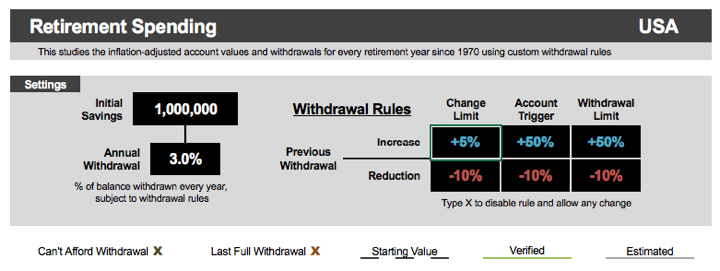
Accordingly, I was impressed to see that Portfolio Charts updated their already-useful Retirement Spending Tool to account for flexible portfolio withdrawals. Everything has been elegantly simplified into four variables:

Withdrawal Rate: the percentage of the portfolio you withdraw every year to fund your retirement expenses

Change Limit: The maximum amount that a withdrawal can increase or decrease from year to year

Account Trigger: A simple rule for when you’re allowed to increase or decrease spending based on how the portfolio is doing relative to its original value

Withdrawal Limit: The minimum or maximum withdrawal you realistically need to pay the bills and live a happy life regardless of what a flexible spending strategy might recommend

Keep in mind that the spending is already inflation-adjusted, i.e. it increases each year with inflation even with no change. Here’s a screenshot:

Take some time to play around with the many combinations. You could see what happens if you let the withdrawals vary wildly. You could see what happens if you only allow the withdrawal amount vary within a tight range. How does your portfolio balance change? For example, I thought about starting with a relatively conservative number like 3% base withdrawal rate, but also be willing to drop it to 2.7% (10% less) if the portfolio drops by 10% in value. Meanwhile, I’d wait until the portfolio increases by 50% before I start paying cash to fly business class everywhere (#goals).

If I were to have a wish list for a new feature, I would like it to show me the minimum balance that the portfolio reached during any of the scenarios. This would let me know the maximum drawdown experienced using my set of variables, as the chart is a little hard to read.