Archives for February 2019

Free Magazine Subscriptions: Money, Time, Fortune, & More

Mercury Magazines offers free subscriptions if you fill out their professional profile. If you provide accurate information, they will present trade publications that are applicable to your field, which is partially how they fund these offers. I have also read that sometimes magazines will offer deep discounts in order to improve their circulation numbers (which in turns make them able to charge advertisers more money). Availability will go in and out of stock.

Thanks to reader Hannah and SD. In my experience, this company is legit and I have gotten free magazines from them in the past. You should not have to enter a credit card (consider using an alias and temporary email as well). You will get a renewal “bill” when the subscription ends, but you can either ignore it or send it back with “cancel” written on the invoice. I would just make sure you actually want to read them, otherwise it’s a lot of wasted paper that piles up.

Roth vs Traditional Pretax 401k? Compare With These Example Worker Profiles

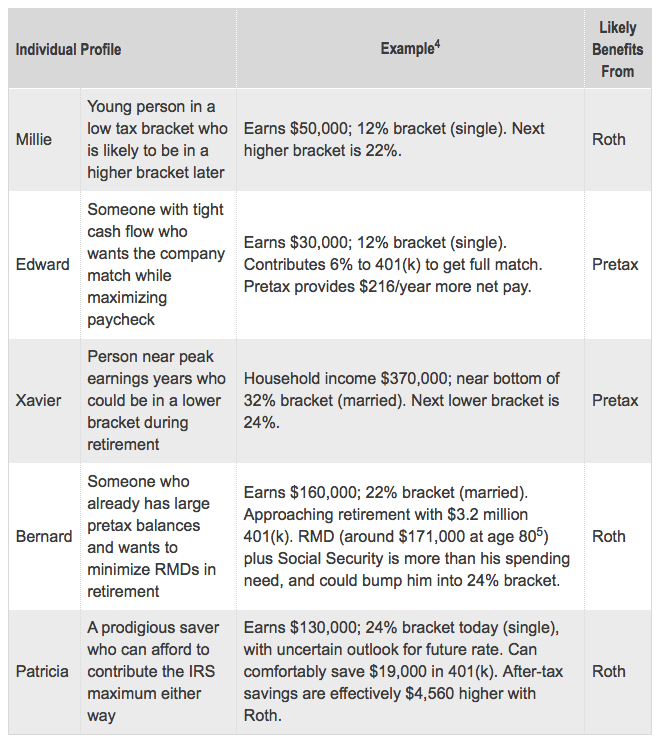
T. Rowe Price has an article Evaluating Roth and Pretax Retirement Savings Options by Roger Young that covers the basics on the choice between a “Traditional” pretax or Roth IRA or 401k account:

The primary factor to consider is whether your marginal tax rate will be higher or lower during retirement. If your tax rate will be higher later, paying taxes now with the Roth makes sense. If your tax rate will be lower, you want to defer taxes until then by using the pretax approach.

With the Traditional pretax, you get to avoid paying income taxes on the contribution now, but you must pay taxes up on withdrawal. With the Roth, you pay income taxes now, but you don’t own any taxes upon withdrawal. However, I am linking to it because it also includes a table with some sample worker profiles. This may help clarify things for people who are still confused about which to pick.

There are other considerations due to our overly-complex tax code, but I think this is still a helpful tool.

Berkshire Hathaway 2018 Annual Letter by Warren Buffett

Berkshire Hathaway (BRK) has released its 2018 Letter to Shareholders. I highly recommend sitting down and reading the entire thing straight from the source. It’s only 15 pages long and (as always) written in a straightforward and approachable fashion. Here are my notes with quoted excerpts. I’ve also added a “personal takeaway” about how I intend to apply the knowledge to my own life.

Changes in the value of their stock holdings are now reported directly as earnings. This means a drop in stock prices can technically make BRK have a “loss” in any given quarter, even if both their wholly-owned businesses and indirectly-owned stock companies all made profits. This didn’t really matter to me, but mostly it’s just a reminder that he doesn’t view his stock holdings in the same way as the newly-required accounting method.

Personal takeaway: Buffett takes a long-term view of his stock holdings. You should too. The share prices may go up and down, but he knows that he owns solid, profitable companies.

In early 2018, Ajit Jain was put in charge of all insurance activities and Greg Abel was given authority over all other operations. This has been the suspected separation of executive duties, and now it is official. Buffett is still CEO, but they keep moving forward to create a seamless transition for when Buffett is no longer around.

Personal takeaway: Nobody likes to think about death, but proper estate planning shows that you care about your family and loved ones. Do it.

The five groves of Berkshire Hathaway. Buffett discusses how you can organize BRK into five parts:

  1. Non-insurance businesses that BRK controls (ex. 80% to 100% ownership).
  2. Equities (ex. 5% to 10% ownership of a large publicly-traded company).
  3. Non-insurance businesses where BRK shares ownership with other parties (ex. 25% to 50% ownership).
  4. Treasury bill and other cash equivalents.
  5. Insurance companies, which generate free float for investment elsewhere.

Personal takeaway: We are not a business, but I would think of our groves as:

  1. Our human capital. We can work and create income. That has a value.
  2. Private ownership of a small business.
  3. Our common stock holdings (mostly ETFs and mutual funds).
  4. Our bonds and cash holdings.
  5. Our direct real estate ownership.
  6. Our personal insurance policies: disability, term life, home, auto, umbrella liability.

On the use of debt and leverage:

We use debt sparingly. Many managers, it should be noted, will disagree with this policy, arguing that significant debt juices the returns for equity owners. And these more venturesome CEOs will be right most of the time.

At rare and unpredictable intervals, however, credit vanishes and debt becomes financially fatal. A Russian-roulette equation – usually win, occasionally die – may make financial sense for someone who gets a piece of a company’s upside but does not share in its downside. But that strategy would be madness for Berkshire. Rational people don’t risk what they have and need for what they don’t have and don’t need.

Personal takeaway: The last sentence – Rational people don’t risk what they have and need for what they don’t have and don’t need.

On the conservative position of BRK insurance companies:

When such a mega-catastrophe strikes, we will get our share of the losses and they will be big – very big. Unlike many other insurers, however, we will be looking to add business the next day.

Personal takeaway: When the next major economic recession comes, will you be ready to both survive and take advantage? Or is your position too fragile?

As usual, Buffett reminds us about how American capitalism has been powerful over the long run (and owning gold hasn’t), and that paying high fees would have left you with half of what you might have gotten:

Let’s put numbers to that claim: If my $114.75 had been invested in a no-fee S&P 500 index fund, and all dividends had been reinvested, my stake would have grown to be worth (pre-taxes) $606,811 on January 31, 2019 (the latest data available before the printing of this letter). That is a gain of 5,288 for 1. Meanwhile, a $1 million investment by a tax-free institution of that time – say, a pension fund or college endowment – would have grown to about $5.3 billion.

Let me add one additional calculation that I believe will shock you: If that hypothetical institution had paid only 1% of assets annually to various “helpers,” such as investment managers and consultants, its gain would have been cut in half, to $2.65 billion. That’s what happens over 77 years when the 11.8% annual return actually achieved by the S&P 500 is recalculated at a 10.8% rate.

Personal takeaway: Buy productive assets, and hold them for a long time. Don’t pay high fees to “helpers”.

Past shareholder letters.

Berkshire’s 2019 annual meeting will take place on Saturday, May 4th. Last year, I really enjoyed listening to it in the car via the Yahoo Podcast. Here are the many ways you can access Berkshire Hathaway Shareholder Meeting Full Videos, Transcripts, and Podcasts.

A Sense of Urgency: Money Can’t Buy You More Time

Over the weekend, I read the NYT Magazine article America’s Professional Elite: Wealthy, Successful and Miserable about the rich and unhappy, which included a man who earned $1.2 million a year in Manhattan and hated his job:

“I feel like I’m wasting my life,” he told me. “When I die, is anyone going to care that I earned an extra percentage point of return? My work feels totally meaningless.” He recognized the incredible privilege of his pay and status, but his anguish seemed genuine. “If you spend 12 hours a day doing work you hate, at some point it doesn’t matter what your paycheck says,” he told me. There’s no magic salary at which a bad job becomes good. He had received an offer at a start-up, and he would have loved to take it, but it paid half as much, and he felt locked into a lifestyle that made this pay cut impossible. “My wife laughed when I told her about it,” he said.

Based on a short conversation in a class reunion, it’s easy to extrapolate endless stressful hours at work, a huge mortgage, fancy private school tuition, expensive vacations, and a high-maintenance spouse. Such a picture makes all of us not earning $1.2 million a year feel better about ourselves. But is he really that miserable?

I suspect it is more like the same situation a lot of people are in. They aren’t happy, but things aren’t bad enough to keep them from still doing the same thing. It’s easy to just say OMY (One More Year) because change is scary. I’d certainly rather be in that position while earning a million bucks a year, rather than earning $40k. He has a lot more optionality than most.

Ever since my post on Retirement Nest Egg Calculators: Running Out of Money vs. Running Out of Time, this following statistic has been stuck in my mind:

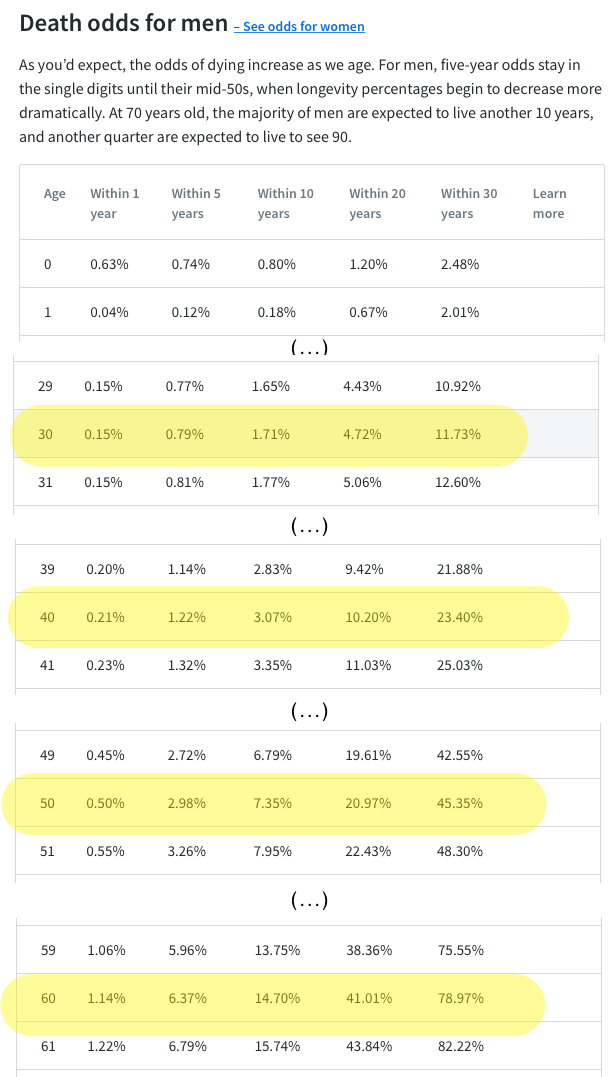
If you’re 40, you have a 10% chance of dying before even reaching 65.

What is your likelihood of dying within the next 20 years? Here are mortality tables based on Social Security actuarial data for US citizens, sorted by age and gender. Below are the rough numbers, along with an edited screenshot of the source at the very bottom.

  • A male, age 30 has a 1 in 20 chance of dying in the next 20 years (age 50).
  • A male, age 40 has a 1 in 10 chance of dying in the next 20 years (age 60).
  • A male, age 50 has a 1 in 5 chance of dying in the next 20 years (age 70).
  • A female, age 30 has a 1 in 35 chance of dying in the next 20 years (age 50).
  • A female, age 40 has a 1 in 15 chance of dying in the next 20 years (age 60).
  • A female, age 50 has a 1 in 7 chance of dying in the next 20 years (age 70).

I try to use these numbers to motivate myself and create a sense of urgency. I’m 40 years old now. There is a 1 in 10 chance that I won’t be old enough to see my daughters even finish college. The person profiled in this article is also probably around 40 years old (15-year reunion of business school). I’m sure there are plenty of 60-year-olds who say “60 isn’t old!” and it isn’t, but that is literally survivorship bias. We all know people who didn’t make it to 60, and these are the overall odds.

Time is your most precious resource. It doesn’t matter what your income is, you only have so much time. Therefore, you should spend it in a way that aligns with your values. Look for ways to get closer to that. If you can’t quit, do the same job with a better employer. Keep working, but switch to a different job within that field/skillset with more personal meaning. Saving more can mean you can get by working fewer hours. If you think you can retire but just can’t seem to pull the trigger, you need to directly confront those last few worries.

Are you unhappy with your situation and still in the same spot as a year ago? Try to find something psychological that will create a sense of urgency. I tell myself “Why am still wasting my time with [insert task]? 1 in 10.”

Andrews Federal Credit Union CD Specials: 6-Month CD at 3.25% APY

afcu_logoAndrews Federal Credit Union has a few share certificate specials that may be of interest. Thanks to reader Mark for the tip.

Each individual member limited to one Special 6-Month Certificate during the promotional period. Must be funded with new money OR the member must have a checking account, debit card, and direct deposit of $750 or more per month. All special share certificates have a $1,000 minimum opening deposit and $250,000 maximum balance. Early withdrawal penalty is 90 days of interest.

Military or federal agency affiliation is not required to become a member or open a certificate. Anyone can join via the American Consumer Council. Check out my Andrews Federal Credit Union Application and Account Opening Review for details.

Personal Finance: Recognizing Control and Using Your Time Efficiently

Morgan Housel wrote a post called The Biggest Returns which really resonated with my outlook on investing and personal finance. The main idea was that you should consider the impact of your efforts in relation to the time and energy spent.

The idea that reducing your needs has the same impact as increasing your income – but the former is more certain and in your control than the latter, so it has a higher expected value – is as true for someone spending $15,000 a year as it is someone spending $15 million per year.

The hard part is becoming satisfied with spending less. […] For me it’s been realizing that what makes people happy is having options – doing what you want, with who you want, when you want, where you want. And options come from savings and assets, which are the opposite of spending.

Stock returns: Limited control. I decided on an asset allocation and invested my money in low-cost, low-turnover investments. Learning about investing and asset allocation initially was a good investment of time, but I still have limited control of the outcome. More importantly, this gave me the conviction and patience that it will work out in the long run. But I still might lose money in any given year, and I can’t just put in more effort and improve that return. I only check in on my portfolio quarterly.

Cash returns: Moderate control. About 1/3rd of my portfolio is in high-quality bonds, which in my definition includes cash and certificates of deposit. Here, I have some more control. For example, if I put money into a 5-year CD at 4% APY, I have high confidence it will do better than a 5-year Treasury bond at 2.50% yield. Sometimes there are such opportunities for the individual investor, sometimes there aren’t. Therefore, I track the best interest rates monthly.

Income: Moderate to significant control. Income is obviously important, and I while would rate it as more important than spending, that doesn’t mean spending in not also very important. There are plenty of people who earn $250k and spend $250k per year, while a $85k earner could spend $60k and save even more. But that same 250k earner has the ability to “see the light” and have their saving explode over the next few years. Unfortunately, there are no easy, foolproof ways to earn a high income. Of course, you should invest in yourself and improve your marketable skills and thus increase your human capital. Some people can move up the corporate ladder, others will do better with a more entrepreneurial route.

Personal spending: Significant control. Managing your spending is all about priorities, but there are two simple ways to attack your spending. First, you could start from the bottom and get rid of the more questionable “wants”: Expensive food habits (coffee, alcohol, snacks), monthly entertainment subscriptions, gambling, etc). Second, you could start from the top and pair down the big “needs”. I could have gotten a mortgage approval for a 3,500 sf house in my neighborhood. I live in a 2,000 sf house. I could pay cash for nearly any vehicle on the market. I bought a used minivan. I could have had fewer kids… Oops!

Credit cards, bank bonuses, and other “found money”: Significant control. You won’t get rich solely from taking advantage of credit card sign-up bonuses, maximizing your cash back, or picking up $10-$100 here and there each week, but I estimate that it adds up to $3,000+ each year for our household. $3,000 is a 5% increase to a $60,000 income, or a free annual vacation. You should pick and choose what works for you; for example I refuse to drive around town (to buy gift cards, redeem coupons, buy and resell, etc). I prefer deals that can be done with just clicks.

This is also a good reminder that even though I might not write about them repeatedly, your biggest returns on effort might be: get a better job, relocate to a city with greater relative opportunity (income vs. cost-of-living), move into a smaller house, and buy a cheaper car (or find cheaper transportation). On a daily basis, the things that catch my eye (and thus what I write about) are actionable ideas where I have control of the outcome.

H&R Block Tax Software 2018: Federal w/ e-File + State $18 (2/19 Only)

Update: This deal is back for one day again – February 19th, 2019.

The benefit of “old-school” desktop tax software is that it doesn’t require your Social Security Number and financial details to be stored in the “cloud”, a fancy word for a third-party server where it can be copied or hacked. Here’s a limited-time deal on H&R Block Tax Software 2018 (PC/Mac download or physical CD).

Amazon has H&R Block Deluxe Federal + State for $18 (list price $45), the lowest price of the year per CamelCamelCamel. This is a 24-hour “Deal of of the Day” (sorry I don’t get advance notice) and matches the lowest price ever for the 2017 version ($17.99). Download or disc. If it is out of stock, you can still buy it and lock in the price. In past years, it has gone on sale for only a few 24-hour periods at this low of a price.

H&R Block Deluxe includes guidance for stock gains and losses, home mortgage interest deduction, and other itemized deductions. Compare that against TurboTax Deluxe Download which makes you upgrade to TurboTax Premier to get guidance for stock sales and dividends. H&R Block Premium includes rental properties and self-employment. All flavors include “Refund Bonus” where you can a 5% bonus if you take your refund in the form of an Amazon gift card.

Keep in mind that for these products 5 Federal e-Files are included but State e-File is extra ($19.95 per state). I would personally just print the (usually shorter) state return out and snail mail it in if you don’t have a free State e-File option.

Building a CD Ladder: Fidelity Auto vs. DIY vs. Treasury Bonds

Building a “CD ladder” means funding a combination of certificates of deposit (CDs) with different maturities so that you have always have a portion of your funds maturing soon (providing liquidity) but you also increase your interest rates (more $$$). Here are two common CD ladder types:


  • 2 Year Ladder: Four maturity “rungs” – 6-month, 12-month, 18-month, and 24-month CDs
  • 5 year Ladder: Five maturity “rungs” – 1, 2 ,3 ,4, and 5-year CDs

You start out by funding a CD for each rung (i.e. a $5,000, 5-year ladder would have $1,000 in each maturity). Then, after a year, you can keep the ladder going by buying another rung at the longest maturity (i.e. the 5-year ladder would buy another $1,000 5-year CD after one year has passed).

Fidelity has a CD ladder service where they will build a CD automatically for you using brokered CDs from their inventory. They will even re-invest, or “Auto Roll”, your maturing funds into a new rung if you wish. The service itself is free, but the CD rates aren’t necessarily the absolute highest available, especially when you include credit unions.

Alternatively, you could move around your own funds and build your own ladder (DIY) using certificates from various banks and credit unions. Finally, you could also buy Treasury bill and bonds of similar maturities, as they are also backed by the government so you can be confident that you’ll get your principal back.

I decided to run a quick survey today (February 13, 2019) to see what your average interest rates would be for the three different methods:

  • Fidelity Auto – Fidelity will construct using the highest rates in their brokered CD inventory.
  • DIY – Picking the highest rate at any FDIC or NCUA-insured institution that is open to anyone nationwide.
  • Treasury – Buying individual Treasury bonds on the secondary market (bond desk, alternative rates).

(Fidelity CDs were issued by State Bank of India, Morgan Stanley, and Goldman Sachs. DIY banks used in this comparison are Ally Bank/Limelight Bank, NASA FCU, and Georgia Banking Company. Rates as of 2/13/19.)

The chart shows that currently DIY you would gain an average of 0.40% annually on your cash invested over the automatic Fidelity service. If you had a $5,000 ladder, that would be $20 in extra interest per year. If you had a $50,000 ladder, that would be $200 a year. If you had a $500,000 ladder, that would be $2,000 a year. You would have to balance the extra work of DIY with the added convenience of the Fidelity service. This number is only a snapshot and will change over time.

Right now, Treasury bonds don’t really offer much of a premium above the top DIY CD rates in this scenario. Even if you had state income tax of 10%, your effective average APY would still only be about 2.8%. That is about break-even with the Fidelity automatic service.

This is one reason why I track the top CD interest rates each month.

NASA Federal Credit Union Application and Certificate Opening Review

I recently joined the NASA Federal Credit Union to take advantage their current certificate rate specials (as mentioned in my monthly list of best interest rates). NASA FCU has had some good specials over the last year or so, and I finally decided to go through the extra effort to open an account last week since I had some funds available. Here are my notes on the application and certificate opening process that might be helpful to others.

Membership eligibility. NASA FCU’s field of membership is open to affiliated people as noted in their membership page, but you can also join a special group to become eligible:

If none of the above apply to you – we’ll provide a complimentary membership to the National Space Society (NSS) which entitles you to full NASA Federal membership benefits

Free and instant! Just click the proper option during the application process.

Application process. You will need to provide the usual personal information – name, address, SSN, driver’s license, etc. I uploaded a scanned image of my driver’s license. They also asked a few identity verification questions, I believe based on my Experian credit report.

Note: Based on online reports, I was expecting that applying for account would result in a hard credit inquiry, likely to my Experian credit report. This tends to be common practice amongst credit unions. However, it has been a week since my application and none of my credit monitoring services (which covers all 3 bureaus) have indicated that a credit check was done, including the one that tracks Experian. It might show up later, but nothing so far.

My account was approved later in the same day as my application. I also read some online reports about NASA FCU asking for additional documentation (i.e. Social Security card), but I was not asked for anything additional.

Tip: When you get the account approval e-mail, you need to open up the secure message to see your new NASA FCU account number. Write down this number as it is the account number of your share savings account.

Initial funding. As with nearly all credit unions, you must fund a share savings account with at least $5 and keep the $5 there. I was given the option to fund with credit card (up to $500) or bank account. I tried to fund it with $500 from a rewards credit card (to get some cash back), but the transaction was rejected. I’m not sure if it was because it was trying to go through as a cash advance, or some other reason. I later funded it with a bank account instead.

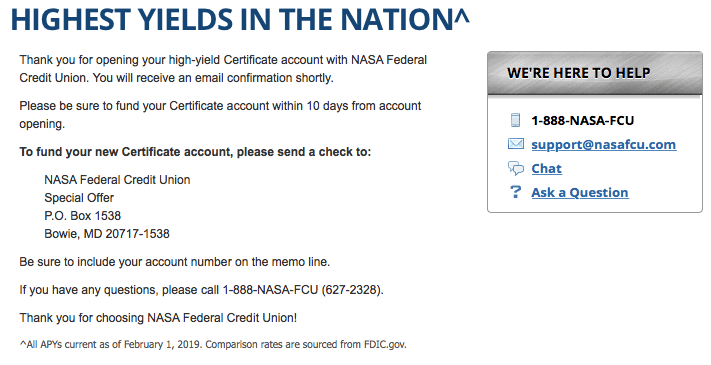
Opening the certificate special. This time around, I opened their special 15-month certificate at 3.20% APY via this page. After doing so, there was a message directing me to fund it with a mailed check to a specific address with 10 days:

There may be other options like walking in a check or using a credit union shared deposit network, but I like to do things online whenever possible. My usual process is to link my new credit union with my Ally savings account hub. First, I used the account number from the approval message (see above) and the NASA FCU routing number of 255077833. I had to use the 2 small test deposit method for verification, so that took a day. Then, Ally let me push funds with a 1-day transfer into the savings account. Finally, I used the NASA FCU Live Chat feature to have them fund my special certificate using the funds in the share savings account. Here’s my timeline:

  • Day 1 – Started application and got approval. Initiated link via Ally Bank.
  • Day 2 – Verification deposits arrived at NASA FCU. Verified link via Ally Bank. Initiated transfer.
  • Day 3 – Funds arrived at NASA FCU. Used Live Chat to fund certificate.
  • Day 4 – Certificate open and funded.

The share certificate now shows up on my online banking page, right next to the share savings account. I didn’t have to mail in anything, like a signature card. I hope that NASA FCU keeps up their trend of offering top certificate rates.

Start Audible Trial via Amazon Echo, Get 4 Free Audiobooks

If you have any Amazon Echo device, you can start an Audible trial by simply saying “Alexa, start my Audible trial”. This will start a 30-day free trial, but through February 8th, 2019 at 4pm PT, signing up in this voice manner will get your 4 free Audiobook credits, not the usual two. Even better, I have been an Audible trial member before, and I was still eligible for this promotion. Here are the promotion details.

Offer valid from 2/1/2019 at 12:00 a.m. PT until 2/8/2019 at 4:00 p.m. PT or while supplies last. Offer available only to new Audible customers who sign up for an Audible trial on an Alexa-enabled device through voice sign-up. You will receive a 1-month Audible free trial that includes 2 credits as well as an additional 2 bonus credits (for a total of 4 credits). At the end of the free trial, your membership will continue until cancelled at the then current full price (currently $14.95 per month) with your designated credit card or another available card on file. Cancel anytime by visiting the Account Details page.

I just signed up and saw the 4 free credits in my account online immediately. I believe that you need an active account to redeem credits, so I would recommend redeeming them all in the next 30 days if you don’t wish to keep up the membership (purchased audiobooks stay in your account forever, no matter what).

I used to buy personal finance and business books on Audible, but I disliked how I couldn’t make highlights and take notes while listening. Nowadays, I mostly listen to biographies and memoirs. My most recent purchases were The Magnolia Story by Chip and Joanna Gaines (Fixer Upper) and The Last Black Unicorn by Tiffany Haddish.

Generation Wealth Documentary: What Are You Chasing? (Free on Amazon Prime)

If you have Amazon Prime, I noticed that the documentary film Generation Wealth is now included as of February 1st, 2019. Here’s a short blurb and the trailer:

Lauren Greenfield examines materialism, celebrity culture, and social status and reflects on the desire to be wealthy at any cost. This visual history of the growing obsession with wealth uses first-person interviews in Los Angeles, Moscow, Dubai, China and around the world to bear witness to the global boom-and-bust economy, and to document its complicated consequences.

I haven’t finished it, but my biggest takeaway is that you shouldn’t be obsessed with certain things because even if you get what you think you want, you still won’t be happy or content!

  • If all you care about is money, you’ll never have enough money. The millionaire wants more. The billionaire also wants more. Someone else will always have a nicer house and a bigger yacht.
  • If all you care about is your looks, you’ll never be pretty enough. Your body can never be too skinny, your lips can never be too full. If someone gave you a $1 million of plastic surgery, you would probably end up just as unhappy as today.
  • If all you care about is social status, you will be striving forever. Why spend your life trying to impress people who don’t matter? The celebrities you want to be like? They aren’t all that happy either.

Obviously I think money is important, otherwise I wouldn’t be here. But money is a tool, not the goal. Can you use your energy in a useful and meaningful manner? Can you cover the basics – safe housing, clean food, and quality healthcare? Do you have loved ones with whom to share your time? None of the answers to these questions require a brand name. None require looking up to anyone on Facebook or Instagram. I try to remind myself of this regularly, whenever I feel the urge to “upgrade” something.

Watching this film made me feel exhausted more than anything else. These people are wasting so much of their life energy chasing something they’ll never reach.

TopCashBack: Shopping Portal With 100% Commission Payout – $10 New Member Bonus

Flat $10 New Member Bonus is back. TopCashBack has a bunch of rotating new member bonuses, but they are often for something like a big package of flushable wipes or laundry detergent. From now until February 14th, 2019, they have brought back the flat $10 cash bonus if you sign up via refer-a-friend link and earn $10 in cash back through shopping. When that happens, your $10 bonus will be “released” and available for withdrawal.

tcb10_1

For some reason, the $10 bonus isn’t indicated on the referral link landing page, but it does show up on the next page after you enter your e-mail and chosen password, before making any purchases. You should see this:

tcb10_2

If you aren’t already a member, some other portals also offer sign-up bonuses:

Original post:

topcashnewWhen you shop online these days, it’s become habit to search out a coupon or go through a shopping portal that gives a percentage back on purchases made through their links. Well, talk about a race to the bottom. Instead of rebating you part of their merchant commission, TopCashBack.com promises to rebate you all of it (and make money via ads on their website). You wouldn’t think that would be a viable business model, but the company is already the #1 cashback site in the United Kingdom so apparently it works for them.

TopCashBack also lets you get your payouts with direct ACH deposit, PayPal, Prepaid cards, or Amazon gift certificates. Sometimes the prepaid cards come with a 3% bonus and I just use those and buy Amazon gift cards.

TopCashBack is reliable and usually at or near the top, but not always. Sometimes one of these sites may privately negotiate a higher payout temporarily. For example, I usually get 1.5% back on eBay purchases from TopCashBack, but sometimes I can get 3 American Airlines miles per $1 spent as well from another portal.