Archives for December 2011

Graham Hill: Less Stuff, More Happiness (TED Talk)

Here’s a TED Talk I just found by Graham Hill about simple living. Try to find something that you can apply to your life in a positive manner, instead of pointing out ways it won’t work. It’s unlikely any of us will live in a place as organized as his. A quick intro:

Can having less stuff, in less room, lead to more happiness? He makes the case for taking up less space, and lays out three rules for editing your life.
90% of College Graduates Have Less Than $40,000 In Student Loans?

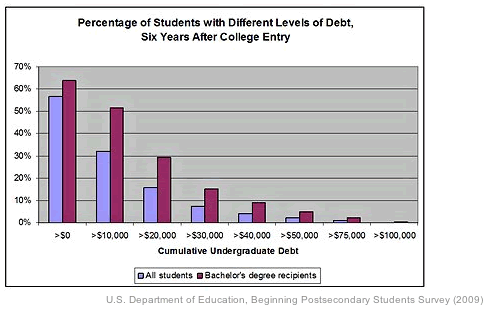
The NY Times Economix blog had a provocative post a few days ago about student loan debt, pointing out a government study that showed that 90% of bachelor degree holders had less than $40,000 in student loans shortly after graduating.

The chart below, using data taken from the Beginning Postsecondary Students Longitudinal Study (BPS) by the Department of Education, shows the percentage of beginning undergraduate students who, six years later, had accumulated more than the indicated levels of debt. One bar is for college entrants, and the second is for the ones who actually received a bachelor degree in that timeframe.

  • In a follow-up, the author clarifies that the study includes both federal loans and private loans via student survey.
  • The study does exclude PLUS loans (Parent loans). About 15% of bachelor’s degree recipients have parents who took out PLUS loans.
  • The chart does not include loan debt from graduate school.
  • The chart does not include credit card debt incurred during school. According to a 2009 survey by Sallie Mae, the average student leaves college with $4,100 in credit card debt.
  • The chart does not include other debt (home equity loan) taken on to pay for education.
  • Debt amounts may grow over time as interest accumulates.

Only 10% with more than $40k in student loans? Only 1% with more than $75k? That’s still a lot of money, but somehow seems less than I would have imagined. I could have easily left school with more than $40k in loans, and that was a decade ago.

I feel like something is missing. Perhaps part of it is the exclusions I listed above. Perhaps I’m thinking about how fast student loan debt is growing overall. In 2010, there became more student loan debt outstanding than credit card debt for the first time. Via Fastweb:

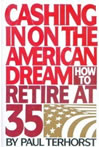
Cashing in on the American Dream: How To Retire at 35 by Paul Terhorst (Book Review)

One of classic books on many early-retirement reading lists is Cashing in on the American Dream: How To Retire at 35 by Paul Terhorst. However, this book was published in 1988 and has been out-of-print for a while. Luckily, I noticed that there were several used copies available on Amazon for $0.01 + 3.99 shipping (or $4 with free shipping) and grabbed one.

Author Background
Terhorst earned his money as an accountant, making partner at a major accounting firm in his early 30s. He retired in 1984 at age 35 with a nest egg of around $400,000. He and his wife Vicki (no children) refer to themselves now as “perpetual travelers”. He wrote this book in a era before the internet became popular – imagine how hard it would be to gather information on this topic back then, limited to early BBS chat boards or snail-mail newsletters. Sometimes I take for granted how easily we can share and discuss information today.

Paul and Vicki used to have a Geocities page that is now defunct, but they still occasionally write travel articles and it looks they have a small internet presence here.

Implementation: Managing Expenses
The basic retirement plan in the book is to spend no more than $50 a day = $18,000 a year (1988). Adjusting with the Consumer Price Index, this would be around $33,000 a year in 2010 dollars. However, personal inflation does not necessarily match the CPI, and they reportedly still manage on $50 a day as recently as 2003.

A major part of lowering your expenses is to avoid living somewhere expensive. Realize that the most expensive cities in the US are up there with the most expensive cities in the entire world! When you’re retired, you can live anywhere. The book includes several example of smaller cities in the southern US with temperate climates, lots of things to do, and a proximity to a major city and airport. They also support living close to the center of these smaller cities, using public transportation, and not owning a car – another big source of savings.

In addition, the author is a strong proponent of spending a good chunk of your time in foreign countries where a dollar goes a lot further. Latin America (Argentina) and Southeast Asia (Thailand) are places where they have lived. The key is to “live like a native, not like a tourist”. Don’t stay in hotels or live in gated communities made for expats. If the natives live on $10,000 a year, you should be very comfortable at $20,000 a year.

They pay for health care with cash in the same foreign countries, which offer quality care at much lower prices than in the US. The rest of the frugal-living advice is pretty standard. Prioritize your spending, cut out the excess consumerism, etc.

Implementation: Creating Investment Income
Investment advice is often referred to as the weakest part of this book. You have to realize that the 1980s were a completely different financial environment. With high inflation, you could buy FDIC-insured CDs paying 8% interest annually. Thus, he recommended liquidating all your assets to cash, including selling your home, and then build a CD ladder creating 8% income. Obviously, this is not an option today. But if you take a step back, you’ll see that the basic premise is that you should never take on any more risk than you need.

It’s hard to find any updated investment advice from Terhorst, but it appears like they are still happily retired and don’t worry about money much. If they needed money, you’d think they’d republish their book. 🙂 I did find this 2003 Kiplinger’s Personal Finance article which provided some insight:

…they began to move their money into stocks – mostly low-cost index funds – when interest rates declined in 1992. Now they have 40% of their portfolio in large- and small-cap stocks, 40% in natural resources companies (oil, gold, platinum), and the rest in money market accounts. […] Their assets now total more than $1 million

These days, I pose that a more realistic early retirement portfolio might be 50% dividend stocks and 50% investment-grade bonds paying out a 3% yield that will keep up with inflation overall. However, creating $33,000 a year would require $1,100,000. Creating $18,000 a year ($50/day) would require $600,000.

Implementation: Saving Up That Nest Egg
I think this area is actually the weakest part of the book. The advice is essentially work hard at your career and be a good company man. Do all the right things to get promotions and work your way up the ranks to management and upper management… until the day you bail out. This is what Terhorst did, and he doesn’t really explore any other options like starting your own business. I suppose the truth is that this method will work for many, but it’s not very satisfying.

Takeaways
The main lesson that I got from reading this book is that the concept of “early retirement” for everyday middle-class folks has been around and available for decades. However, most people today don’t seem to even know it’s an option. I guess it takes a special disposition to be unsatisfied enough with the normal 9-5 grind to do what it takes to get out of it. I’ve also realized that many people – good people! – are quite happy with working 40+ hours a week for 40+ weeks a year for 40+ years of their life. There are so many different ways to balance work, investment income, and spending to retire partially or retire early.. but first you just have realize that you have that option!

E-Trade Commission Free ETF Trade List

E-Trade has decided to join in on the commission-free ETF party, announcing a limited set of ETFs that you can trade with no commission fees effective 12/16/2011. However, to “discourage short-term trading, E*TRADE will charge a short-term trading fee on sales of participating ETFs held less than 30 days.” I tried but couldn’t find how much that fee was on the fees page. Thanks to reader Shraz for the tip.

The fund companies represented include WisdomTree, Global X, and db-X (Deutsche Bank). Many of the ETFs are definitely niche products, like a New Zealand Dollar ETF or a Aluminum ETF… meh. There are a few ETFs that may be somewhat interesting, if you like the idea of a dividend-weighted strategy:

WisdomTree Total Dividend ETF (DTD)
WisdomTree LargeCap Dividend ETF (DLN)
WisdomTree SmallCap Dividend ETF (DES)
WisdomTree Emerging Mkts SmallCap Dividend ETF (DGS)
WisdomTree International SmallCap Dividend ETF (DLS)

For context, here’s more information on other brokerage companies with their own specific ETF lists:

If you are the type of investor that wants to buy low-cost, index/passive ETFs with no commmission fees, I would say that Vanguard and TD Ameritrade are the best bets. You could build a low-cost and simple ETF portfolio from Total US (VTI), Total International (VEU), Total Bond (BND), and Inflation-Protected Bonds (TIP) for free at TD Ameritrade. You’d have to either go with a mutual fund version for TIPS or pay a commission for TIP from Vanguard.

Preview: Discover Card Increases Cashback Limit for 2012

I like to keep track of the rotating categories of the 5% cash back cards out there, but one of the more disappointing areas was always Discover’s low purchase limits of only a few hundred bucks. From October 1st to December 31st, you can earn 5% cash back on up to $300 spent in the following categories: department stores, clothing stores, and restaurants. Not bad for gift-giving purchases, but Chase Freedom even had a commercial specifically about it, as their quarterly limits were $1,500.

Discover® More® Card
From October 1 to December 31, you can earn 5% cash back on up to $1,500 spent in the following categories:

  • Online Shopping
  • Department Stores

You must enroll online to activate the rewards each quarter. Discover card has a tiered cashback rate on other purchases (1% unlimited Cashback Bonus on purchases after your total annual purchases exceed $3000; purchases that are part of your first $3000 earn .25%.).

Essentially, for any quarter you can now earn $75 in cashback at 5% for certain categories, and usually one of them is useful like gas, restaurants, and department stores. These are also areas that you should be able to not spend more subconsciously just because it’s 5% cashback.

Hundreds of Free Kindle eBooks Download Links

I already mentioned checking out library books on the Kindle eReader, but here are also some handy bookmarks to check regularly to find free content on the Amazon.com website:

  • Top 100 Free – Quick and easy, this just lists the popular free eBooks being downloaded at the moment. However, for business and finance books you may have to dig a bit.
  • Limited Time Free eBooks – List of books that are free for a limited time, and then often go back up in price. Grab ’em right away if they look interesting now, and decide whether or not to read them later.
  • Free Classics – List of books that are permanently free due to being old enough to be out-of-copyright, including several well-known classics

Want some suggestions? Here are my recent free downloads.

Reminder: You can read Kindle eBooks in almost any web browser, plus apps for PC, Mac, iPad, iPod Touch, and all major smartphones.

Crediting Hard Work vs. Innate Talent For Success

The conclusion from this Harvard Business Review article has stuck with me all day. Researchers looked into whether people think of their success as the result as either hard work or innate talent, and how it affected them later on. The distinction turns out to be important. Something to think about if you’re raising kids as well.

How often have you found yourself avoiding challenges and playing it safe, sticking to goals you knew would be easy for you to reach? Are there things you decided long ago that you could never be good at? Skills you believed you would never possess? If the list is a long one, you were probably one of the bright kids — and your belief that you are “stuck” being exactly as you are has done more to determine the course of your life than you probably ever imagined. Which would be fine, if your abilities were innate and unchangeable. Only they’re not.

No matter the ability — whether it’s intelligence, creativity, self-control, charm, or athleticism — studies show them to be profoundly malleable. When it comes to mastering any skill, your experience, effort, and persistence matter a lot. So if you were a bright kid, it’s time to toss out your (mistaken) belief about how ability works, embrace the fact that you can always improve, and reclaim the confidence to tackle any challenge that you lost so long ago.

On a related note, have you heard of the Dan Plan? Apparently a guy read Malcolm Gladwell’s book Outliers about how it takes 10,000 hours to become an expert at something, and decided that he wanted to go from never playing golf before to winning a PGA Tour event. He’s somewhere around 2,000 hours now. Even though I think I would have picked something different, I’ll definitely have to check back on his progress later.

LivingSocial: 5,200 Calories from McDonald’s for $13

LivingSocial.com and McDonald’s are selling a coupon booklet good for 5 Big Macs and 5 Large Fries for $13 – that’s $2.60 for each burger/fry combo. Over 200,000 sold already. Supposedly they want to sell a million vouchers like they did earlier this year with Whole Foods. Nutritional facts because I was curious:

Big Mac = 540 Calories, 29g Fat
Large French Fries = 500 Calories, 25g Fat

The means you’re getting 5,200 Calories for the bargain price of $13. 🙂 Are Cheap Calories The Reason We’re Unhealthy? Perhaps, but I’m of the crowd that really doesn’t expect wholesome food when buying fried beef and fried potatoes. I think it’s quite possible to eat well and cheap, but frankly some people prefer the taste of fast food.