Archives for August 2009

PineCone Research Application Link (Paid Online Surveys)

PineCone Research has re-opened their membership with an e-mail to current members. They remain one of the better paying and reliable survey companies, with a payout of $3 (check or PayPal) for each 15-20 minute online survey. The hardest part is getting accepted, as they only take applications intermittently.

Here is an updated application link at Pinecone. (Can expire at any time, so apply now if you’re interested!) Looks open to all, but certain demographics will get more surveys. Only one person per household can sign up.

I shared my thoughts on Pinecone and paid surveys in general here. I call them Bored Money – not terribly efficient but you can do it at your leisure and occasionally get to try some neat things like new soda flavors or even a new Sonicare toothbrush.

The three survey sites that I have been most active with besides Pinecone are NFO MySurvey, Opinion Outpost, and SurveySavvy. I like it them because they consistently offer me paid survey opportunities, they pay upon request reliably (important!), and they don’t mind if I don’t do every single survey offered.
Links: Young Homeowners, Tracking Rent, 1930 Flashbacks, Cheaper Textbooks, & More

A Second Home, a Starter Budget – NY Times
An article about a young couple who rent in Brooklyn but instead bought their first house in the Catskills – a two-bedroom, one-bath, 700sf fixer-upper for $95,000. Check out the picture gallery, I like their sense of interior design using Craigslist finds.

Rental Rates – InvestorLoft
Another resource for tracking rental rates, with a focus on single family homes and condos. Not sure of where they get their data, though. Compare with Rent-o-meter, which I think pulls from Craigslist.

News from 1930
This site reads the Wall Street Journal for each corresponding day in 1930, and offers a sometimes eerie look into the similarities and differences between today and then. (The Great Depression is said to have started with the crash of 1929.) Just like now, there is a lot of uncertainty about the future, and there is always the headline “Leading economists say [insert wild guess here]…”

Textbook Publisher to Rent to College Students
What’s not clear is how much cheaper it is than simply buying new and selling back later. I never understood how a book on a subject like Calculus could have a “new” edition every two years. There should be a law requiring at least 20% new material or something on new editions.

More good stuff from other personal finance blogs:

Unemployed: COBRA vs. Individual Health Insurance

With unemployment still at historic highs in many areas, a common concern is what to do about health insurance. A friend of mine was recently notified that he was going to be laid off, and so we talked about some of the options out there, and I told him I’d do some research about it since I had recently looked into an individual health plan.

About COBRA, Stimulus Bill Subsidy
COBRA gives people who lose their jobs the right to continue coverage under their group health plan. The catch is that workers must pay the entire premium themselves (plus a 2% administrative fee), which can be a lot higher than just the partial payment the employee usually pays. According to this WSJ article, the average cost of COBRA coverage for a family is $13,000 a year. In my friend’s case, he was surprised to see his corporate employer paid nearly $600 a month for his health insurance.

Keeping insurance continuity is important beyond immediate health concerns, because if you don’t have health insurance for more than 63 days, then even group health insurance plans can reject you later due to any pre-existing conditions. That can be a total disaster.

However, in February 2009 the “Stimulus bill” included a provision that would cover 65% of the COBRA premium for up to 9 months for people who qualify. You must have been involuntarily terminated between 9/1/08 and 12/31/09, and also not exceed an adjusted gross income over $125,000 for individuals ($250,000 for married couples filing jointly). According to this IRS page, there is no paperwork or extra tax return details to deal will; you just pay the 35% to your employer and let them handle it. In my friend’s case, this would lower his required payment about $210 a month for the next 9 months. That’s quite a discount!

Individual Health Plans
Still, if you are relatively young and in good health, you should be able to get a much cheaper health plan from many insurers. Group health insurance by definition has to cover everyone in the company, and may cover a lot more than you’d be willing to pay for yourself. However, you’ll have to familiarize yourself with some of the terminology. Here’s another quote from the WSJ article:

“My beef with Cobra is that it is the same gold-plated plan that my employer offered, when I would settle for copper or tin,” he says. Instead, he bought a catastrophic health plan, which covers only major hospitalizations, for $100 a month.

One of biggest comparison sites for individual plans is eHealthInsurance.com, which has a separate section on short-term health insurance plans. From their site:

Short-term health insurance plans provide you with coverage for a limited period of time, and may be an ideal solution for those between jobs or those waiting for other health insurance to start. Typically, short-term plans offer coverage up to six months, although some plans may offer coverage up to 12 months.

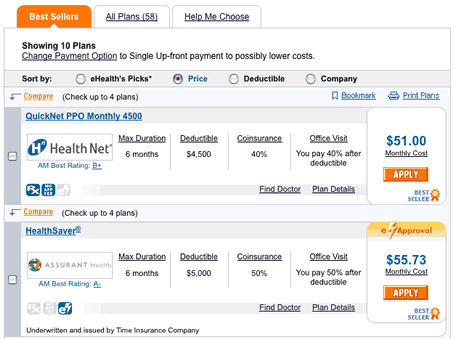
Indeed, I found basic 6-month plans starting at $50 a month, though they come with some hefty deductibles. As quote above, the idea here is just cover catastrophic events.

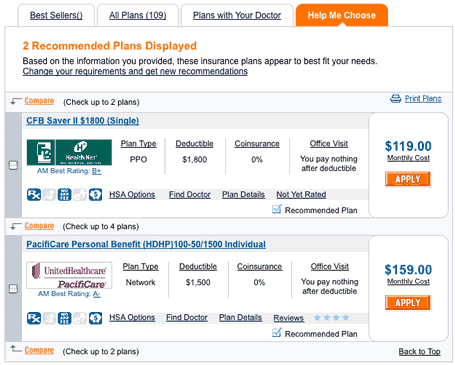
If you see the tab labeled “Help Me Choose”, I found the questionnaire there really helpful in narrowing down the choices. I figured I would want a temporary plan that would basically cover everything over, say $1,000-$2,000, but everything below that I would pay for, including doctor’s visits. The recommended plan ended up being a regular individual plan (not short term) that only cost $120 per month.

The annual deductible was $1,800, but I with 0% co-insurance (nothing above the deductible) as opposed to the 20-40% co-insurance on other plans. So the most I’d be out-of-pocket would be $1,800 a year. If there was no 65% subsidy, this $120/month insurance would beat out the $600/month COBRA option easily. Even now, it’s close. I could even add on a health savings account (HSA) and put more money away tax-deferred.

(The above is just an example. Your actual comparison results are dependent on age, sex, and location.)

How The Average U.S. Consumer Spends Their Paycheck

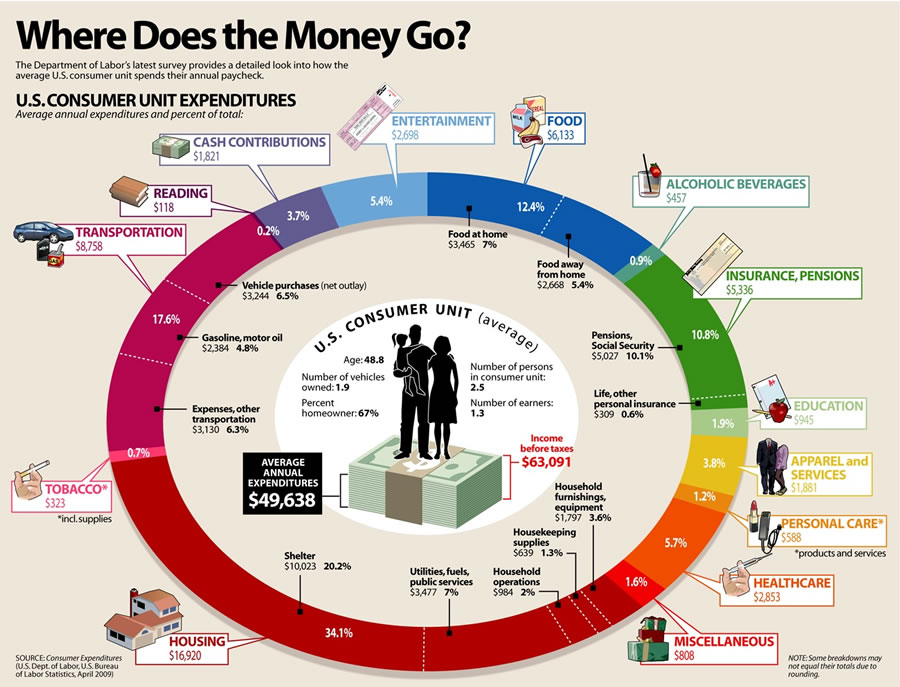
Here’s an interesting graphic of the spending breakdown for the average U.S. consumer. It’s based a theoretical household “unit” consisting of 2.5 people, not individuals. Looks like such a household unit spends approximately $50,000 per year. Click on image for larger version.

I guess taxes are not considered an expense by the government. 🙂 I’m not sure where leisure travel or vacation spending falls under, perhaps split as transportation and housing?

The image was created by Visual Economics, using information taken from the Consumer Expenditure Survey by the U.S. Department of Labor.

Scottrade Brokerage Cash Management Tips

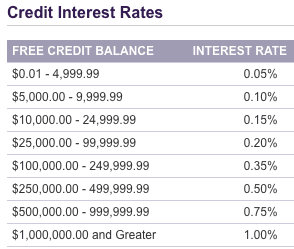
If you have an account with online broker Scottrade, or are thinking of getting one, this post is about moving funds in and out of your account. Like many brokers, the interest paid on idle cash sweep balances is very low at Scottrade, so it doesn’t pay to keep cash there. Here’s a current interest rate schedule from my account page:
Many other online brokers I’ve used like Zecco or TradeKing have online ACH deposits/withdrawal systems similar to online banks, but moving money around with Scottrade is a bit different, although in some ways it is also better.

Deposits
Scottrade has a service called MoneyDirect for electronic deposits. It is similar to most online bank transfer systems in that you just need the routing and account numbers for setup, but only allows one-way transfers from external bank to Scottrade.

However, a useful feature about the MoneyDirect system is that you can make instant, same-day deposits. So I can leave minimal cash in Scottrade, but if I wake up one day and want to make a trade, I can move up $100,000 into my account with just a few clicks during market hours. From the site:

New and existing clients will be given credit for the transfer the day it is requested, as long as the request is made prior to 8:45 p.m. (ET) Monday through Friday. Transfer instructions received on a non-business day or after the specified cutoff time will be processed the next business day around 6:00 a.m. (ET).

Restrictions: Funds deposited through Money Direct cannot be used to purchase stocks under $4, any unlisted stocks, any options, or any stocks that are deemed non-marginable by Scottrade until the third business day after the deposit.

Withdrawals
I’ve had an account with Scottrade for years, but despite vague promises, moving money out electronically through them is still unavailable. However, there is a workaround. If your account has a minimum account equity (cash + stock value) of $5,000, you can request checkwriting capability on your account. With checkwriting, you’ll have a checking account number and routing number that you can use to link to other financial institutions.

If you use certain banks using CashEdge, you can look for the “investment accounts” options as shown here. Scottrade is one of the participating brokers, although you still need your checking account number.

Scottrade will provide you a free Visa debit card and 50 free checks. My checks are through UMB Bank. I’ve gone below the $5,000 level and kept my check writing ability, so even if your account is usually smaller, it may be worth it to reach $5k temporarily to qualify for this feature. In addition, you can now access your money by writing yourself a check, using the debit card for a purchase, or making an ATM withdrawal.

Read my Scottrade review for more tips and my account opening experience.

The Power of Passive Index Fund Investing: An Example

The other day, I was trying to explain to a friend why I invest in index funds. I came up with this example, which I’m not sure is perfect but I thought I’d share it.

Background: Market Cap Indexes
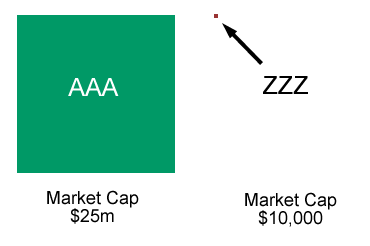
When you hear “index funds”, it traditionally means mutual funds that follow an index which holds companies proportionally to their market capitalization. If a company has 1,000,000 shares and each share is trading at $25, then its total market capitalization is $25 million.

Let’s take the S&P 500 Index. The market cap of Starbucks (SBUX) is $14 billion dollars, while Exxon Mobil (XOM) is worth $334 billion. So an index fund tracking the S&P 500 would hold 24 times as much Exxon as Starbucks.

The index fund is “passively managed” in that it does not make any of its own decisions on the value of each company, it simply accepts the value of the each company as determined by each day’s market trading between millions of investors.

An Alternate Universe

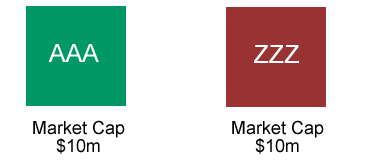
Let’s imagine an alternate universe where we only have two companies, AAA and ZZZ, that make widgets, the one thing people there buy. Both have a million shares outstanding. Company AAA makes widgets and has earnings of $1 million a year. It’s been around a while and is fairly boring, so the price/earnings ratio is 10, making the market cap $10 million. Thus, each share is worth $10.

Company ZZZ also makes widgets and has earning of only $500,000 per year. But it’s newer and makes stylish widgets that attract young people. People seem to think it has greater potential for earnings growth, so the P/E ratio is 20. Thus, the market share is also $10 million, or $10 per share.

An index fund is created to track this alternate universe, and based on market-cap it holds 50% AAA and 50% ZZZ.

So what happens in the future?

Scenario #1
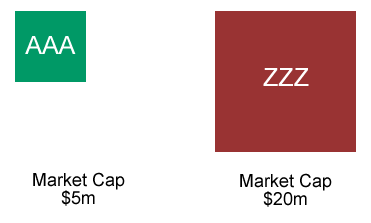
ZZZ could keep taking market share from AAA with their cool and stylish widgets. AAA’s earnings go down to $500,000, and the P/E stays constant at 10, leading to a new market cap of $5m. ZZZ starts earning $1,000,000 per year, and with a P/E of 20 grows to a market cap of $20m.

What happens to the shares in your index fund? Nothing. No trades are made, because only the share values have changed. You hold the same number of shares of each. However, your fund’s value has grown 25% because the value of ZZZ has doubled, while the value of AAA has been cut in half. Your holdings based on market value are now 20% AAA and 80% ZZZ.

Scenario #2
Things are going along, but then a new medical study finds that ZZZ’s widgets cause cancer, and it turns out the CEOs have been covering this up for years. ZZZ tanks, and is now trading at a penny per share, while everyone is switching to AAA’s reliable widgets. AAA goes up to a market cap of $25m ($25 per share).

What happens to the shares in your index fund? Still nothing, even though you now own 99.96% AAA. Meanwhile, your fund has grown another 20% because of AAA’s growth, even with ZZZ’s collapse.

Summary
You don’t know what is going to happen in the future. There are a million different possible scenarios I could have chosen. AAA could have split off a small division called BBB and it could have taken over the world. The most important point is, whatever happens, with a market-cap index fund, you are guaranteed to own all the winners.

You’ll also have owned the losers, but remember you won’t know who they are beforehand. Buggy whip manufacturers used to be huge. Now, iPhone-making companies are growing. One day iPhones will be in landfills, and we’ll be onto downloading knowledge directly into our brains or something. Or maybe we’ll run out of oil and be back to buggy whips. Who knows.

“Don’t look for the needle in the haystack. Just buy the haystack.” – John C. Bogle

This is the power of passively-managed index funds. With low-cost index funds, you’ll even be guaranteed to beat the average investors’ performance because of investment expenses eating into their return.

Free US Airways Silver Preferred Status For 90 Days

US Airways is running a promotion where you can try out their Silver Preferred “Elite” status for 90 days. Normally, you’d have to pay $200 or fly 25,000 Preferred-qualifying miles (or 30 qualifying segments) within a calendar year. You must register by August 31st.

The perks of Silver Preferred include:

  • Priority check-in, express security lines, and early boarding.
  • First and second checked bag (free of charge)
  • Free upgrades to first-class when available.
  • 25% bonus miles flown on US Airways

A pretty good deal if you are making any US Airways flights in the next 90 days. I’m not sure how they count the 90 days, it may be a good idea to register near the end of the promotion if you’re traveling during the winter holidays.

Try Preferred status on for size. See how you like it. At the end of your 90-day trial, you may want to keep it! Once you register, you’ll be Preferred within 14 days. […] Just register between May 15 and August 31, 2009. Then, check your Dividend Miles profile to make sure we have your contact information so we can send you an email with your new status.

OptionsXpress $100 New Account Bonus via Referral

Here’s another solid opening account bonus for an online broker. OptionsXpress is offering new customers a $100 bonus if they open an account with a referral from a current customer. You must maintain an average balance of $500 for 6 months, and make at least one trade. That’s a pretty sweet return on $500 in exchange for you trying out their service.

OptionsXpress offers $14.95 trades, free real-time and streaming quotes, and has lots of features for options traders. There are no minimum account balances, no account maintenance fees, and no inactivity fees.

If you’re looking for something safe to buy, the new WisdomTree Current Income Fund ETF (USY) is designed to have very low volatility and currently yields 1.03%. Another option I like is PowerShares VRDO Tax-Free Weekly (PVI), which also has a stable NAV from VRDOs and currently yields 2.62% tax-free. These would also work well with the TradeKing $50 bonus if you’re low on stock ideas.

I have an account, so if you’d like a referral just contact me with OptionsXpress in the subject, and I’ll be happy to send you one. I only need your e-mail address. You must open your account with the same e-mail you give me, and also use the promotional code FRIEND on your application.

Here’s the complete fine print:

$100 in your account and $100 in your friend’s account
Offer limited to one $100 bonus per referrer and referred friend, for each unique referral resulting in a newly activated, funded optionsXpress account meeting the terms and conditions of the refer a friend program. To qualify for the $100 bonus, the referred account must maintain a per account average balance of $500 for 6 months, and the account must trade at least once. The $100 bonus will be deposited into the referrer and referred accounts within 45 days after the referred friend meets the terms and conditions of the offer. To qualify, the referrer must enter the referred friend’s email address through this page, and the referred friend must enter the promo code “FRIEND” through the new account application form when opening the new account. A referred customer can only qualify for the $100 bonus a total of one time. A customer can only qualify for a total of $500 from any combination of optionsXpress cash promotions per calendar year. Deposits of new funds or securities from existing optionsXpress accounts are not eligible for this offer. Qualified (IRA), linked and shared accounts are not eligible for this offer. This offer is not valid for optionsXpress associates, non-U.S. residents, certain referring parties, and where otherwise prohibited. Customers can not exchange the $100 for other offers, cash or credit. We reserve the right at our sole discretion, to cancel, modify or suspend this offer program at any time without notice.

Historical Net Worth & Goal Chart Updates

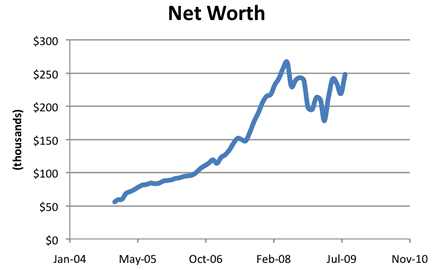
I finally got around to updating all my net worth charts and graphics. Here is my net worth since I started tracking it on this blog in December 2004:

You can also view my net worth since graduating from college in my Net Worth page. You can download my tracking template here.

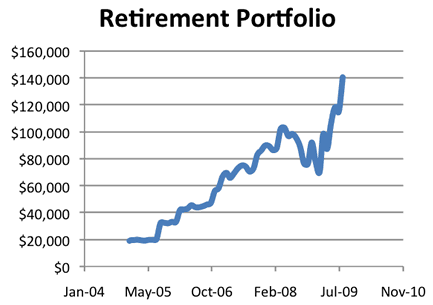
Since I had all the data handy, I also put together a chart of the value of my retirement portfolio. This is simply the sum of all the money in our 401k/IRA/403b’s over the years, including any gains/losses and contributions. Since I did a Traditional-to-Roth IRA conversion a while back, I normalized all the values by taking 30% off of any pre-tax account values. Therefore, the chart is of (estimated) after-tax balances.

As you can see, my portfolio is small enough that regular contributions have been able to counter the rather mediocre returns over the last 5 years so. The swings in our property value is also contributing to making our overall net worth very volatile recently.

Goal Tracker Chart
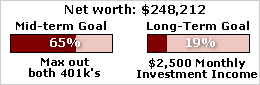
I also wanted to update my little goal meter on the top-right of every page. I updated our 401k contribution progress; we are on track to max them out for 2009. My first long-term goal is pay off my home mortgage, so I won’t have a house payment anymore. My second is to build a $750,000 investment portfolio. More details here.

At a 4% inflation-adjusted withdrawal rate, a very rough rule-of-thumb, $750k would create an annual income of $30,000 per year ($2,500 monthly). This should cover all our non-housing expenses. At the current $140,000 value, I’d theoretically be able to produce about $467 of “passive” income per month.

I’d like to come up with a better graphic to track these things, but for now I’ll stick with the progress bar. Any creative ideas out there?

State Farm Auto Insurance & Rental Car Coverage

Do you know if your auto insurance company will cover you in an accident in a rental car? According to a survey by Progressive Insurance, only 25% bother to ask. We are looking into booking a rental car for a week, so I called State Farm to double-check what the current rules are. A week of loss-damage waiver (LDW) would cost well over $100, so it was definitely worth a phone call.
Below is what I got from my agent, but I’m sure that auto insurance laws vary by state, so don’t assume the following extends to you. Call yourself! If you’re really serious, you’ll get them to show you where all this is written out in your insurance policy. I know I kept mine somewhere.

Liability Coverage. Your existing limits extends to the rental car.

Comprehensive Coverage. This extends to the rental car. Your same deductible applies.

Collision Coverage. This extends to the rental car. Your same deductible applies.

Other Possible Charges
This could be good news for some, but perhaps not quite so good if you have high deductibles. In addition, she did point out that there are certain things that State Farm will not cover from the rental car companies.

  • Claims Processing Fees or “Administrative” Charges – If you get in an accident, it sounds like they can charge you a fee just to deal with it. Blech.
  • Loss-of-Use Charges – The rental car company will claim that for every day the car was being fixed, they could have rented it out. They don’t even have to prove that they were out of cars at the time.

Secondary Rental Car Insurance
This is where the secondary rental car insurance from credit cards can come in handy. Details can still vary depending on the specific card, so look for specific wording in the paperwork that they mail you with the tiny print on amazingly thin paper. Here’s some sample info from Visa:

Visa Auto Rental CDW reimburses you for the deductible portion of your personal automobile insurance, valid administrative and loss-of-use charges imposed by the rental car company, as well as reasonable towing charges resulting from covered damage or theft of the rental vehicle while it is your responsibility.

This seems to plug in the remaining holes in coverage, besides the vague usage of the word “valid”.

Unlimited Non-Owned Car Coverage (UNOC)
Another option is to purchase an additional rider on your auto insurance, which State Farm calls UNOC. She quoted me about $30 per 6-month period. However, you can simply add it on and take it off for something as short as a month, which on a pro-rated basis would cost only $5.

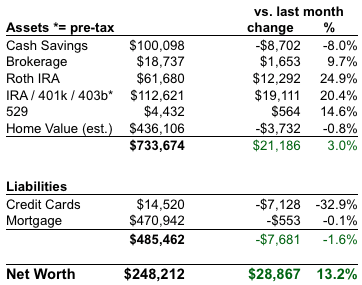
Monthly Net Worth Update – August 2009

Net Worth Chart 2009

Credit Card Debt
For newer readers, I have taken money from credit cards at 0% APR and placed it into online savings accounts, bank CDs, or savings bonds that earn 4-5% interest (much less recently), and keeping the difference as profit. I even put together a series of step-by-step posts on how to make money off of credit cards in this way. However, given the current lack of great no fee 0% APR balance transfer offers, I am mostly waiting on existing offers to end. I just paid off a large-ish balance this month.

Retirement and Brokerage accounts
Besides watching another market rally, we made a bunch of retirement contributions this month. Wife’s 401k is now maxed out at $16,500 for 2009. I made a $5,000 contribution to my Solo 401k. This makes us about 65% done with our goal of maxing out both our 401ks for 2009.

Early in the month, I also decided to go ahead and make our IRA contributions for 2009 (non-deductible due to income limits). So that’s another $10,000.

Cash Savings and Emergency Funds
We still have a little over a year’s worth of expenses in our emergency fund. I was supposed to use up some of the cash to make a principal prepayment this month, but didn’t do it due to a variety of reasons. Mainly, I wanted to do things in order and do the retirement contributions above first. We also found that we have a roof leak that may require some cash.

In addition, we have gotten some quotes on a solar hot-water system for the house, which seems like it would have a fast payback period of 2-3 years. A photovoltaic system would cost significantly more and have a payback period of around 8-9 years depending on size. Still researching this.

Home Equity
Using four different internet valuation tools – Zillow, Cyberhomes, Coldwell Banker, and Bank of America (old version) – I again took the average and took off 5% to be conservative and 6% for real estate agent commissions. The bloodshed slowed a bit this month. 🙂

All in all, more steady progress. I feel like I’m not learning a lot from these updates, but it seems to be a good habit to keep an eye on things.

Costco Membership Certificates w/ $50 in Free Costco Coupons

Update: Costco is no longer allowing me to sell these certificates. Sorry!

See Is Costco Executive Membership worth it?