Archives for May 2007

Surprising Truths (and Half-Truths) About Credit Card Debt

You’ve probably heard that the average American has over $8,000 of credit card debt. It’s been quoted all over the place. But does that single stat accurately explain the whole picture?

A popular source of this data is CardWeb Inc., which tracks such credit card data. Let’s take their 2002 data, which says that American households had average credit card debt of $8,940. Wow! But look closer. This figure is arrived at by dividing total credit card debt outstanding at the end of 2002 ($750.9 billion) by the number of American households that have at least one credit card (84 million). So not only are you counting balances that will be paid in full within the grace period, you are also only dividing by just the households that have a credit card. There are 21 million families with no credit cards at all.

Instead, I think you should only take the the amount of debt that Americans actually paid interest on, and divide it by all American households. To me, this is a more accurate definition of “average credit card debt per American”. This is $612 billion divided by 105 million, or $5,829 per household. And that’s not all.
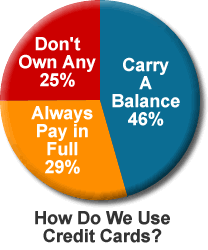
Another source of information is the Federal Reserve’s Survey of Consumer Finances (SCF). Here, the 2004 survey found that the average (mean) balance for those carrying a balance was $5,100, but the median was only $2,200. The large difference between the mean and median values indicates that the debt is not spread around equally – a small amount of borrowers have the majority of the debt. In addition, only 46% of families actually carried a balance, and 25% of families don’t even have any credit cards at all.

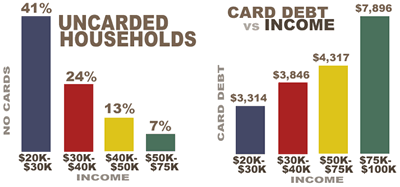
Now, what is the relationship between debt and income level?
altext

(This is actually based on Cardweb data, but the SCF data is very similar.)

Here, we see that as income increases, people are more likely to both use credit cards and also carry higher balances. But from a recent Gallup poll, while the overall debt-to-income ratio among credit card holders is 8.0%, it is over 10% among people earning less than $40,000 a year, and much smaller among people with higher incomes.

Also, I observed that the Federal Reserve total debt numbers are lower than the Cardweb numbers, but the other stats like card ownership and the distribution vs. income are very similar. I suspect that one major reason for this is the self-reported nature of the SCF: People are underestimating their debt due to either denial or embarrassment. So that $2,200 number above may be higher in reality, but still not as high as $5,000 or $9,000.

Summary
On one hand, you cannot refute the fact that credit card debt is indeed a huge problem for many families. Any way you cut it, $612 billion is a big number. And the families with the highest debt-to-income ratios are earning less than $40,000 a year. I think better education and more transparency in credit applications should be implemented.

However, many of the sound bites thrown around about credit cards are very misleading. The majority of households don’t pay any credit card interest at all. None. Zero. Zilch. Of the families that do carry a balance, the median amount owed is in the neighborhood of $2,000-$3,000. Paints a different picture, doesn’t it?

(Yes, people like me who profit from credit card debt probably skew the stats a little tiny bit as well. 😛 )

References
The idea for this post was taken from an older MSN Money article, which used 2001 data. You can find the 2004 Survey of Consumer Finances here, and the Cardweb data here.

Zecco Speeds Up Account Opening Process?

A mere two days after I ranted about Zecco’s slow opening procedure in the second part of my Zecco Free Trades Brokerage Review, reader Richard alerts me that they have removed the mail-in paperwork requirement for many new applicants. After applying, you now see this:

If you applied for an Individual or Joint account on or after Thursday, May 10th, and you have a US Social Security Number, you?re all set.

However, if you either:
– applied prior to Thursday, May 10th for any account
– applied on or after May 10th, but you were asked to mail your documents
– applied for an IRA account
– do not have a US Social Security number:

please provide your required paperwork.

Hmm… This is either coincidence, or maybe I have some influence after all. 😀 Somebody also said that Zecco was swamped with IRA applications near the April 15th deadline, which further slowed things down. Either way, I hope this indicates better things to come!

Kiva Review: Giving a Virtual Hand Up, Not a Handout

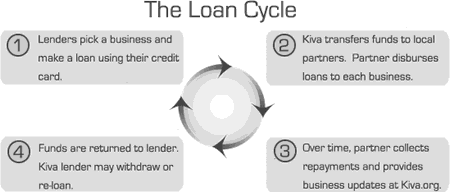
I’ve written about Kiva before, but since I loaned some more money out today I thought I’d bring it up again. Kiva.org allows individuals to make loans starting at $25 to low-income entrepreneurs in the developing world, also known as microcredit. By doing so, you can provide affordable working capital for the poor (money to buy a sewing machine, livestock, etc.), empowering them to earn their way out of poverty.

altext

So far I’ve lent money to people in Samoa, Ecuador, Ukraine, and Azerbaijan. Now, even though I’m not earning any interest on the money I loan out, I’ve read that the borrowers do pay interest on the order of 10% or more. However, these rates are still much better than their alternatives from loan sharks, and the interest goes to fund the local operations. You can view the interest “lost” as charity if you’d like. I kind of just see it as lending money to a friend – no interest, but you’re hoping to create some positive change. Payments are handled through PayPal, and they have a 100% repayment rate so far.

Here’s my favorite loan so far:

Vitolina owns a set of beach fales that she rents out to back-packers or picnickers passing through the village and works hard to keep the structures in good condition. Fales are simple, small open huts with thatched roofs built in the style of the traditional Samoan house. Vitolina?s fales are situated on a white sandy beach on the Samoan coast. She readily welcomes guests and provides them with a simple roof, unbeatable views, and home-cooked meals. She will use the loan to renovate the beach fales.

I would certainly pay for that! Now imagine that she makes a profit, builds more huts, and hires other Samoans as employees. She’s now making a self-sustaining living for herself and several other people. I get my money back, and can lend it out again somewhere else across the globe. Beautiful.

Emigrant Direct Signup Bonus Update – March Payouts

Payout instructions for my Emigrant Direct Referral Bonus went out over the last two weeks for those that either sent me their Form #2’s or Claim Form A’s in March. Please let me know if there are any questions.

Emigrant Direct offers an online savings account paying 5.05% APY with no minimum balance requirements, and I have partnered with them to offer a sign-up bonus worth up to $20 if you choose to open an account with them through my specific link. Combine this with the $25 opening bonus from Capital One 360 and $20 opening bonus from VirtualBank for some quick bucks. Some have minimum opening amounts, but none have ongoing minimum balance requirements or monthly fees, so you can try each one out and just stay with the ones you like.

What If Vanguard or Fidelity Went Bankrupt?

Continuing on the line of thinking started by my post on What if my bank fails?, the next question might be what if my mutual fund company went bankrupt? I mean, I have a lot of money in Vanguard and Fidelity right now. What happens if one of them “pulls an Enron” or simply runs out of money?

One source of information is this 2004 Money magazine article written shortly after previous mutual fund scandals:

What happens if my fund company fails?
Your money is safe. Under the Investment Company Act of 1940, which governs the industry, each fund is set up as an individual corporate entity, with its own board of directors. Essentially, your fund hires the fund company to manage its assets. If the company were to file for bankruptcy, its creditors would not be able to touch the funds’s assets. And the fund’s directors could immediately hire a new manager, pending shareholder approval.

The way I read this, mutual fund managers are interchangeable. If the fund company goes bankrupt, the assets would remains the same, one would just have to hire a new company to manage it. In addition, one of the features specific to Vanguard is that it is set up as client-owned. How this works is that each of us might own a share of a mutual fund like VFINX. In turn, that mutual fund is a separate entity that contributes money to fund Vanguard’s operations, instead of the other way around. Here is an excerpt from Mel Lindauer of the Diehards forum, which explains this setup well:

First, The Vanguard Group Inc. (VGI) is actually a subsidiary of the various mutual funds, each of which is a separate legal entity. The best way to describe Vanguard’s unique structure would be to think of General Motors turned upside down, with Chevrolet, Cadillac, Oldsmobile, Pontiac, etc. as the corporate parents, and General Motors as a subsidiary. If you think of Chevrolet, Cadillac, Oldsmobile, Pontiac, and the other GM divisions as mutual funds, and General Motors (the subsidiary, in this situation) as Vanguard Group Inc., you’ll get the picture.

Since VGI is actually owned and funded by the various mutual funds, it technically couldn’t go bankrupt unless all of the various mutual funds that support it went bankrupt. The only way that could happen would be for the value of all of the stocks and/or bonds held by each and every individual Vanguard mutual fund to go to zero. So, forget about Vanguard going bankrupt — it just isn’t going to happen.

Some have expressed concerns about putting “all their eggs in one basket” by consolidating their investments at Vanguard. There’s simply no need to worry about that. Each fund is a separate investment company (and part owner of the Vanguard Group, rather than the other way around). Thus, having all of your investments in several Vanguard funds is tantamount to having your investments spread among a variety of baskets, each independent of the other. So, put your fears to rest; your investments are safe at Vanguard.

The Real Question – Ethics and Management
In the end, the real fear that one should have is that their mutual fund management will simply make poor or reckless investment decisions and lose your money perfectly legally. Also, in previous ethics scandals, managers also performed illegal trading or other activities specifically forbidden in their prospectuses. This is why ethics and consistency of management should be a component of why you choose to invest in a mutual fund, and why I feel very comfortable with the majority of my assets in Vanguard index funds.

I have never heard of a mutual fund company going out of business. But I’ve read about a lot of bad mutual funds with horrible performance. And this drop usually happens after a period of great performance and the heavy advertising and money inflows that ensues. Something to think about.

Zecco Free Trades Broker Review, Part 2: Corrections, Funds Transfers, and Trading Experiences

This is the second part of my review of the Zecco brokerage account. If you haven’t already, please read the first part of this review, where I went over the main draws of Zecco and the account opening process. Here, I will finish up my review of the opening process and also talk about my trading experiences.
Funds Transfer Speed and Experience
I initiated an online funds transfer from the Zecco website early on Tuesday. The funds were taken out of my savings account on Wednesday. The funds appeared in my Zecco account on Thursday and was available for trading. You probably still want to avoid straddling a weekend, but I’ve made two transfers and both took one business day. I’m glad the transfers are prompt.

One thing about the transfer system is that it can be tricky to find your pending transfer request after you submit it. You actually have to search by processing date, which is tedious.

Trading Interface
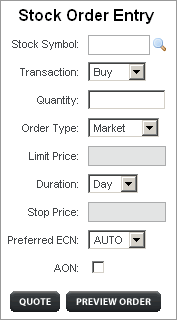
I am not an active stock trader, so I am not an expert at determining the quality of their real time quotes, options setup, or other such things. I thought the trading interface was fine, and similar to the many other brokers I have used. I just want to buy and sell stocks every so often, not day-trade. A screenshot of the order entry form is on the right.

Trading Experience
What I have done so far is make two test trades of the Vanguard Total Stock Market ETF, symbol VTI.

#1: On Day 1, VTI’s last trade was at 149.23, with a bid of 149.16 and ask price of 149.22. I placed a limit order at 3:39pm to buy just one single share at $149.18. The order was filled six minutes later at $149.16 , 2 cents below my limit amount. (As an aside, a bid/ask spread of 5 cents on a $150 ETF seems very reasonable. More on this later.)

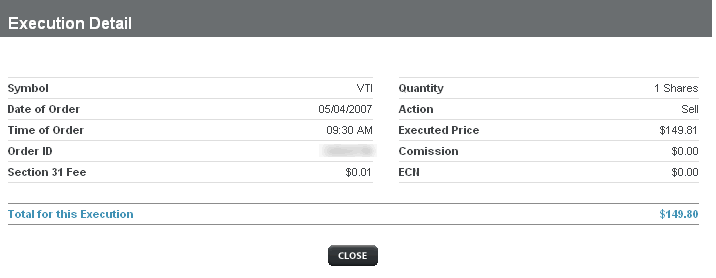
#2: After the market closed on Day 1, I went ahead and placed a sell order on my single share of VTI at my buy price of $149.16. My goal was simply to get my money back. My order was filled right at market open (9:30am) for $149.81. Here is a screenshot from my order history.

I was not charged any commission for either trade, as promised. On the sell order, I was charged a penny for a Section 31 fee. This is a small fee charged by the SEC in order to help fund their overseeing activities, which brokers pass on to us. It’s assessed only when you sell a stock.

What are Section 31 fees and how are they calculated?
The normal calculation for Section 31 fees is $30.70 per $1,000,000 in principle amount on sales. A principle amount of $140 would be subject to a Section 31 fee of $.01.

So I feel my trades were filled successfully and also promptly as the market allowed. There were no indications of shady behavior. For example, with my limit order of $149.16, they could have just given me $149.16 instead of the market price that was $0.65 higher. I would be comfortable using market orders if my goal was to dollar-cost-average into ETFs. Overall, it was pretty cool to be able to trade small amounts and not have to worry about commissions.

Few More Details
» Cost Basis Accounting – They use the FIFO (first-in first-out) method by default on 1099s, and don’t support HIFO (highest-in first-out) on their end. If you want to use HIFO, you’ll have to calculate it manually.

» You get a paper confirmation snail-mailed to you every time you make a trade, which can’t be turned off at this time. This could be a plus or a minus depending on the person.

» Checkwriting and an ATM card is available at an additional cost of $30 annually. I’m not interested, but it’s an option.

» Their reorganization fee of $15 is cheaper than most other brokers I’ve used. Therefore, I also plan to use this account for any future going-private transactions I participate in.

Summary
Overall, Zecco.com fulfills its promise of providing free trades and provides the basic features expected of a legitimate discount broker. My idle cash is even getting 4.38% APY in a money market sweep, which together with the free trades makes the overall cost of this account much less than other discount brokers like Scottrade and Ameritrade (who charge for trades and offer low interest). However, getting the account opened and ready for trading is more difficult than it should be. In other words, the customer service is slower than those same other discount brokers.

The question is simply, is it worth it to you to swap slower customer service for free stock trades? For me, I am definitely keeping this account open, and it is now my primary taxable brokerage account. I have dealt with Penson Financial Services in the past, and I feel they are adequate at their back-end duties. I am not a demanding trader and my balances are not large, so the free trades are simply too enticing. With my personality, paying $5+ for a trade when there is a free option available would nag at me.

Navigation
Zecco Review, Part 1
Zecco Review, Part 2

Comparing the Performance and Tax Advantages of Index Mutual Funds vs. Index ETFs

A reader e-mailed me an interesting article about index funds from today’s Wall Street Journal entitled A Close Race, a Surprising Finish. It’s only available for 7 days, after that a subscription is required.

The basic idea was to try and compare after-tax returns of index mutual funds and index ETFs, due to the often-touted tax-advantages of ETFs. The article summarized these theoretical benefits well:

The tax-related advantages of ETFs stem from their unique structure. ETFs are created when securities brokerages or specialists assemble baskets of stocks that match an ETF’s underlying index and exchange them with the fund for ETF shares that the brokerages can either hold or sell to small investors. These ETF shares can be bought and sold any number of times without the underlying stocks they represent being touched. When the brokerages opt to take ETF shares off the market, the fund hands over stock, rather than cash. This allows the ETFs to avoid selling their underlying stocks to accommodate investor traffic.

(This explains why many mutual funds have purchase or redemption fees to discourage active trading, while ETFs can be bought and sold all day long.)

For this study, commission costs for both were assumed to be zero. So who won?

Big, low-cost index funds from Boston-based Fidelity Investments and Vanguard Group Inc., Malvern, Pa., outperformed the ETFs in most of the comparisons we set up. For the 40 time periods studied, the mutual funds prevailed in 34 — including a sweep of the one-, three-, and 10-year after-tax categories.

Why is this?

The lesson for small investors: Whatever structural differences ETFs may have in the way of tax advantages, other factors — such as a fund’s expense ratio and management philosophy — can be equally important in determining performance in the competitive index-tracking business.

ETF tax advantages pertain, by and large, to capital gains, not dividend distributions. And, as noted, ETFs almost never sell their funds’ underlying securities, so capital-gains taxes are rare… But S&P-500 index mutual funds are pretty efficient, too. They don’t trade holdings as often as mutual funds run by stock pickers, so they rarely distribute capital gains either.

The lack of significant tax advantages for index ETFs is especially true in the case of Vanguard ETFs and mutual fund equivalents, as they are just different share classes of the same investment holding. I believe Vanguard does this so they can use the ETF “side” to keep their taxable events to a minimum, benefiting the mutual fund costumers as well. Here, the only difference in raw performance should be due to the different expense ratios.

Added
Management philosophy? Why does this matter in an index fund? Well, this is another area that may surprise some – it takes skill to manage an index fund!! A good index fund manager can eek out a few more basis points of return. From the article:

In addition, tactical moves by index-fund managers can boost results. While an index fund should, in theory, trail its benchmark by at least the amount of its expense ratio, fund managers can reduce at least some of the cost through techniques such as lending out the fund’s underlying stocks for payments, and buying stocks ahead of anticipated additions to their index.

From Vanguard:

Not all index fund managers have equal skill in tracking target benchmarks. Skilled managers may, for example, be able to minimize the transaction costs associated with managing the portfolio.

Vanguard and Fidelity both seem to be adept managing index funds well. Here is an article from Efficient Frontier (see, I told you it has some good stuff.) that discusses this further, calling it transactional skill, as opposed to stock selection skill.

Summary
This article is intended for people who have already decided that index funds are best for them, and they are just wondering how to best implement it. As the title says, it was a close race and there was no runaway winner. This is important! It’s unlikely you’ll end up in the poor house due to picking over the other.

Now, if you do want to optimize, the article indicates that while low expense ratios, structural tax advantages, and good management are all important, any one by itself won’t guarantee the absolute best performance. You have to find the best combination of all three, as well as consider things like fees, commissions, and minimum balance requirements.

May 2007 Financial Status / Net Worth Update

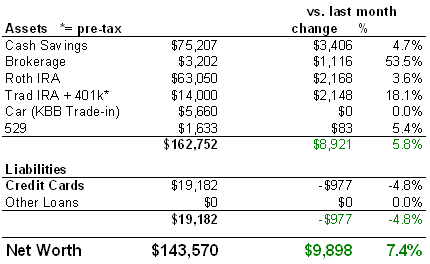
Net Worth Chart April 2007

About My Credit Card Debt
Newer readers may be alarmed by my high levels of credit card debt. In short, I’m borrowing money for free and keeping it in safe investments while earning me 5-6% interest. Along with other things, this helps me earn extra side income of thousands of dollars a year. Recently I wrote up a series of step-by-step posts on how I do this. Please check it out if you are curious.

Commentary

  • The stock market apparently went up this month, again confounding many experts and increased our IRA balances. I continued my monthly contributions towards buying FSTMX within my Self-Employed 401(k).
  • I moved $1,050 into my Zecco brokerage account and made a few free experimental ETF trades. I’ll share the details in the 2nd part of my Zecco review.
  • Another good month of controlled spending gets us to $66,520 of non-retirement funds, reaching 67% of our midterm goal of house down payment. Total cash is now $56,025.
  • Two things that helped boost our savings were the $350 from Vegas gambling winnings and $520 from optimizing credit card cashback on my Citi Drivers Edge MasterCard. 😀

You can see all my previous net worth updates here. Looking ahead to future expenses, we need to start looking into moving companies.

Trying To Avoid Lifestyle Inflation

Most of this post was originally published last year when I was a guest writer at the Get Rich Slowly blog. I have since made some revisions and added some more material below.

One common thread through my How much house should I buy? post is that whatever size house you get, you’ll expand to fill it up. This reminded me a lot about what I call “lifestyle inflation” – the phenomenon where no matter how little or how much someone earns, their spending tends to match their income.

When you were a student, your friends were also broke, and it was easy to eat frozen pizza for dinner and manage without a car. That was probably one of the funnest periods in your life! But when you have more money, you start looking to upgrade: a nicer car, a bigger house, brand name clothes, cooler gadgets. Why? Call it peer pressure, entitlement, or simply money burning a hole in your pocket.

As we progress along our career paths, here are a couple of things that my wife and I are trying to do in order to keep our lifestyles in check:

  • Put saving first. You?ve heard it before, but that?s because it?s works. Pay yourself first. If you get a raise, immediately increase the percentage going into your 401k, IRA, or brokerage account. The less that?s ending up in your bank account, the less you?ll have the urge to spend.
  • Put debt last. Making more does not mean you should borrow more, contrary to what the credit card companies or other lenders may suggest. If you have debt, pay it down. If you don’t, keep it that way.
  • Living on one income. Our dream goal has always been to be able to both work half-time in order to have more time to raise our future children. If this can?t happen, then one of us will work while the other stays home. This is a conscious decision to actually make less money, in order to focus on the more important things in our life. Of course, we’ll have to work double-hard now in order to make our hourly income high enough to pull it off!

    In the meantime, even though both of us are currently working, we are still trying to live as if we only had one income. Over the last 12 months, we saved 43% of our after-tax income.

  • Buy an affordable house. For most people their largest monthly expense is housing. Affordable does not mean what the bank will let you borrow! By simply buying the biggest house possible, you?re also inflating many other things. You have to furnish all those extra bedrooms, heat them every winter, cool them every summer, and insure them. As we plan to live in a very expensive area, this rule will probably be the hardest for us not to break, especially on one income.
  • Be realistic about cars. Probably the second largest monthly expense for many, I am always amazed when people’s car payments are more than half of their housing payments!! But I also know that a new luxury car means more than just higher monthly payments. It means higher insurance premiums, maintenance costs, and repair costs. It also likely has a bigger engine, which means less fuel economy, and may even require premium-grade fuel. Neither of us have ever owned a new car before, which helps keep our expectations low.

It may seem contradictory that we are moving to an area where the median home price is over $600,000, but that choice is predominantly due to a desire to live near family. In the end, we are trying to define a comfortable, simple lifestyle that focuses on what is really important to us. (Of course, we will won’t lead completely spartan lives…) The things that we buy on a $75,000 salary shouldn?t be much different than if we had a $750,000 salary. For example, my wife cuts my hair because I like having a simple haircut, it?s not difficult, and she does it how I like it. Even if we become millionaires someday, I think she?ll still cut my hair. I’ll let you know when we get there 😉

FNBO Direct 6% APY Savings Account Review: Opening Process, Features, and Transfer Schedule

I opened up a savings account at FNBO Direct originally for their high interest rate and no monthly fees. They are currently offering 0.85% APY as of January 2013, still competitive in this current rate environment. Here are my experiences so far as well as some first impressions of this online savings account:

Legitimacy and FDIC Insurance

FNBO Direct is a division of the First National Bank of Omaha, which is a member of the FDIC. If you call the First National Bank of Omaha, they will confirm this link and the website. For the techie folk, the nameservers and IP address range of FNBO.com and FNBODirect.com are the same. Combined with the fact that this account has been around for months, I see no need to worry about the legitimacy of this bank. Many banks choose to distance their online branches from their existing customers, as they are trying to gain new money and low-cost customers who are comfortable with things like electronic statements and online banking.

Opening Process Overview

The opening process went very smoothly. The CashEdge-based application is similar to that of HSBC Direct, but unlike with HSBC there is nothing to wait for in the mail. Nothing to send in either; No paper needed at all!

The application does include an identity verification test based on information from your credit reports. This is identical to what Washington Mutual does for its online savings account. If you have troubles with this, I recommend checking your credit reports for errors. However, a hard credit pull is not performed so it won’t affect your credit.

You can fund via wire transfer, online transfer, or by mailing a check. Here was my timeline:

  • Day 1:Apply online, pass identity verification. Receive e-mail that application was approved. I chose to do an online transfer. Trial verification deposits were sent to funding bank.
  • Day 2:Trial deposits received, and verified (free 57 cents!). FNBO Direct initiates funding transfer.
  • Day 3: I receive my new account number via e-mail, and enroll for online account access. Initial deposit hasn’t showed up, but should go in on Monday (see below). I can add link additional accounts (max of 3) and initiate other transfers.

Account Features, Transfers and Usability

Features
Overall, your basic Capital One 360 clone – $1 to open, no monthly fee, no minimum balances. Otherwise, it’s pretty barebones. No checks. No ATM rebates. You can request an ATM card, which I did, but since it costs $2.50 for each cash withdrawal, I never plan on using it. Here is their complete fee schedule.

Of course, we all know the best feature is the 6% APY interest rate 😉

Transfers
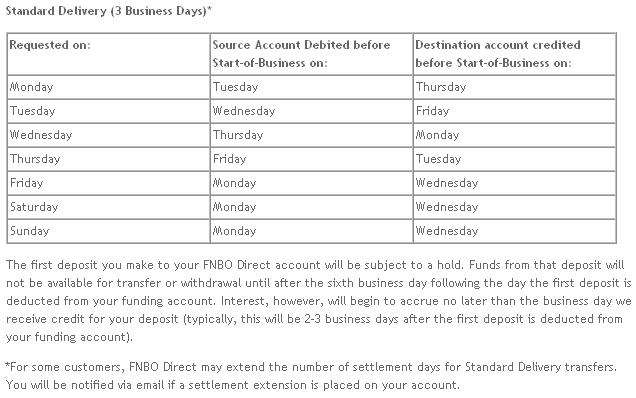
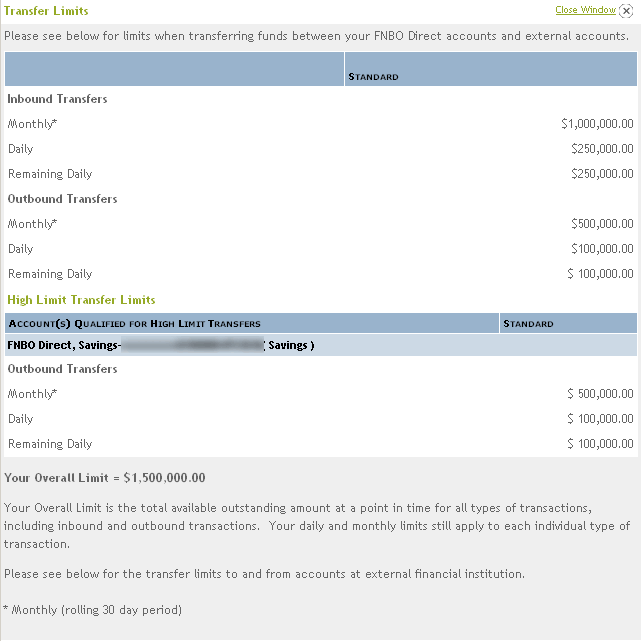
Again this is the familiar CashEdge interface behind the online fund transfers of banks like Bank of America, Presidential Bank, and HSBC Direct. All transfers are free, and the transfer limits are very generous. The transfer schedule appears to be identical to that of HSBC Direct, and takes three business days. (Worst case: If you initiate on Thursday, money is taken out on Friday, but deposit won’t show up at receiving bank until Tuesday.) I know many people dislike these slow transfers, so you should be aware. Here is a screenshot of the schedule:

altext

Note that your initial deposit will not be available for withdrawal for six business days, probably for security reasons.

Usability
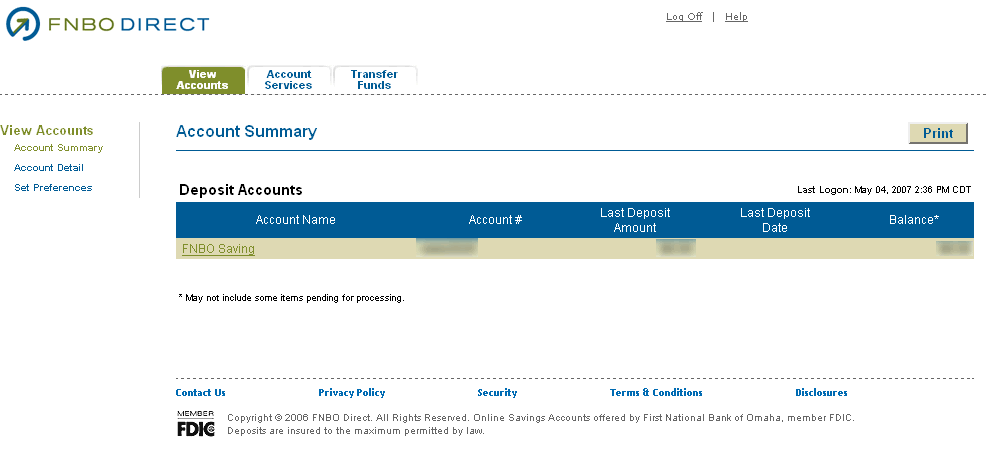
The interface is very simple and utilitarian. I like it. There are only three tabs – View Accounts, Account Services, and Transfer Funds. (Click for a full screenshot of the interface.)

altext

More Information

Customer Service: 877-370-3707, open 24/7.
I’ve called customer service a couple of times, and they do answer and are helpful. Hold times may last a few minutes, but it’s probably due to the recent rush of applicants.

Number of external bank account links allowed: 3

ABA Routing Number: 104000016
I asked them if I could set up third-party transfers like paying my credit card bill with the routing and account numbers, and they said that would be fine. Hopefully it stays that way…

Download formats available: I see no options at all for this. No MS Money, Quicken, or even .csv options.

Interest compounding frequency: Interest is calculated daily and is compounded and credited monthly. Remember, how often interest is compounded really matters very little, especially if you are comparing APYs.

Source: The official website for this online savings account is http://www.fnbodirect.com

More Free Reading Material On Investing

Want more to read about investing? Here are two sites that have supplied me with a lot of good food for thought. I find these intriguing because while both are written by men well known for their financial acumen, they often sway far from those topics and can touch on politics, family life, and the pursuit of happiness in general.

Warren Buffett – Berkshire Hathaway Shareholder Letters
Every year, Mr. Buffett writes a letter to shareholders that discusses his company’s successes, mistakes, future moves, and a bit of everything else. Although I don’t view him as a deity like many others do, and have no plans to buy any BRK stock, I do find his writing to be easy to follow and often offers fascinating insights to a successful investor’s thought process.

However, I think one thing that people overlook is that Warren Buffett gets very intimate with many of the companies that he invests in, either with close relationships with the management or even by becoming the management for a while. He knows these companies inside and out, and can affect change within them. That’s something the common investor can’t easily emulate.

William Bernstein – EfficientFrontier.com Articles
In addition to being a practicing neurologist, starting a portfolio management company, and writing one of my favorite books on investing – The Four Pillars of Investing, Mr. Bernstein also writes a quarterly article on his website EfficientFrontier.com. It mainly discusses asset allocation, such as his thoughts on commodities, but has also wandered into areas like the housing market and estate taxes.

Here’s an excerpt from this most recent article:

If you want to pick your own stocks and bonds, be my guest. Just don?t imagine that making your decisions on the basis of publicly available information and analysis will lead you anywhere but to the poor house. You?re going to have to look at the primary data and analyze it entirely by yourself. And you?d better be good at it.

How Many Square Feet Should Our Home Have?

image credit:  governing.typepad.com

Housing bubble concerns aside, we’re starting to look at some homes on the internet to get an idea of what prices are like right now. One thing we need to decide is what size of place to look at. I was going to title this post “How big a house do we really need?”, but I realized that too often the word “need” is used when we really mean “will be satisfied with as the spoiled people that we are”. 🙂

I mean, I spent the majority of my childhood living in an 800 sq. ft. apartment that is smaller than where we live now with half the people. And now I’m complaining about clutter! What happened?

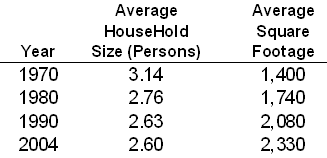
There’s also been some rumblings about the backlash against so-called McMansions, so I decided to look up some stats on average home sizes versus the average number of people in the household. The results were very surprising to me:

altext
Source: U.S. Census Bureau

So from 1970 to 2004, the average household shrunk by 27%, but the average square footage grew by 66%. (Using median numbers gave similar results.) Now numbers can be misleading, but just by looking at the layout of older houses, people really do seem to expect more space now.

Right now it’s just the two of us. Kids are a big unknown, it could be a couple years, it could be more. Hard to predict. Our parents are also hinting that we should have an extra guest room too (ahem). Initially, we are looking at detached homes of about 1,500 square feet, which usually results in a kitchen, one living room, one dining area, 3 bedrooms and 2 baths. No formal dining rooms, family rooms, or other such extras. Since I want one room to be a home office, that leaves one bedroom for us and one flexible bedroom that could be a guest room or for children someday. In the future, I could conceivable make the home office convert to a guest room at night

We know the “average” person moves in less than 7 years, but all of our siblings have settled down in their first homes. And the whole reason we are moving is to be near family, so this home might just last us a very long time. Still, we could go smaller and get a 2-bedroom condo for now. This would save some money now, but we’d have to move again later.

It’s a tough decision! Homeowners: How did you decide how much space you wanted to buy? Was it limited to how much you could afford, what was available in the neighborhood you like, what your friends had, or other considerations? Did you buy what you need right now, or did you look ahead to the future?