Archives for April 2025

Walmart+ Week 2025: Bonus Walmart Cash, Free Express Delivery, Gas Discount, Burger King

Walmart+ Week 2025 is running from 4/28 to 5/4/25 and here are the offers mostly for paid Walmart+ members (not in trial period), including estimated value and potentially useful fine print:

  • 1 Free Express Delivery ($10 estimated value). Get stuff within 1-hour or 2-hours. Available to paid Walmart+ members only. One time use during 4/28/25 – 5/4/25. Express Delivery discount applied at time delivery is scheduled and order is placed. No order minimum.
  • 50 cents off per gallon at Exxon & Mobil Stations. (15 gallons = $7.50 value). Participating stations only. Valid 4/28/25 – 5/4/25.
  • Free Burger King sandwich w/ $1 purchase every day. Walmart + Members can redeem a free single Croissan’wich® with a $1 minimum purchase once per day, and one free Whopper® Jr. with a $1 minimum purchase once per day, at participating U.S. Burger King® restaurants.
  • 6 months of Paramount+ with SHOWTIME plan. Available to paid Walmart+ members only. Limited supply. Valid 4/28/25 – 5/4/25. Separate registration required. Cannot be in an active Paramount+ with SHOWTIME plan upgrade. After free trial, plan will automatically renew at $5.49/mo for monthly members or $64.99/yr for annual members.
  • $5 Walmart Cash with scan & go. One-time. Available to paid Walmart+ members only. Limited to one redemption between 4/28/25 – 5/4/25. Basket must be over $15. Only available while supplies last.
  • $10 Walmart Cash w/ two Walmart+ Week offer redemptions from above list. Available to paid Walmart+ members only when you redeem two Walmart+ Week offers. Valid 4/28/25 – 5/4/25.

I joined Walmart+ in the past, but I didn’t really find value in it. I mostly just use the pickup service because my experience with their delivery service hasn’t been the best (broken/missing items, unexpectedly cancelled deliveries, etc). I suspect this varies by location. I prefer their pickup service as you can add items up until pretty last-minute, and then you can also reject their substitutions all the way up to the time of pickup.

I did notice that Walmart+ members can now use Scan & Go at Walmart (this is popular at Sam’s Club for faster checkouts).

Walmart+ is also offering all expired Walmart+ members a “half off” $49 Discounted Membership Offer until 5/4/2025. If I grabbed all of the Walmart+ Week offers that are actually useful to me, it adds up to about $25. It would be easy to start the 6-months of Paramount+ and use Scan & Go. Is a net price of $25 worth it? 🤔

Aven Advisor: Track Your Finances, Get $5 Starbucks Gift Card Every Week (Homeowners w/ 700+ Credit)

Update June 2025: This offer now appears to be severely limited very soon to occasional gift cards.

Update April 2025: I’ve continued to receive my $5 in SBUX credit every week with no issues, up to over $50 so far. Honestly, getting $5 worth of caffeine every week feels better than it should, no wonder Starbucks is effectively running its own currency. You do need to remember to log into the app every week (Fridays for me, not sure if same day for everyone). Now you can either sign up for Starbucks or Dunkin credit (thanks to DoC).

You can still get an additional one-time $5 cash bonus if you open through Aven.com/advisor and use my invite code JP25DJVG7K during the app sign-up. You’ll need to link a bank account via Plaid to get the $5 transferred to you.

Some caveats: Don’t accidentally sign-up for their credit card, it is not required to get this $5 weekly credit. They have also added new fine print that the offer is limited to residents of AL, AK, AZ, AR, CA, CO, FL, GA, ID, IL, IN, IA, KS, KY, LA, ME, MD, MI, MN, MS, NE, NH, NJ, NM, NC, ND, OH, OK, OR, PA, SD, TN, UT, VA, WI, WY. This was not the case originally.

Original post from 2/3/2025:

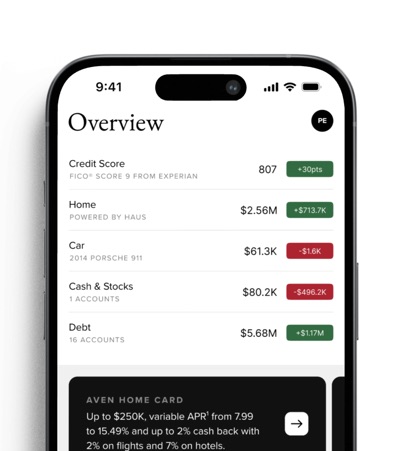
Aven Advisor is a new app that promises to help to track your financial situation. Kind of like the old Mint app, you have to give them your personal info and link up bank accounts/credit cards, and then they offer a unique mix of things:

  • Free weekly credit score (VantageScore 4.0 for me, even though some screenshots show FICO).
  • Find your hidden subscriptions by mining your transactions.
  • Track your home value, neighborhood home prices, and show you nearby house listings.
  • Get a free lien report on your property.
  • Track your bank balances, brokerage balances, and credit card debt.
  • Track the value of your car.
  • Shows you nearby Facebook Marketplace listing for cars and other random things.

So why give them your data? Well, if you are a homeowner with a good credit (700+), they will give you $5 in Starbucks credit once every week. You have to manually open the app and tap the link on every Monday (so they know you’re actively using it), but I’ve successfully gotten my credit. Loads right onto my Starbucks app, see screenshot below.

Join at Aven.com/advisor (remember, only homeowners get the Starbucks offer). You can also get an additional one-time $5 cash bonus with my referral code JP25DJVG7K. Thanks if you use it. You’ll have to link a bank account via Plaid to transfer the $5 into your account.

Frontier Airlines Gold Status Match for All Southwest Rapid Rewards Members

Frontier Airlines is offering a status match promo to their Gold Status for all Southwest Rapid Rewards Members. The status match lasts through December 31st, 2025. Offer is set to expire April 30, 2025. It costs $40 to apply for this status match, but my understanding is that as long as you have a single Frontier flight sometime during 2025 where you’d like to bring any sort of luggage, you’ll basically break-even or better. A single carry-on baggage fee paid at booking starts at $30 and can cost up to $55 ($60 if checked at gate). Standard seat assignments cost from ~$17 to $55.

If you fly Frontier regularly, then this could be a very valuable deal. (I’ve never flown Frontier myself, but I understand that between certain cities, they are often the best deal by far, even with all the various add-on fees.)

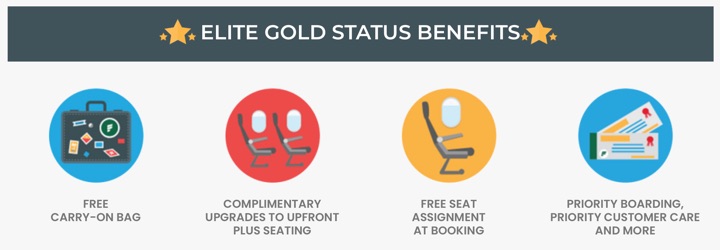
Gold Status includes:

  • Priority boarding (Zone 1)
  • Free seat assignment at booking (Preferred). Possible free Premium seat upgrade at check-in.
  • Free carry-on bag.
  • No change or cancellation fees (+7 days from departure).
  • Priority customer care.
  • 14X points per $1 spent at flyfrontier.com.

Selected terms from the fine print:

· All applicants must be current members of the FRONTIER Miles? program. If you’re not currently enrolled, you may do so here.

· Eligible members must hold a valid Southwest Rapid Rewards membership (joined Rapid Rewards before April 16th, 2025) and provide details.

· The FRONTIER Miles Elite Gold Status offer is valid for purchase for a limited time. The offer may change or be withdrawn at any time, including but not limited to the fees and validity period.

· The Instant FRONTIER Miles Elite Gold Status offer provides eligible and approved members Frontier Elite Gold Status through December 31, 2025.

· The upgrade to the member account will be processed within 24-48 hours.

Best Interest Rates Survey: Savings Accounts, Treasuries, CDs, ETFs – April 2025

Here’s my monthly survey of the best interest rates on cash as of April, roughly sorted from shortest to longest maturities. Banks love taking advantage of our idle cash, and you can often earning more money while keeping the same level of safety by moving to another FDIC-insured bank or NCUA-insured credit union. Check out my Ultimate Rate-Chaser Calculator to see how much extra interest you could earn from switching. Rates listed are available to everyone nationwide. Rates checked as of 4/20/2025.

TL;DR: Short-term savings accounts dropped again slightly overall. Short-term T-Bill rates at around 4.3%. Top 5-year CD rates are ~4.25% APY, while 5-year Treasury rate is ~4%.

High-yield savings accounts*
Since the huge megabanks still pay essentially no interest, everyone should at least have a separate, no-fee online savings account to piggy-back onto your existing checking account. The interest rates on savings accounts can drop at any time, so I list the top rates as well as competitive rates from banks with a history of competitive rates and solid user experience. Some banks will bait you with a temporary top rate and then lower the rates in the hopes that you are too lazy to leave.

  • The top saving rate at the moment: Roger.bank is at 4.65% APY (no min), but does require an additional companion checking account. OnPath FCU has a new account paying 5.00% APY but requires $25,000 min. CIT Platinum Savings is now at 4.10% APY with $5,000+ balance, but also has a $225/$300 deposit bonus you can stack on top. There are many banks in between.
  • SoFi Bank is at 3.80% APY + up to $325 new account bonus with direct deposit. You must maintain a direct deposit of any amount (even $1) each month for the higher APY. SoFi has historically competitive rates and full banking features. See details at $25 + $300 SoFi Money new account and deposit bonus.
  • Here is a limited survey of high-yield savings accounts. They aren’t the top rates, but a group that have historically kept it relatively competitive such that I like to track their history.

Short-term guaranteed rates (1 year and under)
A common question is what to do with a big pile of cash that you’re waiting to deploy shortly (plan to buy a house soon, just sold your house, just sold your business, legal settlement, inheritance). My usual advice is to keep things simple and take your time. If not a savings account, then put it in a flexible short-term CD under the FDIC limits until you have a plan.

  • No Penalty CDs offer a fixed interest rate that can never go down, but you can still take out your money (once) without any fees if you want to use it elsewhere. Marcus has a 13mo No Penalty CD at 4.00% APY ($500 minimum deposit). Farmer’s Insurance FCU has 9-month No Penalty CD at 4.25% APY ($1,000 minimum deposit). Kinecta FCU has 9-month Liquid CD at 4.25% APY ($10,000 minimum) that allows for daily penalty-free withdrawals of up to 50% of the start of day balance. Consider opening multiple CDs in smaller increments for more flexibility.
  • Security State Bank has a 12-month certificate special at 4.65% APY ($25,000 min). Early withdrawal penalty is 180 days of interest.

Money market mutual funds
Many brokerage firms that pay out very little interest on their default cash sweep funds (and keep the difference for themselves). Note: Money market mutual funds are highly-regulated, but ultimately not FDIC-insured, so I would still stick with highly reputable firms.

  • Vanguard Federal Money Market Fund (VMFXX) is the default sweep option for Vanguard brokerage accounts, which has an SEC yield of 4.22% (changes daily, but also works out to a compound yield of 4.30%, which is better for comparing against APY). Odds are this is much higher than your own broker’s default cash sweep interest rate.
  • Vanguard Treasury Money Market Fund (VUSXX) is an alternative money market fund which you must manually purchase, but the interest will be mostly (100% for 2024 tax year) exempt from state and local income taxes because it comes from qualifying US government obligations. Current SEC yield of 4.23% (compound yield of 4.31%).

Treasury Bills and Ultra-short Treasury ETFs
Another option is to buy individual Treasury bills which come in a variety of maturities from 4-weeks to 52-weeks and are fully backed by the US government. You can also invest in ETFs that hold a rotating basket of short-term Treasury Bills for you, while charging a small management fee for doing so. T-bill interest is exempt from state and local income taxes, which can make a significant difference in your effective yield.

  • You can build your own T-Bill ladder at TreasuryDirect.gov or via a brokerage account with a bond desk like Vanguard and Fidelity. Here are the current Treasury Bill rates. As of 4/17/25, a new 4-week T-Bill had the equivalent of 4.32% annualized interest and a 52-week T-Bill had the equivalent of 3.99% annualized interest.
  • The iShares 0-3 Month Treasury Bond ETF (SGOV) has a 4.18% SEC yield (0.09% expense ratio) and effective duration of 0.09 years. SPDR Bloomberg Barclays 1-3 Month T-Bill ETF (BIL) has a 4.13% SEC yield (0.136% expense ratio) and effective duration of 0.15 years. The Vanguard 0-3 Month Treasury Bill ETF (VBIL) hasn’t been around long enough to generate an SEC yield (0.07% expense ratio).

US Savings Bonds
Series I Savings Bonds offer rates that are linked to inflation and backed by the US government. You must hold them for at least a year. If you redeem them within 5 years there is a penalty of the last 3 months of interest. The annual purchase limit for electronic I bonds is $10,000 per Social Security Number, available online at TreasuryDirect.gov.

  • “I Bonds” bought between November 2024 and April 2025 will earn a 3.11% rate for the first six months. The rate of the subsequent 6-month period will be based on inflation again. More on Savings Bonds here.
  • In mid-April 2025, the CPI will be announced and you will have a short period where you will have a very close estimate of the rate for the next 12 months. Read all the details about your options here.

Rewards checking accounts
These unique checking accounts pay above-average interest rates, but with unique risks. You have to jump through certain hoops which usually involve 10+ debit card purchases each cycle, a certain number of ACH/direct deposits, and/or a certain number of logins per month. If you make a mistake (or they judge that you did) you risk earning zero interest for that month. Some folks don’t mind the extra work and attention required, while others would rather not bother. Rates can also drop suddenly, leaving a “bait-and-switch” feeling.

  • OnPath Federal Credit Union (my review) pays 7.00% APY on up to $10,000 if you make 15 debit card purchases, opt into online statements, and login to online or mobile banking once per statement cycle. Anyone can join this credit union via $5 membership fee to join partner organization. You can also get a $100 Visa Reward card when you open a new account and make qualifying transactions.
  • Genisys Credit Union pays 6.75% APY on up to $7,500 if you make 10 debit card purchases of $5+ each per statement cycle, and opt into online statements. Anyone can join this credit union via $5 membership fee to join partner organization.
  • La Capitol Federal Credit Union pays 5.75% APY on up to $10,000 if you make 15 debit card purchases of at least $5 each per statement cycle. Anyone can join this credit union via partner organization, Louisiana Association for Personal Financial Achievement ($20).
  • First Southern Bank pays 5.50% APY on up to $25,000 if you make at least 15 debit card purchases, 1 ACH credit or payment transaction, and enroll in online statements.
  • Credit Union of New Jersey pays 6.00% APY on up to $25,000 if you make 12 debit card purchases, opt into online statements, and make at least 1 direct deposit, online bill payment, or automatic payment (ACH) per statement cycle. Anyone can join this credit union via $5 membership fee to join partner organization.
  • Andrews Federal Credit Union pays 5.50% APY (down from 6%) on up to $25,000 if you make 15 debit card purchases, opt into online statements, and make at least 1 direct deposit or ACH transaction per statement cycle. Anyone can join this credit union via partner organization.
  • Find a locally-restricted rewards checking account at DepositAccounts.

Certificates of deposit (greater than 1 year)
CDs offer higher rates, but come with an early withdrawal penalty. By finding a bank CD with a reasonable early withdrawal penalty, you can enjoy higher rates but maintain access in a true emergency. Alternatively, consider building a CD ladder of different maturity lengths (ex. 1/2/3/4/5-years) such that you have access to part of the ladder each year, but your blended interest rate is higher than a savings account. When one CD matures, use that money to buy another 5-year CD to keep the ladder going. Some CDs also offer “add-ons” where you can deposit more funds if rates drop.

  • KS State Bank has a 5-year certificate at 4.15% APY ($500 minimum), 4-year at 4.15% APY, 3-year at 4.15% APY, 2-year at 4.20% APY, and 1-year at 4.25% APY. $500 minimum. The early withdrawal penalty (EWP) for the 5-year is a huge 540 days of interest.
  • Mountain America Credit Union (MACU) has a 5-year certificate at 4.25% APY ($500 minimum), 4-year at 4.25% APY, 3-year at 4.25% APY, 2-year at 3.95% APY, and 1-year at 4.25% APY. Early withdrawal penalty for the 4-year and 5-year is 365 days of interest. Anyone can join this credit union via partner organization American Consumer Council for a one-time $5 fee (or try promo code “consumer”).
  • Lafayette Federal Credit Union (LFCU) has a 5/4/3/2/1-year certificates at 4.28% APY ($500 min). Slightly higher rates with jumbo $100,000+ balances. Note that the early withdrawal penalty for the 5-year is a relatively large 600 days of interest. Anyone nationwide can join LFCU by joining the Home Ownership Financial Literacy Council (HOFLC) for a one-time $10 fee.
  • You can buy certificates of deposit via the bond desks of Vanguard and Fidelity. You may need an account to see the rates. These “brokered CDs” offer FDIC insurance and easy laddering, but they don’t come with predictable early withdrawal penalties. Right now, I see a 5-year non-callable brokered CD at 4.00% APY (callable: no, call protection: yes). Be warned that both Vanguard and Fidelity will list higher rates from callable CDs, which importantly means they can call back your CD if rates drop later. (Issuers have indeed started calling some of their old 5%+ CDs during 2024.)

Longer-term Instruments
I’d use these with caution due to increased interest rate risk (tbh, I don’t use them at all), but I still track them to see the rest of the current yield curve.

  • Willing to lock up your money for 10 years? You can buy long-term certificates of deposit via the bond desks of Vanguard and Fidelity. These “brokered CDs” offer FDIC insurance, but they don’t come with predictable early withdrawal penalties. You might find something that pays more than your other brokerage cash and Treasury options. Right now, I see a 10-year CDs at [n/a] (non-callable) vs. 4.34% for a 10-year Treasury. Watch out for higher rates from callable CDs where they can call your CD back if interest rates drop.

All rates were checked as of 4/20/25.

* I no longer recommend fintech companies due to the possibility of loss due to poor recordkeeping and lack of government regulation. (Ex. Evergreen Wealth at 5% APY is a fintech.)

Photo by insung yoon on Unsplash

Capital One Venture X Business Card Review: 150,000 Bonus Miles

card_name

Negative changes to lounge access starting February 2026. The card_name is the newest entry into the ultra-premium business card category, with features similar to the Capital One Venture X Rewards credit card for consumers (you can have both at the same time). It has a large new-cardholder bonus, loads of perks, and a hefty annual fee. Right now, there is a limited-time offer targeting those with large annual expenses. Let’s take a look at what it offers:

  • 150,000 Bonus Miles once you spend $30,000 in the first 3 months from account opening 150,000 Miles can be redeemed for $1,500 towards travel! (including airfare and hotel stays).
  • Redeem your miles on flights, hotels and more. Plus, transfer your miles to any of the 15+ travel loyalty programs.
  • $300 Annual Travel Credit. Get up to $300 in annual statement credits when booking through Capital One’s travel booking site. Book your choice of flights, hotel nights, or car rentals. You can redeem these in partial amounts over the course of the year.
  • 10,000 bonus miles (equal to $100 towards travel) every year, starting on your first anniversary.
  • Up to a $120 credit for Global Entry or TSA PreCheck(R).
  • Airport lounge access. Enjoy access to 1,300+ airport lounges worldwide, including Capital One Lounge locations and Priority Pass(TM) lounges, after enrollment.
  • $100 experience credit and other premium benefits with every hotel and vacation rental booked from the Premier Collection.
  • This card has no preset spending limit, so you get purchasing power that adapts to your spending needs.
  • Empower your teams to make business purchases while earning rewards on their transactions, with free employee and virtual cards. Plus, automatically sync your transaction data with your accounting software and pay your vendors with ease.
  • This is a pay-in-full card, so your balance is due in full every month.
  • Annual fee is $395. Free employee cards.

Here is the rewards structure on purchases:

  • 10 Miles per dollar spent on hotels and rental cars booked through Capital One’s travel booking site, where you’ll get Capital One’s best prices on thousands of trip options. They offer a Price Match Guarantee.
  • 5 Miles per dollar on flights and vacation rentals booked through Capital One’s travel booking site.
  • 2 Miles per dollar on every purchase, every day.
  • Redeem miles for any airline, any hotel, rental cars, and more.
  • Transfer your miles to your choice of 15+ travel loyalty programs.

Redemption towards travel, including airline and hotel purchases. Capital One “miles” can be redeemed directly for a cash statement credit on a 1 mile = $0.01 basis when offsetting any travel purchase made on the card within the past 90 days. In other words, 100,000 miles = $1,000 toward travel. That means you can fly on any airline or stay at any hotel, pay with this card, and then “erase” that purchase using your miles balance later. This even includes AirBNB vacation rentals, car rentals, and Uber rides.

This means that earning 2 miles on on every $1 in purchases essentially makes this a 2% back card when applied towards travel. Earn even higher rewards of 5 miles per $1 spent on on flights booked through Capital One’s travel booking site, and 10 miles per $1 spent on on hotels and rental cars booked through Capital One’s travel booking site.

Capital One’s travel booking site offers price matching: if you find a better price on another website within 24 hours of booking, they will refund you the difference.

Miles transfer options. Capital One now allows you to transfer your “miles” into select airline miles programs as well. Here are the airline transfer partners:

  • Aeromexico
  • Air France/KLM
  • Air Canada Aeroplan
  • Cathay Pacific Asia Miles
  • Avianca Lifemiles
  • British Airways Avios
  • Emirates Skywards
  • Etihad
  • EVA
  • Finnair
  • Qantas
  • Singapore Airlines Krisflyer
  • TAP Air Portugal
  • Turkish Airlines
  • Virgin Red

Hotel partners

  • Accor Live Limitless
  • Choice Hotels

If you know how to leverage one of these international airline miles programs, this can be a very valuable option. Otherwise, it’s nice to know you can always get a certain level of value by redeeming against any travel purchase.

Airport lounge access details. Capital One is creating their own lounges within select airports (currently in Washington DC’s Dulles Airport and Dallas/Forth Worth). Venture X Business cardholders get unlimited access and can bring 2 free guests per visit. Employee cards do not get lounge access benefits.

You also get Priority Pass membership, which includes access to 1,300+ participating VIP lounges and even included credits to spend at some restaurants, in more than 600 cities and more than 148 countries.

(UPDATE: Starting February 1, 2026, authorized users will no longer receive complimentary access and will need to pay $125 per year for each additional cardholder to retain lounge access. Primary cardholders still receive two complimentary guests to Priority Pass lounges, and additional cardholders who get lounge access get two complimentary guests (after, $35 per guest). Guest access for Capital One lounges and Landings will cost $25 to $45.)

Many people aren’t aware of the fact that they can apply for business credit cards, even if they are not a corporation or LLC. The business type is called a sole proprietorship, and these days many people are full-time or part-time consultants, freelancers, eBay/Amazon/Etsy sellers, Uber/Lyft drivers, or other one-person business owners. This is the simplest business entity, but it is fully legit and recognized by the IRS. On a business credit card application, you should use your own legal name as the business name, and your Social Security Number as the Tax ID.

This card should not show up on your personal credit reports, so your outstanding balance, credit limit, and closure states won’t affect your credit score. You’ll still see a credit check on your personal credit report from the initial application.

Bottom line. The card_name is an ultra-premium business rewards card that earns a minimum of 2 Miles per dollar on all purchases, which you can either redeem against any travel purchase or transfer to one of their airline/hotel partners. There is a generous new-customer offer. If you can take advantage of the $300 annual travel credit, TSA PreCheck(R)/Global Entry fee credit, and add the 10,000 miles on every anniversary, then you’ve effectively offset the $395 annual fee in all future years. To top it all off, the airport lounge access is very nice.

Due to the $1,500+ first-year value, I will be adding this to my Top 10 Best Small Business Card Bonus Offers.

E-File Federal and State Tax Extension Instantly Online For Free (Updated 2025)

Updated for 2025. This year, the deadline for federal tax filing is Tuesday, April 15th, 2025. If you file for an extension before midnight on that date passes, you can extend the time allowed to file your return by six months to October 15th, 2025. It does not extend the time to pay any tax due. There are many legitimate reasons to ask for such an extension, and the extension is granted automatically without needing to provide a specific reason. In the past, I had a Schedule K-1 that consistently arrived after 4/15, so I would file an extension to file instead of having to make an amended return (I later sold that holding).

Why is filing an extension important? The “Failure to File” Penalty is 5% of the unpaid taxes for each month (or part of the month) that the tax return is late (without extension). The “Failure to Pay” penalty is 0.5% of your balance due for each month (or part of a month). That’s a 10X difference!

The good news is that you can instantly e-file a federal and state tax extension (where available) for free. Advantages of using e-File include:

  • You save the time and postage costs of paper mailings.
  • You can estimate your tax liability using online software and/or calculators.
  • You receive confirmation of receipt via e-mail or text, often within hours.
  • The potential convenience of filing your state tax extension online at the same time.

TaxAct

Tax prep software TaxAct allows you to e-File your Federal and State extension (where applicable) for free through them. I use TaxAct to file my extensions because after using them once, I just found them to offer the most easy and useful user interface. They guide you through the process for federal and every state, letting you choose between printing the form to mail or e-Filing the state extension if available. You don’t need to input payment information, or even use them to file your actual taxes, although you certainly could.

Directions
First, register for free at TaxAct.com with your e-mail address and pick a password if you haven’t previously. You must start a new tax filing, but you don’t need to enter anything. Just look for the option to “File Extension” on the purple left menu bar, and follow their interview directions.

TaxAct supports the electronic filing of extension forms for the following states:

  • Arkansas
  • Arizona
  • California
  • Connecticut
  • District of Columbia
  • Kentucky
  • Louisiana
  • Maryland
  • Massachusetts
  • New Hampshire
  • New Jersey
  • New York
  • North Carolina
  • Oklahoma
  • Pennsylvania
  • Tennessee
  • Texas
  • Virginia
  • West Virginia
  • Wisconsin

Afterward, you can confirm the status of your extension e-file by going to efstatus.taxact.com. They will even send you a confirmation via e-mail or text message. I got my confirmation less than 3 hours after submission.

IRS Direct Pay

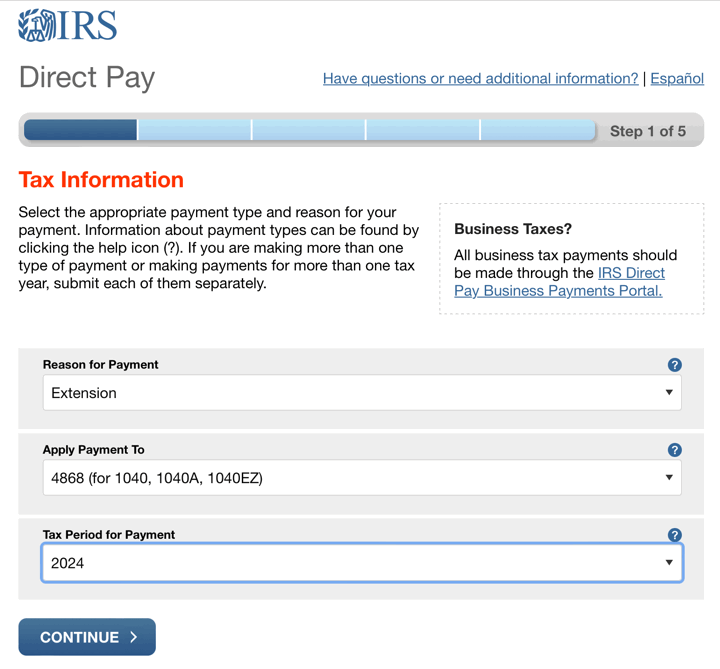
If you only have Federal taxes to worry about, the most direct way to file an extension would be to use IRS Direct Pay. Even if you don’t think you’ll owe any taxes, you can just submit a non-zero payment of $1 (or whatever) and they will file an extension for you along with the payment (remember to note this payment when you later file). As shown in the screenshot above, just choose “Extension” as the Reason for Payment, “Form 4868 (for 1040, 1040A, 1040EZ)” as the Apply Payment To, and 2024 (or whatever applies in your case) as the Tax Period for Payment. You will probably have to answer some identity verification questions, so try to have your previous year’s tax return ready.

Most other tax filing software will also file extensions for you in a similar manner, including TurboTax and H&R Block. I’m not completely sure about all of their state e-File offerings.

(Note: For the 2024 Tax Year, disaster victims in twelve states have automatic extensions to file and pay their 2024 taxes. This includes taxpayers in the entire states of Alabama, Florida, Georgia, North Carolina and South Carolina.)

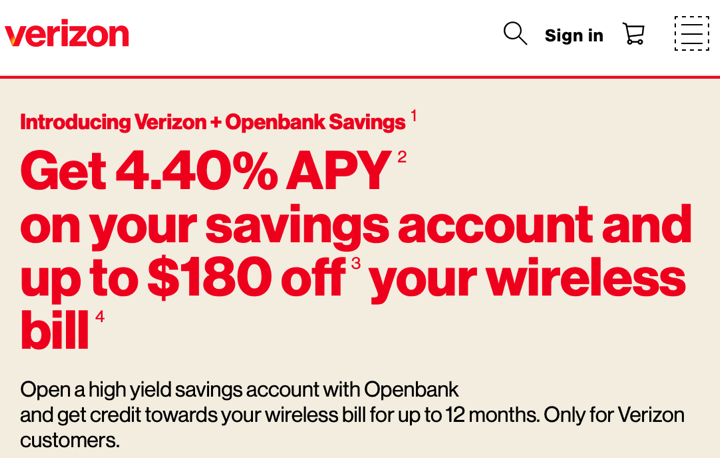
Verizon + Openbank Savings: 4.40% APY + Up to $180 in Bill Credits

Verizon and Openbank have partnered together such if that you open a high yield savings account with Openbank and maintain a qualifying balance, you’ll get up to $15 a month in Verizon bill credits for the first 12 months (total up to $180). You also get the standard APY, which is currently a competitive 4.40% APY. If you are a Verizon customer, it might be worth a look. Here are the tiers:

The Verizon Bill Credit is based on the monthly average daily balance of your High Yield Savings account and can range between $5, $10 or $15 a month according to the following:

– Get up to $60/year ($5/month) in Verizon Bill Credits if your average account balance is between $1,000 and $9,999.99. Offer valid for up to 12 consecutive months from the date you open the account.

– Get up to $120/year ($10/month) in Verizon Bill Credits if your average account balance is between $10,000 and $29,999.99. Offer valid for up to 12 consecutive months from the date you open the account.

– Get up to $180/year ($15/month) in Verizon Bill Credits if your balance is $30,000 or more. Offer valid for up to 12 consecutive months from the date you open the account.

Here are the details on qualifying Verizon accounts:

You’ll need an existing Verizon mobile account with up to 12 phone lines maximum (depending on your plan), 5G Home Internet or LTE Home Internet to be eligible to apply for the Verizon + Openbank Savings account. Verizon Prepaid, Verizon mobile Business, Verizon Fios and Verizon Fios Business accounts are not eligible for Verizon + Openbank Savings

Bonus calculations. There is a $500 minimum to open an account, and the bonus is based on the “monthly average daily balance”.

  • $1,000 balance earning $60/year in credits = 6.0% boost over a year.
  • $10,000 balance earning $120/year in credits = 1.2% boost over a year.
  • $30,000 balance earning $180/year in credits = 0.60% boost over a year.

As long as the base APY is relatively competitive, you could probably justify keeping up to $30,000 in this account, given that the bill credits are basically after-tax money. 4.40% + 0.60% = 5.00%, which is a top overall rate. This is assuming they don’t 1099 you for the bill credits, which I doubt they will considering they are a discount on a service.

However, if you just want the most bang for your buck, you could just keep $1,000 in there for a $60 total bonus. Or you could think of it as a ~10% APY savings account for a year.

This promotion would be a lot more attractive if the bill credits applied indefinitely, instead of only the first 12 months. As it is, it might be attractive if you already have Verizon wireless service.

Hat tip to Doctor of Credit.

Profile of Greg Abel, Next CEO of Berkshire Hathaway

In times of volatility, I often re-read the teachings of Warren Buffett. Although Buffett is becoming much less active at age 94 and no longer making speeches or giving lots of CNBC interviews, if you follow Berkshire Hathaway, don’t miss this in-depth Fortune magazine profile of Greg Abel, who is set to be the eventual next CEO. After reading it, it’s easy to understand why Buffett picked him to be his successor. Highly-intelligent but humble, extremely self-motivated but with good people-skills, working-class background, entrepreneurial since childhood, the list goes on. Here’s an excerpt:

It would surprise almost no one to learn that the man Buffett anointed to succeed him boasts a folksy, super-likable personality; those who know Abel say he has a touch of Warren, minus the showmanship his boss is famous for. Abel grew up in Edmonton, the Canadian prairie town nicknamed the nation’s “oil capital” and famed for its boom-to-bust cycles. His mother was a homemaker who doubled at times as a legal assistant, and his father sold fire extinguishers. “Sometimes people had jobs, and sometimes they didn’t,” Abel recalled in an interview for the Horatio Alger Association, a group that provides scholarships for severely underprivileged students, of which he’s been a strong supporter. “But with your family and good friends you had the opportunity to dream.”

His first business venture consisted of distributing advertising fliers to homes while pedaling his bike around town, earning the rate of a quarter of a penny per delivery. Young Greg—a photo shows him sporting a shaggy Beatles-style hairdo—advanced to collecting discarded pop bottles. He’d keep finding better and better bike routes home from school for spotting the throwaways. He’d grab as many as five per trip, and by the weekend fill his room with 20, worth $1. In high school, he labored filling fire extinguishers for his dad’s employer.

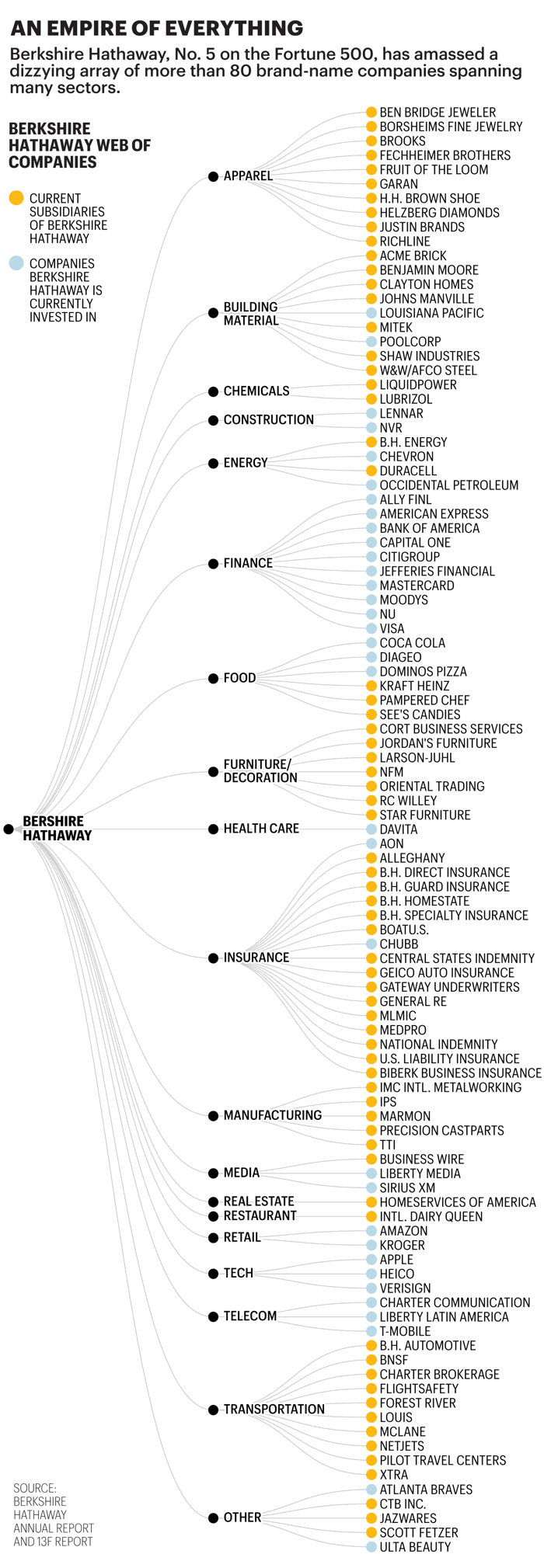
Also included was a cool infographic about all the companies owned partially and outright by BRK (even if the creator did mispell “Berkshire”). Not everyone knows they own Duracell batteries, Brooks running shoes, Forest River RVs, and Benjamin Moore paints.

I’ve picked up shares of Berkshire Hathaway in bits and pieces over the years. If a brokerage bonus gave me a choice, it was always BRKB shares for me. I set aside a certain slice of my cashflow for my self-directed portfolio, and if nothing else looked good but BRK was buying back its own shares, I’d buy BRKB too. Over time, it’s grown to a significant size, enough to wonder if I should keep it given the fact that Buffett won’t be around forever. However, it seems like Buffett has done his best to find someone to “keep the culture” and I expect to hold on for the foreseeable future. I wonder if Greg Abel will open up more to the public as time goes on.

Chase Sapphire Preferred® Card Review: 75,000 Bonus Points

The Chase Sapphire Preferred® Card is a premium travel rewards credit card that has gotten very popular due to its useful rewards structure and flexible Ultimate Rewards points that can be redeemed for cash, travel credits, or transferred to airline miles and hotel points. I’ve had it for years. Here are the highlights:

  • 75,000 bonus points after $5,000 in purchases in your first 3 months.
  • 5X total points on all travel purchased through Chase TravelSM.
  • 3X points on on dining, including eligible delivery services, takeout and dining out.
  • 3X points on select streaming services. Includes Disney+, Hulu, ESPN+, Netflix, Sling, Vudu, Fubo TV, Apple Music, SiriusXM, Pandora, Spotify and YouTube TV.
  • 3X points on online grocery purchases (excluding Target, Walmart and wholesale clubs).
  • 2X points on all other travel purchases.
  • 1 point per dollar spent on all other purchases.
  • $50 Annual Credit on hotel stays purchased through Chase TravelSM. New cardmembers will start earning towards the credit immediately and existing cardmembers will start earning after their next account anniversary.
  • Get complimentary access to DashPass which unlocks $0 delivery fees and lower service fees for a minimum of one year when you activate by December 31, 2027.
  • 25% more value when you redeem for airfare, hotels, car rentals and cruises through Chase TravelSM. For example, 80,000 points are worth $1,000 toward travel.
  • 1:1 point transfer to leading airline and hotel loyalty programs.
  • 10% Anniversary Point Bonus. Each account anniversary, cardmembers will earn bonus points equal to 10% of total purchases made the previous year. That means, $25,000 in spend will earn an additional 2,500 bonus points.
  • No foreign transaction fees.
  • Count on Trip Cancellation/Interruption Insurance, Auto Rental Collision Damage Waiver, Lost Luggage Insurance and more.
  • $95 annual fee.

Note the following text:

The product is not available to either (i) current cardmembers of any Sapphire credit card, or (ii) previous cardmembers of any Sapphire credit card who received a new cardmember bonus within the last 48 months.

Chase has an unofficial rule that they will automatically deny approval on new credit cards if you have 5 or more new credit cards from any issuer on your credit report within the past 2 years (aka the 5/24 rule). This rule is designed to discourage folks that apply for high numbers of sign-up bonuses. This rule applies on a per-person basis, so in our household one applies to Chase while the other applies at other card issuers.

Ultimate Rewards points. This card offers a special 25% bonus on travel redemptions made through the Chase TravelSM site. For example, 60,000 Ultimate Rewards = $750 in travel. 75,000 Ultimate Rewards = $937.50 in travel. Similar to Expedia or Travelocity, you can book flights on most major airlines and hotel chains. This makes it much more flexible to spend your points. You can even buy something more expensive than your points can cover and pay the difference in cash.

If you have other Chase cards that earn Ultimate Rewards points like the Freedom Flex, Freedom Unlimited, Ink Business Cash or Ink Business Unlimited, you can transfer points into this card account and take advantage of the this higher premium. In other words, your existing Ultimate Rewards points balance could be increased in value by getting this card.

The Chase Sapphire Reserve Card is the “ultra-premium” rewards card that offers a bigger 50% bonus on travel redemptions, along with more perks and a higher annual fee.

Prefer airline and/or hotel points? This card also allows you to transfer Ultimate Rewards points into hotel and/or airline miles. Transfer to United Airlines, British Airways, Air Canada, Singapore Airlines, Korean Air, Southwest, Hyatt Hotels, IHG Hotels, and Marriott Hotels at a ratio of 1 Ultimate Rewards point = 1 mile/hotel point. Miles redemption continue to offer great value for savvy travelers, especially for last-minute travel and business class seats. I personally use the transfers to “top off” my account to reach a free coach ticket or free hotel night when I don’t have enough points otherwise. My favorite options are United miles, Southwest miles, and Hyatt hotel points. I usually try to save up my points for a Hyatt hotel stay that gets me over 2 cents per point value.

Cash redemptions are a simple and easy option at straight conversion of 100 points = $1.

Sharing points. Ultimate Rewards points are instantly transferable to other accounts including family members, as long as they have their own Chase card with Ultimate Rewards as an authorized user. This way, you can pool points together for transfers and redemptions if you like.

Additional card benefits:

  • Primary car rental collision damage waiver insurance. Decline the rental company’s collision insurance and charge the entire rental cost to your card. Coverage is primary and provides reimbursement up to $75,000 for theft and collision damage for most rental cars in the U.S. and abroad. Most other cards only offer secondary coverage that kicks in only after the deductible of your individual insurance policy is used.
  • Trip Cancellation/Trip Interruption Insurance. If your trip is canceled or cut short by sickness, severe weather and other covered situations, you can be reimbursed up to $10,000 per trip for your pre-paid, non-refundable travel expenses, including passenger fares, tours, and hotels.
  • Trip Delay Reimbursement. If your common carrier travel is delayed more than 6 hours or requires an overnight stay, you and your family are covered for unreimbursed expenses, such as meals and lodging, up to $500 per ticket

Bottom line. The Chase Sapphire Preferred® Card is a popular premium travel rewards card with 3X points on dining out and 2X points on travel. Ultimate Rewards points are very flexible, either transferrable to several airline/hotel programs or directly redeemable to offset a hotel/airfare purchase through Chase TravelSM.

Compare with the Chase Sapphire Reserve® Card, which offers a bigger 50% bonus on travel redemptions, along with more perks and a higher annual fee.

This offer is on my list of Top 10 Best Credit Card Bonus Offers.

The information for the Chase Sapphire Preferred® Card has been collected independently by My Money Blog. The card details on this page have not been reviewed or provided by the card issuer.

How to Avoid Comparing Against Your All-Time High Portfolio Value

A common question about of the “4% rule” is, well, 4% of what? People like to anchor themselves to the all-time high value of their portfolio, but we can see from recent events that can be a shaky idea. I believe that you should always be prepared for stocks to fall by 50%, which means you could be taking 4% of two very different values. Folks shouldn’t act like they “lost $XX,XXX” when their stocks drop from an arbitrary all-time high, and they shouldn’t plan out the next 30 years of retirement income based on a single value either.

I’m currently reading the new book Rethinking Investing: A Very Short Guide to Very Long-Term Investing by Charles Ellis. He’s been in the industry a long time, but may be best known for his bestselling book Winning the Loser’s Game, first published in 1985.

In the book, Ellis proposed a potentially better way to set your Spending Rule in retirement. It’s not based on the most recent value of your portfolio, and definitely not the all-time high of your portfolio. Instead, he wants you to use the rolling average over the last 5-7 years. Then, you can add the 4% rule (or whatever).

In designing your own spending rule, first, average the year-end values of your assets over the prior several years (preferably more than five years) to dampen the impact of market fluctuations. Next, calculate what would be a prudent withdrawal of the averaged assets—likely 4–5%—to determine what dollar amount you can prudently withdraw from your current portfolio each year to cover some of your expenses.

This has the effect of smoothing out your annual withdrawals:

Averaging your assets over multiple years makes the funds available for your spending far more consistent and predictable. If, for example, you settle on a 5% rate of withdrawal and a six-year moving average of the year-end value of your assets, a 30% drop in the stock market would lead to only a 5% reduction in your payout that year (and much of that reduction likely would be provided by your consistent dividend income).

(Side note: This supports the idea of me tracking my consistent dividend income…)

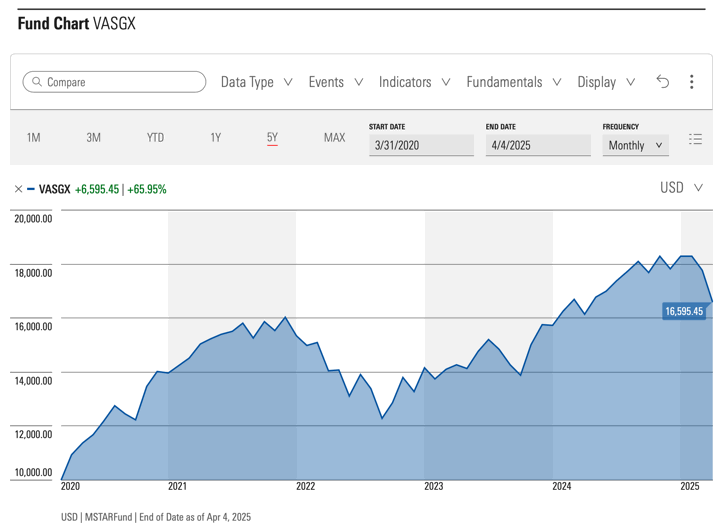
Let’s take a look at Vanguard LifeStrategy Growth Fund (VASGX), an all-in-one fund that is diversified similarly to their Target Date Retirement Funds, but a handy benchmark since it is a constant 80% stocks/20% bonds. Here’s a Growth of $10,000 chart for the last 5 years ending 4/4:

Instead of seeing that you are about 11% off your all-time high value of about $18,300, you might appreciate that you are still above January 2024 levels, and that your 5-year rolling average of year-end values is about $15,400. If you based your 4% withdrawal rate on that value, you would be much calmer now.

I like this strategy, and I believe it should be applied even when you are still accumulating for retirement. Don’t anchor yourself the all-time high of your portfolio and make it your new “If it ever goes below this, I’ll be sad!” value. Instead, mentally track a rolling average of your net worth. I’ll look to add this concept to my portfolio updates, hopefully it’ll reduce my stress levels during volatile times.

Finally, Ellis points out another potential benefit:

Importantly, by following such a Spending Rule, you are then free to concentrate on achieving significantly higher long-term returns without the need to be overinvested in bonds. Stabilizing the investor’s income with a responsible Spending Rule frees the investment portfolio to invest more in equities and produces, over time, a higher and more rapidly rising portfolio value and income stream.

MMB Portfolio Dividend & Interest Income – 2025 Q1 Update

Here’s my 2025 Q1 income update as a companion post to my 2025 Q1 asset allocation & performance update. Even though I don’t focus on high-dividend stocks, income-focused ETFs or high-yield bonds – I still track the income from my portfolio as an alternative metric to performance. The total income goes up much more gradually and consistently than the number shown on brokerage statements (market price), which helps encourage consistent investing. Here’s a related quote from Jack Bogle (source):

The true investor will do better if he forgets about the stock market and pays attention to his dividend returns and to the operating results of his companies. – Jack Bogle

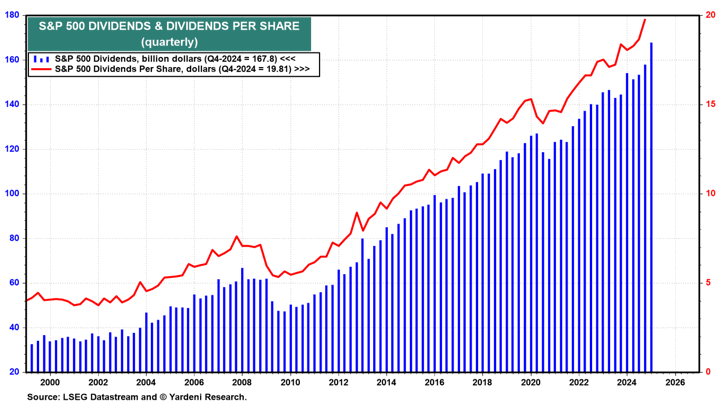
Here is the historical growth of the S&P 500 total dividend, which tracks roughly the largest 500 stocks in the US, updated after 2024 Q4 (via Yardeni Research):

Why I like tracking dividends in general. Stock dividends are a portion of profits that businesses have decided to distribute directly to shareholders, as opposed to reinvesting into their business, paying back debt, or buying back shares. They have explicitly decided that they don’t need this money to improve their business, and that it would be better to distribute it to shareholders. The dividends may suffer some short-term drops, but over the long run they have grown faster than inflation.

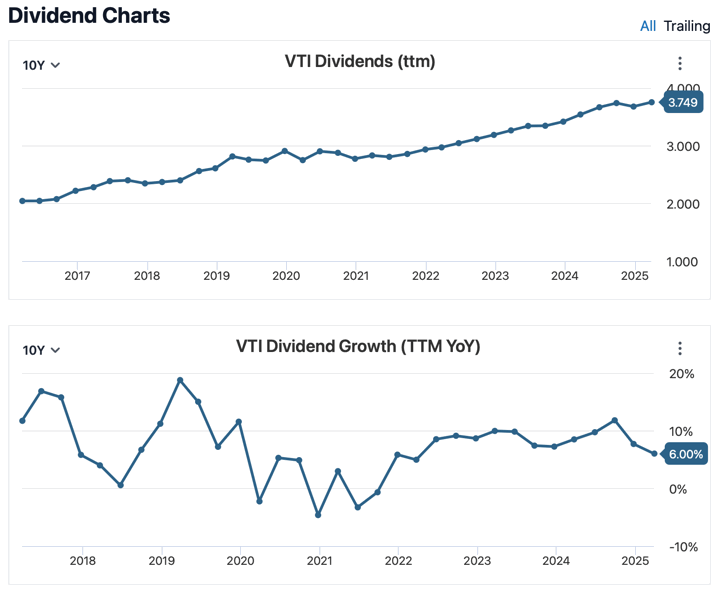
In the US, the dividend culture is somewhat conservative in that shareholders expect dividends to be stable and only go up. Thus the starting yield is lower, but grows more steadily with smaller cuts during hard times. Companies do buybacks as well, often because they are easier to discontinue. Here is the historical growth of the trailing 12-month (ttm) dividend paid by the Vanguard Total US Stock ETF (VTI) via StockAnalysis.com.

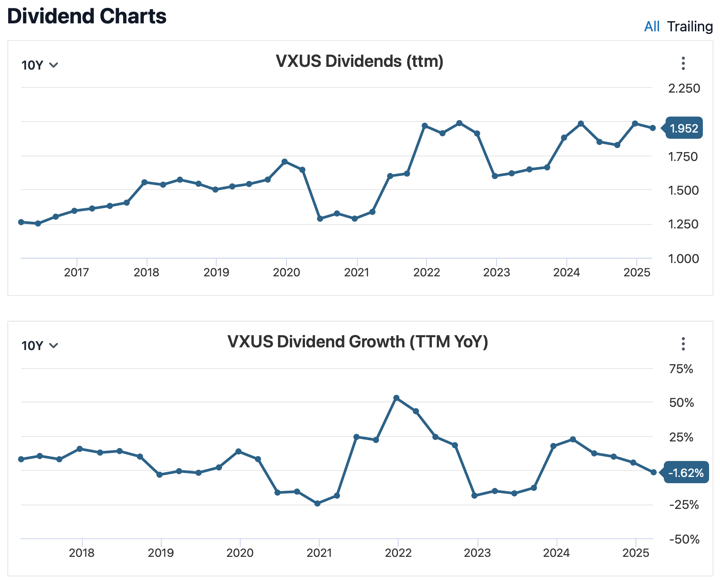
European corporate culture tends to encourage paying out a higher (sometimes even fixed) percentage of earnings as dividends, but that also means the dividends move up and down with earnings. The starting yield is currently higher but may not grow as reliably. Here is the historical growth of the trailing 12-month (ttm) dividend paid by the Vanguard Total International Stock ETF (VXUS).

The dividend yield (dividends divided by price) also serve as a rough valuation metric. When stock prices drop, this percentage metric usually goes up – which makes me feel better in a bear market. When stock prices go up, this percentage metric usually goes down, which keeps me from getting too euphoric during a bull market.

In the case of REITs, they are legally required to distribute at least 90 percent of their taxable income to shareholders as dividends. Historically, about half of the total return from REITs is from this dividend income.

Finally, the last component comes from interest from bonds and cash. This will obviously vary with the prevailing interest rates, the real rates on TIPS, and the current rate of inflation. In 2025, we are finally back to getting paid a certain amount more than inflation on our cash.

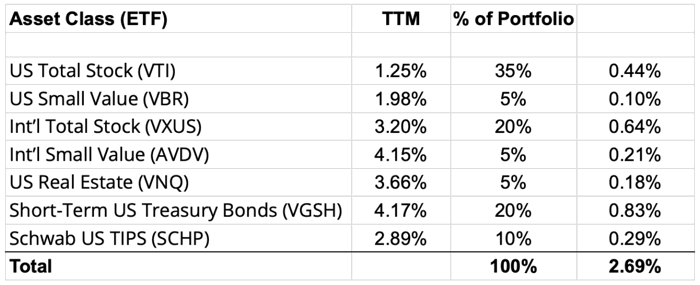
Dividend and interest income from my specific asset allocation. To estimate the income from my portfolio, I use the weighted “TTM” or “12-Month Yield” from Morningstar (checked 4/1/24), which is the sum of the trailing 12 months of interest and dividend payments divided by the last month’s ending share price (NAV) plus any capital gains distributed (usually zero for index funds) over the same period. My TTM portfolio yield is now roughly 2.69%.

In dividend investing circles, there is a metric called yield on cost, which is calculated by dividing the current dividend by the original purchase price. In other words, while my portfolio yield today is 2.69%, the yield-on-cost based on say 10 years ago, may be on the order of 5% or so. 2.69% may not seem like a lot percentage-wise, but I expect it to grow and in total terms it’s a lot more than 10 years ago when I started tracking it.

What about the 4% rule? For big-picture purposes, I support the simple 4% or 3% rule of thumb, which equates to a target of accumulating roughly 25 to 33 times your annual expenses. I would lean towards a 3% withdrawal rate if you want to retire young (closer to age 50) and a 4% withdrawal rate if retiring at a more traditional age (closer to 65). Too much time is spent debating this number. It’s just a quick and dirty target to get you started, not a number sent down from the heavens! You will always have time to adjust later.

During the accumulation stage, your time is better spent focusing on earning potential via better career moves, improving your skillset, networking, and/or looking for asymmetrical entrepreneurial opportunities where you have an ownership interest.

Our dividends and interest income are not automatically reinvested. They are simply another “paycheck”. As with our other variable paychecks, we can choose to either spend it or invest it again to compound things more quickly. You could use this money to cut back working hours, pursue a different career path, start a new business, take a sabbatical, perform charity or volunteer work, and so on. You don’t have to wait until you hit a magic number. FIRE is Life!

MMB Portfolio Asset Allocation & Performance – 2025 Q1 Update

I try to limit checking my portfolio to once a quarter, and this is my 2025 Q1 update that includes our combined 401k/403b/IRAs and taxable brokerage accounts but excluding our house and side portfolio of self-directed investments. Following the concept of skin in the game, the following is not a recommendation, but a sharing of our actual, imperfect DIY portfolio.

“Never ask anyone for their opinion, forecast, or recommendation. Just ask them what they have in their portfolio.” – Nassim Taleb

How I Track My Portfolio
Here’s how I track my portfolio across multiple brokers and account types:

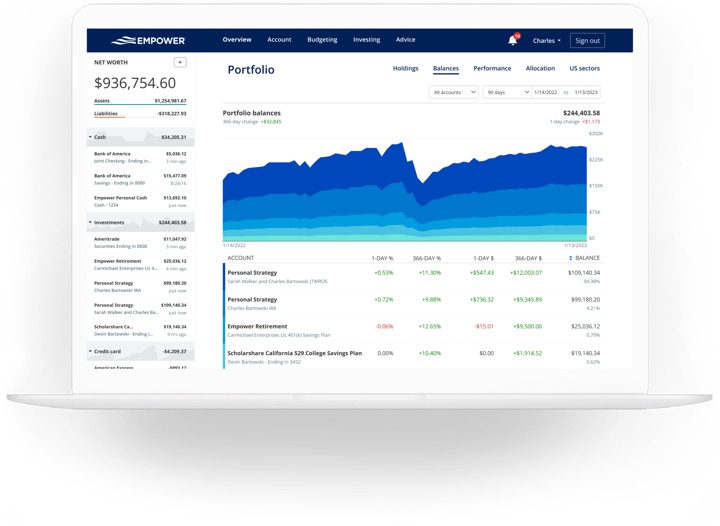
  • The Empower Personal Dashboard real-time portfolio tracking tools (free) automatically logs into my different accounts, adds up my various balances, tracks my performance, and calculates my overall asset allocation daily. Formerly known as Personal Capital.
  • Once a quarter, I also update my manual Google Spreadsheet (free to copy, instructions) because it helps me calculate how much I need in each asset class to rebalance back towards my target asset allocation. I also create a new tab each quarter, so I have a personal archive of my net worth dating back many years.

2025 Q1 Asset Allocation and YTD Performance
Here are updated performance and asset allocation charts, per the “Holdings” and “Allocation” tabs of my Empower Personal Dashboard.

The major components of my portfolio are broad index ETFs. I do mix it up a bit around the edges, but not very much. Here is a breakdown of my target asset allocation along with my primary ETF holding for each asset class.

  • 35% US Total Market (VTI)
  • 5% US Small-Cap Value (VBR/AVUV)
  • 20% International Total Market (VXUS)
  • 5% International Small-Cap Value (AVDV)
  • 5% US Real Estate (REIT) (VNQ)
  • 20% US “Regular” Treasury Bonds or FDIC-insured deposits
  • 10% US Treasury Inflation-Protected Bonds

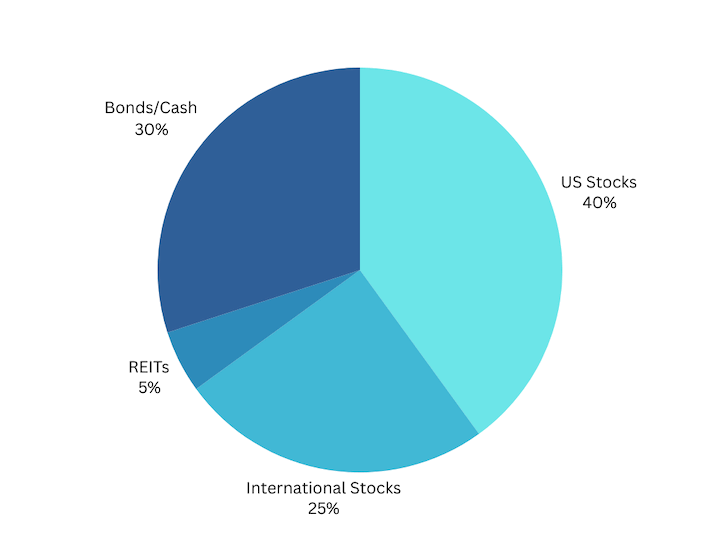
Big picture, it is 70% businesses and 30% very safe bonds/cash:

By paying minimal costs including management fees, transaction spreads, and tax drag, I am trying to essentially guarantee myself above-average net performance over time.

I do not spend a lot of time backtesting various model portfolios, as I don’t think picking through the details of the recent past will necessarily create superior future returns. You’ll usually find that whatever model portfolio is popular at the moment just happens to hold the asset class that has been the hottest recently as well.

The portfolio that you can hold onto through the tough times is the best one for you. Every asset class will eventually have a low period, and you must have strong faith during these periods to earn those historically high returns. You have to keep owning and buying more stocks through the stock market crashes. You have to maintain and even buy more rental properties during a housing crunch, etc. A good sign is that if prices drop, you’ll want to buy more of that asset instead of less. I don’t have strong faith in the long-term results of commodities, gold, or bitcoin – so I don’t own them.

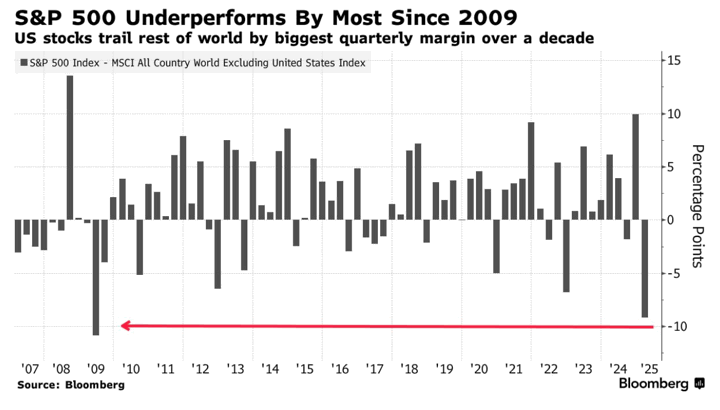
Performance details. According to Empower, the S&P 500 went down about 5% the first quarter of 2025, while foreign stocks went up around 7%. I don’t remember that happening for a while, and apparently it hasn’t happened since 2009 (see below;source). Overall, my portfolio was flat.

Over the last quarter, here’s a Growth of $10,000 chart courtesy of Testfolio for some of the major ETFs that shows the difference in performance in the broad indexes:

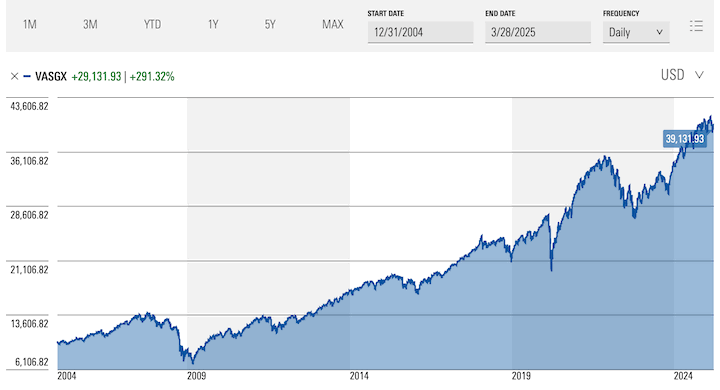
I always like to remember the big picture. Here’s an updated Morningstar Growth of $10,000 Chart for the Vanguard LifeStrategy Growth Fund (VASGX) which holds a static 80% stocks and 20% bonds and most closely mimics my portfolio since 2005, which is when I started investing more seriously and started this blog.

I’ll share about more about the income aspect in a separate post.