Archives for January 2025

Robinhood IRA Boost Promos: 3% IRA Contributions, 2% IRA Rollovers and 401(k) Transfers (Gold Required)

Robinhood brokerage app has some solid Retirement account promos for the New Year. There are much fewer brokerage promos that include both IRA rollovers and 401k rollovers. These can be very lucrative with a large retirement balance, especially as they are uncapped. Robinhood continues to aggressively collect assets. Keep in mind the 5-year minimum hold and 1-year minimum Gold subscription at $5/month.

  • 3% bonus on IRA contributions with a Robinhood Gold subscription. You can still make your 2024 contribution until April 15th, and also your 2025 contribution. Subject to the usual IRA annual maximum contribution limits. Five-year minimum hold period.
  • 2% on IRA and 401(k) transfers to your Robinhood IRA with a Robinhood Gold subscription. Five-year minimum hold period.

3% IRA Match Fine Print:

The 3% matching on contributions requires a subscription with Robinhood Gold ($5/mo) and customers must stay subscribed to Gold for 1 year after your first Gold match to keep the full Gold match. The funds that earned the match must be kept in the account for at least 5 years to avoid a potential Early IRA Match Removal Fee. Match rate subject to change. Non-Gold customers receive a 1% match. For more information refer to the IRA Match FAQ.

$420 match available to Robinhood Gold customers making the maximum 2024 IRA contribution by the IRS tax deadline, and the maximum 2025 IRA contribution. Robinhood does not provide tax advice; consult a tax adviser.

IRS contribution limit for 2024 and 2025 is $7,000 ($8,000 if you’re age 50 or older) annually. Visit the IRS site for more information. The annual tax filing deadline typically is April 15th but may vary by year or individual taxpayer circumstances. All IRA contributions count toward your annual limit.

2% Transfer Boost Fine Print:

The 2% matching on transfers requires a subscription with Robinhood Gold ($5/mo) and customers must stay subscribed to Gold for 1 year after receiving the first Gold match to keep the full Gold match. The funds that earned the match must be kept in the account for at least 5 years to avoid a potential Early IRA Match Removal Fee. Match rate subject to change. Non-Gold customers receive a 1% match. For more information refer to IRA Match 2025 FAQ.

If you contributed $7,000 for 2024, $7,000 for 2025, and roll over $100,000 in IRA/401k balances, that would add up to $2,420.

Robinhood will also reimburse up to $75 in outgoing transfer fees with transfers of $7,500 or more. This is a one-time reimbursement per account type, per external brokerage. You must send in a picture as evidence of the fee.

I’ve already written multiple articles about past flavors of these Robinhood promos, and I participated in the 3% IRA bonus previously. You will need to open up the appropriate IRA account at Robinhood first, and then transfer into that empty IRA container. You can attempt to offset some of the $5/month Robinhood Gold fee by using the free $1,000 in margin, or you might like the higher interest rate they pay on cash sweep with Gold.

Best Interest Rates Survey: Savings Accounts, Treasuries, CDs, ETFs – January 2025

Here’s my monthly survey of the best interest rates on cash as of January, roughly sorted from shortest to longest maturities. Banks love taking advantage of our tendency for idle cash, and you can often earning more money while keeping the same level of safety by moving to another FDIC-insured bank or NCUA-insured credit union. Check out my Ultimate Rate-Chaser Calculator to see how much extra interest you could earn from switching. Rates listed are available to everyone nationwide. Rates checked as of 1/10/2024.

TL;DR: Liquid, short-term rates are lower overall by roughly 0.25%. Very few at or near 5% APY liquid savings now. Longer-term rates actually went up a little; there are 4%+ APY 5-year CDs. Compare against Treasury bills and bonds at every maturity, taking into account state tax exemption. I no longer recommend fintech companies due to the possibility of loss due to poor recordkeeping and/or fraud.

High-yield savings accounts
Since the huge megabanks still pay essentially no interest, everyone should at least have a separate, no-fee online savings account to piggy-back onto your existing checking account. The interest rates on savings accounts can drop at any time, so I list the top rates as well as competitive rates from banks with a history of competitive rates and solid user experience. Some banks will bait you with a temporary top rate and then lower the rates in the hopes that you are too lazy to leave.

  • The top saving rates at the moment include TIMBR at 4.80% APY ($1k min) and Peak Bank at 4.75% APY ($100 min). Roger.bank is another new arrival at 5.00% APY (no min), but does require an additional checking account. Most others have dropped at least a little. For example, CIT Platinum Savings is now at 4.35% APY with $5,000+ balance.
  • SoFi Bank is at 4.00% APY + up to $325 new account bonus with direct deposit. You must maintain a direct deposit of any amount (even $1) each month for the higher APY. SoFi has historically competitive rates and full banking features. See details at $25 + $300 SoFi Money new account and deposit bonus.
  • Here is a limited survey of high-yield savings accounts. They aren’t the top rates, but a group that have historically kept it relatively competitive such that I like to track their history.

Short-term guaranteed rates (1 year and under)
A common question is what to do with a big pile of cash that you’re waiting to deploy shortly (plan to buy a house soon, just sold your house, just sold your business, legal settlement, inheritance). My usual advice is to keep things simple and take your time. If not a savings account, then put it in a flexible short-term CD under the FDIC limits until you have a plan.

  • No Penalty CDs offer a fixed interest rate that can never go down, but you can still take out your money (once) without any fees if you want to use it elsewhere. Marcus has a 7mo/9mo/11mo No Penalty CD at 4.00% APY with a $500 minimum deposit. Farmer’s Insurance FCU has 9-month No Penalty CD at 4.25% APY with a $1,000 minimum deposit. Consider opening multiple CDs in smaller increments for more flexibility.
  • Abound Credit Union has a 8-month certificate special at 4.75% APY ($500 min). Anyone can join this credit union nationwide with $10 fee. Early withdrawal penalty is 90 days of interest.

Money market mutual funds
Many brokerage firms that pay out very little interest on their default cash sweep funds (and keep the difference for themselves). Note: Money market mutual funds are highly-regulated, but ultimately not FDIC-insured, so I would still stick with highly reputable firms.

  • Vanguard Federal Money Market Fund (VMFXX) is the default sweep option for Vanguard brokerage accounts, which has an SEC yield of 4.28% (changes daily, but also works out to a compound yield of 4.36%, which is better for comparing against APY). Odds are this is much higher than your own broker’s default cash sweep interest rate.
  • Vanguard Treasury Money Market Fund (VUSXX) is an alternative money market fund which you must manually purchase, but the interest will be mostly (80% for 2023 tax year) exempt from state and local income taxes because it comes from qualifying US government obligations. Current SEC yield of 4.35% (compound yield of 4.44%).

Treasury Bills and Ultra-short Treasury ETFs
Another option is to buy individual Treasury bills which come in a variety of maturities from 4-weeks to 52-weeks and are fully backed by the US government. You can also invest in ETFs that hold a rotating basket of short-term Treasury Bills for you, while charging a small management fee for doing so. T-bill interest is exempt from state and local income taxes, which can make a significant difference in your effective yield.

  • You can build your own T-Bill ladder at TreasuryDirect.gov or via a brokerage account with a bond desk like Vanguard and Fidelity. Here are the current Treasury Bill rates. As of 1/10/25, a new 4-week T-Bill had the equivalent of 4.31% annualized interest and a 52-week T-Bill had the equivalent of 4.24% annualized interest.
  • The iShares 0-3 Month Treasury Bond ETF (SGOV) has a 4.48% SEC yield (0.09% expense ratio) and effective duration of 0.10 years. SPDR Bloomberg Barclays 1-3 Month T-Bill ETF (BIL) has a 4.34% SEC yield (0.136% expense ratio) and effective duration of 0.08 years.

US Savings Bonds
Series I Savings Bonds offer rates that are linked to inflation and backed by the US government. You must hold them for at least a year. If you redeem them within 5 years there is a penalty of the last 3 months of interest. The annual purchase limit for electronic I bonds is $10,000 per Social Security Number, available online at TreasuryDirect.gov.

  • “I Bonds” bought between November 2024 and April 2025 will earn a 3.11% rate for the first six months. The rate of the subsequent 6-month period will be based on inflation again. More on Savings Bonds here.
  • In mid-April 2025, the CPI will be announced and you will have a short period where you will have a very close estimate of the rate for the next 12 months. I will have another post up at that time.

Rewards checking accounts
These unique checking accounts pay above-average interest rates, but with unique risks. You have to jump through certain hoops which usually involve 10+ debit card purchases each cycle, a certain number of ACH/direct deposits, and/or a certain number of logins per month. If you make a mistake (or they judge that you did) you risk earning zero interest for that month. Some folks don’t mind the extra work and attention required, while others would rather not bother. Rates can also drop suddenly, leaving a “bait-and-switch” feeling.

  • OnPath Federal Credit Union (my review) pays 7.00% APY on up to $10,000 if you make 15 debit card purchases, opt into online statements, and login to online or mobile banking once per statement cycle. Anyone can join this credit union via $5 membership fee to join partner organization. You can also get a $100 Visa Reward card when you open a new account and make qualifying transactions.
  • Genisys Credit Union pays 6.75% APY on up to $7,500 if you make 10 debit card purchases of $5+ each per statement cycle, and opt into online statements. Anyone can join this credit union via $5 membership fee to join partner organization.
  • La Capitol Federal Credit Union pays 6.25% APY on up to $10,000 if you make 15 debit card purchases of at least $5 each per statement cycle. Anyone can join this credit union via partner organization, Louisiana Association for Personal Financial Achievement ($20).
  • NEW: Falcon National Bank pays 6.00% APY on up to $25,000 if you make at least 15 debit card purchases, 1 direct deposit OR ACH credit transaction, and enroll in online statements.
  • Credit Union of New Jersey pays 6.00% APY on up to $25,000 if you make 12 debit card purchases, opt into online statements, and make at least 1 direct deposit, online bill payment, or automatic payment (ACH) per statement cycle. Anyone can join this credit union via $5 membership fee to join partner organization.
  • Andrews Federal Credit Union pays 6.00% APY on up to $25,000 if you make 15 debit card purchases, opt into online statements, and make at least 1 direct deposit or ACH transaction per statement cycle. Anyone can join this credit union via partner organization.
  • Find a locally-restricted rewards checking account at DepositAccounts.

Certificates of deposit (greater than 1 year)
CDs offer higher rates, but come with an early withdrawal penalty. By finding a bank CD with a reasonable early withdrawal penalty, you can enjoy higher rates but maintain access in a true emergency. Alternatively, consider building a CD ladder of different maturity lengths (ex. 1/2/3/4/5-years) such that you have access to part of the ladder each year, but your blended interest rate is higher than a savings account. When one CD matures, use that money to buy another 5-year CD to keep the ladder going. Some CDs also offer “add-ons” where you can deposit more funds if rates drop.

  • KS State Bank has a 5-year certificate at 4.25% APY ($500 minimum), 4-year at 4.25% APY, 3-year at 4.20% APY, 2-year at 4.20% APY, and 1-year at 4.30% APY. $500 minimum. The early withdrawal penalty (EWP) for the 5-year is a huge 540 days of interest.
  • Mountain America Credit Union (MACU) has a 5-year certificate at 4.25% APY ($500 minimum), 4-year at 4.20% APY, 3-year at 4.15% APY, 2-year at 3.95% APY, and 1-year at 4.25% APY. Early withdrawal penalty for the 4-year and 5-year is 365 days of interest. Anyone can join this credit union via partner organization American Consumer Council for a one-time $5 fee (or try promo code “consumer”).
  • You can buy certificates of deposit via the bond desks of Vanguard and Fidelity. You may need an account to see the rates. These “brokered CDs” offer FDIC insurance and easy laddering, but they don’t come with predictable early withdrawal penalties. Right now, I see a 5-year non-callable CD at 4.10% APY (callable: no, call protection: yes). Be warned that both Vanguard and Fidelity will list higher rates from callable CDs, which importantly means they can call back your CD if rates drop later. (Issuers have indeed started calling some of their old 5%+ CDs during 2024.)

Longer-term Instruments
I’d use these with caution due to increased interest rate risk (tbh, I don’t use them at all), but I still track them to see the rest of the current yield curve.

  • Willing to lock up your money for 10 years? You can buy long-term certificates of deposit via the bond desks of Vanguard and Fidelity. These “brokered CDs” offer FDIC insurance, but they don’t come with predictable early withdrawal penalties. You might find something that pays more than your other brokerage cash and Treasury options. Right now, I see a 10-year CDs at 4.00% (non-callable) vs. 4.77% for a 10-year Treasury. Watch out for higher rates from callable CDs where they can call your CD back if interest rates drop.

All rates were checked as of 1/10/2024.

Photo by Giorgio Trovato on Unsplash

MMB Portfolio Dividend & Interest Income – 2024 Year-End Update

Here’s my 2024 Year End income update as a companion post to my 2024 Year End asset allocation & performance update. Even though I don’t focus only on high-dividend stocks, income-focused ETFs or high-yield bonds – I consider myself focused on total return) – I still track the income from my portfolio as an alternative metric to performance. The total income goes up much more gradually and consistently than the number shown on brokerage statements (market price), which helps encourage consistent investing. Here’s a related quote from Jack Bogle (source):

The true investor will do better if he forgets about the stock market and pays attention to his dividend returns and to the operating results of his companies. – Jack Bogle

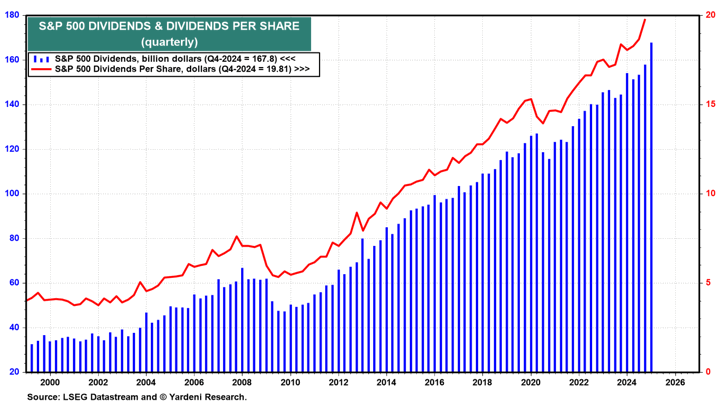
Here is the historical growth of the S&P 500 total dividend, which tracks roughly the largest 500 stocks in the US, updated after 2024 Q4 (via Yardeni Research):

Why I like tracking dividends in general. Stock dividends are a portion of profits that businesses have decided to distribute directly to shareholders, as opposed to reinvesting into their business, paying back debt, or buying back shares. They have explicitly decided that they don’t need this money to improve their business, and that it would be better to distribute it to shareholders. The dividends may suffer some short-term drops, but over the long run they have grown faster than inflation.

In the US, the dividend culture is somewhat conservative in that shareholders expect dividends to be stable and only go up. Thus the starting yield is lower, but grows more steadily with smaller cuts during hard times. Companies do buybacks as well, often because they are easier to discontinue. Here is the historical growth of the trailing 12-month (ttm) dividend paid by the Vanguard Total US Stock ETF (VTI) via StockAnalysis.com.

European corporate culture tends to encourage paying out a higher (sometimes fixed) percentage of earnings as dividends, but that also means the dividends move up and down with earnings. The starting yield is currently higher but may not grow as reliably. Here is the historical growth of the trailing 12-month (ttm) dividend paid by the Vanguard Total International Stock ETF (VXUS).

The dividend yield (dividends divided by price) also serve as a rough valuation metric. When stock prices drop, this percentage metric usually goes up – which makes me feel better in a bear market. When stock prices go up, this percentage metric usually goes down, which keeps me from getting too euphoric during a bull market.

In the case of REITs, they are legally required to distribute at least 90 percent of their taxable income to shareholders as dividends. Historically, about half of the total return from REITs is from this dividend income.

Finally, the last component comes from interest from bonds and cash. This will obviously vary with the prevailing interest rates, the real rates on TIPS, and the current rate of inflation. In 2024, we are finally back to getting paid a certain amount more than inflation on our cash.

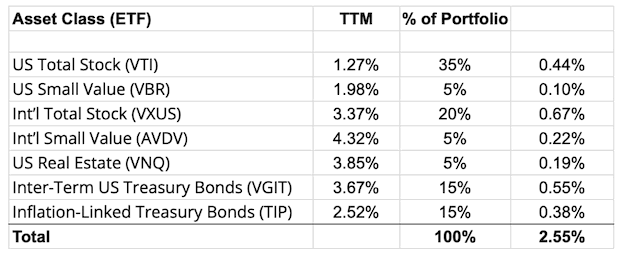
Dividend and interest income from my specific asset allocation. To estimate the income from my portfolio, I use the weighted “TTM” or “12-Month Yield” from Morningstar (checked 1/5/24), which is the sum of the trailing 12 months of interest and dividend payments divided by the last month’s ending share price (NAV) plus any capital gains distributed (usually zero for index funds) over the same period. My TTM portfolio yield is now roughly 2.55%.

As you can see from my total annual income tracker, my total income from this portfolio has been mostly steady since mid-2022 (when interest rates started to rise again). Again, this keeps me from getting too euphoric from the market’s gains. A lot of it is just P/E ratio expansion, which can just as easily be followed by P/E ratio contraction.

What about the 4% rule? For big-picture purposes, I support the simple 4% or 3% rule of thumb, which equates to a target of accumulating roughly 25 to 33 times your annual expenses. I would lean towards a 3% withdrawal rate if you want to retire young (closer to age 50) and a 4% withdrawal rate if retiring at a more traditional age (closer to 65). Too much time is spent debating this number. It’s just a quick and dirty target to get you started, not a number sent down from the heavens! You will always have time to adjust later.

During the accumulation stage, your time is better spent focusing on earning potential via better career moves, improving your skillset, networking, and/or looking for asymmetrical entrepreneurial opportunities where you have an ownership interest.

Our dividends and interest income are not automatically reinvested. They are simply another “paycheck”. As with our other variable paychecks, we can choose to either spend it or invest it again to compound things more quickly. You could use this money to cut back working hours, pursue a different career path, start a new business, take a sabbatical, perform charity or volunteer work, and so on. You don’t have to wait until you hit a magic number. FIRE is Life!

World Of Hyatt Business Credit Card Review: 60,000 Bonus Points Offer

The World of Hyatt Business Credit Card issued by Chase is the small business version of the consumer World of Hyatt credit card. Here are the highlights:

  • 60,000 Bonus Hyatt Points after you spend $5,000 on purchases in your first 3 months from account opening.
  • Up to $100 in Hyatt statement credits – spend $50 or more at any Hyatt property and earn $50 statement credits up to two times each anniversary year.
  • Up to 9X points total per $1 spent at Hyatt – 4 Bonus Points per $1 on qualifying purchases at Hyatt hotels & up to 5 Base Points per $1 from Hyatt as a World of Hyatt member
  • 2X Points per $1 spent in your top three spend categories each quarter.
  • 2X Points per $1 spent on fitness club and gym memberships
  • 1 Point per $1 spent on all other purchases.
  • 5 Tier-Qualifying night credits toward status and Milestone rewards for every $10,000 you spend in a calendar year.
  • World of Hyatt Discoverist status for as long as your account is open. Plus, gift Discoverist status to up to five employees.
  • 10% Redemption bonus. Spend $50,000 in a calendar year and get 10% of your redeemed points back for the rest of the year.
  • $199 annual fee.

Under-the-radar benefit: The “2 Bonus Points total per $1 spent in your top three spend categories each quarter” can cover a lot your spending at 2X Hyatt points per dollar spent. Eligible categories are:

  • Dining
  • Shipping
  • Airline tickets when purchased directly with the airline
  • Local transit & commuting
  • Social media & search engine Advertising
  • Car rental agencies
  • Gas stations
  • Internet, cable & phone services

Application details. Note the following:

This bonus offer is available to you if you do not have this card and have not received a new Cardmember bonus for this card in the past 24 months.

The 5/24 rule is believed to apply to this card. On many Chase cards, there is an unwritten rule that they will automatically deny approval on new credit cards if you have 5 or more new credit cards from any issuer on your credit report within the past 2 years (aka the 5/24 rule). This rule is designed to discourage folks that apply for high numbers of sign-up bonuses. This is applied on a per-person basis, so in our household one applies to Chase while the other applies at other card issuers.

The value of Hyatt hotel points. The most valuable redemption options are for free hotel nights, points+cash hotel combinations, and/or room upgrades. Hyatt allows you the flexibility of combining your points with any other World of Hyatt member to redeem an award. They are also somewhat unique in that you can book a suite directly with points.

Below is their points award chart, and here is their award search tool. Free rooms start at 3,500 points, and you can book suites with points as well.

If you compare with the cash cost of these hotels, the number varies but you are nearly always getting between 1 cent and 2 cents per point value on the low end, and possibly much more on the luxury end. We stayed at Grand Hyatt Kauai on Hyatt points (earned via credit cards), where the cash value is $701 per night when you include all taxes and the $35/night resort fee. That worked out to 2.8 cents per Hyatt point.

I am conservative with point valuations, so I prefer to use a simple value of 1 cent per Hyatt point. However, in reality, I am only going to redeem a Hyatt point if I can get 2 cents per point value. I believe that Hyatt points are now the most valuable hotel points on a per-point basis, above Bonvoy, IHG, etc. In general, I would rather convert my Chase Ultimate Rewards points into Hyatt points than any other hotel program.

As such, a Free Night Award that is valid on up to a Category 4 hotel is worth up to 18,000 Hyatt points at Peak times, which equates to $180 in value at a conservative 1 cent per point.

Hyatt points expire after 24 months of inactivity, but earning points via this credit card counts as activity. Chase Ultimate Rewards points also convert to Hyatt points and the transfer counts as activity.

The free Discoverist status from this card gets you a free bottle of water daily, a free upgrade to premium WiFi internet, dedicated check-in area, and a 2pm late checkout upon request at participating locations. You are also eligible for a minor room upgrade within your type booked.

Bottom line. The World of Hyatt Business Credit Card offers value to small business owners that regularly stay at Hyatt properties. (This is me – World of Hyatt is my favorite hotel rewards program.) The first-year value on this business card is very strong. 60,000 Hyatt points even at a conservative 1 cent per point value is worth $600. As long as you have two $50+ charges at a Hyatt property (including a food or spa purchase), that is another $100. Ignoring every other perk and subtracting the $199 annual fee, that’s still an estimated first-year value of over $500.

I will be adding this to my Top 10 Best Small Business Card Bonus Offers.

The information for the World of Hyatt Business Credit Card has been collected independently by My Money Blog. The card details on this page have not been reviewed or provided by the card issuer.

Navy Federal cashRewards Plus Card: $250 Bonus, 0% APR for 12 Months w/ No Balance Transfer Fee, 2% Cash Back, No Annual Fee

Updated with no balance transfer fee 0% APR offer. The Navy Federal cashRewards Plus Card is the new and improved sibling of the Navy Federal cashRewards Card (no “Plus”). The difference: If the credit limit you get is $5,000 and above, you get the Plus with a higher 2% cash back. Under $5,000; no Plus and the old 1.5% cash back. NavyFed has a limited-time offer starting January 2025. Rest of the highlights:

  • $250 cash back for new cardholders after $2,500 in purchases within 90 days of account opening.
  • NEW: 0% intro APR on balance transfers for 12 months, with no balance transfer fee. This limited-time offer ends 3/31/25.
  • Flat 2% cash back on all purchases with the cashRewards Plus card with $5,000+ credit limit.
  • Flat 1.5% cash back on all purchases with the cashRewards card with less than $5,000 credit limit.
  • No foreign transaction fees.
  • No annual fee.

There is no cap on cash back earned. Cash back does not expire as long as the account is open. Note: There is no longer any benefit to having direct deposit on a NavyFed checking account.

A few readers have commented that they don’t like dealing with miles or points, and prefer simple cash back. This is one of the better cash bonuses on a flat 2% cash back card with no annual fee. I would recommend to maximize your stated income to include all legitimate, eligible sources in order to get the highest credit limit possible.

The primary catch here is that in order to apply, you must be a NavyFed credit union member. Membership eligibility for NavyFed now goes beyond current and retired members of the armed forces to include their families and household members of veterans, Department of Defense personnel, and more. Eligible family members include your spouse, parents, siblings, grandparents, children, stepchildren and grandchildren. If you call them up, they can help you confirm the details on the veterans in your family. The effort can be worth it as NavyFed also offers other useful financial products like mortgages, car loans, certificates of deposit, etc.

M1 Review: DIY Robo-Advisor, $75 Bonus via Referral

I’ve tried out my share of robo-advisors, which always sounded nice in theory but I eventually became disillusioned as they kept generating lot of unnecessary capital gains every time they change their model portfolios to chase the latest and hottest trends. My favorite service for those that want a little extra help is one where I can pick my own custom target portfolio, but the robo still does the hard work: M1 Finance. Here’s a quick rundown of what makes them different:

  • Fully customizable. You pick your own target asset allocation “pie”. (You can add ETFs or individual stocks.) You can simply copy one of the many model portfolios out there, or make your own custom pie as you like. You have full control! M1 handles the tedious stuff, like rebalancing or dividing a $100 contribution across 8 different ETFs.
  • No commissions. Free stock/ETF trades with a low $100 initial minimum for taxable accounts and a $500 minimum opening amount for retirement accounts. After your initial deposit any amount greater than $10 can be deposited.
  • Free with $10,000 balance. Otherwise $3/month. Most robo-advisors charge an annual management fee of 0.25% to 0.50% of assets, or force you to own something bad, like a lot of low-interest cash. (Looking at you, Schwab…)
  • Free dynamic rebalancing. All new deposits (and withdrawals) will be invested (or sold) dynamically to bring your portfolio back toward your target asset allocation. M1 will also rebalance your entire portfolio back to the target allocation for you with a few clicks (for free) whenever you choose, on demand. You don’t need to do any math or maintain any spreadsheets.
  • Fractional shares (dollar-based). For example, you can just set it to automatically invest $100 a month, and your full amount will be spread across multiple ETFs. Dollar-based transactions were one of the advantages of buying a mutual fund, but fractional shares solve this problem. ETFs are also usually more tax-efficient than mutual funds.
  • Real brokerage account with off-the-shelf investments that you can move out. Some robo-advisors hold special, proprietary funds that you have to sell if you ever leave, possibly creating a big tax bill. (Looking at you, Fidelity…) M1 is built on a regular brokerage account, so you can move your Vanguard/iShares/Schwab ETFs and stock shares out to another broker whenever you want.

Now, for a long time, Vanguard didn’t offer automatic fractional investments into ETFs. But as of October 2024, Vanguard now offers fractional ETF investments.

Still, M1 Finance checks off many of the boxes of my brokerage wish list. The only thing they could add would be to have the high availability of knowledgeable customer service of a huge company like Fidelity or Schwab.

If you want to invest in newer factor ETFs that focus on Small-Cap, Value, Momentum, or Quality factors like those from DFA and Avantis, or a mix of dividend-oriented ETFs like SCHD/VIG/VYM, their service makes it much easier to set up a portfolio mix of different ETFs.

M1 Plus features are now available to everyone. M1 Plus was their premium subscription tier with several additional perks. As of May 2024, everyone gets these features, but they are only free with a $10,000 balance and $3/month otherwise.

  • High-yield savings (currently 4.00% APY as of 7/1/25). FDIC-insured up to $5 million.
  • Competitive margin rates.
  • Custodial accounts for kids.
  • Extra 3pm PM ET trade window.
  • Automated “smart” transfers.

$75 referral bonus. M1 has a $75 referral bonus if you open a new account with $10,000 and maintain it for 30 days. Here is my M1 referral link (thanks if you use it!) from which you must start opening your new account.

A bonus that amounts to 0.75% of your initial deposit with only a 30 day hold is technically a 9% annualized yield.

ACAT Transfer bonus. This is not currently available.

Bottom line. M1 Finance is a brokerage account that acts like a customizable robo-advisor with automatic rebalancing into a target portfolio. You control the model portfolio, and they do the tedious work. Great for implementation of a low-cost, index or passive ETF portfolio. New pricing structure as of May 2024: Free for those with $10,000 in assets, otherwise $3 a month.

MMB Portfolio: Should I Own Less International Stocks? (2024 Year End)

The most common reader question about my personal portfolio is definitely the fact that the allocation to international stocks has been a drag on performance relative to owning 100% US stocks. This is kind of a repeat topic, so I won’t dive into the full debate again, but wanted to offer some expanded and updated thoughts to my response to a comment from reader John. All numbers below are taken as of January 2025.

The divergence between the performance of US stocks and the rest of the world started around 2009, which of course coincided with most of my investing lifetime so far. 😒 Here’s a chart from the Bloomberg article Global Diversification Has Disappointed. Don’t Give Up on It (gift article for next 7 days). Worth a read.

As noted in my portfolio updates, my asset allocation floats along with total world market cap breakdown, as tracked according to the Vanguard Total World Stock ETF (VT). I remember a time when it was only 45% US and 55% Rest of the World (World ex-US). As of the end of 2024, it is now at 65% US and 35% World ex-US.

In practical terms, this means that I used to own about the same amount of Vanguard Total US Stock Market ETF (VTI) and Vanguard Total International Stock ETF (VXUS), a 1:1 ratio. But as of the end of 2024, I now own about double the amount of VTI relative to VXUS, a 2:1 ratio. So my performance isn’t exactly that of the chart above due to ongoing investments over time, but it’s still been much lower than if I used owned 100% US stocks.

I can’t change the past. The question is: Should I change my asset allocation now?

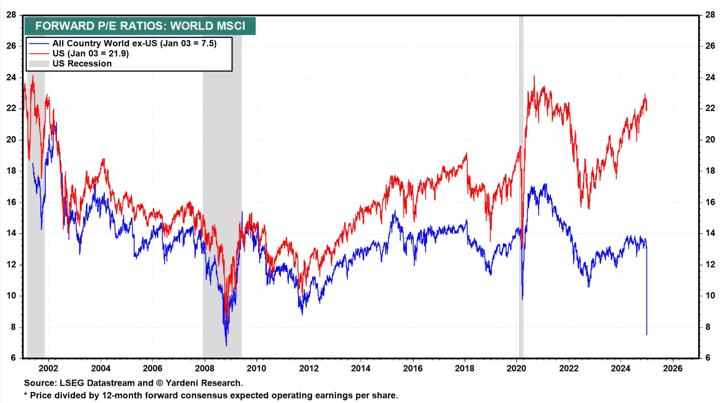
Let’s look closer. A significant chunk (not all) of the outperformance has been due to a higher P/E ratio. Below is a Yardeni chart of the P/E ratio of US stocks vs. International stocks. The gap looks like the greatest in 25 years. Can this trend continue? I don’t know, and I don’t think anyone really knows.

Are US stocks simply a better investment, forever? They might be. The US definitely offers a very business-friendly environment overall. That’s why I just let it float. If the US manages to continue this outperformance in the future, then one day my allocation might grow to 75%/25% (3:1 ratio) or even 80%/20% (4:1 ratio). My portfolio adjusts.

This is the same theory as owning all of the companies in a market-weighted S&P 500 index fund: you own all the winners, and you also own the losers, but owning the winners is good enough to pull everything up overall. If the US keeps being a huge winner, I’ll own a lot of the US. If not, I still own the entire haystack. Therefore, I plan to continue holding a chunk of international stocks according to the investable market-cap float with maybe a slight home bias.

I could sit here and lament how big my portfolio would have been if I had bet on 100% US for the last 15 years, but honestly the stock markets have been kind to me as a business owner (although I’d say at the expense of the average worker bee) even with my international stocks and bond holdings. The 10-year trailing average annualized return has been 9.33% for VT vs. 12.50% for VTI. Owning a mix of winners and losers has still worked out just fine, and I was covered in case history turned out differently. I have no complaints.

Photo by Andrew Neel on Unsplash

MMB Portfolio Asset Allocation & Performance – 2024 Year-End Update

Here’s my Year End 2024 update for our primary investment holdings, including all of our combined 401k/403b/IRAs and taxable brokerage accounts but excluding our house and side portfolio of self-directed investments. Following the concept of skin in the game, the following is not a recommendation, but a sharing of our real-world, imperfect, low-cost, diversified DIY portfolio.

“Never ask anyone for their opinion, forecast, or recommendation. Just ask them what they have in their portfolio.” – Nassim Taleb

How I Track My Portfolio
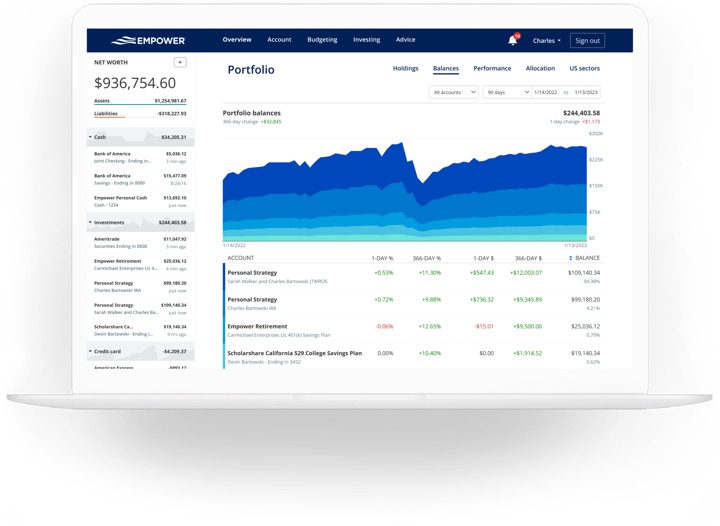
Here’s how I track my portfolio across multiple brokers and account types. There are limited free advanced options after Morningstar discontinued free access to their portfolio tracker. I use both Empower Personal Dashboard (previously known as Personal Capital) and a custom Google Spreadsheet to track my investment holdings:

  • The Empower Personal Dashboard real-time portfolio tracking tools (free) automatically logs into my different accounts, adds up my various balances, tracks my performance, and calculates my overall asset allocation daily. Formerly known as Personal Capital.
  • Once a quarter, I also update my manual Google Spreadsheet (free to copy, instructions) because it helps me calculate how much I need in each asset class to rebalance back towards my target asset allocation. I also create a new tab each quarter, so I have a personal archive of my holdings dating back many years.

2024 Year End Asset Allocation and YTD Performance
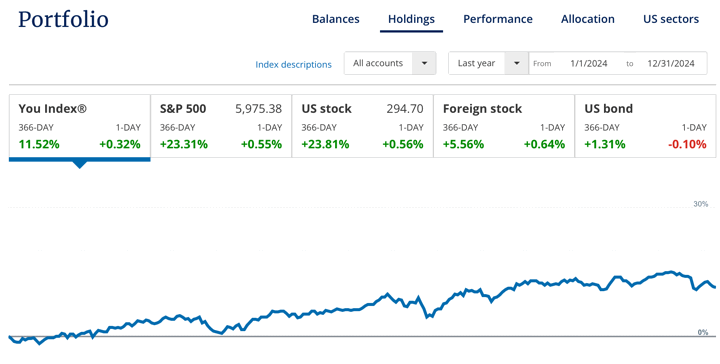
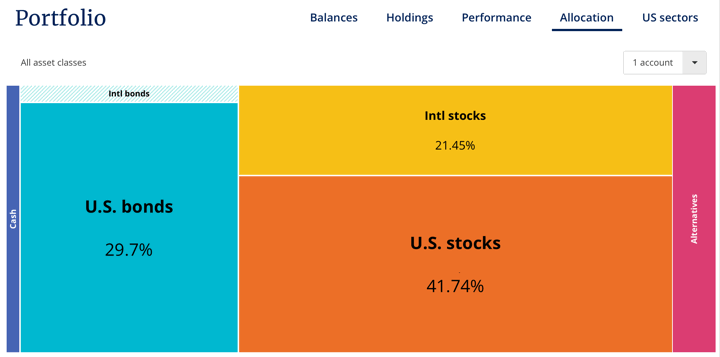
Here are updated performance and asset allocation charts, per the “Holdings” and “Allocation” tabs of my Empower Personal Dashboard.

I own broad, low-cost exposure to productive assets that will provide long-term returns above inflation, distribute income via dividends and interest, and offer some historical tendencies to balance each other out. I have faith in the long-term benefit of owning all of the best businesses worldwide, as well as the stability of high-quality US Treasury debt.

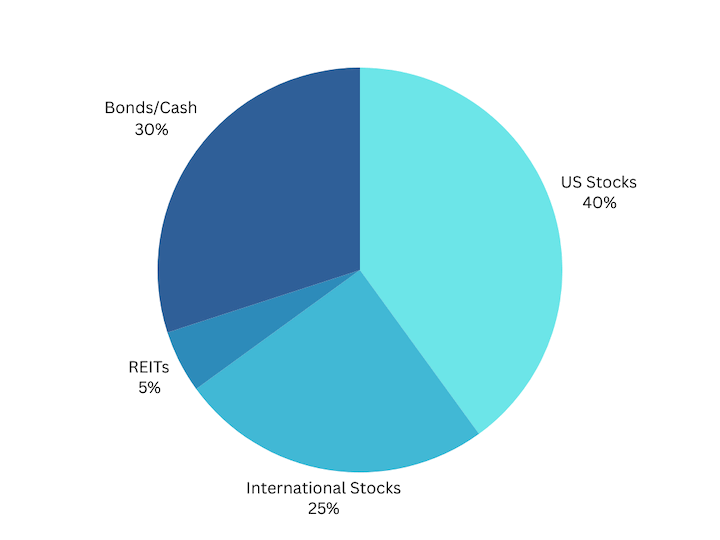
I let my stock holdings float relatively close to the total world market cap breakdown, and it is now at ~65% US and ~35% ex-US. I do add just a little “spice” to the broad funds with the inclusion of “small value” factor ETFs for US and Developed International stocks as well as diversified real estate exposure through US REITs. But if you step back and look at the big picture, this is my simplified target portfolio:

By paying minimal costs including management fees, transaction spreads, and tax drag, I am trying to essentially guarantee myself above-average net performance over time.

The portfolio that you can hold onto through the tough times is the best one for you. Every asset class will eventually have a low period, and you must have strong faith during these periods to earn those historically high returns. You have to keep owning and buying more stocks through the stock market crashes. You have to maintain and even buy more rental properties during a housing crunch, etc. A good sign is that if prices drop, you’ll want to buy more of that asset instead of less. I don’t have strong faith in the long-term results of commodities, gold, or bitcoin – so I don’t own them.

I do not spend a lot of time backtesting various model portfolios, as I don’t think picking through the details of the recent past will necessarily create superior future returns. You’ll usually find that whatever model portfolio is popular at the moment just happens to hold the asset class that has been the hottest recently as well.

I have settled into a long-term target ratio of roughly 70% stocks and 30% bonds within our investment strategy of buy, hold, and occasionally rebalance. My goal has evolved to more of a “perpetual income portfolio” as opposed to a “build up a big stash and hope it lasts until I die” portfolio. My target withdrawal rate is 3% or less. Here is a round-number breakdown of my target asset allocation along with my primary ETF holding for each asset class.

  • 35% US Total Market (VTI)
  • 5% US Small-Cap Value (VBR/AVUV)
  • 20% International Total Market (VXUS)
  • 5% International Small-Cap Value (AVDV)
  • 5% US Real Estate (REIT) (VNQ)
  • 15% US “Regular” Treasury Bonds or FDIC-insured deposits
  • 15% US Treasury Inflation-Protected Bonds or I Savings Bonds

I do let things wobble a bit so I don’t have to keep rebalancing. Also, I have limited tax-deferred space for TIPS so I own less than I might otherwise. So the bonds is closer to 20% Treasuries and 10% TIPS.

Performance details. According to Empower, my portfolio went up around 11.5% in 2024. The S&P 500 went up 23.3% in 2024, while the US Bond index went up around 1.3%. Another year of relative underperformance in international stocks in the books.

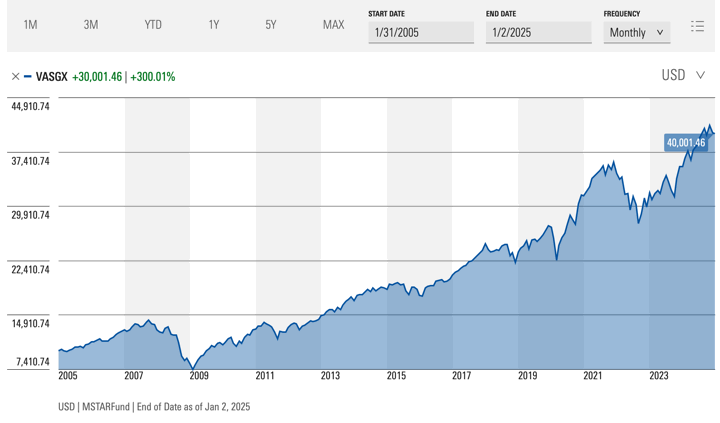
Overall, we spent some of our dividends/interest and also made some 401k/IRA contributions with income to take advantage of tax-deferred opportunities. We no longer have the crazy savings rate of our 20s and 30s. Owning stocks continues to reward long-term investors. Out of curiosity, I generated a Morningstar Growth of $10,000 Chart for the Vanguard LifeStrategy Growth Fund (VASGX) which holds a static 80% stocks and 20% bonds and most closely mimics my portfolio since 2005, roughly when I started investing more seriously and started this blog. A very rough approximation is to expect your money to double every decade (Rule of 72). The money that I invested 20 years ago has indeed roughly doubled twice (4X).

I’ll share about more about the income aspect in a separate post.

2024 Year-End Review: Annual Broad Asset Class & Target Fund Returns

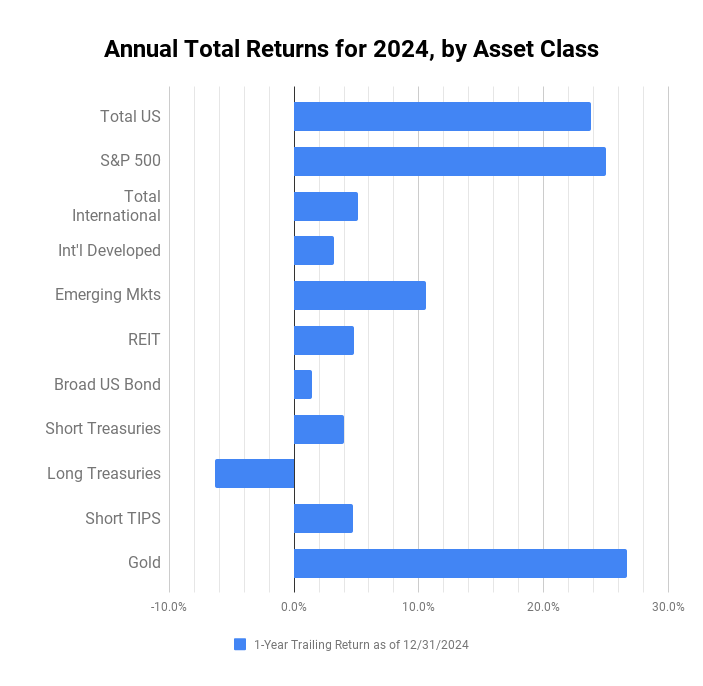
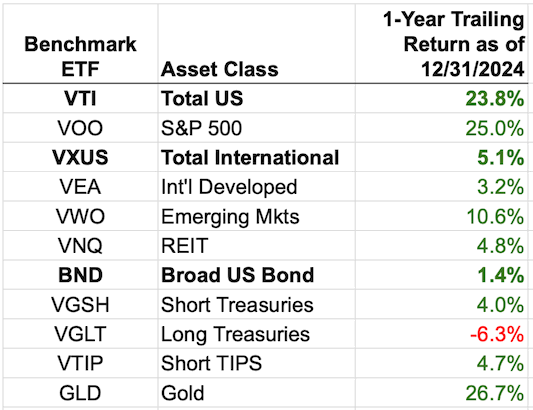
Happy New Year! 🎉 🥳 Let’s see how the year went for the broad asset classes that I track. Per Morningstar, here are the total annual returns (includes price appreciation and dividends/interest) for select asset classes as benchmarked by popular ETFs after market close 12/31/24.

I didn’t include Bitcoin or any other crypto because I honestly don’t track it, don’t own it as part of my long-term portfolio, and would not advise my family to own it. However, I acknowledge that it went up something like 120% this year.

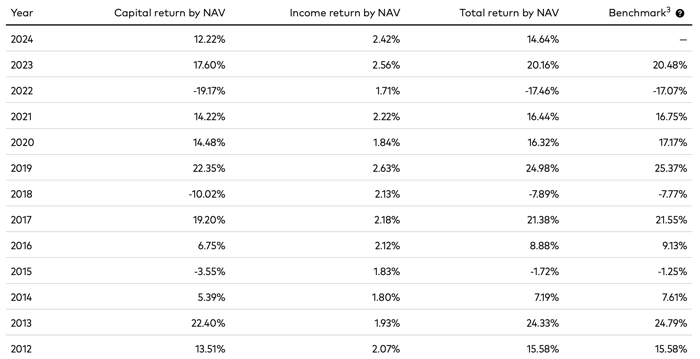
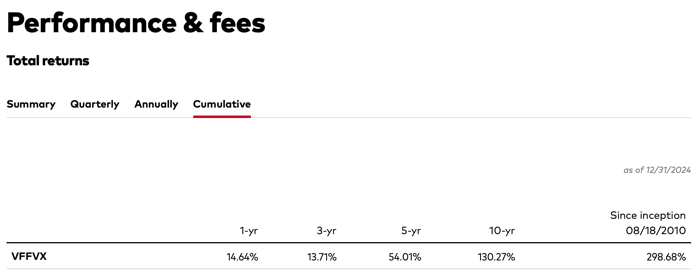
The “set and forget” Vanguard Target Retirement 2055 fund (VFFVX) , currently consisting of roughly 90% diversified stocks and 10% bonds, was up 14.6% in 2023.

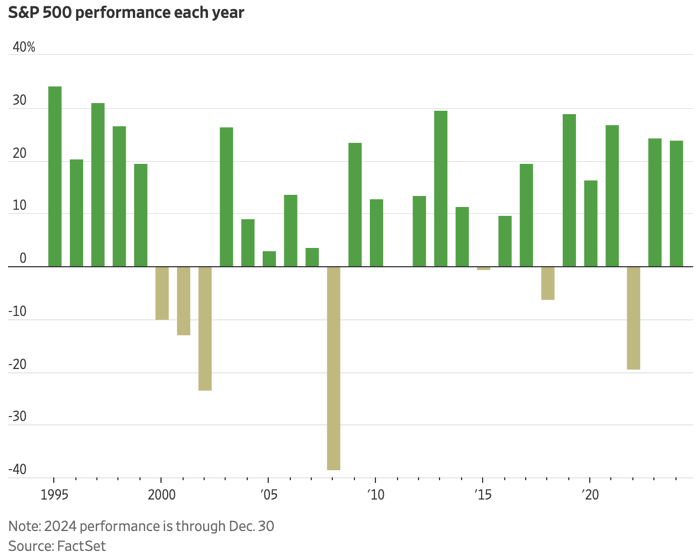
Commentary. 2024 again shows that you want to stay in the game. If you waited on the sidelines because stocks have historically high valuations and you were waiting for a dip… well, that didn’t work out. The S&P 500 had two great years in a row, the best two consecutive years in over 25 years according to the WSJ (gift article):

Historically, the S&P 500 annual return is negative in roughly every 1 in 4 years. But holding through that volatility is part of the price you pay for the long-term returns. For most of us, the best we can do is to “stay the course” and enjoy the up years while knowing that the down years will inevitably be sprinkled in there. I try my best not to skip and ignore all the predictions, or even listen to daily market close announcements. If you stand by the roulette table and stare long enough at the red and black numbers that come up, your mind will start to find patterns where they don’t exist.

Instead, here are your cumulative returns through the end of 2024 if you had been a steady investor in the Vanguard Target Retirement 2055 fund over the past several years, despite the many, many problems of the world:

(These work great inside 401ks and IRAs. I’d avoid buying Target Retirement funds in a taxable account.)

Holding cash would have been a lot less scary, but the returns would have been a lot less impressive. I will post more about my personal portfolio changes and performance shortly.