Archives for September 2024

Hawaiian and Alaska Airlines Merger Takeaways and Tips

Alaska Airlines has closed their acquisition of Hawaiian Airlines, although they will continue with their separate brands for a while at least. Here the pages about the merger on the Hawaiian site and the Alaska site with details about how the programs and perks will work during the transition. I read through all of the coverage and here are my notes and takeaways.

  • You can now transfer miles in either direction on a 1:1 ratio here (50 miles minimum, may take 72 hours). Most people seem to feel that Alaska miles are worth more than Hawaiian miles due their long list of partner airlines including American, British Airways, and Cathay Pacific, but it’s possible that you have a specific use for Hawaiian miles.
  • You can currently still transfer Membership Rewards points to Hawaiian Airlines (and then Alaska). This may not last once the dust settles.
  • You can currently still transfer Bilt Rewards points to Alaska Airlines (and then Hawaiian). This may not last once the dust settles.
  • Marriott Bonvoy points convert to both Alaska and Hawaiian at a 3:1 ratio, so nothing really new, but it offers another pathway if you’re going for a big redemption. If you transfer exactly 60,000 Bonvoy points, you get a 5,000 mile bonus for a total of 25,000 Alaska/Hawaiian miles.
  • If you have a Hawaiian Airlines credit or debit card, you can use their Share Miles feature to transfer an unlimited number of Hawaiian miles from anyone else into your account (friends and family) with no fees. I just swept all of my kids’ miles into my account, which I can then convert to Alaska if needed.
  • This also indirectly means you can pool Alaska miles for free now from various people, and avoid those huge “gifting” fees. For example, transfer Kid #1 Alaska miles to Kid #1 Hawaiian miles account. Then use Share Miles to combine with your target primary Hawaiian account, and then transfer to target primary Alaska account..
  • You may want to consider getting a Hawaiian Airlines credit card from Barclays (or business version), in case they make a future change to the issuer or program. You also get that Share Miles feature. For now, it doesn’t appear you can use the discounted companion ticket from the Hawaiian card on Alaska flights.
  • You may want to consider getting an Alaska Airlines credit card from Bank of America (or business version), in case they make a future change to the issuer or program. For now, it doesn’t appear you can use the discounted companion ticket from the Alaska card on Hawaiian flights.

In the past year or so, I’ve gotten both the Hawaiian and Alaska cards and have been taking advantage of the perks, including the free checked bags, companion fares, Share Miles, and other discounts. I’m not a heavy flier, but hopefully the merging of all these accumulated miles can offer some useful award redemptions for the family.

Free At-Home COVID Tests via US Postal Service (September 2024)

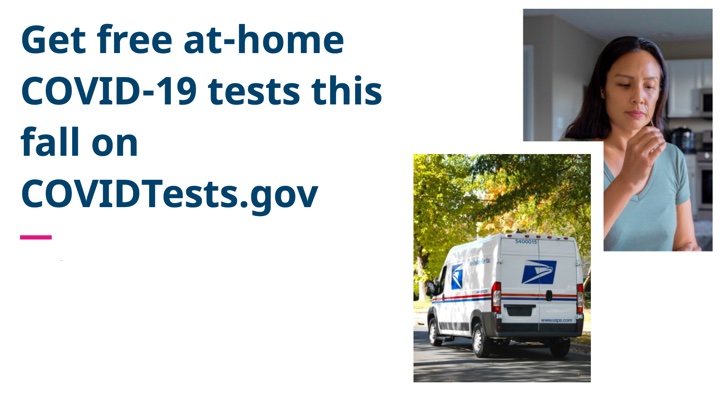
Updated September 2024: You can now order another round of at-home COVID tests, this time 4 tests per household. Order via this US Postal Service website. Shipping is free. Details from site:

As of late September 2024, residential households in the U.S. are eligible for another order of #4 free at-home tests from USPS.com.

Here’s what you need to know about your order:

– Each order includes 4 individual rapid antigen COVID-19 tests (COVIDTests.gov has more details about at-home tests, including extended shelf life and updated expiration dates)
– Orders will ship free, starting September 30, 2024

Total Wireless (Verizon) Switch Promo: $15/month Unlimited Plan For Metro, Mint, or T-Mobile Customers

If you currently have cell service from T-Mobile, Metro, Ultra Mobile, or Mint Mobile (all owned by T-Mobile), consider this aggressive deal from Total Wireless (owned by Verizon). You must switch over at least 2 lines and bring your own device. Importantly, this offer also ends soon 9/30/24. Here is the press release, and the offer page is Totalwireless.com/byebye.

  • $15/month per line (includes all taxes and fees) for their Total 5G Unlimited plan. This usually cost $50/month with AutoPay. Discounted price is guaranteed for 5 years.
  • Unlimited 5G data on Verizon 5G network, never throttled. Total promises “Unlimited data that never slows you down because of how much you use” and that “Speeds do not slow down through network management”. This is better terms than most MVNOs offer, which usually have lower priority during congested spots and throttling after a certain amount data usage. Supposedly, these are better data terms than the basic Visible plan.
  • 15 GB hotspot.
  • Free international calling from the US to 85+ destinations, texting to 200+ destinations.
  • Free international roaming in Canada & Mexico, 15+ countries total.
  • No contract.

It seems that T-Mobile and Verizon are in a bit of a beef right now regarding poaching each other’s customers. Might a good time to take advantage? I’m definitely considering it as a Mint customer, although I do hate the porting process as I’ve run into problems before. The switching is always the most stressful part.

To activate this offer, Metro, Mint Mobile, Ultra Mobile and T-Mobile customers can bring their phones to exclusive Total Wireless stores or visit Totalwireless.com/byebye, use code “BYEBYEMETRO,” “BYEBYEMINT,” or “BYEBYETMOBILE” and port in their phone numbers.

Quicken Simplifi App: Free 30-Day Trial (Offer Expires September 30th)

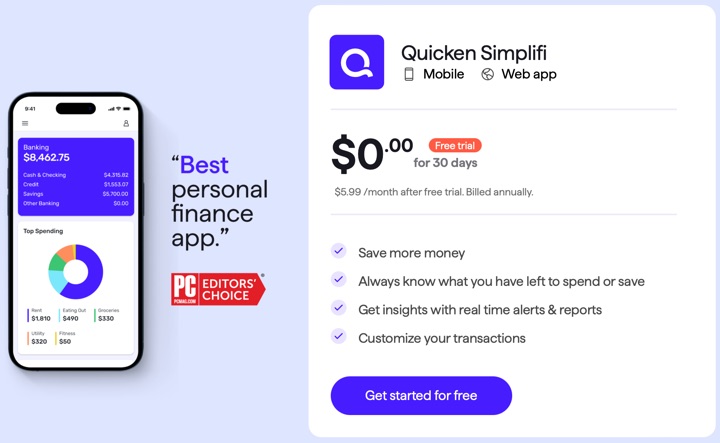
Quicken Simplifi is running a free 30-day trial of their personal finance app. Simplifi is their app-first “Mint-like” software that aggregates all your accounts daily, tracks spending, categorizes for budgets, analyzes investments, and all that. They also still offer their desktop-first Quicken Classic software (although Simplifi has a web interface and Classic has a companion app…). After the free trial, the cost is “$5.99/month, billed annually”, in other words… $71.88 a year. They’ll want your credit card at sign-up, so be sure to set a calendar reminder to cancel. They’ll tell you the date.

I haven’t replaced Mint with anything myself (I ending up deleting all accounts from Credit Karma and just directly log in to websites now), so I will give this a shot. Simplifi won the best budgeting/personal finance app from Wirecutter and PC Mag, but I’d also like to see how it handles investments. It doesn’t look as robust as Empower Dashboard (formerly Personal Capital) (most recent portfolio update). 30 days should be enough time to settle in and feel if it’s worth the cost. Offer ends soon on 9/30. The fine print:

30-day free trial only available to new customers. After 30 days, you will be billed at the then annual price. All offers are for the first year only when you order directly from Quicken by September 30, 2024, 11:59 PM PT. Offer good for new memberships only. Subscription billed annually. Offer listed above cannot be combined with any other offers. Upon the end of your membership term, the subscription will automatically renew at the then-current rates, unless you cancel or we terminate this agreement.

Aisle: Free Food after Venmo/PayPal Rebate

If you like the idea of free or discounted full-sized samples of trendy new food products, especially plant-based or health-focused ones, check out Aisle Offers. I also noticed that there are some discounts available on more established brands. Here’s a quick rundown of how it works:

  • You will need to opt-in your phone number and agree to receive a lot communication via texts.
  • Browse various offers from new food brands and make sure you successfully register first. Each vendor may send you specific details from a different phone number. For example, Cretor’s confirmed that you can buy any flavor, any size, any retailer but only up to $4.75 max rebate.
  • Buy the product (again, sometimes limited to specific retailers).
  • Text them a picture of the receipt.
  • Aisle will either Venmo or Paypal you the funds.

It seems that they are trying to minimize the friction of giving out free samples to folks, as opposed to manned tables like Costco or traditional paper coupons.

Here are several examples of free products that I see right now, although they will change quickly and are based on the retailers and stocking patterns near your specific geographic location. Something of a treasure hunt.

Might be a fun thing to try if you like such snacks. Hat tip to Doctor of Credit and Reddit. Reddit users report wait time usually varies from same day to 1-2 days, but is sometimes longer. The company appears legit; here is their brand-facing website.

Apple Watch as Standalone Phone For Kids: BetterRoaming eSIM Review

Our middle school has adopted some of the recommendations as outlined in the book Anxious Generation and other public policy folks:

  • Phones are not allowed during the school day at all. They are allowed after school.
  • Recommended: No smartphone until high school.
  • Recommended: No social media until age 16.

However, the school also does not provide any supervision when not in an after-school activity, so we needed a way to communicate with them regarding pickups and carpools and such. I ended up buying an Apple Watch SE w/ Cellular (SE 2 is the one I bought, SE 3 is newest model) and went with BetterRoaming for service as a standalone phone. The major providers like T-Mobile, AT&T, and Verizon all have different policies, but they cost at least $12-$15 a month for an independent smartphone if you don’t already have some sort of expensive unlimited plan with them. However, if you’re on a cheapo MVNO like me (Mint Mobile), many don’t support smartwatches at all. Of those that do, like the free smartwatch included on Visible+, they only let you use the watch as a paired device that shares the number with your existing iPhone.

BetterRoaming is an eSIM provider that operates worldwide, formerly known as UK-based Truphone before it was acquired by private investors. I could not find a concrete source, but based on their other eSIMs, I believe it uses either AT&T or T-Mobile towers in the US. The cost for service is $78 annually upfront ($6.50/month) (or $10.99 per month, month-to-month) and includes unlimited talk, text, and data. This was the cheapest standalone plan I could find.

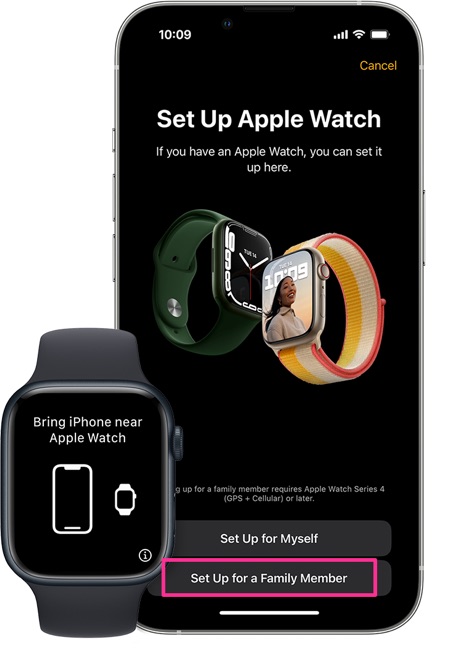
There was a 7-day free trial, which I appreciated. The setup was relatively easy; the parent will need an iPhone that is connected to the Apple Watch via the Watch app for setup and changing settings, but be sure to follow the directions from BetterRoaming carefully and set up the watch as an independent phone with its own phone number. Pick “Set up for a Family Member”. Apple Watch uses eSIM so the rest is done over the air.

During real world usage, it feels like phone usage in 2000 with spotty coverage. The watch is small and thus has a small antenna, so sometimes even side-by-side my regular phone will have service but the Apple Watch will not. Making traditional phone calls is the most reliable method to make contact. Anything using data, like iMessage or even texting, works less reliably. Other times, it’s probably my kid who does not notice the message. (Sometimes she forgets to charge the Watch and it dies completely, so definitely have a fallback plan.) The speakerphone on the Apple Watch is pretty good, but based on my personal experience the speaker can get damaged if exposed to salt water.

There is a “Schooltime” feature on the Apple Watch that restricts usage during preset hours, like Monday-Friday, 7am to 3pm. The child can disable the feature, but it is logged. During Schooltime hours, incoming calls are all ignored and don’t show up on the watch at all. I added my phone number as an whitelisted phone number; this way I can always contact her in an emergency, or during M-F school holidays where the feature is still accidentally active.

A couple of months in, I am satisfied with the combination of Apple Watch + BetterRoaming service. My middle school child now has the equivalent of a flip phone that is attached to her wrist (more likely to be heard, but also less likely to be lost). I didn’t have to change from my cheap MVNO plan (yet, I’ll need a family plan soon). I don’t have to worry about running out of minutes or text or data, even though we barely use them. I can track her location with “Find My” app, if necessary. I feel the cost is fair (of course, I’d like it to be cheaper given the light usage). With luck, the watch will last long enough to be passed down to the next child. 🤞

Update 2026: After a full year of BetterRoaming service, I have switched my Apple Watch plan over to US Mobile. BetterRoaming worked, but US Mobile is better for my situation. I am writing up a full review for later, but here are the main reasons:

  • BetterRoaming uses either the T-Mobile or AT&T networks, and US Mobile uses the Verizon network. In my area, Verizon has the best coverage. The watch still struggles with its tiny antenna, and there are still dead spots in buildings, but it’s better on Verizon.
  • US Mobile lets you pick the area code for your phone number. BetterRoaming just assigns you one and you don’t get to choose. This may or may not matter to you.
  • At my annual renewal, US Mobile’s annual plan was $78 while BetterRoaming was at $99. BetterRoaming has since dropped the price to match, so both are now $78 for a year if prepaid upfront. However, I don’t know if you can renew at $78 with BetterRoaming, as it says the savings are only for “New customers”. US Mobiles looks to be cheaper on an ongoing basis.
  • US Mobile overall has a better customer support and user interface than BetterRoaming. It was so good that (in addition to other reasons), a few months afterward I also switched my personal smartphone line from Mint Mobile to US Mobile.

With better coverage on the Verizon network (for me), cheaper ongoing price, and better customer service, US Mobile is a clear winner as of 2026.

Vanguard Digital Advisor: Estimating the Benefit of Tax-Loss Harvesting

One of the features of Vanguard’s Digital Advisor Services (VDAS) that is hardest to replicate on your own is the automated tax-loss harvesting (TLH). VDAS will monitor the prices of each of your stock ETFs daily, sell some or all of them at a loss when they deem appropriate, purchase a surrogate replacement ETF at the same time to avoid IRS wash rules, and keep track of what could be hundreds of different tax lots on an ongoing basis. A DIY investor could perform a similar version of this, but it would definitely be higher on the continuum of effort and skill required.

Therefore, a potential customer might want to estimate the benefit from TLH, and compare that with the VDAS fee of ~0.15% annually. It is possible that the TLH feature could completely offset the cost of the entire service. I dug around and found the following resources that explain everything from the general background behind TLH to how VDAS implements them specifically.

I especially appreciate the intellectual honesty of the research whitepapers because it is one of the few articles from a robo-advisor that actually admits that TLH can actually lower your after-tax return if your personal situation is not ideal. Most other robo-advisors quote some pretty idealistic assumptions to get their numbers. Here’s a quote:

In recent years, tax-loss harvesting (TLH) has been aggressively advertised as a near-certain way to increase after-tax returns by anywhere from 100 basis points to 200 basis points—in some cases even 300!—annually. […] But many individual investors do not fit this mold or should first focus on other more valuable options such as investing in tax-advantaged accounts. These investors will eventually be disappointed with the size of their TLH benefit if they set their expectation at 100 to 200 basis points.

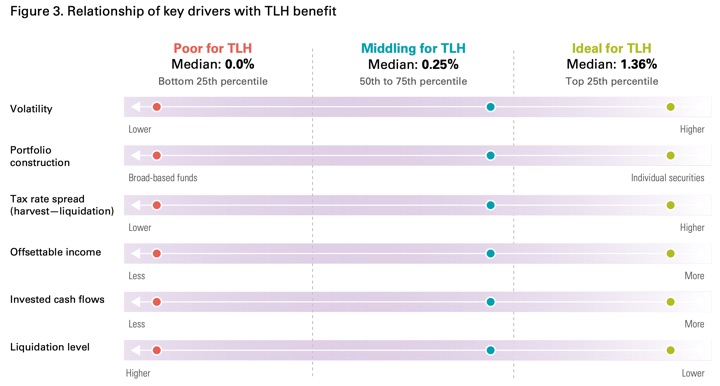
Here are the many factors that will affect the actual benefit from tax-loss harvesting, along with a brief description and how VDAS handles it.

  • Future stock price volatility. You need losses to harvest them, and the bigger the losses, the bigger the harvest. You then need the stock price to bounce right back, preferably quickly after you harvest them. Stable and steadily-growing markets aren’t helpful in creating TLH alpha.
  • How often will you keep making new investments. If you have frequent regular investments of new cashflows, this creates more tax lots where a loss could result, and then harvested.
  • Future time horizon. Markets tend to go up over time. As time goes on, the benefit of TLH will decrease because there will be fewer losses left to harvest.
  • How often will they check for losses. Monitoring the situation daily should help find more opportunities to harvest losses. Vanguard Digital Advisor states they will check daily.
  • Number of different portfolio securities held. The more different things you can sell to create losses, the more TLH opportunities there are. Expect “direct indexing”, where you own a tiny bit of every stock instead of a pooled ETF, to be marketed more and more heavily in the future. Vanguard Digital Advisor holds ETFs, not individual securities.
  • Do you have external capital gains to offset losses? Tax savings are generated by using harvested losses to offset capital gains elsewhere. Without capital gains, taxable ordinary income can only be reduced by up to $3,000 a year. Therefore, people with small businesses, private equity, real estate, or other investments that generate a lot of capital gains are more likely to benefit from harvesting losses.
  • Your current and future tax brackets. Tax savings are generated now by offsetting capital gains and income at your current tax rate. However, you are lowering your cost basis and thus deferring those capital gains to the future. If your future tax bracket is higher, then you may actually end up paying more in taxes later. Note your future tax bracket may be higher due to legislation, not only due to income changes. Others expect to defer “indefinitely” and use the step-up in basis upon death or make a qualifying charitable donation.
  • Reinvesting tax savings. A significant part of the theoretical TLH benefit comes from investing any tax savings so that you are taking advantage of those deferred taxes and growing them further.
  • Future stock market return. This effect from the compounding of reinvested tax savings depends on the size of the market return, obviously.

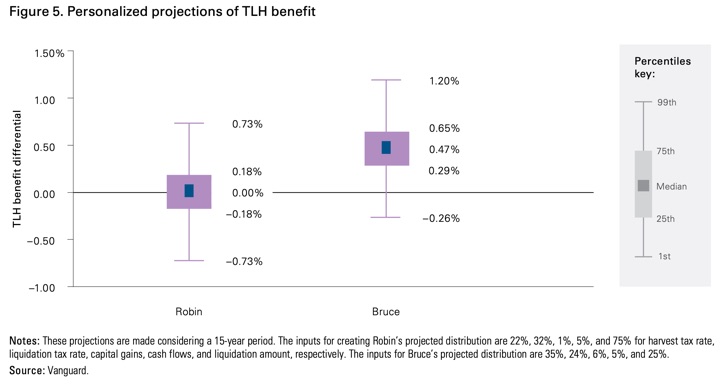
As you can see, many of these factors depend on your personal situation. Vanguard introduces two imaginary model investors to explain the potential differences. This is my own abbreviated summary.

Robin is a doctor in her early 30s. She is currently in the 22% income tax bracket. But after she finishes her residency in two years, she expects to spend most of her career in the 32% bracket or higher. She mostly saves in tax-deferred accounts, so she doesn’t expect to generate significant capital gains. Due to fact that her future tax rate is higher than now, and her low expectations for capital gains, her likely benefit is low, possibly zero or even negative.

Bruce is in his late 50s and a partner at a large consulting firm that regularly realizes capital gains when new partners buy into the partnership and when he eventually sells all his shares for ~$4 million. Essentially, unlimited capital gains to offset losses. He is currently in the 35% bracket, but, based on his plans for a frugal retirement lifestyle, he aims to be in the 24% income tax bracket throughout retirement. Due to the fact that he expects his future tax rate to be lower than now, and his high expectations for capital gains, his likely benefit is high, with a median projected benefit of 0.47% annually.

These appear to be reasonable estimates for the real-world benefit of TLH at two relatively extreme examples. I think most people will be somewhere in between. So a median expectation of 0% to 0.50%, but just as important, a wide possible range of actual results! Many other robo-advisor presentations do not adequately disclose their assumptions, including the possibility of negative “alpha” if your tax rates end up being higher in retirement. (Many people feel that higher tax rates will eventually be coming due after years of deficits.)

I hope that this information will allow a potential VDAS/VPAS customer to manage their own expectations of the benefits of TLH, based on their own individual factors – most importantly, having sizable new investments that may result in temporary losses, the expectation of lower tax rates in the retirement/withdrawal phase, and having enough capital gains from other activities to offset any harvested losses.

Vanguard Digital Advisor Robo-Advisor Review (Updated September 2024)

(Updated September 2024. If you’re wondering about the future of Vanguard, take note that they have been actively tinkering with their robo-advisor service, Vanguard Digital Advisor Services (VDAS). In June 2024, VDAS added the ability to include a spouse/partner in your plan, such that the portfolio is managed on a household level. In August 2024, VDAS started using fractional shares to invest every last dollar. In September 2024, they lowered the minimum requirement to $100 (formerly $3,000). I decided to wade through the 119-page Client Relationship Summary and VDAS/VPAS Brochure & Supplement again for the third time and completely re-write this review.)

Here are my notes on the robo-advisor service Vanguard Digital Advisor, current as of September 2024:

What is Vanguard Digital Advisor Here’s what they say:

In our robo discretionary offers we provide online financial planning tools designed to help you create a goal-based financial plan, and the service will create an investment strategy aligned with your personal inputs. We’ll monitor your enrolled accounts frequently using an algorithm. We’ll have full investment discretion in order to transact as necessary to align your account(s) with your goal(s).

My interpretation is that they will manage a portfolio of Vanguard ETFs for you based on your inputs into their website. There is also online software to help you create a financial plan towards multiple goals (i.e. they tell you how much you need to save each month). With VDAS, you don’t get access to a human advisor.

Types of Vanguard accounts available to be managed. VDAS can manage Vanguard 401(k) and the following retail accounts held at Vanguard Brokerage, (although you may need to sell your existing investments). They will consider all of the accounts together for purposes of tax-efficient asset location.

  • Individual or joint tenants with rights of survivorship (JTWROS) taxable accounts.
  • Traditional IRAs.
  • Roth IRAs.
  • Rollover IRAs.
  • Inherited IRAs owned by natural, adult investors.
  • Single-participant SEP-IRAs.

Their wording suggests that Vanguard will let you link other ineligible Vanguard account and external non-Vanguard account balances and include them into your long-term goal projections, but they won’t analyze their asset allocation and adjust your Vanguard asset allocation in response.

Existing outside portfolio? You will likely need to sell your existing investments if you want them to manage that money. VDAS wants a clean slate. They say they will analyze your existing holdings, including how much capital gains you have built up, and either recommend that you don’t sell them (but not enroll in VDAS), or sell them and enroll in VDAS where they will re-invest your funds for you.

Factors used to personalize your portfolio. The #1 competition for this product is probably Vanguard’s own series of Target Retirement Funds. Those are based on a goal retirement year, in 5 years increments, and now only cost 0.08% all-in for younger investors. So if you’re 25 years old, you basically have maybe 4-6 possible glide paths available.

In contrast, VDAS says they have “over 300 personalized glide paths” available. Here are the factors that they consider, based on their documentation:

  • Taxable income/salary
  • Anticipated spending needs
  • Current savings/savings rate
  • Risk attitude (Very Conservative, Conservative, Moderate, Aggressive and Very Aggressive)
  • Current age
  • Marital/partner status
  • Expected retirement age
  • Significant single-stock exposure

To be honest, I’m not sure how many users will end up with a vastly different glide path than one of the Target Retirement funds, especially considering they will most likely be constructed with the same four underlying ETFs that underpin them (more on that later). But if you have a unique situation, this personalization could be attractive.

Now available in 100% index, index/active mix, and ESG flavors. In addition to the original all-index portfolio, you can now also chose a (slightly more expensive) option that includes some actively-managed Vanguard funds or an all-index portfolio that has an environmental, social, and governance (“ESG”) filter.

But for most people picking the traditional 100% index option, your portfolio will consist of the “Four Totals”:

  • Vanguard Total Stock Market ETF (VTI)
  • Vanguard Total International Stock Market ETF (VXUS)
  • Vanguard Total Bond Market ETF (BND)
  • Vanguard Total International Bond ETF (BNDX)

As noted, these ETFs are simply different share classes of the exact same funds that underpin the Vanguard Target Retirement Funds.

Pricing and fees. How much does VDAS cost? VDAS has an all-in cost of 0.20% of assets managed annually for their all-index option, but that includes the cost of underlying ETFs. (I’m focusing on the all-index option here, there is a 0.25% all-in cost on their active/index mix option.) Your portfolio of ETFs will probably have their own expense ratio of ~0.05%, so the cost of VDAS itself will effectively be ~0.15%. That works out to $15 a year for every $10,000 invested.

In comparison, Vanguard Target Retirement Funds as of September 2024 have average expense ratios of only 0.08% all-in. The Vanguard Target Retirement Funds got a lot cheaper when finally switched to holidng Institutional shares of their underlying component funds instead of the most-expensive Investor shares. I thought that the gap between the costs would only narrow over time, but they kept the cost of VDAS the same for a gap of 0.12%.

As DIY person, I would remind folks that you can always buy the exact same four ETF building blocks at any low-cost broker (including Vanguard itself). That would make your all-in cost just the ~0.05%. However, DIY investors won’t have automatic rebalancing or automatic tax-loss harvesting.

If you have over $50,000 in assets, you can “upgrade” to Vanguard Personal Advisor Services (VPAS) where you can talk to humans for a higher all-in cost of 0.35% for the all-index option. However, I’m really not sure what actually VPAS has to offer beyond a human voice because they don’t appear to guarantee well-informed advice from a Certified Financial Planner or anything. Essentially, you seem to get some additional hand-holding from a rep who is familiar with the software.

If you have over $500,000 in assets, you can upgrade again to Personal Advisor Select, which does include a dedicated CFP. This costs a flat advisory fee of 0.30% annually (on top of the expense ratio from investments). This might actually be worth the upgrade for those that start with VDAS but over time their financial situation becomes more complicated.

Automated rebalancing: VDAS will check daily and rebalance within 5% bands. Rebalancing will be done in a tax-sensitive manner. Here’s the official text:

On each day that the markets are open for trading, we will typically look to assess Portfolios for whether a rebalancing opportunity exists consistent with our investment strategy and the following criteria (“Rebalance”). Under normal circumstances, if any asset class (stocks, bonds, or cash) is off the target asset allocation by more than 5%, the Portfolio will be rebalanced to its target allocations (asset and sub?asset) or, in the future, within allowable guardrails pending embedded tax cost.

I believe that automated rebalancing is an important and sometime under-appreciated benefit of a managed portfolio over a DIY portfolio. Us DIY folks all think we’ll rebalance the same way without emotion, but sometimes… in times of stress… we don’t. It’s hard to assess the benefit in terms of excess performance, because you are really adjusting risk and any “rebalancing bonus” tends to come and go depending on the historical period.

Automated tax loss harvesting (TLH). VDAS includes tax-loss harvesting on taxable brokerage accounts. This is the practice of selling equity ETFs at a loss to “harvest” them and replacing them with similar securities to maintain market exposure. If done correctly, this can improve your after-tax return. They will now consider the tax effects across an entire household (when filing joint tax returns). Here is their language:

The Services offer a tax loss harvesting service (“TLH Service”) election for taxable individual and joint brokerage accounts. TLH involves selling a security at a loss and purchasing another security to maintain your asset allocation. Depending on your personal circumstances, a TLH strategy can add value in the form of reduced taxes when harvested losses are used to lower your tax bill and potentially grow your savings if you are able to reinvest those tax savings. For Enhanced Households the TLH Service applies to all eligible Enrolled Accounts in the Portfolio.

From their other documents, Vanguard performs their TLH using only other Vanguard ETFs as the “surrogate” ETF pair to claim the loss but also avoid wash sale rules.

The actual benefit of tax-loss harvesting can vary widely based on individual factors. Most importantly, how much of your portfolio is actually in taxable accounts, and how much of that is stocks? Not to mention, TLH can actually lower your return in certain situations by deferring the tax bill to a future period when your tax rate is higher. This is complicated topic with no single answer. TLH could be a net positive, though, that helps offset the VDAS fee and maybe even then some.

Multiple goal support. VDAS now supports multiple goals in its software. For example, you might have a house downpayment as a short-term goal and retirement as a long-term goal.

Fractional shares of ETFs now included. This is a new feature that they basically had to add if since they wanted to lower the minimum balance to $100. Otherwise, there would be no point as VTI is over $250 for a single share.

My take. Vanguard is obviously focusing a good deal of their energy on Digital Advisor, and I think this is probably a smart move for them. The Vanguard ETFs themselves continue to be well-run and cheap, but I believe their “at-cost” structure has incentivized Vanguard to minimize customer service costs at their in-house brokerage and instead quietly push folks to hold Vanguard ETFs at outside brokers (it’s cheaper for them this way). However, Digital Advisor allows them to charge another layer of fees for management services, hopefully justifying and paying for better service for those customers. If they can keep improving this product technology while also lowering the price as it scales, I believe it can grow in popularity.

Best Interest Rates on Cash Roundup – September 2024

Here’s my monthly roundup of the best interest rates on cash as of September 2024, roughly sorted from shortest to longest maturities. There are lesser-known opportunities available to individual investors, often earning more money while keeping the same level of safety by moving to another FDIC-insured bank or NCUA-insured credit union. Check out my Ultimate Rate-Chaser Calculator to see how much extra interest you could earn from switching. Rates listed are available to everyone nationwide. Rates checked as of 9/15/2024.

TL;DR: Rates are dropping at all maturities, from money market funds outward, but really fast starting at 1 year out. Still 5%+ savings accounts and short-term CDs. Compare against Treasury bills and bonds at every maturity, taking into account state tax exemption. I no longer recommend fintech companies due to the possibility of loss due to poor recordkeeping and/or fraud.

High-yield savings accounts
Since the huge megabanks still pay essentially no interest, everyone should at least have a separate, no-fee online savings account to piggy-back onto your existing checking account. The interest rates on savings accounts can drop at any time, so I list the top rates as well as competitive rates from banks with a history of competitive rates and solid user experience. Some banks will bait you with a temporary top rate and then lower the rates in the hopes that you are too lazy to leave.

  • The top rate at the moment is at Poppy at 5.50% APY (3-month rate guarantee). Newcomer Pibank is also at 5.50% APY. I have no personal experience with either, but they are the top rates at the moment. CIT Platinum Savings at 4.85% APY with $5,000+ balance.
  • SoFi Bank is at 4.50% APY + up to $325 new account bonus with direct deposit. You must maintain a direct deposit of any amount each month for the higher APY. SoFi has historically competitive rates and full banking features. See details at $25 + $300 SoFi Money new account and deposit bonus.
  • Here is a limited survey of high-yield savings accounts. They aren’t the top rates, but a group that have historically kept it relatively competitive such that I like to track their history.

Short-term guaranteed rates (1 year and under)
A common question is what to do with a big pile of cash that you’re waiting to deploy shortly (plan to buy a house soon, just sold your house, just sold your business, legal settlement, inheritance). My usual advice is to keep things simple and take your time. If not a savings account, then put it in a flexible short-term CD under the FDIC limits until you have a plan.

  • No Penalty CDs offer a fixed interest rate that can never go down, but you can still take out your money (once) without any fees if you want to use it elsewhere. Marcus has a 7, 11, and 13-month No Penalty CD at 4.50% APY with a $500 minimum deposit. Consider opening multiple CDs in smaller increments for more flexibility.
  • Merchants Bank has a 1-year certificate at 5.25% APY ($1,000 min). I could not locate their early withdrawal penalty. This is their fixed-rate CD, watch out for the flex-rate ones.

Money market mutual funds
Many brokerage firms that pay out very little interest on their default cash sweep funds (and keep the difference for themselves). Note: Money market mutual funds are highly-regulated, but ultimately not FDIC-insured, so I would still stick with highly reputable firms.

  • Vanguard Federal Money Market Fund is the default sweep option for Vanguard brokerage accounts, which has an SEC yield of 5.19% (changes daily, but also works out to a compound yield of 5.32%, which is better for comparing against APY). Odds are this is much higher than your own broker’s default cash sweep interest rate.

Treasury Bills and Ultra-short Treasury ETFs
Another option is to buy individual Treasury bills which come in a variety of maturities from 4-weeks to 52-weeks and are fully backed by the US government. You can also invest in ETFs that hold a rotating basket of short-term Treasury Bills for you, while charging a small management fee for doing so. T-bill interest is exempt from state and local income taxes, which can make a significant difference in your effective yield.

  • You can build your own T-Bill ladder at TreasuryDirect.gov or via a brokerage account with a bond desk like Vanguard and Fidelity. Here are the current Treasury Bill rates. As of 9/13/24, a new 4-week T-Bill had the equivalent of 5.03% annualized interest and a 52-week T-Bill had the equivalent of 4.02% annualized interest.
  • The iShares 0-3 Month Treasury Bond ETF (SGOV) has a 5.21% SEC yield and effective duration of 0.10 years. SPDR Bloomberg Barclays 1-3 Month T-Bill ETF (BIL) has a 5.11% SEC yield and effective duration of 0.08 years.

US Savings Bonds
Series I Savings Bonds offer rates that are linked to inflation and backed by the US government. You must hold them for at least a year. If you redeem them within 5 years there is a penalty of the last 3 months of interest. The annual purchase limit for electronic I bonds is $10,000 per Social Security Number, available online at TreasuryDirect.gov. You can also buy an additional $5,000 in paper I bonds using your tax refund with IRS Form 8888.

  • “I Bonds” bought between May 2024 and October 2024 will earn a 4.28% rate for the first six months. The rate of the subsequent 6-month period will be based on inflation again. More on Savings Bonds here.
  • In mid-October 2024, the CPI will be announced and you will have a short period where you will have a very close estimate of the rate for the next 12 months. I will have another post up at that time.

Rewards checking accounts
These unique checking accounts pay above-average interest rates, but with unique risks. You have to jump through certain hoops which usually involve 10+ debit card purchases each cycle, a certain number of ACH/direct deposits, and/or a certain number of logins per month. If you make a mistake (or they judge that you did) you risk earning zero interest for that month. Some folks don’t mind the extra work and attention required, while others would rather not bother. Rates can also drop suddenly, leaving a “bait-and-switch” feeling.

  • OnPath Federal Credit Union pays 7.00% APY on up to $10,000 if you make 15 debit card purchases, opt into online statements, and login to online or mobile banking once per statement cycle. Anyone can join this credit union via $5 membership fee to join partner organization. You can also get a $100 Visa Reward card when you open a new account and make qualifying transactions.
  • Genisys Credit Union pays 6.75% APY on up to $7,500 if you make 10 debit card purchases of $5+ each per statement cycle, and opt into online statements. Anyone can join this credit union via $5 membership fee to join partner organization.
  • Credit Union of New Jersey pays 6.00% APY on up to $25,000 if you make 12 debit card purchases, opt into online statements, and make at least 1 direct deposit, online bill payment, or automatic payment (ACH) per statement cycle. Anyone can join this credit union via $5 membership fee to join partner organization.
  • Andrews Federal Credit Union pays 6.00% APY on up to $25,000 if you make 15 debit card purchases, opt into online statements, and make at least 1 direct deposit or ACH transaction per statement cycle. Anyone can join this credit union via partner organization.
  • Pelican State Credit Union pays 6.05% APY on up to $20,000 if you make 15 debit card purchases, opt into online statements, log into your account at least once, and make at least 1 direct deposit, online bill payment, or automatic payment (ACH) per statement cycle. Anyone can join this credit union via partner organization membership.
  • Orion Federal Credit Union pays 6.00% APY on up to $10,000 if you make electronic deposits of $500+ each month (ACH transfers count) and spend $500+ on your Orion debit or credit card each month. Anyone can join this credit union via $10 membership fee to partner organization membership.
  • All America/Redneck Bank pays 5.00% APY on up to $15,000 if you make 10 debit card purchases each monthly cycle with online statements.
  • Find a locally-restricted rewards checking account at DepositAccounts.

Certificates of deposit (greater than 1 year)
CDs offer higher rates, but come with an early withdrawal penalty. By finding a bank CD with a reasonable early withdrawal penalty, you can enjoy higher rates but maintain access in a true emergency. Alternatively, consider building a CD ladder of different maturity lengths (ex. 1/2/3/4/5-years) such that you have access to part of the ladder each year, but your blended interest rate is higher than a savings account. When one CD matures, use that money to buy another 5-year CD to keep the ladder going. Some CDs also offer “add-ons” where you can deposit more funds if rates drop.

  • Lafayette Federal Credit Union (LFCU) has a 5-year certificate at 4.32% APY ($500 min), 4-year at 4.42% APY, 3-year at 4.52% APY, 2-year at 4.78% APY, and 1-year at 5.04% APY. Slightly higher rates with jumbo $100,000+ balances. Note that the early withdrawal penalty for the 5-year is a relatively large 600 days of interest. Anyone nationwide can join LFCU by joining the Home Ownership Financial Literacy Council (HOFLC) for a one-time $10 fee.
  • Advancial Federal Credit Union has has a 5-year certificate at 4.47% APY (higher $50,000 min). Anyone nationwide should be able to join via membership with partner organization US Dog Agility Association, but I would call or check first.
  • You can buy certificates of deposit via the bond desks of Vanguard and Fidelity. You may need an account to see the rates. These “brokered CDs” offer FDIC insurance and easy laddering, but they don’t come with predictable early withdrawal penalties. Right now, I see a 5-year non-callable CD at 3.80% APY (callable: no, call protection: yes). Be warned that now both Vanguard and Fidelity will list higher rates from callable CDs, which importantly means they can call back your CD if rates drop later. (Issuers have indeed started calling some of their old 5%+ CDs as of September 2024.)

Longer-term Instruments
I’d use these with caution due to increased interest rate risk (tbh, I don’t use them at all), but I still track them to see the rest of the current yield curve.

  • Willing to lock up your money for 10 years? You can buy long-term certificates of deposit via the bond desks of Vanguard and Fidelity. These “brokered CDs” offer FDIC insurance, but they don’t come with predictable early withdrawal penalties. You might find something that pays more than your other brokerage cash and Treasury options. Right now, I see a 10-year CDs at [none available] (non-callable) vs. 3.66% for a 10-year Treasury. Watch out for higher rates from callable CDs where they can call your CD back if interest rates drop.

All rates were checked as of 9/15/2024.

Photo by Giorgio Trovato on Unsplash

Toilet Paper Shrinkflation Stats and Evidence

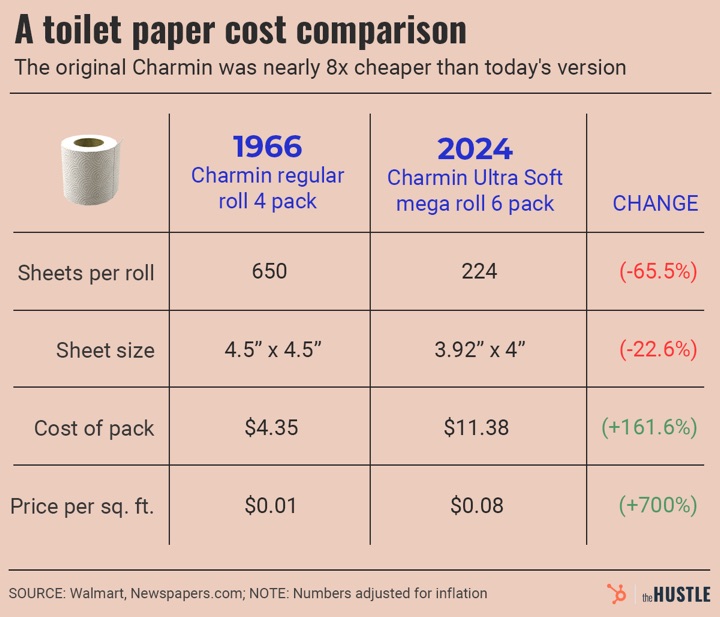
The Hustle has an entire article on toilet paper shrinkflation that confirms all of your suspicions with historical evidence. (They even went to eBay to get some of the old stuff!) The rolls got smaller and lighter. The number of sheets dropped. The individual sheets each got a bit narrower. The price per square foot got higher. The rolls got so small they had to start calling them double rolls (that were smaller than the original single rolls!), and now we’ve reached “Mega XL” and “Super Mega”…

Of course, not all brands are the same. The folks on the Slickdeals forum seem to use the Costco Kirkland Signature cost per square foot as the benchmark ($0.0133/sf). As with index funds, I guess the easiest way to get a fair deal is just to simply buy the low-cost benchmark. 🧻 🤑

British Airways Visa Signature Card Review: 75,000 Bonus Avios Offer

The British Airways Visa Signature® Credit Card is a Chase-issued card that offers unique perks with British Airways. The Avios program offers a distance-based award system in the US (including Hawaii), allowing you to fly domestically for less points than you might think on partner airlines like American Airlines. You may also use Avios to fly business class to Europe. Avios are very flexible; I recently used to in Japan Airlines. Here are the highlights:

  • 75,000 Avios after you spend $5,000 on purchases within the first 3 months of account opening.
  • Up to $600 Reward Flight Statement Credits. Receive statement credits of $100 for Economy and Premium Economy – or $200 for Business and First Class seats – three times per year, up to $600, when you book a reward flight travelling on British Airways and pay taxes, fees and carrier charges with the British Airways Visa Signature® Credit Card.
  • Every calendar year you make $30,000 in purchases on your British Airways Visa card, you’ll earn a Travel Together Ticket good for two years.
  • 10% off British Airways flights starting in the US when you book through the website provided in your welcome materials.
  • Earn 3 Avios per $1 spent on purchases with British Airways, Aer Lingus, Iberia, and LEVEL.
  • Earn 2 Avios per $1 spent on hotel accommodations when purchased directly with the hotel.
  • No foreign transaction fees.
  • $95 annual fee.

The Avios reward chart is now based on how far you want to travel in terms of miles. So what can you do with all those points?

Redeem awards domestically on partner American Airlines. Within the US, it’s usually easiest to find flights on partner American Airlines. There are no fuel surcharges when booking with American. Seating availability will be limited, but if you are flexible there is decent inventory.

  • Los Angeles to Honolulu, Hawaii using only 13,000 Avios one-way and 26,000 Avios points roundtrip. I ran a quote and it cost $659 broken down to $621 fare and only $38 in taxes. So in this case you could save $621 in exchange for 26,000 points, which is 2.4 cents per point. This also works from Hawaii to Phoenix, Portland, San Diego, San Francisco, San Jose, and Seattle. You can also do JFK to LAX for 25k points roundtrip.
  • Shorter-distance flights can be a good deal as well. Roundtrip from Chicago to New York City is only 18,000 Avios points + about $30 in taxes. Charlotte, NC to New York City is only 12,000 Avios roundtrip. Los Angeles to Las Vegas is also 12,000 Avios roundtrip. Los Angeles to Portland, Oregon is 18,000 Avios roundtrip.

The Avios program has a lot of good airline partners and you can combine Avios within a household. I’ve also used the ability to household Avios to combine all the small Avios balances from my kids’ account and use them for an award seat on partner Japan Airlines.

Finding partner awards on BA.com is better than is was in the past, so try it first. Type in your to/from cities within the US, choose to book flights with Avios points (“Book” then “Book a flight with Avios”). As usual, it helps to book far ahead (or last-minute) and to be flexible with dates. Here’s a quick screenshot of a one-way flight booking from LAX to HNL for 13,000 points and $5.60 in taxes. Families can take note that there were 7 seats available at this price on the flight when I looked.

Use the American Airlines AA.com website and look the cheapest level awards. Record the exact flight dates and numbers, and then call at British Airways at 1-800-452-1201 to book them. If you can’t find the same flight on BA.com, they should waive the phone book fee (they did for me). Don’t be discouraged if you have to use this method, especially if you aren’t flying nonstop. Also, call back and talk with a different agent if they aren’t helpful initially.

Travel Together Ticket. Every calendar year that you spend $30,000 on your British Airways Visa Signature Credit Card, you get a “Travel Together Ticket” good for two years.

The Travel Together Ticket allows you to pay 50% of the Avios fare when travelling solo or gives you a second seat for a companion, on the same flight and in the same cabin when you book a reward flight on a British Airways, Iberia or Aer Lingus flights, including respective selected subsidiaries and franchise partners of these airlines originating from anywhere in the world, not just the United States. All you’ll have to pay is the taxes, fees, and carrier charges for the reward seats.

Beware of fuel surcharges on British Airways flights. Don’t use Avios for a economy British Airways flight from USA to Europe, because you’ll still be subject to taxes and fees on award redemptions, which are often half the entire cost of the ticket. I ran a quick search for a random New York City (JFK) to London (LHR) flight that cost $1,050, the taxes and fees alone were $650. You can get the $400 “fare” for 40,000 Avios points, but that’s only 1 cent a point value.

Bottom line. The British Airways Visa Signature® Credit Card earns you Avios, which are very flexible points good for not just between US and Europe, but also within the USA domestically and internationally via their many partner airlines. It’s a keeper card if you can take advantage of their companion ticket.

Also see: Top 10 Best Credit Card Bonus Offers.

Always Use Limit Orders, Since Your Market Orders Just Become Bad Limit Orders Anyway

I don’t know how everyone else does this, but whenever I buy shares of an ETF for my portfolio, I always use a limit order. But it’s usually a “lazy” limit order, because I am just aiming to buy immediately at roughly the market price and the limit order is simply insurance against a flash crash or similar anomaly that happens rarely, but still happens. So I look at the bid/ask prices, and add some wiggle room, and submit a limit order good until the end of day.

I’ve read advice elsewhere to place a limit order at the midpoint between bid and ask, but that makes it so there is a good chance the order will not fill that day, and may never fill if the market keeps moving. I don’t want to keep chasing the market price and staring at the order book on a trading screen. I just want a fair fill, and I want it done. My holding period will be decades, so consistently investing in the market is the most important.

However, on newer trading apps like Robinhood, the default option is always a market order. With smartphone user interfaces, all it takes is a quick swipe and off it goes. Sometimes it takes a little hunting around to even find the limit order option.

It turns out, Robinhood actually agrees that market orders are dangerous. Behind the scenes, Robinhood and many other brokers do something called “order collaring” and quietly turn your market order into a limit order with a 5% margin. For example, if the stock is trading around $100 and you put in a market order (that says you’ll pay whatever the best price is that the moment, even if it is $5,000 or something, technically) into a limit order for $105 max. Matt Levine wrote Money Stuff column about order collaring (gift article) that points out that there are trading bots that specifically take advantage of these 5% collared orders, especially on more thinly-traded stocks.

Here’s how I imagine Robinhood’s thinking:

“We gotta keep things simple and fun for these newbie investors, so we will just let them do market orders with a single swipe, no entering numbers or doing math required! Hmm… but market orders are kinda stupid and dangerous. So… let’s actually make them a +/- 5% limit order so they can’t really hurt themselves so badly that they’ll get mad at us. If they are careless enough to do a market order, then they won’t notice a 5% bad fill but they might notice something worse.”

According to Vanguard, the median bid-ask spread for their popular Vanguard Total Stock Market ETF (VTI) is 0.01%. That means roughly 3 cents a share at the current price of ~$270. Here’s a screenshot from my order screen today. The bid might be $268.83 and the ask might be $268.86. Here, I might just put in a limit order at $270 so that even if the market moves up a little quickly, I still get my order filled. It filled at $268.93, and a few minutes later it was at $269.29.

Meanwhile, 5% of $270 is $13.50 per share. That’s a lot! 500 times the usual spread, and something is usually wrong if it’s that much off. I know that VTI is not thinly-traded, and 99.9% of the time, it won’t matter what you put in for your limit. But once in a while, it will matter, and it only takes an extra few seconds to place a limit order instead of a market order.

My guess is perhaps people think that putting in a limit order will actually encourage the market maker to take advantage of them? It’s like if you say “I’ll pay up to $5 for that Pepsi”, and someone will charge you exactly $5. It’s better just to do a market order and not “show your hand”? But this information about order collaring reaffirms that market orders aren’t any better because they just get turned into very loose limit orders anyway. The bots will still see you as a potential sucker. You might as well set a tighter limit yourself.