Archives for September 2024

Paper US Savings Bonds with Federal Tax Returns Eliminated

Goodbye, physical US savings bonds! Per this TreasuryDirect announcement, the US Treasury will no longer allow to you to buy an additional $5,000 in paper Series I savings bonds each year with your tax refund, effective January 1st, 2025. (If you haven’t filed your 2023 Tax Year returns, you can still get them with your late filing by October 15, 2024 using IRS Form 8888.)

Honestly, I’m very surprised it lasted this long. You haven’t been able to buy paper bonds anywhere else for over a decade. Finding a bank to even cash in an existing paper bond is like a treasure hunt. (It’s easier to just convert them to electronic first, then sell them online.) My theory is that there was some warehouse full of blank paper bonds that they wanted to use up. Here are some stats on who actually used this option:

– On average, 35,000 tax filers each year bought paper Series I bonds: this represented .03 percent of tax filers, and less than 10 percent of Series I bond purchasers.
– Less than 10 percent of participants consistently participated (more than 2 years).
– Sales of paper I bonds through this program made up less than 1 percent of all series I savings bond purchases.

(I might be too lazy to update all of my old Savings Bonds update posts…)

Purchase limits otherwise remain the same: $10,000 in electronic I Bonds and $10,000 in electronic EE bonds per year per Social Security Number or Employer Identification Number. For those looking for another way to expand their purchasing power, that means you can also buy for a child, grandchild, LLC, or a trust.

DirecTV and Disney Dispute: Request $30 Service Credit

If you have DirecTV and are affected by their failed contract negotiations and subsequent loss of ESPN and other Disney-owned channels, they are quietly offering a $30 bill credit, supposedly enough such you can sign up for Sling TV via this special $10 off discount page and watch those ESPN channels on there during the dispute.

You’ll have to visit https://www.directv.com/tvpromise/ and navigate through their complicated site to manually request the $30 credit. Alternatively, you could call up DirecTV directly and try to cancel and see what retention offers they have available.

FuboTV is also offering a 7-day free trial and $30 off the first month. Disney-owned Hulu is also offering $30 off its Hulu Live TV service. Pettiness!

Stock Valuation Methods – Are They Historically High in 2024?

US stock returns have been doing quite well, and my brokerage statement numbers keep going up. Should I be worried? Here are some ways that people try to measure whether stock valuations are cheap or expensive, along with some current numbers as of September 2024.

Quick background. Value is often said to be “what you pay” versus “what you get”. For the stock market, you divide price by earnings and get the “P/E ratio”. If a business costs $100 a share and that share earns $100 in profit every year, you get a P/E ratio of 1, which is usually considered very cheap. If another business at the same price earns only $1 per share every year, you get a P/E ratio of 100, which is usually considered very expensive. The inverse of P/E ratio is earnings yield, for example a P/E ratio of 100 is the same as an earnings yield of 1% (1/100).

Cyclically-Adjusted Earnings Yield vs. TIPS yield. CAPE stands for cyclically-adjusted price-to-earnings ratio, which basically means you use the average earnings over the last 10 years to smooth things out. Some call it PE10, or Shiller PE after Professor Robert Shiller who popularized it. This WSJ article Markets Are Way Out of Line With Reality, According to These Measures (archive) offers some nice charts about CAPE and other valuation methods. As you can see, the CAPE is pretty high right now.

I’m currently reading The Missing Billionaires: A Guide to Better Financial Decisions and they also use the CAPE and it’s inverse to offer a prediction of the future real return of the stock market:

The most popular metric for estimating the expected return of a broad stock market is known as Shiller’s cyclically adjusted price-to-earnings ratio (CAPE).a When the CAPE ratio is high, investors are paying a high price for a normalized stream of earnings, and the prospective return of the stock market is low. This finding makes logical and intuitive sense and is borne out in historical data over a long horizon.

[…] We can say something still more specific and powerful: 1/CAPE is a pretty good, though imperfect, predictor of the inflation-adjusted (i.e., real) return of the stock market over a long horizon. The measure 1/CAPE is known as the cyclically adjusted earnings yield (we’ll often shorten to “earnings yield”) because it’s calculated as earnings divided by price. If you invest in the stock market when the earnings yield is 6%, your best expectation is that you’ll earn a long-term return (after inflation) of 6%.

Here is their evidence, taken from the book:

For example, if the CAPE is 35 as of this writing, that means the cyclically-adjusted earnings yield is roughly 2.9%. That means they predict the long-term real return of the S&P 500 to ~3% as of this writing.

As a form of comparison, they suggest looking at the current real yield of TIPS: 1.7% real yield for the 10-year TIPS and 2% real yield for the 30-year TIPS. The gap between the predicted equity return and that of a “risk-free” bond is known as the (one version of) the equity risk premium (ERP). A 1% ERP is historically pretty low, but at least it is positive!

Fed Model: Current Earnings Yield vs. 10-Year Treasury Yield. Another valuation model from the WSJ article is the Fed Model, which usually takes the current P/E ratio (price divided by expected forward earnings or earnings over the last 12 months) and compares it against the traditional, nominal 10-year Treasury yield:

The Fed Model, named by strategist Ed Yardeni in the late 1990s, attempts to compare stocks with bonds by comparing the earnings yield, or earnings per share divided by price, with bond yields. It is widely used to work out whether stocks are expensive or cheap compared with the safer alternative, Treasurys. At the moment, the Fed Model suggests they are very expensive indeed. They were even more expensive a month ago, before 10-year yields fell sharply, when the S&P 500 was the most expensive relative to bonds since 2002.

You can read some criticisms of the Fed model as a predictive measure on its Wikipedia page.

Using either valuation model, you can see that the prices of US stocks relative to their earnings is high according to historical standards. Turning this observation to action is much harder. When should you jump out? When should you jump back in? How high is too high? According to the timing models suggested in The Missing Billionaires book, right now they would be only about 20% equities. I simply don’t have the confidence in the historical back-tested data to make such drastic moves in my own portfolio. My only “skill” is the lazy tendency to do nothing and letting time work things out.

Acknowledging Our Feelings About Stock Market Wobbles

I read far too many parenting books, and now I know it is important to acknowledge our feelings. That doesn’t mean we can respond however we want, be we should be conscious and identify the feelings when they arrive. Adults could extend this the stock market as well. We may try not to look, but it’s hard to completely ignore everything all the time. Even though stock market rises over time, it can still be frustrating to make a purchase, only to have the prices go down the very next day. Check out this chart from Cullen Roche of Discipline Funds:

This idea of constant and repeated regret reminded me of this chart outlining the investments of Isaac Newton in the famous bubble of the South Sea Company in the 1700s.

I can’t guarantee the accuracy of this chart as it was hard to follow the source trail, but anyone who has lived through a bubble can understand how this occurred, even to a genius like Newton. It must have drove him crazy. It may also explain why Newton is credited with the quote “I can calculate the movement of the stars, but not the madness of men”.

These days, there is also a constant flow of articles predicting future wobbles or confidently explaining past wobbles. Yet, there are very, very few people who can say that their financial freedom was achieved by taking action in response to any of these market wobbles. At the same time, there are tons of people who have found their greatest feat was investing early and then leaving it alone for a long time (many times this works out via a steady mortgage payment).

I know that I’m personally much better at ignoring the wobbles now because I’m older and have seen firsthand the benefits of leaving stuff alone. Whenever I start worrying about how high valuations have gotten, I remind myself that so much of my wealth has been the result of sitting on my hands and letting these feelings pass.

Mint Mobile Security: Improve Login Security with Authenticator Apps & Number Lock

I still use Mint Mobile for cell service, now paying $240 a year ($20 a month) for 15 GB of data each month. (There is usually a promo for new customers, I think 3 months free if you buy 3 months.) I upgraded from the lower 5GB tier in order to let my kids use my cell phone as a WiFi hotspot to do homework in the minivan while the others are in activities. Now owned by T-Mobile, it still provides solid value and I’ve had it now for over 4 years (my old review).

Continuing my focus on security, here are two important ways at Mint Mobile to best protect yourself from scams that try to steal your phone number in order to access important financial accounts. These are both opt-in, but I think the extra effort is worth it.

Activate 2FA via Authenticator App

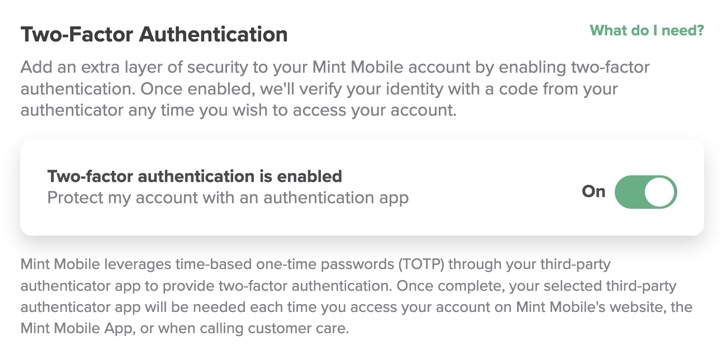
In order to better secure your Mint Mobile account overall, you should enable two-factor authentication (2FA) using a third-party TOTP Authenticator app. Examples include Google Authenticator, Authy, or 1Password. You can activate this either via the Mint app or at Mintmobile.com. Here are the official instructions from Mint: How do I set up and manage two-factor authentication?

To access your Mint Mobile account with 2FA enabled, you’ll need to provide a security code from a third-party authentication app to confirm that you’re the one logging into your account, not some weirdo trying to mess with your SIM.

Be sure to understand how to use your Authenticator app if you lose your phone. You will either want to have it cloud-based so you can get the 6-digit code via other methods, or have special backup codes printed out if staying offline.

Activate Number Lock

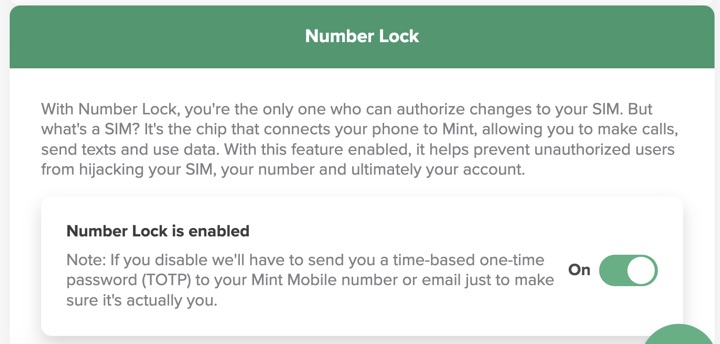
The Number Lock feature prevents the ability to request a “port out” of your number to another phone or carrier. This includes yourself if you wanted to switch carriers, so you’ll need to log into your account and disable it first if you want to do that. Note that as long as you can log into your Mint Mobile account, you can de-activate this feature. This makes the above 2FA even more important.

When Number Lock is turned on in your account, you won’t be able to activate a new SIM, order a replacement SIM or change phones. You’ll need to disable Number Lock whenever you wish to take any of these actions, but we recommend waiting until just before to do so.

Here are the official instructions from Mint: What is Number Lock?

Number Lock is a security feature that protects your SIM (physical SIM or eSIM) from unauthorized changes. Your SIM is the chip that connects your phone to the Mint Mobile network, allowing you to make calls, send texts and use mobile data. It stores your account information and your phone number. Enabling Number Lock helps prevent shady characters from hijacking your SIM, your phone number and ultimately your account.