Archives for August 2021

Albert Banking App Review: Smart Savings, No Fee $250 Cash Advances, $75 Referral Bonus

Albert is another new fintech “super app” that wants to combine your banking, budgeting, saving, and investing needs all in one place. On their paid “Genius” tier, Albert includes a team of humans that you can chat with and ask specific questions via text chat or email (not phone). More highlights:

  • Banking. No minimum and no monthly fees. Cash back offers on certain purchases through debit card. Up to $250 in cash advances until next paycheck with no interest (but up to $4.99 fee). Banking products through Sutton Bank, member FDIC.
  • Budgeting. “Smart Savings” feature analyzes your spending, income, and bills and sets aside small amounts of money into a separate account, automatically on your behalf. They will also suggest subscriptions to cancel, bills to negotiate, cheaper car insurance, etc.
  • Savings. You can set up multiple “Goals” like emergency fund, house downpayment, or vacation. Albert will give you a 0.10% to 0.25% “bonus”, which is basically interest.
  • Investing. Requires Genius upgrade. Seems like many other robo-advisors that create and manage a portfolio based on a questionnaire. $1 minimum balance. Albert Investments, LLC is an SEC Registered Investment Advisor.
  • Genius premium tier. Core banking functionality is free, but to access the financial advice of Geniuses, you must subscribe at a minimum cost of $4 per month. The official price is “pay what you think is fair”. First month is free.
  • $75 referral bonus for new users. Details below.

My experience. I opened an Albert account myself to check it out. The opening process was smooth, but immediately after I signed up for the “Smart Savings” feature, they sucked out $28 from my linked Chase checking account. I guess they preemptively analyzed my Chase account instead of the Albert account, which is not what I expected. In looking at other app store reviews, a common complaint is that the “Smart Savings” took out too much money and triggered overdraft fees on their linked accounts. I’d be careful of this feature. I’m not sure how I feel about the data mining of my non-Albert accounts.

I then tried to take advantage of their Instant Cash option with “no fees, no interest, and no credit check”. Honestly, this feature sounds like it would be very popular if it worked as smoothly as promised. Note that if you want the cash instantly, you have to pay a $4.99 fee. If you are willing to wait 3 days, then there is no fee.

Initially, I kept running into errors. I finally started the process and you do have to answer a few questions regarding your income. They will also data mine your external account to make sure you have regular direct deposits coming in. Finally, you must provide them your external debit card number, as they will charge the debit card to make sure you pay back the Instant Cash when your next paycheck arrives.

The cash back offers on the debit card are similar to those single-use offers from American Express and Chase. These may vary by user, but I received “10% off one Doordash order (max $5 discount)” and “10% off one Target purchase (max $5 discount)” with similar offers for Starbucks, Whole Foods, Lyft, Etsy, Shell, McDonalds, Walmart, and Sephora. A few bucks here and there, but it could add up.

I never upgraded to Genius, as I was not interested in their robo-advisor feature. The core features of Smart Savings and Instant Cash do not require the upgrade.

$75 referral bonus details. The Albert referral program lets you refer new users, and both the referred and referrer get $75 when the new account receives a qualifying direct deposit of $200 or more into Albert Cash within 30 days of account opening. This my Albert referral link – thanks if you use it! Here’s a screenshot of my $75 cash bonus posting the exact same day as my first direct deposit. Fast and as promised.

As noted in my Turning Small Deals into a $100,000 Nest Egg post, you can motivate yourself by treating these bonuses as a way to max out your Roth IRA. $6,000 annual limit = $500 per month = $125 per week. (Once you fund your Roth IRA, who knows how big it might grow?)

Crazy Rich IRAs: From Peter Thiel to Ted Weschler

Propublica recently reported that venture captialist Peter Thiel has a $5 billion Roth IRA. Essentially, he bought some lottery tickets using his IRA wrapper, and they paid off. The controversial part is that these lottery tickets weren’t available to everyone. They were dirt-cheap private shares of a startup that were only available to founders and a handful of early investors. At such an early stage, you can pretty much value your private company shares at whatever you wish. Here’s the Propublica version:

Open a Roth with $2,000 or less. Get a sweetheart deal to buy a stake in a startup that has a good chance of one day exploding in value. Pay just fractions of a penny per share, a price low enough to buy huge numbers of shares. Watch as all the gains on that stock — no matter how giant — are shielded from taxes forever, as long as the IRA remains untouched until age 59 and a half. Then use the proceeds, still inside the Roth, to make other investments.

It’s not clear how they found this data, but they also included the owners of other large IRAs:

Ted Weschler, a deputy of Warren Buffett at Berkshire Hathaway, had $264.4 million in his Roth account at the end of 2018. Hedge fund manager Randall Smith, whose Alden Global Capital has gutted newspapers around the country, had $252.6 million in his. Buffett, one of the richest men in the world and a vocal supporter of higher taxes on the rich, also is making use of a Roth. At the end of 2018, Buffett had $20.2 million in it. Former Renaissance Technologies hedge fund manager Robert Mercer had $31.5 million in his Roth, the records show.

Ted Weschler, along with Todd Combs, are the heirs to the “stock picking” part of Warren Buffett’s job at Berkshire Hathaway. Greg Abel will be the future CEO and help handle all the wholly-owned subsidiary companies within Berkshire, and Ajit Jain will run the large insurance operation.

As a public figure, Weschler submitted this personal statement defending and explaining his IRA, and it reveals some interesting details. He opened his first “IRA” in 1984 as a 22-year-old Junior Financial Analyst making $22,000 a year. He seems to be mixing up the terms for 401k and IRAs in his letter (confirmed in WaPo story below). His timing was lucky, as 401k plans had just been born with the earliest ones starting around 1980. Here is a 1982 WSJ newspaper scan about these newfangled “salary reduction plans”, which were what 401k plans were initially called.

Anyhow, his 401k/IRA balance had grown to $70,385 by the end of 1989, when he rolled it over into a self-directed IRA at Charles Schwab. Fast forward 23 years, and by the end of 2012, his IRA was worth $131,000,000! Thanks to the new Roth IRA conversion option when he promptly rolled it over into a Roth IRA even though he had to pay $29 million in taxes. By 2018, the balance was at $264 million.

Also significant:

I invested the account in only publicly-traded securities i.e., all investments in this account were investments that were available to the general public.

[…] In closing, although I have been an enormous beneficiary of the IRA mechanism, I personally do not feel the tax shield afforded me by my IRA is necessarily good tax policy. To this end, I am openly supportive of modifying the benefit afforded to retirement accounts once they exceed a certain threshold.

This WaPo article is a follow-up with Ted Weschler about his amazing IRA skills.

I also realized that Weschler wanted to encourage young people to do what he did to accumulate his nine-digit net worth: save and invest, early and often, and take advantage of any retirement account benefits offered by their employer. “In a perfect world, nobody would know about this account,” he said. “But now that the number is out there, I’m hopeful that some good can come of it by serving as a motivation for new workforce entrants to start saving and investing early.”

My takeaways:

  • You may not agree with all the tax rules, but there is a reason why standard personal finance advice includes maximizing your Roth IRA contribution each year AND taking full advantage of your 401k plan with any employer contribution.
  • If you believe that your future tax rate after age 60 will be higher than your current tax rate, then you should consider converting any pre-tax “Traditional” IRA balances into Roth IRAs, even if it requires a big lump sum payment today.
  • If your income is too high to qualify for a regular Roth IRA, check if you are eligible to contribute to a “backdoor” Roth IRA, essentially making a non-deductible Traditional IRA contribution and quickly performing a Roth IRA conversion. If you are high-income and a big saver, look up the “mega backdoor” Roth IRA, which involves making a non-deductible contribution to your 401k plan (if allowed by employer plan document).
  • Roth IRAs have differences from Traditional IRAs beyond just the timing of the tax being upfront or at withdrawal. If you want to leave an inheritance (as these rich people most likely do), realize that Roth IRAs don’t have the required minimum distribution (RMD) rules that apply to traditional IRAs. Bottom line: More compounding + more tax shelter = bigger estate.
  • Consider putting your riskiest investments with the highest potential upside inside your Roth IRA. My Roth IRA holds REITs: low tax-efficiency and higher risk/return profile. No sleepy bonds!
  • As a BRK shareholder, if you were to think of a contest to win “The Next Warren Buffett”, finding the person who built the biggest IRA in the world using publicly-available investments would be a pretty smart filter! Maybe Berkshire Hathaway’s investment side will be alright after Buffett and Munger are gone.

S&P 500 Returns by Components 1900-2020: Earnings Growth + Dividends + P/E Changes

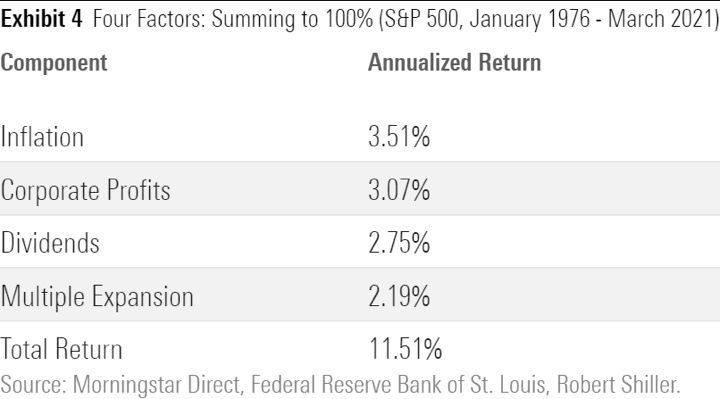
In the previous post How Much of Historical Stock Returns Is Due To P/E Ratio Expansion?, we saw how the S&P 500 historical average total return could be broken down into separate components of earnings growth, dividends, P/E multiple changes, and inflation. Here’s how it broke down from the period of January 1976 to March 2021:

I wondered: Is this a common breakdown? What about other periods of time? You may have seen charts showing the rolling historical 10-year total returns of the S&P 500. For example, 1980-1990, 1981-1991, 1982-1992, and so on. Here is such a chart:

Crestmont Research has generously shared the same total returns, but broken down into the separate components of earnings-per-share (EPS) growth, dividends, and P/E multiple changes. As they put it:

There are only three components (excluding transaction costs and expenses) to the total return from the stock market: dividend yield, earnings growth, and change in the level of valuation (P/E ratio). To assess the potential returns from stocks for the next decade, this analysis presents the total return and its components for every ten-year period since 1900.

Observations. Despite my discovery that it didn’t take 25 years to recover from the 1929 crash, notice that the Great Depression was the only period where corporate earnings consistently dropped for an extended period. We do see the dividends still being paid out, but experiencing your business make less and less earnings for years must have been very difficult.

Since approximately the time of World War II, the overall profits of the S&P 500 companies have risen in every single 10-year period. Meanwhile, the dividend yield was also positive, although it has experienced a gradual decrease over time. If you just look at those two components added together, that is quite impressive.

Finally, we see that the component with the wildest swings by far is the Price/Earnings ratio. From this visualization, it looks like huge “waves of optimism” and “waves of pessimism” that are end up causing most of the overall volatility in total return. Right now, we appear to be still riding one the waves of optimism.

Weekend Listening: NPR Planet Money Summer School Investing Edition

In 2020, the NPR Planet Money podcast did a series called Summer School that focused on economics concepts. You can still listen to those, but the 2021 Summer School series is about investing. Hardcore personal finance geeks might come away bored, but I enjoy hearing how they try to simplify and and explain these complex topics in an approachable manner. If I remember, I plan to have my kids as teens listen to these episodes. Here are the podcasts so far, which include excerpts from earlier Planet Money episodes:

  • Planet Money Summer School 1: The Stock Market
  • Planet Money Summer School 2: Index Funds & The Bet
  • Planet Money Summer School 3: Smooth Spending & The 401K
  • Planet Money Summer School 4: Bonds & Becky With The Good Yield
  • Planet Money Summer School 5: Bubbles, Bikes, & Biases

The bubble episode has a good story about bicycles (not tulips!). When I’m in an efficient mood, I enjoy listening with the Overcast app (iOS only) at 1.25x speed with “Smart Speed” that skips over silences (and somehow speeds up even more during ads) to save time. I believe Pocket Casts also has similar features, is available on both iOS and Android, is free, and is apparently partially-owned by NPR recently sold to Automattic (parent of WordPress).

Myth: It Took 25 Years to Recover From 1929 Stock Market Crash

Sometimes, it pays to scratch a little beneath the surface. In 2012, well-known behavioral scientist Dan Ariely published a paper that found that when people signed an honesty declaration at the beginning of a form, rather than the end, they were less likely to lie. It since has been cited in more than 400 other academic papers. Nine years later, a group of anonymous researchers at Data Colada actually looked at the data and found it clearly fudged using copy-and-paste and a random number generator. (They have to be anonymous to avoid retribution.) Dan Ariely and the other authors have since retracted the paper and disavowed any prior knowledge of the fake data.

You may have heard that it took 25 years for the stock market to recover during the Great Depression. I’ve heard it and simply accepted it as truth, until today. It’s true that the Dow Jones Industrial Average (DJIA or just “Dow”) peaked at 381.17 on September 3rd, 1929. It is also true that the DJIA did not reach that level of 381.17 again until November 23rd, 1954. That is a span of over 25 years.

However, as this 2009 NY Times article by Mark Hulbert explains, that’s not the whole story when you dig a little deeper.

[…] a careful analysis of the record shows that the picture is more complex and, ultimately, far less daunting: An investor who invested a lump sum in the average stock at the market’s 1929 high would have been back to a break-even by late 1936 – less than four and a half years after the mid-1932 market low.

The truth is that it took about 7 years for an investor to recover (1929-1936), even if they invested all their money at the very peak. This came 4.5 years after the Dow hit its period low of 41.22 in the middle of 1932. Why?

  • Dividends. Back then, dividend yields were much higher. The absolute dividend payout did not drop nearly as severely as the prices. When the Dow hit a low of 41.22 on July 8, 1932 (that 90% drop you’ve read about), the dividend yield was close to 14%.
  • Deflation. “The Great Depression was a deflationary period. And because the Consumer Price Index in late 1936 was more than 18 percent lower than it was in the fall of 1929, stating market returns without accounting for deflation exaggerates the decline.” Every dollar actually bought significantly more in 1936 than in 1929.
  • Human misjudgment. The DJIA is composed of 30 stocks, which are picked by humans to represent the broad market. According to this article, a total of 18 companies were swapped in and out of the DJIA between 1929 to 1932. That was the highest number of changes to the Dow ever in such a short amount of time. This was a stressful time, and the Dow committee often “sold low” and “bought high” when picking companies to remove and add.

The Great Depression was still an extraordinarily painful time with minimal social safety nets, followed closely by World War II. I recommend reading The Great Depression: A Diary by Benjamin Roth for a vivid picture of what it felt like to live through the Great Depression.

In normal times the average professional man makes just a living and lives up to the limit of his income because he must dress well, etc. In times of depression he not only fails to make a living but has no surplus capital to buy stocks and real estate. I see now how important it is for the professional man to build up a surplus in normal times.

Even today, how many are prepared for the stock market to go down for 2.5 years and then take another 4.5 years to get back to even?

[5/9/1932] Those men who were wise enough to sell during the boom and then keep their funds liquid in the form of government bonds, etc. were not farsighted enough or patient enough to wait almost three years to re-invest. Most of them re-invested a year or more ago and now find stock prices have sagged to 1/3 of what they were when they thought they were buying bargains.

Still, 7 years is very different than 25 years. Imagine being 50 years old and your IRA contribution at 25 years old is still underwater! The worst time period for stock market returns was actually 1972-1982, when it took roughly 10 years to recover if you invested at the peak:

[…] according to a Hulbert Financial Digest study of down markets since 1900, the average recovery time is just over two years, when factors like inflation and dividends are taken into account. The longest was the recovery from the December 1974 low; it took more than eight years for the market to return to its previous peak, which was reached in late 1972.

None of this, of course, guarantees that stocks will have a quick recovery from the market decline that began in October 2007. But it suggests that the historical record isn’t as bleak as it looks.

Chewy National Dog Day Sales: Spend $100, Get $30 Gift Card + 10% Off All Gift Cards

Online pet store Chewy.com is offering a variety of National Dog Day promotions:

  • Spend $100, Get a $30 gift card on select Dog products. Decent selection of a variety of dog products. Look to see if your normal purchases are included.
  • 10% off all Chewy eGift Cards. Save up to $100 on $1,000 of gift cards. Discount shows at checkout. Valid until 8/28/2021 12:00AM EST, while supplies last. Limit 1 gift card per order, limit 1 order per customer. Promotion limit of $1,000 on gift card purchases per customer.
  • Spend $75, Get a $15 gfit card on select Cat products. They didn’t forget the cats!

They also have 35% off your first Autoship order, which is similar to Amazon Subscribe & Save where you’ll then save an ongoing 5%-10% if you continue. However, you can cancel at any time, even after the first order. Flea medicine, big bag of dog/cat food, bulk pack of treats, etc.

I still keep “baby pictures” of my now 12-year-old dog on my phone, although the lock screen has been usurped by the human babies:

Best Visual Explanation of the Convexity of Long-Term Bonds

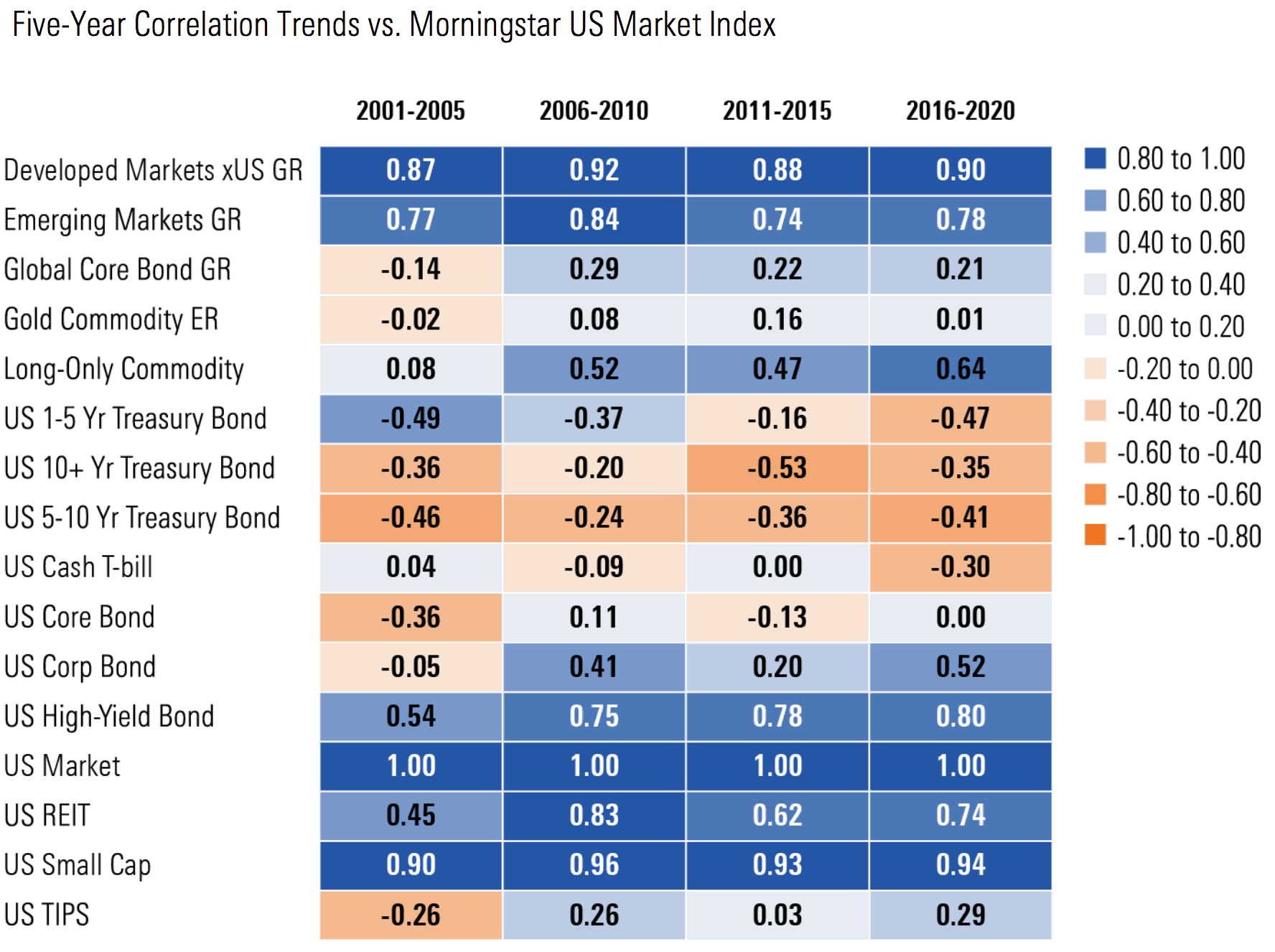
Long-term US Treasury bonds are often considered a good asset class to own due to their historically low correlation with stocks. When stocks go down, long-term bonds tend to go up (and vice versa). While the 30-year is not specifically included here, you can infer this based on the Treasury bond data from this Morningstar table:

For example, here is an older 2015 chart with correlations agains the S&P 500:

5yearcorr

While doing some additional research on adding long-term US Treasuries to a portfolio, I came across the concept of bond convexity. It’s a relatively complicated topic… I mean here is the very first sentence of the Wikipedia entry:

In finance, bond convexity is a measure of the non-linear relationship of bond prices to changes in interest rates, the second derivative of the price of the bond with respect to interest rates (duration is the first derivative).

Yikes! Thankfully, the next sentence is easier to digest:

In general, the higher the duration, the more sensitive the bond price is to the change in interest rates.

Yet, if you truly want to understand convexity, that sentence is quite incomplete. This is especially the case in low-interest rate environments like we have now in 2021.

After reading through some seriously tedious explanations mixed with college calculus flashbacks, I thankfully found the article High Profits and Low Rates: The Benefits of Bond Convexity at PortfolioCharts.com. I recommend reading the full post for an approachable explanation with no greek letters. The prize at the end is this excellent graphic:

As of this writing 8/23/2021, the yield on the 30-year US Treasury is 1.87%. Let’s round this to 2%. Based on this graphic:

  • If interest rates were to drop by 1%, the 30-year bond would increase in value by roughly 27%.
  • If interest rates were to rise by 1%, the 30-year bond would decrease in value by roughly 18%.

You may have though that since rates are so low already, any changes at this point won’t matter much. Turns out, they matter more. Long-term bonds can still pack quite a diversifying “punch” even at these low rates, both on the upside and downside (though not symmetrical). Those are some wild swings for “safe bonds”. This is definitely an interesting asset class, but be sure you know what you are getting into before purchasing.

How Much of Historical Stock Returns Is Due To P/E Ratio Expansion?

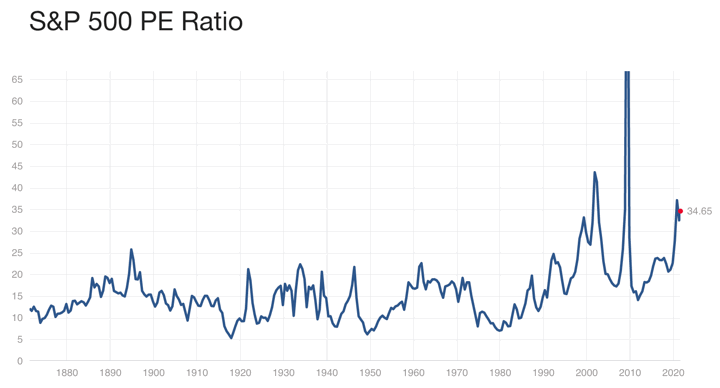
According to Multpl.com, the P/E ratio of the S&P 500 is now 35, and the dividend yield is only 1.3%. The all-time low dividend yield was 1.11% back in August 2020. Even if you consider stock buybacks, the earnings yield is less than 3%! That means if corporations all distributed every penny of their profits as dividends, it still wouldn’t be higher than 3%. Before we go any further, I’m not advocating market timing, as people were saying that the S&P 500 was “overvalued” back in 2015 when the P/E ratio was 25 and the dividend yield was 2%. Nobody truly knows what will happen to prices in the short-term.

Even if the P/E ratio seems a lot higher now than the historical average, what has that actually meant? The Morningstar article How Much Has the Market Benefited from Investor Optimism? examines how much of the historical return of the S&P 500 from 1976 through March 2021 was from P/E expansion.

In January 1976, the P/E ratio was only 11.8. In March 2021, the P/E ratio was 31.5. That seems like a huge difference, and over that 45-year time period, it did add 2.2% to the overall historical average annual return. But we also got 3% from earning growth, and another 2.75% from dividends, for a total return of ~8% above inflation. 8% real return!

In a way, this is somewhat comforting, as if you look at the long-term, a shrinking P/E ratio won’t completely destroy your retirement by itself. Instead of adding 2%, it might subtract 2%.

Looking ahead, if you assume a generous 4% from earnings growth, 0% from a constant P/E ratio, and 1.3% from dividends, that’s roughly a 5% future real return. But if the P/E ratio goes back even partly back to historical averages, that will be closer to a 4% real return. The problem is that bonds are giving us 0% real return at best, so I’m sticking with owning productive businesses.

The numbers on my brokerage statements keep going up so perhaps I shouldn’t complain, but I sure hope the earnings start to catch up to the prices soon (as some predict). I like the idea of the P/E ratio going down due to higher earnings rather than lower prices!

Free Grubhub+ Membership For Rest of 2021 (Targeted)

Grubhub is offering free Grubhub+ membership for the rest of 2021 (usually $9.99 a month) – and Seamless+ – for targeted customers, although many others will still get 30 days of free Grubhub+ membership. In addition, this offer does not require a credit card and will NOT auto-renew at the end of the period. Hat tip to Dansdeals. Grubhub+ includes:

  • Unlimited free delivery from from nearly 200,000 restaurants ($12 minimum order).
  • 10% back on pickup orders. Earn 10% back in GH+ Cash on eligible pickup orders to use towards your next pickup order.
  • Exclusive member discounts featuring free food, dollars-off and more from popular restaurants.

You might also be able to get a free Grubhub+ membership via the free Lyft Pink membership (reg. $199 a year) included free with the Chase Sapphire Reserve card. This adds another potentially valuable perk to offset that high annual fee. Once you have both Lyft Pink and Grubhub accounts, link them together and activate here.

If you have not joined Grubhub yet, you can first get $10 off your first Grubhub order of $15+ if you join via my referral link. I will get food credits as well. Thanks if you use it!

Finally, get up to 11% cash back on your first Grubhub order and 2% cash back on future orders via Rakuten app. (You must order via their app.) The fact that Rakuten gives cash back on Grubhub purchases make it an easy way to trigger the $30 bonus for new Rakuten users.

Real-World Smoothing Effects of Regular Investments (Dollar Cost Averaging)

Most people must rely on the power of smaller, regular investments from work income to build up their retirement nest egg. In the latest Sound Investing email, Paul Merriman shared a new Lifetime Investment Calculator that helps you see how these gradual investments (dollar-cost averaging) would have added up during various periods, using actual historical returns from 1970 to 2020.

I’ve already tried to illustrate how regular investments of $250 or $500 a month can add up over time. But instead of having to manually gather performance numbers from a Vanguard Target Retirement fund in a spreadsheet, this fancier calculator lets you adjust many more variables. You can choose different asset allocations, stock/bond ratio, investment amounts, and so on. Importantly, the calculator uses actual historical returns, so you can see what would happen if you invested through the 2001 dot-com bust, 2008 financial crisis, and so on.

You can start the sequence of returns from any of the 51 years to replicate your financial picture as if your decisions were available in the past. For example, you could simulate the role of luck by starting or ending your journey in a bull or bear market. It is not a financial planning calculator per se, nor meant to be a complete planning tool, but it allows you to customize both growth (accumulation) and distribution phases based on your personal timeline and investments.

If you aren’t familiar with Paul Merriman, he is an advocate of adding a bit of complexity to index fund portfolios via additional exposure to smaller and value-oriented companies. For a test run, I went for the “Ultimate Buy and Hold Worldwide (70% US/30% International)” portfolio, alongside a simple S&P 500 portfolio.

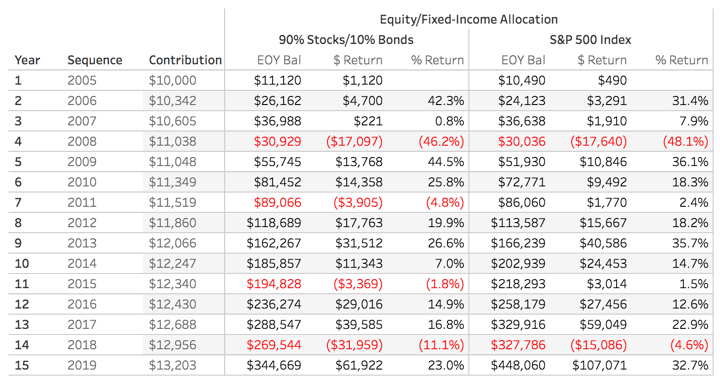
Here is $10,000 invested every year for 15 years, with small ~3% increases each year with inflation (ideally corresponding with a higher paycheck), starting in 2005:

Here is $10,000 invested every year for 15 years, with small ~3% increases each year with inflation (ideally corresponding with a higher paycheck), starting in 2000:

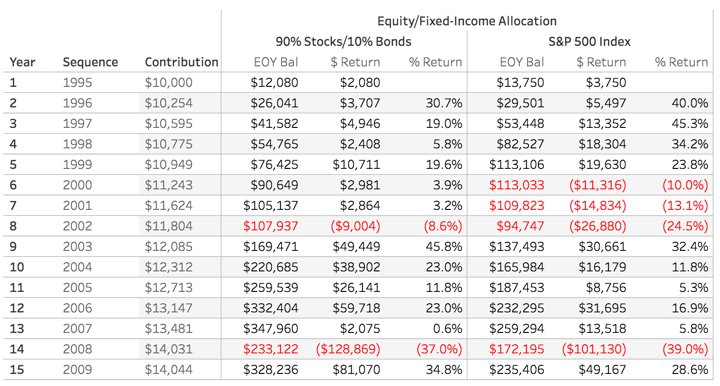
Here is $10,000 invested every year for 15 years, with small ~3% increases each year with inflation (ideally corresponding with a higher paycheck), starting in 1995:

You can see that an internationally-diversified portfolio may not be the best in some periods, but it also may not be the worst in others. (I admit I am a bit confused as to why the performance numbers for any given year are slightly different for each test run, perhaps someone out there can explain that to me.)

Even in the 1995-2010 period that contained both the 2001 dot-com bust and the 2008 financial crisis, your ending balance would still have ended up much higher than your total contributions with the internationally-diversified portfolio.

Richer, Wiser, Happier: Notes From 40+ Super Investors NOT Named Warren Buffett

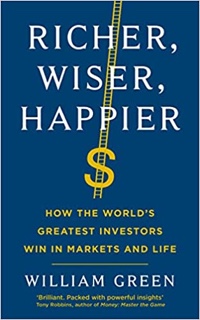
It was very telling that the first chapter of Richer, Wiser, Happier: How the World’s Greatest Investors Win in Markets and Life by William Green was a profile of Mohnish Pabrai. In other words, not Warren Buffett! If you aren’t a student of value investing, then you probably have never even heard of him before. He is best known for a being a “clone” investor.

“I’m a shameless copycat,” he says. “Everything in my life is cloned.… I have no original ideas.” Consciously, systematically, and with irrepressible delight, he has mined the minds of Buffett, Munger, and others not only for investment wisdom but for insights on how to manage his business, avoid mistakes, build his brand, give away money, approach relationships, structure his time, and construct a happy life.

That descriptor always seemed a bit derogatory, but after reading more about Pabrai in this book, I grew quite a lot of appreciation and respect for his approach. If you also like collecting outside wisdom (especially about investing) and incorporating into your life, you will likely enjoy this book as well. Green is an excellent writer and journalist that has managed to interview over 40 of the world’s greatest investors (many of which I’d never heard of until now), and this became the most heavily-highlighted book in my Kindle. Here are a fraction of them:

Mohnish Pabrai

Rule 1: Clone like crazy. Rule 2: Hang out with people who are better than you. Rule 3: Treat life as a game, not as a survival contest or a battle to the death. Rule 4: Be in alignment with who you are; don’t do what you don’t want to do or what’s not right for you. Rule 5: Live by an inner scorecard; don’t worry about what others think of you; don’t be defined by external validation.

Cloning Buffett, who once showed him the blank pages of his little black diary, Pabrai keeps his calendar virtually empty so he can spend most of his time reading and studying companies. On a typical day at the office, he schedules a grand total of zero meetings and zero phone calls. One of his favorite quotes is from the philosopher Blaise Pascal: “All of humanity’s problems stem from man’s inability to sit quietly in a room alone.” […] He says it helps that his investment staff consists of a single person: him. “The moment you have people on your team, they’re going to want to act and do things, and then you’re hosed.”

John Templeton

To his credit, Templeton was especially demanding of himself. Take his attitude toward saving and spending. “After my education, I had absolutely no money and neither did my bride,” he told me. “So we deliberately saved fifty cents out of every dollar we earned.”

Distrustful of debt, he always paid cash for his cars and homes. He also claimed that his wartime bet was the only time he ever borrowed money to invest. During the Great Depression he’d seen how easy it was for overextended people to come undone, and he regarded fiscal discipline as a moral virtue.

Howard Marks

“Look, luck is not enough,” he says. “But equally, intelligence is not enough, hard work is not enough, and even perseverance is not necessarily enough. You need some combination of all four.

He plans to work indefinitely because he finds it intellectually rewarding, not because he has an “unquenchable” thirst for money or status. He recalls his Japanese studies professor explaining a Buddhist teaching that “you have to break the chain of getting and wanting”—an aimless cycle of craving that leads inevitably to suffering.

Irving Kahn

Kahn became Graham’s teaching assistant at Columbia in the 1920s, and they remained friends for decades. I wanted to know what he’d learned from Graham that had helped him to prosper during his eighty-six years in the financial markets. Kahn’s answer: “Investing is about preserving more than anything. That must be your first thought, not looking for large gains. If you achieve only reasonable returns and suffer minimal losses, you will become a wealthy man and will surpass any gambler friends you may have. This is also a good way to cure your sleeping problems.”

Just think for a moment about those basic ingredients that helped to make for a richly rewarding life. Family, health, challenging and useful work, which involved serving his clients well by compounding their savings conservatively over decades. And learning—particularly from Graham, an investment prophet who, Kahn said, “taught me how to study companies and succeed through research as opposed to luck or happenstance.”

Joel Greenblatt

This raises an obvious but crucial question: Do you know how to value a business? There’s nothing admirable or shameful about your response. But you and I need to answer this question honestly, since self-delusion is a costly habit in extreme sports such as skydiving and stock picking. “It’s a very small fraction of people that can value businesses—and if you can’t do that, I don’t think you should be investing on your own,” says Greenblatt. “How can you invest intelligently if you can’t figure out what something is worth?”

These experiences have led him to an important revelation: “For most individuals, the best strategy is not the one that’s going to get you the highest return.” Rather, the ideal is “a good strategy that you can stick with” even “in bad times.”

Charlie Munger

Munger often preaches about the importance of avoiding behavior with marginal upside and devastating downside. He once observed, “Three things ruin people: drugs, liquor, and leverage.”

Asked for career advice, he opines: “You have to play in a game where you’ve got some unusual talents. If you’re five foot one, you don’t want to play basketball against some guy who’s eight foot three. It’s just too hard. So you’ve got to figure out a game where you have an advantage, and it has to be something that you’re deeply interested in.”

Survivorship bias! I would say that one of the dangers of this book is that it may make you want to be a stock picker. All of the people profiled are probably have a net worth of over $50 million if not much more. Many made a few bold bets, and they paid off big. I want an oceanfront house in Newport Beach, my own private jet, and a vintage car to drive across Asia too!

The rewards for investing intelligently are so extravagant that the business attracts many brilliant minds.

Beating the market means being different. Can you make “unconventional bets that the crowd would consider foolish”? Are you a good fit for the “bizarrely lucrative discipline of sitting alone in a room and occasionally buying a mispriced stock”? Do you have enough humility to make a good judgment, mixed with the self-confidence to bet big when you think you have an edge?

Even if you think you do, survivorship bias reminds us that there are many, many highly-intelligent, hard-working people who tried their best to apply these concepts, but did not succeed. They are missing from the pages of this book, and you’ll never read their stories.

The true goal is independence. The good news is that you don’t need be a great stock picker. Even if you just invest in low-cost index funds and can stick with it, you can do quite well and still achieve the ability to be independent and become in control of your time on Earth.

Buffett said, “If you’re even a slightly above average investor who spends less than you earn, over a lifetime you cannot help but get very wealthy.”

Howard Marks: “Most people should index most of their money.”

The pattern is clear. In their own ways, Greenblatt, Buffett, Bogle, Danoff, and Miller have all been seekers of simplicity. The rest of us should follow suit. We each need a simple and consistent investment strategy that works well over time—one that we understand and believe in strongly enough that we’ll adhere to it faithfully through good times and bad.

“You build capital and then you can do whatever you want because you’re independent.” For many of the most successful investors I’ve interviewed, that freedom to construct a life that aligns authentically with their passions and peculiarities may be the single greatest luxury that money can buy.

p.s. Here is a list of the people profiled in this book; I can’t guarantee I got all of them but it’s definitely close. A good source for additional research.

  • Sir John Templeton
  • Irving Kahn
  • Bill Ruane
  • Marty Whitman
  • Jack Bogle
  • Charlie Munger
  • Ed Thorp
  • Howard Marks
  • Joel Greenblatt
  • Bill Miller
  • Mohnish Pabrai
  • Tom Gayner
  • Guy Spier
  • Fred Martin
  • Ken Shubin Stein
  • Matthew McLennan
  • Jeffrey Gundlach
  • Francis Chou
  • Thyra Zerhusen
  • Thomas Russo
  • Chuck Akre
  • Li Lu
  • Peter Lynch
  • Pat Dorsey
  • Michael Price
  • Mason Hawkins
  • Bill Ackman
  • Jeff Vinik
  • Mario Gabelli
  • Laura Geritz
  • Brian McMahon
  • Henry Ellenbogen
  • Donald Yacktman
  • Bill Nygren
  • Paul Lountzis
  • Jason Karp
  • Will Danoff
  • François Rochon
  • John Spears
  • Joel Tillinghast
  • Qais Zakaria
  • Nick Sleep
  • Paul Isaac
  • Mike Zapata
  • Paul Yablon
  • Whitney Tilson
  • François-Marie Wojcik
  • Sarah Ketterer
  • Christopher Davis
  • Raamdeo Agrawal
  • Arnold Van Den Berg
  • Mariko Gordon
  • Jean-Marie Eveillard
  • Guy Spier

Turning Small Deals into a $100,000 Nest Egg

There is a story circulating about MIT students offered $100 in free Bitcoin back in 2014. A few quickly spent it on dinner at a local sushi restaurant. Some kept it all, now worth about $14,000. Some agreed to help fellow students set up a crypto wallet to hold their Bitcoin, in exchange for some of it. 1 BTC was worth about about $300 back then, and about $45,000 now. Those sushi dinners ended up being quite expensive, but can you really blame them? How many of us went out and backed the truck up on Bitcoin in 2014?

However, that got me thinking about the various deals that I post on this blog. I don’t know what you do for work, but I trust that you work hard and balance your levels of passion, income, and ability. I can’t help you much with your career, but these deals are a way to find common ground, as they are available to the great majority of readers. You may think of them as “free sushi dinners”, but they can equally be a powerful source of retirement savings and income.

1. Consider a target of $500 monthly profit coming from whatever deals are currently available. It could be higher interest on savings accounts, bank sign-up bonuses, credit card cash back, credit card sign-up bonuses, brokerage bonuses, US Mint purchases, savings on your normal everyday purchases, solo-business promotions, and so on. This is a relatively aggressive target, but if you consider everything together and average it out, it can add up quickly. I’ve been doing similar deals since I was 21 years old making $20,000 a year with $30,000 in student loans.

2. $500 a month = $6,000 a year = Maxed-out Roth IRA contribution. The 2021 contribution limit for Roth IRAs in $6,000 a year, with an additional $1,000 for those aged 50+. I always find this a very handy target to help me focus my profit from the “deals and offers” game. If you have a partner, going for $12,000 combined is an even better target. I’ve made every effort to do the max for 20 years now.

3. Invest in simple, transparent, productive assets. Some people are great with real estate, others reinvest in their own private small businesses. We should appreciate that anyone with $1,000 can open a IRA at Vanguard with minimal fees and invest in the all-in-one Vanguard Target Retirement Fund, which is a low-cost, diversified mix of global stocks and bonds. You don’t need to gamble on options at Robinhood, put too much in Bitcoin lottery tickets, or get insider access to a trendy “alternative/long/short/volatility-managed” hedge fund. Put it in, turn on automatic reinvestment of dividends, and walk away. Inside a Roth IRA, you don’t have to worry about taxes on dividends or capital gains distributions.

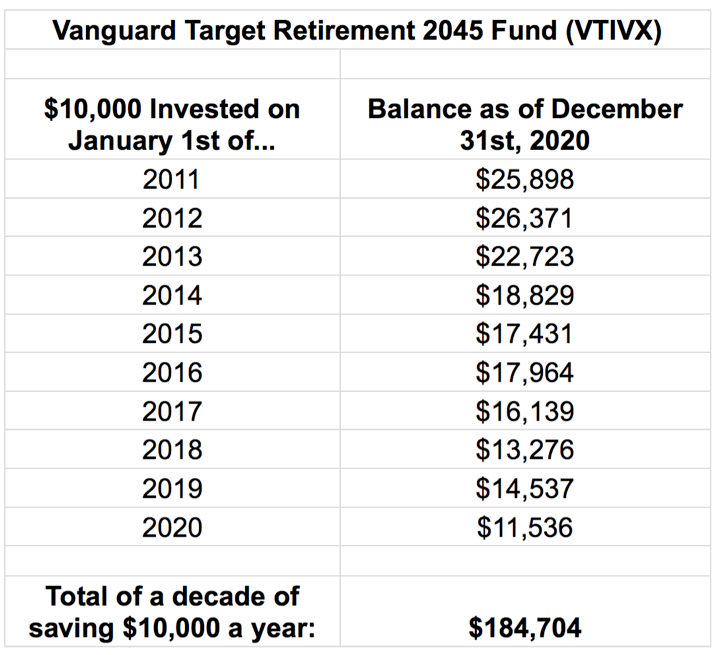
4. Repeat for 10 years. If you did this from 2011-2020, you’d have over $100,000. Every January, I show how regular, steady investments over time can end up with excellent results. Here is a table from What If You Invested $10,000 Every Year For the Last 10 Years? 2021 Edition:

Global stock markets are up even further in 2021 (VTIVX is up another 12% YTD as of this writing), but we can simply stick with these numbers. The chart assumes a $10,000 annual investment ($833 a month), but we can easily scale it down to our $6,000 annual investment.

If you invested $6,000 a year into the Vanguard Target Retirement 2045 Fund, every year for the past 10 years (2011-2020), you would have ended up with a total balance of $110,822. (If two people did this, they would have over $220,000!) These are real-world numbers based on $500 a month, not a theoretical result from a calculator. You can argue the details, but even with only $250 a month, you’d have ended up with over $50,000. (You would have done even better going all-in with an S&P 500 index fund as well, but this is an easy, set-and-forget choice including global stocks and bonds.)

I admit, I like to play the game of “winning” easy/free money. I find it much more enjoyable than any video game. I also try to only pick and choose those that offer a good payout/effort ratio, usually over the equivalent of $100 an hour. Now, these small deals will never replace a successful career, which can supercharge your savings into the realm of financial independence. However, this is yet another reminder that small amounts, however attained, can add up to a surprisingly big number over time when invested productively and left alone. I have the Vanguard IRA statements to prove it. 😀