Archives for September 2019

Yes, Health Insurance Costs Impacted My Early Retirement (FIRE) Plans

health

When the topic of early retirement comes up, a common question is “Are you concerned about health insurance?” I could be a cheerleader and say “nah no big deal”, but to be honest it has impacted my early retirement plans. Not only are the costs high today, but imagine how much higher they will get in the future if current trends continue.

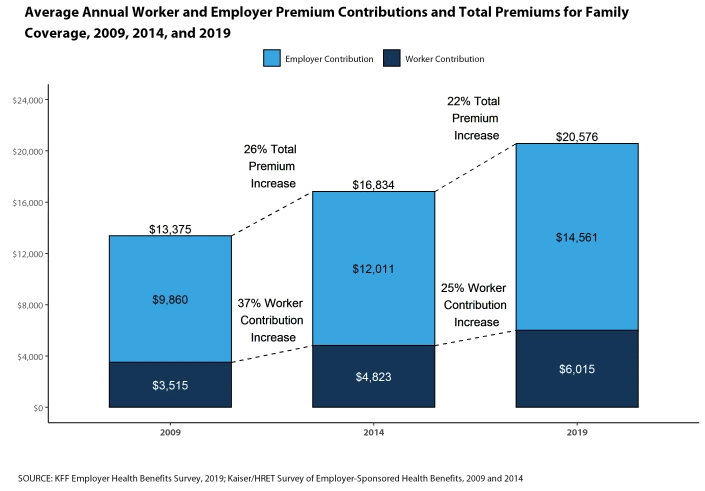
The Kaiser Family Foundation (KFF) released the results of their annual Employer Health Benefits Survey, and the cost of family health coverage in the U.S. now tops $20,000 a year. This is more than a 50% jump from just 10 years ago:
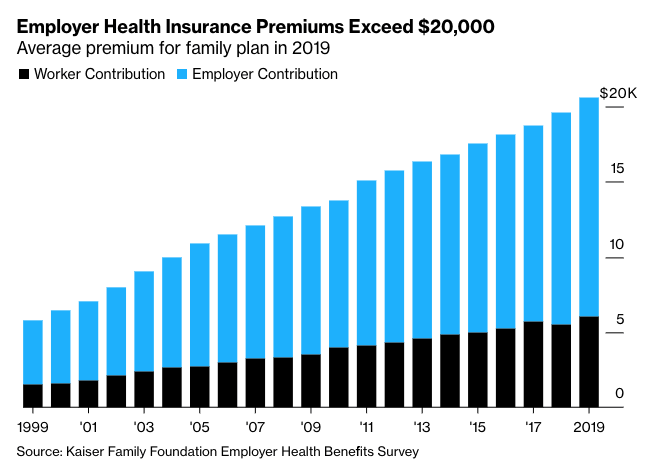
Here’s another chart (same data set) from this Bloomberg article that goes farther back.
If you are single or a couple without kids, here’s a state-by-state map breakdown of the average monthly premium for the lowest Silver plan (per person):

The premium prices listed above don’t include deductibles and out-of-pocket expenses, which are rising as well and add up to another $2,000 per year on average:

Deductibles are rising even faster than premiums, meaning that patients are on the hook for more of their medical costs upfront. For a single person, the average deductible in 2019 was $1,396, up from $533 in 2009. A typical household with employer health coverage spends about $800 a year in out-of-pocket costs, not counting premiums, according to research from the Commonwealth Fund. At the high end of the range, those costs can top $5,000 a year.

Obviously, budgeting another $15,000 to $20,000+ in healthcare costs is going to be a huge factor to consider. Here are the ways that I have seen folks deal with this cost.

  1. Use an Affordable Care Act (ACA) plan and get a subsidy if your income (MAGI) is low enough to qualify. KFF has a very handy ACA subsidy calculator that will help you estimate this. If you live in California, The Finance Buff has some helpful information on the California Health Insurance subsidy. The annoying part is you never know if the rules will change on you down the road.
  2. Plan ahead with a job that offers health insurance benefits after you retire and before Medicare kicks in. You’ll probably have to hunker down with the same employer for a number of years.
  3. Save enough money (or create enough income) to pay for health insurance premiums.
  4. Find a part-time job that you both enjoy and offers health benefits. Employers know that health insurance is expensive, but you can negotiate benefits as part of your total compensation.
  5. Run a part-time side business that earns enough profit to cover health insurance costs. Look for potential group discounts or tax breaks that are available as a business instead of a consumer.
  6. If it works for your situation, try a high-deductible health plan (HDHP) and fund a Health Savings Account (HSA) due to the tax advantages.
  7. Join a direct primary care arrangement or health care sharing ministry that is exempt from ACA.
  8. Extend your current employer coverage for up to 18 months through COBRA (check cost).
  9. Move to a foreign country with reasonable and transparent cash pricing.
  10. Some people have bought short-term health insurance plans, but these are not ACA-compliant “full insurance”. Beware the limitations. Read the horror stories first.
  11. Here’s a person who gave up a promotion and quit her job to qualify for Medicaid.

Right now, we are covered by employer-sponsored health insurance, but for us it is a negotiated part of the total compensation. You can’t expect an employer to keep your same benefits package when you work less than full-time, but you can agree to take less salary in exchange for health insurance. At other times, we have bought health insurance directly. The most recent cost was around $1,600 a month for our family, very close to that $20,000 number. Even if we could qualify for a partial ACA subsidy, we would still be looking at around $10,000 a year in healthcare costs.

The difference with healthcare costs is that once you qualify for Medicare, your costs should hopefully be much less than that $20,000 a year price tag. According to BI, the national average cost for Medigap Plan F is $1,712 annually, or just under $150 a month.

So the amount you have to save to retire early depends on how many years you have until age 65. For us, that’s 25 years so that’s a big number and I don’t see how that doesn’t extend the time you need to be ready for retirement. Health insurance was definitely a factor in us going the more gradual semi-retired route.

Now imagine the overall impact that healthcare costs have on businesses, both big and small. Services and products cost more to make when every employee costs more to insure. I was able to take risks as an entrepreneur because my spouse had health insurance that covered both of us. If I had to keep my family covered with health insurance, I might still be working at MegaCorp. As Warren Buffett has said, “medical costs are the tapeworm of American economic competitiveness”. In the coming years, I wonder how both the healthcare and student loan situations will change, because the current trajectories are unsustainable.

How To Lose Your Money Investing

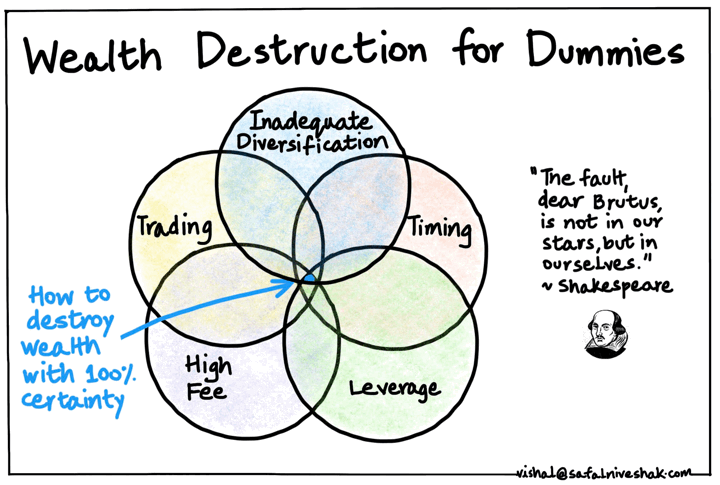
Sometimes the best solution to a problem comes by approaching it backwards. Charlie Munger often spoke about the principle of inversion. Instead of looking for things that you should do to achieve a goal, make a list of things you would do to make sure you never reach that goal. Then do whatever you can to avoid those things.

Safal Niveshak offers us this related graphic in his post 5 Ways to Destroy Your Wealth. I’m always a sucker for a clever Venn diagram…

Definitely a good list. However, I would say this graphic is more focused on “How To Destroy Wealth Investing“, as I can think of plenty of other ways to destroy wealth…

Chase Sapphire Banking: $1,000 Bonus For New/Existing Customers ($75,000 Assets)

New bonus. Chase has a new $1,000 cash bonus offer if you upgrade to or open a new Sapphire Banking account. To qualify, you must transfer a total of $75,000 or more in new money or securities into eligible Chase checking, savings and/or investment accounts. You must open by 11/19/2019, complete the $75k transfer within 45 days of opening, and maintain that balance for at least 90 days from the date of funding. Chase will deposit the bonus into your new account within 10 business days after meeting the requirements.

Banks are trying to develop relationships with the “might be rich in the future” crowd instead of only courting the “really rich”. Okay, the official term is “mass affluent”. Sapphire Banking is a new brand extension of their popular Chase Sapphire line of credit cards, although you don’t need to have one to open this account.

Sapphire Banking details. This is a “premium” checking account for those that can keep $75,000 in deposits or investments in qualifying Chase accounts. If you have less than $75k in assets, then a $25 monthly fee applies. Sapphire Banking perks include:

  • No ATM fees, including rebates on fees charged by non-Chase ATMs.
  • No fees for foreign exchange (ATM/debit), outgoing wire transfers, or stop payments.
  • No fees on the first four overdrafts within 12 months.
  • Free online stock and ETF trades with You Invest by JP Morgan.
  • Access to Sapphire lounges at concerts, sports and special events, early ticket sales and premium seats.
  • $0 monthly service fee on a linked Chase Total Business Checking account.

Moving over ETFs, mutual funds, and stocks. Since investments count towards the $75,000 requirement, if you have that much in ETFs, mutual funds, or stocks at another broker, you could perform an in-kind ACAT transfer over to their discount brokerage firm You Invest. All of your tax basis information should also move over seamlessly these days. Your old broker may charge you an outgoing ACAT fee about about $75, although you might ask You Invest if they will reimburse you for this fee. This would let you avoid parking $75,000 at Chase earning nearly zero interest (okay, it’s 0.01% APY). Losing out on 2% interest on $75k works out to a rate of $125 interest per month ($1,500 per year).

Alternatively, you could move over some cash and then invest in something similar to cash. I’m not sure if You Invest will let you buy individual US Treasury bills or brokered CDs. If not, you might also consider ultra-short bond ETFs like MINT or Treasury Bill ETFs like BIL.

Bonus math. Let’s say they want you to keep your $75k there for 90 days and to be safe you keep it there for another 10 business days until you see the bonus. Let’s make that 120 total days to be conservative. Earning $1,000 over 120 days on a $75,000 balance is ~4% annualized. This is on top of any other return from your investments (T-Bill interest, etc).

This is about the highest bonus that I have seen on this account, which is good because you can only get it once per 12 month period. This includes the You Invest bonus, which would only give you $200 right now if you transferred in under $100,000. The bonus will be reported on a 1099-INT:

You can only participate in one Chase Private Client CheckingSM, Chase SapphireSM Checking or You InvestSM new money bonus in a 12 month period. Coupon is good for one time use and only one bonus per account. Bonus is considered interest and will be reported on IRS Form 1099-INT (or Form 1042-S, if applicable).

Bottom line. Chase Bank has a premium checking account tier called Sapphire Banking, targeted at the “mass affluent”. There is a new account bonus of $1,000 for both new and existing Chase bank customers if you move over $75,000 in cash and/or investment assets.

Capital One Walmart Rewards Mastercard Review: 5% Back, But With Restrictions

Today, Walmart launched their new Capital One Walmart Rewards Mastercard (credit card) and Walmart Rewards Card (store card that only works at Walmart). Here are the highlights, which unfortunately include some hoops and hurdles to jump through.

  • Intro offer: 5% back at Walmart in-store when using Walmart Pay during the first 12 months.
  • 5% back on purchases at Walmart.com and Walmart app (includes Walmart Grocery Pickup and Delivery).
  • 2% back on Walmart purchases in stores after the introductory offer.
  • 2% back on restaurants and travel.
  • 1% back on all other purchases.
  • No foreign transaction fee.
  • No annual fee.

You can redeem your rewards during online checkout at Walmart.com, for recent purchases, and statement credits. (Gift cards and travel are listed as options too, but why would you choose that over cash unless they offer some sort of bonus?)

The only long-lasting benefit is the 5% back at Walmart.com and Walmart app (includes Walmart Grocery Pickup and Delivery). If you spent $1,000 a year at Walmart.com, then that’ll get you $50 in cashback. I might spend that much at Walmart in-store over a year, but definitely not Walmart.com at this time. If they released Walmart’s in-store sales volume compared to their online sales, I think you’d see a large disparity.

I was disappointed to see that 5% back in-store only works (1) if you remember to set up and use their Walmart iOS or Andriod app and (2) it only lasts for the first 12 months. After a year, it’s back down to only 2% back on Walmart purchases which really isn’t very appealing with multiple 2% cash back on everything alternatives. Did they not realize that nobody liked their old Synchrony card because it only offered a super-sad 1% back at Walmart stores?

Why is Walmart so stingy with the cash back? Perhaps Walmart’s profit margins are too slim to match Target REDcard’s 5% cash back on both in-store and online purchases. I suppose you could see that as a good thing. But still, it gives me little reason to get this card. Costco only offers 2% back via their self-branded credit card, but at least throws in 4% back on gas and 3% back on travel and restaurants. Meanwhile, Amazon offers 5% back if you have Prime and includes Whole Foods purchases.

Bottom line. Walmart has a new co-branded credit card. The only long-lasting benefit is the 5% back at Walmart.com and Walmart app (includes Walmart Grocery Pickup and Delivery). It’s not very good any place outside of Walmart, and not even especially good at Walmart stores after the first year. If Walmart.com steps up their game to include better delivery options, perhaps it will be worth a second look.

My Money Blog Portfolio Income and Withdrawal Rate – September 2019 (Q3)

dividendmono225One of the biggest problems in retirement planning is making sure a pile of money lasts throughout your retirement. I have read hundreds of articles about this topic, and there is no single solution. My imperfect (!) solution is to first build a portfolio designed for total return using assets that have enough faith in to hold through an extended downturn. I do not look for the highest income – no specialized ETFs, no high-dividend-only stocks, no high-yield bonds.

Then, only after that do I check out how much it distributes in dividends and interest. Dividends are the portion of profits that businesses have decided they don’t need to reinvest into their business. The analogy I fall back on is owning a rental property. If you are reliably getting rent checks that increase with inflation, you can sit back calmly and ignore what the house might sell for on the open market.

I track the “TTM Yield” or “12-Month Yield” from Morningstar, which the sum of a fund’s total trailing 12-month interest and dividend payments divided by the last month’s ending share price (NAV) plus any capital gains distributed over the same period. I prefer this measure because it is based on historical distributions and not a forecast. Below is a very close approximation of my investment portfolio (2/3rd stocks and 1/3rd bonds).

Asset Class / Fund % of Portfolio Trailing 12-Month Yield (Taken 9/17/19) Yield Contribution
US Total Stock
Vanguard Total Stock Market Fund (VTI, VTSAX)
25% 1.85% 0.46%
US Small Value
Vanguard Small-Cap Value ETF (VBR)
5% 2.35% 0.12%
International Total Stock
Vanguard Total International Stock Market Fund (VXUS, VTIAX)
25% 3.05% 0.76%
Emerging Markets
Vanguard Emerging Markets ETF (VWO)
5% 2.71% 0.14%
US Real Estate
Vanguard REIT Index Fund (VNQ, VGSLX)
6% 3.29% 0.20%
Intermediate-Term High Quality Bonds
Vanguard Intermediate-Term Treasury ETF (VGIT)
17% 2.20% 0.37%
Inflation-Linked Treasury Bonds
Vanguard Short-Term Inflation-Protected Securities ETF (VTIP)
17% 2.12% 0.36%
Totals 100% 2.41%


Here is a chart showing how this 12-month trailing income rate has varied over the last five years.

One of the things I like about using this number is that when stock prices drop, this percentage metric usually goes up – which makes me feel better in a gloomy market. When stock prices go up, this percentage metric usually goes down, which keeps me from getting too euphoric. I see it as a very conservative, valuation-based withdrawal rate metric due to our very long retirement horizon of 40+ years.

In practical terms, I let all of my dividends and interest accumulate without automatic reinvestment. I treat this money as my “paycheck”. Then, as with my real paycheck, I can choose to either spend it or reinvest in more stocks and bonds. This number does not dictate how much we actually spend every year, but it gives me an idea of how comfortable I am with our withdrawal rate.

I am a proponent of aggressively saving, and then using the potential income that brings to improve your daily lifestyle. Instead of sitting on a beach, we used our nest egg to allow us to work less hours in a more flexible manner as parents of young children. Others may use it to start a new business, travel around the world, do charity or volunteer work, and so on. The income from our portfolio lets us “work less and live more” now as I now fear running out of time more than running out of money.

(If you’re still in the accumulation phase, you don’t really need to worry about this number. I believe a 3% withdrawal rate remains a reasonable target for something retiring young (before age 50) and a 4% withdrawal rate is a reasonable target for one retiring at a more traditional age (closer to 65). If you are young, instead focus on your earning potential via better career moves, investing in your skill set, and/or look for entrepreneurial opportunities where you own equity in a business.)

My Money Blog Portfolio Asset Allocation Update, September 2019 (Q3)

portpie_blank200

Here’s my portfolio update for the third quarter of 2019. Most of my dividends arrive on a quarterly basis, and this helps me determine where to reinvest them. These are my real-world holdings, including 401k/403b/IRAs, taxable brokerage accounts, and savings bonds but excluding our house, cash reserves, and a few side investments. The goal of this portfolio is to create sustainable income that keeps up with inflation to cover our household expenses.

Actual Asset Allocation and Holdings

I use both Personal Capital and a custom Google Spreadsheet to track my investment holdings. The Personal Capital financial tracking app (free, my review) automatically logs into my accounts, adds up my balances, tracks my performance, and calculates my asset allocation. I still use my manual Google Spreadsheet (free, instructions) because it helps me calculate how much I need in each asset class to rebalance back towards my target asset allocation.

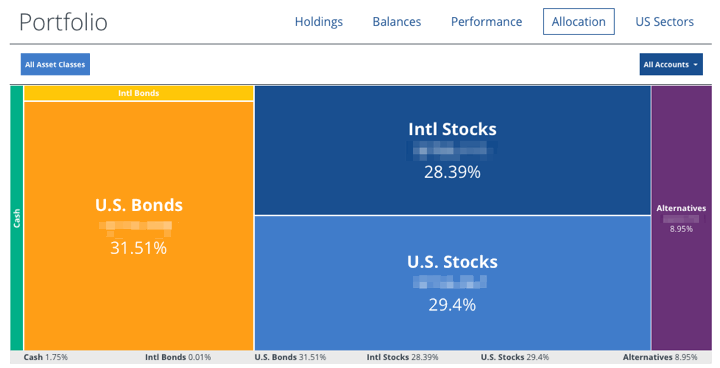
Here are my YTD performance and current asset allocation visually, per the “Holdings” and “Allocation” tabs of my Personal Capital account, respectively:

Stock Holdings
Vanguard Total Stock Market Fund (VTI, VTSAX)
Vanguard Total International Stock Market Fund (VXUS, VTIAX)
WisdomTree SmallCap Dividend ETF (DES)
Vanguard Small Value ETF (VBR)
Vanguard Emerging Markets ETF (VWO)
Vanguard REIT Index Fund (VNQ, VGSLX)

Bond Holdings
Vanguard Limited-Term Tax-Exempt Fund (VMLTX, VMLUX)
Vanguard Intermediate-Term Tax-Exempt Fund (VWITX, VWIUX)
Vanguard Intermediate-Term Treasury Fund (VFITX, VFIUX)
Vanguard Inflation-Protected Securities Fund (VIPSX, VAIPX)
Fidelity Inflation-Protected Bond Index Fund (FIPDX)
iShares Barclays TIPS Bond ETF (TIP)
Individual TIPS securities
U.S. Savings Bonds (Series I)

Target Asset Allocation. Our overall goal is to include asset classes that will provide long-term returns above inflation, distribute income via dividends and interest, and finally offer some historical tendencies to balance each other out. I make a small bet that US Small Value and Emerging Markets will have higher future long-term returns (along with some higher volatility) than the more large and broad indexes, although I could be wrong.

I don’t hold commodities, gold, or bitcoin. While you could argue for each of these asset classes, I believe that it is important to imagine an asset class doing poorly for a long time, with bad news constantly surrounding it, and only hold the ones where you still think you can maintain faith based on a solid foundation of knowledge and experience. That’s just not the case for me with certain asset classes.

Stocks Breakdown

  • 38% US Total Market
  • 7% US Small-Cap Value
  • 38% International Total Market
  • 7% Emerging Markets
  • 10% US Real Estate (REIT)

Bonds Breakdown

  • 33% US Treasury Bonds, intermediate
  • 33% High-Quality Municipal Bonds (taxable)
  • 33% US Treasury Inflation-Protected Bonds (tax-deferred)

I have settled into a long-term target ratio of 67% stocks and 33% bonds (2:1 ratio) within our investment strategy of buy, hold, and occasionally rebalance. I will use the dividends and interest to rebalance whenever possible in order to avoid taxable gains. (I allow it drift a bit either way.) With a self-managed, simple portfolio of low-cost funds, we minimize management fees, commissions, and taxes.

Holdings commentary. On the stocks side, somehow despite all of the various news stories stock prices have been resilient. I’m like a lot of other people and waiting for the next recession to come, but I also know to stay in the game. US stocks have beaten international stocks for a while, but I remain satisfied with my mix, knowing that I will own whatever successful businesses come out of the US, China, or wherever in the future.

On the bond side, my primary objective is to hold high-quality bonds with a short-to-intermediate duration of under 5 years or so. This means US Treasuries, TIPS, or investment-grade municipal bonds. I don’t want to worry about my bonds. I then tweak the specific breakdown based on my tax-deferred space available, the tax-effective rates of muni bonds, and the real interest rates of TIPS. Right now, it is roughly 1/3rd Treasuries, 1/3 Muni bonds, and 1/3rd TIPS. It looks like I need to redirect my dividends into more bonds.

Performance commentary and benchmarks. According to Personal Capital, my portfolio went up 13% so far in 2019. I see that during the same period the S&P 500 has gone up nearly 20%, Foreign Developed stocks up nearly 13%, and the US Aggregate bond index was up about 7%.

An alternative benchmark for my portfolio is 50% Vanguard LifeStrategy Growth Fund and 50% Vanguard LifeStrategy Moderate Growth Fund – one is 60/40 and the other is 80/20 so it also works out to 70% stocks and 30% bonds. That benchmark would have a total return of +14.82% for 2019 YTD.

I’ll share about more about the income in a separate post.

The Hidden Economics of College Admissions

NY Times Magazine has an interesting longread What College Admissions Offices Really Want by Paul Tough, adapted from his new book The Years That Matter Most: How College Makes or Breaks Us. Angel Pérez and Trinity College allowed an inside look at the admissions process of a small liberal arts college. The entire thing is definitely worth a read, but here are my notes and highlights.

  • Both public and private universities stress about making their budget numbers balance. Tuition, endowments, and government funds must cover their expenses. Many colleges lose money year, and some of these are eventually forced to shut down.

    Tuition revenue, which along with room and board provides about two-thirds of Trinity College’s operating budget, had been falling for several years, and Trinity was running a steep deficit, losing $8 million a year.

  • This financial stress makes it hard to be truly need-blind and offer every student the aid package they need to afford college.

    Enrollment managers know there is no shortage of deserving low-income students applying to good colleges. They know this because they regularly reject them — not because they don’t want to admit these students, but because they can’t afford to.

  • The simplest way to balance their budget is to admit more students who can afford to pay full tuition, even if they aren’t the best applicants.
  • “We were taking some students who probably should not have been admitted, but we were taking them because they could pay”

    There is a popular and persistent image of college admissions in which diversity-obsessed universities are using affirmative action to deny spaces to academically talented affluent students while admitting low-income students with lower ability in their place. Boeckenstedt says the opposite is closer to the truth. If you’re an enrollment manager, he explains, the easiest category of students for you to admit are below-average students from high-income families.

  • High-income household have advantages in a few different ways. There are always a certain number of spaces set aside specifically for alumni, big donors, and those who excel at collegiate sports. These all tend to benefit those of high income.

    Most of Trinity’s athletes play sports that are popular in prep schools and rare in low-income public schools: field hockey, lacrosse, rowing and, especially, squash. The result is that at Trinity, as at many other Division III schools in the Northeast, the recruited athletes are actually more likely to be white and wealthy than the rest of the freshman class.

  • SAT and ACT scores also tend to correlate strongly with income.
  • Boeckenstedt’s chart shows an almost perfect correlation between institutional selectivity and students’ average family income, a steady, unwavering diagonal line slicing through the graph. With only a few exceptions, every American college follows the same pattern.

  • Even though many of the most elite colleges now tout their “free tuition” for low-income students, the overall numbers haven’t changed much.

    The most selective colleges in America were the least socioeconomically diverse. […] At “Ivy plus” colleges (Chetty’s term for the Ivy League plus Stanford, M.I.T., Duke and the University of Chicago), more than two-thirds of undergraduates, on average, came from families in the top income quintile, and fewer than 4 percent of students grew up in the bottom income quintile.

  • Hardly anyone pays the full “sticker” price at private universities. In fact, on average, students pay half the sticker price.

    At private, nonprofit four-year colleges — a category that includes most of the nation’s highly selective institutions — 89 percent of students receive some form of financial aid, meaning that almost no one is paying full price.

    In 2018 the average tuition-discount rate for freshmen at private, nonprofit universities hit 50 percent for the first time, meaning that colleges were charging students, on average, less than half of their posted tuition rates.

  • Colleges use variable pricing based on how badly they want you in their class and how much they think you’ll pay. If you get an admission to a private college with zero “merit” aid, sorry but you’re probably on their low end and they want your money to help pay for lower-income students that they want more. “We’ll take you, but only if you pay full price.”

    “Admissions for us is not a matter of turning down students we’d like to admit. It’s a matter of admitting students we’d like to turn down.”

    “Everybody wants to have more selectivity and better academic quality and more socioeconomic diversity, and they want more revenue every single year,” he explained. “Part of my job since arriving at Trinity College has been educating this community about the fact that you can’t have it all at the same time. You’ve got to pick which goals you’re going to pursue.”

  • Capitalism works from the student perspective as well. Parents and students have come to expect such tuition discounts if they are a stronger applicant and have multiple aid offers.

    its wealthy admits were demanding steeper and steeper tuition discounts in order to attend, and overall tuition revenue was falling as a result.

  • Everyone seems to place too much power in “America’s Best Colleges” rankings by U.S. News & World Report.

    The U.S. News list is openly loathed by people who work in admissions; in a 2011 poll, the most recent available, only 3 percent of admissions officials nationwide said they thought the “America’s Best Colleges” list accurately reflected the actual best colleges in America, and 87 percent said the list caused universities to take steps that were “counterproductive” to their educational mission in order to improve their ranking.

Perhaps I am too jaded, but I don’t really mind a private college allowing some extra “full price” students in order to offer more low-income students a full scholarship. I found it more interesting that data analytics now optimize exactly how much tuition they can get out of you. Can you really call it “financial aid” when you have a $70k sticker price and “only” charge someone $60k a year? I always hated calling something a “financial aid package” when it was mostly loans.

Firefox Private Network: Free Browser-Based VPN Encryption During Beta

If you’re like me, you take advantage of all the free WiFi you can get to avoid having to pay too much for a big cellular data plan. Coffee shops, airports, libraries, hotels, conference centers, etc. The problem is that (as Mozilla puts it) if a “Wi-Fi connection is free and open to you, it’s also free and open to hackers”. The solution to this problem is to use a Virtual Private Network (VPN) that acts like a secure “tunnel” between you and the service you are reaching. The VPN tunnel keeps other folks from peeking in on your e-mail passwords, website visits, exact location, and so forth.

Firefox promotes itself as a privacy-focused web browser alternative, and its newest feature is called Firefox Private Network, which bakes VPN encryption into the browser itself. While it is in beta testing, this feature is free to all Firefox for desktop users in the United States. They do plan on charging for it at some point in the future. However, I think this presents a good opportunity for more people to become more familiar with using a VPN and see that it isn’t very complicated.

While I don’t necessarily feel everyone “needs” a VPN, I have used one myself for many years. Even if I only occasionally work in public spaces with shady WiFi, I figure that paying a few bucks a month is worth avoid a bigger cellular data plan and it allows me to connect to that free airport WiFi with peace of mind. Some people use a VPN 24/7 as they don’t want Comcast/Spectrum/AT&T/Verizon collecting their internet data either.

I’m not a VPN expert, but I switched to NordVPN about a year ago because their “no logs” policy was audited (VPN reviews are a mess in general) and a 3-year subscription cost only $3.49/month. I switched from Encrypt.me, which also worked fine but it costs a lot more at $10 a month or $99 a year. Other options: The winner of a Lifehacker poll was Private Internet Access. The Wirecutter picked TunnelBear. (NordVPN, TunnelBear, and PIA are affiliate links, Encrypt.me and Firefox PN are not.)

If you use a traditional VPN service (not the Firefox version), they usually allow you to change your IP address location so that for example you can use Netflix even when you travel temporarily internationally. It also helps me do some website testing as I can see how different sites load if I was visiting from Europe, Asia, etc. Which reminds me, if you are self-employed or run your own business, a VPN can be a worthwhile tax-deductible business expense.

Reminder: Nobody Can Predict Future Interest Rates (Especially the Experts)

The financial prediction industry is simply mind-boggling to me. There is zero long-term memory or accountability. You can make all the predictions you want about the stock market, gold prices, and interest rates, and nobody remembers your bad calls. You get a contrarian call right, and all of a sudden you’re on all the TV interviews and news articles.
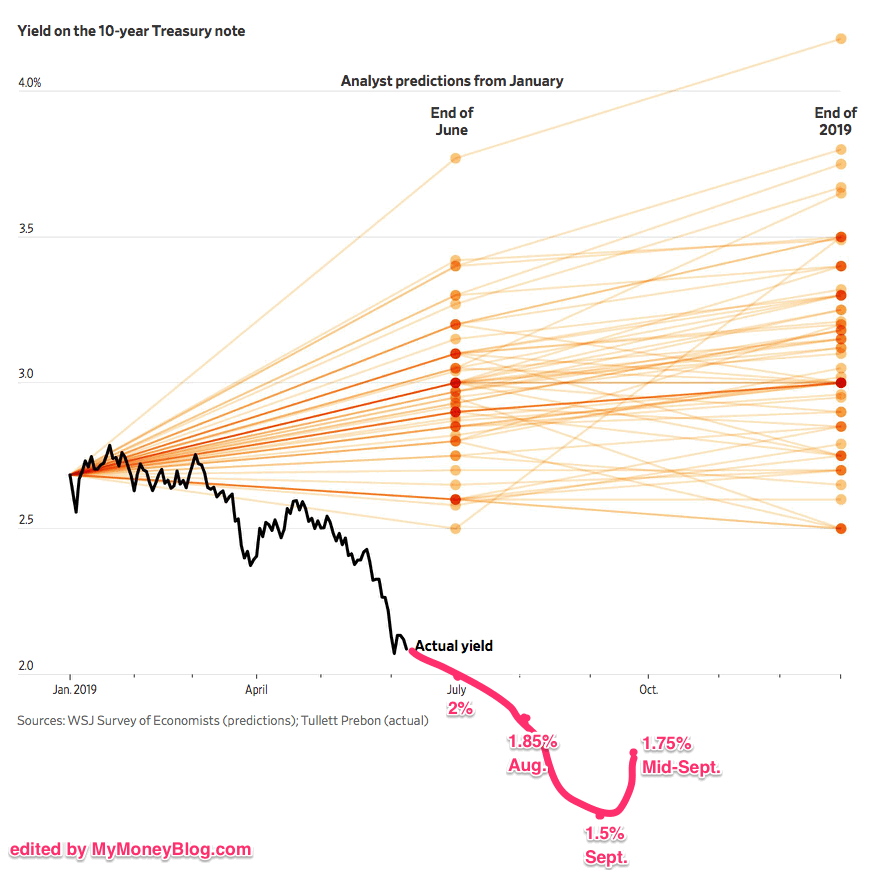
Allow me to remind you of what the Wall Street Journal’s panel of economists predicted in January 2019 as to what interest rates would look like the rest of the year (WSJ source). I have updated the chart with the current rates (click to enlarge). This was less than 10 months ago!

Apologies for the sloppy graphics, but you can see that 10-year rates dropped down to 2% in July, down even further to 1.5% at the beginning of September, with a slight bounce up to around 1.75% today. Not a single prediction was even close to reality.

When I was stocking up on 4% APY 5-year CDs last year, I was reading comments like “Why lock in such a low rate? You’re going to see much higher rates soon!”. Now, all of the comments are “You better lock in that 3% CD before rates drop further!”

Predicting interest rates even only as far as the next 12 months, is incredibly hard. You can’t do it reliably. Nobody can do it reliably. You might get it right, but that is called luck and not skill.

Individual investors don’t have an advantage in predicting future rates, but they do have their own set of special advantages. As an individual investor, you can purchase certificates from any FDIC-insured bank or NCUA-insured credit union if the interest rate is better than the comparable US Treasury. Over the last couple of years, I was able to buy multiple 5-year CDs at 4% APY when the 5-year Treasury was well below 3%. You have to act decisively, but any individual can do it. Pension funds and other institutional investors can’t.

I have a ladder of 5-year CDs. Each year, I buy a 5-year CD when a compelling interest rate arises. I don’t care about the rate direction, as long as I get about 1% above US Treasuries. After 5 years of doing this, you will have a ladder of CDs such that each year one CD is maturing and you can simply reinvest the funds each year. If I managed to put one year of expenses into each rung of this ladder, I now have 5 years of expenses in the bank, fully-insured and ready to go in case of financial emergency. An extra 1% on each $100,000 is $1,000 a year. That’s real money.

If this sounds like too much trouble to open accounts at multiple banks, you can always still with a Total US Bond fund (like AGG or BND). You’re essentially buying an ladder of bonds. BND has an average effective maturity of 8 years and average duration of 6 years. You might also buy it automatically inside a Vanguard Target Retirement Fund. Just keep buying it and ignore any talk about “The Fed”. Keep the chart above in your mind.

Landed: Shared Equity Down Payment Program For Educators

Home ownership continues to be a goal for many people, but downpayment requirements also keep rising with housing prices. I previously posted about Unison, which offers downpayment assistance in exchange for a percentage of any future upside (or downside) on your home. Their example states a 40% cut, although it will vary with the size of assistance. Unison also charges an origination fee of 2.5% of the downpayment assistance.

Landed offers a similar shared equity down payment program, but restricted to employees of selected school districts, colleges, and universities in high-cost areas. They also offer up to a 10% downpayment assistance (i.e. $50,000 on a $500,000 home), but they only ask for 25% of future upside (or downside). Instead of charging an origination fee, they ask you to use a real estate agent in their network, who have all agreed to pay Landed part of their commission (0.75% of purchase price). You can use your own agent, but you’d still have to pay that 0.75% fee. That’s a clever trick to avoid any upfront fees.

Here’s another important twist: You must agree to stay with your current employer for at least two years after buying your home. I believe that if you don’t, you will need to pay Landed back within 30 days (even if you don’t sell the home). You may also need a certain amount of time employed with the school. The idea is to improve employee retention in these high-cost areas.

Currently, Landed covers K-12 school districts, colleges, and universities in California (San Francisco Bay Area, Los Angeles Metro Area, and San Diego Metro Area), Colorado (Denver and Boulder metro areas), the state of Hawai?i, and Washington (King County Metro Area). Right now, you can get up to $120,000 in down payment support. They plan on expanding to other high-cost areas including the East Coast.

Unison vs. Landed fee comparison. Let’s say you have a $500,000 house. The Unison numbers are based on the stated example on their website. Unison might provide $50,000 assistance (“co-investment”) and you put in $50,000, and that is the 20% downpayment needed. If the house appreciates by $100,000 and is sold for $600,000, then Unison would get $40,000 of that appreciation (plus their original $50,000 back) and the homeowner would get $60,000. If over time the house doubles in value to $1,000,000, then Unison would keep $200,000 and (plus their original $50,000 back) and the homeowner would keep $300,000 of the gain. The upfront fee would be $1,250 (2.5% of $50,000).

Since Landed only asks for 25% of the upside, the numbers would be $25,000 on a $100,000 gain ($15,000 less than Unison), and $125,000 on a $500,000 gain ($75,000 less than Unison). There is no upfront fee if you use their real estate agent, but Landed will get $3,750 (0.75% of $500,000).

Here’s a separate breakdown example from Landed for a $600,000 home purchase, assuming you sell after 10 years of mortgage payments and either have a $100,000 gain or loss.

I know that some people will scoff at say “who would accept such a bad deal and give up all that home appreciation?”, but for many people the idea of scraping up $50,000 is many times more imaginable than coming up with $100,000. I’m not saying it’s a good idea, but I definitely understand the demand and think these programs will be popular as a result.

It is interesting that both “shared equity” companies have the same basic concept, it’s just the specific implementation that is different. Landed focuses on a group that tends to have stable employment and potentially solid retirement benefits but low base salary. It’s also a group that people want to see living in the neighborhoods that they work in, like firefighters and nurses, and thus can get cheaper funding from non-profit sources. However, this would also mean that if the concept gains traction, there is room for competition to lower the costs for everyone else.

NetNewsWire 5.0: Free RSS Reader for Mac

If you like things old-school and still follow blogs and news sites using RSS feeds, you may be interested to know that the NetNewsWire RSS reader name has gone back to its original creator and there is a new version now available as a free, open source download for Mac OS X 10.14.4 or newer. Since the demise of Google Reader, I know that many people have switched to Feedly, but I have been a paying user of NetNewsWire for a long time.

By the way, here is the raw My Money Blog RSS feed URL.

Causes of Wealth: Reality vs. News Coverage

Our World in Data has a very in-depth page on Causes of Death from around the world. Then they asked: Does the news reflect what we die from? What if they compared what we read in the news and the raw data? Here is a chart that compares actual death stats against Google search data and the mentions of causes of death in both the New York Times and The Guardian newspapers (click to enlarge):

Two-thirds of us will die from either heart disease, cancer, diabetes, or kidney disease. Meanwhile, over 70% of the causes of death you’ll read about in the news are either murder, suicide, or terrorism.

What about the disconnect between reality and what we read in the news about becoming wealthy? Here’s my quick take using a Google Spreadsheet (obviously not exact or based on actual data):

Most people probably realize that the news does not exactly reflect the real world. However, we can still unconsciously develop a “bias for single events”, even with financial topics. There’s also “social media bias” where what you see is only the highly-edited positive clips of their life. You see their #bestlife, but what you don’t see are their credit card debt, the downpayment from the Bank of Mom and Dad, or anxiety attacks about money.