Archives for May 2019

Couples and Money: The Proportional Sharing Method

If there’s one topic that’s probably more sensitive than people talking about their money, it’s how they split their money with their partners. I am swayed by the method proposed by this post – Why Couples Should Split Expenses By How Much They Make by Tracy Moore.

Let’s say Partner #1 makes $7,000 per month and Partner #2 makes $3,000 per month. That means Partner #1 makes 70% of the total income and Partner #2 makes 30% of the total income. The proportional sharing method would have Partner #1 pay for 70% of the total expenses and Partner #2 makes 30% of the total expenses.

Result: If the household expenses are $5,000 per month, Partner #1 pay $3,500 per month (70%) and Partner #2 makes $1,500 per month (30%). Why not any of the alternatives?

You can act all day long like you don’t mind supporting someone, but you do. You can act all day long like you don’t mind being completely subsidized by someone else, but you do. You can act all day long like you don’t mind going halvesies even though she makes $50k more than you do, but you do. And so on. You can pretend to throw everything together in a blind pot and pay everything out of it, but if the one who makes less spends more, and believe me, they always do, you’ll care.

I should disclose that my wife and I don’t do this, and we’ve always just put everything into a single pot and spent from there. However, I don’t think what works for us will work for everyone. First, we married relatively young with minimal individual net worth. (I did work really hard to pay off my student debt so I could at least start us out on a positive number.) Second, we both agreed to the communal pot idea from the beginning. I’ve always figured that if somehow we divorced, we’d just split whatever assets we had down the middle anyway even if I earned more. Third, although our incomes both varied, we never went through a prolonged period where one person was unemployed and resentment could possibly build up. We have both worked consistently the entire time, even after transitioning to working less than full-time and watch the kids the rest of the time.

In the end, I do know that both sides have to agree that the setup is fair. Our choice to both work and both take care of the kids was definitely a conscious decision to pursue our idea of “fairness”, although I know that setup isn’t possible for everyone. That’s why, for a couple that is starting out with a history of being on their own financially, it seems like this idea of proportional sharing is a good starting point for an open discussion.

Do you think there is a better “default” method for merging finances if you’re a couple with different incomes?

Keep Your Hilton Honors Points From Expiring with a $1 Amazon Purchase

hiltonhonors0Updated with alternative method. My relative lack of travel these days means that I am constantly keeping miles and points from expiring. Here’s the official policy of Hilton Honors point expiration:

Hilton Honors Points do not expire as long as Members remain active in the program. To keep an account active, Members can stay at one of Hilton’s hotels, or earn or redeem Hilton Honors Points within 12 months. [For Hilton Honors credit card holders, Hilton Honors Points will not expire as long as the Member is a cardholder in good standing.]

You need to earn or spend Hilton points every 12 months, which is on the short side. My usual strategy is to use Hilton Honors Dining to earn a few points at my neighborhood burger joint, but I was running short on time. I found that you can redeem Hilton points at Amazon through their Shop with Points program. The redemption ratio is 500 Hilton Honors points = $1 on Amazon.

First, link your Hilton Honors account to Amazon.

az_hilton

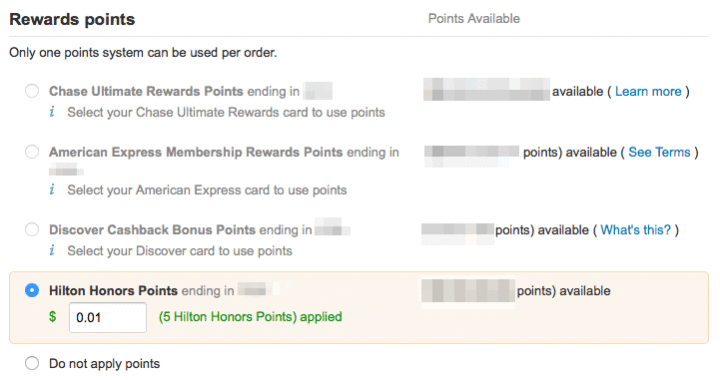
Next simply use as little as 5 Hilton Honors points to offset $0.01 of any purchase. If you were planing on buying something for $25, just pay for $0.01 with Hilton points, and $24.99 on your credit card. You used to be able to simply buy a $1 Amazon gift code for 500 points and call it a day, but that is no longer an option. If you have Amazon Prime and no other needs, you can still buy one of the following items that cost only $1 or less:

Checkout and choose to pay with Hilton Points, where you can specify to only use as little as 5 points ($0.01). You would want to make sure that it is in stock, so they charge you immediately.

Check for the activity to show up in your Hilton.com account the same day as it is shipped:

az_hilton2

Bottom line. If you have Hilton points expiring soon, you can redeem as little as 5 Hilton points for $0.01 off any Amazon purchase and create qualifying activity that posts the same day. If you have Amazon Prime, I share some $1 ideas. Hilton points are more valuable when redeemed for a free hotel night, but in this case it can be worth sacrificing a few to keep the rest alive and active.

Nomadland Book: What Really Happens When You Don’t Save Enough For Retirement?

I’m reading Nomadland: Surviving America in the Twenty-First Century by Jessica Bruder. Essentially, it’s the story what happens to a group of people when their plans for retirement fall apart. Here’s the book blurb:

From the beet fields of North Dakota to the campgrounds of California to Amazon’s CamperForce program in Texas, employers have discovered a new, low-cost labor pool, made up largely of transient older adults. These invisible casualties of the Great Recession have taken to the road by the tens of thousands in RVs and modified vans, forming a growing community of nomads.

You’ll probably retire earlier than you expect. Consider this EBRI chart showing the big difference between when workers expect they will retire (dark blue) and when people actually retired (light blue). One-third (34%) of all workers ended up “retired” by the time they reached 60, but the majority didn’t see it coming (which I assume means it was mostly involuntary).

Going through the book, here is a rough breakdown of the stages that the people went through:

Plan A: Ideal retirement. You have plenty of savings and income in retirement. I’m all set with a rock-solid pension, Social Security, and a big pile of investments.

Plan B: Make everything more modest. I don’t have as much as I’d hoped. Maybe I don’t need that beach condo? Maybe I’ll move into a smaller primary house. It’ll be easier to clean. I’ll just have to take less vacations. No problem.

Plan C: Work longer. Hmm, not still enough. That’s okay, I’ll just keep my job a little longer. I have lots of valuable work experience. I’m still healthy.

Plan D: Find any job. I’ve been laid off, and now I’ll have to find something that is full-time and offers benefits. The easiest targets are retail: Walmart, Home Depot, McDonald’s.

Plan E: REALLY cut expenses. My house is going into foreclosure. I have to sell all my other assets, including whatever life insurance policies, 401k plans, jewelry, and anything else of value that I have accumulated.

Plan F: Ask for assistance from extended family or friends. I can’t find any steady work that pays the bills (or may no longer be healthy enough to do so). I need to find cheaper living arrangements, immediately. I might crash with my children or other family/friend.

This corresponds well with this EBRI survey that I found afterward:

What happens if none of this works? That’s the common thread through many of the people profiled in this book. Not only did Plan A fail, but their backup plans also failed. Many had a late divorce. Many lost their high-paying jobs in their 50s, when they were planning to work until 70. Others had medical issues that racked up huge bills. They worked retail for a while, but it never added up to a decent full-time income. There just aren’t as many jobs for someone in their 60s and 70s. They lived with their children for while, but their kids are struggling as well.

One solution that some came up with in this book with is to change “homeless” to simply “houseless”. You buy a big van or small RV for well under $10,000 and you live in it. As long as you can find a place to park it, you’ve just cut your housing cost down drastically. People figure out to live on $500 a month. You can also now travel for temporary work – Amazon warehouse picker, campground manager, agricultural farm worker. As more and more people do this, they have formed communities and annual gatherings to support each other.

The book has me switching between two feelings: empathy for what brought them to this place, and curiosity about the mechanics of their day-to-day life as modern-day nomads. For now, one big takeaway is that people can and do fall through the cracks. The folks in this book are still taking action and working to survive and hopefully once again thrive.

Firstrade Free Trades on Stocks, ETFs, Options, Even Mutual Funds

Firstrade.com has announced free online trades on stocks, exchange-traded funds (ETFs), options and mutual funds. All of them. As a more traditional online broker, Firstrade includes access to all stocks, ETFs, options and mutual funds currently available in the U.S. There are no limits on the number of trades allowed, no minimum holding periods, and no minimum account requirements.

Pricing comparison. Here’s their updated pricing chart, including a side-by-side comparison with TD Ameritrade, Fidelity, E*Trade, and Schwab. Note that each competitor does offer their own selected list of commission-free ETFs.

Customer service. Since they are offering free trades, you might be worried that it would be hard to get assistance. They actually offer a lot of help options including live chat and free call-back phone service:

Are they legit? Yes, Firstrade Securities has been around since 1985, and I actually have an idle account with them from an old promotion. They have been a competitive discount online broker for a while, with their only physical branch in Flushing, New York. They are unique in that they offer special service to Chinese-speaking customers by providing a Chinese language version of their site (Simplified and Traditional) and also Chinese-speaking customer service reps (Mandarin and Cantonese). But other than a few Chinese character links on their site, you wouldn’t otherwise notice.

iOS and Android apps. Both iPhone and Android apps are available. Touch ID/Face ID supported on iOS. In May 2019, they released a redesigned 3.0 version of their iOS app, which now looks more like the other app-first brokerages. Screenshot:

Up to $200 rebate of transfer fees if you switch. They will rebate up to $200 in transfer fees if you move your assets over to them from another broker. Here’s the fine print:

Firstrade will rebate the account transfer fee (ACATS only) up to $200 charged by another brokerage firm when completing a Full Account Transfer for $2500 or more (excluding mutual funds & fixed income products). The rebate will be based solely on the actual transfer fee charged by the firm you are transferring from. To receive transfer rebate, please submit (upload, fax or email) a copy of your most recent statement from your previous broker with evidence of transfer charge. Submissions must be received within 60 days of transfer date. Credit will be deposited to your account within 30 days of receipt of evidence of charge. This offer applies to Firstrade regular investment accounts and IRAs (Traditional IRA, Roth IRA, and Rollover IRA), excluding Partnership, Corporate, Investment Club, ESA Education Planning Account, and Custodial Accounts. The account must remain open for 12 months with the minimum funding or assets required for participating in the offer — if your account assets fall below $2,500 due to withdrawals or outgoing transfers, Firstrade may reverse the transfer rebate at the time of withdrawal. Offer valid from 09/19/2017 to 08/31/2018.

Firstrade is kind of stuck in the middle between the huge mega-brokers and slick startups, so this is a big move for them to get some attention. The big financial names – Fidelity, Schwab, Vanguard all have some commission-free ETFs but not all stock trades. Robinhood and WeBull are new start-ups that have free stock/ETF trades, but not free mutual fund trades.

Bottom line. Firstrade is a discount broker with real human customer service that is moving to the new world of app-centric trading, offering free online trades on all stocks, exchange-traded funds (ETFs), options and mutual funds. No minimum account requirements.

Dividend ETF Comparison: Total Market vs. High Dividend vs. Steady Dividend Growth

After my post on mailbox money last week, I did some poking around comparing different dividend-focused ETFs. Specifically, the idea of focusing on companies with a steadily growing dividend, not a high dividend yield. Here are three different ways that you could buy an ETF and live off the dividends:

  • Vanguard Total Market ETF (VTI). The CRSP US Total Market Index includes ALL of the US companies in proportion to their size (market cap). SEC yield was 1.83% as of 4/30/19.
  • Vanguard High Dividend Yield ETF (VYM). The FTSE High Dividend Yield Index screens for companies with high dividend yields. SEC yield was 3.25% as of 4/30/19.
  • Vanguard Dividend Appreciation ETF (VIG). The NASDAQ US Dividend Achievers Select Index screens for companies with at least ten consecutive years of increasing annual regular dividend payments. SEC yield was 1.86% as of 4/30/19.

We see that buying the high-dividend ETF would definitely get you bigger quarterly dividends upfront. But what about total return (share price appreciation + reinvested dividends)? We don’t know the future, but let’s see how things worked out through the Great Recession. Both of the dividend ETFs started in 2006, so here is what would have happened to $10,000 invested in each of the ETFs as of January 1st, 2007. I used Morningstar charts for this.

Here are two main takeaways:

  • At the depths of the crash in early 2008, the high-dividend ETF (VYM) suffered the worst drawdown, while the steady dividend ETF (VIG) had the mildest drawdown. Your $10,000 would have gone down to $5,175 with VYM, $5,564 with VTI/VTSAX, and $6,400 with VIG.
  • The total return numbers are relatively similar over the long run. Right now, the steady dividend ETF (VIG) is even leading slightly. As of 5/18/2019, your final values for the $10,000 invested in 1/1/2007 are $24,267 with VYM, $26,610 with VTI/VTSAX, and $26,831 with VIG.

What about consistency of dividends? One of the difficult things about retirement investing is that while the price of things can vary, most people like the idea of a steady income. We can look back and see if the steady dividend ETF really delivered even through the 2008 Great Recession. Here’s are the quarterly dividends from 2007 to 2018 for both the Vanguard High Dividend Yield ETF (VYM) and Vanguard Dividend Appreciation ETF (VIG):

The Vanguard Dividend Appreciation ETF (VIG) did provide a much more steady “paycheck” through 2008 and 2009 than the Vanguard High Dividend Yield ETF (VYM). If you relied on this money to pay your monthly bills, a steady dividend that didn’t drop with the overall stock market would be greatly appreciated.

Bottom line. Simply buying stocks with high dividends is not the solution to all your problems, as that high dividend may drop significantly during a bear market. In this historical comparison, the steady dividend method worked out pretty well. Since 2007, you got a lower drawdown during the bear market, solid long-term returns, AND a steady dividend check throughout. The future may not turn out the same way, but it’s definitely something to research further. One might even accept a little bit less total return for a more reliable stream of income.

Disclosures: I own VTI, aka the entire haystack. I don’t own VIG or VYM.

Capital One Savor Cash Rewards Credit Card Review – $200 Bonus + 3% Cash Back at Restaurants and Grocery Stores (no Walmart/Target)

card_name

Capital One has refreshed their card_name with a sign-up bonus, no annual fee, and unlimited 3% cash back at both restaurants and grocery stores (no Walmart/Target Superstores). Here are the highlights:

  • One-time $200 cash bonus once you spend $500 on purchases within the first 3 months from account opening
  • 3% cash back at grocery stores (excluding superstores like Walmart® and Target®). No spending cap.
  • 3% cash back on dining, entertainment and popular streaming services.
  • 1% cash back on all other purchases.
  • 8% cash back on Capital One Entertainment purchases.
  • 5% cash back on hotels and rental cars booked through Capital One Travel, where you’ll get Capital One’s best prices on thousands of trip options. Terms apply.
  • No rotating categories or sign-ups needed to earn cash rewards; plus cash back won’t expire for the life of the account and there’s no limit to how much you can earn.
  • 0% intro APR on purchases and balance transfers for 15 months; reg_apr,reg_apr_type after that; balance transfer fee applies.
  • No foreign transaction fees.
  • No annual fee.

The application page provides some direct clarifications on the rewards structure.

What counts as dining?
Purchases at restaurants, cafes, bars, lounges, fast-food chains and bakeries.

What counts as entertainment?
Buying tickets to a movie, play, concert, sporting event, tourist attraction, theme park, aquarium, zoo, dance club, pool hall or bowling alley. Also, making purchases at record store and video rental locations. This excludes non-industry entertainment merchant codes like cable, digital streaming, and subscription services.

What counts as a grocery store?
A supermarket, meat locker, freezer, dairy product store and specialty market. Excludes superstores like Walmart® and Target®.

The rewards on this card are nice and simple. You earn cash, which can be redeemed as a statement credit or a mailed check. There are other options, but none are especially interesting or more valuable than cash.

Bottom line. The card_name has a $200 sign-up bonus, no annual fee, and unlimited 3% cash back at both restaurants and grocery stores (no Walmart/Target Superstores).

Also see: Top 10 Best Credit Card Bonus Offers.

Mailbox Money in Retirement: Social Security, Pensions/Annuities, Bond Interest, and Stock Dividends

I am always curious about the nitty-gritty details of how real-world financial planners guide their clients. Krueger & Catalano has shared some unique insights on their website, including the topic of creating retirement income in How Much is Enough?:

Financial Freedom occurs when multiple streams of income exceed all expenses (needs and wants), and can last until the age of 100.

They call this “mailbox money” – stable sources of income that show up reliably and automatically at predictable intervals. Here are four different streams of income that they include:

Social Security: Optimize to best navigate hundreds of claiming rules
Pension: Either corporate pension or a personal pension
Municipal & Treasury Bonds: Safest most liquid form of mailbox money
Dividends: Inflation beating mailbox money

You’ll note that there is no mention of “safe withdrawal rates”, where you keep taking out some percentage because it has worked out historically 95% or 99% of the time (but you still check your statements nervously if the value goes down).

Let’s take a closer look at these four sources of retirement income.

Social Security. Social Security benefits are paid monthly, and it increases with inflation each year for the rest of your life (backed by the US government, so safer than an insurance company). In addition, you can delay claiming up to age 70, which increases your monthly payment (and thus all future payments). This means you can effectively “buy” a bigger inflation-adjusted annuity by spending down your personal savings for the years that you are delaying Social Security. Smart people have done the math and shown it’s a good deal relative to private annuities.

(It can be even more complex than this, especially for couples with different incomes and ages. There are paid services devoted to optimizing your Social Security benefit.)

Pension and/or annuities. Whether through a corporation, government, municipality, or private insurer, these are all sources of monthly income that will last for life. Some adjust with inflation, some don’t. Some have full joint survivorship benefits, some are limited. There is still some risk if you have a flat payout, as the purchasing power will decrease over time as inflation eats away at it.

You can create your own pension using immediate annuities from a private insurance company. For a male/female couple that are both 65, a recent sample quote showed a 5.74% payout rate. That means a $1 million lump-sum payment would pay out $57,400 per year for as long as one of you are alive. However, this also means that your heirs get nothing from that lump sum.

Municipal and Treasury bonds. They stick with the safest bonds, which means US Treasury bonds and AAA-rated municipal bonds. They don’t like any mutual funds or ETFs, so they buy individual issues.

I am partial to the idea of sticking with the safest bonds available. I don’t want to take risk with bonds either. However, I prefer the diversification and convenience benefits of low-cost Vanguard Treasury bonds and/or muni bond funds over individual holdings, especially if you are a DIY investor and don’t want to manage that additional complexity (or keep paying an advisor to manage that complexity).

The average 10-year Treasury yield is now under 2.5%. That’s roughly $25,000 per year on $1 million invested. Individual Treasury bonds pay out interest semi-annually, although mutual funds can pay out more often. If you choose to spend all the interest as “mailbox money”, then your monthly purchasing power will also probably decrease slowly over time due to inflation.

Dividends. They like to take the dividends from individual stock holdings picked from high-quality companies. They use the Dividend Aristocrats list as an example, which are companies that have grown dividends for at least 25 consecutive years. (I prefer to bank the dividends from low-cost Vanguard funds.)

I believe that dividend investing has a behavioral advantage if an investor can focus on the income showing up and then allow themselves to ignore swings in the share price. The only way to realize the higher total returns of stocks is to hold on during the downturns. (I would concede that the future total return of Dividend Aristocrats might be lower than the S&P 500. The question is whether the greater peace of mind is worth any difference?)

If you take the ProShares S&P 500 Dividend Aristocrats ETF (NOBL) and add back in the 0.35% expense ratio (because you self-manage), the dividend yield is currently 2.5%. That’s roughly $25,000 per year on $1 million invested. The good news is that this form of mailbox money should increase faster than inflation over time.

I think it is helpful to visualize all of these different options when planning out your own retirement income plan. How much of your personal savings do you put towards delaying and thus increasing your Social Security benefit? Creating a bigger steady annuity paycheck but with no estate leftover? Creating a smaller paycheck with bonds but with high safety and full liquidity? Creating a smaller paycheck with dividends but with higher future growth? I also like the idea that each of these streams are designed to minimize the stress from reading news headlines. Definitely food for thought.

Berkshire Hathaway Post-Shareholder Meeting CNBC Interview 2019 Full Video, Full Transcript (Buffett, Munger, and Gates)

On the Monday after the recent Berkshire Hathaway shareholder meeting, Becky Quick of CNBC did another 2-hour interview with Warren Buffett, Charlie Munger, and Bill Gates. CNBC has thankfully posted the entire interview online along with a full transcript.

As usual, I like things directly from the source, so I watched the entire thing. Here are my notes that deal with investing:

Warren Buffet-style value investing distilled. You start out by picking a good business first. Then, you pay attention to the price. If the price is good, you buy. If the price is not attractive, you don’t. You can’t predict the mood of Mr. Market, he may be depressed or manic. (If it’s not a good business, then skip it no matter the price.)

But we watch the prices of things we do more than current events. Because in the end– we aren’t buyin’ ‘em because what’s gonna happen next month or next quarter. You know,we’re really buying ’em because we think they’ll be good businesses ten years from now. If somebody came to us with a good business today, we’d buy it. And we’d buy it regardless of what’s going on in the tariff situation. We might this wouldn’t be the case. But you might– we’re more likely perhaps to get something when other people are– fearful. You see that in a big way instantly in the market, you know, in the market for businesses. It’s– but it’s–still there in people’s minds.

On share buybacks and Apple. Share repurchases, or buybacks, are when a company buys its own shares outstanding. People argue about how this is “good” or “bad”, when really it’s all just rather pointless.

Repurchases can be the dumbest thing in the world or the smartest thing in the world. and I’ve seen both but they’re just — repurchases by the company are just like purchases to us, they’re dumb a one price and smart at another price. And I like it when companies — I like it when we’re invested in companies where they understand that. Many companies just repurchase and repurchase, you know, it’s the thing to do, and they’re encouraged to by some shareholders and by their brokers. Repurchases can be dumb. They can be smart. At Apple, they’ve been smart.

Berkshire has never bought at stock at IPO. Here’s a simple thought model that shows why buying a new-issue stock on IPO is nothing to get excited about.

WARREN BUFFETT: Well, because I looked at it, I really don’t want to discuss Uber. And I don’t have any special feelings about it than any other coming to market. But I would say that in 54 years — well, I don’t think Berkshire’s ever going to – I mean, the idea of saying the best place in the world I can put my money is something where all of the selling incentives are there, commissions are higher, you know, the animal spirits are rising. I mean, that’s going to be better than 1,000 other things I can buy where there is no similar selling enthusiasm and the desire to get the deal done on extra commissions. That’s the single best thing to buy on a given day. I mean, it’s –

CHARLIE MUNGER: And I can’t think of a time we’ve ever done it.

WARREN BUFFETT: Yeah.

BECKY QUICK: Ever bought an IPO.

CHARLIE MUNGER: Yeah. Never will.

When asked about a book recommendation, Buffett said The Moment of Lift: How Empowering Women Changes the World by Melinda Gates. There are some other practical observations about topics like politics and healthcare, if that floats your boat.

Callan Periodic Table of Investment Returns 2019

dilbert_divers

One of the harder things about investing is buying an investment that has been performing poorly. How many people are getting media attention for pushing the idea of diversification in international stocks right now? None. I mean, some folks are talking about it, but nobody is getting any media attention. It’s not “trending” because nobody’s interested. US stocks have been smoking European and Japanese stocks for a while.

Even if something is a good long-term investment, the short-term ride can be very bumpy. Callan Associates updates a “periodic table” annually with the relative performance of 8 major asset classes over the last 20 years. You can find the most recent one at their website Callan.com. The best performing asset class is listed at the top, and it sorts downward until you have the worst performing asset. Here is the most recent snapshot of 1999-2018:

The Callan Periodic Table of Investment Returns conveys the strong case for diversification across asset classes (stocks vs. bonds), investment styles (growth vs. value), capitalizations (large vs. small), and equity markets (U.S. vs. non-U.S.). The Table highlights the uncertainty inherent in all capital markets. Rankings change every year. Also noteworthy is the difference between absolute and relative performance, as returns for the top-performing asset class span a wide range over the past 20 years.

I find it easiest to focus on a specific Asset Class (Color) and then visually noting how its relative performance bounces around. In last year’s update, I noted that Emerging Markets (Orange) and MSCI World ex-US (Light Grey) had bounced back to the top. Of course, by the time 2018 ended, they were right back to the bottom again.

(Dilbert comic source)

Charlie Munger: Financially Independent at Age 38 in 1962

Despite the fresh packaging, we should remember that the “FIRE” concept (Financially Independent, Retire Early) is anything but a new concept. Even I can’t help being a little intrigued by the clickbait title “This Secret Trick Let This Couple Retire at 38”. Such an article could have been written about the 95-year-old Charlie Munger before he started investing alongside Warren Buffett:
The first 13 years I practiced law, my income [from practicing law] was $300,000 total. At the end of that 13 years, what did I have? A house. Two cars. And $300,000 of liquid assets. Everyone else’d have spent that slender income, not invested it shrewdly, and so forth.

I just think it was, to me, it was as natural as breathing, and of course I knew how compound interest worked! I knew when I saved $10 I was really saving $100 or $1,000 [because of the future growth of the $10], and it just took a little wait. And when I quit law practice it was because I wanted to work for myself instead of my clients, because I knew I could do better than they did.

Net worth analysis. According to his Wikipedia bio, the 95-year-old Munger graduated from law school in 1948. Let’s say he practiced law from 1949 to 1962. At the end of those 13 years, he states that he had $300,000 in liquid assets, a house, and two cars. The median value for a Los Angeles area house in 1962 was about $15,000. The median cost of a new car in 1962 was about $3,000. Adding this all up means his net worth in 1962 was about $321,000.

That was a significant amount of money in 1962. According this CPI inflation calculator, that is the equivalent of $2.7 million in 2019 dollars. In other words, the Munger household was financially independent when he was 38 years old.

Income analysis. He also states that in those 13 years as a lawyer, he made $300,000 total. For the sake of simplicity, let’s just say he earned the same income every year. That works out to $23,000 per year. This was a relatively high income – $193,000 per year in 2019 dollars. According to this source, the median family income in 1962 was $6,000 per year. That means he was earning about four times the median average household income.

Super-saver, super-investor, or a little of both? Maybe he shared this somewhere else, but I don’t know his saving rate or his investment return. He does boast of both not spending all that “slender” income and also about investing it “shrewdly”. We have his annual income and his final ending net worth, so you can set one and figure out the other using a compound return formula. I’m assuming everything is after-tax for simplicity again.

  • Let’s say he was a super-saver with a 50% saving rate. That means he saved $11,500 every year and invested it for 13 years. That would work out to an 10.5% annual compounded rate of return.
  • Let’s say he was a super-investor with a 20% annual compounded rate of return. That would work out to an annual savings of $5,500 per year, or a 24% savings rate.

I found that the annualized return of the S&P 500 index from January 1949 to January 1962 was about 18% when you include dividends (source). Thus, my guess is that he was somewhere between these two markers: 50% savings rate/10.5% annual investment return and 24% savings rate/20% annual investment return. These stats are definitely admirable and impressive, but also show that he didn’t hit the lottery or anything crazy.

Munger’s example reaffirms that if you have a relatively high income, save a high percentage of that income, AND invest that money into productive assets, your net worth will grow quite quickly.

A criticism of financial independence seekers is that it is pitched to “everyone” but only works for the rich. It is absolutely true that it is the easiest for high-income earners. How could it be any other way? At the same time, there are many households that earn high incomes that spend 95%+ of it every year. If these folks realize they have financial independence within their grasp, and then change their behavior to achieve it, I still view that as a positive thing. It’s always hard to spend less than the people you hang around with.

In our case, we both eventually earned six-figures, but not the entire time. When we earned a combined $60,000 a year, we lived on $30,000. When we earned a combined $100,000, we lived on $50,000 per year. When we earned $200,000, we lived on under $100,000. Would we have been able to maintain the 50% savings rate on a $60,000 income for 15 years? I’ll never know. I know it would have been much more difficult, and I’m glad we didn’t have to try. I’m also glad we started when we were young and without kids.

Managing expenses (frugality) alone will not get you there, but I still believe it is an important factor once you get your income to a certain level. I would argue that a household earning $100,000 and spending $50,000 per year is much better off in the long run than a household earning $150,000 and spending $125,000 or even $100,000 per year. Now, if someone is making minimum wage, it will be hard to have a lot left over to invest. Your efforts would be best focused on the income side of the equation.

Bottom line. Charlie Munger was born in 1924 and reached financial independence at age 38 from his earnings as a lawyer (before he became partners with Warren Buffet). While he is now best known as a billionaire investor, he took a familiar path to financial independence: solid 9-5 income, consistently high saving rate, and prudent investment of the difference. The same formula he started using in 1949 remains available 70 years later to someone starting in 2019.

The Best Time To Plant A Tree Is Now

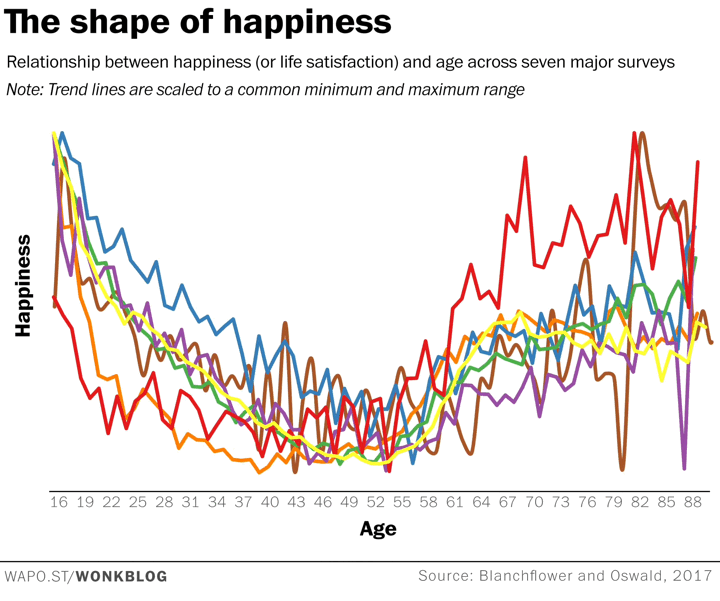
Have you heard of the “happiness curve”? According to multiple studies of life satisfaction, I am entering the unhappiest period of my life at age 40 (WaPo):

My theory is that this is simply the inverted curve of “number of humans that I am responsible for”. When you are in your 40s and early 50s, that is when you have both children and your aging parents to worry about. Younger than that, you have no kids and your parents are still healthy. Older than that and your kids are grown and you are back to being only responsible for yourself again.

In any case, I definitely feel that right now is the hardest time for me to stop and enjoy the moment. There’s always another fire to put out. Either a kid or a parent has a health issue. At the same time, I will never be younger than today.

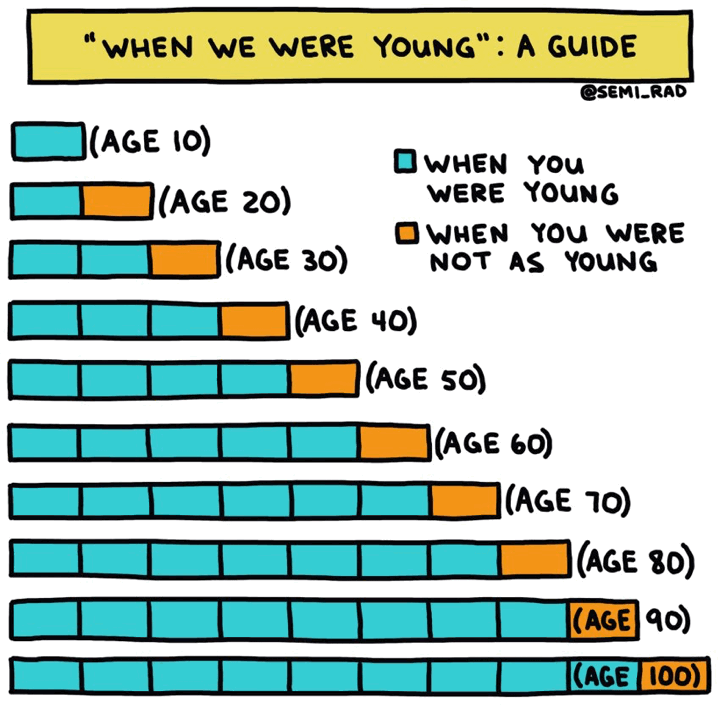
Brendan Leonard has a great graphic is his Outside article Remember When We Were Young?:

I am reminded of the old quote (Chinese proverb?):

“The best time to plant a tree was 20 years ago. The second best time is now.”

The best time to improve your financial situation is now. The best time to gather the courage to live a life true to yourself, not the life others expected of you, is now.

I think this extends to life as well. The best time to work at building an happy and fulfilling life is now. The best time to enjoy time with my young kids is now. The best time to enjoy time with my parents is now. One day, I will look back on this period and realize it was one of the best times of my life… I just need constant reminders!!!

Immediate Annuities vs. Safe Withdrawal Rates

Annuities have a rather mixed reputation, which I think is mostly deserved. Some are amazingly complex and expensive (the word “Indexed” can be bad in this world). Then there are simple, straightforward ones that are worth consideration, including single premium immediate annuities (SPIA). The most basic version lets you convert a lump-sum payment into a regular stream of income payments that is guaranteed and doesn’t ever vary, period.

Michael Edesess has an article Are Annuities the Best Strategy to Fund One’s Retirement?. The article is on a site meant for financial advisors, so it’s got a lot of jargon inside. However, I do like that it provided some hard numbers to consider.

Here are current market rates:

In other words, a 65-year-old male hands over $100,000 and will get $6,720 per year ($560 per month), every year, for the rest of his life. Putting up $1,000,000 will get you $67,200 per year ($5,600 per month). Whether he lives to 68 or 108, he will end up with zero dollars. A female would get a bit less due to a longer average lifespan, and a joint annuity even less than that as the likelihood of at least one person living a long time is higher.

The article then compared the annuity payout against the “safe withdrawal rate” as calculated by popular industry methods. The Bengen method has a fixed payout percentage every month, adjusted annually for inflation. The HWS strategy uses a variable payout with a floor rate and allows a higher payout if the portfolio has high returns. I’ll just share one of them.

As you can see, the immediate annuity offers a higher annual payout in almost all cases. This is good.

However, you are giving up certain things in exchange for this higher income. Once you die, there is nothing left for heirs or charity. Thus, part of your return is simply them giving your own money back to you (return of principal). You have lost permanent control of that money, with no liquidity if for any reason you had a big expense. Finally, unless you buy a special inflation-adjusted annuity with a much lower initial payout, your monthly payment will buy less and less as inflation eats away at it over time.

I would also read about your applicable state guaranty limits and always stay under them. It is rare for an insurance company to fail, but it has happened. Read about the Executive Life Insurance Company. The state guaranty association system is not as good as FDIC insurance, but being within the limits is much better than being above the limits!

Bottom line. I would research single-premium immediate annuities as a source of retirement income once your reach age 59.5. I would avoid any annuity that is linked or “indexed” to the stock market. Personally, I am thinking of annuitizing a fraction of my portfolio (less than 10%) once I reach a certain age, but only if it remains under state guaranty limits.