Archives for July 2011

Wow, I Actually Found Some Unclaimed Money

Over the years, I’ve read numerous articles about “missing money” that the government may be holding for me. I would always enter my name, but there was never any unclaimed property for me… until today!

I was reading an Businessweek article about how California and many other states were using the interest from all their unclaimed money from things like dormant savings accounts to bridge their budget gaps. Even Warren Buffett is owed $20 from an old escrow account.

I visited the California Unclaimed Property page and found that I was owed $75 from an unclaimed check from “DSL SERVICES LITIGATION ACCOUNT”, which I can only assume is the result of being part of some class action settlement. I’ll have to send in a copy of my driver’s license and Social Security card for identity verification.

You can find your state-specific unclaimed property page via Unclaimed.org. You should search in any state where you have lived. MissingMoney.com is a related site that will search several participating databases all at once, but not all of them (like California, for instance). Finally, also check out TreasuryHunt.gov to locate any Treasury bonds and savings bonds using your Social Security Number.

While looking around, I saw several other official-sounding websites offering to locate missing money for a fee. Not surprisingly, one of them always “found” $156.16 in my name, whether it was James Smith or Iam Notsosmarten. What a scam, so watch out.

Tinkering With Site Design

I changed up some of the design of the website last night, not really sure why, I had some free time and have been meaning to try some things out. I don’t have the motivation to do a complete redesign, but wanted to update things slightly to account for modern screen sizes and resolutions. I’ve made the content a bit wider (this also allows for larger embedded images), widened the sidebars a bit, made the text a bit bigger, and changed the spacing a little. Let me know if you have any suggestions.

Don’t Let 401(k) Auto-Enrollment Decide Your Contribution Rate For You

The Wall Street Journal has a rather surprising article 401(k) Law Suppresses Saving for Retirement regarding a recent law that allowed employers to automatically enroll their employees into their 401(k) retirement plans. The goal was to encourage saving and make contributing a certain percentage rate the default option for workers, after which they could change the contribution rate to whatever they wanted (even zero). Before now, the default option was usually little more than passing out a brochure.

Auto-enrollment seemed like it was working. More workers than before were using 401(k) plans. The problem was, the default percentage rate for most plans was about 3%. It turns out that for some people that 3% is actually less than the 5-10% than people might have chosen on their own if started from zero. As a result, the study showed that 40% of workers ended up actually saving less after auto-enrollment began. Talk about unintended consequences!


Source: WSJ (Click to enlarge)

Possible reasons include inertia (aka laziness), but I suspect that if a company sets it at a certain percentage, then there can be a subconscious belief that such a number is the “recommended” or “approved” contribution rate. In reality, that 3% appears to be chosen simply to be low enough as to avoid workers opting-out immediately. In other words, much lower than what would be required to fund a proper retirement.

The study noted was done by the Employee Benefit Research Institute, which actually wrote a rebuttal article that focused on the fact that auto-enrollment is increasing the savings rate for many people, especially those with lower incomes. The problem is not with auto-enrollment itself, but more with tinkering with the default contribution rate. Another potential tool is an “auto-escalation” feature that increases employee savings rates by a set amount each year, say 1%, to encourage more savings over time.

When it comes down to it, the study pretty much reaffirms the original conclusion that started auto-enrollment in the first place. Lots of people are too busy, forgetful, uneducated, or scared to make the proper financial decisions for themselves. Don’t rely on your employer to decide how much to save for retirement.

Everyone has a different situation, but if you don’t have a pension or other significant retirement assets, your overall savings rate is probably going to have to be more than 10% if you expect to replace most of your income upon retirement. The tax advantage of traditional and Roth 401ks is very significant over time. Finally, if you have an employer match available, don’t say no to free money!

How Not To Select A Good Mutual Fund

I was looking through the Barnes & Noble bargain bin and found a book called “How to do just about everything”. Okay, how to unplug a toilet… how to carve a turkey… hey, a personal finance section! Wow, quite awful. After coming home and looking up the book, I found out it was by eHow.com. I should have known. Check out this gem on How to Select a Good Mutual Fund (eHow link), which offers the following advice:

2. Determine how many mutual funds you will invest in. Three to five funds is generally considered an adequate amount of diversification.

Yes, let’s determine diversification by the actual number of funds. One… two… three… done! Never mind that I could easily have more diversification in one mutual fund than in 15 separate niche funds. This is like deciding the best book is the one with the most pages. At least later on it says to vary the size of companies in the funds. However, there is no mention of real diversification between stocks vs. bonds, domestic vs. international, passive vs. active management, etc. What else?

5. Choose high-performance funds by using Internet resources and newspapers to pick those funds that have had the best performance over at least the last three years.

Huh? I don’t know how the advice could get much worse than this. Picking whichever funds that had the best performance over the last three years will virtually guarantee that you will have below average returns going forward. Check out these articles on the persistence of mutual fund returns based on studies of actual mutual fund return data over decades. “The majority of well-done studies tend to support a lack of persistence for all but the worst performing equity mutual funds.”

Don’t chase performance! Again, we see no mention of better indicators like expense ratio, turnover ratio, tax-efficiency, manager ownership of shares, etc.

Content Mills Warning
So how does such a poor article get prominent placement in search engines, not to mention published in a book? eHow is a content mill that encourages people to churn out large numbers of articles with low quality standards, promising them a cut of all future ad revenue. Google has recently penalized them for their low-quality articles as well.

In addition, eHow has a history of treating their freelance writers poorly, and their most recent move was to cut off their share of ad revenue completely, offering them either a lowball buyout or nothing. I’m sure they have some good articles, but in general I would say you’re better off avoiding them, especially for money-related topics.

Certified Financial Planner (CFP) Education on the Cheap

Over the long weekend, a few conversations rekindled my curiosity about gaining a Certified Financial Planner (CFP) designation. Now, I really don’t want to be a financial planner. I’m quite happy with my current career right now. I primarily want the CFP knowledge to help me manage my own finances, but to be honest I might be willing to pay a little extra to put the initials after my name.

According to the CFP website, the three main steps are (1) the education requirement, (2) passing the exam, and (3) the 3-year experience requirement. The education requirement can be fulfilled by a $2,000 online course that takes 6-8 weeks, or can be skipped if you are a CFA, CPA, ChFC, or CLU already. The exam costs $595 to take. The 3-year experience requirement is the most difficult for me, as I won’t have time to rack up 6,000 hours of “experience in the financial planning process” unless writing this blog counts. Annual renewal fees are $325 a year.

What if I just want the education at the lowest cost? There are several online CFP Board-Registered programs each with their own curriculum, but they tend to share the same six overall course topics. Both Boston University and UCLA Extension make their textbook lists public. 6 courses times 6 textbooks times ~$110 a textbook = $660. But we all know that publishers like to simply do some light housekeeping and pop out a new edition every other year to force students to pay up. The older edition usually at least 95% the same, but at a fraction of the new price. I took the BU textbook list and went comparison shopping:

Introduction to Financial Planning
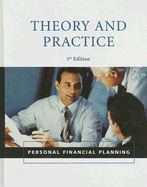
Personal Financial Planning Theory and Practice, Dalton
6th edition (2009) costs $125 new at Amazon
5th edition (2008) costs $30 used at Half.com

Risk Management and Insurance
Introduction to Risk Management and Insurance, Dorfman
9th edition (2007) costs $157 new at Amazon
8th edition (2004) costs $2.50 used at Half.com

Investments
Investments: An Introduction, Mayo
10th edition (2010) costs $183 new from AbeBooks
9th edition (2007) costs $7 used from Half.com

Tax Planning
Prentice Hall’s Federal Taxation 2012: Individuals, Pearson
2012 edition costs $155 new from Amazon
2011 edition is $55 used from Half.com

(I can see the benefit of having the most up-to-date tax book, but it’s not like I’m going to buy the latest version of this book every year. I’d just try to keep up with any changes.)

Retirement Planning and Employee Benefits
Retirement Planning and Employee Benefits for Financial Planners, Dalton
6th edition (2010) is $75 new from Amazon
5th edition (2008) is $18 used from Amazon Marketplace

Estate Planning
Fundamentals of Estate Planning, Fontaine
12th Edition (2010) is $67 used from AbeBooks. (Couldn’t find it new?)
11th Edition (2008) is $4.20 used from AbeBooks.

Adding up the used prices for these 6 books, the total comes to about $120 (plus shipping and taxes, used prices change regularly). This seems like a more economical way to achieve the knowledge for the DIY set. Chances are, you could even use them with an official course if you really wanted to.

I’d be willing to bet that I could read through these previous editions of textbooks and pass the CFP exam. It’s 10 hours long, but I read that it’s also all multiple-choice. I wish I could try. However, it appears that just to sit for the exam, I must pay for a $2,000 course that seems to primarily consist of some online videos. I can definitely see the benefit of videos for audio/visual learners though, as I’m sure the textbooks can be pretty dry stuff.

Weekend Reading: The American Dream, Dollar Coins, Fidelity Problems, and United/Continental Merger

Happy Birthday America! Here’s some of what I’ve been reading over the long weekend:

The Death of the American Dream I
A good long-ish editorial from the The American Interest magazine about the “American Dream”. The American Dream used to be owning your own family farm. “In 1900, 41 percent of Americans worked on farms. Today fewer than 2 percent do.” The updated Dream became lifetime employment (plus a pension of lifetime income) plus owning a home through a 30-year (half a lifetime) mortgage. There is no longer lifetime employment these days, and perhaps the government-subsidized 30-year mortgage is up next. Also see Part II.

$1 Billion That Nobody Wants
An NPR investigative article about how the US government keeps making billions of dollar coins, even though most people prefer paper bills. I suppose this answers why you can buy coins from the US mint with a credit card, enabling people to rack up credit card rewards, and also a good way to meet minimum spend requirements for the big bonus cards. I think the two options should be to either stop making paper bills, or stop spending so much money pushing dollar coins on us. Until then, since the coins exist already, we are essentially getting paid by the government to distribute them.

Fidelity’s Experience Proves Bigger Doesn’t Mean Better
Morningstar article outlines reasons why Fidelity is having some issues with their actively managed funds. One issue is manager turnover; Their average manager tenure is 3.2 years, ranked 24th out of the 25 largest firms. They also have too many funds and not enough talent for all those positions. For example, Fidelity has 17 large-growth funds geared toward retail investors alone. As they earn a big chunk of profits from retirement plans, they will be much less likely to allow unconventional managers who take risks for big returns. Also see my review of Fidelity’s Portfolio Advisory Service product.

United and Continental Merger Updates
If you haven’t heard, United and Continental are merging, and you can link your accounts and transfer miles between the two frequent flier programs at your convenience. Combine your two balances to make one award flight, for example. I’m a United Elite and I heart my Economy Plus seats. Thanks reader Michael for the tip.

The Continental OnePass Plus credit card is still offering 30,000 miles + $50, and will still work after the merger.

California vs. Amazon.com in Sales Tax Battle

California, along with many other states, is broke. As part of an attempt to create more revenue, California passed a more aggressive law to force online merchants to collect sales tax. A 1992 Supreme Court decision stated that retailers that don’t have a physical presence in a state don’t have to collect sales taxes for sales to that state. But some states have passed new laws that redefine “physical presence” to include online affiliates and any subsidiaries.

Amazon.com affiliates are the thousands of websites like this one, where if you click on a link to a book or other product and buy something within a certain time frame, I get a commission of a few percent of your purchase. It’s a safe bet that the majority of blogs you read participate, even if the actual revenue is relatively small. But, by California’s new definition, if just one person is both an affiliate and lives in California, then Amazon.com has to start collecting sales tax from everyone in the state. What’s Amazon’s solution? Easy, cut off all CA affiliates immediately. That’s what they’ve done everywhere else. From CNN:

Other states that have passed the so-called “Amazon tax” in recent years include Connecticut, Illinois, New York, North Carolina, Arkansas and Rhode Island. The retailer has dropped the associates program in all these states, except New York, where it has a brought a lawsuit against the state.

Many other merchants that operate online like Overstock.com have been doing the same thing. They’d much rather lose the incremental revenue from affiliates than have to effectively increase prices for all customers from an entire state. For many website owners, Amazon is their primary source of income, and this move will force many of them to pick up and move.

At the same time, not paying sales tax is one of the expected benefits of buying from Amazon. (Even though in many states you’re technically still supposed to calculate and send it in manually, people rarely do.) This understandably annoys the national brick-and-mortar merchants like Walmart or Target.

As both a consumer and an Amazon affiliate, I am a concerned onlooker. These are two behemoths playing a high-stakes game, but I feel empathy towards those small businesses that just lost a huge chunk of their revenue overnight through no fault of their own. They seem to be collateral damage in this battle.

More reading: NYT, IBT

Capital One 360 Financial Independence Day Promotions

Capital One 360 is running their usual “Financial” Independence Day promotion. Valid only July 1st & 2nd, 2011 (why not until the 4th? who knows).

  • New 360 checking account customers will receive an opening bonus of $50 when they make three purchases within 45 days of account opening. Those that then set up and make at least two direct deposits of $250 by August 31st will receive an additional $76 bonus for a total savings of $126.
  • Investors who open a new ShareBuilder account will receive a $76 account bonus after their first investment.