I’ve been seeing a lot of media coverage on the increase in foreclosures recently. It’s clear that there have been examples of predatory and misleading lending practices, as well as examples of people showing poor financial judgment, although most articles seem to focus on the former. But I couldn’t help finding this Wall Street Journal article ‘Subprime’ Aftermath: Losing the Family Home to be almost amusing. If it was trying to illustrate how sub-prime lenders were evil, it did a really bad job.
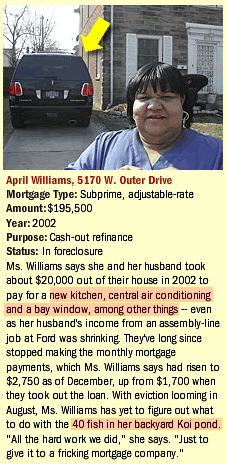 Take Ms. April Williams, who is the main character interviewed for this story and also featured in the box to the right.
“This has stripped us of our whole pride,” says April Williams, 47 years old, who has until August to pay off her mortgage or vacate the two-story Colonial at 5170, where she and her husband have lived for 11 years. “There’s going to be no people left in Detroit if they keep doing this to them.”
They did this to them? Let’s see here – they have an unstable job, but still decide to purchase stainless-steel appliances, custom tile, a new bay window, central air-conditioning, a backyard koi pond… and is that a $50,000 Lincoln Navigator luxury SUV parked in her driveway??
For this specific situation, I feel like both sides are in many ways getting their just desserts. Borrowers like Ms. Williams were greedy, bought more toys than they could afford, and now have to deal with the penalties. Their lenders were also greedy in extending them so much undeserved credit, and I’m sure will be losing money in the event of a foreclosure.
As for the big picture, I have mixed feelings. The capitalistic pro-free markets side of me thinks the system will fix itself. Lenders who got hit with all these defaults will tighten borrowing standards accordingly to maintain profits, while continuing competition will keep them honest. A bail-out would just create a bigger mess of things.
At the same time, I do think there should be regulations that require more simplicity and transparency in mortgage lending and real estate transactions. Everyone I talk to says that they are faced with 6 inches of paperwork when closing on a new home, and none of them fully understands it all. Everybody says “just sign”. There could be a clause that gives up your first-born child for $19.95 and you wouldn’t know it in all that legalese.
 Before we move, we are planning to donate a ton of extra things like clothing, kitchen appliances, and books. Since this might be the first year ever that we can deduct charitable donations from our taxes (yay!), I wanted to check in what documentation I needed to obtain. Apparently, the government thinks too many people have been inflating the values of their old sweaters and other creative deductions:

 There are many reasons why people buy organics vegetables, and one of them is to avoid ingesting pesticides. While the benefits are not entirely proven, it is clear that buying organic can be pretty pricey – Whole Foods grocery is even dubbed “Whole Paycheck” for this reason. As found in Money magazine, the Environmental Working Group has a
  While reading this month’s issue of Kiplinger’s Personal Finance magazine, I found that UC Irvine offers a free online course on the Fundamentals of Personal Financial Planning:
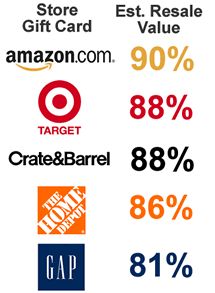 Instead of doing every store under the sun, I tried to take a small sample of different types of stores. Even with only 10 data points per store, the cards often sold in a tight price range, with the relative standard deviation of this small sample size being about 2%. The results are on the right.
 When
When  The Best Credit Card Bonus Offers – 2026
 Big List of Free Stocks from Brokerage Apps
 Best Interest Rates on Cash - 2026
 Free Credit Scores x 3 + Free Credit Monitoring
 Best No Fee 0% APR Balance Transfer Offers
 Little-Known Cellular Data Plans That Can Save Big Money
 How To Haggle Your Cable or Direct TV Bill
 Big List of Free Consumer Data Reports (Credit, Rent, Work)