To reduce clutter, this post has been merged with When Should You Redeem I Savings Bonds? A Calculator. You can access the calculator directly here.
Archives for November 2006
My Money Worries
Posted on November 6, 2006 // 20 Comments
 Here are the money thoughts that are swirling around my head these days:
I need to find a job. My wife needs to find a job. We need to move. We need to find a house that we can afford.
No big deal, eh? It’s a very weird transitional place for us. A year from now, we both hopefully will have good-paying jobs and be making double what we’re earning now, and be living near one of our families. It’s the like the calm before the storm. I know that everything will work out in the end, but I still can’t stop worrying about it now and then.
My Money Blog Thanksgiving Giveaway – Over $400 in Prizes!
Posted on November 5, 2006 // 460 Comments

It’s a time for giving thanks, and I am very grateful for all you awesome readers of this blog. Honestly, this blog has helped me keep on track and it was really fun along the way. I started blogging in December 2004, revealing our net worth of $55,750. As you can see on your top right of the screen, two years later we have doubled that! What better way to celebrate this success than to give away a bunch of stuff! 😉

Index Funds: The 12-Step Program for Active Investors – Book Review
Posted on November 4, 2006 // 7 Comments
Almost a perfect counterpoint to The Little Book That Beats The Market (review), this book could easily be titled The Big Book That Shows You Can’t Beat The Market. It weighs nearly 5 pounds, and is almost 400 pages long. This thing is a beast!
Instead, the title is Index Funds: The 12-Step Program for Active Investors. This is actually a pretty good title as well. Instead of starting at the pure beginner level, it assumes that you know a little bit about the market. Maybe you’ve dabbled in stocks, or have some hot mutual fund picks on your 401(k). The basic layout of the book is this:
1) Present an active-trading idea, and then
[Read more…]
The Little Book That Beats The Market: Book Review
Posted on November 4, 2006 // 14 Comments
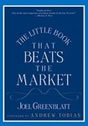 There’s been a lot of buzz about The Little Book That Beats the Market, so I was excited when it finally came in from the library. Of course, at the time I was midway through Index Funds: The 12-Step Program for Active Investors, which I’ll also be posting a review about shortly. Alternating between the two books was like a roller coaster – the Little Book fanning the (little) stock-picking flame inside me, and Index Fund book trying just as hard to stamp it out forever.
The Little Book is well, really little. It’s about the size of a 5″x7″ photograph and barely over 100 pages long. It could be easily finished in one afternoon. The writing style is simple and easy to read, although many of the jokes felt a bit forced to me.
It starts with a nice little story which explains what you are actually buying when you purchase a stock. In short, you’re not buying a physical object, but a stream of future earnings. This is why stock prices fluctuate so much – you’re trying to predict the often-hazy future.
Accordingly, Greenblatt argues that the Market is simply crazy over the short term. But due to this craziness, there is the opportunity to snap up a company at a bargain price. Enter the Magic Formula: Buy good companies at bargain prices. Doing some number-crunching, using the formula gives you historical annual returns of about 30%, beating the market by 20% every year. All with lower risk than the market. Yowza! Sounds good right?
The tricky thing about this book is how ‘good’ and ‘bargain’ are defined. Greenblatt uses a vague definition in the main part of the book, and then a more complicated definition in the appendix. Thanks to JLP at AllFinancialMatters, I discovered this Barron’s article which confirms that even other quantitative people can’t understand the exact definition of the Magic Formula or replicate his awesome returns. They used a different stock database, leading to the returns going down significantly. That’s a bit fishy.
But… even if you use his dumbed-down (my name, not his) definitions of:
Good = High Return On Assets (ROA), and
Bargain = Low P/E ratio,
both of which are part of most stock screeners, you still get market-beating results.
Criticisms
Any time a book claims to beat the market, people line up to crap all over it. I mean, isn’t this just good ole’ Value investing? Traditionally this is done with other ratios like Book-to-Market ratios. Again, the data seems to support that the Little Book method does better than other ratios.
Another criticism, which is noted in the book, is if everyone knows this secret, won’t the prices adjust and remove this market inefficiency? Greenblatt counters this with the fact that his method only works for the long-run, and will underperform the market for sometimes years at a time. This volatility will scare away enough investors and/or fund managers over the long haul such that the premium will endure. Okay, maybe.
My personal nitpick is that the returns also don’t take into account trading commissions and bid-ask spreads. Greenblatt glosses over this point by implying “This method kicks so much ass (remember, 30%!) that you could pay full-service broker commissions and you’d still come out ahead!”
But let’s take a closer look. He suggests holding 30 stocks, each for only a year. Unless you’re investing huge sums, that’s a big drag. If you buy in $500 chunks ($15,000 total portfolio size) with $10 trades, that’s a 4% dent in profits every year (buy and sell). Even at $5 trades, that’s 2%. Finally, if you’re not holding these in an 401k/IRA, you’ll have to deal with taxes.
Added:
1) His returns were based on data from 1988 to 2004, which may be the best he could get will full data, but still is less than 20 years. Will it persist?
2) The book has a website, MagicFormulaInvesting.com, which you can generate the current picks per the Little Book method.
Conclusion
So, if you add in the database inconsistencies, smaller future market inefficiencies, the existing value-premium, the trading costs, and taxes, will you still end up with a risk-adjusted market-beating return for the next 20 years? I have no clue. I can only say that I’m not changing any of my current investments, but if I do eventually set up a small stock-picking portion of my portfolio, I’ll keep the results of this book in mind.
Although I don’t really recommend it as an investing guidebook like The Four Pillars of Investing, I did find it a fun book to read. I think it presents a new-ish view on picking stocks and was a refreshing change of pace for me.
Overall Rating:  (ratings explained)
Did I Just Waste $50 On Firewood?
Posted on November 3, 2006 // 23 Comments

We just bought a 1/3 cord of firewood for $50 off of Craigslist (only partially shown above), figuring we’d try out our new fireplace this winter. But then I ran across this article about how conventional fireplaces are useless:
As a fire burns in a conventional fireplace lot of warm house air is sucked past the leaky door and up the chimney. The air sucked up the chimney is replaced by cold outside air that has to be warmed up to a comfortable temperature by your oil, gas or electric furnace.
Now, this may be true, but does that counteract the radiative heat from the flame/hot fireplace surface area? Oh well, I’m not paying $2,000+ for a new fireplace insert. We set up our couch right in front of the fireplace so it is very toasty and romantic.
How To Get A Free Month of Amazon Prime
Posted on November 2, 2006 // 20 Comments
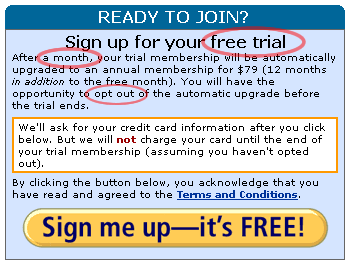
Yep, Amazon is giving out a free trial of Amazon Prime for up to 3 months to lots of people, which includes free 2-day shipping on most items with no minimum purchase. Click here to see if you qualify. Hopefully you’ll be greeted with this image:
Got a Discover Card? Get $20 Gift Card For Each $200 Spent At Select Malls
Posted on November 2, 2006 // 14 Comments
Get a free $20 Discover Gift Card instantly by spending $200 on your Discover Card at select malls from November 1 through December 31, 2006. Just take your receipts totaling $200 to the customer service desk of any of the participating malls to receive your Discover Gift Card. You can get up to 5 gift cards per account. Link via SlickDeals.
All Discover cards should be eligible for the promotion, including some good cards I’ve mentioned before – the Discover Miles Card which offers 0% on purchases and balance transfers for 6 months and Discover More Card, offering 0% APR on balance transfers and purchases for 15 months, along with no balance transfer fees for initial balance transfer. More details here (opening bonus with the Miles card).
Now, I don’t have to tell you bright folks that spending $21 more than you would have otherwise to save $20 is not a smart thing to do, right?
Save 50% On Utility Bills With This Energy Analysis Tool
Posted on November 1, 2006 // 16 Comments
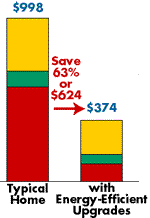 Winter is a comin’, which means higher heating costs for much of the country, so you should try out the energy audit tool at Home Energy Saver, a government site which uses advanced simulations to find out cost-effective ways to cut down your utility bills. According to their potential savings calculator, we’re talking 50% off here.
First, you give it your zip code, and it pulls up some initial information on your house based on your geographic area. You can then go with those estimates or enter in more details for a more accurate analysis. The tool then calculates your home’s energy consumption and potential energy-saving ideas. You can even choose a specific payback period and they will only give you recommendations that will be profitable within that period.
[Read more…]
Emigrant Direct Signup Bonus Update – September Payouts
Posted on November 1, 2006 // 2 Comments
Everyone who sent me their Form #2 in September for my Emigrant Direct Opening Promotion should have been paid. If not, please e-mail me. If you’re interested in opening an account with Emigrant Direct’s 5.05% APY with no minimums, don’t miss your bonus of up to $20?
Carnivals
Posted on November 1, 2006 // Leave a Comment
My Money Blog participated in some carnivals again this week:
- Carnival of Personal Finance #72 at It’s Just Money
- Carnival of Investing #46 at 1st Million at 33
- Festival of Frugality #46 at Lazy Man and Money
If you are interested in participating in the Carnival of Investing either by entering a submission or hosting, please see here.
 The Best Credit Card Bonus Offers – 2026
 Big List of Free Stocks from Brokerage Apps
 Best Interest Rates on Cash - 2026
 Free Credit Scores x 3 + Free Credit Monitoring
 Best No Fee 0% APR Balance Transfer Offers
 Little-Known Cellular Data Plans That Can Save Big Money
 How To Haggle Your Cable or Direct TV Bill
 Big List of Free Consumer Data Reports (Credit, Rent, Work)