Search Results for: feed

Peer-to-Peer Renting: Lease Your Stuff to Strangers, Hopefully Buy Less Stuff

Recent articles in the New York Times and BusinessWeek magazine talked about the growing emergence of websites where individuals can rent out their belonging to other strangers, coining the new term “collaborative consumption”. I like the idea. Not only can you make some extra money renting out your stuff when you aren’t using it, but as a borrower that means you need to buy less stuff as well. In addition, people can use it as a “test-drive” to try out things like a certain model car or an iPad. Here’s a list of websites in this area, please let me know any that I’ve missed.

RelayRides
Peer-to-peer car rentals! Rent your car to strangers by the hour. Started in Boston and now available in San Francisco Bay Area as well. Free to join, and renters start with $25 free driving credit. Prices are cheaper than competitors like ZipCar, which owns their own private fleet. Claims that owners can make $250 a month on average renting out their vehicles. Rates include gas and insurance.

Similar: Spride Share (currently in SF Bay Area), WhipCar (UK),

Airbnb
Rent out extra rooms in your house (or the entire house, a castle, or private island…). Free to sign up. Set your own prices and availability. Airbnb facilitates all bookings and financial transactions. They already have over 50,000 properties in 10,000 cities.

Similar: ParkatmyHouse (rent out driveway or garage space in crowded areas)

Zilok
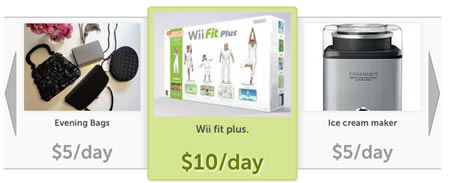
Technically you can rent out anything on this site, but it has specific categories for cars, vacation sites, power tools, and event rentals. You can rent from businesses or individuals. Looks like a PS3 is going for $20-$25 a day.

Similar: SnapGoods (newer, but more polished website), Rentalic

Share Some Sugar
Can I borrow a cup of sugar? You can also rent out anything on this site, but SSS seems to promote borrowing between people in the same neighborhood for free (with a refundable security deposit). After browsing a bit, I realize that I could use a lawn aerator, if only there was someone nearby with one available.

Similar: ShareZen (more for collaborative ownership of a plane, home, or boat), Skyara (a marketplace for “experiences”)

I suppose the main concern would be either theft or breakage of your property. Most sites have a user rating and feedback system similar to that of eBay, as well as security deposits. The car rental agencies do provide insurance, but I don’t believe the other sites do. In many cases, you can restrict your lending to members of your social network of friends via sites like Facebook.

Of course, the hardest thing about these sites is often getting the critical mass of adequate inventory to rent out to interested customers. Let’s hope one of these gains some traction. The one I want to use right now would be ParkatmyHouse. Combine their inventory with a real-time iPhone/Android app, and you could search for cheap parking almost anywhere. If you live where parking is scarce, you could profit from what is usually just a headache.

Why You Shouldn’t Use Debt Settlement Agencies

The following is a guest post from reader Daniel Gershburg, Esq., who writes about the inner workings of debt settlement agencies. Daniel is a bankruptcy attorney in New York and New Jersey.

Over the past several years, our economy has gone into the tank. Rampant unemployment, underemployment, in fact a near collapse of the financial system have completely reshaped our financial lives. Millions of Americans are in credit card debt over their heads and can’t afford to pay even the minimums. And the creditors have, in many cases, several cut credit lines and hiked our interest rates. In a situation like this, a debtor basically has three options.

The first option is to file for Bankruptcy. While I think it’s the soundest option, both with regards to ones credit and future financial well being, I’m also a Bankruptcy attorney, so of course I feel that way.

The second option is to try and settle with credit card companies and bring down your interest and pay off your debt….good luck with that. They’re about as interested in settling with you now as you are in buying an investment property in Las Vegas.

The third option, and the option I’d like to discuss in depth here, is employing a Debt Settlement company to try and settle the debt for you. This not only, in my opinion, is the worst option of the lot, but based on what these companies claim, may border on fraud. Literally, fraud. Here’s why:

The promise of bailouts

Turn on the radio or the TV and you’ll hear absolute nonsense about how debt settlement companies can reduce the amount you pay to your creditors by up to 80%. One, called the Obama Credit Card Relief Program (I’m serious) promises to Cut Up To 70% Off Credit Card Debts under “Bailout Relief”. Again, absurd. The claims that many of them make aren’t even mathematically feasible based on most people’s budgets.

Many of these companies also make claims that they are Not for Profit companies. You hear that and you think of people planting trees, feeding the homeless in soup kitchens, and you begin to almost subconsciously trust these companies. The IRS did a little research into these feel good claims. Here’s what they found:

Over the past two years, the IRS has been auditing 63 credit counseling agencies, representing more than half of the revenue in the industry. To date, the audits of 41 organizations, representing more than 40 percent of the revenue in the industry, have been completed. All of the completed audits have resulted in revocation, proposed revocation or other termination of tax-exempt status. [Source: IRS.gov]

How do debt settlement companies really work?

[Read more…]

Poll: Top-Down or Bottom-Up Budgeting?

I was in a discussion about budgeting and eventually decided that there are two primary types of budgeting by households. I called them “bottom-up” and “top-down”. However, there are some differing definitions of these terms floating around, mostly in connection with businesses or governments. So first, some quick definitions:

Bottom-Up Budgeting is focusing on your spending and trying to manage each one. You keep track of your spending, either item-by-item with lists or by category using software like Quicken or Mint.com. You look at each expense somewhat holistically and decide consciously if you need to cut back or if you are happy with the amount being spent. Whatever is left, is put into savings.

Top-Down Budgeting is the simpler, big-picture type of budgeting. You decide how much you want to save from your income, either by percent or total amount. Examples: I want to save 10% of my take-home pay. I want to save $1,000 a month. After you figure how much you want to save, you just try to set that aside, and spend the rest however you like.

Alternatively, you might say “I want to spend $3,000 a month total.” I still consider this top-down budgeting if you are not looking at each expense separately each month. The focus is still basically saving some fixed amount for the future.

Share! Vote in my poll…

What method of budgeting do you prefer?

View Results

Loading ... Loading ...
If you don’t see the poll above, you may be viewing the RSS feed and should click and visit the actual blog website.

Guide to Buying a Used Car on Craigslist

The following is a guest post from reader Andy, who bought his last vehicle on Craiglist and shared some of his experiences and advice.

I bought our last vehicle used on Craigslist (CL) and am a big advocate of buying used and direct from private parties (i.e. not from a used car dealer). New cars depreciate significantly when you drive them off the lot and that works to the disadvantage of the used car seller and the advantage of the buyer. Also, provided you can avoid lemons and rust, with regular maintenance today’s cars (especially those with a V6 engine) can reliably last up to two hundred thousand miles before they need to be replaced.

I think you can get a better deal when buying from a private party because you cut out the middle-man (the dealer) and can often negotiate on price if you are a serious buyer and show up with cash. The market for used cars is inefficient. That doesn’t mean you can show up and steal a late model Mercedes from a seller for $500. Kelly Blue Book values on just about all models are easy by anyone. However, the market for used cars is inefficient with regard to quality. In general the KBB value on a car (same make, model and mileage) that has been thrashed by a teenager and never had an oil change is the same for one that has been babied by a retiree who only drove it on sunny days and took it regularly to the dealer for all scheduled maintenance. To me, getting a great value on a used car is finding the latter and avoiding the former, and being willing to pay close to blue book value when I do.

Unlike going to a used car dealer, when buying a car on CL you need to do some research upfront and determine the make and model of car you want to buy, or at least narrow it to a couple of options to narrow your search. Also I try to know what year(s) I am looking for. Models change every few years and while it is cheaper to buy a car dating to just before a model change you want to be sure there are no significant upgrades in the more recent model that you’d prefer to have (i.e. less rollover risk in an SUV, airbags, or a significantly better engine). Also, Consumer Reports is an excellent source of information on the performance and reliability of brands, makes, models, and years. Once I know what car I am looking for I next begin my CL search.

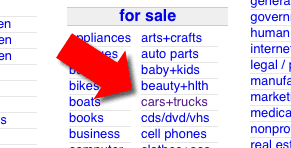
Within the cars and trucks section of Craigslist there is a drop-down box next to the search box that defaults to “cars+trucks.” I always click on this and bump it up one selection to “cars & trucks – by owner” which eliminates most of the used car dealers, though not all. Another reason I avoid dealers in addition to the lack of transparency is adverse selection. Used car dealers may carry some cars they bought at auction that may have had damage or other unsavory history. This is a big investment and I’d prefer to avoid those risks. Here are the steps I use to find a car I feel comfortable buying on Craigslist:
[Read more…]

Updated myFICO Coupon Codes & Twitter Tip

Update February 2011: Use coupon code FICO25 for 25% off!

The last time I actually paid for my credit score was before I bought my house, and that was basically a fit of paranoia to make sure it was crazy-awesome before the lender pulled it. There are plenty of “FAKE-O” credit scores out there, but the only place to get your real FICO score is myFICO.com.

I’ve actually checked my FICO score several times since then for free, as promos usually pop up every couple month or so. I always try to post them here, but am often a bit late. This happened again this week, with myFICO offering free scores to the first 3,000 people. It was announced on their Twitter feed @myfico, so you may want to follow them for future opportunities. (While you’re at it, follow me @mymoneyblog too. I sometimes post smaller or short-lasting deals only on my Twitter page.)

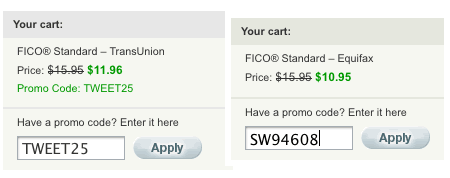
Here are the best promotional codes out there currently: TWEET25 to get 25% off your TransUnion FICO and SW94608 to get 30% off your Equifax FICO. You enter the promo code relatively late in the buying process, right before entering your credit card information.

Whenever you do buy a score, I would recommend trying to correlate your score and the current information on your report. Then you can start to learn what changes really affect your personal score. I’ve applied for 12 credit cards and canceled 5 with almost no appreciable affect to my scores (see credit score myths) – despite all the “rules” – only to have a huge balance on my mom’s credit card (with me as authorized user) show up and drop it by 30 points.

SmartyPig: Tips and Tricks To Use Like a Bank Account

In a previous post about 4 Stash Your Cash Deals Most People Haven’t Heard Of, I mentioned the new FDIC-insured savings site SmartyPig.com since they have consistently high yields, currently at 2.15% APY on balances up to $50,000 with no minimums or monthly fees. Funds are held at BBVA Compass Bank.

I also mentioned that even though they do have a some restrictions due to their “piggy bank” image, they have added enough flexibility (in response to user feedback, which should be applauded) that you can use it virtually like any other savings account. I got a few questions on what I actually meant by that statement, so here are a few “hacks” that I have used to increase the flexibility of my savings. I prefer to think of it as getting around their gentle nudges to keep saving. 🙂

Ground Rules

When transferring money into SmartyPig, you must do it in the form of Savings Goals. Your goal can be anywhere between $250 and $250,000, and you must transfer in at least $25 from a linked bank account to get it started. You can also schedule a recurring deposit of at least $10 a month towards the goal, but you don’t have to.

  • You can make as many goals as you like.
  • You can make additional one time, non-recurring contributions to a goal.
  • You can end a goal at any time without penalty, but you will have to redeem the entire existing balance all at once. There are no partial redemptions.
  • You can change your goal amount at any time.
  • You can transfer funds in between goals instantly. There is a limit of five outgoing transfers per calendar month per goal. Accrued interest cannot be transferred and will remain in the goal where it was earned.

Emergency Fund / Partial Redemptions

Setting up SmartyPig as an emergency fund is straightforward. I set a big goal like $25,000, and then put in a regular contribution. But what if something comes up and I want to make a withdrawal of say $1,000 out of the $5,000 I’ve already set aside? According to the site, I must end the entire goal and cash it out completely. Not so fast. In this case, I would:

  • Start a new goal, call it Emergency Fund 2.0.
  • Transfer $4,000 from my original goal into the new 2.0 goal.
  • Now, I should be left with $1,000 in my original goal, and I can cash it out by clicking on “Stop Goal”. I’ll also be cashing out all the remaining accrued interest.
  • I am left with a new goal with $4,000 still earning 2.15% APY, and $1,000 is headed to my main checking account to pay for the unexpected expense.

“Boosted” Gift Cards to Multiple Retailers

Another perk of SmartyPig is the ability to redeem your cash goal for a retailer gift card with a “boost”. You can get a 1% bonus at Wal-mart, 3% at Lowes, 4% at Amazon.com (my fave), and 12% at Macy’s. So for a $250 goal, I could cash out for $260 at Amazon. By default, you can only redeem a goal for one retailer. But by using the method above, you can effectively split your goal balances into smaller chunks.

4 Stash Your Cash Deals Most People Haven’t Heard Of

Here are four places to stash your cash that aren’t advertised very heavily, so your co-workers probably haven’t heard of them. They are all FDIC-insured, and offer higher yields than most of their direct competitors. Each one is best depending on your investment time frame and deposit size.

Free Rewards Checking at DanversBank

DanversBank offers their Free Rewards Checking account paying 4.01% APY on balances up to $25,000, provided you satisfy the following each month:

* perform at least 12 debit card transactions (excluding ATMs);
* receive their monthly statement electronically;
* access Online Banking, and
* sign up for direct deposit or receive a recurring ACH.

There are no minimum balance requirement or fees, and ATM fees are refunded as well if you meet the above requirements. The branches are located in the Boston area, but accounts are open to anyone in the US. If you can be diligent every month (otherwise you get piddly interest), these types of account are great interest boosters.

Ally Bank 5-Year CD with Small Early-Withdrawal Penalty

Ally Bank LogoOkay, so Ally does spend a lot of money on advertising, but a feature they rarely mention is actually the best reason to open an account with them. They only hit you with a early withdrawal penalty of 60-days of lost interest if you “break” a CD with them. The Ally Bank 5-year CD currently yields 1.60% APY (as of 10/25/13). Rates change constantly, but let’s assume you have a certificate of deposit from any bank paying 2.99% APY with an early withdrawal penalty of the last 60 days of interest. (2.99% APY ~= 2.95% rate compounded daily.) Here’s how your actual annualized interest rate would fluctuate given your holding period.
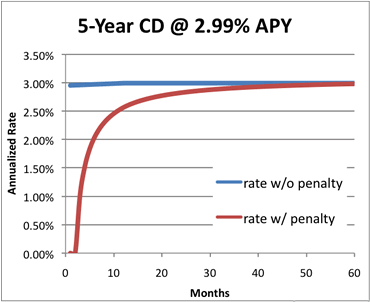

If you look carefully at this charts, you’ll see some great deals:

  • After only 4 months, your annualized rate is 1.48%. (Essentially you 2 months out of 4, which is half of 3.04%). This isn’t bad at all, considering their liquid online savings account is currently paying 0.85% APY.
  • After 1 year, your annualized rate is 2.49%. You can’t find a better rate than this at any other bank for a 1-year CD. Likewise, after 2 years, your annualized rate is 2.87%, compared to Ally’s current 2-year CD at 1.05% APY, although it does have a “raise your rate” feature that lets you bump it up once if rates rise.
  • After 3 years, your annualized rate is 2.83%, again a top rate. Thus, even opening a 5-year CD and holding for anywhere between four months and 3 years gets you a better rate than any other bank currently out there (including Ally itself). There’s also no minimum deposit required to open, so you can make each CD as small as you like!

SmartyPig FDIC-Insured Online Piggy Bank

I reviewed SmartyPig.com a while back when they had just broke onto the scene, but they have made a lot of improvements in response to customer feedback since then. You can think of them like an online piggy bank that helps you towards savings goals, but they’ve added so much flexibility that you can pretty much use them like any other savings account. The best part? They currently pay 2.15% APY on balances up to $50,000 (FDIC-insured). That’s better than any other savings account out there, with no additional requirements. No minimums, no maintenance fees.

An added feature is that if you set a savings goal and reach it, they offer “boosts” if you redeem your cash for a gift card in their mall. My favorite is the 4% boost at Amazon, which for example will get you a $260 gift card for $250 cash. Other highlights include Macy’s at 12% and Travelocity at 10% boost.

Sallie Mae Bank – Online Savings Account

Sallie Mae is best known as the huge student loan originator and servicer. Their new Sallie Mae Bank is an FDIC-insured bank that offers a very competitive 1.40% APY in their online savings account. Not a bad deal to lend out money to captive students at high interest rates, and pay much less as a bank! Hopefully this means that they can keep their rates higher than other banks.


The quickest way to describe it is as another clone of Capital One 360 (currently paying 0.75%). That means… liquid, no minimum balance, no minimum fees, and no deposit caps or tiers (just the $250k FDIC insurance limit to worry about). It’s designed to complement your existing accounts. You can link an unlimited amount of other bank accounts for easy online transfers, which take the usual 2-3 days to complete. Interest is compounded daily and credited monthly.

Also, if you have an account at Upromise, you can link your Sallie Mae account and have your Upromise earning deposited there. You can even get a 10% extra bonus if you do one of the following:

To be eligible for the 10% annual match on your Upromise earnings from Upromise you must link your High-Yield Savings Account to your Upromise Account and, within 90 days of opening your High-Yield Savings Account, either: (1) set up an Automatic Savings Plan with a monthly deposit of $25 or more, or (2) fund the account with $5,000 or more. Upromise will match 10% of your Upromise earnings posted as “funded” to your Upromise Account during the calendar year of January 1 through December 31. Your 10% annual match will be deposited into your High-Yield Savings Account in February of the following year provided that both accounts remain active and are in good standing at the time of transfer.

Free $10 Restaurant.com Certificate

Reader Bill offered a helpful comment about the promotional site FeedItForward.restaurant.com where you can give and receive free $10 certificates from Restaurant.com until Christmas.

However, I wanted to point out this offer is tricky in that you have to weigh the benefit of getting a $10 certificate for free or simply buying a $25 certificate for $2, since most restaurants have a minimum purchase requirement and you can only use one certificate per visit.

The way the math works out, if the restaurant requires the same minimum purchase of anything over $12, you’re better off buying the $25 certificate for $2. Let’s say you want to spend just $15. With the $10 certificate, the final net cost is $5. With the $25 certificate for $2, the final net cost is only $2.

A common scenario is a $20 minimum purchase for the $10 certificate, and a $35 minimum purchase for the $25 certificate. As long as you plan on spending at least $35, then you’re much better off buying the $25 certificate for $2. Getting $20 worth of food would end up with a net cost of $10. But getting $35 worth of food would only end up with a net cost of $12 ($2 for the $25 certificate + $10).

Run a search at Restaurant.com first to find a place you like and carefully note their specific restrictions.

Notes From A Kiyosaki Rich Dad, Poor Dad Series Audio CD

While going through some old boxes, I found an old CD case containing some audiobook recordings from a real estate program by Robert Kiyosaki and Dolf De Roos. I’m pretty sure they are from this set called Rich Dad’s Roads To Riches – 6 Steps To Becoming A Successful Real Estate Investor.

Kiyosaki is best known for his book Rich Dad, Poor Dad (my 2005 review). People tend to either hate him or love him, but to me he’s just a guy who has wrapped up a legitimate way to make money – investing in real estate – and tried to simplify and market it to the general public in a palatable way. You can read about most of the criticisms at this link, although it is a bit long (Reed really hates this guy.). I see his books as having the occasional nugget of wisdom buried in a pile of shiny happy fluff.

Luckily, I took notes when I listened to it the first time, so I didn’t have to go through it all over again. Here’s the stuff I decided was worth remembering.

  • Avoiding Alligators. A general rule is that you should never invest in a home that does not immediately produce positive cashflow. In other words, the rent covers your mortgage plus other expenses, and you don’t have to keep making monthly payments out of your savings or income. A property that requires more money every month is called an “alligator”. Why? Because you have to constantly feed it and feed it. If you ever stop, it eats you.
  • When To Expand. Along the same lines, if you keep buying alligators, you can only buy a finite number before all your money is tied up feeding them. If you buy cashflow-positive properties, it is much easier to keep buying them. Once your property value increases, you can extract the equity by refinancing and use to invest in another cashflow positive house. This way, you’re never in a bind with regards to cashflow.
  • Tenant Screening Tip. When looking for tenants, always ask for the contact information of the current landlord and the landlord before that. This is because the current landlord might lie to you in order for you to accept their nightmare tenant, and have them move out peacefully. The previous landlord will be willing to tell you the truth.
  • Treat It Like A Business. Don’t put up with tenants that chronically pay rent late. Maintain concrete rules for due dates, charge late fees when applicable, and if necessary, initiate the eviction process promptly. If you show them that you won’t tolerate late payments, this will either whip the wishy-washy ones into shape, or get rid of the bad ones as soon as possible.

The rest:

  • The 100:10:3:1 Rule. This rule basically states that to find an appropriate real estate investment, you’ll need to look a 100 properties, makes offers on 10 of them, attempt to finance 3, and you may finally buy one of them. Basically: look hard and be picky.
  • On Leverage. $10,000 can control $10,000 worth of stocks. If it goes up 10%, then you are up $1,000. Alternatively, $10,000 can control $100,000 worth of real estate through borrowing money (leverage). If your real estate goes up 10%, then you’re up $10,000. Of course, they don’t focus on the fact that if your home’s value drops by just 10%, you’re completely wiped out. The ability to leverage cuts both ways, but can help with cashflow.
  • Property Manager. Hate the idea of fixing toilets at 3am in the morning? Hire a “good” property manager. Unfortunately, no tips were included on how to find such a mythical creature. (Similar to unicorns and the “cheap and prompt handyman”) Also, property managers usually charge about 10% of your gross rent.

Tracking Investment Portfolio Using Google Docs

I spent a little time tinkering with Google Docs Spreadsheets today, trying to use it to track the asset allocation of my investment portfolio.

GoogleFinance() Function
This function allows you to import data from Google Finance like current stock prices, p/e ratios, or performance. Here is the Google Docs Help page. For example, if you want to pull up the price of a share of Google stock, you’d enter this into a cell.

=GoogleFinance("GOOG"; "price")

Importing Personal Data
I could not find an easy way to import my actual holdings into Google Docs, but I’m not sure if you want that capability due to privacy concerns. Google Docs does allow you to import from RSS or XML feeds. I ended up just manually entering the ticker symbols and number of shares I held for each mutual fund. This means I will have to update my 401(k) funds after each paycheck, and my other holdings when I make a transaction or when a dividend is paid.

Shared Example
Below is a shortened version of my online file, as a quick example.

You can view the full version more easily here. To edit, go to File and click on “Create a copy…”. You can then poke around and change the ticker symbols to your own.

In the full version, I have columns that compare my current asset allocation percentages to my target percentages. This can help people who wish to rebalance when their allocations are off by a certain amount. I can see that I am currently overweight in Emerging Markets due to their recent run-up, and underweight in TIPS. Everything else seems close enough.

The pie charting function seems a little buggy, I couldn’t get it to show the proper labels.

Zecco April Fools’ Day Error Aftermath

Apparently my post on the million dollar account balances at Zecco Trading got picked up by The Consumerist over the weekend, but the tone was changed with the inflammatory title “Worst April Fools’ Day Joke Ever: Zecco Pretends To Give Away Millions”. People got excited, the SEC got involved, and the entire post over there has since been revised (see URL for original title) to incorporate the official reply from Zecco:

On April 1, 2009, one of our vendors provided Zecco Trading with an incorrect data feed which caused some customers to see erroneously high buying power. This error was quickly corrected, but about 1% of our customers were impacted. All positions in excess of our customers’ true buying power have since been closed. Except in a very small number of egregious and fraudulent cases, customers will not be responsible for losses (or gains) incurred for trades in excess of their buying power.

Additionally, we want to make it clear that contrary to some reports, this was not in any way intentional and was not an April Fool’s joke. We take the integrity of our customers’ accounts very seriously and we have taken measures to ensure this does not happen again. We sincerely apologize to our customers if this caused any confusion.

To be fair to Zecco, I never said it was an April Fools’ joke, I only said it happened on April Fools’ Day and because of that there was (understandable) speculation as to whether it was a joke or a system glitch. It turns out it was the latter. Either way, it’s always a bad idea to spend money that you know isn’t yours.

Free Fully-Licensed Software: GiveawayOfTheDay.com

Here’s another creative idea for a website. GiveawayOfTheDay.com lets you download a fully-licensed, no-trial, no-shareware version of some neat software. The catch is that it is only available for one day, during which you must both download and activate the software on you computer. Also targeted at the Windows OS.

The developer of the software gets some good publicity, feedback on their product, and the opportunity to earn money down the road with future license upgrades. If you think about it, most people who download the product this way were probably not going to buy it anyways.

Today’s download is PDFZilla, which converts PDFs into “editable MS Word Documents, Rich Text Documents, Plain Text Files, Images, HTML Files, and Shockwave Flash SWF Files.” Of course, you probably won’t find something useful to you every day, but it’s worth adding the feed to your RSS reader. There was some DVD authoring software that looked promising a couple days ago.