Archives for May 2024

FIRE is Not Beans & Rice. FIRE is Not Pink Lambos. FIRE is Life!

FIRE (Financial Independence, Retire Early) is certainly a catchy acronym, but it always seems to confuse people because the word “retire” suggests a line between working and not working. What does it mean to “Retire Early”? What if you only work part-time? What if you like your job and have no intention of quitting completely? Beyond that, FIRE has been further hijacked. I’ve noticed that many mainstream articles about FIRE follow a similar template:

  • Create your own custom definition of FIRE. For example, FIRE is people who eat only lentils, use 100 coupons at the grocery store, and don’t have any friends nor fun. Alternatively, FIRE is just rich people who didn’t have to make any effort at all, they are just smug rich people.
  • Once this straw man is created, you can easily attack it. Eating only lentils is weird and you are a foodie. The person using coupons is that super-annoying person that spends 10 minutes at the cashier. This person did FIRE but now regrets never having friends or fun when they were younger. How sad. That person is rich and therefore you personally have no chance at it, so why bother unless you make $300,000 a year or enjoyed a million-dollar windfall?

On the other hand, I think pointing out the many possible paths as a good thing. One of those lifestyles will likely click with some specific reader. A recent entry is from the NY Times with Your Neighbors Are Retiring in Their 30s. Why Can’t You? Meet the schemers and savers obsessed with ending their careers as early as possible (gift article). Yet the cover, of course, is a pink $300,000 Lamborghini…

If we want to stay catchy and shiny, but make it broader and more encompassing, how about “FIRE is Life!” I am a latecomer to the Ted Lasso bandwagon (yay free Apple+ trial!), but this is how I interpret the catchphrase “Football is Life!” from the character Danni Rojas.

  • To be successful at football, you need to work hard. This is the variable that you can control, and thus should be your focus.
  • To be successful at football, you need be lucky. You need some natural-born talent, supportive people, and a few breaks along the way. Thus, you should act with humility.
  • Sometimes you start strong, but still lose. Sometimes you start horribly, but still win.
  • Sometimes you try your best, but you still lose a particular game.
  • Some people have a playing style that is very aggressive and risk-taking.
  • Some people have a playing style that is very defensive and reliable.
  • Some people follow the rules with good character, and others break the rules whenever they think they can get away with it.
  • There is great beauty in the game, if you step back and take the time truly understand it.
  • You are far from the first person to play football. People having been kicking around balls since before you were born. According to Wikipedia, the earliest known written evidence for a similar game with standardized rules was 2,000+ years ago (Han Dynasty, China).

Similarly, FIRE is not something invented in the 2000s. It didn’t even start with Your Money or Your Life in 1992. People have been pursuing financial independence since… there have been people. Sure, for about two million years we were hunter-gatherers. But as soon as people could gather enough wealth to not have to spend their time gathering food or working for food, they did. Well, a few of them did. Here’s a selection from my old FIRE books reading list.

The Quest of the Simple Life by William J. Dawson is a book from 1907 that talks about escaping the grind and spending less money to create a simpler life (sound familiar?). My review and highlights: The Quest of the Simple Life: Escaping The Work Grind in 1907 vs. Today. Here is a sample quote on the cost of “keeping up appearances”:

Money may be bought at too dear a rate. The average citizen, if he did but know it, is always buying money too dear. He earns, let us say, four hundred pounds a year; but the larger proportion of this sum goes in what is called ‘keeping up appearances.’ He must live in a house at a certain rental; by the time that his rates and taxes are paid he finds one-eighth of his income at least has gone to provide a shelter for his head. A cottage, at ten pounds a year, would have served him better, and would have been equally commodious. He must needs send his children to some private ‘academy’ for education, getting only bad education and high charges for his pains; a village board-school at twopence a week would have offered undeniable advantages. He must wear the black coat and top-hat sacred to the clerking tribe; a tweed suit and cap are more comfortable, and half the price. At all points he is the slave of convention, and he pays a price for his convention out of all proportion to its value. At a moderate estimate half the daily expenditure of London is a sacrifice to the convention or imposture of respectability.

FIRE is considering the possibility that you don’t have to spend all of what you earn. Considering what is “enough”. Considering how much (life)time to devote to work, and how soul-sucking that work should be. There is no black and white answer. The variables are infinitely adjustable.

Along the way, I’ve changed my mind on some things. I am not retired. I could try to live off what I have saved so far, but I was surprised to find that I do like some of the mix of purpose, money, community, etc. that comes with finding the right kind of work. I also cut back enough to make time to pick up my kids every day after school. Financial independence is the power to spend your finite time how you wish. Saving $1,000 helps with that. Saving $10,000 helps with that. Saving $100,000 helps more.

The most important lesson that I would tell my kids is that the pursuit of FIRE has been an overwhelmingly positive experience. My life is infinitely better for taking the time to make more conscious decisions about how I make money, spend money, invest, and so forth. Not only can I spend more time with loved ones, I am more present and happier during those times. FIRE is Life!


Upside App Promo Codes: $1.50+/Gallon Cash Back on Gas, 15%+ Off Restaurants

Update July 2024: Upside closed my account effective immediately and without prior warning because I used “unauthorized” promo codes. Just FYI, I would cash out now and whenever you have enough of a balance.

Original post:

(Update: Added new codes SOFI35, SHSBPO , and SHSVBALL. SOFI35 looks to for those initially signing up for a new account and offer $0.35 off/gal, and SHSBPO/SHSVBALL was able to be applied to my existing account and should increase the cash back from eligible restaurants by 5%. I saw up to 25% off in total.)

Upside is an app that earns cash back rewards on gas and restaurants. The cash back is on top of whatever cash back or rewards your credit card already earns. For the most part, you look up a local gas station or restaurant on the Upside app, “claim” the offer, and then shop at the gas station or restaurant with a linked credit card. Upside somehow tracks your credit card number through their systems and match up the transactions (takes a few days). The cash back can then be redeemed directly back into your bank account (no fees if $10 minimum cash out).

They used to require you to take pictures of your receipts, but I didn’t have to for my gas purchases. They might still ask in some cases, I believe.

Right now, there are several live promo codes that are stackable such that you can earn $1.50+/gallon on your first few purchases. I successfully earned a total of $1.75/gallon back on my first fill-up, which works out to over $20 cash back. Here are the promo codes which are potentially stackable starting with my referral code.

  • Download the Upload app first and create an account.
  • After installing, click on the person icon in the top right, then “Profile”, and then “Promo code” box. Try to enter each of the codes below. You may need to go back to the “Profile” screen to re-enter the next code. If it doesn’t give you an error, the code should be been applied. There is no other confirmation, other than seeing your cash back offer values go up.
  • JONATHAN633925 for extra 15 cents/gallon on first purchase. Should be auto-filled if you used the link above.
  • UBERPC20
  • UBER35
  • SHOPPERS35
  • USHIP35
  • YOUTUBE10
  • GOPUFF35
  • GOPUFF15
  • AMEX35
  • PERKSATWORK230
  • CASHCABK25
  • SOFI35
  • SHSBPO

Sources: These were collected across Doctor of Credit and GetUpside Reddit. Many of them might not work, but honestly I just tried them all to see whatever would stick. Also, I think most of them only work for the first 3 fill-ups or so.

After entering them all one-by-one, you can go back and look on your local map to see what gas stations are available nearby. Remember to first link up the credit card you use for gas (person icon > “Wallet”), and then claim the offer before you fill up and pay using that specific credit card. It’s a rather vague process, but the cash back magically showed up after 2-3 days. Hopefully, I can rack up at least $50 in cash back on gas with these promo codes.

Beyond a lot of fast food chains, I’m also seeing 6% to 20% off at a lot of local restaurants that also participate in Neighborhood Nosh (formerly iDine), which is a similar program in that the cash back is on top of credit card rewards and through linked credit card numbered. The Upside cash back percentages I’ve seen are often higher, however, so this app might actually be a long-term keeper if it keeps working reliably.

Merrill Edge Brokerage: Best High Interest Rate Options on Cash (5%+ APY, Updated May 2024)

Updated May 2024 with refreshed rates, new Preferred Deposit online initial deposit option, lower $1 minimum on money market funds. Merrill Edge is a self-directed brokerage arm of Bank of America and Merrill Lynch. They are a decent broker overall, but honestly the only reason I keep my account open with them is to qualify for their Preferred Rewards Platinum tier, which allows me an effective 2.6% flat cash back on “everything” credit card (offsets any travel purchase) as long as I maintain a Merrill Edge brokerage account with at least a $100,000 balance (even if just buy-and-hold Vanguard ETFs).

Unfortunately, the interest rate paid on their default cash sweep option is horrendous. They seem to have learned from Bank of America that lots of people don’t pay attention and they can earn a lot of easy profits paying 0.01% APY when you can earn 5%. Not very customer-friendly, but “net interest margin” is a huge source of profits. However, if you are motivated enough (as my readers tend to be), then you can stay at Merrill Edge and still do a lot better. Here is a summary of all the options available if you do want to keep your cash there.

Manually sweep your idle cash out. If you have a BofA checking account, you can perform instant transfers from your Merrill Edge cash balance into your BofA account. Then I simply initiate (“pull”) money out via a high interest savings account. This is a bit tedious, but most of my cash shows up during predictable periods (quarterly dividends).

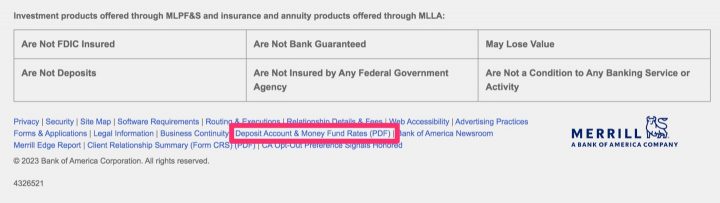
Current rate sheet. You can always check current interest rates by scrolling to the bottom of any Merrill Edge page and clicking on the blue link “Deposit Account & Money Fund Rates”. Right now it links to this PDF.

Default cash sweep. Your default cash sweep interest rate is the one for “Merrill Lynch Bank Deposit Program – Tier 1 (<$250,000)". As of 5/15/24, it is a sad, sad 0.01% APY. This is a FDIC-insured cash sweep. The bad news is that you can’t change it to automatically sweep to anything else right now. The good news is that there are some other options available if you are willing to do a bit of work.

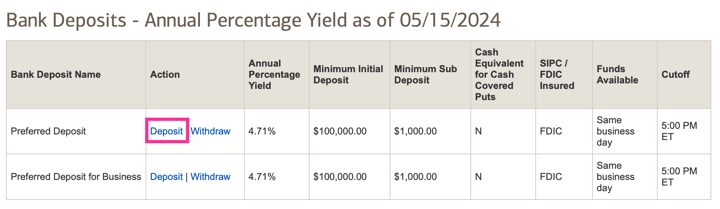
Preferred Deposit. The first page of the rate PDF only includes FDIC-insured options. You’ll note the highest rate is something called “Preferred Deposit”. As of 5/15/24, it is a much more competitive 4.71% APY. In order to use this option, you must open it with at least $100,000 in cash. However, once you establish that $100,000 position, you can then go below that amount while still maintaining future access (subsequent transactions have a $1,000 minimum). However, this is not a sweep (nothing goes in or out automatically). Here is a detailed product PDF.

To initiate this option, you can either call them up at 877.653.4732 or place an order online. To find this option the website, go to “Research” > “Mutual Funds”, and then “Cash Management Solutions” in the secondary menu. If you scroll all the way to the bottom, you should find the option to deposit. See screenshot below. Thanks to reader Bob for the tip.

This is a non-sweep product – an order must be entered for all transactions (deposits and withdrawals). Please contact your representative for additional information.

Treasury bills (auction and secondary). You can buy US Treasury bills and bonds directly through the fixed income desk. You can place either an auction order for a “new” T-Bill or buy them on the secondary market. Technically, there is no commission for online orders and a $29.95 fee per broker-assisted order. However, they don’t allow online orders for new auctions, so effectively it costs $29.95 per auction order. You can buy online on the secondary market with no commission, but there will be bid/ask spreads and possible quantity minimums based on the available inventory.

Money market mutual funds. If you scroll down to the second page of the rate PDF, you will find a list of money market mutual funds. These are not FDIC-insured, but they are still regulated by the SEC and required to hold very safe investments of a very short duration.

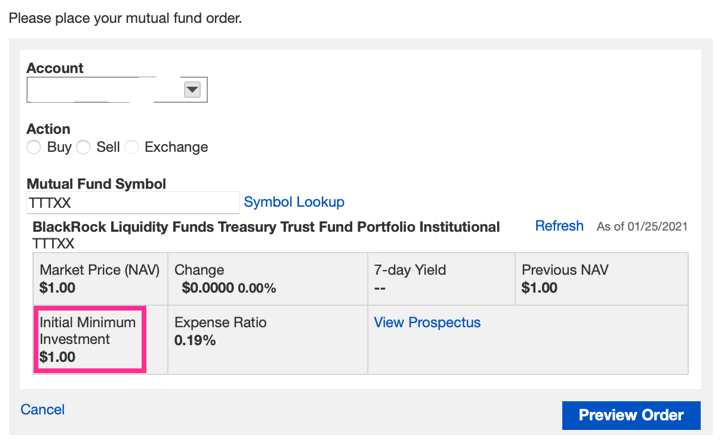
You can place trades on money market mutual funds online. You must select “Mutual Funds” from the “Trade” Tab drop down menu, and then enter the fund symbol you are interested in. Many of these are institutional class shares, but Merrill now allows access with a minimum investment of only $1.00 (used to be higher). Here are some examples.

  • BlackRock Liquid Federal Trust Fund – Institutional Class (TFFXX*). SEC yield of 5.17% as of 5/15/24.
  • BlackRock Liquidity Funds: TempCash Fund – Institutional Class (TMCXX). SEC yield of 5.32% as of 5/15/24.
  • BlackRock Liquidity Funds: Treasury Trust – Institutional Class (TTTXX*). SEC yield of 5.18% as of 5/15/24.

* I chose these funds also because they hold a high percentage of US Treasury bonds, and interest on US government obligations is tax-exempt from state and local incomes taxes. The percentage varies, but in 2023 it was 98.65% for TFFXX and 94.07% exempt for TTTXX (source). This can increase your tax-effective yield significantly.

Again, these money market mutual funds can’t be set as an automatic sweep; you must manually move money in and out of the product. This also means that if you want to for example buy new shares of stock, you would need to first put in an order to sell your money market mutual fund shares into cash (in order to have the funds available to buy that stock). The system won’t be able to automatically sell your fund. You’ll have to coordinate settlement times if buying stocks and/or ETFs. Finally, note that these options are for taxable brokerage accounts. IRAs may have more limited options. There are also some additional federal and/or state tax-exempt municipal money market fund options available.

Buying an outside ETF. You can also use your free stock trades to buy an ETF that is close to cash (ultra-short duration, high-quality bonds). These will not be FDIC-insured and carry a bit of duration risk, but if your ETF holds T-Bills then those are also fully backed by the US government. Here are a few ideas (with rates as of 5/15/24):

  • The iShares 0-3 Month Treasury Bond ETF (SGOV) has a 5.27% SEC yield and effective duration of 0.17 years. SPDR Bloomberg Barclays 1-3 Month T-Bill ETF (BIL) has a 5.20% SEC yield and effective duration of 0.07 years.

Bottom line. Merrill Edge has a default cash sweep option with a very low interest rate. If you have significant assets with them, you might want to call your rep and tell them your opinion and try to spark a change. Otherwise, I detail your available options if you want to keep your cash at Merrill Edge and earn a much higher interest rate.

When Fintech Apps Break: Lessons From Juno, Yotta, Copper, Yieldstreet Wallet, Synapse, Evolve Bank Lawsuits

What happens when the technology behind a Fintech app breaks down? We found out last week, when unfortunately millions of users lost access to their funds (and still haven’t gotten it back as far as I can tell, as of this writing 5pm ET 5/20/24). That’s a week and counting! Spoiler alert: My understanding is it was really the relationships between humans arguing about money that broke down.

A little Fintech background. When you open an account with a Fintech App (financial technology company), you are often presented with some fine print: “*[Fintech App] is not a bank. Banking services provided by [Real Bank], Member FDIC.” What does that mean? It means that the Fintech is charge of managing the customer-facing interactions – a software layer if you will – and the bank provides access to FDIC insurance and the banking transaction infrastructure. The bank usually opens up an “FBO account” for the fintech. Here is a good definition from Treasury Prime:

An FBO Account (For-Benefit-Of Account) is an umbrella fiduciary account that pools various funds “for the benefit of” a number of beneficiaries, such as end-users, without the fintech assuming ownership interest in the accounts. For fintechs that want to control more of the user experience and not leverage pre-defined bank processes, a fintech may choose to open an FBO account instead. […]

The fintech company can open up the FBO account that sits on their partner bank’s core for the benefit of all of its customers, and use it to establish virtual accounts. In this scenario, the fintech’s end customer would have a sub-account (or “ledger” account) that sits within the umbrella FBO account. The fintech can then track these virtual accounts on a ledger with the support of its BaaS provider.

Deposits held by the customer as a beneficiary to the FBO account are FDIC-insured on a pass-through basis to the same extent as if the deposits were made directly, assuming specific requirements are met.

Significantly, the fintech has no ownership interest in the FBO account and has no control over the funds. The bank maintains control over the funds at all times.

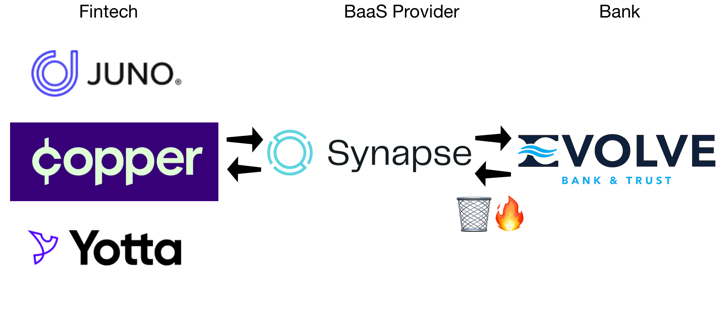
In some cases, the bank itself provides and markets this “Banking as a Service” to external fintech companies. In other cases, there are standalone “Banking as a Service” (BaaS) companies that are essentially the middlemen between fintechs and banks. This was the case with Juno, Yotta, and Copper. (I would not open an account with any of these places right now. Read on for the drama.)


I’m not an expert on these matters, but this is my best understanding of what happened:

  • Synapse, a BaaS provider, had a dispute over millions in unpaid fees and misappropriated user funds with another fintech, Mercury, and the same Evolve Trust & Bank. (Mercury later went to partner directly with Evolve.) Synapse filed for bankruptcy in 2023. Another company, Tabapay, was in talks to acquire Synapse, but that was announced as cancelled on May 9th, 2024. Synapse blamed Evolve Bank & Trust for not resolving existing issues so that the acquisition could move forward. Another player, Lineage Bank, did payment processing for Synapse and also cut off Synapse on May 9th, 2024. They also still holds millions of user funds in an FBO account.
  • On May 11th, 2024, Synapse blocked Evolve from accessing to their “Dashboard” which had the transaction ledger data of every fintech user from Juno, Yotta, and Copper. Since this meant that Evolve Bank & Trust couldn’t verify the reason for money coming in and out of the FBO accounts held at their bank, they completely froze access to those FBO accounts.1 This meant that ACH transfers in and out no longer worked, and debit card transactions also failed.
  • Synapse says that they restored this Dashboard access on May 13, 2024.2 Evolve disputes this and says that they have not received adequate settlement and ledger reports.3 Evolve and Synapse continue to argue inside a US bankruptcy court.
  • Jason Mikula (Fintech Business Weekly, @mikulaja) has been providing some of the most direct and timely insight on this situation.
  • Right now, things are still a dumpster fire. 🗑🔥 The FDIC apparently is not getting involved because this is not a bank failure. The bankruptcy judge is basically looking down at two fighting children and yelling “You two! Sort it out!” Meanwhile, more than entire week has passed and the end customers still haven’t been able to access their funds as this writing 5pm ET 5/20/24.

In the previously-mentioned Treasury Prime article, it goes on to mention the heightened risk of an “intermingled FBO model” setup. I don’t know if this is what Synapse offered, but it does ring several alarms 🚨:

Some BaaS providers offer an intermingled FBO model through bank partnerships. In this particular model, the BaaS provider opens one FBO account for the benefit of all of its fintech end-users across various companies, rather than have each fintech open an FBO account with the partner bank directly.

The level of risk in this arrangement could be profoundly greater than the risk of a traditional FBO account.

[…] Even more concerning to the fintech in this arrangement is the significant ledgering precision and reconciliation required in this model. Any slight ledgering error or calculation gap could require rebalancing and re-ledgering all ledger accounts or sub-accounts in the entire FBO account. This could potentially create a domino effect and impact the records and corresponding funds of a large number of accounts.

The takeaway? Fintechs are still a new form of banking that isn’t well-regulated and things can break. Even though pass-through FDIC insurance applies, I would still never make any fintech my primary day-to-day checking account due to the possibility of short-term loss of access. Now, I’d bet that I am in the top 0.1% of people with the most fintech accounts opened. I’m probably nearing triple digits. I still plan to open new accounts, try out new features, and earn sign-up bonuses and perks. Even if I try to perform due diligence, I know that these folks learned from the school of “ask for forgiveness, not permission”. If startups choose to “move fast and break things”, it may take a while to fix them. Not all fintechs are the same, but never put all your eggs in one basket.

I still expect all customer funds to be released eventually, but I know that the lack of access to funds can be very painful for people and that is very unfortunate. It bugs me that you know that the rich CEOs aren’t being forced to negotiate with landlords, credit card companies, medical providers, and so on. Here is a link to file a CFPB complaint.

I don’t plan to do any future business with any of the parties involved. The biggest fintechs involved seem to have stuck with a bankrupt BaaS provider for several months because they didn’t find a better option (or nobody else wanted to deal with them). Yotta did lottery-type games. Juno did crypto. Per an email from Juno:

Over the last 6 months we have attempted several times to diversify our banking stack and even spent 3 months of engineering resources to integrate with a new partner. Given that our platform offers crypto adjacent services, it has been incredibly difficult to get a final approval from a bank partner to onboard customers. This is a broader problem specific to the crypto industry due to the current regulatory climate not being favourable to crypto or crypto adjacent companies.

Copper, Juno, and Yotta all neglect to mention this crisis on their front pages. They should be more transparent with their issues. With the public anger growing, Yotta instead went and completely deleted their X/Twitter account. Wow.

1 From TechCrunch:

An Evolve spokesperson confirmed to TechCrunch that on May 11, “Evolve Bank & Trust faced an unexpected challenge when Synapse abruptly and without prior notice disabled our access to an account and transaction information dashboard controlled by Synapse and needed by Evolve. This sudden disruption significantly impacted our ability to maintain the visibility and transparency that Evolve needs to have into accounts and transactions. In response to this situation, Evolve took swift and decisive action to safeguard the security of end user funds and ensure compliance with applicable laws. As a precautionary measure, we made the difficult decision to freeze payment and card activity until we could successfully re-establish access to the dashboard as well as receive necessary account and transaction data and reports. While we understand the inconvenience this may have caused, this step was taken with the utmost consideration for the security and integrity of end user accounts. Evolve continues to work diligently to obtain necessary information from Synapse.”

2 From Medium written by the Synapse founder:

The continuation of the account freeze by Evolve, despite the restoration of Dashboard access on Monday, May 13, 2024, is unsupportable. Freezing the funds has been unnecessary and punitive, causing significant harm to depositors who rely on access to their funds for essential needs.

3 From Forbes:

The hearing brought no end to the dispute that led Evolve to block customer access to funds, after, it says, Synapse cut off its access to a dashboard necessary for the bank to run compliance screens and determine how much money each individual fintech customer actually has in pooled accounts maintained for their benefit. Synapse says that access was restored this past Monday, but Evolve insists it still doesn’t have what it needs.

Barash did what he could to force a resolution. He ordered Synapse to provide settlement and ledger reports that Evolve Chief Technology Officer Christopher Staab testified the bank had not received. He also ordered executive and technical team members from Evolve and Synapse to meet and confer by Monday to discuss how to restore consumers’ access to their funds.

IKEA Gift Card Promo: Buy $50 eGift Card, Get $10 eGift Card (Limit $500)

ikea0Buy a $50 IKEA eGift card, get bonus $10 eGift Card. That’s $10 off every $60 of IKEA stuff, which seems pretty good. Limit $500 total gift cards purchased ($100 in bonus gift cards). The website URL is funky, but it is linked directly from the IKEA.com gift card page, so looks legit. Set to run 5/15 through 5/21/24, but this offer has ended early in the past. Terms and conditions:

*Valid in U.S. only. Limited quantities of Bonus Cards available. Valid on Digital Gift Card purchases of $50 or more only from IKEA-USA.com. Not valid on physical or in-store Gift Card purchases. Offer will apply automatically at check-out if purchase qualifies. Additional $10 Digital Gift Card (“Bonus Card”) will be emailed automatically to the purchaser’s email address provided at check-out within 24-48 hours. LIMIT: $500 in Digital Gift Cards/10 Bonus Cards per purchaser during offer period. Gift Cards not redeemable for cash (unless required by law). Except for purchase limits set forth above, offer subject to IKEA Gift Card terms and conditions, https://www.ikea.com/us/en/customer-service/gift-cards-pub3d1efe50. Other restrictions may apply. See IKEA-USA.com for details. ©Inter IKEA Systems B.V. 2024.

Note the waiting period of 24-48 hours for the bonus gift card to show up. Found via Doctor of Credit.

Morningstar Asset Class Correlation Charts 2024: 20-Year Historical Matrix

Morningstar has published their 2024 Diversification Landscape Update (direct link to PDF), another useful whitepaper for DIY investors that looks closer at the correlations between different asset classes. In their Key Takeaways, they note the quick turnaround from “The Classic 60/40 Portfolio is Dead” articles at the end of 2022 to “The Classic 60/40 Portfolio is Back!” at the end of 2023.

After a dismal year in 2022, the plain-vanilla version of a 60/40 portfolio (made up of US stocks and US investment-grade bonds) gained about 18% in 2023. Diversifying into other asset classes generally led to lower returns.

This marks a reversal from 2022 when portfolio diversification was a net positive. However, the basic 60/40 portfolio, composed of US stocks and high-quality bonds, has been tough to beat over longer periods. A 60/40 portfolio improved risk-adjusted returns versus an all-stock benchmark in more than 87% of the rolling three-year periods starting in 1976.

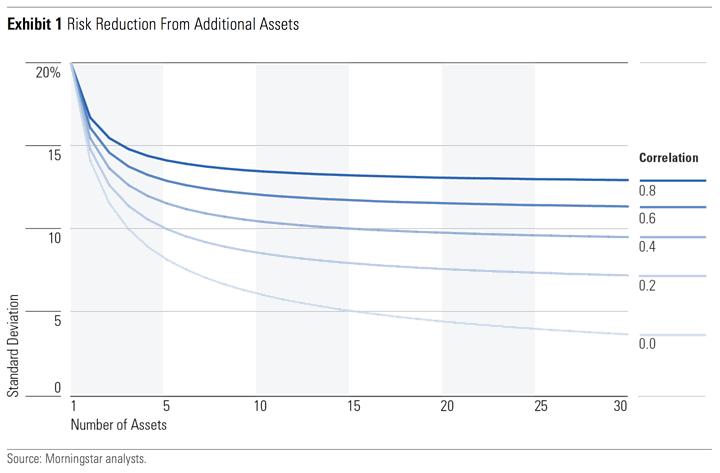
A potential benefit from owning multiple asset classes is that the lower the correlation between asset classes (the less they move in the same direction), the greater the reduction in volatility you get by combining assets. As long as you combine asset classes with correlations below 1 (perfectly correlated), you get some degree of volatility reduction. (See top graphic.) You can also see that the volatility reduction benefit mostly occurs within the first few asset classes; you don’t need 10 of them.

As you can see from the 60/40 Key Takeaway, the catch here is that correlations aren’t always stable. We have to look for longer historical trends with evidence that it will continue. Here are a few selected charts from the research paper.

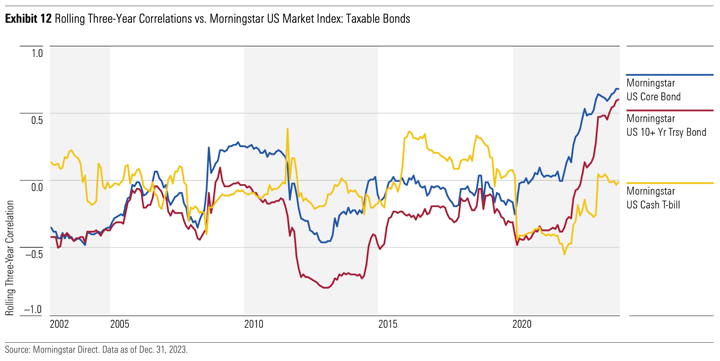
T-Bill and Chill. Over long periods, US Treasury bonds have a lower average correlation to US stocks than a Total Bond index that includes investment-grade corporate bonds. But T-Bills (cash) get rid of the interest rate risk within T-Bonds as well, which often results in T-Bills being the most reliable shelter from the storm. You might not get a handy negative correlation boost during a stock crash, but the correlation will be reliably close to zero and your principal will be ready and waiting to deploy.

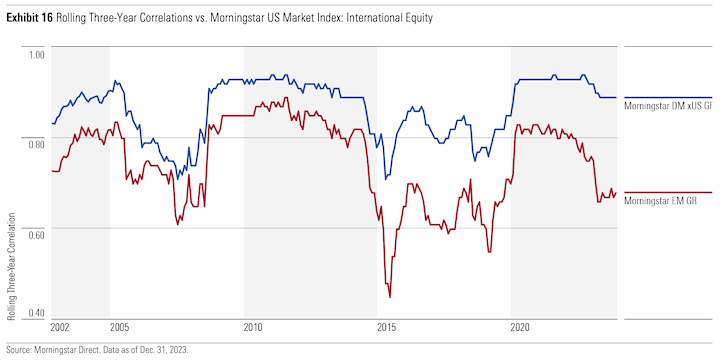
International stocks offer a small diversification benefit, but are usually strongly correlated with US stocks. (Though a little less so recently.) In the end, you must have faith that international stock returns will at times exceed US stock returns for periods of time to invest in this asset class. That faith has been tested recently, but I still would rather own them than not.

Commodities and Gold. Commodities go through boom and bust cycles as part of their nature, and the correlations with US stocks can also stay high or low for years at a time. I find it all very unreliable and unpredictable. Now, Gold has shown a consistently low correlation with US stocks, which is definitely an attractive quality. I’m more concerned about the long-term returns. Again, you need to have faith that long-term average gold returns will be well above inflation.

Long-term average correlations between asset classes. At the bottom of the whitepaper, don’t miss the charts which include correlation matrixes between major asset classes over the last 1, 3, 5, 10, 15, and 20 years.

5.10% APY CDs, 5.10% APY No-Penalty CDs, 5.276% APY Savings via Raisin (Limited-Time Bonus Boost, up to $200)

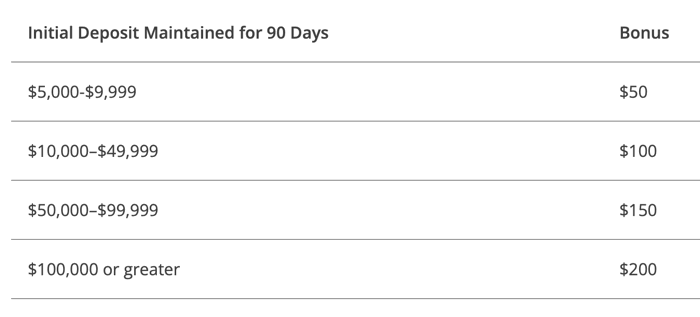
Limited-time Referral Bonus Boost: The Raisin referral bonus for new accounts has been hiked for a limited time, doubled on some tiers and now up to $200. The new tiers are below. At the $5,000 and $10,000 amounts, the bonus works out to 1% of the deposit for a minimum 90 day hold, which works out to a 4% annualized boost above the existing interest rates. ($50k tier = 1.2% APY annualized boost, $100k tiers = 0.8% annualized boost). Here is my referral link and my personal referral code is jonathanp31786. Thanks if you use it.

Full review:

Updated rates for July 2024. Raisin.com (formerly SaveBetter) is a financial marketplace that allows you to access high-interest certificates of deposit and savings accounts from multiple different banks and credit unions without having to open up a new account at each one. Every participation institution is either FDIC-insured or NCUA-insured. The participating banks, product terms, and interest rates change regularly. SaveBetter is now Raisin, to better match the same popular service that runs in Europe. Here are the top Raisin offers as of 5/1/2024:

High-Yield CDs

  • 5.10% APY for 12-month CD. CDs are for locking in a rate. I don’t really consider anything less than a year term to be useful. Minimum opening deposit is $1.

No-Penalty CDs

  • 5.10% APY for a 9-month No Penalty CD. Your rate will never go down, but there is also no early withdrawal penalty. Withdrawals may be made 30 days after opening.

Liquid Savings

  • 5.27% APY Savings Account. Minimum opening deposit is $1. No limit on number of transactions.

Background on Raisin. Raisin is a marketplace for partner banks and credit unions looking to promote their deposit products. They offer liquid savings account, No-Penalty CDs, and High-Yield traditional CDs. Funds are held in a custodial account at the bank or credit union that is providing your selected savings product(s). The banks are all FDIC-insured and the credit unions are all NCUA-insured. Raisin does not charge any monthly maintenance fees. Raisin’s US operations are a subsidiary of Raisin GmbH, a German financial company that also offers high-interest deposit products across Europe.

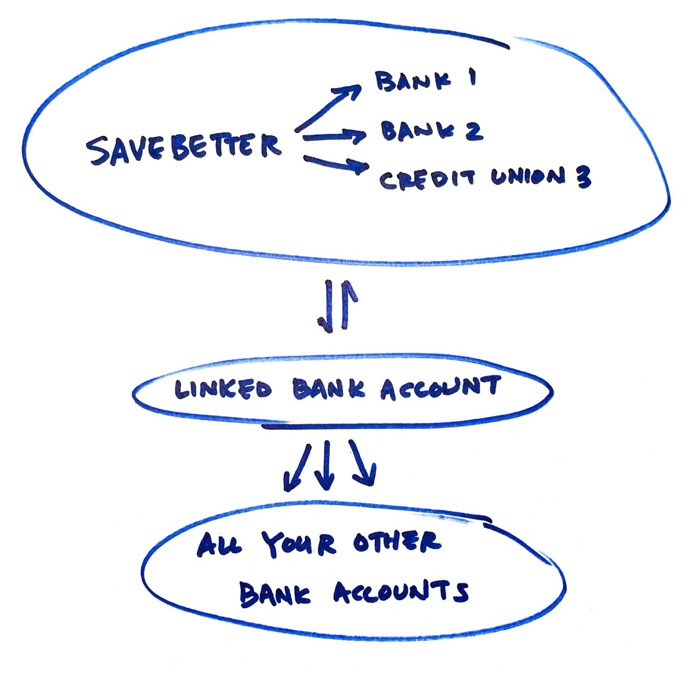
The benefit for the consumer is that you can easily access promotional rates at a new bank or credit union without having to open yet another new account (and endure credit checks, identify verification hurdles, join partner organizations, leave funds in share savings accounts, etc). This makes it easier to chase higher savings accounts and CD rates. You must link a single external bank account and make all your deposits and withdrawals electronically through that linked account. You can only have one external bank account linked at a time, so choose carefully.

A drawback is that you do not get direct access to your Raisin sub-accounts via routing number and account number. You must go through the Raisin site to open accounts, make deposits, and make withdrawals. Your single linked external bank is your only access to Raisin, so in a way I mentally name it also as my “Raisin bank account”. Here is a simple illustration I made that helps me visualize this setup:

Here are some more details from the Raisin site:

5. What is a custodial account and how does it work?
Custodial accounts are involved in how Raisin directs the money transfers from customers to the banks and credit unions holding their savings. When a customer makes a deposit through their Raisin account into a savings product offered by a given financial institution, the funds move from the customer’s external bank account (also referred to as the reference account) to an omnibus custodial account held by Lewis and Clark Bank (functioning in the role as a custodian bank) at the financial institution offering the savings product.

6. How does pass-through deposit insurance work?
Although Raisin customers’ deposits are pooled in omnibus accounts, there is no impact on the eligible deposit insurance coverage you receive from the financial institution holding your savings. This is because the government entities providing federal deposit insurance — the FDIC for banks and NCUA for credit unions — permit pass-through coverage. So your money that’s pooled in a custodial account still has the coverage it would have were it held in an individual account in your name.

I suspect this setup is a lower cost structure for the banks as well, which in turn allows higher interest rates. After learning about omnibus accounts, I noticed that other places like Fidelity Investments also use them in their cash sweep accounts as temporary holding accounts. Search for “omnibus” in your terms and conditions. This is also similar to how “brokered CDs” are usually managed when you buy them through a broker like Vanguard and Fidelity – the funds are pooled together at the issuing bank and don’t include individual account numbers. Same with the FDIC-insured accounts inside many 529 plans.

Referral bonus ($5,000+ deposit required). The minimum deposit for both their savings and CDs are usually as low as $1 (each product has different terms). However, if you are new to Raisin and plan to deposit at least $5,000, they do have a referral program if you open via a referral link and enter my personal referral code jonathanp31786. You must deposit $5,000 for 90 days to earn $25, and then additional $5 for every subsequent $5,000 deposit past that, up to a max of $125 bonus ($105,000 total deposit). Here’s the fine print:

Making $125 has never been so easy or rewarding. Simply enter in the code you received from your friend or family member when you sign up for an account with Raisin. Once you fund your account and maintain an initial balance of $5,000 or more for 90 days, you will earn a minimum bonus of $25 and a maximum bonus of $125 depending on the account balance you maintained after 90 days. The bonus will be paid out within 30 days of qualification. Funds will be deposited into your external bank account linked to Raisin.

The referral bonus has gone up for a limited-time. Please see the top of the post for the current tiers.

Juno Finance App: Banking Interruptions, 5% APY and 5% Cashback Terminated

Update May 2024: Juno just sent out the following e-mail today, which may be the best of example of public relations double-speak that I’ve seen in a while. Look at all those meaningless words! 😳 Juno paid out a lot of above-average valuable perks for a while, even before their crypto pivot, and I’m still not sure where the money came from. Unfortunately, the music has finally stopped and the party looks to be over. 🎉 🙅 They are reporting banking interruptions (ACH transfers + debit cards) and are terminating their 5% APY interest and 5% cashback program with only 48 hours notice (5/15/24). If you still have money there, I would recommend starting the withdrawal process but also having some patience. I have no reason to expect any principal losses but these types of disruptions do occur with fintech apps at times, unfortunately. This tweet says they are looking to switch banking providers in the next 4 weeks (!), but when you allow something like this to happen, that may be too little too late.

Dear Jonathan,
Juno stands at the intersection of banking and cryptocurrency, providing the quickest and easiest access to over 20 blockchains in the United States through ACH, Wire, Cash App, and more. We pride ourselves on promoting self-custody by eliminating mandatory holding periods for crypto withdrawals, distinguishing us from many U.S. crypto exchanges.

The past 18 months have witnessed remarkable growth in crypto and stablecoin sectors. These innovations are essential for creating fair and transparent financial services. At Juno, we are committed to a future where financial control rests with the users, not the banks.

In the past few days, banking services on Juno have been temporarily disrupted. Our team is hard at work collaborating with our banking services provider, Evolve Bank & Trust, and brokerage partner, Synapse Brokerage LLC., to resolve the disruptions as quickly as possible. This disruption, however, further strengthens our commitment to build a future where you are in control of your money at all times, not the banks.

Introducing Juno 2.0 – Reimagining Banking for Tomorrow

In 2024, Juno will focus intensively on developing financial services centered around crypto and stablecoins to ensure that you are always in control of your money. Our goal is to seamlessly integrate banking and crypto infrastructures to foster innovative experiences in savings, payments, and investments, making crypto and stablecoins practical for everyday use.

As part of this strategic realignment, starting May 15, 2024:

Cash held in Juno accounts will no longer accrue the 5.00% bonus, regardless of the account balance.
Additionally, purchases made with the Juno card will no longer receive a 5% cashback.

We recognize that these changes might be disappointing. However, please be assured that this decision was made with careful consideration of our long-term vision to give Juno members financial freedom by placing crypto and stablecoins at the heart of banking and financial services.

Thank you for your understanding and continued support. Should you have any questions or need more information, our customer support team is always here to assist you.

Update January 2024: Juno is now paying a 5.00% annualized bonus on balances from $20,000 up to $250,000 and 3.00% annualized on balances below $20,000.

Original post below, now outdated, last updated circa 2023:

Juno.finance (formerly OnJuno) is a fintech that combines an FDIC-insured bank account and a crypto custodian. Details:


  • New: Earn 5.00% annualized bonus on all cash deposits up to $250,000 and 3.00% annualized on balances below $20,000. This applies to traditional cash deposits (USD), which are FDIC-insured through Evolve Bank & Trust. Applies to both the Basic and Metal tiers. No transaction or direct deposit requirements.
  • New: JCOIN Loyalty Program. Earn loyalty tokens “JCOIN” when you complete certain actions with Juno. Existing users should check their accounts as Juno may have given you a bunch for free that you must claim. These loyalty tokens are redeemable inside the app for various perks including gift cards.

OnJuno partners with Evolve Bank and Trust for FDIC insurance. A reminder that cryptocurrencies, including USDC stablecoins, are not covered by FDIC insurance even though the creators claim they are backed 1:1 by US dollars. Juno has added support for crypto and external wallets. Don’t confuse your FDIC-insured USD deposits with stablecoins.

Traditional Bank-to-bank transfers. OnJuno uses the Plaid service to link with external bank accounts for funding and free ACH transfers (both deposits and withdrawals). They also provide you with the full account number and routing number, which you can use to connect with other banks like Ally, Marcus, CapOne 360, etc. The routing number is 084106768 which is confirmed as that of Evolve Bank & Trust. I was able to make a deposit and withdrawal initiated at Ally without issue (subject to transfer limits of $20,000 daily/$500,000 monthly). As with some other fintechs, their in-house limits are lower.

Bonus rate, not APY? You may notice that they don’t use “APY” and instead say “bonus rate”. Here’s their reason:

The Bonus Rate is offered entirely by OnJuno and is not interest provided by Evolve Bank and Trust. The bonus rate You earn will be credited to Your account at the beginning of each month. Your funds begin generating a bonus rate once they are available on Your OnJuno Checking Account. Please note that OnJuno reserves the right to cancel, remove, and change this bonus at any time. OnJuno also reserves the rights, in sole discretion, to refuse this bonus without cause, reason, and notice.

I’ve been getting my bonus rate every month without issue at the proper annualized rate, so this just seems to be a legal thing. Your interest is still shown on a 1099-INT at the end of the year.

Additional details.

  • Customer service. You can contact them via phone at 415-969-5775 (9am to 6pm Pacific) or online message (they replied to me within a few hours).
  • No minimum balance requirement.
  • Fee-free access to both Allpoint and Moneypass ATM networks (85,000+ locations).
  • Free debit Mastercard.
  • No mobile check deposit yet.

Bottom line. Juno is a fintech banking app with a high-interest checking account with no direct deposit or debit card usage requirements. FDIC-insurance from Evolve Bank and Trust. It does have ties with crypto, which may be either a plus or minus for you.

2024 Berkshire Hathaway Annual Shareholder Meeting Video, Transcript, and Notes

The 2024 Berkshire Hathaway Annual Shareholder Meeting occurred on May 4th, 2024, and while there are lots of articles offering highlights (including this one), it’s never the same feeling as tuning into the actual thing. I always find a few nuggets that mean something to me, even if just a small side remark. Warren Buffett, Greg Abel, and Ajit Jain answered questions while we felt the palpable absence of the late Charlie Munger.

CNBC again has the broadcast rights. You can find the full 7+ hour live re-broadcast on CNBC YouTube (at least for now) and they have also uploaded most of it (not all) to the CNBC Buffett Archives site. Their official transcript is not yet available, but you can find a helpful transcript from Steady Compounding or listen to the audio podcast version here. Personally, I like to listen to the audio in the car once, and then read through the transcript for the second round.

Here are a few personal takeaways and notes.

Charlie Munger tribute. The meeting started with a video tribute to Charlie Munger, but that part is not included in many of the video links. Be sure to watch it here on the full video starting at 30:34. It is a very nice and touching tribute, including many classic Charlie Munger quotes. He did things his way, all the way to the end. I always loved that Buffett and Munger genuinely had fun together. When asked about “one more day with Charlie”, here was part of Buffett’s response:

We always lived, in a way where we were happy with what we were doing every day. I mean, Charlie. Charlie liked learning. He liked, as I mentioned in the movie, he liked a wide variety of things. So he was much broader than I was.

But I didn’t have any great desire to be as broad as he was. And he didn’t have any great desire to be as narrow as I. But we had a lot of fun doing anything. And, you know, we played golf together, we played tennis together, we did everything together. And this you may find kind of interesting.

We had as much fun, perhaps even more to some extent, with things that failed, because then we really had to work and work our way out of them. And in a sense, there’s more fun having somebody that’s your partner in digging your way out of a foxhole than there is just sitting there and watching an idea that you got ten years ago just continually produce more and more profits. So it wasn’t, you know, he really fooled me, though. He went to 99.9 years. I mean, if you pick two guys, you know, he never publicly said he never did a day of exercise except where it was required when he was in the army.

He never did a day of voluntary exercise. He never thought about what he ate. You know, we started every day, and Charlie had. He was interested in more things than I was, but we never had any doubts about the other person, period. And so if I’d had another day with him, we’d probably have done the same thing we were doing the earlier days and we wouldn’t have wanted another.

The only book available at their on-site bookstore this year was the new 2023 edition of Poor Charlie’s Almanack: The Essential Wit and Wisdom of Charles T. Munger.

Current Berkshire Hathaway stock price is close to intrinsic value. Berkshire’s cash pile keep growing, and sometimes it buys back shares when Buffett thinks it’s a good deal for existing shareholders. Right now, it seems like Buffett thinks it is only slightly undervalued to intrinsic value. Historically, buying BRK when BRK buys a lot of BRK has been a pretty good bet. (Say that three times fast!)

And our stock is at a level where it adds slightly to the value when we buy in shares. But we would. We would really buy it in a big way, except you can’t buy it in a big way because people don’t want to sell it in a big way, but under certain market conditions, we could deploy quite a bit of money in repurchases. And as you’ll see on the final slide, we have bought it in the last five years. We can’t buy them like a great many other companies because it just doesn’t trade that way.

Buffett sees higher tax rates as likely in the future, at least for corporations. When asked why he trimmed his position in Apple stock, Buffett (as he often does) redirected the question a bit to taxes.

We don’t mind paying taxes at Berkshire, and we are paying a 21% Federal rate on the gains we’re taking in Apple. And that rate was 35% not that long ago, and it’s been 52% in the past when I’ve been operating. And the government owns. The Federal government owns a part of the earnings of the business we make. They don’t own the assets, but they own a percentage of the earnings, and they can change that percentage any year.

And the percentage that they’ve decreed currently is 21%. And I would say with the present fiscal policies, I think that something has to give, and I think that higher taxes are quite likely, and the government wants to take a greater share of your income, or mine or Berkshire’s, they can do it. And they may decide that someday they don’t want the fiscal deficit to be this large, because that has some important consequences, and they may not want to decrease spending a lot, and they may decide they’ll take a larger percentage of what we earn and we’ll pay it.

[…] And if I’m doing it at 21% this year and we’re doing it at a higher percentage later on, I don’t think you’ll actually mind the fact that we sold a little Apple this year.

Living a good life. As usual, he dropped some good general life advice.

But the opportunity in this country is basically limitless. When you think of going back not that many centuries, if you were going to be a shepherd or something like that, 100 years from now, your grandson was a granddaughter, was going to be a shepherd, nothing really happened. And what has happened in the last 200 years with the combination of the industrial revolution, whether it’s science or education or health, you name it. We are so lucky to be born when we were the people in this room, and many of us were lucky enough to be born in the United States as well, that you.

You’re entering the best world that’s ever existed, and you want to find the people to share it with and the activities to participate in that fit you. And if you get lucky, like Charlie and I did, you find things that interest you young. But if you don’t find them right away, you keep looking. And I always tell students to take the job. I mean, find the job that you would like to have if you didn’t need a job.

And sometimes you can find that very early, and sometimes you go through various experiences, but don’t forget what you actually are trying to do, and there’s no place to do it like this country. Find the person that you like to share your life with in many cases. And, you know, sometimes you get lucky into that early, and sometimes you make mistakes.

But I would try to, in a very, very general way, I would try to figure out how you’d want to look back on your life and think about yourself and start today to go on the path that leads to that goal and expect some difficulties along the way. But if you’re thinking that way, you’re more likely to get there.

Keep trying, expect bumps, appreciate what you already have, and don’t let envy ruin it all. This Munger quote from the 2023 Daily Journal shareholder meeting sticks in my head: “I can’t change the fact that a lot of people are very unhappy and feel very abused after everything’s improved by about 600% because there’s still somebody else who has more.”

Berkshire shareholders as both savers and givers. Buffett reinforced the stereotype that Berkshire Hathaway shareholders are different and tend to be relatively frugal, practical, and not focused on outward appearances. Not only did a shareholder donate $1 billion dollars to a medical school in the past year (such that tuition will be free in perpetuity), but it didn’t even require them to change the name of the school. Another BRK shareholder just anonymously donated $500 million.

The next generation is fully in place. My overall impression was that while Buffett is still the top guy, with the passing of Charlie he has psychologically already passed the baton to Greg Abel and Ajit Jain. Abel is who all the subsidiary business managers deal with on a daily basis. Ajit is fully in control of the insurance side. Buffett basically said that Berkshire should be good for the next 20 years and he’s done the best he can (knock on wood).

We’ve really got the problem solved for the next 20 years unless something untoward happens. And if something untoward happens, then. Then the directors need to find, probably within our own organization, somebody that they’ve got confidence in to maintain the special advantages we have over another 20 years period. There’s various things that are low probabilities, but you still have to think about them, and we are in that position now. Now, if you asked me whether.

If something happened to Greg today, everybody says, don’t travel on the same plane. The thing to do is not travel in the same auto. Planes don’t go down that often. Autos crash all the time. I’ve seen all these corporate policies on that, which are kind of crazy when you think about the real risk.

But in any event, Greg is going to have to tell the directors about what if something happened tomorrow. He has to tell the directors about what should be done if anything happens to him. And that’s not an easy thing to do, and I don’t have.

Buffett will still be there to make sure that they properly pounce during the next crisis when everyone is scared but Berkshire. I get the sense that is really the only thing left that would get him really excited: the possibility of a future big moment with lots of buying opportunities. A few last big brush strokes for his masterpiece.

And that’s sort of the story of Berkshire. We’ll try to increase operating earnings, and we will try to reduce shares when it makes sense to do so. And we will hope for an occasional big opportunity. And we’re quite satisfied with the position we’re in.

Best Interest Rates on Cash Roundup – May 2024

Here’s my monthly roundup of the best interest rates on cash as of May 2024, roughly sorted from shortest to longest maturities. There are lesser-known opportunities available to individual investors, often earning you a lot more money while keeping the same level of safety by moving to another FDIC-insured bank or NCUA-insured credit union. Check out my Ultimate Rate-Chaser Calculator to see how much extra interest you could earn from switching. Rates listed are available to everyone nationwide. Rates checked as of 5/8/2024.

TL;DR: Mostly only minor changes since last month. Still 5%+ savings accounts and short-term CDs, with long-term CD rates holding roughly steady since last month. Compare against Treasury bills and bonds at every maturity, taking into account state tax exemption.

Fintech accounts
Available only to individual investors, fintech companies often pay higher-than-market rates in order to achieve fast short-term growth (often using venture capital). “Fintech” is usually a software layer on top of a partner bank’s FDIC insurance.

  • 5.26% APY ($1 minimum). Raisin lets you switch between different FDIC-insured banks and NCUA-insured credit unions easily without opening a new account every time, and their liquid savings rates currently top out at 5.26% APY across multiple banks. See my Raisin review for details. Raisin does not charge depositors a fee for the service.
  • 5.36% APY (before fees). MaxMyInterest is another service that allows you to access and switch between different FDIC-insured banks. You can view their current banks and APYs here. As of 5/8/24, the highest rate is from Customers Bank at 5.36% APY. However, note that they charge a membership fee of 0.04% per quarter, or 0.16% per year (subject to $20 minimum per quarter, or $80 per year). That means if you have a $10,000 balance, then $80 a year = 0.80% per year. This service is meant for those with larger balances. You are allowed to cancel the service and keep the bank accounts, but then you may lose their specially-negotiated rates and cannot switch between banks anymore.

High-yield savings accounts
Since the huge megabanks STILL pay essentially no interest, everyone should have a separate, no-fee online savings account to piggy-back onto your existing checking account. The interest rates on savings accounts can drop at any time, so I list the top rates as well as competitive rates from banks with a history of competitive rates and solid user experience. Some banks will bait you with a temporary top rate and then lower the rates in the hopes that you are too lazy to leave.

  • The top rate at the moment is at My Banking Direct at 5.55% APY . Poppy at 5.50% APY (3-month rate guarantee). I have no personal experience with them, but they are the top rates at the moment. CIT Platinum Savings at 5.00% APY with $5,000+ balance.
  • SoFi Bank is at 4.60% APY + up to $325 new account bonus with direct deposit. You must maintain a direct deposit of any amount each month for the higher APY. SoFi has historically competitive rates and full banking features. See details at $25 + $300 SoFi Money new account and deposit bonus.
  • Here is a limited survey of high-yield savings accounts. They aren’t the top rates, but a group that have historically kept it relatively competitive such that I like to track their history. Sad to see Ally Bank falling even further behind.

Short-term guaranteed rates (1 year and under)
A common question is what to do with a big pile of cash that you’re waiting to deploy shortly (plan to buy a house soon, just sold your house, just sold your business, legal settlement, inheritance). My usual advice is to keep things simple and take your time. If not a savings account, then put it in a flexible short-term CD under the FDIC limits until you have a plan.

  • No Penalty CDs offer a fixed interest rate that can never go down, but you can still take out your money (once) without any fees if you want to use it elsewhere. Raisin has a 9-month No Penalty CD at 5.10% APY with $1 minimum deposit and 30-day minimum hold time. Marcus has a 13-month No Penalty CD at 4.70% APY with a $500 minimum deposit. Also available at 7- and 11-months. Consider opening multiple CDs in smaller increments for more flexibility.
  • NexBank has a 1-year certificate at 5.40% APY ($25,000 min). There is a 180-day interest penalty if you withdraw your CD funds before maturity.
  • CIBC Agility Online has a 13-month CD at 5.36% APY ($1,000 min). Reasonable 30-day penalty if you withdraw your CD funds before maturity.

Money market mutual funds + Ultra-short bond ETFs
Many brokerage firms that pay out very little interest on their default cash sweep funds (and keep the difference for themselves). Note: Money market mutual funds are highly-regulated, but ultimately not FDIC-insured, so I would still stick with highly reputable firms. I am including a few ultra-short bond ETFs as they may be your best cash alternative in a brokerage account, but they may experience losses.

  • Vanguard Federal Money Market Fund is the default sweep option for Vanguard brokerage accounts, which has an SEC yield of 5.26% (changes daily, but also works out to a compound yield of 5.39%, which is better for comparing against APY). Odds are this is much higher than your own broker’s default cash sweep interest rate.
  • The PIMCO Enhanced Short Maturity Active Bond ETF (MINT) has a 5.33% SEC yield and the iShares Short Maturity Bond ETF (NEAR) has a 5.24% SEC yield while holding a portfolio of investment-grade bonds with an average duration of ~6 months.

Treasury Bills and Ultra-short Treasury ETFs
Another option is to buy individual Treasury bills which come in a variety of maturities from 4-weeks to 52-weeks and are fully backed by the US government. You can also invest in ETFs that hold a rotating basket of short-term Treasury Bills for you, while charging a small management fee for doing so. T-bill interest is exempt from state and local income taxes, which can make a significant difference in your effective yield.

  • You can build your own T-Bill ladder at TreasuryDirect.gov or via a brokerage account with a bond desk like Vanguard and Fidelity. Here are the current Treasury Bill rates. As of 5/7/24, a new 4-week T-Bill had the equivalent of 5.37% annualized interest and a 52-week T-Bill had the equivalent of 5.15% annualized interest.
  • The iShares 0-3 Month Treasury Bond ETF (SGOV) has a 5.27% SEC yield and effective duration of 0.10 years. SPDR Bloomberg Barclays 1-3 Month T-Bill ETF (BIL) has a 5.21% SEC yield and effective duration of 0.08 years.

US Savings Bonds
Series I Savings Bonds offer rates that are linked to inflation and backed by the US government. You must hold them for at least a year. If you redeem them within 5 years there is a penalty of the last 3 months of interest. The annual purchase limit for electronic I bonds is $10,000 per Social Security Number, available online at TreasuryDirect.gov. You can also buy an additional $5,000 in paper I bonds using your tax refund with IRS Form 8888.

  • “I Bonds” bought between May 2024 and October 2024 will earn a 4.28% rate for the first six months. The rate of the subsequent 6-month period will be based on inflation again. More on Savings Bonds here.
  • In mid-October 2024, the CPI will be announced and you will have a short period where you will have a very close estimate of the rate for the next 12 months. I will have another post up at that time.

Rewards checking accounts
These unique checking accounts pay above-average interest rates, but with unique risks. You have to jump through certain hoops which usually involve 10+ debit card purchases each cycle, a certain number of ACH/direct deposits, and/or a certain number of logins per month. If you make a mistake (or they judge that you did) you risk earning zero interest for that month. Some folks don’t mind the extra work and attention required, while others would rather not bother. Rates can also drop suddenly, leaving a “bait-and-switch” feeling.

  • OnPath Federal Credit Union pays 7.00% APY on up to $10,000 if you make 15 debit card purchases, opt into online statements, and login to online or mobile banking once per statement cycle. Anyone can join this credit union via $5 membership fee to join partner organization. You can also get a $100 Visa Reward card when you open a new account and make qualifying transactions.
  • Credit Union of New Jersey pays 6.00% APY on up to $25,000 if you make 15 debit card purchases, opt into online statements, and make at least 1 direct deposit, online bill payment, or automatic payment (ACH) per statement cycle. Anyone can join this credit union via $5 membership fee to join partner organization.
  • Andrews Federal Credit Union pays 6.00% APY on up to $25,000 if you make 15 debit card purchases, opt into online statements, and make at least 1 direct deposit or ACH transaction per statement cycle. Anyone can join this credit union via partner organization.
  • Pelican State Credit Union pays 6.05% APY on up to $20,000 if you make 15 debit card purchases, opt into online statements, log into your account at least once, and make at least 1 direct deposit, online bill payment, or automatic payment (ACH) per statement cycle. Anyone can join this credit union via partner organization membership.
  • Orion Federal Credit Union pays 6.00% APY on up to $10,000 if you make electronic deposits of $500+ each month (ACH transfers count) and spend $500+ on your Orion debit or credit card each month. Anyone can join this credit union via $10 membership fee to partner organization membership.
  • All America/Redneck Bank pays 5.15% APY on up to $15,000 if you make 10 debit card purchases each monthly cycle with online statements.
  • Find a locally-restricted rewards checking account at DepositAccounts.

Certificates of deposit (greater than 1 year)
CDs offer higher rates, but come with an early withdrawal penalty. By finding a bank CD with a reasonable early withdrawal penalty, you can enjoy higher rates but maintain access in a true emergency. Alternatively, consider building a CD ladder of different maturity lengths (ex. 1/2/3/4/5-years) such that you have access to part of the ladder each year, but your blended interest rate is higher than a savings account. When one CD matures, use that money to buy another 5-year CD to keep the ladder going. Some CDs also offer “add-ons” where you can deposit more funds if rates drop.

  • Credit Human has a 59-month CD at 4.70% APY. 48-month at 4.70% APY. 35-month at 4.75% APY. 23-month at 5.30% APY. 1-year at 5.05% APY. $500 minimum. The early withdrawal penalty (EWP) for CD maturities of 36 months or more is 365 days of interest. For CD maturity of 1 year, the EWP is 270 days of interest. This is actually a credit union, but is open nationwide with a American Consumer Council (ACC) membership. Try promo code “consumer” when signing up at ACC for a free membership.
  • First Internet Bank has a 5-year CD at 4.50% APY. 4-year at 4.45% APY. 3-year at 4.61% APY. 2-year at 4.76% APY. 1-year at 5.26% APY. $1,000 minimum. The early withdrawal penalty (EWP) for CD maturities of 2 years or more is 360 days of interest. For CD maturity of 1 year, the EWP is 180 days of interest.
  • BMO Alto has a 5-year CD at 4.50% APY. 4-year at 4.50% APY. 3-year at 4.50% APY. 2-year at 4.65% APY. 1-year at 5.05% APY. No minimum. The early withdrawal penalty (EWP) for CD maturities of 1 year or more is 180 days of interest. For CD maturities of 11 months or less, the EWP is 90 days of interest. Note that they reserve the right to prohibit early withdrawals entirely (!). Online-only subsidiary of BMO Bank.
  • You can buy certificates of deposit via the bond desks of Vanguard and Fidelity. You may need an account to see the rates. These “brokered CDs” offer FDIC insurance and easy laddering, but they don’t come with predictable early withdrawal penalties. Right now, I see a 5-year non-callable CD at 4.60% APY (callable: no, call protection: yes). Be warned that now both Vanguard and Fidelity will list higher rates from callable CDs, which importantly means they can call back your CD if rates drop later.

Longer-term Instruments
I’d use these with caution due to increased interest rate risk (tbh, I don’t use them at all), but I still track them to see the rest of the current yield curve.

  • Willing to lock up your money for 10 years? You can buy long-term certificates of deposit via the bond desks of Vanguard and Fidelity. These “brokered CDs” offer FDIC insurance, but they don’t come with predictable early withdrawal penalties. You might find something that pays more than your other brokerage cash and Treasury options. Right now, I see a 10-year CDs at 4.50% (callable: no, call protection: yes) vs. 4.47% for a 10-year Treasury. Watch out for higher rates from callable CDs where they can call your CD back if interest rates drop.

All rates were checked as of 5/8/2024.

Photo by micheile henderson on Unsplash

Robinhood ACAT Bonus: 1% of Taxable Brokerage Assets Transferred w/ No Cap, 2-Year Hold

Offer is back, new deadline is June 28th. Robinhood has brought back their 1% ACAT Transfer bonus of a flat 1% of the transferred amount with no cap. That means a transfer of $10,000 in asset value from an external brokerage account will earn a $100 bonus, a $100,000 transfer will earn a $1,000 bonus, and a $1,000,000 transfer will earn a $10,000 bonus. The bonus should arrive about 2 weeks after the completed transfer, but note that you must keep the assets there for 2 years otherwise they will claw it back. Here is the full PDF fine print. Here is the online FAQ.

For eligible Robinhood customers who complete an ACATS transfer within the Offer Period, Robinhood will deposit 1% of the net transferred asset value to the customer’s Brokerage Account, subject to a two-year earn-out as discussed below. “Net transferred asset value” is the total value of the initiated ACATS minus the value of any outflows from April 30, 2024 at 12:00:00 AM ET until the ACATS is settled, excluding outflows that led to a chargeback. The Bonus will be provided within approximately two weeks from when the customer’s eligible ACATS transfers are completed. The Offer Period begins April 30, 2024 and ends June 28, 2024; however, Robinhood may change these dates at any time without notice. Transferred assets are eligible if they are initiated during the Offer Period.

As with all similar ACAT transfer offers, you can transfer over your existing stock holdings and the cost basis should also transfer over with no tax consequences. You don’t have to move cash. You just keep your same old shares of Apple or Coca-Cola or S&P 500 index ETFs or whatever at a different broker. If you already wanted to hold cash, you could also own things like Treasury bill ETFs or ultra-short term bond ETFs and earn interest on top of the bonus, but in that case this bonus isn’t that great because you’re only getting 1% spread over two years.

I’ve explored some of my Robinhood concerns during their 3% IRA transfer promotion. Here is some of that same information copy-and-pasted here.

Robinhood doesn’t allow all asset types, so you can’t own mutual funds, individual bonds, and closed-end funds. Robinhood is not a full-featured brokerage firm. Here is the full list of what is and isn’t allowed. They support the following:

  • U.S. exchange-listed stocks and ETFs
  • Options contracts for U.S. Exchange-Listed Stocks and ETFs
  • ADRs for over 650 globally-listed companies

This means that if you want to move your balance over to Robinhood, you will have to sell any mutual funds (or convert them to ETFs), individual bonds, brokered CDs, and so on. I converted my Vanguard mutual funds to ETFs, and it took 1-2 business days.

SIPC insurance limits and excess insurance. Robinhood is a member of the Securities Investor Protection Corporation (SIPC), which steps if a broker fails. Robinhood has also purchased additional excess SIPC insurance on the private market. From the Robinhood site:

Robinhood Financial LLC and Robinhood Securities, LLC are both members of SIPC, which protects securities for customers of its members up to $500,000 (including $250,000 for claims for cash). Explanatory brochure available upon request or at www.sipc.org.

We’ve purchased an additional insurance policy for Robinhood Markets, Inc., Robinhood Financial LLC, and Robinhood Securities, LLC to supplement SIPC protection. The additional insurance becomes available to customers in the event that SIPC limits are exhausted. This additional insurance policy provides protection for securities and cash up to an aggregate of $1 billion, and is limited to a combined return to any customer of $50 million in securities, including $1.9 million in cash. Similar to SIPC protection, this additional insurance doesn’t protect against a loss in the market value of securities.

From SIPC.org::

SIPC protects against the loss of cash and securities – such as stocks and bonds – held by a customer at a financially-troubled SIPC-member brokerage firm. The limit of SIPC protection is $500,000, which includes a $250,000 limit for cash.

Is SIPC a U.S. Government Agency?
No. SIPC is not an agency or establishment of the United States Government. SIPC is a non-profit membership corporation created under the Securities Investor Protection Act.

My brokerage firm has excess SIPC insurance. How does that work?
Excess SIPC insurance is insurance provided by a private insurer and not by SIPC. The insurance is intended to protect brokerage customers against the risk that customers will not recover all of their cash and securities in the proceeding under the Securities Investor Protection Act (SIPA). Under many of these policies, customer eligibility for recovery is not determined until after the SIPA liquidation of the customer’s brokerage firm has concluded and the amount of the customer’s recovery in that proceeding has been established.

Some people have concerns that Robinhood is a smaller company with a history of questionable judgment and violating securities regulations. Robinhood holds the current record for highest FINRA fine ever. As a result, you may choose to limit the amount transferred to Robinhood to under $500,000 in assets (and $250,000 cash) per eligible account type. Here are the different “capacities”. For example, you could have an individual taxable account, a traditional IRA, and a Roth IRA at Robinhood and each one would have $500,000 in coverage. I will be staying under these limits as well, but my IRA balance simply isn’t that big anyway.

Note that if you opt-in (or don’t opt-out) to Stock Lending during the account transfer or account opening process, any securities that are loaned out are no longer protected by the SIPC. This is usually offset by a promise of 100% collateral, but that assumes trust that Robinhood will post that collateral. See Gamestop short squeeze for a very recent example of Robinhood… not posting enough collateral. Therefore, I also don’t recommend Stock Lending with Robinhood.

Robinhood limitations on beneficiaries. Robinhood only allows a primary beneficiary who is an adult. That means no trusts, no minors, and no “per stirpes” instructions. See article.

Whom can I designate as my beneficiary?
To be eligible as a TOD or IRA beneficiary, the individual must be a person who is at least 18 years old, a US Citizen, or otherwise be legally permitted to open a Robinhood account.

Robinhood will also reimburse your transfer fees up to $75 if you transfer at least $7,500 worth of assets. After the transfer is completed, you must contact then via the live chat function and they will reimburse you after you upload a screenshot of the fee charged.

When you transfer out eventually, Robinhood does charge a $100 Outgoing ACAT fee. Ideally, there will be another broker to reimburse that fee in the future, but who knows. Here is their full fee schedule [pdf].

Customer service tips. Robinhood does not have a traditional phone number to reach customer service. You have to go the help section, search for a topic, and then look for the “Contact Us” button at the bottom of the page (presumably after you have read the canned answer and still need help). Then you can either have a Live Chat or request a Callback where they will call you back on the phone at a later time.

Security and Privacy tips. To access these settings on the iPhone app, click on the head/body icon on the bottom right, then the three lines icon on the top left, and then “Security and privacy”. On the plus side, Robinhood supports a variety of 2FA options: SMS, Device passkeys, and Authenticator apps. Scroll down further and you can also opt out of their data sharing.

Bottom line. Two years is a longer hold period than some other broker offers, but 1% of assets is still pretty solid overall and worth considering for transferring some buy-and-hold index funds where you don’t want to move them again for a while. (For example, you might get 0.4% of assets elsewhere, but also only have to keep it there for 90 days and be free to chase another bonus afterward.) Some people may also choose to consolidate their taxable brokerage accounts at Robinhood if they already took advantage of the 3% IRA offer. The deadline for this revived offer is currently June 28th, 2024. The bonus value will most likely be reported as taxable income on a 1099-INT as interest earned, but may also end up as 1099-MISC income. (I am reminded again how good the 3% IRA offer was, as the bonus was a non-taxable increase in your Roth IRA balance as compared to this 1% offer that is at best taxable ordinary income.)

Vanguard Adds New $100 Account Closure and Outgoing Transfer Fee

Vanguard recently announced some new and/or increased fees for their brokerage accounts. Here is their updated full commission & fee schedule. The following are effective July 1, 2024:

  • Account closure and ACAT outgoing transfer fee: A $100 fee may be charged for account closure or transfer of account assets to another firm. The fee will not be assessed for clients who hold at least $5 million in qualifying Vanguard assets.
  • Broker-assisted trade commission: A $25 broker-assisted commission will be charged for each Vanguard mutual fund and Vanguard ETF trade placed over the phone and for closing transactions placed by Vanguard Brokerage Services® to cover a margin call or satisfy an outstanding debt owed in your brokerage account. Broker-assisted commissions will not be charged for brokerage accounts enrolled in a Vanguard-affiliated advisory service or for clients with $1 million or more in qualifying Vanguard assets. This previously applied to individual stocks, but not Vanguard ETFs and mutual funds.
  • Stock certificate deposit fee: A $100 processing fee (per CUSIP) will be charged for the deposit of physical share certificates into your brokerage account.
  • Class action service fee: With the introduction of this new service in which Vanguard Brokerage will facilitate filing claims on behalf of clients in an attempt to recover class action settlement funds, a fee of 20% will be deducted from these recovered funds prior to their deposit into your brokerage account.
  • Foreign securities and American Depositary Receipts (ADRs) dividends fee: A fee of 1% on the gross dividend amount will be charged when a dividend is paid on a foreign or ADR asset held in U.S. dollars.
  • Restricted security legend removal fee: A $250 processing fee may be charged for research and removal of a restriction on a security held in your brokerage account.

The following are effective July 1, 2024:

  • Tax filing fee for master limited partnerships (MLPs) held in an IRA will change from $300 to $500 per account.

These moves could be seen as Vanguard expanding its “at cost” philosophy. Vanguard decided that paper statements cost too much money, so they made everyone pay for them if they wanted them. Vanguard is probably seeing a lot of accounts being closed and/or transferred out, and now they want you to cover the cost to administer that as well.

An alternative view is that most of these fees are justifiable in that most of Vanguard’s competitors also charge them. Vanguard is simply becoming more like every other broker. It’s up to you to decide if that is a good thing.

While a lot of other brokers indeed have outgoing transfer fees, Fidelity still charges nothing for both full and outgoing ACAT transfers. Schwab and Merrill Edge charge $50 for a full outgoing transfer, but $0 for a partial transfer.

I would say the most surprising fee is the account closure fee. I can understand the outgoing transfer fee, but I think there is a reason why I could not find an account closure fee at Fidelity, Schwab, or Merrill Edge. If you have $5,000 invested and need to sell everything to pay for an unexpected bill, Vanguard will now ding you for another $100 on the way out. Even if justified in terms of administrative work required, it just doesn’t look so good on the public relations front.

I suppose the actionable advice is that if you were thinking about transferring multiple accounts out of Vanguard, you might want to do so before the new fee is implemented. A brokerage, Traditional IRA, and Roth IRA would add up to $300 now. Although, if I did move out, it would be for ACAT transfer bonuses which usually include outgoing ACAT fee rebates, so I don’t plan to rush into anything. If I had a smaller account, I would consider it more strongly as the ACAT fee rebates usually require a minimum asset level of $5,000 to $10,000.

During a discussion about an outgoing transfer last year, a Fidelity rep told me: “No, we won’t charge you a fee when you transfer out, and we won’t charge you a fee when you come back.” In other words, they are confident that their product is good enough that while you might leave to try out a competitor, chances are good that you’ll eventually come back.