Archives for November 2023

CIBC Bank Agility Online Savings $250/$500 Deposit Bonus (New & Existing)

CIBC Bank USA has brought back a $250/$500 deposit bonus for customers that are adding new money to their Agility online savings account (you can be a new or existing customer). The bonus is on top of the interest rate, currently a competitive 5.01% APY (as of 11/7/23). $1,000 minimum to open. No monthly maintenance fees. CIBC stands for the Canadian Imperial Bank of Commerce. Hat tip to DepositAccounts.

I think it’s best to simply quote their terms and conditions first:

In order to qualify for an account bonus, you must increase the current balance in your CIBC Bank USA (“CIBC”) Agility Savings account by depositing funds of $25,000 or more of New Money (defined below) from an external bank between 12:00 a.m. ET on November 1, 2023 and 11:59 p.m. ET on December 19, 2023 (the “Funding Period”). The New Money must remain in your account until 11:59 p.m. on March 18, 2024. This offer applies to both new and existing accounts. If you are funding by ACH transfer, keep in mind timeframes for applicable verification and for transfer origination which may take 1-3 business days before the funds are credited to your Agility Savings account. The funds must be credited during the Funding Period.

You must also enroll into online statements:

If you are not already enrolled in e-statements, you must enroll in Online Banking and change the Statements Delivery Method to “Online” during the Funding Period. You must continue online statement delivery through March 18, 2024.

The bonus amount is $250 for $25,000+ and $500 for $50,000+ in new money as follows:

The amount of your bonus will be determined as follows:

– $250 bonus – The New Money you deposited from an external bank during the Funding Period was between $25,000 and $49,999.99 (“Tier 1”), and you maintained at least $25,000 in New Money until 11:59 p.m. ET on March 18, 2024.
– $500 bonus – The New Money you deposited from an external bank during the Funding Period was $50,000 or more (“Tier 2”), and you maintained at least$50,000 in New Money deposited in the account until 11:59 p.m. ET on March 18, 2024.

Additional details:

If you fulfill the offer requirements outlined above, CIBC Bank USA will deposit the bonus into your CIBC Agility Savings account no later than May 17, 2024. In order to receive the bonus your account must be open and not overdrawn at the time of the bonus payout. Only one bonus allowed per primary account owner Tax ID.

New deposit bonus example. Here’s how it might work for a new customer:

  • Open a new CIBC Agility Savings Account AND also make your $25,000 or $50,000 deposit of new money (from outside CIBC) arrives safely before December 19, 2023.
  • Remember to sign up for online eStatements as soon as you open your account.
  • Earn $250 when you deposit at least $25,000 and keep the money in your account at least past March 18, 2024. (Roughly 3 months or 90 days minimum, probably a little more to be safe.)
  • Earn $500 when you deposit at least $50,000 and keep the money in your account at least past March 18, 2024. (Roughly 3 months or 90 days minimum, probably a little more to be safe.)
  • You may withdraw after 3/19 (although 5% APY isn’t awful), but keep the account open with a few dollars and with online statements active. You should receive the bonus payment no later than May 17, 2024 (another 2 months).

Effective APY. If you meet the tier values exactly, this works out to a 1% bonus on $25,000/$50,000 over a minimum 90 day hold time. This works out to 4% annualized, plus the 5.01% APY interest (variable), for a total effective interest of roughly 9% APY annualized for 3 months. This is a little optimistic as you will probably add a few days of holding time on either end. If you simply held it there for 4 months, that would still be an effective 8% APY for 4 months.
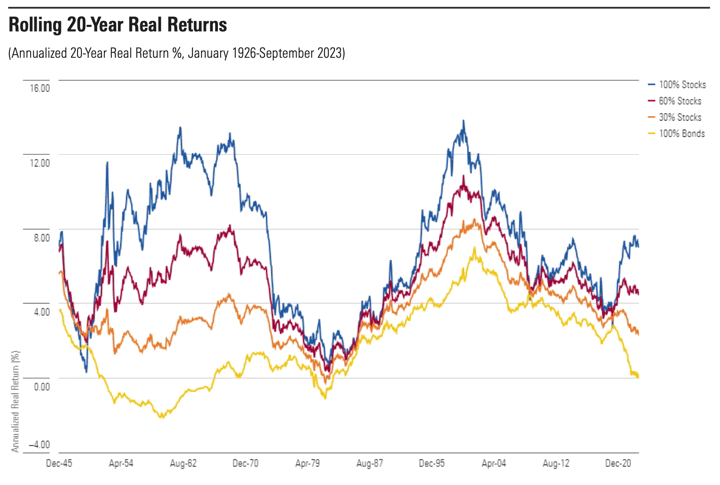
Historical 20-Year Rolling Real Returns: Stocks vs. Bonds (1926-2023)

One of the problems with personal finance content is that there are really only so many ways you can say “buy a low-cost stock index ETF and do nothing for 20+ years”. The pressure to make it more complicated is quite intense, if only to cure your own boredom. If only more action actually resulted in higher returns.

The vast majority of people cannot do reliably better than a US Total Market index fund or S&P 500 index fund in the world of publicly-traded stocks. Each decade, more and more people have realized that low-cost market-cap weighting is a very simple yet powerful trading algorithm that automatically adjusts to guarantee that you own all the big winners while avoiding as much of the middlemen fees and taxes as possible.

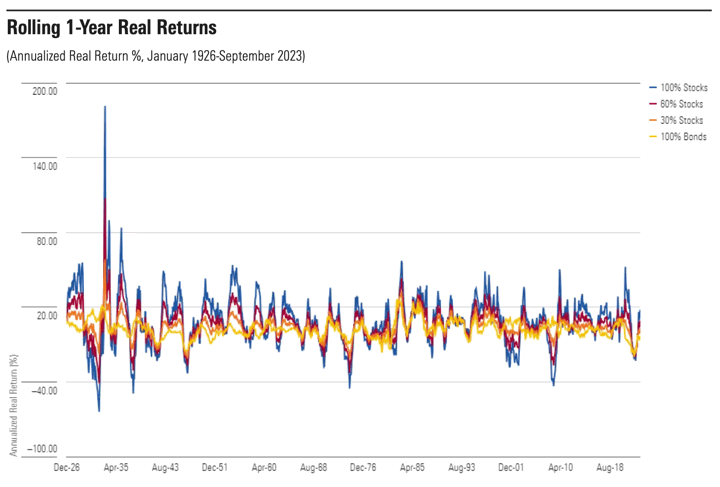
As Charlie Munger says, “The big money is not in the buying and the selling but in the waiting.” To illustrate, John Rekenthaler has a new Morningstar article called How Time Horizon Affects the Odds of Equity Investing with some excellent charts about the returns of portfolios of varying proportions of stocks and bonds over different periods of time (1, 5, 10, and 20 years). Check out all the charts there, but here are some highlights and commentary.

Over a single year period, who knows what you will get? Stocks might win by a lot, or they might lose by a lot. You can also see from the vertical axis markers that the potential swings are pretty wild. Double your money? Possible. Lose half your money? Also possible.

However, over 20-year rolling period, you can see that a 100% stock portfolio beat everything else 99% of the time. Most of the time, by a LOT. Even when stocks performed relatively poorly, it’s only by a little.

Finally, notice that in none of the 20-year rolling periods did stocks perform worse than inflation. They always matched inflation at the very minimum (0% real return). Young folks can consider this justification for why most Target Date Retirement funds start at 90%+ stocks for people in their 20s and even 30s.

I would also consider that statistic in the context of the “new & improved no risk portfolio” and you may feel better about the long-term safety of your portfolio.

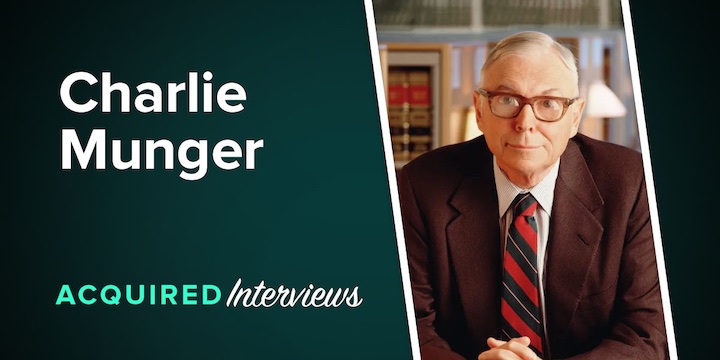
Charlie Munger Acquired Podcast Interview w/ Transcript (October 2023)

The Acquired Podcast has new episode with Charlie Munger. As usual Charlie was candid and dropped some truth bombs, although we never quite get to hear what he really thinks about venture capital… 🤐 If you scroll down on the page, you’ll also find a full transcript of the interview.

Here are a few selected highlights (slightly edited by me at times to match the audio):

The extra-wide parking spaces at Costco! I always felt they were a competitive edge.

Ben: What was it about Costco that made you realize this is one of those few moments in a lifetime?

Charlie: They really did sell cheaper than anybody else in America and they did it in big, efficient stores. All the parking spaces were 10 feet wide instead of eight or nine feet or whatever they normally are. They did it all right and they had a lot of parking spaces. They kept out of their stores, all these people didn’t do big volumes, and they gave special benefits to the people who did come to the stores in the way of reward points [via the Executive membership 2% back].

Rational people don’t risk what they have and need for what they don’t have and don’t need.

David: But your relationship with Warren?

Charlie: We were both somewhat similar. We both wanted to keep our families safe and take a good job for our investors and so on. We had similar attitudes.

David: Did it change over the decades?

Charlie: No. Warren still cares more about the safety of his Berkshire shareholders than he cares about anything else. If we used a little bit more leverage throughout, we’d have three times as much now, and it wouldn’t have been that much more risk either. We never wanted to give them the least a chance of screwing up our basic shelter position.

The three things.

Person: Charlie, if you started with Warren today and you were both 30 years old, do you think you guys would build anything close to what Berkshire is today?

Charlie: The answer to that is no, we wouldn’t. We had… everybody that had unusually good results… almost everything has three things: They’re very intelligent, they worked very hard, and they were very lucky. It takes all three to get them on this list of the super successful. How can you arrange to have just […] good luck? The answer is you can start early and keep trying for a long time, and maybe you’ll get one or two.

Climb the mountain once.

Andrew: I don’t think you’re saying there are no opportunities whatsoever. I think you’re just saying low expectations and fewer bonanzas.

Charlie: The beauty of it is: you only have to get rich once. You don’t have to climb this mountain four times. You just have to do it once.

It was a great interview, and prompted me to add these other Acquired Podcast episodes to my playlist:

New & Improved “No Risk” Portfolio: Stock Upside with 100% Guarantee to Beat Inflation

Allan Roth has another thought-provoking article called Beat Inflation Handily, and Risk-Free with a very attractive proposition:

Do you want an expected return of nearly 6% annually above inflation but also want to be assured you will beat inflation in a worst-case scenario? Until now, I would have responded “only in your dreams.” But today, that dream is a reality.

Previously, he wrote about a simpler “No Risk” Portfolio that guaranteed your money back in nominal (face value) terms. For example, if you started with $100,000, you’d end up with $100,000 after 10 years. However, inflation would mean that the buying power of your $100,000 would be less after 10 years.

This new & improved “No Risk” portfolio uses individual TIPS to guarantee that even if your stocks go to zero, your total money invested will at least match inflation and maintain buying power. This is because current TIPS guarantees returns of roughly 2.5% above inflation, all by itself.

At current TIPS yields, this can effectively be achieved with roughly 50% stock index ETFs and 50% individual 25-year TIPS. At current yields, every ~$50,000 in 25-year TIPS will end up at a real (inflation-adjusted) $100,000 after 25 years. That means you could throw in ~$50,000 into stocks and every single penny from your stock index ETF returns is gravy on top!

Here’s how the total annualized real (after-inflation) return of your portfolio would look, depending on real (after-inflation) stock returns:

I don’t plan to change my portfolio to this one. Instead, it serves as a useful tool and alternative perspective about asset allocation. There are clear benefits from holding guaranteed bonds, both of the nominal and inflation-linked type. You may think insuring against a total loss from stocks is overkill, and I would tend to agree. But it sure does feel nice to have a floor somewhere, as there have been decades historically where stocks have experienced a negative real return.

Stocks offer some of the highest historical average returns and the highest expected future returns. But if you haven’t experienced a prolonged bear market, your faith hasn’t been truly tested yet. If you’re in your 20s, the stress is different than if you are in your 60s. Imagine the peace of mind from knowing your “worst-case” scenario is still a reasonably-comfortable retirement for you and your loved ones.

Savings I Bonds November 2023: 1.30% Fixed Rate, 5.27% Total Composite Rate

Savings I Bonds bought from November 1, 2023 through April 30, 2024 will have a fixed rate of 1.30%, for a total composite rate of 5.27% for the first 6 months. The semi-annual inflation rate is 1.97% as predicted (3.94% annually), but the full composite rate is dependent on the fixed rate for each specific savings bond and so it is a little bit higher. This total composite rate is a bit lower than current short-term Treasury yields, and the fixed rate is about 1% lower than that of current short-term TIPS yields. Press release.

Every existing I Bond will earn this inflation rate of ~3.96% eventually for 6 months; you will need to add your own fixed rate that was set based the initial purchase month. See you again in mid-April for the next early prediction for May 2024.

Original post from 10/13/23:

Savings I Bonds are a unique, low-risk investment backed by the US Treasury that pay out a variable interest rate linked to inflation. With a holding period from 12 months to 30 years, you could own them as an alternative to bank certificates of deposit (they are liquid after 12 months) or bonds in your portfolio.

New inflation numbers were just announced at BLS.gov, which allows us to make an early prediction of the November 2023 savings bond rates a couple of weeks before the official announcement on the 1st. This also allows the opportunity to know exactly what a October 2023 savings bond purchase will yield over the next 12 months, instead of just 6 months. You can then compare this against a November 2023 purchase.

New inflation rate prediction. March 2023 CPI-U was 301.836. September 2023 CPI-U was 307.789, for a semi-annual inflation rate of 1.97%. Using the official composite rate formula:

Composite rate formula: [Fixed rate + (2 x semiannual inflation rate) + (fixed rate x semiannual inflation rate)]

This results in the variable component of interest rate for the next 6 month cycle being ~3.94% to 3.96% if you use a fixed rate of between 0% and 1%.

Tips on purchase and redemption. You can’t redeem until after 12 months of ownership, and any redemptions within 5 years incur an interest penalty of the last 3 months of interest. A simple “trick” with I-Bonds is that if you buy at the end of the month, you’ll still get all the interest for the entire month – same as if you bought it in the beginning of the month. It’s best to give yourself a few business days of buffer time. If you miss the cutoff, your effective purchase date will be bumped into the next month.

Buying in October 2023. If you buy before the end of October, the fixed rate portion of I-Bonds will be 0.90%. You will be guaranteed a total interest rate of 0.90 + 3.40 = 4.30% for the next 6 months. For the 6 months after that, the total rate will be 0.90 + 3.96 = 4.86%.

Comparing with the best interest rates of October 2023, these rates lower than what is available via regular nominal Treasury bonds and other deposit accounts.

Buying in November 2023. If you buy in November 2023, you will get ~3.96% plus a newly-set fixed rate for the first 6 months. The new fixed rate is officially unknown, but is loosely linked to the real yield of short-term TIPS. My rough guess is somewhere between 1% and 1.5%. The current real yield on short-term TIPS is higher than it was during the last reset, when the fixed rate was set at 0.9%. Every six months after your purchase, your rate will adjust to your fixed rate (set at purchase) plus a variable rate based on inflation.

If you have an existing I-Bond, the rates reset every 6 months depending on your specific purchase month. Your bond rate = your specific fixed rate (based on purchase month, look it up here) + variable rate (total bond rate has a minimum floor of 0%).

Buy now or wait? Between those two options, I would buy in November as you’ll likely get a slightly higher fixed rate and a higher initial inflation rate. If you’ve already bought for 2023, you’ll eventually get the newer inflation rate after six months. However, right now you might prefer to buy TIPS instead (especially if you have tax-deferred space available) as they will likely have a higher real yield.

Unique features. I have a separate post on reasons to own Series I Savings Bonds, including inflation protection, tax deferral, exemption from state income taxes, and potential tax benefits if used toward qualified educational expenses.

Over the years, I have accumulated a nice pile of I-Bonds and consider it part of the inflation-linked bond allocation inside my long-term investment portfolio.

Annual purchase limits. The annual purchase limit is now $10,000 in online I-bonds per Social Security Number. For a couple, that’s $20,000 per year. You can only buy online at TreasuryDirect.gov, after making sure you’re okay with their security protocols and user-friendliness. You can also buy an additional $5,000 in paper I bonds using your tax refund with IRS Form 8888. If you have children, you may be able to buy additional savings bonds by using a minor’s Social Security Number. TheFinanceBuff has a nice post on gifting options if you are a couple and want to frontload your purchases now. TreasuryDirect also allows trust accounts to purchase savings bonds.

Concerns about TreasuryDirect customer service. Opening a TreasuryDirect account or conducting other transactions can sometimes be a hassle as they may ask for a medallion signature guarantee which requires a visit to a physical bank or credit union and snail mail. This doesn’t apply to everyone and seems to have gotten better recently, but plan to experience some delays in any transaction that you try to accomplish (registration changes, converting paper bonds, changing bank accounts). They just seem to be overwhelmed in general.

Bottom line. Savings I bonds are a unique, low-risk investment that are linked to inflation and only available to individual investors. You can only purchase them online at TreasuryDirect.gov, with the exception of paper bonds via tax refund. For more background, see the rest of my posts on savings bonds.

[Image: 1942 US Savings Bond poster – source]