Archives for March 2023

Free 1-Year TripAdvisor Plus Membership from Target Circle ($99 Retail + Tested Results)

Target Circle is Target’s rewards program (free to join) and 3/5 to 3/11 is “Target Circle Week” where they have special offers. Standard perks include 1% back on your Target purchases if you don’t get the 5% back from REDcard, and you get a 5% off single purchase coupon on your birthday.

One of the Circle Week deals is a free 1-year membership to TripAdvisor Plus ($99 cost usually). This premium subscription service offers the following:

  • Member-only discounted hotel rates at 100,000+ hotels worldwide.
  • 10% Off every bookable experience (tickets, tours, and attractions).
  • “Access member-only perks and benefits from Tripadvisor’s travel partners”
  • “Get complimentary travel advice from experts via SMS with Trip Text.”

When you sign up, you must provide a valid credit card number or PayPal. However, by default, the free trial does NOT auto-renew automatically.

Is it worth signing up? I’m really not sure how useful the last two things on that list are, but 10% off activities is clear and the first can at least be tested. I tried out a test booking, and TripAdvisor Plus did offer a significantly better deal than if I chose book directly from the hotel as a basic free member.

Direct from the hotel was $276 + taxes:

Direct from regular Tripadvisor was $278 + taxes:
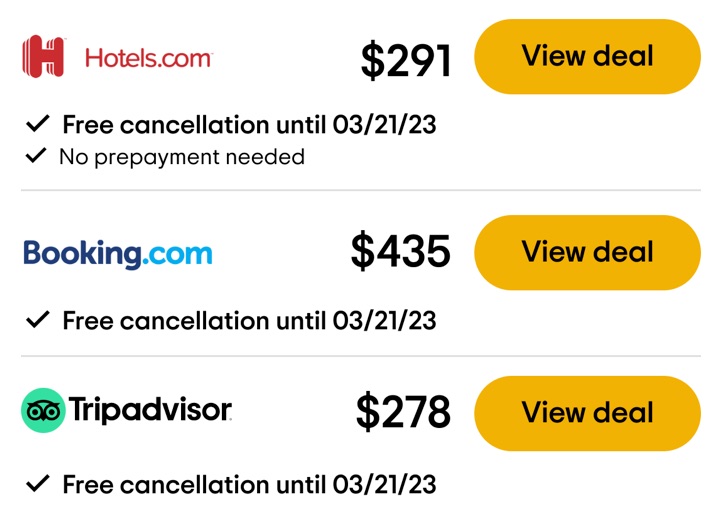
Direct with TripAdvisor Plus was $217 + taxes ($69 savings):

This just one data point, but a potential $50+ savings per night shows that it is worthing obtaining (for free) and checking when booking a hotel room. Whether it is reliably worth $99 a year is another question. It depends on your personal travel habits and if you don’t mind that fact that you lose some perks from booking directly with the hotel.

I’ll have to also remember the 10% off activities and compare with Viator, etc. One of the partner perks is a $1 membership to something called the Dollar Flight Club, which I have never heard of before.
Health Care Sharing Ministries: Understanding the Risks and Bankruptcy Examples

Back in 2020, I wrote a post Do Not Buy List: Healthcare Sharing Ministry As Health Insurance Alternative. Although they may present a lower-cost option that even aligns with your faith, they can also contain hidden and unpredictable risks. Since then, membership has grown but many have also found themselves stuck with large and unexpected unpaid bills.

Sharity Ministries, also formerly known as Trinity HealthShare, went into bankruptcy in 2021 and left their 40,000+ members with over $300 million in unpaid healthcare claims. A 2022 lawsuit by the State of California alleged that Sharity Ministries paid out as little as 16 cents of every dollar it took in.

Medical Cost Sharing Inc. of Missouri was shut down by the FBI and Dept. of Justice in early 2023 after allegedly taking in millions in premiums but only paying out an estimated 3.5% of premiums collected.

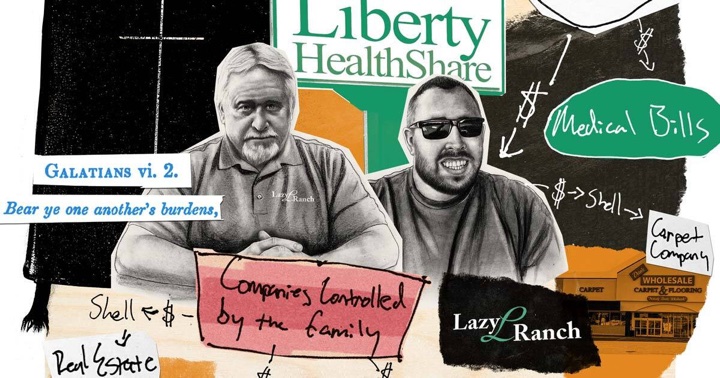
Liberty Health Share, which has over 220,000 members, has been involved in multi-million dollar settlements with its vendors (which records show were owned by relatives or prior business partners of the CEOs) and is the subject of a new investigative article by Propublica: A Christian Health Nonprofit Saddled Thousands With Debt as It Built a Family Empire Including a Pot Farm, a Bank and an Airline.

The failure of federal and state agencies to move decisively against the Beers family has left Liberty HealthShare members struggling with millions of dollars in medical debt. Many have joined a class-action lawsuit accusing the nonprofit of fraud.

One of the main issues is that they purposefully operate in a gray area where they make all the rules. Anyone can claim to pay 100% of “eligible” expenses, as long as they get to define “eligible”. The “non-profit” executives can also pay other businesses affiliated with themselves, which in turn do make plenty of profit.

Despite abundant evidence of fraud, much of it detailed in court records and law enforcement files obtained by ProPublica, members of the Beers family have flourished in the health care industry and have never been prevented from running a nonprofit. Instead, the family’s long and lucrative history illustrates how health care sharing ministries thrive in a regulatory no man’s land where state insurance commissioners are barred from investigating, federal agencies turn a blind eye and law enforcement settles for paltry civil settlements.

With minimal regulatory oversight, things can go bad without anyone noticing:

There is no national data showing how much health care sharing ministries spend on members’ medical bills. However, as scrutiny of sharing ministries increased in recent years, some states have begun to require financial disclosure. Data published by the Massachusetts’ insurance board shows that Liberty spent about 56 cents of every dollar it took in from members in that state on medical expenses in 2019 and 2020, a figure that would be scandalous if it were an insurance company. The federal government requires insurance companies to spend at least 80 cents of every dollar on direct care.

While they may claim to be non-profit charities, these entities are all businesses in the end. They must balance revenue and expenses, deal with the overall economy, deal with internal and external fraud. The numbers have to add up, while low premiums conflict with generous claims payouts. Charities fail. Businesses fail. Can you predict which one?

Given that a single medical diagnosis could add up to $100,000 or $200,000 or more in total bills, the failure of a health care sharing ministry could basically mean the bankruptcy of most families. Even worse, they may place a household in the position to avoid or skip important treatment. The entire reason we have car, home, and life insurance is to prevent financial disaster from a single incident.

Things can go well for a long time. Bernie Madoff’s clients were quite happy with his services… until they weren’t. Warren Buffett summarizes with this quote:

Over the years, a number of very smart people have learned the hard way that a long string of impressive numbers multiplied by a single zero always equals zero.

I share the stories above that have occurred just over the past few years, and while I’m hopeful that there will be no future examples, I’m also realistic that the list will likely continue to grow. Be careful out there. It’s not worth risking a zero for me.

Elements Financial CU: 4.25% APY Savings Until 10/31, 5.00% APY Rewards Checking for 12 Months ($20k Max)

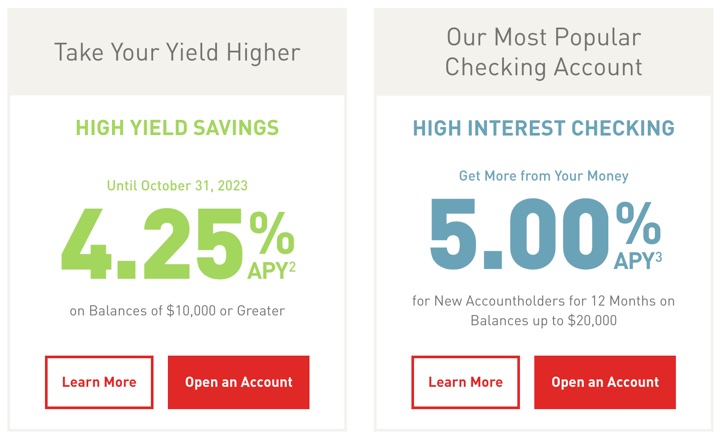
New promos with rate guarantees. Elements Financial Credit Union has a new rate of 4.25% APY on their High-Yield Savings on balances of $10,000+ (different from their Helium Savings). The promo rate is guaranteed until October 31, 2023. (Technically, it lasts until the 1st of the 12 month after you initial month, so actually between 11 and 12 months.)

There is also a promo rate of 5.00% APY on their High Interest Checking account, only valid on balances up to $20,000. Also for new accountholders only, with the promo APY fixed for 12 months from account opening date. Requires 15 qualifying transactions (such as using your debit card) every statement cycle. No monthly fee with electronic statements.

Note that their definition of qualifying transactions is also less strict than others. The following are qualifying transactions: Debit card purchases, checks, bill payments, ATM withdrawals and ACH withdrawals.

Per DepositAccounts, anyone can join with one-time $5 membership in Tru Direction, a not-for-profit organization dedicated to improving financial literacy. However, I couldn’t find anything about this on their membership page, other than Elements will provide you with $5:

Open an Elements checking or savings account or apply for a loan or credit card. During the application process, we will open you an Elements savings account (that’s the part that makes your membership official). We’ll even put $5 in to get you started — no need to transfer funds from an existing account!

I’m not sure how I feel about this one. 5.00% APY on $20k is a nice number ($1,000 a year in interest), but I don’t like having to remember the hoops for an entire year. They don’t seem to treat their existing customers nearly as well as new ones. Some of you may have signed up back in September 2022 when they offered a guaranteed 3.25% APY for a year on their Helium Savings. Right now, that account would only pay 1.00% APY once the promo ends.

HMBradley Bank Review: 4.50% APY w/ New Credit Card Spend Requirements

Update May 2023: Rate tiers are now up to 4.50% APY. You may be grandfathered from the activity requirements until 6/30/23 if you were an existing user.

Older review, last updated October 2022:

HM Bradley announced several significant changes to their product (again). I’ve updated the review completely and removed all the historical changes as it was just getting too long.

HM Bradley (HMB) is a fintech software layer on top of a partner bank’s infrastructure. They are terminating their initial relationship with Hatch Bank at the end of October 2022 and changing completely over to New York Community Bank (NYCB). Existing HMB customers will need to open up a new account at NYCB before the end of October. HMB is also changing up their interest rate structure, but is offering a special intro offer to existing HMB customers. Detailed review below.

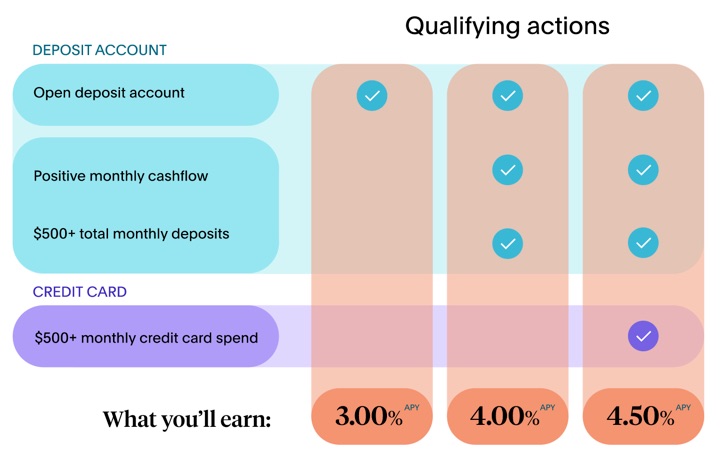
Rate tiers. Interest is earned on balances up to $250,000 with NYCB (up from $100,000 with Hatch Bank) and the rate you earn is set for the next month based on the current month’s activities. Here are the current rate tier and requirements:

  • 1.00% APY. All customers who open an HMBradley Deposit Account with NYCB will be rewarded with 1.00% APY. No other requirements.
  • 2.00% APY. Customers who make a direct deposit of at least $500 per month to their HMBradley Deposit Account with NYCB and maintain positive monthly cash flow (meaning that monthly deposits exceed monthly withdrawals, not including HMBradley Credit Card payments) will earn 2.00% APY in the following month.
  • 3.00% APY. Customers who fulfill the 2.00% APY requirements AND also spend $500 per month on their HMBradley Credit Card will earn 3.00% APY in the following month.

Limited-time offer to switch for existing customers. HM Bradley is waiving some of the requirements for new customers that signed up to switch by 10/31/22:

Any customer who opens an HMBradley Deposit Account with New York Community Bank (NYCB) before November 1, 2022, will receive Level 2 Annual Percentage Yield (APY) until April 30, 2023.

Any customer who opens an HMBradley Deposit Account with NYCB and has an HMBradley Credit Card in good standing before November 1, 2022 will receive Level 3 APY on the balance of the HMBradley Deposit Account with NYCB until April 30, 2023.

You’ll have to start doing the requirements in April to get the higher rates in May 2023.

Requires a “real” direct deposit every month. You must receive some sort of direct deposit each month, as defined below:

For our accounts, we define direct deposits as those deposits made by the customer’s employer, a federal or state government agency, or retirement benefits administrator. These generally include payments made by corporations and other organizations. We do not consider deposits to an account that are made by an individual using online banking or other payment provider such as PayPal or Venmo as direct deposits. HMBradley shall make the final determination as to whether a deposit qualifies as a direct deposit for purposes of qualifying to earn interest.

Based on my experience, they do have a system for filtering incoming deposits, but it is not 100% accurate and your direct deposit may have to be reviewed manually. Their online account interface should clearly indicate whether you have made the required direct deposit for the current month. I had to contact them in order for them to manually check and mark the transfer as a direct deposit. Having it marked properly is required to get the top rate.

Positive monthly cash flow is based on ALL deposits and withdrawals (except HMB credit card spend). For the calculation of “positive monthly cash flow”, all deposits are considered including incoming transfers from another personal bank account. At the same time, your “spending” will also include any transfer out of your account, even if it’s just to another bank account that you own. They don’t count purchases made on your HMB credit card, which incentivizes you to use it – but conveniently they don’t care about your credit card spending habits as long as you’re using their card…

Basically, money has to keep coming into HMBradley and not go back out on a net basis every month. That’s a very unique requirement, but also hard to keep up forever. Even if you are a diligent saver, you will want to redirect some of those funds into other assets like stocks, ETFs, real estate, etc.

Credit card details. The HMBradley credit card is invite-only and partially based on their estimate of your income (which is in turn based on the size of your deposits, although you can attempt to self-report). Invitations are not guaranteed. You must opt in to their “One Click Credit” service which basically checks your TransUnion credit report so they can market stuff to you (soft inquiries). If your TransUnion credit file is frozen, they will not offer you an invite. But once you officially apply, you will have a hard inquiry.

Starting at the October 2022 monthly billing cycles, the HM Bradley credit card is basically a flat 1.5% cash back credit card with no annual fee. Prior to this, it used to be a more complicated 3/2/1% rewards card with tiered categories and a $60 annual fee (waived for first year). 2% cash back would have been nice, but now it’s just another vanilla mediocre rewards card.

Additional features. It’s still not exactly clear how other basic features will change with the new NYCB accounts. ATM rebate policy? Well, right now, they don’t even give you a debit card! This change seems a bit rushed.

Once you accept the new NYCB deposit account agreement and disclosures, we will ask you to agree to allow us to transfer your funds (including any funds in a Plan and accrued interest) from your deposit account at Hatch Bank to your new deposit account with New York Community Bank (NYCB). We will also provide you with your new account and bank routing numbers. You will want to use this information to change your direct deposit and recurring ACH transfers as soon as you can.

Unfortunately, we are unable to offer debit cards for new deposit accounts at this time. You will still be able to make ACH transfers, and we will let you know when a new debit card is available.

My thoughts. Interest rate changes are happening very quickly these days, and it is unknown how aggressively HM Bradley will keep up. If I didn’t already have an HMB account, I wouldn’t bother opening one up as the positive monthly cashflow requirement can get complicated if you save your money in different ways. I will be looking for them to raise their rates at least a bit more above the competition if I am going to keep jumping through that many hoops.