Archives for May 2010

InvestForLess: American Funds With No Load?

Although I don’t invest in any mutual funds with loads or sales charges, I know that many people like to buy American Funds. Although they don’t do any print advertising or press releases, they are the third-largest fund company in the world behind Fidelity and Vanguard. Buying $10,000 in the Class A shares of the American Funds Growth Fund of Americas (AGTHX) would normally cost you 5.75% ($575) in sales fees upfront. Or since American Funds are only sold through advisors, perhaps you’re paying them an annual management fee of at least 1% of assets instead, or some combination thereof?

But new website InvestForLess.com would like to charge everyone a flat $250 annual fee and grant you access without any sales charges (turn down the volume since there’s an annoying auto-loading video).

From this Kiplinger article, it sounds like they are officially registered advisors, trying to sell their bare-bones services (i.e. access to advisor-sold funds) on a volume-based model:

InvestForLess is sort of like the Costco of mutual funds. It charges $250 per year for membership in its platform. Once you join, you can buy the “adviser” or “institutional” share classes of funds on its platform for free. This is possible because InvestForLess, despite looking and smelling like a broker, is structured as a registered investment adviser, with Trade-PMR, a broker-dealer, as its custodian. So InvestForLess members will have access to the same share classes that are available to other advisers on the Trade-PMR network.

However, there is already some pushback from commission-based advisors, as both Charles Schwab and Scottrade have agreed to, and then since backed out, from being their custodian. Currently, their custodian is Trade-PMR. I don’t think the fight is over yet, but it’s an interesting development.

Vanguard Voyager Status Minimum Now $50,000

Another recent change at Vanguard is that their Voyager membership tier is now available to those with household assets totaling $50,000 or more. The minimum was previously $100,000. The minimum for Voyager Select remains at $500,000 and Flagship remains at $1,000,000.
Eligibility
Here’s the fine print from Vanguard. 401k plan assets also can count if they are administered by Vanguard and are invested Vanguard mutual funds. Households are also determined by address, so if your spouse or parents use the same address and have Vanguard assets, that can count as well.

Membership is based on total household assets held at Vanguard, with a minimum of $50,000 to qualify for Vanguard Voyager Services®, $500,000 for Vanguard Voyager Select Services®, and $1 million for Vanguard Flagship Services®. We determine membership by aggregating assets of all eligible accounts held by the investor and his or her immediate family members who reside at the same address, including investments in Vanguard mutual funds, Vanguard ETFs®, annuities through Vanguard, The Vanguard 529 Plan, and certain small-business accounts. Assets in employer-sponsored retirement plans for which Vanguard provides recordkeeping services may be included in determining eligibility if the investor also has a personal account holding Vanguard mutual funds. Note that assets held in a Vanguard Brokerage Services® account (other than Vanguard ETFs) aren’t included when determining a household’s eligibility.

If your assets nudge above $50k one day, Vanguard might not bump you up to Voyager immediately. It’s probably worth a phone call and they’ll change your membership level, which should stay that way even if your balances drop due to market fluctuations (and not withdrawals).

Voyager Benefits
Here are the main perks of Voyager when compared with a regular investor with less than $50,000 in assets.

  • Voyager representative. I believe you get a different phone number to call. (Look on the top right after you log in.) Perhaps this results in shorter hold times? I wonder if Voyager representatives are more experienced or otherwise “better”.
  • Possibly lower account fees. You no longer need electronic statements to waive their mutual fund account service fees. (Otherwise $20 per year for each Vanguard fund in which you have a balance under $10,000.) At Vanguard Brokerage Services, you also avoid the $20 annual account service fee.
  • Possibly lower commissions. You get $7 trades on all stock and non-Vanguard ETF trades, instead of for only the first 25 per year. (Otherwise $20 per trade afterward.)
  • A financial plan from a Certified Financial Planner (CFP) costs $250 instead of $1,000.

This is a nice change for us… I’m happy to report that I am a Voyager client now.

Commission-free Vanguard ETF trades in Vanguard Brokerage Accounts

Vanguard sent out an announcement today that they are responding to recent moves by Fidelity/iShares and Schwab by offering their own lowered commission costs, the highlights are of which are:

Commission-free Vanguard ETF transactions. Vanguard brokerage clients may make commission-free transactions in Vanguard’s entire line-up of 46 low-cost ETFs, which is the largest suite of ETFs available without commissions.

Ultra-low equity commissions. Most Vanguard brokerage clients will pay $7 or $2 to trade stocks and non-Vanguard ETFs®.

[…]Unlike competitors’ commission schedules, the same commissions apply to both transactions conducted on Vanguard.com and those executed with the assistance of a Vanguard brokerage representative.

Added: For the brokerage account, a $20 account service fee is charged annually. The fee is waived for Voyager, Voyager Select, and Flagship members.

The details of new price structure are based on the amount of assets held at Vanguard. But everyone gets at least free Vanguard ETF trades and $7 trades for the first 25 per year ($20 after that).

First impressions? Sweeeeeet. 🙂 Looks like it might be time for some mutual fund to ETF conversions.

Bundle.com: Compare Spending Patterns With Similar Folks

I’ve been catching up on my stack of old magazines, and in the process discovering a bunch of new websites. One appropriate site to mention is Bundle.com, which describes itself as the “first money comparison site that lets you see how people just like you spend and save money.” Here’s a promotional video from them which walks you through it:

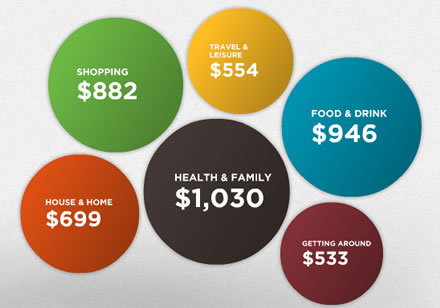
For example, this is what the households in San Francisco, CA were spending their money on in December 2009:

“House & Home” does not include mortgage or rent, but are things like utilities, home repair and improvements, and phone service. “Health & Home” includes insurance, child care, pet care, and charitable giving. Where does the data come from? Via their FAQ:

With a team of experienced statisticians and data junkies, we’ve compiled, tagged and sorted data from a (still-expanding) collection of sources. Our data comes from the U.S. government, from anonymous and aggregated spending transactions from Citi, and from third party data providers.

Aha, my sneaky Citibank card! This is exactly the kind of data I would think would be recorded and sold from aggregation sites like Mint.com. Now, is it just me, or is there no data available under the “Saving” tab?

Free 500 American Airlines Miles

You can get 500 free American Airlines miles if you register for the AAdvantage eShopping Mall as a new member by May 31st, 2010. The mall is like other cashback shopping portals, except that they give you American miles back instead.

You’ll need to provide any valid credit card number, which allows you get miles back for purchases at physical retail stores. Fine print below… though the 500 miles showed up much earlier than 8-10 weeks for me. Quick and easy.

You must register on this page to earn the 500 mile enrollment bonus. Bonus miles will post to AAdvantage eShopping member’s account within 8 to 10 weeks from enrollment. This offer is not valid for existing AAdvantage eShopping members.

LendingClub Updated 2010 Review: Historical Returns and Trends

I’ve been investing with LendingClub for over two years now. They securitize person-to-person loans so that you can lend money to other people in $25 increments, and you collect the interest after some fees. The stated interest rates are about 7-16%. On their home page, they boast of very impressive returns:

If you had invested $10,000 in Lending Club Notes in June 2007 (when we started issuing loans) and continued to reinvest your returns, you’d have made over 9.5% net annualized returns to date, outpacing a high yield corporate bond index, the NASDAQ, S&P 500 and even 1-3 year treasuries.

While I can only assume this statement is technically true, you have to remember that the way they state the numbers includes a lot of new loans that have not had a chance to “age” until maturity. LendingClub notes are all for a three year term. It would be more informative, in my opinion, to specifically look at the return of only loans that have completed. Since LC is so new, how about as old as possible.

For that, I go to the Statistics section. I should point out that the date range is for the origination date of the loans. The observation date is today. Accordingly, the default view of “Show All Time” shows every single loan from mid-2007 until today. Again, this includes a lot of new loans, many of which are impossible be classified as defaulted yet (must be 120+ days late). Instead, let’s narrow down the origination dates so we can look at loans of a set age.

June 1, 2007 to December 31, 2007
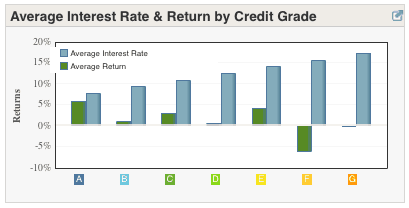
We’ll start with the loans that originated in 2007, their first year of operation. Even though these loans aren’t all completely done, they are the oldest loans available with an average age of about 2.5 years. Here are the average returns and average interest rates, sorted by credit grade:

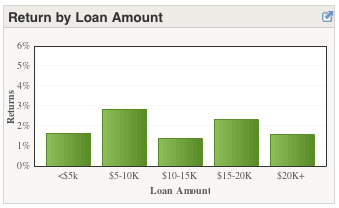
Here are the average returns by loan amount:

The interest rates being charged (blue) are predetermined by LC, and as you’d expect they increase as credit quality decreases. However, the returns (green) are not what you might expect. Grade A loans appear to have performed the best, but other than that there is no real direct relationship between return and credit grade. I see no clear relationship between loan size and return, either. Most importantly, by visual estimate, the average return for all of these loans is only approximately 2%. This is way off from 9% returns.

(Read on for more…)
[Read more…]