Have you seen those “follow the green line” ads from Fidelity? Well, they reminded that a reader sent me their retirement account holdings for review which was managed through the Fidelity Portfolio Advisory Service (PAS). This is a managed portfolio service, which means that you pay Fidelity a fee and they do all the research, selection, buying, and selling for you. Fidelity has two managed-portfolio tiers for individual investors, with the Portfolio Advisory Service for account balances of $50,000+, and the Private Portfolio Service for those with $300,000+ to invest.
At only a $50,000 minimum portfolio size, it appears that the PAS is targeted a relatively large portion of the generic public. Unfortunately, in the wealth management business such small balances usually also mean generic, cookie-cutter portfolios with little or no personalization. Here’s what Fidelity says:
In the Fidelity Portfolio Advisory Service product, customers are invested into model portfolios of Fidelity and non-Fidelity mutual funds based on their time horizon, risk tolerance and investment goals. These model portfolios are managed by a team of investment professionals that includes Portfolio Strategists and Mutual Fund Analysts.
Sounds like “we make you answer a short questionnaire and the computer spits out an asset allocation” to me. Let’s see how Fidelity constructs this person’s portfolio. I will mention here that this is an IRA account, so that taxes aren’t a huge concern.
Portfolio Comparisons
Benchmark Portfolio
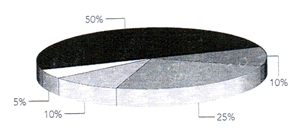
This particular account used the “Growth w/ Income Portfolio” benchmark, which has an overall 60% Stocks/40% Bonds balance. Other portfolio options are Conservative (20% stocks), Balanced (50% stocks), Growth (70% stocks), Aggressive Growth (85% stocks), and All Equity (100% stocks). Here are the indexes and asset allocation for this portfolio.
Stock
50% Total US (Dow Jones US Total Stock Market Index)
10% Developed International (MSCI EAFA Index)
Bond
25% US Investment Grade Bond (Barclays Capital US Aggregate Bond Index)
10% US High-Yield (Merrill Lynch US High Yield Master II Constrained Index)
Cash
5% Treasury Bills (Barclays Capital 3-month US T-Bill Index)
Hypothetical Index Fund Portfolio
As mentioned in the statement, you cannot invest in an index. So, I created below a portfolio consisting of actual investments that passively track the above indexes with minimal costs. I chose the cheapest ETF that tracks the exact index if possible, not the cheapest ETF that was similar. I also included the annual expense ratios.
50% SPDR Dow Jones Total Market ETF (TMW) 0.21%
10% Vanguard Europe Pacific ETF (VEA) 0.16%
25% Vanguard Total Bond Market ETF (BND) 0.14%
10% SPDR Barclays Capital High Yield Bond (JNK) 0.40%
5% SPDR Barclays Capital 1-3 Month T-Bill (BIL) 0.13%
The total weighted expense ratio was 0.20%.
Actual Fidelity-Managed Portfolio
The actual choice of investments in this account matches the benchmark asset allocation closely, and included over 30 different mutual funds. You can view the entire mutual fund list here, but here is the overall breakdown:
51.5% US Stock Funds
10.0% International Stock
28.5% Investment-Grade Bonds
10.0% High-Yield Bonds
0% Cash
This includes a mix of twenty (!) different actively-managed domestic stock funds from both Fidelity and outside companies like Janus and T. Rowe Price (Okay, 1.5% was in one index fund – S&P 500 Fidelity Spartan.) The average expense ratio for these was approximately 1%. Six different international stock funds were included, with an average expense ratio of ~1.2%. The overall bond fund expense ratios were 0.8%. This brought the total weighted expense ratio to ~0.94%.
Performance Comparisons
Now for the important part, returns after all fees. This account was not ten years old, so the best long-term return number was the 5-year historical annualized returns. The statement was as of 6/30/09.
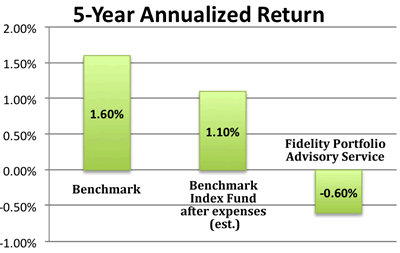
First up, we have the 5-year annualized of the Benchmark Portfolio, which as of 6/30/09 was 1.6%. Of course this is a benchmark, which doesn’t include any management fees or commissions.
I was unable to find performance numbers as of 6/30/09 for my Hypothetical Index Fund Portfolio as it is already 2010 (if someone knows how to do this please let me know). However, we can estimate the return since the total weighted expense ratio was 0.20%. If we estimate trade commissions to be $5 per trade x 5 ETFs = $25 per month… on a $100,000 portfolio that is 0.30%. (Such trade commissions would be zero if held at Zecco or WellsTrade, given the account size.) Assuming the ETFs follow the indexes closely, then the 5-year returns would be in the neighborhood of 1.1%.
Now, what was the actual 5-year annualized return on this fully-managed account? -0.6%. Yes, negative 0.6%.
Conclusion
Over the past 5 years, the Fidelity Portfolio Advisory Service managed to construct a portfolio that lagged a simple index fund portfolio by 1.70% annually. That’s a huge difference over time. Use any compound interest calculator and stick in two numbers that differ by 1.7%, and you’ll see the effect of compound interest working against you for a few decades. Why did this account perform so poorly relative to its benchmark? Isn’t it supposed to beat the benchmark?
Too many advisors. To me, if people choose to hire someone to manage their investments, it would be to tap into their expertise and special insight. I’d want him/her to make calculated bets that will beat the market. Putting my money in 34 different mutual funds, each with their own team of advisors, seems like everyone’s bets would cancel each other out.
While the reason given for so many funds was “diversification”, the only phrases that came to my mind were “overlap” and “lack of focus”. You don’t need to own a ton of funds to get diversification. With so many funds, you’d probably end up owning the same companies as the index fund anyway.
Costs matter. The actively-managed mutual funds are the first layer of expenses, which was a weighted 0.94%. Then there is the second layer of management fees charged by Fidelity, which includes all trade commissions and varies from .25%–1.7% based on asset levels. In this account, it was 0.8%. Thus, in order to simply match the benchmark, the investments chosen would need to outperform it by 1.74%. Every. Single. Year. That is a stiff headwind.
The really sad thing is, even if I just invested in the index funds through the Fidelity PAS and basically paid them to do nothing, I would have still done better than the funds they chose. 1.6% index – 0.2% index fund expenses – 0.8% Fidelity fee = gaining 0.60% a year. Compare that with losing 0.60% a year.
For a $200,000 portfolio paying 1.38% in portfolio management fees, that’s $2,760 a year. Don’t pay nearly 3 grand a year for a cookie-cutter asset allocation that doesn’t even match an index fund. It can be well worth your time to learn more about investments yourself. Here are some starting ideas.
 The Best Credit Card Bonus Offers – 2026
 Big List of Free Stocks from Brokerage Apps
 Best Interest Rates on Cash - 2026
 Free Credit Scores x 3 + Free Credit Monitoring
 Best No Fee 0% APR Balance Transfer Offers
 Little-Known Cellular Data Plans That Can Save Big Money
 How To Haggle Your Cable or Direct TV Bill
 Big List of Free Consumer Data Reports (Credit, Rent, Work)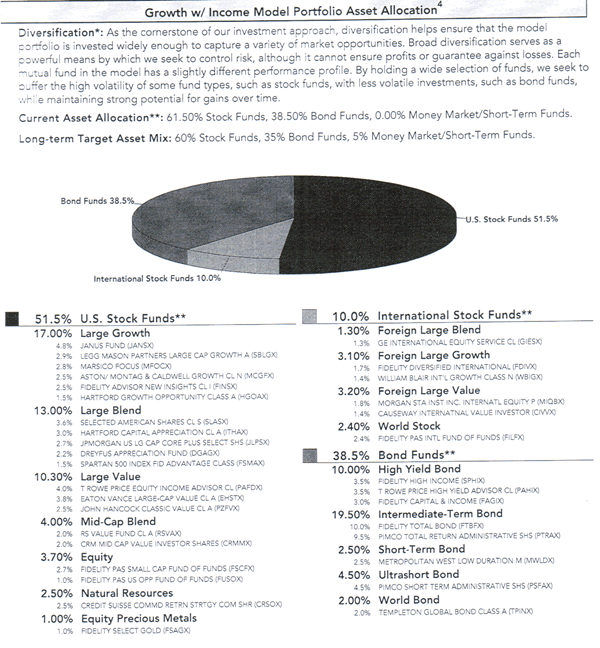
Mr. Bogle would be proud. Great analysis.
Uh oh, the Fidelity hawks are going to be after you for exposing this scam.
Excellent evaluation but there is more (on the downside). About 3 years ago, I did an extensive evaluation of my portfolio with Fidelity as I was rolling over my company 401k and pension into a Fidelity roll-over IRA. When they presented their proposal of the mutual funds they would hold and manage for me as part of the PAS , I was struck by the large number of non-Fidelity funds and this seemed very odd. On further investigation, I found that many of these funds had 12b-1 charges. So not only were they on average charging me 1.5% for management fees, but also directing me into funds where they could rake additional profits.
There were some other downsides, but none as substantial as the one mentioned above and in your comments.
I have to admit they almost had me. But after the PAS proposal, I realized I did not need to pay them for all the overhead and went elsewhere for advice and low cost management (not assets under management) using index funds and asset allocation (Dimensional Funds, Vanguard, and Index Funds all managed at Schwab).
I have a fidelity account and I get a lot of pressure from them to use their Portfolio Advisory Service; they keep calling every few months. now I know why they push it so aggressively; must be a big money maker for them. thanks for the hard work in exposing them.
I fixed the link to the scanned entire portfolio list.
I use Fidelity for a lot of things, but I would stay far away from this managed-portfolio service.
Couldn’t agree more, I’m terribly disappointed with my Fidelity Investments Portfolio Advisor Service. There company only allows me to speak with a representative M-F and they don’t return email, voicemail, and requests from their chat inquiries. Very non customer service focused. I’m taking my business else ware.
My wife’s 401(k) is with New York Life. Aside from the normal drawbacks of a small company 401(k)– tiny selection, no index funds, terrible online interface– this one has the added annoyance of three giant pictures on the home screen. One says “I want to manage my account,” the prominent middle photo says “I want experts to manage my account,” and the last says “I want to learn more.” The “learn more” material is so unhelpful it effectively pushes the account management service.
Help
I have a PAS worth $600,000. with Fidelity since 7/07 when I retired I am still down approx.-7%, since I gave it to Fidelity. I have been thinking about switching to Vanguard but my wife ask what the difference the all charge you. Any thoughts about not having a PAS and not paying the quarterly expense. I know I will pay the funds expense but just have either Vanguard or Fildelity choose the funds.
I manage my 401 alot less simple. But don’t know if I could do the same for my main money. Looking for Help
One more questions wouldn’t Vanguard just have a computer spit out the asset allocations?
Since I have a PAS with Fidelity and I pay them a fee each quarter, who is paying the expenses and trades they make in my account? I never see a charge for a trade. Also since they have me in over 20 funds some with loads who is paying for that cost? Is it just take from the percent they charge me?
I second Chuck’s comment above. Index funds all the way.
Bud,
You are asking all the right questions and by visiting mymoneyblog you are headed the right direction. By going with index funds and doing simple asset allocation yourself you can save yourself thousands of dollars. Or you can go with advice from Vanguard which I would trust. I suggest you do not go with an asset under management model. Say that there is a 2% charge by Fidelity for PAS. That’s $12k/year for you. Are they providing that kind of value? One way of thinking about it is that 12k=60 hours at $200 an hour. Are you getting that kind of service you would expect for that?
For your education I suggest:
http://www.bogleheads.org/
It’s the perfect forum for asset allocation beginners and pros. Look at their reading list.
I am a big fan of Paul Merriman and his firm for all the free advice they give and their model portfolios: http://www.fundadvice.com/portfolio.html#merrimanmodelportfolios
Get his book. But, they have an AUM model which I don’t believe in so I don’t use them (I’m with Evanson Asset Management if you want to google them). However, their portfolio advice is very good and although their podcasts are too ‘folksy’, the content is usually very good.
Good luck.
@Bud – The trade commissions are included in your quarterly fee.
The fund load expenses are taken from your account balance, which may be hard for you to see. For example, they might spend $10,000 on a fund but you’ll just end up with $9,500 of it to start, and you might think that’s just market volatility. They’ll justify by saying you’ll have lower annual expense ratios in the long run, but that’s just compared to the other share classes.
Annual expense ratios are taken daily bit-by-bit out of the net asset value (NAV) share price of the mutual fund. It won’t be a line item on your statements.
The .25%-1.7% management fees are ridiculously high, borderline rip off.
You can find portfolio management services that charge a fee of .10% to .25% based on asset level.
I feel that you really need to have a significant amount of assets to benefit from hiring a money management firm and I don’t mean Fidelity, Schwab etc. If you are going to go with these types of firms then you are probably better served by a portfolio consisting of low cost index funds properly allocated. I do know of some high net worth, institution management firms that have excellent long term records of outperforming the market over long periods but then again most investors do not have the scratch to get that kind of service. Really the whole industry is a marketed collection of smoke & mirrors. That is why many of the smartest minds in the financial money management industry suggest the avg investor stick with index funds.
I never see a charge for a trade. Also since they have me in over 20 funds some with loads who is paying for that cost? Is it just take from the percent they charge me?
Another brilliant expose of the pointlessness of managed fund services. A handful of ETFs can get most of the asset allocation covered at a fraction of the annual cost.
Personally, as well as my passive vehicles I do hold some individual stocks and indulge in a bit of trading, but at least I get to benefit from the fun of wasting money, rather than paying someone to do it for highly renumerated day job! 😉
Hey,
Thanks for the informative review, helped on this end.
As for your backdated market close prices, I don’t know if this helps – but when you enter new data into a new Morningstar portfolio, you can enter the purchase date and then click the $ button. This brings up the market close of the date. The only caveat is that this service is still sort of far from perfect, but maybe it helps.
@”Ex-Fidelity”- “On further investigation, I found that many of these funds had 12b-1 charges. So not only were they on average charging me 1.5% for management fees, but also directing me into funds where they could rake additional profits.”
Look at Fidelity’s website there is a net vs. gross fee. All 12b-1 fees Fidelity recieves are credited back to the customer. Also they do not offer a portfolio that charges 1.5% (unless you are speaking of expense ratios + management charges)
@ Jonathan – Fidelity as an institution is not charged a Load for loaded funds you come across in the portfolio, so the client would not pay the load either.
Saying that…I agree with the general topic of conversation and the chance of Fidelity beating this bechmark very well may not happen. I would just emphasize the fact that with the ETF approach you need to make sure you rebalance and stick to a strategy (not jump in and out of the market based on emotion). If you are able to successfully take this approach over the next 5 yrs (which almost no individual investor has historically) you have a good shot at beating the “experts”.
Riletrade
In the Portfolio Advisory Service documents given to me from Fidelity there wasn’t anything I could see that said no 12b-1 charges. On the “Growth Portfolio-the Details” page they recommend 24 funds. Of these 24 funds only 7 are Fidelity which is what made me curious about the whole proposal. I mean, here is (was?) the largest mutual fund company in the world and they could not find funds in their own family to offer?
Here is a sampling of the data:
Name – Symbol – 12b-1 – expenses
August 2007: Jennison Growth Fund – PFJAX .3 1.04
Today: 5.5% front load; 1.13% finance (from google finance)
August 2007: Legg Mason Opportunity Trust – LMOFX .25 1.6
Today: 1.29% expense .25 12b-1
and…(12b-1, fees)
RSVAX (.25, 1.34)
ITHAX (.25, 1.18)
…
you get the idea.
In addition to the above fees in the PAS document (page 20) it states, “…your estimated net annual fee would be 0.74%”
If you read the PAS fine print, it seems like Fidelity reduces your portfolio management fee paid to them by the amount of “kickbacks” it receives from mutual funds. In theory this would make it a wash, although some customers may just see a cheap fee and not know it was subsidized by money paid to Fidelity by other mutual fund providers.
Jonathan,
The issue I had with Fidelity is the nature of their offerings and the fine print. Perhaps it’s bad marketing collateral and lack of clarity on their part on the overall fees. But, as we know, fees is one of the things we can control in our selection of investments. If I can’t understand it, I won’t do it.
I want to say that Fidelity’s offerings were in line with asset allocation models and it’s better to pay Fidelity’s additional fees than have no plan at all. However, for the knowledgeable investor, there are other alternatives for portfolio advice at significantly less cost. For example, Vanguard’s services or fixed fee services which do not use assets under management. Or, models can be built from sites like yours or others.
thanks
Great blog; just did a rollover IRA to Fidelity, had meeting about PMS asset allocation, was asked my risk level number (1 thru 10–I said 6) and bingo, got the pre-cooked prospectus with the asset allocation chart with a bunch of both Fidelity and non-Fidelity funds. Now I’m not sure whether this is worth it based on these postings or should I just select 3 or 4 funds or index funds and monitor them/change every 6 months. Age 62 and I need to temporarily withdraw some in between jobs but also want stronger growth to make up for past losses. Was stuck in basically cash for last year and missed the 60% jump; don’t want to make same mistake. Any ideas/suggestions? Would active trading (not day trading, but more like monthly) with portion of rollover in say 10 stocks be good to “pump” up the IRA a la Jim Cramer advice, etc.? I agree that if you pay for management, they should be more proactive in protecting against losses.
I would ask yourself why you were “stuck” in cash and missed the market rally. Was it because you were emotionally involved? Trying to time the market and got in/out at the wrong time? Where you frozen to the point where you didn’t know what to do? Those kind of mistakes can REALLY hurt a portfolio’s return in the long run. I would say if you are ready to commit to a discipled strategy and stick to your asset allocation & rebalancing plan, you are ready to manage the portfolio on your own. You can also think about taking 10% of your portfolio to invest in individual stocks to see if you can get lucky with a few and boost your overall return. But you also have to be prepared to do your homework (jim cramer says an hour a week per stock, so thats 10 hr/week) on those stocks. If you are honest with yourself and don’t think you will have the time, expertise, or interest to keep up with the management of your portfolio, best to have someone do it for you whether it be through actively managed funds or professional management.
Great analysis of fido’s pas.
My wife’s rollover IRA ($325K+) has been with Fidelity PAS for several years. Her advisor kept her invested during the recent crash. All of her friends bailed out of the market, missed the rally and are still out.
While my wife balks about the fees (<.09) she sleeps well. I manage her other 401K ($50K+). If I managed the IRA, I am not certain I would have prevented her from joining her friends and bailing out as well.
Maybe the best approach is to have some management diversification!?
Regards,
tennis
Bud said:
“I have a PAS worth $600,000. with Fidelity since 7/07 when I retired I am still down approx.-7%, since I gave it to Fidelity. I have been thinking about switching to Vanguard but my wife ask what the difference the all charge you.
One more questions wouldn’t Vanguard just have a computer spit out the asset allocations?”
I realize I’m very late to this thread, Bud, but the difference is simple: while Vanguard’s portfolio advice services will also have a computer spitting out cookie-cutter allocations, they will recommend a portfolio with a small number of low-cost index funds, one for each asset class. So, instead of 8 different international funds like the Fidelity PAS, they’ll put you on Total International Index Fund or its three non-overlapping components (the Europe, Pacific and Emerging Market funds).
You can also expect your portfolio annual average expense ratio at Vanguard to be in the region of 0.20-0.30% (and even less if your portfolio is large enough to qualify for the institutional funds, or if you go the ETF route). So yes, they all charge you, it’s just that Vanguard’s going to charge you less than a third of what Fidelity does.
Great analysis. You should check out the holdings for the Fidelity Freedom target data funds—they have exactly the same problem as the portfolio you’re looking at, even if to a somewhat smaller degree (about 21 funds instead of 34).
“While the reason given for so many funds was ‘diversification’, the only phrases that came to my mind were ‘overlap’ and ‘lack of focus.'”
Well, the first phrase that comes to my mind is “let’s milk these suckers for a lot of fees and spread the wealth around to all of our less popular funds.” With a portfolio this badly designed, I can only blame malice.
They have a lot less funds now, moving to sub-advised funds to cut underlying expenses, utilize etf’s and reduce overlap. Fidelity also has 5%-8% of portfolios out of benchmark using TIPS, commodities and leveraged loans. Fee structure’s been reduced greatly as well. My advisor was buying stock in March of 2009 when I wanted to suck my thumb in the corner. That’s why I pay them .68%
For starters, Fidelity is a very reputable company. PAS is an excellent solution for the majority of the population, because individual investors have a terrible track record of buying high/selling low. The main idea behind Asset Allocation, which is what PAS subscribes to, is risk management. You pay a fee for access to closed funds, loaded funds which you don’t have to pay a load for, and a disciplined research and rebalancing process. Probably the greatest benefit, is having a financial advisor, assigned to keep you abreast of the market, but mainly to keep you away from yourself. Who is there to tell you not to sell out of a freedom fund, or an index fund? no one. if you are concerned and want to sell out of the market, as lots of people were in say, march of 2009, PAS was buying more stock positions, and fully funding each asset class to ensure participation when the bull market hits. You pay a fee. Big deal. If you dont’ realize that paying this fee will fatten your investment account long term, then you are clueless. No one can predict the swings of the market, but long term, these programs are designed to give investors a much better chance than if they were on their own. Also, benchmarks aren’t there to be beaten. As mentioned above, fee’s make that nearly impossible, but if you can find a way to invest in a blended benchmark, go nuts. Again, you are responsible then to track/rebalance, and stay disciplined, and can’t be upset if active managers crush index funds every now and then as they did last year.
@tony – Why not also disclose whether or not you work for Fidelity? Your IP addesss is from Fidelity Investments, so that suggests that you do. Isn’t that the type of thing they would teach you to do in such a reputable company?
I have been investing for 30 years. I joined the PAS program 3 years ago. As tony said, Fido is a reputable company. Their service is very good. I can always contact my account manager. The other point is paramount. I joined PAS to take the emotion out of my investing decisions. One bad decision to get out at the bottom and not know when to get back in will cost your the equivalent of many years of sub 1% fees. I agree with the over diversification comments and they seem to be taking steps to correct this. As I get older I sleep better at night this way and not have to worry about outfoxing the market and potentially making a big mistake. I don’t have as much time to recover anymore. I have made mistakes in the past and I don’t want to make anymore. Yes it’s conservative but I think my risks are lower this way. I have worked for 35 years, have a big nest egg, and I want to make sure it’s there for me when I stop working working. My biggest investing mistakes have been driven by emotion. The PAS service takes the emotion out of the equation.
JB, I used to belong to PAS for 2 years and during that time I was invested in the aggressive portfolio and paying the 1% you talk about. I did some research and noticed that their FAMRX (85/15) fund not only beat out my asset model, but was cheaper. I’ve since dropped Fidelity and signed up with Vanguard. Vanguard overall has much cheaper expense ratios and don’t always try and sell you the latest and greatest product. The Yale Unconventional lazy portfolio crushed my fidelity portfolio, if I only had known then what I know now…
So, while we are stuck in this trading range pattern I took $100k and invested it myself. I have been in and out of Verizon and Exxon Mobil a couple of times and made a 15% profit, exposing myself for only three months of market risk. That’s better than PAS by far. However, I don’t think this is a long term investment strategy. Now, how about this? Just put your money in Verizon. Buy it on a dip under $30 and get a 7% dividend and play the spikes when it it suits you. It’s only one stock but how safe is the ‘new’ phone company? They never missed a dividend and everyone wants their cell phone, internet and TV. Even if we have a depression. Same goes for Exxon.
I used to work for a local Fidelity walk in branch and had to sell PAS quite a bit. It really is money management for the mass market, a cookie cutter approach, they have you go through a long series of questions making it seem like your portfolio is customized to your situation when in reality it isn’t. PAS has probably two main portfolios balanced 50/50, and growth 70/30 that 80% of the client’s fall into. What is even worse is that they have you list outside assets you have bonds, stock, etc to make sure the PAS portfolio is set up appropriately based on the big picture and it makes no difference at all! The fees are terribly high as everyone has discussed approximately 2% all in, and they have trailed their bench mark pretty consistently the last 10 years big surprise. I suppose for some folks with under 200k it isn’t the worst thing in the world if they won’t watch it. However, if you have 300k plus there are better options that will have better performance, lower fees, & be customized to your personal goals.
-Steve
Thanks for Analysis,
No time to trade stocks and can’t stay disciplined so I must pay…. Talked with all three companies Vanguard, Fidelity, and Schwab. Only have 250k to put away for at least ten years, so no access to hedge funds.
Schwab is best. If you do it on your own, Schwab finally surpassed Vanguard with lowest expense ETFs and MF index expenses. Fidleity and Schwab both have access to some great active funds. Some have a commission…Schwab $45, Fidelity was $75. The managed portfolio returns are similiar across all firms but fees….Schwab is .50% for managed mutual funds and .75% for new ETF portfolio. Fidelity starts at 1.10% only mutual funds.
I manage a little and let Schwab manage most…will see who does better. Checking account works well too.
Good Luck,
dc
PAS is over-priced and lags index performance year after year. I noticed the portfolios had less than 10% government bond exposure at the height of the crash recently, genius! They always lag investing trends and explain it by stressing the “allocation” approach. The planners in the local offices have high goals for selling the product, and the branch managers are pushy…especially the Central NJ offices. Use fund builder portfolio tools and you”ll be fine with preiodic rebalancing!
Just meet with Fidelity to go over PAS. Almost signed up yesterday and found this article today.
Doubt about how well PAS can provide but also nervouse about my Stock holding about 80% in my IRA account managing by me.
I don’t like the idea of maintainance fee, if index fund is good, which index fund ya’ll recommend? What about ETF fund, shed me some light.
TryHard, you need some financial education based on your questions. I suggest http://www.bogleheads.org/wiki/Bogleheads_Financial_Start-Up_Kit
There are many different investment methodologies. You have to pick one. Unless you are privy to discovering inefficiencies in the market, it has been shown asset allocation with low cost fees beats all with the lowest level of risk. So, it’s not about a particular stock or ETF. Nor is it about a maintenance fee (as long as they are low). What more info do you need? You’ve seen how people here are not recommending Fido and in fact there are silly Fido people posting how wonderful Fido is, not knowing that it’s easy to trace from where the post are coming. One easy answer for you might be to start with Vanguard as they are lower cost and do the allocation for you. However, you don’t say how much you have to invest.
If you really are interested and want to learn, continue to learn and converse with others, visit the bogglehead link above. About everything has already been discussed there. cheers and good luck.
I dont trust any advisor who wont show me what he does with HIS money.
I have had a Fidelity PPS Account for just over 2-years. A PPS Account is managed almost the same as a PAS Account, except that Fidelity makes moves taking tax-management into consideration (tax-loss harvesting). The weighted annual expense ratio of the funds is 1.0% and Fidelity’s annual management fee is an additional 1.1% (Total fees and expenses of 2.1% annually). My PPS Account is what they call the “Aggressive Growth Target Portfolio” which is benchmarked with the following:
*60% US Equity Component (US Total Stock Market Index)
*25% International Equity Component (MSCI EAFE Index)
*15% Municipal Bond Component (Barclays Municipal Bond Index)
After reviewing the article and comments above, I took a hard look at the alternatives. I could adjust the Hypothetical Index Fund Portfolio listed above to meet the target allocation that I seek as follows:
*60% SPDR Dow Jones Total Market ETF (TMW)
*25% Vanguard Europe Pacific ETF (VEA)
*9% Vanguard Total Bond Market ETF (BND)
*6% SPDR Barclays Capital High Yield Bond (JNK)
However, after reviewing the Vanguard website it seemed like a better portfolio would be to swap out the TMW ETF mentioned above with the Vanguard Total Stock Market ETF (VTI) which has an expense ratio of 0.07% instead of SPDR’s 0.21%.
Does anyone have any comments on me liquidating my Fidelity Account and putting the money into the portfolio I list here in my comment? I appreciate all feedback, as this is my first posting and I am just now taking control of my investment decisions. Let me know if you have any additional questions and I will respond!
Thank you,
-Eric
Eric,
Regarding ‘liquidation’ of your account, you don’t give much information on the nature of these accounts but some things to consider:
* If these are tax deferred accounts (IRA, 401k…) you would roll them over (I hope) into another tax deferred account (at Vanguard or Schwab or other institution).
* For non-tax deferred accounts give some consideration to the cost of selling. You may not want to sell all the holdings. For example if you were to sell a Fido international fund, pay large taxes on gains, only to buy another similar international fund at a non-fido institution, I would recommend you just hang on to the fido fund (assuming the mgt fees are ok and the funds are holding about equivalent holdings). Getting out of PAS/PPS is one thing…getting out of a fund is another and they have different consequences.
Can you get out of PPS without selling all your funds?
* Figure out what asset allocation you want (bogleheads is a site totally devoted to an unending discussion on this subject!). You don’t say anything about your age or situation so it’s difficult to say anything about your proposed allocation.
* Figure out the consequences to get out of PPS if any (do you have to sell funds or just ‘loose’ their management over-site?)
* Figure out which of your funds you need to sell to achieve your asset allocation goals. As mentioned, maybe some of the funds you hold help meet goals and have reasonable fees.
* Don’t accidentally sell Tax-Deferred funds!
* Identify the funds that are low cost and meet allocation needs.
* Maybe keep some at fido and some elsewhere.
* Don’t generate too much taxable income to move from like fund to like fund. Example: Move from Fido International to Schwab International – on the sale of Fido you generate a $50,000 tax hit (unless in tax deferred); no point in paying taxes now. Hopefully when you retire your taxes will be less (but ya never know).
Some other resources for asset allocation besides bogleheads is: http://www.marketwatch.com/lazyportfolio
Thank you ex-fidelity for your comprehensive and thoughtful response. You have given me, and others that view this webpage, several good things to take into consideration when making major moves from managed accounts and within portfolios. You make an excellent point regarding the difference between tax-deferred (retirement accounts) and non-tax deferred (personal accounts) situations. I will answer your questions so that others that subsequently see this page can follow along.
Your main question “Can you get out of PPS without selling all your funds?” is answered as follows:
Fidelity Portfolio Advisory Accounts (PPA and PPS) allow for a client to remove themselves from the managed serviced program and keep/transfer their funds “in-kind” to a separate non-managed account within Fidelity (which could then be transferred in-kind to an account outside of Fidelity).
My personal situation is that I am a single 35-year old male with no debt and no mortgage. I have a steady job in sales at a company that I have been with for over 5-years. I have a non-tax deferred (personal account) PPS account with Fidelity. All capital gains and losses are subject to current tax regulations. My short-term gains are taxed as ordinary income (my tax bracket per year is currently either 28% or 33% depending on how well I perform at my sales job in a given year). My long-term capital gains are taxed under long-term capital gains rates (currently 15%).
Separately, I hold all of my tax-deferred accounts at TD Ameritrade and they are managed by a small firm that actively invests in ETF’s to an asset allocation that I am comfortable with. My tax-deferred account is not part of the discussion of this thread.
For my situation, I like the overall allocation that I mentioned in my original posting (60% domestic equity, 25% international equity, and 15% fixed-income). However, I will review the boglehead and marketwatch resources that you mentioned. As I migrate away from Fidelity’s managed services, I will evaluate each fund to see which ones I should sell and which ones I should keep (as you suggested) taking tax consequences into consideration.
Given all of the information above, does anyone have any comment on maintaining a portfolio of ETF’s similar to:
*60% SPDR Dow Jones Total Market ETF (TMW)
*25% Vanguard Europe Pacific ETF (VEA)
*9% Vanguard Total Bond Market ETF (BND)
*6% SPDR Barclays Capital High Yield Bond (JNK)
Happy 2011 and Happy Investing!
Folks,
I still think there is confusion on the fees. I am paying .88% which is consistent with PAS net maximum advisory fee. I am told by Fido that I am not paying any 12B-1 charges or any other fees embedded in the mutual fund. What am I missing?
JB-
The way I understand it is that you are paying a marginal 0.88% annual fee directly to Fidelity (which means you have a PAS Account with assets between $500K – $1M). In reality, you are actually paying a higher overall blended fee on your assets with Fidelity since the fee is 1.38% on the first $200K, 1.18% on the next $100k, 1.08% on the next $200k, and then 0.88% on the next $500k. Each of the mutual funds in your portfolio also has an annual gross expense ratio which most likely averages 0.8% – 1.2% (depending on your mix of domestic equity, foreign equity, and bond funds). The mutual fund expense goes to the company that manages the mutual fund (sometimes Fidelity but usually a non-Fidelity firm).
I have been told that the institutional mutual funds that Fidelity PAS purchases have no sales-loads nor 12B-1 charges. However, no one escapes the mutual fund’s annual expense (which is clearly identified for each fund in your quarterly performance report).
My guess is that your overall fees on a $500K PAS Account are 2.22% (1.22% fee to Fidelity + 1% average expense to the funds).
I have a PPS Account and not a PAS Account though, and am not sure if I got all of the above exactly right.
JB – There is a lot of false information on this post. I worked @ Fidelity for a decade & sold tens of millions of PAS every year. Fidelity does not tell you the whole story on PAS. For obvious reasons, they don’t want you to know the whole story. Your .88% fee is your advisory fee. Eric is incorrect in his assessment that you are only being charged .88% on your balance above 500k. That .88% is your “blended” fee. That’s it. As a matter of fact, I’m almost certain they put your total management fee on your statement every month/quarter. Take a look, it’s there. If not, call your PAS relationship manager at their number on your statement and ask them, “What is my total fee I pay to PAS/Fidelity out of my pocket, to have this account managed.” They cannot lie to you on a recorded line. All their calls are recorded. They will tell you your total fee you pay. Or just look at your billing statements they send you every quarter with you fee, add them up, and divide by your account value. That’s your real fee (within a few bucks).
The real “Fee” you are charged in reality, is that .88% PLUS, your fund expense ratios. Those right now in PAS (IRA’s) are averiging 1.1%. So your “ALL IN FEE” is 1.98% (which is pretty high for the industry if you ask me & others). You are truly “paying” 1.98% to have this managed account. What I am saying is not disputable by the way. I did this every day and know exactly how they charge. You are NOT being charged any 12B-1 fees or Loads or other Charges. some people have said they charge 12B1 fees & loads/charges….Not True. They can use A shares and institutional fund shares & not pay the loads. Any one in the industry knows this. Because they have so much money with for example, American Funds, they can own an American Funds fund in your PAS account & not charge you a load or a fee. So that person in this post was absolutely incorrect that said that. No loads on any of the funds. They also do not “charge” you to buy a fund or sell a fund. Any fees incurred by Fidelity for any of that, they eat, and that’s why they charge you the .88% management fee. It is true that they either use Fidelity Funds or other company funds, and they do have a revenue from both Fidelity funds that they use and from non-Fidelity funds they use. Overall, I can attest that PAS and PPS and their Trust Services, are all very much under-performers. They underperform their own benchmarks. Eric is pretty close on the 2.22%. I’d say you’re more than likely around 2.0% all in fees. PPS accounts are more expensive than IRA/PAS accounts. A $1M PPS account is going to be 1% fee + avg. fund expense ratios of 1.1%, and a $1M PAS/IRA account is going to be around .8% + avg. fund expense ratios of about 1.1%, for anywhere from a 1.9% to 2.2% all in fees either way you slice it. Not the highest fees in the industry, but by far not even close to the best fees or the best portfolio management in the industry. PAS will underperform the market in a bull market, and outperform the market in a bear market. They use too many funds, and their fees are too high. I sold $20M + of PAS/PPS per year for several years. It’s not for everyone, but better than what a lot of individual investors can do on their own.
You’re better off using a good advisor on the Fidelity platform. Ask your Fidelity branch rep to refer you to a Wealth Advisor Solutions advisor who manages money on the Fidelity Platform and who charges 1% or less. Your return will absolutely KILL PAS every single year, and you will not just be one client of a thousand that each PAS relationship manager has. Better yet, ask the Fidelity rep who sold you the PAS account if they use PAS for their 401k assets in their personal 401k account at Fidelity. I guarantee you they don’t….and guess what….here’s the kicker, for Fidelity employees to use PAS in their 401k at work, IT’S FREE!!!! And none of them use it. I beat PAS performance by several hundred basis points every year I was there. NOT a good product…but a CASH COW for Fidelity. Take my word for it. That’s why the Fidelity branch reps will constantly try to get you into PAS. B/C that’s what upper management is constantly cramming down their throats. Again, you’d be better off using a reputable advisor from Fidelity’s WAS platform. The branch reps can refer you to them. You just have to sign a disclosure to get a list of some firms in your area.
By the way…..EXCELLENT description & breakdown/analysis of PAS by whomever wrote the above article. Right on target.
Check this out. I did some figuring on fees in Fidelity’s Portfolio Advisory Service. (Which I just took all of my money out of.) On top of the 1.09% fee that they were charging me on my entire account for managing my portfolio, I figured the fees for the mutual funds they invested me in, assuming 5% growth over 10 years:
$9,132.76 (Mutual Fund Fees/Expenses over 10 years)
$12,695.02 (Management Fees over 10 years)
That’s $21,827.78 over 10 years in fees!
Imagine how much it would be over 20, 30 years!
Not to mention, I had been analyzing PAS vs. what I had before I switched, and they weren’t even beating me. They tell you with PAS that the good days aren’t as good and the bad days aren’t as bad. Well, that’s because you don’t have as much money with PAS!
FINRA has a Fund Analyzer online that you can use to see how much mutual fund and etf fees will cost you over whatever period of time you select. It really opened my eyes.
I have just retired, have a total portfolio of $400,000 all in Fidelity mutual funds, and am more inclined to hire management than to manage it myself. I am considering either Jack Bowers management (ed. Fidelity Monitor) or Fidelity Portfolio Advisory Services. I’d appreciate the thinking of others with experience in this arena.
Carole. PAS would be a mistake, but would be ok if you’re fine with a 1% fee and 1.1% fund expense ratio, so 2.1% minimum all in fee. They underperform in up markets & outperform in down markets. They never move out of the market. That can & has been a significant disadvantage. PAS does use non-fidelity & fidelity funds. Jack Bowers seems very narrow and only uses fidelity funds. Fidelity has a few decent equity funds, but they are best known for their stellar bond funds. Other fund companies have much better stock/equity funds. Feel free to send me an email & I’d be happy to give you better detail. I was a Vice President/Senior Account Executive at Fidelity for 10 years, and sold/positioned hundreds of millions of dollars in PAS. I can answer any question on it without bias. You’d be way better off with a Fidelity Independent Investment Advisor who uses Fidelity for client money & asset custody, but can use any ETF or any Mutual Fund in the industry. (not jack bowers) they can also use fidelity institutional class advisor funds (NO LOAD) b/c they are on the fidelity Registered Investment Advisor platform. Some of the advisor class “I” shares are half the fee of the fidelity retail funds that Fidelity PAS & Jack Bowers both use. Never use the loaded “A” shares, but it’s ok to use the no load no transaction fee “I” shares. You need a good, trusted, for fee advisor who can use any fund and any ETF. Not just Fidelity.
I appreciate all the comments here. It was helpful!
Just discovered this website and it has renforced my decision to get out of PAS -real sooon. I have been in it since mid-2010 and while I always understood the fees I thought returns would at least be close to the various benchmarks. I have a conservative portfolio and the return this year (as of 11/30) is .20 – while the universal conservative portfolio benchmark (published on their own webside) is over 3%. When I questioned my PAS rep he admittedly stated that PAS was positioned for a more robust recovery and rising interest rates and neither occured – so much for all that expert analysis they sell you on. Interestingly enough, my dedicated account manager (not the PAS rep) left Fidelity a few months ago and now has his own consulting firm. He did not go into detail at the time he told me he was about to leave – only that he was not happy with the way things were being run and that he could do much better for his clients on his own – this was completely confidential of course. So my decision once I move out of PAS is – do I go into low cost Index ETF’s (all of which you can purchase from your Fidelity account at $7 per trade – at least for me anyway – except for about 30 or so iShare ETF’s whcih cost you nothing – OR, do I seek out an advisor like the ex-Fidelty rep above. I’m 64 and not looking to make a killing but to just maintain what I have and earn a modest return in a conservative portfolio – Any advice?
Can someone tell me how to get out of PPS? Do I just call them and what do I say? Is there a fee for leaving the service? Also, can I keep the 20 or so funds they have my money into without being in the PPS? My PPS account is rather small – $135K, but it’s a big investment for me. They have been charging around $1400 per year to manage it and with no growth.
I’m 68 years old and will have to start the mandatory withdrawals in a year and half. And, I’d like the amount to grow a bit before that. And, how do I find an “independant advisor” and what and how do they charge? Do you think that would be better for me? Will appreciate your help. And yep, I’m a novis at this.
@Tom: I am 60 and I recently got out of PAS with a Balanced Portfolio which produced results worst than your conservative portfolio. Please note that Fidelity will refer you to an Independent Advisor based on their platform if you ask them. However, most Independent Advisors will have a minimum investment requirement; i.e. $500k, and similar fees to PAS. Take a look at AssetBuilderInc. For me, I think Cash is King in this market and risk investment neutral.
@David: Just call and tell them you want out. You won’t be able to keep any of their funds. You can reinvest in the ones that you can identify by yourself, but the strategic investment funds are named that to hide what they really investing in; like
the Fidelity recommended ones on their website.
I found this reference on another website: The Mutual Fund Strategist
Anyone use them?
“However, if you have 300k plus there are better options that will have better performance, lower fees, & be customized to your personal goals.”
Whom would you recommend?
Thanks,
Rob
I was over looking the Portfolio Advisory Services Fundamentals and came across this paragraph which has me really concerned:
“Mutual funds held in your Account that otherwise may not be eligible to you as a retail investor maybe purchased in your Account. If you cease to be a client of Portfolio Advisory Services, Strategic reserves the right to redeem any and all shares of such funds and you may incur a gain or loss as a result. If such funds are transferred to a non–Portfolio Advisory Services account, you will be subject to the terms and conditions specified in that fund’s prospectus.”
Does this mean that if you close your account, they will keep the money in all these “private” mutual funds?
John – Not exactly. It means that Fidelity is using what they call the “Strategic Advisors Funds” in PAS and PPS portfolios. These are proprietary funds which you generally cannot buy on your own. They do not “keep” your funds if you close the account. However, they do sell your strategic advisors funds before they move your cash to your requested account. If you have a gain, and they sell, that could trigger a taxable gain. Strategic Advisors funds mostly consist of other Fidelity mutual funds as their underlying holdings. So Fidelity charges you roughly 1.1% for a management fee, and another 1% on average for underlying mutual fund expense ratios. So you’re paying them about 2.1% to have your money managed in mutual funds. Hopefully that all makes sense. Bottom line is if you liquidate a pas or pps portfolio, they are going to sell most of your mutual funds and hand over the cash. Strategic Advisors funds are only available in pas & pps, and are not available for purchase to the general public, and quite frankly aren’t that great of funds anyway.
FYI: As an existing Fidelity customer that got out PAS, and now manage my portfolio myself, I can confirm what Scott and Steve say (above) is correct.
I’m thinking of moving my business’s simple plan to Fidelity and I would like some feedback on their service in this area? Will my employees get the support they need to make intelligent investment decisions, etc?
Thanks,
Frank
Steve: I’m curious about something. In your posts, you have stated that you worked for Fidelity for 11, 12, 13, and 14 years. I’m not questioning your knowledge but I find it hard to understand how you could be confused about how long you worked for the company. Frankly, it might seem a little suspicious to someone who noticed this discrepency in your posts.
Hi Zone III,
Thanks for pointing that out, honestly, didn’t realize I had listed different years of employment on my posts. I left the Fidelity/Corporate world almost 4 years ago to establish my own business, sometimes it seems like an eternity ago!
Natually, as a Registered Investment Advisor the SEC has all my employment history and credentials listed online for those who want to verify them. (can type in my last name and get background information)
http://www.adviserinfo.sec.gov/(S(lrbtdnzfvve500almvq4cicn))/IAPD/Content/Search/iapd_Search.aspx
Hope That Helps,
My Apologies……the first investment advisor search link I put in didn’t seem to work. This should, a handy site for the public to have if they want to research an advisor.
http://www.adviserinfo.sec.gov/IAPD/Content/Search/iapd_Search.aspx
Update to my 1/14/12 post: In June 2012, I moved ALL my accounts (Six – 2 Roths, 2 Rollovers, Annuity & brokerage) from Fidelity to Vanguard. They did a comp financial analyis and suggested several Vanguard broad based “low cost” index funds. For the most part I took their advice – with a 35% equity 65% bond allocation. As of today, my allocation has changed to 40% equity 60% bond and the total portfolio is up approx 7.4% since July 2012 (10 months). My total expense ratio is under .20%. I realize the market has had a good run during this period but I regret not making this move years ago.
Hi Tom,
Sounds like a real good moving making the transition out of Fidelity PAS to something lower cost. I am always an advocate of lowering fees especially in an environment where finding double digit returns in equities consistently might be challenging. As a result paying even an extra .50% can have a big impact on results.
Pretty solid results being up 7.4%….with a 35% Equity / 65% Fixed Income Portfolio. As you have noticed the overall global markets have been up 25% from July of 2012, naturally your portfolio wouldn’t share all of those returns because you have a 1/3 in the markets. However, from a risk adjusted basis you have trailed it a bit probably by 1% approximately.
One other thought with a very strong market the last 10 months, it looks like your portfolio has gone from 35% equity to 40% equity and opportune time to take profits or rebalance.
Just some thoughts…..let me know if you need any help.
Steve- appreciate your response and advice. The 7.4% return was based on my “conservative” calculation, but Vanguard shows my personal performance on the total portfolio since inception as 8.2 % – which is more in line with your comments. I tend to estimate on the downside based on past market experiences!
And yes, it may be a good time to do some rebalancing. I’m good for now. Thanks
Thank you so much! Fidelity is trying to sell me on Strategic Advisors and I have had my doubts. Thanks to you my own suspicions and my own analysis has been confirmed. In my interviews they gave only partial information and did not appear to want to entertain detailed inquiries. I will not go with Strategic Advisors.
@steve – Appreciate your previous helpful comments, but please don’t use this blog to find new clients. Nothing personal, applies to all readers. Thanks.
This has been very informative. I have used Fidelity for years. I am now talking to my Account Executive over the phone. I have never called my account exec before. Wait..that is not true. Years ago I did and the account exec at that time did the same thing that others have talked about,,,,giving me ideas of which funds to go into…many of which were non fidelity funds. Seemed odd. Never took his suggestions. I have always made decisions of which funds on my own and done pretty well. Now i am curious what to do with the money in cash that is earning practically nothing. Any ideas from anyone? So far the current account exec hasnt sold me on anything either. 🙁
Fidelity floating rate fund for your cash.
I started a Fidelity PAS account with $500,000 in 2008. They invested it in around 45 mutual funds then sold them off on the dip and bought new funds. Four years later when the account was closed it was still worth $500,000 but had a $100,000 capital gains liability now built in.
Fidelity extracted a 1% fee for this which was raised to 1 1/4% mid course.
Fidelity did pretty well on this PAS account, but I didn’t.
I’m doing better on my own.
I’ll cut to the chase. Avoid Fidelity’s PAS. I bailed after just more than 40 days when the market was up and my PAS account had lost a commensurate amount. I only wish that I had seen this blog before I committed to PAS.
unless you are fabulously well to do the only real play with a fund is in an indexed fund. -30-
The worst mistake to give account to fidelity to manage. Wish I wouldve seen this posts before investing with them.
Very late in discovering this Fido blog. Yet it was Deja Vu all over again. I was a previous high value Fido customer who was advised by my account manager that I would be better served transferring to a Fido managed portfolio account. Paid my1.5% fee for lack luster performance and could never get straight answers on total costs. Later realized that I had been “harvested” when I discovered that they had loaded me with Fido Mutual Funds. To add injury to insult later I discovered that these Fido MF could not be moved to another WM firm w/o liquidating them, thereby incurring a large capital gains tax burden. Doesn’t make me feel any better but glad to see I wasn’t alone in being “harvested” by Fido.
I have just pulled my manged accounts – Their Dividend growth fell short of S&P bench market before fees, Tax managed portfolio – created $10k in tax losses on paper (it saved me $2000 in taxes but my fees were $4000.
tactical allocation account is a fraction of S&P – no where near (*my S&P ) benchmark. In my other accounts I only hold the S&P500 for last 5 years – & bonds, and increase or decrease allocation depending on market business cycle. Once they start taking fees off you will lose and miss out on the compounding of funds that the fees subtracted. Follow John Vogle’s advice and stay indexed etfs