401ks: How Does Your Employer Match Up?

My last post got me to thinking – How many companies match 401ks, and how much? My old employer matched 100% up to 6%, with full vesting in 5 years. Here is some 2006 data via a press release from a company called Aon Consulting:

This study also shows that 85 percent of organizations make contributions to employee 401(k), 403(b) and 457 plans to a certain level. In fact, 29 percent of companies offer a 100 percent match on employee contributions, while 7 percent provide a 75 percent match and 39 percent of employers match 50 percent of employee contributions. The level to which companies provide a match varies, based on employee contribution. More than 40 percent of organizations match employee contributions of 6 percent or more of pay, 16 percent match pay contributions between 5 percent and 6 percent, and 18 percent of companies match employee contributions between 4 percent and 5 percent of pay.
Good News: Wife Is Getting A 401k!

Several of you mentioned that I should increase my wife’s 401k contributions after her recent raise. Great advice, but alas, she had no 401k. We were a 401k-less family. I say were because it looks like soon her employer is giving her one! Details are a bit fuzzy, but it looks like she gets a 100% match up to 1.5%. Not going to win any employer-of-the-year awards, but hey it’s progress. I really hope the administrator is Vanguard or Fidelity, but I as long as the fees aren’t onerous and there are some index funds I’ll be happy.

$89 million dollars of employer matches were left on the table in 2003. I hope none of y’all out there are giving up your 401k matches. It’s the quintessential free money! Money gurus agree: Everyone should be contributing to max out the employer match even if you have credit card debt. Where else can you get an instant 50-100% return on your money (depending on your specific match)?
[Read more…]

Merging SEP and Rollover IRA Funds with Traditional IRA

I love Vanguard, but it seems all their funds require $3,000 to open, except for the STAR fund, which really doesn’t interest me. Unfortunately, I could only contribute $2,500 to my SEP-IRA for 2005. Arrgh. The good thing is that, if you have a regular Traditional IRA with them, you can simply have them transfer the funds from your SEP-IRA or Rollover IRA into your Traditional IRA. There are no tax consequences and it doesn’t affect your IRA contribution limits. That way, you have a bigger chunk of money that is easier to work with, and can help you avoid low-balance fees and minimum balance requirements.

Now, instead of having three IRAs ($8.7k Traditional, $16k 401k Rollover, and $2.5k SEP), I just have one with $27k that is invested as I like. I don’t know if I’ll do a SEP-IRA again this year, I just didn’t have the option before of an individual 401ks since I had to open one up by the end of the year. I wish these financial companies would step it up and start offering Roth Individual 401ks already!

Announcing… My New ETF and Mutual Fund Portfolio!

I’ve done it! I got tired of my market-timing foolishness and bought IVV anyways today. I also put in orders to exchange all my Vanguard funds to try and match the asset allocation I decided on previously. Here’s what my actual portfolio looks like now:

16% iShares S&P 500 Index ETF (IVV)
19% Vanguard [Large Cap] Value Index Fund (VIVAX)
20% Vanguard Small-Cap Value Index Fund (VISVX)
11% Vanguard REIT Index Fund (VGSIX)
11% Vanguard International Value Fund (VTRIX)
11% Vanguard Emerging Markets Stock Index Fund (VEIEX)
11% Vanguard Intermediate-Term Investment-Grade Bond Fund (VFICX)

If you want to know exactly how much I have of each, my total invested amount is $63,400. I’m very happy I finally did this. My previous Vanguard Target Retirement Funds (such as VTIVX) were not a horrible choice, but I think this portfolio will outperform it in the long run with minimally added risk. In other words, I believe that it is closer to the Efficient Frontier.

If you want to read about my whole retirement portfolio planning saga, here are the highlights, starting from way back in 2004:

2004
December – Which Broker for my Roth IRA?
December – Read some books which really helped me understand the reasoning and power behind index investing: A Random Walk Down Wall Street and The Four Pillars of Investing.

2005
January – Decided on Vanguard Target Retirement 2035 Fund (VTTHX)
August – Should I Rollover My 401k and Where To? Part 1, Part 2, Part 3, Part 4.

2006

March – A Portfolio Snapshot; Decided a change was needed.
March – Portfolio Options: Slice & Dice, Keep It Simple, or Just One Fund.
April – Final Target Portfolio
April – Choosing a Discount Stock Broker: Part 1 and Part 2.
April – Ended up with opening an account with Scottrade.

Now that this is all set, and I have some free trades from Scottrade burning a hole in my pocket (thanks to you all), I have the itch to spend some time learning about trading individual stocks and options. However, if anything, active trading will remain a very small part of my overall portfolio.

Final Draft Portfolio: Both ETFs and Mutual Funds

Ok, so here’s my final draft for my new retirement portfolio. I’ve decided to go with a portfolio based closely on my Keep It Simple Portfolio. The twist is that I’ve decided to keep all my taxable funds in exchange-traded funds (ETFs), while keeping my tax-deferred IRA funds in conventional mutual funds. Hopefully this will allow me to take advantage of the tax benefits of ETFs where they matter, while at the same time keeping the simplicity and automatic dividend reinvestments of mutual funds. First, my overall target asset allocation:

90% Stocks / 10% Bonds
(40% Large Cap / 20% Small Cap / 20% Int’l / 10% REIT / 10% Bonds)
[Read more…]

Portfolio Option #3: Just One Fund

Ah, mutual fund companies love your money, and fully realize many people are lazy, busy, or just don’t want to deal with money. So they created the All-in-One fund. The one I like the best for our purposes is the Vanguard Target Retirement 2045 Fund (VTIVX). I don’t really care about the dates on the funds, as each company does things a bit differently. Let’s look under the hood. Currently, VTIVX has the following underlying funds:

Vanguard Total Stock Market Index Fund (VTSMX) – 70.4%
Vanguard Total Bond Market Index Fund (VBFMX) – 12.1%
Vanguard European Stock Index Fund (VEURX) – 11.8%
Vanguard Pacific Stock Index Fund (VPACX) – 5.7%
[Read more…]

Where Am I On The Efficient Frontier?

When I talk about maximizing your return (reward) for a given amount of risk, that is called being on the Efficient Frontier. For a very neat illustration of this, check out this Interactive Risk/Reward Chart from IFA, which lists 15 index portfolios as well as 20 of their suggested portfolios.

The individual index portfolios illustrate that individual asset classes like 1-Yr Bonds, Emerging Markets, or Micro Cap each have their own risk/reward characteristics. But, if you combine a bit of each, you can make a nice happy combination to optimize your risk/reward ratio. Why take any extra risk without more reward? That nice sloping line is the Efficient Frontier. My portfolio options are somewhat similar to the #80 dot, but with some tweaks to minimize expenses and complexity.
[Read more…]

Portfolio Option #2: Keep It Simple

Now, let’s see if we can take the slice and dice portfolio option and make it a bit simpler, and hopefully avoid all extra fees.

Theoretical Allocation
20% S&P 500 (VFINX or VTGIX)
20% Large Cap Value Index (VIVAX)
20% Small Cap Value Index (VISVX)
10% REIT (VGSIX)
20% Total International Index (VGTSX)
10% Intermediate-Term Bond (VFICX)
[Read more…]

Portfolio Option #1: Slice And Dice

Man, figuring out a good set of funds to work into your asset allocation plan is hard! There are so many different funds to choose from. So I’ve decided to break it down into three possible scenarios that I can then choose from, varying from complex to super-simple. The first scenario is to pick a variety of funds that each focus on a specific asset category. This will result in more complexity and possibly higher fees, but in theory may result in better long-term returns.

First, I’ll list the funds that I would use in theory, and then I’ll list how they would actually fit in reality into our two Roth IRAs, one Traditional IRA, and taxable accounts. The goal is to put the most tax-inefficient funds into the most tax-deferred accounts.
[Read more…]

Current Portfolio Snapshot and Thoughts

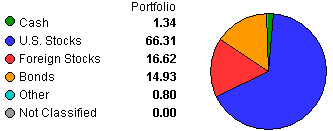
Well if you’re going to try and change your portfolio, you might as well take a ‘Before’ snapshot for comparison later. I entered our retirement account holdings as of today into Morningstar’s X-Ray tool and got the following asset allocation:

Current Asset Allocation

This is based on our current holdings of only two mutual funds:
[Read more…]

Vanguard IRA Benefit For Joint Account Holders

For those that have an Roth, Traditional, or SEP IRA at Vanguard like me, you probably noticed that they charge a custodial fee of $10 a year for each mutual fund you have with a balance of less than $5,000. This can add up if you own multiple funds in different IRAs. The only way to get around this is if “the IRA owner?s Vanguard account assets (including IRAs, employer-sponsored plans, brokerage accounts, annuities, and nonretirement accounts) total $50,000 or more.”

I just discovered that for joint accounts, the total value goes towards both account holders. For example, if my wife and I hold a joint taxable account with $50,000 in it, we would both be exempt from IRA custodial fees no matter what our IRA balances were, even though the $50k is shared between us. Might be helpful for those near the threshold.

Reconstructing Our Portfolio: Initial Thoughts

Now that I have decided to stop spending time learning to trade individual stocks, I want to focus instead on optimizing our retirement portfolio. Right now we have almost $50,000 in retirement accounts, and if I liquidate my stock positions and start adding money regularly to a taxable brokerage account we can keeping building on that. That seems like enough money to split in between some different mutual funds to achieve a more specific asset allocation.

I intend to choose an asset allocation based on Modern Portfolio Theory, which tries to achieve the greatest return for a given amount of risk. Or the least risk for a given long-term expected return. There is lots of math and research behind it, but I’ll get more into that later. I’ve gone ahead and ordered a book dedicated to this, The Intelligent Asset Allocator by William Bernstein, to be my main resource. My overall goals are to (1) make my portfolio optimized with minimal expenses and (2) make it easy to maintain and continuously add money to.