Estimating Future Investment Returns: 30-Year Forecast

It’s very hard to estimate exactly how much we’ll have to save for retirement, as that would require knowing how much our investments will grow in the future. Even if we try to do long-term trends, this can be difficult. But Richard Ferri, author of All About Asset Allocation and founder of Portfolio Solutions, LLC has done his best by layering risk premiums to estimate market returns. You can find the article for free online – ‘Portfolio Solutions 30-year Market Forecast’. An excerpt:

At the end of each year, we analyzed several economic and market risk factors including Federal Reserve forecasts, inflation forecasts derived from inflation protected securities, and the volatility of asset classes, styles, and categories. From that data, we developed estimates for longterm future returns.

Here are some of the results:
[Read more…]
FundAdvice.com and Portfolio Tweaking

Spent some time this weekend reading many of the articles at FundAdvice.com. The website is the educational arm of Merriman Capital Management, an investment management firm that is heavily into DFA funds. They promote no-load, asset-specific, low-cost funds (which often end up as index funds), and have a lot of interesting things to say on both active and passive investing.

I naturally gravitated towards the passive investing articles, and favorite article so far is ‘The ultimate buy-and-hold strategy’, which agrees with why I want to slice-and-dice my portfolio. I was also intrigued by their ideas for investors with small portfolios. Instead of picking an all-in-one fund or a cash fund until you have enough to invest, they advise you to pick the asset class with the most potential return but highest volatility (U.S. small-cap value to begin with) and build upwards.
[Read more…]

Work For A Big Company? Read a Review of Your 401(k) Plan

Do you work for a large government entity or corporation? Are you looking for an independent review of your company’s 401k plan or maybe some investment suggestions? I just ran across 401khelp.com, which does just that for a large list of companies, including for example Bank of America, Boeing, ChevronTexaco, Cingular Wireless, Cisco Systems, Citigroup, Costco, Dow Chemical, General Motors, Hewlett Packard, Home Depot, Honeywell, IBM, Microsoft, Nike, and the U.S. Government.

I wouldn’t follow their fund suggestions blindly, but it’s something to consider. They do seem to promote low-cost index funds overall, but also like some actively managed ones as well. This is part of a larger site, FundAdvice.com, which I’m still perusing. I am intrigued by their suggested portfolios, especially their Vanguard ones since it’s close to my portfolio, but I haven’t entirely figured out their philosophy behind them yet.

Finding a Good Self-Employed Solo 401k Administrator

As I’ve mentioned in my SEP IRA versus Solo 401(k) comparison, the problem with the additional paperwork involved with a 401(k) is that you have to find an administrator that is willing to do it for you at minimal cost. Compare that with the SEP-IRA, you can usually walk up to many brokers, open up an account, and start trading anything with no annual fees and just commissions.

For example, I opened up my SEP-IRA last year with Vanguard, but I can’t open up a Self-Employed 401(k) with them directly as they won’t be my administrator. The only option I found was to go through a third-party administrator like 401kBrokers, which charges an annual maintenance fee of 0.25% of the account balance. I think the fees are pretty fair considering there is no setup fee or other annual fees, but I still don’t want to pay them if I don’t have to.
[Read more…]

Self-Employed Solo 401k vs. SEP-IRA Basics

If you have self-employment income, there are a variety of ways to save some taxes and put some away for retirement. As I have no employees, right now my top two choices are the SEP-IRA (Simplified Employee Pension), which I used for 2005, and the Self-Employed/Solo 401k. After a bunch of reading, here’s what it boils down to:

SEP-IRA: Allows tax-deductible contributions and tax-deferred growth. Easy to set up at basically any broker. Very minimal paperwork involved.

Self-Employed 401k: Similar tax advantages as SEP-IRA, but with more paperwork, a more limited number of administrators, and higher contribution limits.
[Read more…]

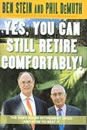
Book Review: Yes, You Can Still Retire Comfortably!

After reading their investing book Yes, You Can Time The Market! and liking their writing style and slightly different view on things, I decided to read Ben Stein and Phil DeMuth’s book on retirement – Yes, You Can Still Retire Comfortably!

Even though this book is targetted at Baby Boomers worried about their impending retirement, and I’m still in my 20s, it was an interesting read. First, they scare you with (true) tales of underfunded pension plans, a shaky Social Security system, and rising healthcare costs. Obviously, you need to do something about it!
[Read more…]

How Much Of Your Salary Should You Save For Retirement?

This is a difficult question to ask, but this paper I ran across entitled ‘Savings Rates and “Economic Security” in Retirement’ tries to take a stab at it. Here is the abstract:

Some simple number crunching using historical market return data for retirement planning. How much do we need to save to provide for a comfortable and secure retirement?

Here are some of his initial assumptions:
[Read more…]

Save Towards House Down Payment or Retirement?

If you know you need a big house downpayment in a year for a $500,000 house, do you:

A) Totally minimize your retirement contributions (just get your 401k match if any), and save everything else towards that downpayment, knowing at best you’ll get about 20% down?

B) Plan to save enough so that you’ll get at least 10% down (enough for a 80/10/10 loan), but put the rest away in tax-deferred accounts?

I’m shifting towards B, as I just don’t know if I want to have so much of our net worth tied up in a house. This way, I have a more balanced distribution as well as more money tucked away to grow until retirement. But then again, I’ll probably have to pay a higher rate for the piggyback loan or PMI. Thoughts?

August 2006 Retirement Portfolio / Cash Snapshot

Here is another snapshot of my retirement portfolio as of market close 8/3. I haven’t bought or sold any funds since my last update. I hope to use this data later to better track my overall investment returns.

[Read more…]

Retire to Mexico?

mexflag.jpgI found out that a friend of mine’s parents have been retired in Mexico for years now as US expats. Supposedly the housing and living expenses are affordable, taxes are low, and the healthcare is reasonably good. I have no idea if any of these things are true, and obviously this is not for everyone, but according to him they are very happy there. Good weather, nice people, and so on.

I wonder, where are other popular international places to retire? Asia? Africa? Western Europe sounds more expensive. I doubt that I would really want to retire away from family, but the idea has a certain charm.

June 2006 Retirement Portfolio / Cash Snapshot

In addition to my monthly net worth updates, I’ve decided to also take snapshot of my investing portfolio and my overall asset allocation. I want to also track any fund or ETF purchases so that I can better calculate my actual returns over time.

I haven’t decided whether to do it monthly or quarterly, but here’s my retirement portfolio as of today:

Retirement Portfolio
Fund $ %
IVV – iShares S&P 500 Index ETF $9,500 15%
VIVAX – V [Large-Cap] Value Index $11,700 19%
VISVX – V. Small-Cap Value Index $12,000 19%
VGSIX – V. REIT Index $7,100 12%
VTRIX – V. International Value $6,500 11%
VEIEX – V. Emerging Markets Stock Index $5,900 10%
VFICX – V. Int-Term Investment-Grade Bond $7,100 12%
BRSIX – Bridgeway Ultra-Small Market $1,900 3%
Total $59,800
June Fund Transactions
None.

I also decided, after meaning to do it for a long time, to track my “what I could come up with in 24 hours” cash balance as well as my current metric of “non-retirement” funds for my Mid-Term goal. This Liquid Available Cash is a better measurement of how much money I could put towards a house down payment as it removes things like my 0% balance transfer money, and my car equity. My small individual stock portfolio is included because I would just sell them as needed.

Right now, I’m just putting down my best estimate.

Liquid Available Cash $25,000 (est.)

Thoughts

The stock market overall ain’t doing so hot. I wish I had more money to dollar-cost average, but I think I have already put too much money into retirement and have neglected my cash needs. I am going to keep most of the money I make this summer in cash accounts and hopefully pump up that $25,000 number a bit.

I am also considering moving my IVV S&P 500 ETF holdings, which are currently in a taxable account at Scottrade, to a Self-Employed 401k (administrator unknown). Since they are currently at a loss, I won’t have any capital gains tax to pay if I sell and I’ll just need to find an appropriate ETF to avoid wash-sale rules. I’ll also be able to harvest some tax losses.

Fidelity 401k Decisions

So while we were gone the details were announced for my wife’s 401k. It appears that there is a 1.5% flat contribution (regardless of how much you contribute) instead of the match that was mentioned previously, and also some sort of performance-based bonus of up to another 1.5%. So far it is very vague as to what those performance targets are. Another piece of good news is that the plan administrator is Fidelity.

We only have a few days left to sign up with our own options, otherwise we get put initially into the default plan, which is just the 1.5% flat contribution invested into Fidelity’s Auto-Pilot Freedom Funds.
[Read more…]