Archives for December 2025

Lyft: $15 Ride Credit by Linking Atmos (Alaska Airlines) Account

Get a $15 Lyft ride credit if you link your Atmos Rewards (Alaska/Hawaiian Airlines) and Lyft accounts for the first time before 1/14/26. Lyft ride credits will be awarded within 5 days of the end of the Promotional Period and expire on January 31, 2026 at 11:59PM PT. Just did it, was easy enough.

If you pick Atmos as your rewards earning partner on Lyft, you get:

  • 2 Atmos points per $1 spent on everyday Lyft rides including Standard, Priority Pickup, and XL rides.
  • 3 Atmos points per $1 spent on airport rides and elevated Lyft rides including Extra Comfort, Black, and Black SUV rides.
  • Work rides earn double points – With Lyft Business Rewards, eligible riders can earn 4-6 points per $1 spent on business profile rides vs. 2-3 points on personal rides.

Fine print:

Eligible Members who link their Atmos™ Rewards and Lyft accounts for the first time during the Promotional Period will receive a $15 Lyft ride credit. “Eligible Members” means Atmos™ Rewards Members who have linked their Atmos™ Rewards and Lyft accounts on alaskalyft.com during the Promotional Period and have selected “Atmos™ Rewards by Alaska and Hawaiian” as their active partner in the ‘Rewards’ section of the Lyft App at the time the Lyft ride credit is deposited. “Promotional Period” means December 17, 2025, at 12:01am PT to January 14, 2026, at 11:59pm PT. The Lyft ride credit is eligible to be used on any Lyft ride type, excluding bicycle and scooter rides. Valid only in the United States (including Puerto Rico). Members who linked their Atmos™ Rewards and Lyft accounts prior to the Promotional Period are not eligible for a $15 retroactive ride credit. Lyft ride credits will be awarded within 5 days of the end of the Promotional Period and expire on January 31, 2026 at 11:59PM PT. This offer may be modified, suspended, or terminated at any time without notice.
The Triple Benefits of Travel

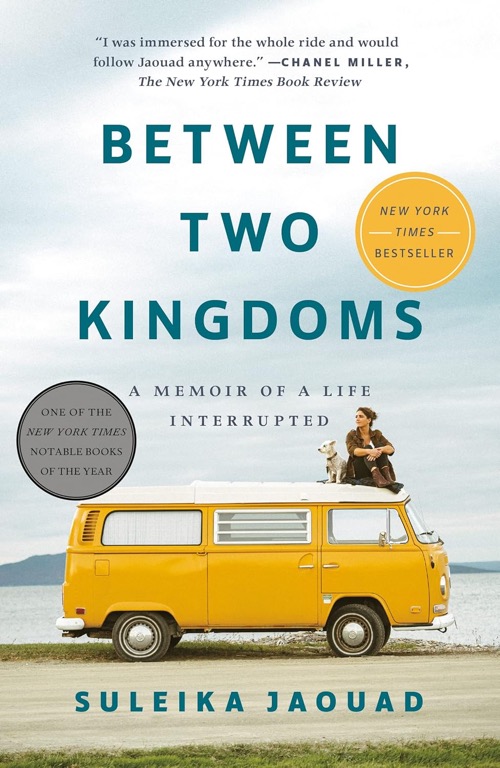
As we leave one year and get ready to enter the next, here’s a good quote from Between Two Kingdoms: A Memoir of a Life Interrupted by Suleika Jaouad (recommended; a very moving memoir).

He has a theory: When we travel, we actually take three trips. There’s the first trip of preparation and anticipation, packing and daydreaming. There’s the trip you’re actually on. And then, there’s the trip you remember. “The key is to try to keep all three as separate as possible,” he says. “The key is to be present wherever you are right now.” This advice, more than any, stays with me.

Just having a trip booked is enough to make you happier, according to the Institute for Applied Positive Research:

– 97% of survey respondents report that having a trip planned makes them happier.
– 82% say a booked trip makes them “moderately” or “significantly” happier.
– 71% reported feeling greater levels of energy knowing they had a trip planned in the
next six months.

This time of year seems to be a mix of when we are most likely experiencing all three of these effects – remembering past trips with kids no longer young and folks no longer with us, spending time with close ones this very moment, and starting to plan that next trip in 2026. A good reminder to savor it all.

The Power of Sharing

December 2025 marks the 21st anniversary of this site. Every year about this time, I think to myself: “How crazy! It worked!” I’ve been able to choose my work (or not to work) on my own terms for a while now. However, I keep going because I feel that the sharing and writing itself provides both myself and others an ongoing benefit. Writing for others makes me research more thoroughly and improve my understanding of the topic. While it may be trendy to mock “content creators”, I continue to love learning new stuff from online communities and individuals.

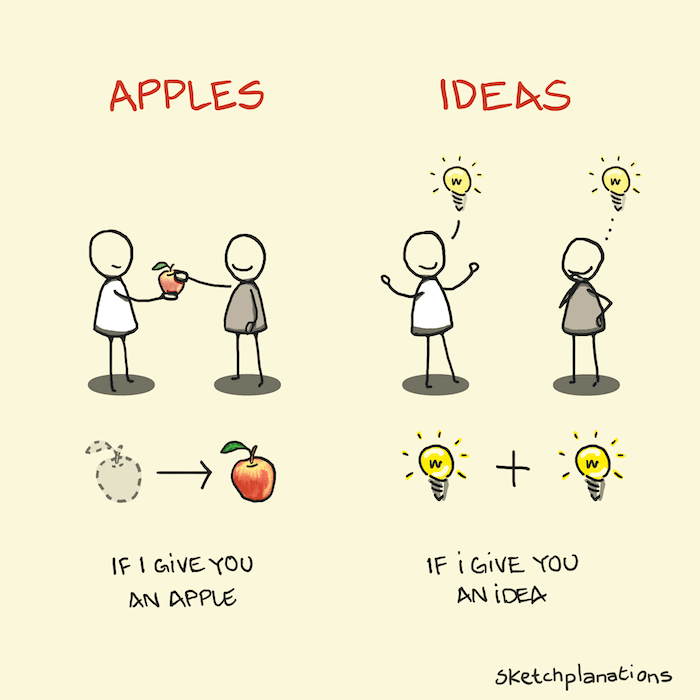
Another of the substacks I follow is Sketchplanations by Jono Hey, which explains complex ideas using simple sketches. Topics may include everything from vocabulary words to scientific theories. Apple and Ideas illustrates the following quote often attributed to George Bernard Shaw:

If you have an apple and I have an apple and we exchange apples, then you and I will still each have one apple. But if you have an idea and I have an idea and we exchange these ideas, then each of us will have two ideas.

In another sketch, Three Bricklayers Story does a great job explaining the “Three Bricklayers parable” about the power of having different perspectives in your work.

In that way, I think that each of us, sharing our own ideas with others, even has a greater purpose. Everyone can help each other move forward a little bit. I truly believe that everyone has something valuable to share about what lights their fire. Perhaps you post occasionally to an online forum, or just pass things along to close friends and children. Even sharing a mistake, what not do, is valuable. Making a mistake also means you at least took action, took a risk. I’m a shy person, but I’m always amazed that I always learn something even after short, casual conversations. Sometime just a quick side comment can turn me onto a hugely important concept.

Finance still intrigues me, but it’s also fun to be a beginner again; I consider myself a curious novice in running, triathlons, and woodworking.

The Central Struggle of Investing: Repeatedly Choosing Easy but Boring

Michael Burry, of “Big Short” fame, recently shut down his hedge fund and started a Substack with an educational goal. I enjoy following his musings because he’s not afraid to say what he thinks, even if I often don’t agree (or have any idea what he’s obliquely referring to). He recently posted a “foundational” article that is supposed to show his thinking process, with a familiar beginning:

For those that do not trust anything analog, since 1990, there have been over 750 replacements in the S&P 500 Index. Google’s Gemini 3 Pro swears by it. Claude Max agrees.

Gemini 3 Pro and Claude Max further propose that 45% of the top 20 names in the 1999 NASDAQ 100 ended up bankrupt or acquired after a >75% loss. This checks out, my conference room says.

Capital is always fighting to be recycled.

Thusly, you now carry the knowledge that most investors are best off in an index – and have no need to invest in individual stocks.

If one is rather young and has 50-70 years left, then one absolutely should be almost entirely invested in common stock indices, preferably the S&P 500 or the Nasdaq 100 or both. Live life, touch grass, achieve real things, automatically reinvest dividends, and let the compounding of the Index Gods do the work. Maybe not this very day, but over time, this is the way for most.

Of course, some of us just do…not…want…easy.

For them, well, their God gave them GameStop.

He then goes very deep into how he analyzed GameStop and through skill and smarts, of course made some nice returns on the trade.

This is the central humblebrag of professional investors. *You* should index, but here’s what *I* do instead.

This also relates to the central struggle for all individual investors. If you are a motivated person who studies investing with an honest and open mind, you realize that you probably shouldn’t really be actively trading. But if you are a motivated person who studies investing, you probably think you are in the tiny minority that can make money reliably with actively trading. Smart enough to turn off “easy” mode.

The other problem with “easy” is that it is usuually boring and often slow. Meanwhile, your Robinhood app or equivalent will happily sell you:

  • Crypto, including memecoins that have zero utility.
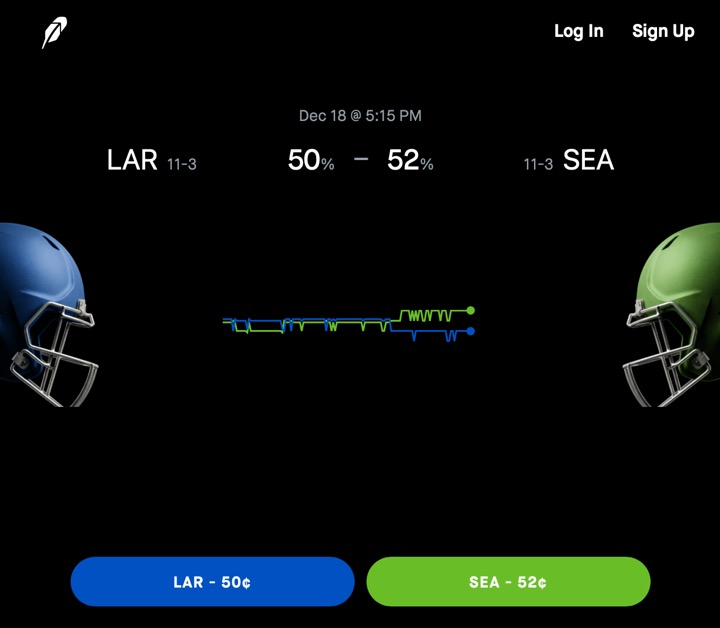
  • Gambling, err “Prediction markets” on this weekend’s NFL game.
  • “Dividend” ETFs with a crazy 12% yield that some think will last forever.
  • Aggressive options that can lose all your money within days.
  • “Boomer candy” ETFs that promise stock-like upside with zero downside.
  • Index “Plus”. Index with extra ketchup. Index minus the ketchup. Just 25 basis points extra!

I spend a lot of my own time doing just this – reading such interesting ideas across various corners of the investing world but repeatedly convincing myself to pick “easy”. Doing nothing, over and over again.

Walmart: $10 off $50 First 3 Pickup & Delivery Orders (New Customers)

Walmart has a promotion right now offering new customers $10 off $50+ on their first 3 orders of pickup or delivery with promo code HOLIDAY10. Here is the press release and the fine print with a few restrictions. If you do mostly grocery items like, they should be fine. Might be worth trying just to see if it works. Hat tip to DoC.

Terms & Conditions
– Valid only for your first (3) orders of pickup or delivery.
– $50 order minimum.
– Discount will be applied to your order of pickup or delivery.
– This offer can’t be used for photo, personalized items, pharmacy, gift cards, alcohol or items sold by Marketplace sellers.
– Customer responsible for all applicable taxes.
– This offer may not be combined with other special offers.
– Promotion code expires 12/31/25.
– Offer subject to change or expire without notice.

Everyone is dealing with inflation in their own way, and my response has been trying out all the many “Great Value” items that Walmart offers, from butter to yogurt to canned black beans. And honestly, they’ve mostly been just fine. I feel that Walmart business has been doing so well for this reason, and also because they make their Pickup service very user-friendly:

  • Even after making your initial order, you can continuously keep adding OR removing items, right up until they start shopping your order. Many stores don’t let you remove items after ordering.
  • Their inventory management is more accurate than before, with fewer out-of-stock items and substitutions. Frequent substitutions are really annoying when you try to meal-plan the entire week ahead, like me.
  • If they do substitute, they let you know beforehand and you can decline in the app.
  • You can also decline substitutions when you actually pick up, and they will return it for you without you having to enter the store.

Fidelity Tax-Loss Harvesting Tool: Help Identify Capital Loss Opportunities

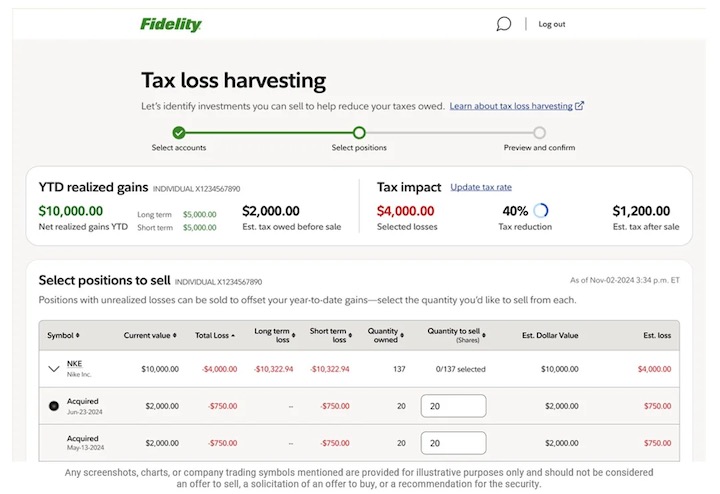
Fidelity has a number of useful Tools & Calculators, most of which are open to everyone to use. However, their Tax-Loss Harvesting Tool (login required) is meant for Fidelity taxable brokerage customers, as it is based on your personal data and shows the size of your expected capital gains this year, while also helping you identify capital losses that you can “harvest” if you wanted.

You’ll need to provide your marginal tax rates (make an estimate with current brackets here). The tool can even help you place the (market) order to sell those shares with just a couple clicks.

This Fidelity article How to reduce investment taxes contains a lot of details on the practice of tax-loss harvesting:

An investment loss can be used for 2 different things:

– The losses can be used to offset investment gains.
– Remaining losses can offset $3,000 of income on a tax return in one year. (For married individuals filing separately, the deduction is $1,500.)

[…] There are 2 types of gains and losses: short-term and long-term.

– Short-term capital gains and losses are those realized from the sale of investments that you have owned for one year or less.
– Long-term capital gains and losses are realized after selling investments held longer than one year.
The key difference between short- and long-term gains is the rate at which they are taxed.

Short-term capital gains are taxed at your marginal tax rate as ordinary income. The top marginal federal tax rate on ordinary income is 37%.

Wash sale warning: The tool can’t cross-reference all your other non-Fidelity trades, and also doesn’t even account for your Fidelity trades within tax-deferred accounts. If a wash sale occurs, your loss will be disallowed. Here’s the warning provided:

Wash sale warning: Estimated savings based on tax-loss harvesting assumes that you will not have a wash sale that would defer your tax loss.

If you sell shares at a loss and you purchase additional shares of the same or a substantially identical security (in the same or a different account) within the 61-day period that begins 30 days before and ends 30 days after the trade date of the sale, the purchase may result in a wash sale. If a wash sale occurs, the loss from the transaction will be “disallowed” for tax purposes, and the amount of the loss will be added to the cost basis of your shares in the same security. Fidelity adjusts cost basis information related to shares in the same security when a wash sale occurs within an account as the result of an identical security purchase.

You must check your own records across all of your Fidelity and non-Fidelity accounts to ensure that you are correctly accounting for losses related to any wash sales.

ETFs are often the easiest way to harvest a tax loss. Even if you buy-and-hold ETFs, consider ETF tax-loss harvesting (my post from 2008?!) as you can harvest the loss from the sale of an ETF, and then immediately buy a similar but not “substantially identical” ETF without triggering a wash sale. This has become common industry practice. There’s a Fidelity article on this too.

When evaluating your ETFs against the wash-sale rule, compare the issuer, index, and underlying holdings between the two ETFs being swapped. The more dissimilar these are, the more likely it is that you won’t trigger a wash sale.

Even Vanguard does ETF tax-loss harvesting in their advisory services using “surrogate ETFs”.

Surrogate funds are the ETFs (exchange?traded funds) Vanguard Personal Advisor uses toreplace investments sold to harvest losses. They are Vanguard ETFs® with similar asset and sub?asset allocations to the funds we’re replacing.

There may not be as many opportunities to harvest a tax loss this year since most things are up (a good thing!), but something to keep in mind down the road.

The usual disclaimer: I do not provide legal or tax advice. The information herein is general and educational in nature and should not be considered legal or tax advice.

LifeX TIPS ETFs: Monthly Inflation-Adjusted Income

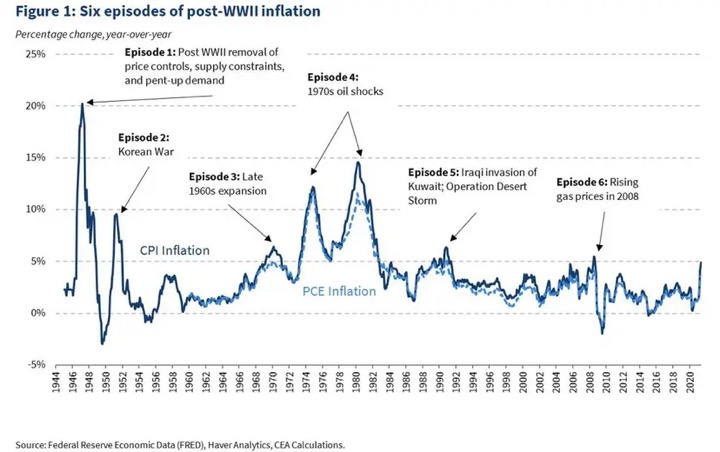
Sometimes it seems like everyone just wants risk these days. Crypto. Sports gambling. Options trading, ETFs that magically yield 10% or more. However, if you’re in the opposite camp and you want the absolute least amount of risk, you’d want to retire off an investment that has a return that is fully-guaranteed, pays out a monthly income like clockwork, is even guaranteed to grow with inflation. Inflation was relatively mild for a long time until recently, but historically it has been a significant risk factor.

If that interests you, check out 3 Ways to Build an Inflation-Adjusted Pension by Allan Roth – which first reminds you that Social Security is exactly this! – but also introduces a new series of LifeX Inflation-Protected Longevity Income ETFs.

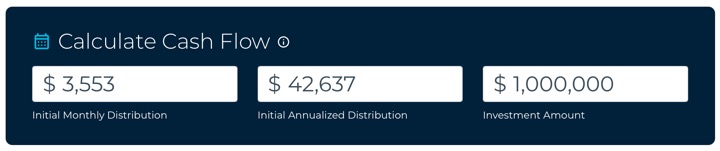
At current rates as of 12/11/25, the LifeX 2055 Inflation-Protected Longevity Income ETF (LIAM) contains a managed portfolio of United States Treasury Inflation Indexed Bonds (TIPS) that can provide you with a 4.26% guaranteed real withdrawal rate for 30 years. That means a $1,000,000 portfolio would distribute roughly $42,600 in annual income this year, but that number would increase with CPI inflation each year for 30 years (through the year 2055). At 3% average inflation, your 30th year’s income would have grown to over $100,000 a year. Of course, inflation could be a lot higher, which is why no private insurance company will sell you inflation protection over such a long period of time.

After those 30 years, you will be left with nothing. Your initial principal will be gone. Therefore, your income taken each year is partially a return of principal.

The expense ratio is 0.25%, which isn’t Vanguard-level but not horrible. I like that it does all of the work for you in a tidy ETF package, as building a TIPS ladder yourself can be a bit tricky (and do you want to keep doing it at age 80, 90?). Of course, I also worry about what happens if you bought a 30-year ladder at 65 and happen to live past 95. It could happen, and remember, this product is meant for the risk-averse folks that like to cover all the bases.

In general, I feel a TIPS ladder or equivalent that adjusts with inflation would work well in combination with a traditional annuity like an SPIA or a deferred longevity annuity that starts at a later age, which doesn’t adjust with inflation but does provide an higher initial fixed income that can last as long as you live. This is what I have set up for my parents – Social Security that rises with inflation, plus a joint income annuity that pays out as long as one is living.

inKind Dining App: New $25 off $25 Promo

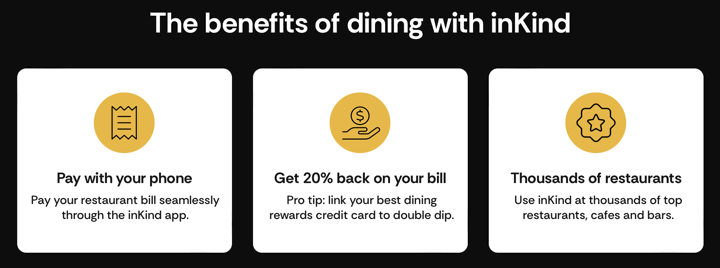
Added new $25 off $25 link (may be targeted). inKind is a startup that provides restaurants financing in exchange for “food and beverage credit”. Retail customers can use inKind to pay their food bill at participating restaurants through the app and get 20% back in “inKind Cash” credit on their bills. They say over 4,000 restaurants are in their network, mostly nicer local spots, but some chains like California Pizza Kitchen are also included (which is a favorite for our family).

The good thing is that you don’t have to let the server know ahead of time, or do anything awkward like using a coupon. You just get the check and then use the inKind app to pay. All the restaurants use the same backend Toast software, so you just need a number from the top of the paper bill. Within the inKind app, you can link your existing rewards credit card and also earn those rewards on your net cost (will still code as dining). inKind works primarily for dine-in, but some restaurants do specifically allow take-out. You are supposed to order the takeout from within the inKind app, but as long as you get the bill with the code, you should be able to pay using the app.

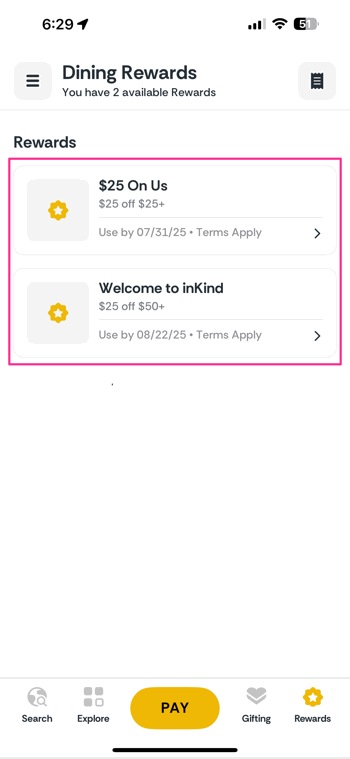
Current promos:

If you have a big bill, know that you can “split the check” within the app, so that two separate people can use a $25 off $50 discount in their respective inKind apps.

You should see your multiple offers in the app:

California Pizza Kitchen is part of the inKind network, and they are a reliable way to use these offers. They usually have some sort of promo going, like right now they have $10 Pizzas on Monday and Tuesday that you can stack.

Now, I can’t guarantee this will work for you, but this may work with CPK take-out and not just dine-in. (Be sure order directly from CPK.com or over the phone, not another app like Doordash or Grubhub.) The place we go to just has a separate take-out counter and the default check that comes from them should work with inKind. If not, tell them you want to pay with inKind and they should be able to generate the right check with the number on top. Make sure you meet the minimum purchase amount.

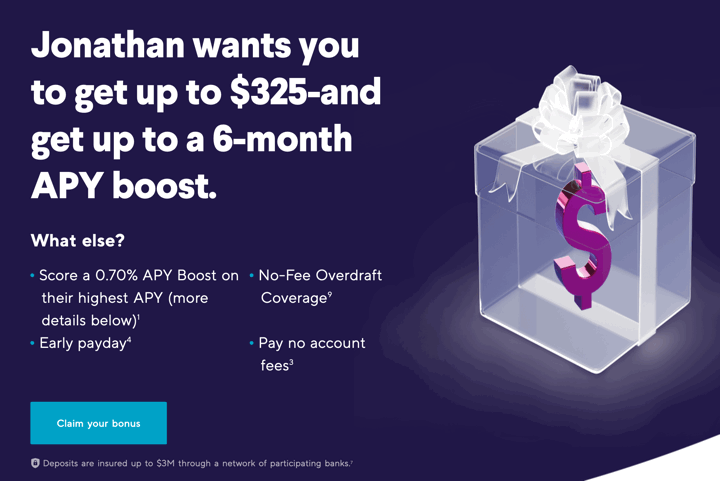
SoFi Offers: SoFi Plus Changes, New 5% Grocery Card, $325/4.20% APY Checking Bonus, $300-$1000 Loan Bonuses

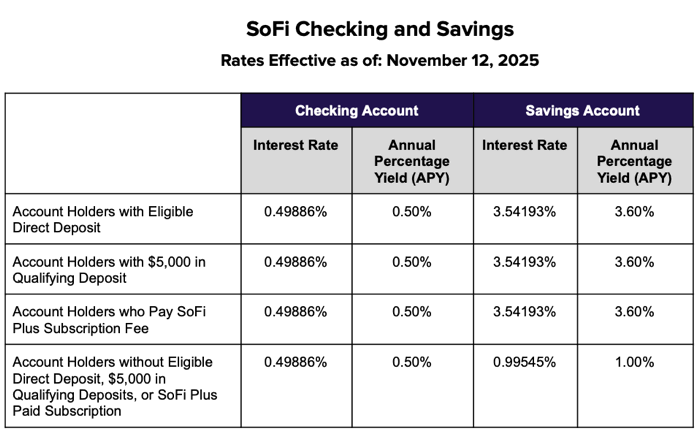
Update December 2025: SoFi announced some changes to their available features and what is only available with their SoFi Plus “Premium” membership program. I feel that they are trying to build something like “Robinhood Gold”, but hopefully better promos are coming because I don’t feel the perks are worth the cost right now. First, there are now three different ways to earn their higher APY tier (any single ONE of these is enough):

  • Eligible Direct Deposit of any amount (even $1). Many people can split their paycheck multiple ways.
  • $5,000+ in combined balances across SoFi Checking and Savings accounts
  • SoFi Plus members that pay $10/month fee.

You can see this on their rate sheet (as of 11/12/25):

Second, SoFi Plus is now paid-only at $10/month. You no longer get it for free with a direct deposit, although they are extending complimentary access to all SoFi Plus benefits through March 30, 2026 with eligible deposits. You can see a list of SoFi Plus benefits here.

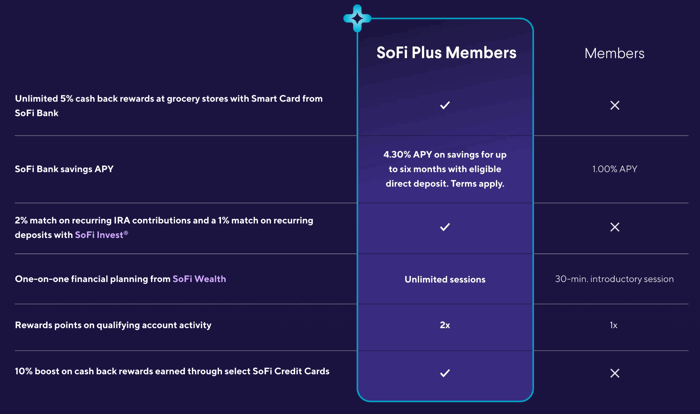
For the most part, the SoFi Plus benefits are the same as before. A notable new addition is the SoFi Smart Card which is a charge card linked to your SoFI Bank accounts that offers unlimited 5% cash back at grocery stores.

Otherwise, I would say the most valuable SoFi Plus perks that existing Direct Deposit folks lost with this change are:

  • 10% rewards boost on the SoFi Unlimited 2% Credit Card, which turns the 2% cash back into 2.2% cash back.
  • 2% match on recurring IRA contributions, plus a 1% match on recurring deposits made through SoFi Invest taxable brokerage accounts.
  • Possibly the ability to “schedule an unlimited number of appointments with a financial planner”, although I’m not sure of the quality of this advice. There is no indication you’re guaranteed at least a CFP. I’ve never used this feature, but it might be nice if you wanted to get some general advice.

Update April 2024: SoFi made a few notable changes recently, both positive and negative:

  • The SoFi Unlimited 2% Credit Card added 10% boost on their rewards with direct deposit into SoFi Checking or Savings. This would work out to 2.2% cash back rewards points on everyday purchases. (As of December 2025, this is now restricted to SoFi Plus members paying $10 a month.)
  • There is a new inactivity fee of $25 per account for every 6 months of login inactivity.
  • The outgoing ACAT transfer fee was increased to $100. Previously $75.

Original post:

SoFi (“Social Finance”) is an all-in-one finance app that expanded from students loans into banking, stocks, crypto, credit cards, and more. Here are their current promotional offers; New users can receive a separate opening bonus for each separate part of SoFi (Money, Invest, Loans, etc).

  • SoFi Checking Referral Offer: Up to $325 new user bonus. Open a new SoFi Money account and add at least $10 to your account within 5 days, and get $25. Then get up to $300 additional bonus with qualifying direct deposit. Plus up to 4.30% APY.
  • SoFi Credit Score Tracking Offer: $10 in rewards bonus points. You’ll earn $10 in rewards points when you activate free credit score monitoring
  • SoFi Invest Referral Offer: $25 new user bonus. Taxable brokerage account. Open an Active Investing account with $10 or more, and you’ll get $25 in stock.
  • SoFi 401(k) Rollover Offer: Up to $10,000 Bonus. Get a 1% match when you roll over your 401(k) into a SoFi IRA. Partnered with Capitalize to make the transition easier.
  • SoFi Student Loan Refi: $300 bonus. Warning: Do your research before refinancing your Federal student loans to a private lender.
  • SoFi Doctors and Dentists Student Loan Refi: $1,000 bonus. Special low rates just for doctors and dentists.
  • SoFi Private Student Loan: $300 bonus.
  • SoFi Personal Loans Referral Offer: Fixed $300 bonus. Fixed $300 bonus, 90 days after successful funding. The loan has no fees and you can pay it back in full after 90 days (you can pay it down to $50 before then to accrue minimal interest, thus making a new profit after the bonus).

Valuation Gap Chart: US vs. International Developed vs. Emerging Markets

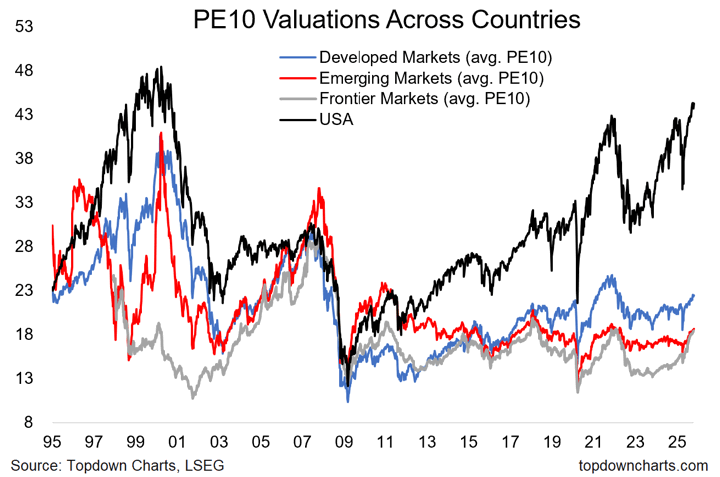
As 2025 winds down, you will probably read a lot of articles remarking how international stock indexes have outperformed US stock indexes like the S&P 500 by a significant amount this year. This hasn’t happened in a while! Yet, the following chart shows that the gap in valuations is still very wide.

PE10 stands for the ratio of price to 10-year average trailing earnings (AKA CAPE ratio, or cyclically-adjusted P/E ratio) which attempts to smooth out earnings spikes. Image via TopDownCharts.

Kraken Crypto: Existing Users 30 Days of Free Spins, New User Bonuses

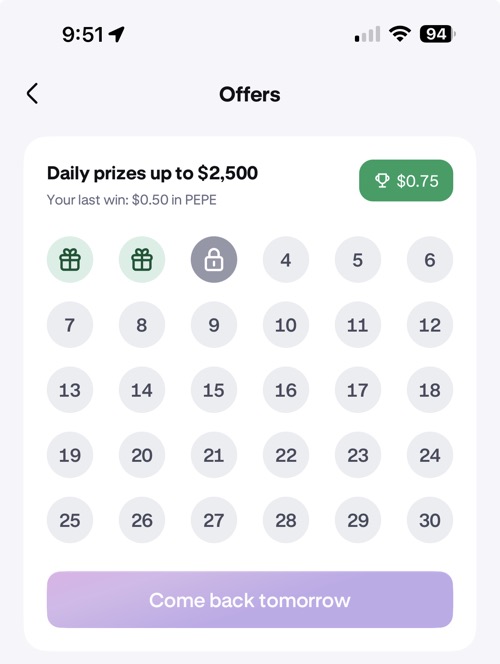
Update: A quick heads up for existing Kraken users that many people are being targeted for another 30 days of their “Daily Spin” game given out to new users. You will need to make one trade to activate (even buying $1 of BTC or USDG and paying a penny fee works). Then you get 30 days of spins, like free slot machine pulls. The total average winnings over 30 days seem to be reliably at least around $15-$20. Check your offers tab; The e-mail subject was “🎄Spin to win up to $2,500 this Christmas!”, which looked a little spammy so you might have missed it.

Original post:

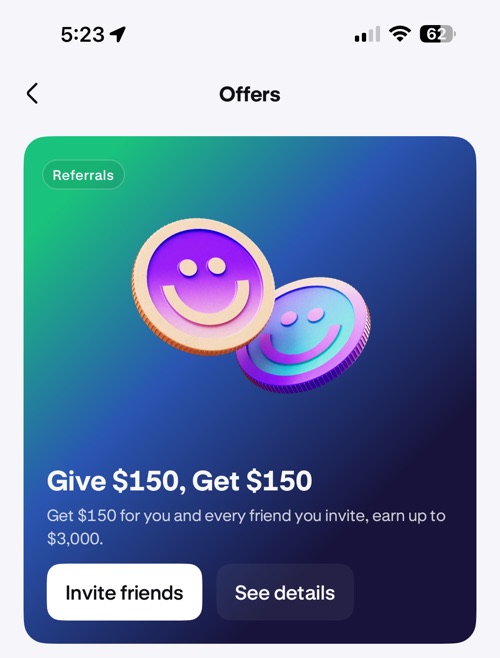
Crypto exchange Kraken is now offering up to a $150 bonus in crypto after you open a new account and complete the requirements. You can confirm when entering the code, as shown above. You must trade crypto that isn’t stablecoin, like BTC. The details are below. That’s my referral link, which should auto-populate with the promo code 2zr4jyp5 . Thanks if you use it!

  • Open an account and deposit at least $100.
  • Trade at least $100, earn $15.
  • Trade at least $300, earn $20. ($35 total)
  • Trade at least $500, earn $50. ($75 total)
  • Trade at least $5,000, earn $75. ($150 total)

Select cashback portals are offering bonuses as well, which change regularly but can be upward of $100 as well, like TopCashback and Rakuten (search “Kraken”). The payouts vary up to daily, but I would wait until one is above $100, currently Rakuten is at $150 at time of writing (Hat tip to DoC). I am not 100% certain if this will stack with the referral discount, but I would still try going through the portal link and then adding the referral code. There are multiple successful reports of stacking.

Be on the lookout for a Daily Spin game which offers free spins for 30 days as well.

Other crypto offers:

Best Interest Rates Survey: Bank Accounts, Treasury Bills, Money Markets, ETFs – December 2025

Here’s my monthly survey of the best interest rates on cash as of December 2025, roughly sorted from shortest to longest maturities. Banks and brokerages love taking advantage of idle cash, and you can often earning more money while keeping the same level of safety by moving to another FDIC-insured bank or NCUA-insured credit union. Check out my Ultimate Rate-Chaser Calculator to see how much extra interest you could earn from switching. Rates listed are available to everyone nationwide. Rates checked as of 12/5/2025.

TL;DR: Savings account interest rates have dropped slightly overall, moving with Fed rates. You can still get 4.6% and 4.5% APY if you accept some hoops/restrictions, but most are a little under 4% now. Short-term T-Bill rates have fallen, now ~3.7%. Top 5-year CD rates are ~4.25% APY, while 5-year Treasury rate is ~3.7%.

High-yield savings accounts*
Since the huge megabanks still pay essentially no interest, everyone should at least have a separate, no-fee online savings account to piggy-back onto your existing checking account. The interest rates on savings accounts can drop at any time, so I list the top rates as well as competitive rates from banks with a history of competitive rates and solid user experience. Some banks will bait you with a temporary top rate and then lower the rates in the hopes that you are too lazy to leave.

  • The top saving rate at the moment: Pibank at 4.60% APY (no min), but they have some weird restrictions; like you can only use wire/Plaid to deposit and wire transfers to withdraw funds?! Hyperion Bank has a 4.50% APY money market account ($10,000 minimum, new money) with a 6-month rate guarantee. CIT Platinum Savings is now at 3.75% APY with $5,000+ balance and is offering an up to $300 deposit bonus which increases your effective APY for a while. There are many banks in between.
  • SoFi Bank is at 3.60% APY + up to 4.30% APY for 6 months + $325 new account bonus with qualifying direct deposit. You must maintain a direct deposit of any amount (even $1) each month for the higher APY. SoFi has historically competitive rates and full banking features.
  • Here is a limited survey of high-yield savings accounts. They aren’t the top rates, but a group that have historically kept it relatively competitive such that I like to track their history. This month they start at 3.30% APY on up.

Short-term guaranteed rates (1 year and under)
A common question is what to do with a big pile of cash that you’re waiting to deploy shortly (plan to buy a house soon, just sold your house, just sold your business, legal settlement, inheritance). My usual advice is to keep things simple and take your time. If not a savings account, then put it in a flexible short-term CD under the FDIC limits until you have a plan.

  • No Penalty CDs offer a fixed interest rate that can never go down, but you can still take out your money (once) without any fees if you want to use it elsewhere. Marcus has a 13-month No Penalty CD at 3.95% APY ($500 minimum deposit). Farmer’s Insurance FCU has a 9-month No Penalty CD at 4.00% APY ($1,000 minimum deposit). USALLIANCE Financial CU has a 11-month No Penalty CD at 3.90% APY ($500 minimum deposit).
  • USALLIANCE Financial CU has a 12-month certificate at 4.18% APY ($500 min). Early withdrawal penalty is 180 days of interest. Anyone can join this credit union via partner organization American Consumer Council (try promo codes “consumer”, “abnb”, or “USFFCU” to join for free).

Money market mutual funds
Many brokerage firms that pay out very little interest on their default cash sweep funds (and keep the difference for themselves). Note: Money market mutual funds are highly-regulated, but ultimately not FDIC-insured, so I would still stick with highly reputable firms.

  • Vanguard Federal Money Market Fund (VMFXX) is the default sweep option for Vanguard brokerage accounts, which has a 7-day SEC yield of 3.89% (changes daily, but also works out to a compound yield of 3.96%, which is better for comparing against APY). Odds are this is much higher than your own broker’s default cash sweep interest rate.
  • Vanguard Treasury Money Market Fund (VUSXX) is an alternative money market fund which you must manually purchase, but the interest will be mostly (100% for 2024 tax year) exempt from state and local income taxes because it comes from qualifying US government obligations. Current 7-day SEC yield of 3.88% (compound yield of 3.95%).

Treasury Bills and Ultra-short Treasury ETFs
Another option is to buy individual Treasury bills which come in a variety of maturities from 4-weeks to 52-weeks and are fully backed by the US government. You can also invest in ETFs that hold a rotating basket of short-term Treasury Bills for you, while charging a small management fee for doing so. T-bill interest is exempt from state and local income taxes, which can make a significant difference in your effective yield.

  • You can build your own T-Bill ladder at TreasuryDirect.gov or via a brokerage account with a bond desk like Vanguard and Fidelity. Here are the current Treasury Bill rates. As of 12/5/25, a new 4-week T-Bill had the equivalent of 3.72% annualized interest and a 52-week T-Bill had the equivalent of 3.61% annualized interest.
  • The iShares 0-3 Month Treasury Bond ETF (SGOV) has a 3.85% 30-day SEC yield (0.09% expense ratio) and effective duration of 0.10 years. SPDR Bloomberg Barclays 1-3 Month T-Bill ETF (BIL) has a 3.71% 30-day SEC yield (0.136% expense ratio) and effective duration of 0.15 years. The new Vanguard 0-3 Month Treasury Bill ETF (VBIL) has a 3.89% 30-day SEC yield (0.07% expense ratio) and effective duration of 0.10 years.

US Savings Bonds
Series I Savings Bonds offer rates that are linked to inflation and backed by the US government. You must hold them for at least a year. If you redeem them within 5 years there is a penalty of the last 3 months of interest. The annual purchase limit for electronic I bonds is $10,000 per Social Security Number, available online at TreasuryDirect.gov.

  • “I Bonds” bought between November 2025 and April 2026 will earn a 4.03% rate for the first six months. The rate of the subsequent 6-month period will be based on inflation again. More on Savings Bonds here.
  • In mid-April 2026, the CPI will be announced and you will have a short period where you will have a very close estimate of the rate for the next 12 months. I will post another update at that time.

Rewards checking accounts
These unique checking accounts pay above-average interest rates, but with unique risks. You have to jump through certain hoops which usually involve 10+ debit card purchases each cycle, a certain number of ACH/direct deposits, and/or a certain number of logins per month. If you make a mistake (or they judge that you did) you risk earning zero interest for that month. Some folks don’t mind the extra work and attention required, while others would rather not bother. Rates can also drop suddenly, leaving a “bait-and-switch” feeling.

  • OnPath Federal Credit Union (my review) pays 6.00% APY on up to $10,000 if you make 15 debit card purchases, opt into online statements, and login to online or mobile banking once per statement cycle. Anyone can join this credit union via $5 membership fee to join partner organization. You can also get a $150 Visa Reward card when you open a new account and make qualifying transactions.
  • Genisys Credit Union pays 6.75% APY on up to $7,500 if you make 10 debit card purchases of $5+ each per statement cycle, and opt into online statements. Anyone can join this credit union via $5 membership fee to join partner organization.
  • Oklahoma Central Credit Union pays 6.00% APY on up to $10,000 if you make 15 debit card purchases (non-ATM) per statement cycle. Anyone can join this credit union if they are “affiliated with another credit union”.
  • La Capitol Federal Credit Union pays 5.75% APY on up to $10,000 if you make 15 debit card purchases of at least $5 each per statement cycle. Anyone can join this credit union via partner organization, Louisiana Association for Personal Financial Achievement ($20).
  • First Southern Bank pays 5.50% APY on up to $25,000 if you make at least 15 debit card purchases, 1 ACH credit or payment transaction, and enroll in online statements.
  • Credit Union of New Jersey pays 6.00% APY on up to $25,000 if you make 12 debit card purchases, opt into online statements, and make at least 1 direct deposit, online bill payment, or automatic payment (ACH) per statement cycle. Anyone can join this credit union via $5 membership fee to join partner organization.
  • Andrews Federal Credit Union pays 5.50% APY (down from 6%) on up to $25,000 if you make 15 debit card purchases, opt into online statements, and make at least 1 direct deposit or ACH transaction per statement cycle. Anyone can join this credit union via partner organization.
  • Find a locally-restricted rewards checking account at DepositAccounts.

Certificates of deposit (greater than 1 year)
CDs offer higher rates, but come with an early withdrawal penalty. By finding a bank CD with a reasonable early withdrawal penalty, you can enjoy higher rates but maintain access in a true emergency. Alternatively, consider building a CD ladder of different maturity lengths (ex. 1/2/3/4/5-years) such that you have access to part of the ladder each year, but your blended interest rate is higher than a savings account. When one CD matures, use that money to buy another 5-year CD to keep the ladder going. Some CDs also offer “add-ons” where you can deposit more funds if rates drop.

  • United Fidelity Bank has a 5-year certificate at 4.25% APY ($1,000 minimum), 4-year at 4.20% APY, 3-year at 4.20% APY, 2-year at 4.25% APY, and 1.5-year at 4.15% APY. Early withdrawal penalties are not disclosed clearly online.
  • Mountain America Credit Union (MACU) has a 5-year certificate at 4.00% APY ($500 minimum), 4-year at 4.00% APY, 3-year at 4.05% APY, 2-year at 4.20% APY, and 1-year at 3.85% APY. Early withdrawal penalty for the 4-year and 5-year is 365 days of interest. Anyone can join this credit union via partner organization American Consumer Council (use promo code “consumer” when joining).
  • You can buy certificates of deposit via the bond desks of Vanguard and Fidelity. You may need an account to see the rates. These “brokered CDs” offer FDIC insurance and easy laddering, but they don’t come with predictable early withdrawal penalties. Right now, I see a 5-year non-callable brokered CD at 3.90% APY (callable: no, call protection: yes). Be warned that both Vanguard and Fidelity will list higher rates from callable CDs, which importantly means they can (and will!) call back your CD if rates drop significantly later.

Longer-term Instruments
I’d use these with caution due to increased interest rate risk (tbh, I don’t use them at all), but I still track them to see the rest of the current yield curve.

  • Willing to lock up your money for 10 years? You can buy long-term certificates of deposit via the bond desks of Vanguard and Fidelity. These “brokered CDs” offer FDIC insurance, but they don’t come with predictable early withdrawal penalties. You might find something that pays more than your other brokerage cash and Treasury options. Right now, I see a 10-year CDs at 4.00% (non-callable) vs. 4.13% for a 10-year Treasury. Watch out for higher rates from callable CDs where they can call your CD back if interest rates drop.

All rates were checked as of 12/5/25.

* I no longer recommend fintech companies due to the possibility of significant loss due to poor recordkeeping and the lack of government protection in such scenarios. The point of cash is absolute safety of principal.

Photo by Giorgio Trovato on Unsplash