Archives for November 2025

Bask Bank Interest Checking $300 Bonus + 3% APY Rate Boost (New Customers)

Bask Bank has a new promotion for their Interest Checking account:

  • Open a new Bask Interest Checking Account between November 1, 2025, and January 31, 2026. Offer is available to new Bask Interest Checking customers who do not have an existing Interest Checking Account as of October 31, 2025.
  • Maintain an average monthly balance of at least $1,500 in your Bask Interest Checking Account and complete five or more monthly purchases, totaling a minimum of $50, using your Bask debit card.
  • 3.00% APY Rate Boost: Earn a 3.00% APY Boost from November 1, 2025, through January 31, 2026,
    when qualifying activities are met. This is on top of the “base” Checking rate, which can vary but is currently 1% APY.
  • $300 Cash Bonus ($100 x 3): Earn up to a $300 Cash Bonus from November 1, 2025, through April 30, 2026, when qualifying activities are met. Qualifying participants will receive a $100 Cash Bonus paid to their Bask Interest Checking Account at the close of each monthly statement period when all qualifying activities are met. Participants can receive a maximum of three Cash Bonus payments during the Cash Bonus Period.

Interest Checking has no monthly fees and no minimum balance. You could also pair with the Bask Bank Interest Savings account, currently paying a competitive 4.05% APY. This is not a fintech; Texas Capital Bank is the underlying bank, previously also behind the old BankDirect brand.

I already have this account as well from a previous $200 bonus. I should probably close it as I don’t use it.

This is a solid bonus that doesn’t require a direct deposit, just a few debit card purchases. I already have an open Mileage Savings Account with $20 or so in it so that I can earn a few American Airlines miles each month as “interest” and keep my AA miles active. (The payout isn’t as great as it once was, so I don’t keep anything sizable in there anymore, but maybe they’ll hike it back up someday.)
Savings I Bonds November 2025: 0.90% Fixed Rate, 3.13% Inflation Rate (4.03% Total for First 6 Months)

Update: Savings I Bonds bought from November 1, 2025 to April 30, 2026 will have a fixed rate of 0.90% and inflation rate of 3.13%, for a total composite rate of 4.03% for the first 6 months. Compare the total rate with the current short-term Treasury yields (1-year @ ~3.7%), and compare the fixed rate with the short-term TIPS real yields (5-year @ ~1.3%).

Every existing I Bond will earn this inflation rate of ~3.13% eventually for 6 months; you will need to add your own fixed rate that was set based the initial purchase month. See you again in mid-April for the next early prediction for May 2026.

Original post from 4/11/25:

Savings I Bonds are a unique, low-risk investment backed by the US Treasury that pay out a variable interest rate linked to inflation. With a holding period from 12 months to 30 years, you could own them as an alternative to bank certificates of deposit (they are liquid after 12 months) or bonds in your portfolio.

New inflation numbers were announced (late due to the government shutdown) at BLS.gov, which allows us to make an early prediction of the November 2025 savings bond rates just before the official announcement on the 1st. This also allows the opportunity to know exactly what an October 2025 savings bond purchase will yield over the next 12 months, instead of just 6 months. You can then compare this against a November 2025 purchase.

New inflation rate prediction. May 2025 CPI-U was 319.799. September 2025 CPI-U was 324.800, for a semi-annual inflation rate of 1.56%. Using the official composite rate formula:

Composite rate formula: [Fixed rate + (2 x semiannual inflation rate) + (fixed rate x semiannual inflation rate)]

This results in the variable component of interest rate for the next 6 month cycle being ~3.12 to 3.13%, depending on the fixed rate.

Tips on purchase and redemption. You can’t redeem until after 12 months of ownership, and any redemptions within 5 years incur an interest penalty of the last 3 months of interest. A simple “trick” with I-Bonds is that if you buy at the end of the month, you’ll still get all the interest for the entire month – same as if you bought it in the beginning of the month. It’s best to give yourself a few business days of buffer time. If you miss the cutoff, your effective purchase date will be bumped into the next month. (You should always sell at the very beginning of the month.)

Buying in October 2025. If you buy before the end of October, the fixed rate portion of I-Bonds will be 1.10%. You will be guaranteed a total interest rate of 1.10 + 2.88 = 3.98% for the next 6 months. For the 6 months after that, the total rate will be 1.10 + 3.12 = 4.22%.

Buying in November 2025. If you buy in November 2025, you will get ~3.12% plus a newly-set fixed rate for the first 6 months. The new fixed rate is officially unknown, but is loosely linked to the real yield of short-term TIPS with some reductions. In the previous 10 days, 5-year TIPS real rates have ranged from 1.19% to 1.30%. If I had to guess, I’d put a new fixed rate somewhere between 0.8 to 1.0%, for a total rate of about 4%. Every six months after your purchase, your rate will adjust to your fixed rate (set at purchase) plus a variable rate based on inflation.

If you have an existing I-Bond, the rates reset every 6 months depending on your specific purchase month. Everyone will eventually get this variable rate. Your bond rate = your specific fixed rate (based on purchase month, look it up here) + variable rate (total bond rate has a minimum floor of 0%).

Buy now or wait? Between those two options, if you are a long-term holder, you might grab the 1.1% fixed rate “bird in the hand” in October as the fixed rate will likely be lower in November. If you’re in it for the short-term, you may want to buy in November in case inflation shoots up.

Unique features and benefits! There are definitely reasons to own Series I Savings Bonds, including inflation protection, tax deferral, exemption from state income taxes, and potential tax benefits if used toward qualified educational expenses.

Unique drawbacks! You can only buy new savings bonds through TreasuryDirect.gov, which is limited in its customer service resources and features. There is also no option for paper tax forms nor statements (or even online monthly statements), so your heirs may never know they exist! If they do find it, it may take them several months and a lot of effort to close out all the estate paperwork. If you forget your password, it may take weeks or longer to unlock your account.

If you become a victim to theft or fraudulent activity, they will not replace any lost or stolen savings bonds. They explicitly accept no liability:

§ 363.17 Who is liable if someone else accesses my TreasuryDirect ® account using my password?

You are solely responsible for the confidentiality and use of your account number, password, and any other form(s) of authentication we may require. We will treat any transactions conducted using your password as having been authorized by you. We are not liable for any loss, liability, cost, or expense that you may incur as a result of transactions made using your password.

The juice may not be worth the squeeze when you can own individual Treasury bonds or TIPS within any full-service brokerage account.

I also used to believe that the government would not tamper or attempt to politically influence these BLS CPI statistics that are at the core of many important functions, including Social Security inflation adjustments, TIPS, and these I Savings Bonds. Now I’m not so sure.

Personally, I sold all my savings bonds in 2024 and do not plan to buy any more. I’m older now and I feel the small potential benefit just doesn’t outweigh the small possibility that I could lose the entire amount due to estate-handling mistakes or online hack. I’d rather own TIPS and US Treasuries directly in a full-service brokerage account.

Annual purchase limits. The annual purchase limit is now $10,000 in online I-bonds per Social Security Number. For a couple, that’s $20,000 per year. As of 2025, you can only buy online at TreasuryDirect.gov, after making sure you’re okay with their poor service. (No more tax refund savings bonds.) Technically, the purchase limits are per Social Security Number or Employer Identification Number. For those looking for another way to expand their purchasing power, that means you can also buy for a child, grandchild, LLC, or a trust.

Bottom line. Savings I bonds are a unique, low-risk investment that are linked to inflation and only available to individual investors. You can now only purchase them online at TreasuryDirect.gov. They have both unique benefit and drawbacks. For more background, see the rest of my posts on savings bonds.

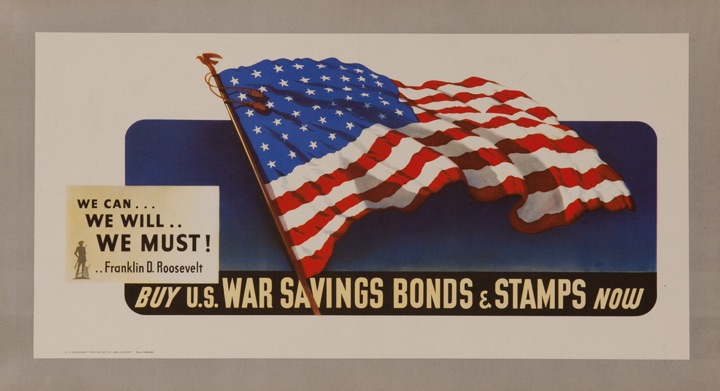
[Image: 1942 US Savings Bond poster – source]

Ally Bank Checking (Spending Account): $300 Bonus w/ Direct Deposit (EXPIRED)

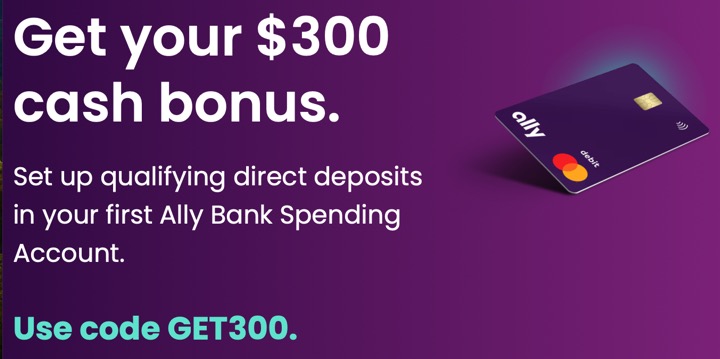
Bonus now EXPIRED. Ally Bank has a new checking account promotion for their “Spending Account”. You must open your first Spending Account by 11/18/2025 and use the promo code GET300, fund it within 30 days of opening, and set up qualifying direct deposits of at least $1,000 a month for two consecutive months. Your first monthly qualifying direct deposit(s) totaling at least $1,000 must post to your Spending Account within 60 days of when you open the account. You’ll then get a $300 bonus within 30 days of the qualifying direct deposits.

If you don’t have an Ally Spending account already but are using their Savings account, this is a good bonus to grab. If you don’t have an Ally Savings account yet, I would open a Savings first grabbing this $100 bonus (which works for both Savings and Checking and only works if you have no Ally accounts at all), satisfy all the requirements, and then after do this bonus on your first Checking (allows you to have other Ally accounts).

Spending Account mini-review. Their Spending Account is solid but nothing extraordinary – a checking account with no monthly fees, no minimums, online bill payments, ATM rebates up to $10 per statement cycle, but it only pays a sad 0.10% APY interest on balances up to $15k and 0.25% APY on balances above $15k. However, it does pair well if you already use the Ally Savings Account. You can set an Ally Savings account to be the automatic (and free) backup funding source if you overdraft the Spending account. You can also have multiple Savings Accounts (useful when they enforced the six withdrawals per month limit). So when Ally was my primary account, I would keep a very minimal amount in my Spending Account, a bigger amount in Savings Account #1 as overdraft backup, and another bigger amount in Savings #2 or Savings #3 or No Penalty CD or whatever.

All deposits would go straight into Savings #1, earning higher interest right away. You can even do mobile check deposit directly into Savings. Bill Pay must come out of Spending/Checking, but all of my 5-10 payments would be scheduled on say the 2nd of the month. (You can request to shift each of your credit card due dates to match up.) I would then schedule a big transfer from Savings #1 to Spending/Checking on the 1st of the month. If a random withdrawal hits my Spending/Checking, it would just trigger an auto-withdrawal from Savings #1. The result: maximum interest earned from Savings and minimal idle cash in Spending/Checking.

While I have used my Ally Bank accounts regularly for years due to their well-designed bank-to-bank transfer service and overall solid customer service, the Ally Savings APY has been lagging during this period of interest rate hikes, usually 1% APY behind the rate leaders. Most of my idle cash has moved into money market mutual funds (like VUSXX or FDLXX) and Treasury bonds, both earning me at least 1% APY more on an after-tax basis due to my local state income tax deduction.

FT Profile of Fidelity Investments: Culture, History, and Future Prospects as Primary Brokerage

The Financial Times (a British newspaper) has a rare profile of Fidelity Investments (paywall, archive) with the title “Can Fidelity keep its grip on America’s investments?”. Fidelity is privately-held (49% by the founding Johnson family now in its third generation, 51% by employees) and they don’t seek the limelight. They didn’t grant an interview for this article, and they seem to only disclose the absolute minimum financial information about their company as required by law. I can respect that, but at the same time, I like to better understand the custodian of a big share of my net worth, so I read the article with interest. Here are my takeaways.

Fidelity’s longevity is at least partially due to its willingness to pivot with the times. They were once best known for their actively-managed mutual funds like Magellan, then became a 401(k) behemoth managing trillions, accepted low-cost passive investing options, and even today are more open to crypto than other big companies (a Fidelity stablecoin is coming). They don’t move crazy fast, but they do move thoughtfully.

They are willing to be different things to different people. They have some of the largest companies in the world as their customer through 401(k) plans, they are the home to very power financial advisors and their billionaire clients, and they also count tiny individuals like myself as clients who trade less than 10 times a year and only mostly low-cost (non-Fidelity) ETFs. They’ve somehow figured out how to balance all these activities and profit from them all:

Astute fee management has also played a part. “Fidelity is a full-fee, full-cost player, not a discounter like Vanguard,” the former employee says. “Abby [Johnson] has masterfully priced her services across asset classes, products and channels.”

Fidelity’s mutual fund fees are competitive. According to Morningstar Direct, the average asset-weighted cost of an active equity fund in the US is 0.59 per cent a year, compared with Fidelity’s 0.43 per cent. Among passive products the average is 0.10 per cent and Fidelity’s is 0.03 per cent.

Fidelity is able to take a longer-term view.

Even in the face of such challenges, its advocates say Fidelity has another important string to its bow. As a private, family-controlled company — Edward and Ned each ran it for over three decades — it is not subject to the demands of quarterly reporting and managing shareholder expectations, helping management to focus on longer-term strategy and innovation.

“I would say this is the secret sauce of the Johnson family,” the former employee says. “They think about 25-year periods. I’m sure [Abby’s] father was petrified about: how do I keep this thing going so that my daughter can take over?”
“As they prepare for the generation coming up behind Abby, they will be thinking about where the next 50mn [customers] are going to come from.

Overall, Fidelity has the vibe of the sober adult in the room. Not the crypto teenager that can take huge risks since they have nothing to lose. Not the young adult Robinhood trying to break things first and ask for forgiveness later. However, they are also not the old man who complains about everything new and refuses to change their habits out of stubbornness. Based on the new stuff I learned in this article, I still see Fidelity as a good long-term home for my investments.