Archives for August 2025

Blue Cash Preferred® Card from American Express Review: 6% Cash Back at US Supermarkets ($6,000/Year), Enhanced $120 Disney Streaming Credit

card_name

Updated with improved $120 Disney Streaming Credit (now up to $10 per month with no minimum or bundle required). The card_name is one of my longtime keeper cards even with an annual fee. The headline feature is 6% cash back at US stand-alone supermarkets on up to $6,000 per year in eligible purchases (then 1%), but I also use it for 6% cash back on all my streaming subscriptions. If you spend $100 a week at supermarkets, that alone will earn you over $300 a year in rewards. The welcome offer is also currently very generous. The highlights:

  • Earn a $250 statement credit after you spend $3,000 in eligible purchases on your new Card within the first 6 months.
  • 0% Intro APR on purchases and balance transfers for 12 months from the date of account opening. After that, your APR will be reg_apr,reg_apr_type.
  • 6% cash back at U.S. supermarkets on up to $6,000 per year in eligible purchases (then 1% after that).
  • 6% cash back on select U.S. streaming subscriptions.
  • 3% cash back at eligible U.S. gas stations.
  • 3% cash back on eligible transit including taxis/rideshare, parking, tolls, trains, buses and more.
  • 1% cash back on other purchases.
  • Cash Back is received in the form of Reward Dollars that can be redeemed as a statement credit and at Amazon.com checkout.
  • $120 Disney Streaming Credit. Get up to a $10 monthly statement credit after using your enrolled Blue Cash Preferred(R) Card for a subscription purchase, including a bundle subscription purchase, at disneyplus.com, Hulu.com, or Plus.espn.com U.S. websites. Subject to auto-renewal.
  • Apply with confidence. Know if you’re approved for a Card with no impact to your credit score. If you’re approved and you choose to accept this Card, your credit score may be impacted.
  • $0 intro annual fee for the first year, then $95.
  • See Rates and Fees

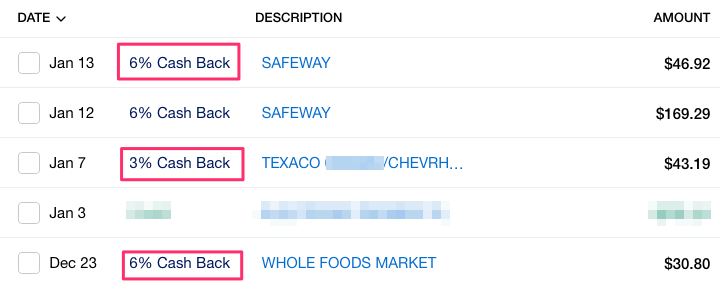
Max out your benefit by buying gift cards at US supermarkets. I use this card to buy gift cards at eligible supermarkets to use up the annual limit and get 6% back. My local Safeway has an entire wall of options, but I usually go with Amazon, Apple, or Starbucks (gifts). You can easily confirm that your purchase still gets 6% cash back on your account online:
Supermarkets details. “US stand-alone supermarkets” means that superstores, convenience stores and warehouse clubs are not considered supermarkets. This means no Super Wal-Mart, no Super Target, no Costco. Examples of merchants that do count (and this is not a complete list!) are (source):

ALDI
FreshDirect
Gelson’s
Hy-Vee
Kings Food Markets
Meijer
ShopRite
Smart & Final
Stop & Shop
Trader Joe’s
Vons
Whole Foods
Winn-Dixie

Gasoline details. “US stand-alone gas stations” means that superstores, supermarkets, and warehouse clubs that sell gasoline are not considered gas stations. This means no Target, no Costco, no Sam’s Club. Examples of merchants that count (again not a complete list!) are Exxon, Mobil, Hess, Shell, Gulf, Murphy USA, Murphy Express.

US Streaming Subscriptions details. These are all included at 6% cash back:

Amazon Music Unlimited
AMC+
Apple Music
Apple TV+
Audible
Britbox
DirecTV Stream (formerly known as AT&T TV or AT&T TV NOW)
Discovery+
Disney+
ESPN+
Fubo TV
HBO Max
Hulu
iHeartRadio
Kindle Unlimited
Luminary
MGM+
MLB.TV
NBA League Pass
Netflix
Pandora
Paramount+
Peacock
Prime Video
Sling TV
SiriusXM Streaming and Satellite
Spotify
Starz
TIDAL Music
YouTube Music Premium
YouTube Premium
YouTube TV
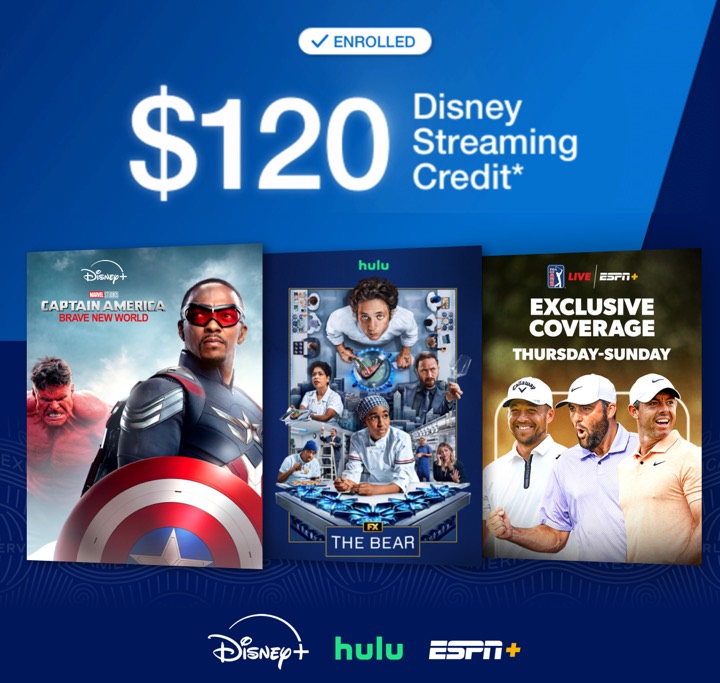
Disney Streaming credit details (worth up to $120 a year). Now, with the enhanced $120 Disney Streaming Credit, you can earn up to $10 back per month as a statement credit when you use your enrolled Blue Cash Preferred® Card to purchase a subscription, or bundle subscription, on DisneyPlus.com, Hulu.com, or Plus.espn.com U.S. websites, now with no minimum purchase requirement. Subscription is subject to auto-renewal.

If you already have this card, you can enroll in this offer here.

Annual fee. There is a $0 intro annual fee for the first year, then $95, but with the improved Disney Streaming credit that works with no minimums from Disney Plus, Hulu, and ESPN+, that can already more than completely offsets any future annual fee on its own. We already pay for Disney+ with no ads, so we already max out the $120 in annual credits.

The 6% cash back category can also quickly help this card earn its keep. The max cap of $6,000 annually works out to a steady averaged rate of $500 a month, which at 6% back would net you $360 cash back in a year vs. $60 at 1% cash back. Heck, simply hitting the $100 mark in a single trip at the supermarket is far too easy these days.

Alternatively, the card_name offers 3% Cash Back at U.S. supermarkets (on up to $6,000 per year in eligible purchases, then 1%) and other perks but with no annual fee. Terms apply. (See Rates and Fees)

Cash back is officially given in the form of Reward Dollars that can be redeemed as a statement credit, gift cards, and merchandise. You can also use it to offset your Amazon.com purchases at checkout. I usually just stick with statements credit to directly pay down my monthly bill.

Bottom line. The card_name has the key feature of 6% cash back at US supermarkets (on up to $6,000 per year). You can now also get 6% cash back on Netflix/Spotify/HBO Now as well as 3% cash back at US gas stations and transit (Uber/Lyft/train). This has been a “keeper” card for me for many years now. I treat it like one of my 5% cash back cards, except there are no rotating categories or activations to worry about. They also just improved their Disney Streaming credit to be worth up to $10/month ($120 annually), which I also utilize.

Rates and Fees for Blue Cash Preferred® Card from American Express :Rates and Fees for Blue Cash Preferred® Card from American Express

Rates and Fees for Blue Cash Everyday® Card from American Express: Rates and Fees for Blue Cash Everyday® Card from American Express
Random Tip: Amazon Items Under $1

Did you know that if you search for “items under $1” on Amazon, you’ll get… a bunch of random stuff not under $1… but also many items indeed $1 and under? If you click on the checkbox to the top left, you can list only Prime-eligible items. As long as you buy things in separate orders but close together, they’ll usually ship together with Prime but each purchase will process separately on your credit card. These can be useful for:

  • Rewards checking accounts that require a minimum 10 or 15 transactions per month.
  • Any situation where you need multiple, separate purchases, like some bank bonuses or certain debit or credit card rewards programs.
  • Cheap items to reach the upper tier of Subscribe & Save 10%/15% savings when you get to 5+ items.
  • Sometimes you just find decent deals on stuff you need.

(Note: If you are reading this in an email/RSS reader, unfortunately I am not allowed to include any Amazon affiliate links in e-mails, so they have been removed. Please click here to view the links.)

A few examples for items under $1 (prices may change after posting):

The Only AI Megatrend That Matters: Own the Businesses

We are surrounded by predictions about the imminent effect of AI. The CEO of Anthropic says that AI could wipe out half of all entry-level white-collar jobs, a “white collar bloodbath“. Vanguard (which has really started to like throwing predictions around 🔮), says the AI megatrend is “likely to augment most jobs, not replace them” with this fancy graphic on their estimates for time savings due to AI for over 800 occupations:

In the end, I only see one real “megatrend”. Ask yourself, will this make the lives of workers better, or business owners? Will the time saved by AI augmentation or automation really makes your life as an employee better? Will we all get 4-day workweeks? Or will your time just be filled by higher expectations of productivity? I’m sorry but I can’t see workers winning. I’ve always been a bit negative in this viewpoint, but that’s also why I worked so hard to try to achieve financial independence by owning businesses instead of relying on working 40 years x 40 hours a week as an employee.

What would Bogle say? Here’s part of the transcript from an interview with Joe Davis, Vanguard Global Chief Economist:

Rebecca: Principle, Investment Strategy Group
In light of all of this, how should investors be thinking about positioning their equity portfolios?

Joe: Global Chief Economist
I think it’s really important to break it down into two phases, because this could be a decade in the making.

One is, if Jack Bogle were here, I know what he would say.

He’d be like, “Joe, own the haystack,” which is all the equity market because you have technology exposure.

Then secondly, if you’re going to concentrate in areas of the market themselves and not simply own the entire equity market, history shows two things very clearly.

One is technology stocks, whatever that technology is, really outperform fora solid period but also get somewhat overvalued.

And then if you focus there, the timing stuff to get and then you can miss opportunities if the technology broadens the other parts of the economy, because if it hasn’t done that, then the technology’s overrated and technology stocks will really underperform.

So I think it’s important just eyes wide open in terms of how you think about that transition — you’re exposed to technology companies already, and if you’re going to overweight it, you may eventually miss opportunities of less valued companies that start to harness the very technology itself.

As the kids say, VTI and chill. Owning the haystack is owning businesses. If anything, the “optimal equity portfolio position” is to make sure you own as many chunks of businesses as you can.

US Bank Smartly Credit Card Review: More Negative Changes September 2025

Update August 2025: Previously-grandfathered “V1” cardholders should have received both paper and e-mail notifications of new changes that are to be effective 9/15/25. The e-mail subject will be “Important information about your U.S. Bank Smartly Visa Signature Card”. There appears to be two possible sets of new requirements.

The more restrictive version basically changes you to the current version available to new applicants, which requires all qualifying balances to be held in a checking account earning essentially zero interest. There are also new excluded categories like tuition and estimated tax payments.

Updated rewards earning
You will continue to earn unlimited 2% cash back on every purchase with no caps.¹

The way in which you earn a Smartly Earning Bonus will be updated as follows:
Earn up to an additional 2% cash back on your first $10,000 in eligible Net Purchases each billing cycle when paired with a U.S. Bank Smartly® Savings account plus qualifying balances in U.S. Bank Smartly® Checking and/or Safe Debit account(s).¹
– Earn a total of 2.5% cash back with a qualifying balance between $10,000 and $49,999.
– Earn a total of 3% cash back with a qualifying balance between $50,000 and $99,999.
– Earn a total of 4% cash back with a qualifying balance of $100,000 or more.

Not all purchases are eligible to earn the Smartly Earning Bonus. Purchases classified in the categories listed below may be excluded from earning the Smartly Earning bonus:
– Education/school, gift cards, insurance, or tax
– Business-to-business transactions (i.e. advertising services, construction material suppliers, etc.)
– Transactions using third-party bill payment services

These purchases will earn the base 2% cash back and are not calculated as part of the $10,000 billing cycle cap.

The less restrictive version is mostly the same, with the very important difference being that your qualifying balances can still be held in an investment account. Thanks to reader Playc.

Updated rewards earning
You will continue to earn unlimited 2% cash back on every purchase with no caps.¹

The way in which you earn a Smartly Earning Bonus will be updated as follows:
Earn up to an additional 2% cash back on your first $10,000 in eligible Net Purchases each billing cycle when paired with a U.S. Bank Smartly® Savings account and average daily combined qualifying balances in U.S. Bank deposit, trust or investment accounts.¹
– Earn a total of 2.5% cash back with a qualifying balance between $5,000 and $49,999.
– Earn a total of 3% cash back with a qualifying balance between $50,000 and $99,999.
– Earn a total of 4% cash back with a qualifying balance of $100,000 or more.

Not all purchases are eligible to earn the Smartly Earning Bonus. Purchases classified in the categories listed below may be excluded from earning the Smartly Earning bonus:
– Education/school, gift cards, insurance, or tax
– Business-to-business transactions (i.e. advertising services, construction material suppliers, etc.)
– Transactions using third-party bill payment services

These purchases will earn the base 2% cash back and are not calculated as part of the $10,000 billing cycle cap.

Unfortunately, I got the more restrictive version. That means they will have completely changed their advertised and promised features less than 6 months from getting this card. As a result, I will be closing my Smartly Checking, Smartly Savings, Smartly credit card, and US Bank brokerage account. Not a good look for a place that wants to be taken seriously as one of the major nationwide banks. Unreliability is not something most banks want to be known for.

Update 4/15/25: The rumors were true and have taken effect as of 4/15/25. If you have not applied yet, I wouldn’t bother. Given the spending cap and bonus category exclusions, in nearly all cases, the potential lost interest on the required cash deposits (earning no interest) will be higher than any additional potential cash back rewards earned. I consider this now basically a 2% cash back card.

Update 4/8/25: The same Reddit user has posted follow-up details, and they appear to confirm the details of the initial rumor. Please refer to the newest Reddit post, screenshot #1, screenshot #2, and screenshot #3. They appear legitimate in my opinion.

For existing cardholders, no changes have been announced. Everything is the same, for now. No $10k/month spending cap. Balance tiers are the same. Investment account balances still count. No new bonus category exclusions. Hope the grandfathering of loyal customers lasts, as we went through a good amount of trouble moving over significant assets.

For new cardholders that apply after April 14th, this card is no longer attractive above the base 2% cash back. They will require the qualifying deposits to be held in the Smartly Checking or Safe Debit accounts, which earn zero or essentially zero interest. Balances held in a brokerage account no longer qualify. Even balances held in their own Smartly Savings account (currently up to 3.50% APY) no longer qualify. Given the spending cap and bonus category exclusions, in nearly all cases, the potential lost interest on this cash will be higher than the additional potential cash back rewards earned. Goodbye, Smartly, we hardly knew ye.

Update 4/7/25: The rumors have gotten more supporting evidence. Reddit user Zanutrees posted this screenshot from an internal US Bank e-mail that appears to be legitimate. The two most critical quotes:

  • A revised U.S. Bank Smartly Visa Signature® Card is launching soon and will be available for application in branches starting April 14! Resources to help you prepare for the launch of the revised card will become available on Card Central tomorrow, April 8.
  • It is important to note that existing Bank Smartly cardmembers as well as any clients who applied prior to April 14 will receive the original Bank Smartly Card features and benefits; the revised card features and benefits will only affect clients who apply for the card on or after April 14.

Overall, the two actionable responses are the same as below (apply ASAP or never). We just got more support behind the 4/14 deadline and the fact that they will be offering grandfathering (for an unspecified amount of time).

Update 4/2/25: Doctor of Credit reports a Reddit rumor that the US Bank Smartly credit card will be undergoing some major negative changes as of 4/14/25. This includes:

  • Base is still 2% cash back on unlimited amounts. Bonus cash back (up to another 2% for a total of 4%) is capped to $10,000 in purchases per statement cycle.
  • Bonus cash back now excludes: Educational/school, gift cards, insurance, taxes, business to business transactions, and 3rd party bill payments.
  • For new cardmembers after April 14th, only checking account balances count now towards the $10k/$50k/$100k deposit requirements. Critically, savings account balances and investment balances do not count after 4/14 for new cardmembers. Existing customers will be grandfathered in for now.

Again, the above is a rumor. However, I do believe the following are true:

  • There is basically no way that this card can continue to exist without some sort of added restrictions. 4% with no cap simply does not math out, as I guarantee that some people are paying $100,000 in college or private school tuitions, $300,000+ in tax bills on this card, and who knows how many business transactions between “friendly” parties…
  • US Bank has a history of first rolling out a consumer-friendly product, and then later pulling it from the market or changing the features.
  • US Bank also has a history of grandfathering in existing customers of those products and continuing to offer them some/all of the old features.

Therefore, I see two possible actionable responses:

  1. Giving up on this Smartly card and not applying at all, and possibly avoiding the US Bank ecosystem altogether. It’s hard to work with unreliable people. If these changes take place, after 4/14 the lost interest on $100,000 in cash will outweigh the extra 2% by a good margin.
  2. Working extra fast right now in order to open up your US Bank Smartly savings account (this seems to be the easiest to open), then Smartly checking w/ bonus, then the US Bank self-directed brokerage account, fund it with $100,000, and apply for the Smartly credit card all as soon as possible, definitely before the rumored 4/14 deadline. Take advantage of the fact that they probably have to grandfather in these current terms at least for a year or so, otherwise in theory they would be bait-and-switching and might get in trouble.

Since my last update, I opened a new US Bank brokerage account, moved over $101,000 in cash, and then invested it all into the SGOV ETF that holds Treasury Bills. (I could have moved over stock ETFs instead, but I had the cash available.) I then applied for the Smartly credit card and was approved with a $25,000 limit despite my previous lack of “pre-approval”. I was hoping that reaching their top rewards tier first would encourage them to approve my new card, and maybe it helped. I’m okay with accepting the rumored changes as long as they grandfather me in on the brokerage balances; it could have been worse. What do you think?

I just took a quick look at the application page. Everything still looks the same as before as of today. I did take some screenshots in case there are subtle changes later.

Update 11/11/24: Applications for this card are now open. No sign-up bonus. It let me check if I was “pre-approved” with a soft pull (had to unfreeze TransUnion for it to work), but I was not pre-approved. That might be because I recently applied for the Altitude Reserve (now-discontinued) after setting up a Smartly Checking and Savings account to get “in” with them but was getting impatient (was denied for US Bank credit cards in the past without a banking relationship due to my geographic area). Will have to sit this one out for now, but plan to try again later if they don’t pull it quickly.

Original pre-review post:

US Bank recently announced the US Bank Smartly Visa Signature Card, a new rewards credit card that offers up to 4% cash back on all purchases, if you have enough qualifying balances with them. This is the newest entrant to relationship banking, where banks offers you extra perks for combining multiple account types with them like savings accounts and investment/retirement accounts.

The card is not open to applications yet, but you can get on an e-mail waitlist. Here are the details of how that “up to 4% cash back” breaks down according to this US Bank press release and CNBC article.

Base rewards of 2% cash back on all purchases, with no limit. Technically, this card earns 2 points per $1 spent in eligible net purchases. In order get 2% cash back, you must redeem those points into an eligible U.S. Bank checking or savings account.

Bonus rewards of 0.5%, 1% or 2% cash back based on your qualifying combined balances at US Bank. You must also have an open Bank Smartly Savings account. Your qualifying combined balances with U.S. Bank include “open consumer checking account(s), money market savings account(s), savings account(s), CDs and/or IRAs, U.S. Bancorp Investments and personal trust account(s).” Business accounts, commercial accounts, and the Trustee only (IFI) client relationship do not qualify.

  • $5,000 – $49,999.99 earns 2.5% total cash back. Total of 2.5 Points per $1 (a base of 2 Points plus the Smartly Earning Bonus of 0.5 Points),
  • $50,000 – $99,999.99 earns 3% total cash back. Total of 3 Points per $1 (a base of 2 Points plus the Smartly Earning Bonus of 1 Point).
  • $100,000+ earns 4% total cash back. Total of 4 Points per $1 (a base of 2 Points plus the Smartly Earning Bonus of 2 Points).

Other bits: CNBC article reports no annual fee. Points will expire if there is no reward, purchase, or balance activity on your account for 12 consecutive statement cycles. Bank Smartly Credit Card and Bank Smartly Savings available in all 50 states.

Bank Smartly savings account. Let’s take a closer look at the Bank Smartly Savings account, which also earns difference rates based on both your balance inside the Smartly savings account itself AND your qualifying combined balances at US Bank. Here’s their current interest rate grid, updated as of 9/3/2024.

Importantly, these rates can change at any time. But right now, if you have at least $25k in Smartly and $25k in combined qualifying combined balances across US Bank, you can get the current top rate of 4.10% APY.

There is also a $5 monthly maintenance fee, which is waived if you have a Bank Smartly® Checking account (or Safe Debit account which also costs $4.95 a month). The Bank Smartly® Checking account itself has a $6.95 monthly fee, waived with $1,500+ average account balance, qualifying U.S. Bank consumer credit card, or combined monthly direct deposits totaling $1,000+.

Therefore, technically if you get this credit card, that would make the Bank Smartly Checking account free, which in turn would make the Bank Smartly Savings account free. Right now there is also a $450 bonus for new Bank Smartly Checking customers with a direct deposit requirement.

Rough opportunity costs with depositing cash at Bank Smartly Savings. Let’s try some rough theoretical numbers. Let’s say you actually have $100,000 in cash lying around, but you could get ~5.10% APY elsewhere and so you would be giving up ~1% APY to park your money at US Bank instead. If you held all of it at Bank Smartly Savings to qualify for the 4% cash back on the credit card, you’d be giving up $1,000 in taxable interest each year ($100,000 x 1%).

In exchange, you are getting 2% extra cash back over your existing, flat 2% cash back card. Cash back rewards are generally considered non-taxable as they are a rebate on your purchase. If you assume a marginal tax rate of 0% (this is just a guess), then you’d need $50,000 in annual purchases ($4,166 a month) at 2% extra cash back to break even with the hit from the lower interest. If you assume a marginal tax rate of 22%, then you’d need a little less: $39,000 in annual purchases ($3,350 a month) at 2% extra cash back to break even with the hit from the lower interest.

US Bank self-directed investments accounts! As with the Bank of America Preferred Rewards program, an alternative way to satisfy the balance requirements with minimal opportunity costs is to transfer over existing assets into a self-directed US Bank brokerage account. For example, you could transfer over $100,000 in index ETFs inside an IRA or taxable brokerage account. This would appear to fully satisfy the requirements as a “U.S. Bancorp Investments” account. This way, US Bank also gets a stronger foothold in the world of wealth management, as all the banks seem to want these days.

Be careful though, as US Bank’s self-directed brokerage account has a slightly higher fee schedule than much of the competition. Stock trades are $4.95 each, although you get 100 free trades per calendar year if you have both a Bank Smartly Checking account and paperless statements. There is a $50 annual account fee and a separate $50 annual IRA fee; these are waived if you have $250,000 in combined statement household balances.

My quick take. If all of these details actually hold through launch, they would be a potential improvement over the best current situation of 2.62% cash back on all purchases via the Bank of America Preferred Rewards program (also requires $100k in assets held at BofA) and a BofA cash back credit card. (The Robinhood 3% credit card is still “coming soon”.) But will it last? Even the BofA 2.62% has remained something of an outlier, but my hunch is that it has encouraged enough of people to keep a ton of cash at BofA earning zero interest so that BofA is still happy overall. Given that this new US Bank program actually offers a decent interest rate and an even higher cash back rate, I am concerned about its longevity. On the other hand, maybe this is US Bank’s big push to become a major player on the national level of Bank of America or Chase.

I’d have to open a lot of new accounts to go for this one. Savings account, brokerage account, credit card, move over assets, all for a bonus that is based on my credit card spend so will trickle in slowly. (None of these have a big upfront bonus.) Given the amount of shady stuff US Bank will probably have to deal with when paying 4% cash back, I’d also have to trust that it will last long enough to be worth the effort.

US Bank has a history of making cards and then pulling them from the market, but sometimes they also let the grandfathered users keep the old perk system. Hmm…

Marriott Bonvoy Business® American Express® Card Review: 125,000 Points Limited-Time Offer

card_name

New limited-time offer, at all-time high values. The card_name is the re-branded business credit card of the Marriott Bonvoy program. This card offers unique perks for Marriott customers, along with a generous new customer incentive. Here are the highlights:

  • Limited-time offer: Earn 125,000 Marriott Bonvoy points after you use your new Card to make $8,000 in eligible purchases within the first 6 months of Card Membership. Terms apply. Offer ends 10/22/2025.
  • New award night top-off option: Marriott now allows you to supplement your free night certificates with up to 15,000 points of your own. For example, the 50k Award can be used to book a hotel at 65,000 points level if you spend 15,000 points of your own. This opens up the number of potential hotels available in expensive areas.
  • Room rate discount: 7% discount on eligible Marriott Bonvoy hotel bookings as a benefit of being both a Marriott Bonvoy(R) member & a Marriott Bonvoy Business(R) American Express(R) Card Member when you book directly with Marriott through an eligible channel for a participating property under the Amex Business Card Rate.
  • 6X points at hotels participating in the Marriott Bonvoy(R) program.
  • 4X points at restaurants worldwide, at U.S. gas stations, on wireless telephone services purchased directly from U.S. service providers and on U.S. purchases for shipping.
  • 2X points on all other eligible purchases.
  • Receive a Free Night Award every year after your Card renewal month. Plus, earn an additional Free Night Award after you spend $60k in purchases on your Card in a calendar year. Award can be used for one night (redemption level at or under 35,000 points at hotels participating in Marriott Bonvoy(R). Certain hotels have resort fees.
  • Complimentary Marriott Bonvoy Gold Elite Status with this card.
  • Elite Night Credits: Receive credit for 15 nights towards the next level of Marriott Bonvoy Elite status, each calendar year.
  • Annual fee is $125.
  • See Rates and Fees

Keep in mind the following terms and conditions:

Welcome offer not available to applicants who (i) have or have had the Marriott Bonvoy™ Premier Plus Business Credit Card from Chase, the Marriott Rewards® Premier Plus Business Credit Card from Chase, the Marriott Bonvoy Business™ Credit Card from Chase, or the Marriott Rewards® Business Credit Card from Chase in the last 30 days, (ii) have acquired the Marriott Bonvoy Boundless™ Credit Card from Chase, the Marriott Rewards® Premier Plus Credit Card from Chase, the Marriott Bonvoy Bold™ Credit Card from Chase, the Marriott Bonvoy™ Premier Credit Card from Chase or the Marriott Rewards® Premier Credit Card from Chase in the last 90 days, or (iii) received a new Card Member bonus offer in the last 24 months on the Marriott Bonvoy Boundless™ Credit Card from Chase, the Marriott Rewards® Premier Plus Credit Card from Chase, the Marriott Bonvoy Bold™ Credit Card from Chase, the Marriott Bonvoy™ Premier Plus Credit Card from Chase or the Marriott Rewards® Premier Credit Card from Chase.

This is more specific than before, note the different 30-day, 90-day, and 24-month waiting periods that may now include consumer cards. American Express usually gives you a pop-up warning during the application process if you are ineligible based on their records. This is why you should be looking to get the best possible bonus (like a limited-time offer) when you do apply.

Many people aren’t aware of the fact that they can apply for business credit cards, even if they are not a corporation or LLC. The business type is called a sole proprietorship, and these days many people are full-time or part-time consultants, freelancers, eBay/Amazon/Etsy sellers, Uber/Lyft drivers, or other one-person business owners. This is the simplest business entity, but it is fully legit and recognized by the IRS. On a business credit card application, you should use your own legal name as the business name, and your Social Security Number as the Tax ID.

NEW: Certificates can be combined with up to 15,000 points for nicer hotels. Marriott now allows you to supplement your free night certificates with up to 15,000 points of your own. In other words, if your certificate is worth 35,000 points, the maximum hotel value you can redeem for is 50,000 points after adding 15,000 points of your own. if your certificate is worth 50,000 points, the maximum hotel value you can redeem for is 65,000 points after adding 15,000 points of your own.

You can use the Marriott free night search tool to price out some sample hotels for yourself. Also, here are details on the Free Night Award Top Off option.

What is a reasonable estimate for the value of a Marriott Bonvoy point? Based on multiple real-world searches of redeemable properties, I choose to use a conservative estimate of 0.70 cents per Bonvoy point. That means 50,000 Bonvoy points = estimated $350 redeemable value, and 100,000 Bonvoy points = estimated $700 redeemable hotel night value. However, I almost always get closer to 1 cent per point value when I actually choose to redeem. Remember to compare the full price of the hotel price with all taxes, as that is what you would have to pay instead of just points.

What can I book with 65,000 points? Based on a few quick searches (log in and try to book with points), the following premium hotels can potentially be booked for 65,000 points or less. (* Marriott no longer publishes a fixed point award chart):

  • The Westin Hapuna Beach Resort, Big Island, Hawaii
  • The Royal Hawaiian in Waikiki, Oahu, Hawaii
  • The Ritz-Carlton, Bali
  • Le Meridien Maldives Resort & Spa
  • JW Marriott Venice Resort & Spa
  • Renaissance Orlando at SeaWorld®
  • Walt Disney World Swan Reserve
  • The Ritz-Carlton Orlando, Grande Lakes

35k Free Night Award (Anniversary). At your card anniversary, you will receive a Free Night Award that is good for one night (redemption level at or under 35,000 Marriott Bonvoy points) at a participating hotel. This excludes the very top properties, but for regular travelers it will be very easy to get your $95 or even $125 value. Many W Hotels, Westin, and even some Ritz-Carltons worldwide are included. Here are some sample hotels that may qualify under the 35,000 point limit (* Marriott no longer publishes a fixed point award chart):

  • Sheraton Kona Resort (Big Island, Hawaii)
  • Courtyard Waikiki Beach (Honolulu, Oahu)
  • Sheraton Kauai Resort (Kauai, Hawaii)
  • W Atlanta
  • New York Marriott at the Brooklyn Bridge
  • Chicago Marriott Downtown Magnificent Mile
  • W Chicago
  • The Ritz-Carlton, Beijing, China
  • The S. Regis Bangkok, Thailand

You can expand this even further if you use the top-off option and look for hotels at up to 50,000 Bonvoy points.

Bottom line. The card_name is the co-branded business card between Marriott hotels and American Express. You also get a Free Night Award at card anniversary, which can be worth much more than the annual fee. Check out the current welcome offer, which can be redeemed for multiple free nights at hotels around the world.

Also see: Top 10 Best Small Business Card Bonus Offers.

(See Rates and Fees)