Archives for June 2025

US Asset Valuations vs. Rest of the World (Last 30 Years)

If you enjoy finance charts as I do, I recommend following Callum Thomas of TopDownCharts either via X/Twitter or weekly e-mail newsletter. One of the recurring themes recently is the extended outperformance of US assets vs. the rest of the world. But importantly, a good portion of this outperformance is due to an increase in valuation, meaning folks are paying a higher price per dollar of earnings. That’s not the same as the price increasing simply because earnings are higher.

This chart shows how US asset overall are at higher relative valuations:

This chart shows the relative valuation trends (US over ex-US, Growth over Value, and Large-cap over Small-cap stocks):

Find more interesting charts in their recent 10 Charts to Watch in 2025 (half-time) post.

What does this all mean? Mostly it’s just an interesting part of history to me. Roughly 2/3rds of my stock holdings are US and I’m not selling any of it, so I’m not making a contrarian bet or anything. However, I do think that remaining diversified with exposure to the rest of the world is the way to go. Nearly all Target Date Funds in 401k plans are already diversified in this manner. A lot can happen in the next 30 years.

Top 10 Best Small Business Credit Card Bonus Offers – September 2025

Updated September 2025. Do you have small business income or work as an independent contractor? Freelance, Uber/Lyft, DoorDash, Amazon, eBay, Etsy, Airbnb? A small business credit card separates your personal and business expenses and can build up your business credit profile. If you are not a corporation or LLC, you can apply as a sole proprietorship, with your name as the business name and your Social Security number as the Tax ID number. These are the top 10 credit card offers that I would personally apply for right now (or have already). Recent changes:

  • Added Amex Platinum 200k, Delta 90k, Marriott 125k, CSR 200k, Venture X 350k, Citi AA 75k, Spark $2,000, Amex Gold 100k.
  • Removed Hilton 175k, Alaska 70k, Marriott 125k, Hyatt 60k+FreeNightAward, JetBlue 60k, Ink Unlimited $900.

This is a companion post to my Top 10 Best Credit Card Bonus Offers for personal cards. Notice that small business bonuses are on average even higher than those on consumer cards.

The Business Platinum® Card from American Express

  • 200,000 Membership Rewards® points after $20,000 in eligible purchases in the first 3 months. See link for details.
  • American Express Global Lounge Collection® provides complimentary access to more than 1,400 airport lounges across 140 countries and counting, including their exclusive Centurion® Lounge.
  • Unlock over $2,500 in statement credits with business and travel benefits annually* on the Business Platinum Card. Terms apply. Learn more. *After meeting qualifying spend thresholds.
  • $895 annual fee.
  • See Rates and Fees

Chase Sapphire Reserve® for Business Card

  • 200,000 Ultimate Rewards points after $30,000 in purchases in the first 6 months. See link for details.
  • $300 Annual Travel Credit, plus a long list of other credits – Curated Gift Card, Google Workspace, ZipRecruiter Credit, DoorDash, Lyft.
  • Up to $120 Global Entry or $85 TSA PreCheck fee credit.
  • $795 annual fee.

Delta SkyMiles® Gold Business American Express Card

  • Limited-time offer: 90,000 Bonus Miles after $6,000 in eligible purchases in first 6 months of Card Membership. Offer Ends 10/29/2025. See link for details.
  • 90,000 Skymiles are worth at least $900 in Delta airfare with “Pay with Miles” option.
  • First checked bag free on Delta flights ($70 value per roundtrip, per person).
  • $200 Delta flight credit. Get a $200 credit to use toward future Delta travel after $10,000 in purchases within a calendar year.
  • $0 introductory Annual Fee for the first year, then $150.
  • See Rates and Fees

Capital One Spark Cash Plus Card

  • $2,000 cash bonus after $30,000 in purchases in the first 3 months. Additional $2,000 cash bonus for every $500K spent during the first year. See link for details.
  • Unlimited 2% cash back spent on all purchases with no limit.
  • $150 annual fee; Spend $150,000 annually and Capital One will refund this fee every year.

American Express® Business Gold Card

  • 100,000 Membership Rewards points after $15,000 in eligible purchases in the first 3 months. See link for details.
  • Up to $240 Annual Flexible Business Credit. Earn up to $20 in statement credits monthly after you use the Business Gold Card for eligible U.S. purchases at FedEx, Grubhub, and Office Supply Stores. Enrollment is required.
  • Up to $155 Annual Walmart+ Credit. Get up to $12.95 back in statement credits each month when you pay for a monthly Walmart+ membership (subject to auto-renewal) with your Business Gold Card. Enrollment is required.
  • Annual fee is $375.
  • See Rates and Fees

Capital One Venture X Business Card

  • 150,000 Bonus Miles once you spend $30,000 in the first 3 months. 150,000 Miles can be redeemed for $1,500 towards travel (including airfare and hotel stays). See link for details.
  • $300 annual travel credit. Get up to $300 in statement credits when booking through Capital One’s travel booking site.
  • Additional 10,000 bonus miles (equal to $100 towards travel) every year, starting on your first anniversary.
  • Lounge access to 1,300+ airport lounges worldwide, including Capital One Lounge locations and Priority Pass(TM) lounges, after enrollment.
  • Up to a $120 credit for Global Entry or TSA PreCheck(R).
  • $395 annual fee.

CitiBusiness / AAdvantage Platinum Select Mastercard

  • 65,000 American Airlines miles after $4,000 in purchases in first the 4 months. See link for details.
  • First checked bag free on domestic AA flights for you and up to 4 companions (Up to $80 value per roundtrip, per person).
  • $0 annual fee for the first year, then $99.

Ink Business Preferred® Credit Card

  • 90,000 Ultimate Rewards points (worth $900 straight cash back or $1,125 toward travel when redeemed through Chase Travel) after $8,000 in purchases in the first 3 months. See link for details.
  • 3X points on the first $150,000 spent on travel, shipping purchases, internet/cable/phone services, and advertising purchases with social media sites and search engines.
  • Primary rental car coverage when renting for business purposes.
  • $95 annual fee.
  • Subject to 5/24 rule.*

The Hilton Honors American Express Business Card

  • 150,000 Hilton Honors Bonus Points after $8,000 in purchases in your first 6 months. Plus an additional 25,000 Hilton Honors Bonus points after an additional $2,000 in purchases within your first 6 months of Card Membership. Offer Ends 8/13/2025.
  • Up to $240 in Annual Hilton Credits. Get up to $240 back each year on eligible Hilton purchases made on your Hilton Honors American Express Business Card, with up to $60 in statement credits per quarter.
  • $195 annual fee.
  • See Rates and Fees

Marriott Bonvoy Business® American Express® Card

  • 125,000 Marriott Bonvoy points after $8,000 in eligible purchases within the first 6 months of Card Membership. Terms apply. Limited-time offer ends 10/22/2025. See link for details.
  • Additional Free Night Award upon card anniversary (worth up to 35,000 Bonvoy points). Earn another additional Free Night Award after spending $60K in purchases on your Card in a calendar year.Free Night Awards are valid at hotels participating in Marriott Bonvoy®. Certain hotels have resort fees.
  • New award night top-off option: Marriott now allows you to supplement your free night certificates with up to 15,000 points of your own. For example, the 50k Award can be used to book a hotel at 65,000 points level if you spend 15,000 points of your own. This opens up the number of potential hotels available in expensive areas.
  • Annual fee is $125.
  • See Rates and Fees

Hawaiian Airlines Business MasterCard

  • 50,000 Hawaiian miles after $4,000 in purchases in first 90 days. See link for details.
  • Receive a one-time 50% off companion discount for roundtrip coach travel between Hawaii and The Mainland on Hawaiian Airlines.
  • $99 annual fee.

BofA Business Advantage Unlimited Cash Rewards card

  • $500 statement credit after $5,000 in purchases in the first 90 days. See link for details.
  • 1.5% cash back on all purchases, which can be increased to 2.62% cash back when combined with the Preferred Rewards program.
  • No annual fee.

US Bank Business Leverage Card

  • 75,000 bonus points after $7,500 in purchases (on the Account Owner’s Card only) in first the 120 days. 75,000 bonus points can be redeemed for $750 in cash back. See link for details.
  • Availability may be restricted to certain states.
  • $0 annual fee for the first year, then $95.

JetBlue Business Card

  • 50,000 TrueBlue points after $2,000 in purchases in first 90 days and paying the annual fee. See link for details.
  • First checked bag free for the primary cardmember and up to 3 companions when tickets are purchased with your JetBlue Plus Card.
  • $99 annual fee.

Alaska Airlines Visa Business Card (Bank of America)

  • 60,000 Alaska miles + Companion Fare Voucher after $4,000 in purchase within 90 days. See link for details.
  • Companion fare voucher is “Buy one ticket, get one for $122” ($99 fare plus taxes and fees from just $23).
  • Free checked bag on Alaska flights for you and up to six other passengers on the same reservation (worth $70 roundtrip per person).
  • $70 annual fee for company, plus $25 per card.

Capital One Spark Cash Select Card

  • $500 cash bonus after $4,500 in purchases in the first 3 months. See link for details.
  • Unlimited 1.5% cash back spent on all purchases with no limit.
  • No annual fee.

* Note: Certain Chase cards have a “5/24 rule” which is an unofficial rule that they will automatically deny approval on new credit cards if you have 5 or more new credit cards on your credit report within the past 2 years. This rule applies on a per-person basis, so if you are new, you might want to start with those Chase cards.

American Express(R) Business Gold Card: See Rates and Fees. The Business Platinum(R) Card from American Express: See Rates and Fees. The Hilton Honors American Express Business Card: See Rates and Fees. Marriott Bonvoy Business(TM) Card from American Express(R): See Rates and Fees. Delta SkyMiles(R) Gold Business American Express Card: See Rates and Fees

American Express® Gold Card: As High As 100,000 Points Welcome Offer, $84 Dunkin’ Credit, $100 Resy Credit, $120 Uber Cash, $120 Dining Credit

card_name

The card_name has been refreshed in order to get back to its former glory as a status card with several new perks and credits mostly related to travel and dining. Here are the highlights:

  • You may be eligible for as high as 100,000 Membership Rewards(R) Points after you spend $6,000 in eligible purchases on your new Card in your first 6 months of Card Membership. Welcome offers vary and you may not be eligible for an offer. Apply to know if you’re approved and find out your exact welcome offer amount – all with no credit score impact. If you’re approved and choose to accept the Card, your score may be impacted.
  • 4X Membership Rewards(R) points at restaurants worldwide (on up to $50,000 of purchases per calendar year, then 1X for the rest of the year).
  • 4X Membership Rewards(R) points at U.S. supermarkets (on up to $25,000 of purchases per calendar year, then 1X for the rest of the year).
  • 3X Membership Rewards(R) points on flights booked directly with airlines or on amextravel.com.
  • 2X Membership Rewards(R) points on prepaid hotels and other eligible purchases booked on AmexTravel.com.
  • 1X Membership Rewards(R) point per dollar spent on all other eligible purchases.
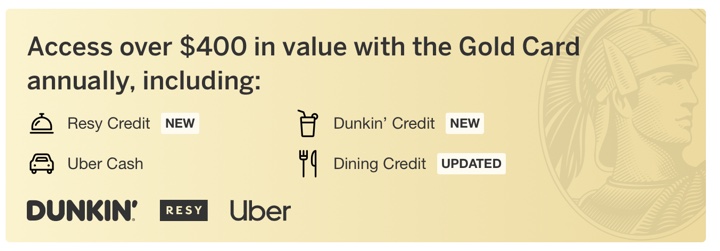
  • $120 in Uber Cash. Add your Gold Card to your Uber account and get $10 in Uber Cash each month to use on orders and rides in the U.S. when you select an American Express Card for your transaction. That’s up to $120 Uber Cash annually. Plus, after using your Uber Cash, use your Card to earn 4X Membership Rewards(R) points for Uber Eats purchases made with restaurants or U.S. supermarkets. Point caps and terms apply.
  • $84 Dunkin’ Credit (NEW): Get up to $7 in monthly statement credits after you enroll and pay with the American Express(R) Gold Card at U.S. Dunkin’ locations. Enrollment is required to receive this benefit.
  • $100 Resy Credit (NEW). Get up to $100 in statement credits each calendar year after you pay with the American Express(R) Gold Card to dine at U.S. Resy restaurants or make other eligible Resy purchases. This is broken down into up to $50 in statement credits semi-annually. Enrollment is required.
  • $120 Dining Credit. Earn up to $10 in statement credits monthly when you pay with the American Express(R) Gold Card at Grubhub, The Cheesecake Factory, Goldbelly, Wine.com, and Five Guys. Enrollment is required.
  • The Hotel Collection benefit. Explore over 1,000 upscale hotels worldwide with The Hotel Collection and receive a $100 credit towards eligible charges* with every booking of two nights or more through AmexTravel.com. *Eligible charges vary by property.
  • Apply with confidence. Know if you’re approved for a Card with no impact to your credit score. If you’re approved and you choose to accept this Card, your credit score may be impacted.
  • No foreign transaction fees.
  • $325 annual fee (increased). Additional cards (authorized users) are free.
  • See Rates and Fees

Note the following:

Welcome offer not available to applicants who have or have had this Card or the Premier Rewards Gold Card. We may also consider the number of American Express Cards you have opened and closed as well as other factors in making a decision on your welcome offer eligibility.

The application will tell you if they detect that you are not eligible for the bonus based on their records.

Membership Rewards points can be converted to the following airline and hotel programs (there are more, this is just a selection):

  • Delta SkyMiles
  • Hawaiian Airlines
  • JetBlue
  • ANA Mileage Club (partner of United Airlines)
  • Air Canada (partner of United Airlines)
  • British Airways (partner of American Airlines)
  • FlyingBlue (Air France/KLM)
  • Singapore Airlines
  • Virgin Atlantic
  • Choice Privileges
  • Hilton Honors
  • Marriott Rewards (Starwood)

You can also transfer to gift cards many retailers at varying rates, but many available at the rate of 10,000 MR points = $100 gift card. My most common redemption is a $100 Home Depot card for 10,000 points, sometimes less when they run special discount. However, don’t expect the cash-equivalent prepaid credit cards at that rate, it’s usually closer to a 0.6 cent/point ratio.

The value this card really depends on if you can use up their long list of annual credits, worth over $400 in value annually. Their target customer is a “food lover” that travels regularly. If you can take advantage of the credits, your potential first year value is higher than $800 with the current limited-offer.

Bottom line. The new card_name has a bunch of new features more targeted at the young, urban traveler including hundreds of dollars of potential credits related to dining out and travel.

(See Rates and Fees)

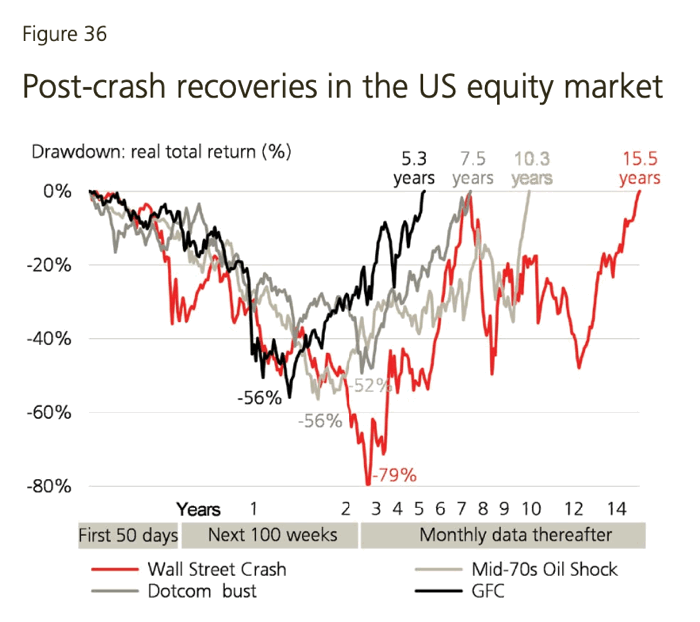
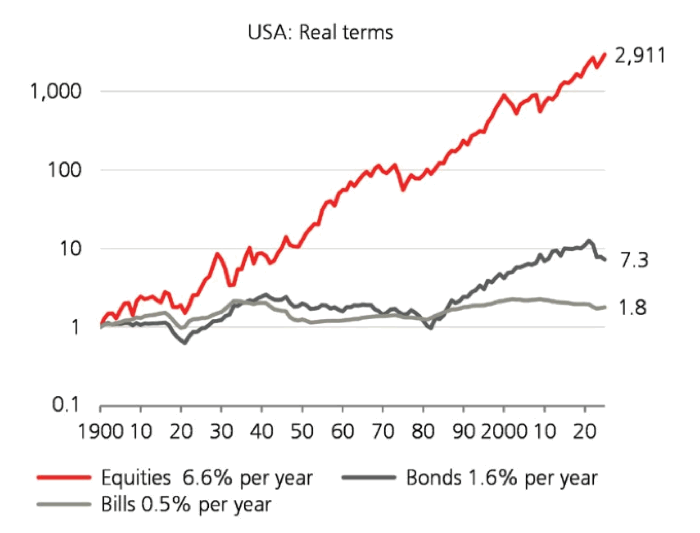
UBS Global Investment Returns Yearbook: 125 Years of Market History (1900-2025)

The 2025 edition of the UBS Global Investment Returns Yearbook is available for free download in a 22-page PDF with 10 Key Insights on the UBS website. This annual publication provides an excellent “big picture” overview of the last 125 years of market history, and serves as a partial antidote to all the junk we are bombarded with about what happened in the the last 24 hours.

UBS Global Investment Returns Yearbook documents long-run returns on stocks, bonds, bills, currencies and other assets since 1900. Its goal is to inform investors about long-run historical performance, to interpret it, analyze it, learn from it, and help illuminate current concerns.

I definitely recommend downloading the report and at least scrolling through the historical charts and headline insights. The lessons may be familiar, but they are a good reminder of what builds wealth over the long run.

  • The composition of the stock market changes significantly over time.
  • Stock outperformance over bonds and cash over the long run is huge.
  • Patience is required to capture this outperformance from stocks.
  • Diversification can help, but it’s not guaranteed.

New Chase Sapphire Reserve Personal & Business Cards: Huge Bonus, Huge Annual Fee, Huge List of Perks

Chase managed to make a media event out of its revamp of the Chase Sapphire Reserve and new Chase Sapphire Reserve Business cards. The personal and business credit cards both have a huge $795 annual fee, huge new cardholder bonus, and long list of perks. Very much like the American Express Platinum, these “coupon book” perks revolve around an upscale “lifestyle” that includes staying at luxury hotels, flying Premium Economy and Business Class, eating at nice restaurants, and so on.

I’m not sure I fit this mold, and it’s definitely going to take a bit of reading to figure out all the angles. At a very high level, the $300 annual travel credits are relatively easy to redeem and after that the net annual fee becomes ~$500. Can I get $500 in value from the rest of the card? 🤷 You may find it fits you better; the application links are now available. Here are the highlights:

New Chase Sapphire Reserve Credit Card (Personal)

  • 100,000 Ultimate Rewards points + $500 Chase Travel promo credit (must be used all at once, and bought through Chase Travel portal) after $5,000 in purchases in the first 3 months.
  • New application restrictions that are more vague, instead of “5/24”. However, if you don’t qualify for the bonus, they will tell you ahead of time and you won’t get a hard credit pull.
  • $300 Annual Travel Credit, which is pretty flexible.
  • 8X points on Chase Travel portal purchases.
  • 4X Points on flights and hotels purchased directly.
  • 3X points on dining worldwide.
  • $500 Annual The Edit Hotels Credit. The Edit is a “collection of over 1,100 hand-picked hotels and resorts around the world”. The ones I’ve seen are all expensive, luxury hotels.
  • $300 Annual Dining Credit. Up to $150 in statement credits from January through June and again from July through December for a maximum of $300 annually for dining at restaurants that are part of the “Sapphire Reserve Exclusive Tables.” Again, expensive restaurants.
  • Points Boost – Redeem points at up to 2x value on select flights and hotels. You’ll have to book via Chase Travel portal, and the best boost are for Premium Economy class and above.
  • $1,000+ in additional credits – Apple TV+, Apple Music, Lyft, DoorDash, StubHub, Peloton
  • Lounge Access – Priority Pass Select membership, Chase Sapphire Lounges, and some Air Canada Lounges.
  • $120 Global Entry or TSA PreCheck® or NEXUS Fee Credit.
  • $795 annual fee. $195 for each authorized user.

New Chase Sapphire Reserve for Business Credit Card

  • 200,000 Ultimate Rewards points after $30,000(!) in purchases in the first 6 months.
  • New application restrictions that are more vague, instead of “5/24”. However, if you don’t qualify for the bonus, they will tell you ahead of time and you won’t get a hard credit pull.
  • $300 Annual Travel Credit
  • 8X points on Chase Travel portal purchases.
  • 4X Points on flights and hotels purchased directly.
  • 3X points on social media & search engine advertising.
  • $500 Annual The Edit Hotels Credit. The Edit is a “collection of over 1,100 hand-picked hotels and resorts around the world”. The ones I’ve seen are all expensive, luxury hotels.
  • $1,000+ in additional credits – Curated Gift Card, Google Workspace, ZipRecruiter Credit, DoorDash, Lyft.
  • $120 Global Entry or TSA PreCheck® or NEXUS Fee Credit.
  • Lounge Access – Priority Pass Select membership, Chase Sapphire Lounges, and some Air Canada Lounges. Two guests may accompany the Primary Cardmember to the lounges free of charge.
  • $795 annual fee.

I will be including these both in my lists of Top 10 Best Credit Card Bonus Offers and Top 10 Best Business Card Offers.

Best Broker for DIY Investors? Customer Satisfaction Survey Results 2025

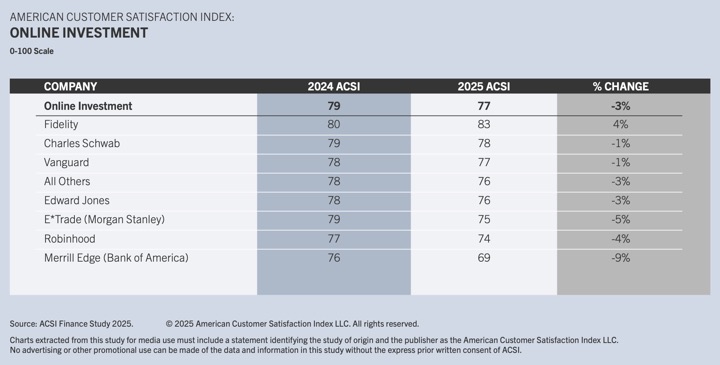
The American Customer Satisfaction Index (ACSI) is a “national cross-industry measure of customer satisfaction” and they recently released their survey results on the finance vertical. Below are their rankings for “online investment”, which covers the major brokers for do-it-yourself investors. Measured categories include mobile app quality, customer service, and research tools.

#1 Fidelity was at the top both this year and last year, but the main difference from the previous years is the significantly increased gap between Fidelity and the rest of the field, notably #2 (Schwab) and #3 (Vanguard). Morgan Stanley/E-Trade and Merrill Edge also had big drops.

The majority of my assets remain split between Fidelity and Vanguard, and over time I actually like having the features of both. See also: AI Pioneer Divides Assets Across Multiple Banks and Brokerages.

Sources: RIABiz, ASCI Press Release.

Amtrak Guest Rewards Preferred Mastercard: 40,000 Point Offer (Worth $1,000 in Amtrak Fare)

Limited-time is back, expires 7/30. The Amtrak Guest Rewards Preferred Mastercard, issued by First National Bank of Omaha (FNBO), offers a variety of perks for Amtrak riders. It also currently has a 40,000 points limited-time offer that is worth up to roughly $1,000 value in Amtrak train fare or $400 in Amazon gift cards. This boosted offer came around the same time last year. Here are the highlights:

  • 40,000 bonus points after spending $2,000 in the first 3 billing cycles of account opening.
  • Roundtrip companion coupon upon account opening and card anniversary.
  • One-class upgrade upon account opening and card anniversary.
  • Station Lounge pass upon account opening and card anniversary.
  • 3X points per $1 spent on Amtrak travel, including onboard purchases.
  • 2X points per $1 spent on dining, travel, transit and rideshare.
  • 1X point per $1 spent on all other purchases.
  • 5% Amtrak Guest Rewards point rebate when you book your Amtrak redemption travel.
  • 20% rebate on food and beverage purchases on board, via statement credit on this card.
  • 1,000 Tier Qualifying Points (TQPs) every time you make at least $5,000 in purchases in a calendar year, up to 4,000 TQPs
  • Amtrak points will not expire as long as your card account is open.
  • No foreign transaction fees.
  • $99 annual fee.

This offer is not going to be attractive for everyone, but it can be very valuable if you either enjoy recreational train travel or if you can use it for your commuting needs.

Amtrak points are currently worth roughly 2.5 cents per points towards Amtrak train fare. That means 40,000 points is worth approximately $1,000 in Amtrak train fare. Amtrak redemptions are variable and directly-linked to the cash cost, so you can use points on basically any ticket. There is also the potential value of the companion coupon, lounge pass, and one-class upgrade.

The best value is for train fare, but Amtrak points do transfer to certain other hotel programs, although some require elite status in those programs.

Gift cards. You can also redeem for various gift cards at a rate of 5,000 points = $50 gift card. So 40,000 points would get you $400 in gift cards to Amazon, Apple, Best Buy, Target, Walmart, etc.

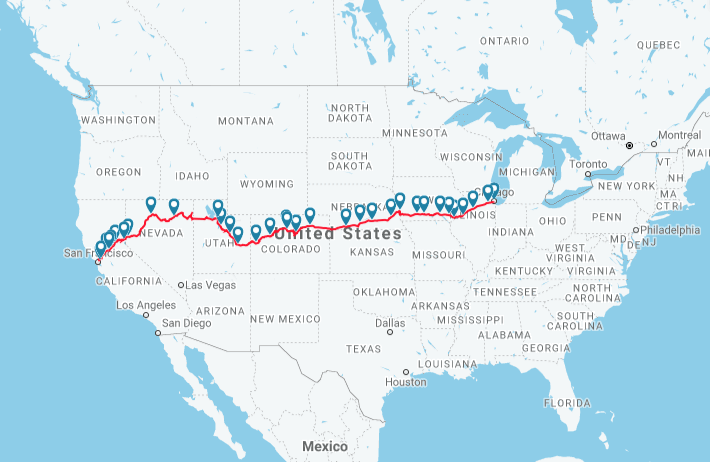
You could take the train across the entire country! There is an 18-hour Capitol Limited overnight train from Washington D.C. to Chicago in a “Superliner Bedroom” with a private bathroom.

You could then take the 3-day, 2-night trip on the California Zephyr from Chicago to San Francisco. Enjoy the views as you cut through both the Rockies and Sierra Nevada mountain ranges.

Bottom line. The Amtrak Guest Rewards Preferred Mastercard currently has a limited-time offer that can get you roughly $1,000 value in Amtrak train fare, with an $99 annual fee. The potential value is high, but I don’t know if it is too niche to include in my list of Top 10 Best Credit Card Bonus Offers. For you folks that prefer cash or near-cash, you could also get $400 in Amazon or Walmart gift cards with 40,000 points, minus the $99 annual fee.

Portfolio Asset Allocation: Asset Class Risk/Return Charts (2025)

While continuing my CFP course on Investment Planning, their sections on portfolio construction and asset allocation contained several updated 2025 versions of charts (including data through the end of 2024) that I have been posting on this site since the early days. Crazy that I first started looking at this stuff in the 2000s and now the 25-year charts barely go back that far!

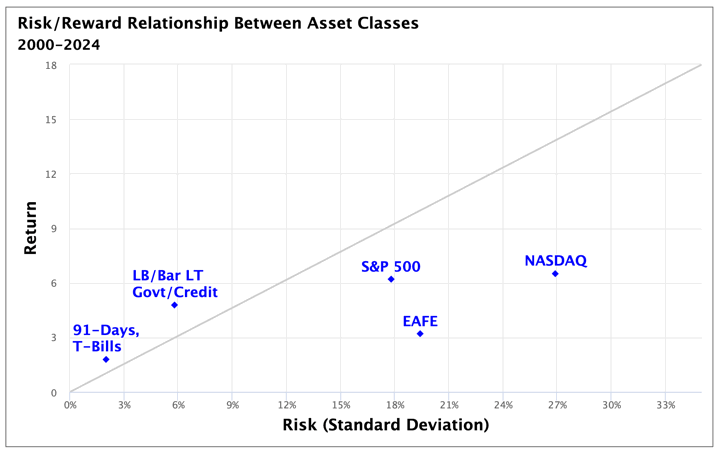
1. Based on the past 25 years of performance (2020-2024), here is a chart of annualized return vs. standard deviation (volatility, a proxy of risk).

Takeaways: International stocks have had a very bad run, performing worse than long-term US bonds. T-Bills/Cash staked out their usual position as low risk/low return. I would also note that the difference between a 7% average annual return and a 3% average annual return over 25 years is huge, and this chart doesn’t really communicate that.

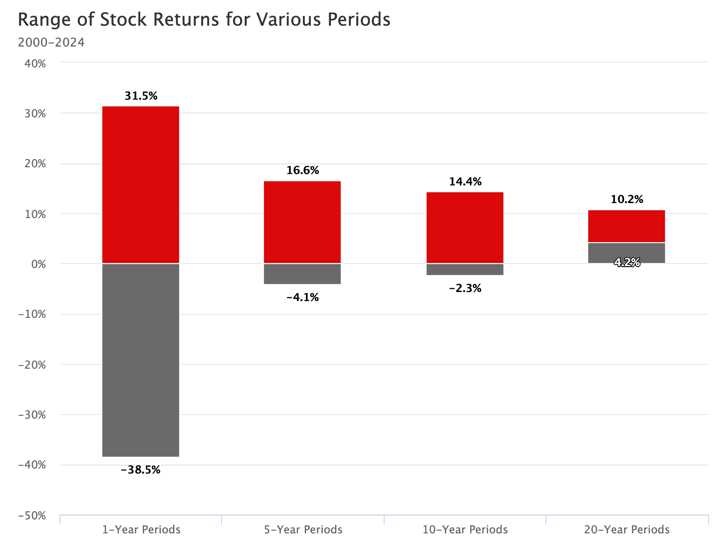
2. Here is the range of S&P 500 stock returns for various holding period lengths from 2020-2024.

Takeaways: Your range of average annual returns narrows as your holding period lengthens. This fits with the feeling that the swings in the past seem to fade away over time. But that doesn’t change the fact that going forward, your (hopefully large) stock portfolio in retirement might still drop by 40% in a single year.

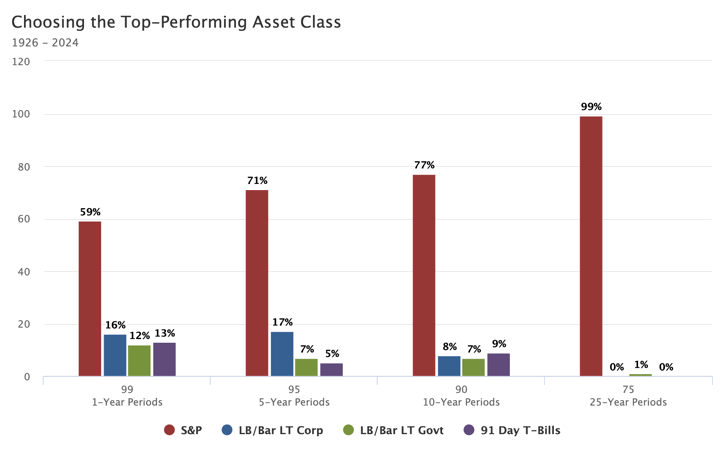
3. Here is a bar chart of the top performing asset classes for various holding period lengths from 1926-2024.

Takeaways: For 25-year periods, 99% of the time stocks win. But a lot of those were overlapping 25-year periods. You have to consider how confident you are using 100 years of looking back to predict 50+ years into the future.

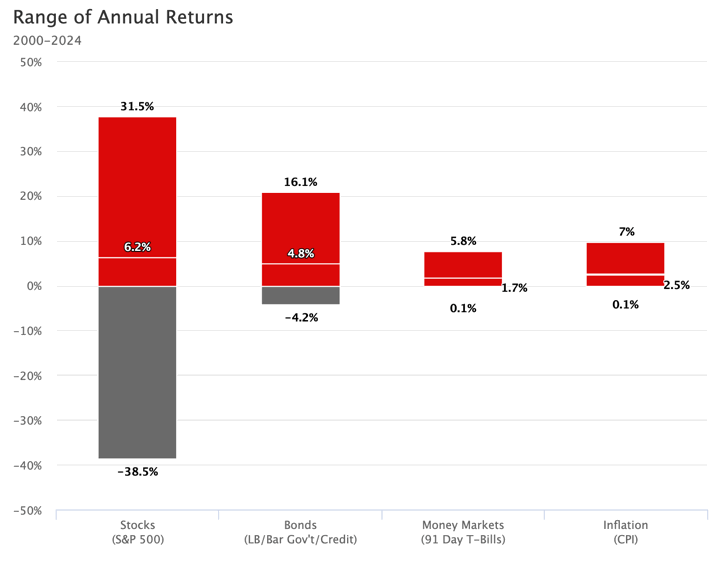
4. Here is the range of annual returns for the major asset classes from 2000-2024.

Takeaways: As you might expect, stocks are the most volatile by far.

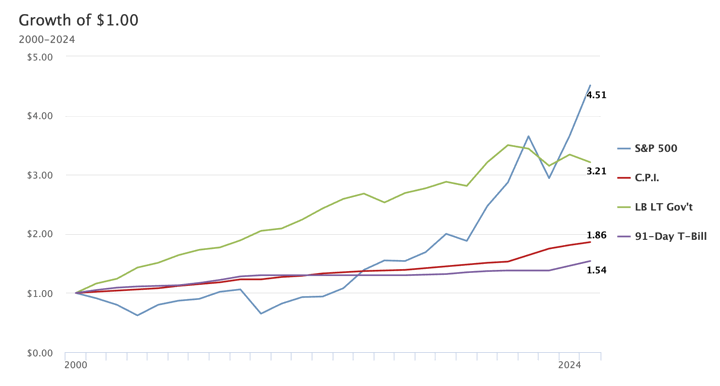
5. Here is the Growth of $1 chart from 2020-2024 for selected major asset classes.

Takeaways: Long-term bonds actually beat stocks for a long time, as this period started right during the Dot-Com crash. But stocks still came back to win by a significant margin. Cash barely keeps with in inflation, so the inability to keep up with inflation is its own risk.

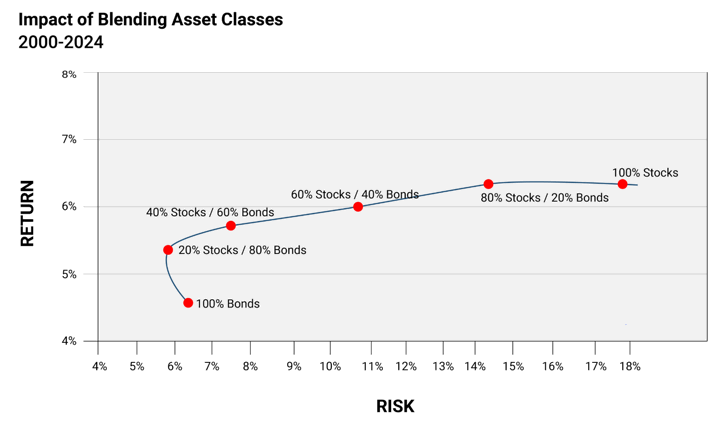
6. Here is the impact of blending different percentages of stocks and bonds on their combined performance and volatility.

Takeaways: These charts do change with the time period, but they usually show that owning around ~20% in stocks can actually give you a better return with the same amount of volatility (risk proxy) rather than owning zero stocks. So even if you are very risk-averse, owning at least some stocks is often advised. On the other end, there is often diminishing returns when you go above ~80% stocks.

TIAA Traditional and Lifetime Income Annuities Now Available to Public via IRA

TIAA-CREF recently announced that they are allowing the public to invest in their fixed and income annuities inside a Traditional or Roth IRA (via Bogleheads). This includes their most well-known TIAA Traditional Annuity, which has traditionally been only available to those working in nonprofit colleges, universities, hospitals (TIAA stands for Teachers Insurance and Annuity Association of America).

This was a Father’s Day coincidence, as what they suggest is very similar to what I helped set up for my father. As a long-time educator, the bulk of his retirement savings was accumulated using the TIAA Traditional annuity through both employer and employee contributions. After considering many factors, I advised him to annuitize a portion of it upon retirement for guaranteed lifetime income. The rest of the portfolio was stock and bond mutual funds.

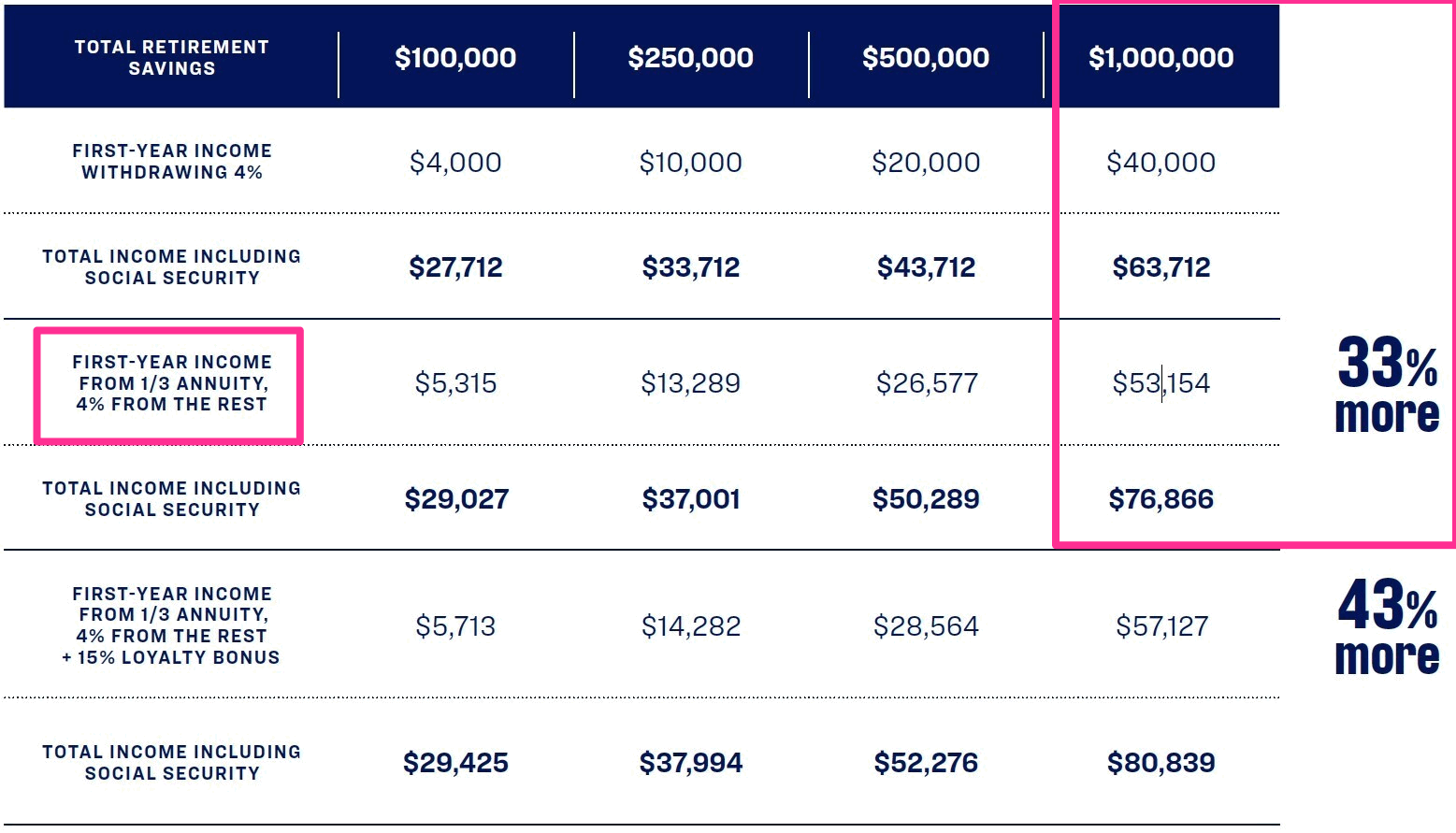
In the example that TIAA provides, they annuitize 1/3rd of the total available portfolio, and the rest is spent down using the popular “4% withdrawal rule”. Their claim is that “annuitizing a portion of your savings with TIAA Traditional offers between 33% and 43% more income than a 4% withdrawal strategy.”

Looking at the fine print, they state:

Calculation uses the TIAA Traditional “new money” income rate for a single life annuity with a 10-year guarantee period at age 67 using TIAA’s standard payment method beginning income on March 1, 2025 (7.9462%).

So a 67yo person taking a single-life income annuity with a 10-year guarantee, which pays out 8% of principal every year. So if you annuitized $1,000,000, you would get roughly $80,000 a year in annual income, guaranteed, every year until death (with minimum 10 years of payments, or $800,000). 8% is double (100% more) what you’d get out from the “4% rule”, so if you annuitize 1/3rd if your portfolio, it would boost the first-year income by 33%. Math works out.

Here are some additional details I would emphasize:

  • With the income annuity used, the 8% withdrawal rate won’t ever go up or adjust with inflation. It’s a fixed payout every year, so the real inflation-adjusted value will decrease over time. After 15 years or 30 years, the payout from $1M would still be $80,000.
  • The “4% rule” taken from perhaps a 60% stock/40% bond portfolio is designed to be raised with inflation each year. After 15 years, the $40,000 a year from $1M would be $62,000 with 3% average inflation and $72,000 a year with 4% average inflation. After 30 years, the $40,000 a year from $1M would be $97,000 with 3% average inflation and $130,000 a year with 4% average inflation.
  • At death, the TIAA annuity would have zero value (assuming past the 10-year guarantee). Your 60/40 portfolio may have a lot (or a little, or nothing) left over.
  • The TIAA annuity is a guaranteed only by the claims-paying ability of TIAA. TIAA is usually one of the absolute top-rated insurance companies in terms of safety, but it doesn’t print its own money.

Overall, I felt that the trade-offs were worth it for my parents. They are financially conservative folks. Their annuitized income was lower because they took a joint-life annuity with my mother, but when added on top of their combined Social Security, their guaranteed monthly paycheck in retirement was large enough to cover all of their basic monthly expenses. Unless there was a big one-time expense, they would not have to take a single penny out of the rest of their investment portfolio.

I knew the value of the TIAA income would decrease over time due to inflation, but some studies have shown that retiree expenses also tend to trend downward over time. Social Security will still go up with inflation, and so should their investment portfolio over the long run.

TIAA Traditional as an accumulation vehicle. My dad was already with TIAA Traditional for decades before I started helping him with his finances, and while I am thankful for the financial stability of TIAA-CREF, I don’t know that I would pick the TIAA Traditional Annuity if I was starting out today. As a fixed annuity, there is a guaranteed minimum interest rate and then they credit extra if their underlying investments do well. The value thus is always increasing steadily and never goes down, which some people may like. Even a “safe” bond fund can have a negative year, as we saw recently.

Based on the numbers that I have seen, the long-term average return of TIAA Traditional will probably be very close to that of a low-cost Total US Bond Fund like BND. So it’s like a bond fund with smoothed returns. But this also means the long-term average return of TIAA Traditional will likely not be as high as if you held a Target Retirement Fund with stocks/bonds. Thus, I could see TIAA Traditional as a partial substitution for the bond portion of your portfolio, especially if you plan on annuitizing it upon retirement and can thus earn some of that vague “loyalty bonus”. THAT is the main advantage of TIAA – the ability to earn an excellent annuitization income rate from a very solid company.

(You can view the current TIAA Traditional interest rates here. Note that there are multiple different rate classes, and since the IRA class is fully liquid, it tends to offer one of the lower rates.)

For my parents, I am quite happy with the results of annuitizing a portion of your retirement portfolio. It depends on your own goals, but a fixed base monthly paycheck in retirement offers great peace of mind. I personally enjoy the fact that they stress much less about market swings. If TIAA continues to offer competitive income payout rates along with their top-tier safety rating, I will definitely keep this option in mind for myself.

Costco Membership Changes (Extended Hours, Self-Checkout Improvements, New Credits)

Costco has been making several changes recently, and it’s not just the new hours. As someone who has recently joined Sam’s Club, it is interesting to see how the competition between them has actually made them both better.

All Members

  • Using hand scanner to quickly zap at Self-Checkout. Although Costco does not (yet?) use the nifty Scan&Go system using your mobile phone, they have started allowing you to use the wireless hand scanner at Self-Checkout. No longer do you have to pick up every single item and put it on the scale. Now you can use the hand scanner and try to match the speed-zapping skills of the veteran cashiers. They are also testing out the equivalent of Scan&Go, but this is already pretty close.
  • Costco Digital Membership card. I don’t really mind the new door scanners, as at least now I don’t have to carry my physical membership card anymore. The Costco app works at the door, at checkout, and at the food court.
  • Coke products at Food Court. I’m old enough to remember Coke in the food court, but it has been Pepsi for the last 12 years. By the end of June, all of the fountain drinks should be Coke products again. Not a big deal, but I am Team Coke, so that makes me happy. Sam’s is still Pepsi. Long live the $1.50 hot dog!
  • Extra hour on Saturdays. This is for all members, and they will close at 7pm instead of 6pm traditionally. Should start 6/30.
  • Extended gas station hours. Earlier in 2025, Costco extended its gas station hours to 6 a.m. to 10 p.m. Monday through Friday, 6 a.m. to 8:30 p.m. on Saturdays, and 6 a.m. to 7:30 p.m. on Sundays.
  • New types of specialty stores. There are now smaller, separate Costco locations popping up that only focus on furniture and appliances. I guess this how Costco plans to keep growing its sales volume, because they will eventually get saturated with their normal stores.

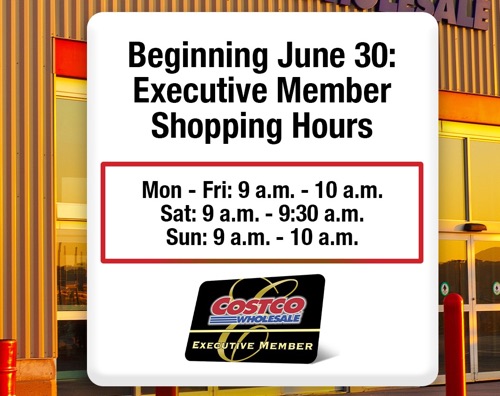
Executive Members *Only* (starts 6/30)

  • New Early Shopping Hours
    • Monday – Friday: 9 a.m. – 10 a.m.
    • Saturday: 9 a.m. – 9:30 a.m.
    • Sunday: 9 a.m. – 10 a.m.

    Sam’s Club has kept their extra hours for Plus members this entire time, I know that it is usually 8am to 10am on weekdays at my nearest Sam’s.

  • Monthly $10 credit towards “Same-Day” or Instacart orders of $150+ for US and Canadian members.
  • At $130 a year for Executive instead of $65 for Gold, the breakeven spending amount given the 2% Executive cash back is now $3,250 a year, or an average of ~$271 per month. Correction: Costco gas purchases don’t earn the 2% Executive cash back.

Still missing the best feature from Sam’s Club? The best thing about Sam’s Club (now that I will eventually run out of my 20% off gift cards from Pepper) is their Pick Up service. Their app has solid inventory accuracy, and this way I can just shop on the app, have them bring everything directly to my car, and save a lot of time with no price markup. Sam’s Club has copied the Kirkland private label and I see Member’s Mark everything now. I wonder if/when Costco will copy the Sam’s Club Pick Up service.

Have you noticed any other changes at Costco?

Capital One Spark Cash Review: Simple Business Card with 2% Cash Back on Every Purchase

card_name

The card_name is a straightforward business credit card offering a big early spend bonus offer in addition to ongoing unlimited 2% cash back on all purchases (or better). Here are the highlights:

  • Earn a $1,000 cash bonus when you spend $10,000 within 3 months of account opening.
  • Unlimited 2% cash back on every purchase, everywhere with no limits or category restrictions.
  • 5% Cash Back on hotels and rental cars booked through Capital One’s travel booking site.
  • Free employee cards, which also earn unlimited 2% cash back on all purchases.
  • Rewards won’t expire for the life of the account, and you can redeem your cash back for any amount.
  • No foreign transaction fees
  • $0 annual fee for the first year; $95 after that.

The required spending hurdle may seem like a lot, but many businesses make a lot of purchases for raw materials and/or inventory. If you pay estimated taxes each quarter, you can also pay the IRS via credit card with a 1.75% fee and still come out ahead.

This card does not have all of the bells and whistles like top-level rewards, transferrable airline miles, or airport lounge access. For that, look into the Capital One Venture X Business Card and its higher annual fee.

If you also hold the Spark Miles, Capital One Venture, or the Capital One Venture X rewards cards, you can convert your cash back rewards into their “miles”, which are then transferrable to various airline miles programs including British Airways Avios. With the right companion card, $2,000 in cash rewards could be converted to 200,000 miles.

Many people aren’t aware of the fact that they can apply for business credit cards, even if they are not a corporation or LLC. The business type is called a sole proprietorship, and these days many people are full-time or part-time consultants, freelancers, eBay/Amazon/Etsy sellers, Uber/Lyft drivers, or other one-person business owners. This is the simplest business entity, but it is fully legit and recognized by the IRS. On a business credit card application, you should use your own legal name as the business name, and your Social Security Number as the Tax ID.

Bottom line. The card_name is the flavor of Capital One business cards that has the combination of straightforward and solid 2% cash back rewards, modest annual fee ($0 for the first year; $95 after that), and works like a traditional credit card.

Due to the high current first-year value, I will be adding this to my Top 10 Best Small Business Card Bonus Offers.

Self-Paced CFP: Insurance Planning Highlights and Self-Paced Study Experiences

Finally… I passed the “Insurance Planning” course for my University of Georgia Self-Paced CFP class. That’s only #2 out of the 7 topics, but here are a few quick observations so far:

  • After trying a couple of times… 😅 I was not able to pass the course exams without studying the course materials first. You need 80% correct to pass, and I’d be in the 60% to 80% range without any studying.
  • I’ve been able to pass the exams after only reading the online course slides and review questions. I haven’t opened the textbooks once (as shown in pristine condition above!), even though I spent extra for the physical textbooks (as opposed to electronic-only).
  • As a personal finance geek, I did know a lot of the material beforehand, but there are definitely new bits that I’m learning here and there. The material is dry, but it covers a lot of topics.
  • Like many other professional certification exams, much of passing means studying specifically for the test. The questions aren’t necessarily weighted by what’s commonly used in financial planning practice, but by what is easiest to test in a multiple-choice format. That means memorizing formulas that require a financial calculator, “none of the above”, “all of the above”-type questions, and minor differences in definitions. I now understand why even after completing this educational course requirement, most CFP applicants sign up for another ~$1,000 “cram course” that just drills you on sample test questions.

Back to Insurance Planning. I got stuck on this course for while as it is a very wide topic with some rather dull topics, so here is a high-level overview of what was covered.

Three main categories of “Pure Risk” for individuals and families:

  • Personal
  • Property
  • Liability

Principles and Purpose of Insurance

  • Types of risk (pure vs. speculative)
  • Methods of managing risk (avoidance, reduction, retention, transfer)

Property and Casualty Insurance

  • Homeowners and renters insurance
  • Auto insurance
  • Liability and umbrella policies
  • Business-related coverage

Life Insurance

  • Types (term, whole, universal, variable)
  • Suitability and needs analysis
  • Policy selection, riders, beneficiary designations

Health Insurance and Disability Insurance

  • Health plans (PPO, HMO, HDHP, etc.)
  • Medicare and Medicaid
  • Social Security
  • Disability coverage (short-term, long-term, own vs. any occupation)
  • Long-Term Care Insurance

Employee and Group Benefits

  • Group life, health, and disability plans
  • COBRA and continuation coverage
  • Cafeteria and flexible spending accounts

Annuities

  • Types (fixed, variable, immediate, deferred)
  • Payout options and guarantees
  • Tax treatment and suitability

Role of a financial planner.

  • Coverage level determination
  • Help clients identify coverage gaps or excesses.
  • Refer clients to qualified Property & Casualty (P&C) agents.
  • Evaluate insurance as part of a broader financial plan.
  • Review and update over time

For example, for personal liability insurance you would ask about:

  • Personal Auto Policy (PAP): For motor vehicle-related liabilities.
  • Homeowners Policy: Covers bodily injury/property damage to others.
  • Comprehensive Personal Liability (CPL) Policy: Standalone liability coverage.
  • Umbrella Policy: Broad, high-limit policy supplementing existing coverages.

You may not need all of them individually, but some combination of these should work together to make sure there no holes. It’s also possible that you may have duplicate coverage or otherwise too much insurance.

A lot of financial advice focuses on “offense”: maximizing income, minimizing expenses, and optimizing investments. But “defense” is just as important, as it includes protecting from loss of future income and loss of existing assets.