Archives for December 2024

Last-Minute Healthcare FSA Reminder (Average Loss $441!), Amazon $10 FSA Offer

Updated for 2024, new $10 Amazon bonus. Here’s a year-end reminder to get back all the money sent into Healthcare Flexible Spending Accounts (HC FSA) due to their “use it or lose it” structure (see possible extensions below). According to the latest analysis by EBRI, roughly half (!) of FSA accountholders forfeited funds to their employer in 2022. The average forfeiture was $441.

I am picking up an extra pulse oximeter and forehead thermometer after our multiple fun journeys with kids and respiratory illnesses this year.

Quick ideas. If you didn’t exhaust your funds with insurance copays or deductibles, here are eligible items that you can still buy over-the-counter without a prescription. Just order things online and then submit the receipt. Amazon even has a special FSA-eligible page that directly accepts FSA/HSA debit cards, complete with an “under $25” and “little-known eligible items” section. Consider using this time to stock your hurricane/earthquake/snowstorm emergency kits.

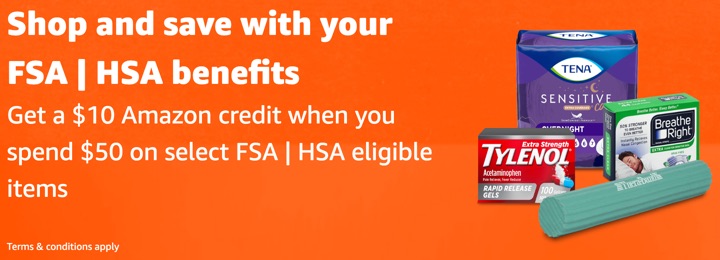
Right now, they are also offering $10 Amazon credit when you spend $50 on eligible FSA items.

(You may need to view this page on the website to see all the Amazon links.)

The 2020 CARES Act added the following categories for 2021 and beyond:

Ideally, if you use an FSA card and shop through an eligible FSA store, things will be auto-approved. Otherwise, when getting a receipt, make sure it clearly includes the following:

  • Date of service or purchase
  • Name or description of the item
  • Amount of purchase

Deadline extensions. Employers have the option of adding one of the following:

  • Some plans allow a grace period until March 15th of the following year as opposed to a December 31st deadline to use your funds, but it may only apply to claims and not late purchases. Check with your employer on if they opted-in to these extensions.
  • Some plans allow participants to carry over up to $500 in unused FSA funds into next year. Check with your employer.

Big, exhaustive lists. Some of these are searchable by keyword as well.

But remember, your FSA administrator has the final say as to the exact guidelines for reimbursement according to your plan. Every year, I have to deal with claim rejections and extra paperwork. The skeptic in me suspects that this bureaucratic nightmare is part of their business model. (Remember mail-in rebates?) Guess who gets to keep unreimbursed FSA funds? The employer, which can then use the money to pay for… the FSA administrator.

Got a Health Savings Account (HSA) and think you are ineligible for an FSA? Look for a “limited-purpose FSA” option that is restricted to dental and vision care services. These have the same max annual salary deduction.
Warning: Avoid Buying Vanguard Target Retirement Funds in Taxable Accounts

Vanguard Target Retirement Funds are a huge series of “all-in-one” mutual funds, now with over $1 trillion in total assets. I don’t hold them myself, but I have advised my parents to invest their IRAs in them. I appreciate that they are low-cost, diversified, and rebalanced automatically to maintain a reasonable asset allocation, meaning that I don’t have to actively monitor them myself.

However, due to a mix of factors, it is important to know that these Target Retirement 20XX funds tend to make larger capital gains distributions than an equivalent mix of index ETFs. This can cause unexpected tax bills, especially for those with large balances and near retirement. Inside a 401k or IRA, none of this matters. But you should avoid owning them in a taxable brokerage account unless you accept these disadvantages as a price of their ease of ownership.

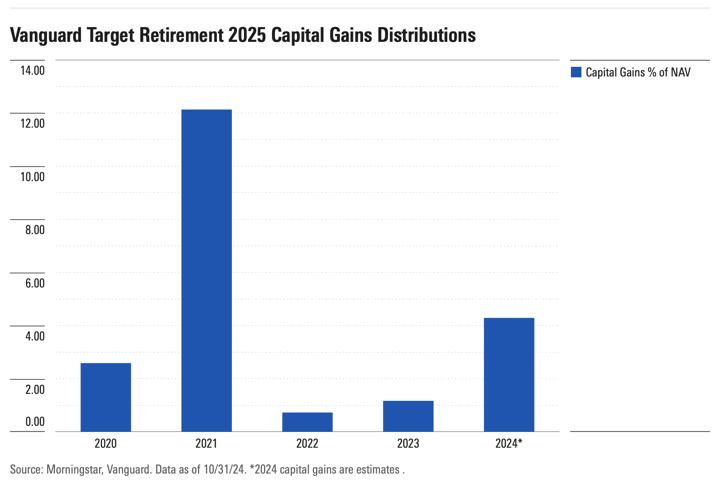
Back in 2021, these made large capital gains distributions due to a mishandling of mutual fund expense changes by Vanguard. Vanguard eventually had to settle a class action lawsuit for $40 million. This 2022 Morningstar article has more details: Lessons From Vanguard Target-Date’s Capital Gains Surprise.

The Vanguard Target Retirement 2025 and 2020 funds again announced a higher capital gains distribution amount than its peer funds in its 2024 estimate report. The 2025 TDFs for American Funds, Fidelity, and T. Rowe Price were all in the 0.53% to 2.10% range, and American Funds are actively-managed! The Fidelity Freedom Index 2025 Funds only distributed 0.53%.

Assuming a $1 million balance in Vanguard Target Retirement 2025, the 4.29% capital gains distribution would work out to $42,900 in additional, likely unexpected income. At a long-term gains rate of 15%, that’s a tax bill of $6,435.

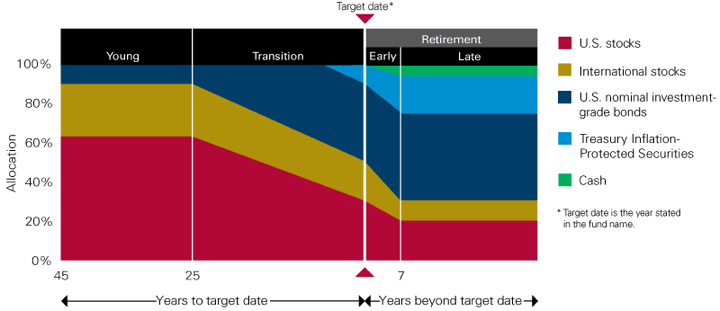
This could all happen again and again. Why? For one, Vanguard’s steeper glide path at this age period means they are selling stocks for bonds faster than other funds. Second, folks have been selling their shares, either because they need the money for retirement expenses or because they are part of the larger trend of selling to switch to ETFs. Either way, these two things are expected to continue in the foreseeable future.

ETFs have inherent structural advantages over mutual funds that help them to avoid creating capital gains. I suspect that it is only a matter of time before Vanguard introduces a line of Target Retirement ETFs, which would be able to minimize capital gains distributions. Of course, that could mean even more people selling their Target Retirement Mutual Funds if they can’t figure out how to make converting a non-taxable event, which would result in even more capital gains distributions! I’m not saying this would happen for sure, but it is a possibility that may create a spiral of increasing capital gains.

The actionable move here is to avoid buying into the Target Retirement Funds in a taxable account right now. If you are a younger investor, a Target Retirement Fund is 90% stocks anyway, essentially split into 60% VTI (Total US Stock) and 40% VXUS (Total International Stock). I’d just buy those two core building-block ETFs if you manage to have extra money to invest after 401k/403b/457/TSP and IRAs. If you wanted to be more exact, you could buy 55% VTI, 35% VXUS, and 10% BND.

Consumer Reports: Top 10 Most Reliable Car Brands 2024

Consumer Reports has released their annual “Best Cars” issue. Their definition of “best” involves a combination of their self-conducted road tests, safety ratings, owner satisfaction surveys, and owner reliability surveys. However, I’m mostly just concerned about their reliability ratings. I like to track the ones moving up and the ones moving down. I do believe it says something broad about the current state of each manufacturer.

Subaru uses a lot of the same parts across all of its vehicles, which means fewer new designs and thus higher reliability. They are also now a more mature company, after a period of very fast growth. Their all-wheel drive has basically stayed the same for years and years, and it’s on every vehicle so they have it down. Toyota/Lexus has a long history of opting for small, incremental changes rather than complete redesigns. This makes them more boring, but boring tends to be reliable.

Still, Consumer Reports recommends that you shop by specific vehicle model and not just by brand make. In general, new models have more problems than those that are 2-3 years old.

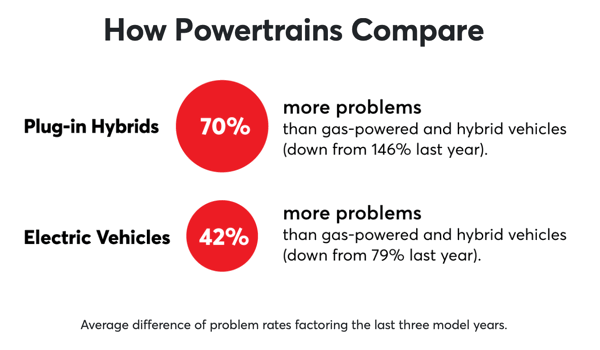
Hybrids are surprisingly now nearly as reliable as traditional ICE cars despite their add complexity, while plug-in hybrids have 70% more problems overall than ICE vehicles (down from 146% more last year). Pure electrics have 42% more problems than ICE vehicles (down from 79% more last year). My assumption is that this is again because hybrids have been around longer and the engineers have had a chance to solve the problems that arose. I’m still quite happy with my old Toyota minivan, although I have been watching reviews of the new Volkswagen ID Buzz. Maybe after a few more years…

Thank You, John Rekenthaler, For The Uncomfortable Truths About Investing

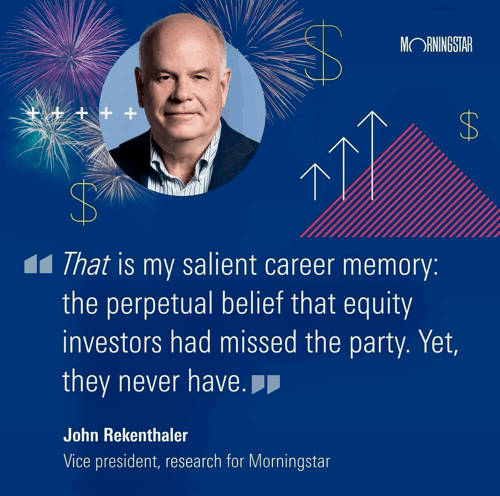
John Rekenthaler, longtime Director of Research at Morningstar, recently announced his retirement from a 35+ year career with the article Farewell, For Now. As a regular reader of his “Rekenthaler Reports”, I have respected his clear writings that were often about the uncomfortable truths of investing.

I am old enough to remember when the “5-Star Rating” from Morningstar was the ultimate goal of every mutual fund, as that meant they could place a huge ad inside Kiplinger’s Personal Finance and Money magazines (along with the inevitable other mentions) and wait for the money to roll in. Morningstar still has fund ratings and offers stock picks, but they’ve also evolved their business and to their credit, acknowledged these “uncomfortable truths”:

5-star Morningstar ratings weren’t very useful. Even way back in 2000, the research showed that high past performance did not result in high future performance. The only thing that showed “persistence” were the worst-performing funds. Bad funds stayed bad. From a 2000 article by Jane Bryant Quinn:

John Rekenthaler, Morningstar’s research director, says there’s actually not much difference between mid-ranked funds and top-rated ones. Three-star, four-star and five-star funds have been found to perform pretty much alike, he says.

Still, those funds do better, on average, than two-star or one-star funds. If that’s the case, you shouldn’t worry if your fund moves from level to level, as long as it rates three stars and up.

Low expense ratios matter the most in fund selection. Russell Kinnel was the author of the 2010 Morningstar article How Expense Ratios & Star Ratings Predict Success, but Rekenthaler was also part of that research team and the admission was really big news for that time:

Perhaps the most compelling argument for expenses is that they worked every time–because costs always are deducted from returns regardless of the market environment. The star rating, as a reflection of past risk-adjusted performance, is more time-period dependent. When the market swings dramatically, the star rating is going to be less effective.

Investors should make expense ratios a primary test in fund selection. They are still the most dependable predictor of performance. Start by focusing on funds in the cheapest or two cheapest quintiles, and you’ll be on the path to success.

Doing nothing is often the best investing advice. Could it be that the “Do Nothing Portfolio” could compete and often beat the average mutual fund and even index funds (which still add and remove stocks within their index)? There is a lot of interesting stuff here: More Lessons From the Do Nothing Portfolio.

There is something to be said about minimizing your trading to the absolute minimum. The reason behind making extra trades is often either performance-chasing or panic-selling. Less is often more.

Edges don’t last. From William Bernstein:

Rekenthaler’s Rule: “If the bozos know about it, it doesn’t work anymore.” In other words, as soon as an anomaly is uncovered, it is arbitraged out of existence.

Time IN the game, not timing the game. Rekenthaler even included some uncomfortable truths inside his last article. If he had listened to Jack Bogle and picked the low-cost Vanguard S&P 500 index fund from early on instead of his actual picks (as an employee at Morningstar!), he’d likely be much richer today. But because he still kept investing consistently and mostly in US stocks, he still did just fine. Thus, we should not expect investing perfection from ourselves, either.

Another tribute article: What I Learned From John Rekenthaler

Amazon Last-Minute Gift Card Sale: Up to 20% Off (Lowe’s, Nordstrom, DoorDash, Uber, Instacart, Combos) + $200 No Fee Visa Gift Card

Tick, tock… Amazon is having a big last-minute gift card sale with up to 20% off many retailers. These aren’t the best deals ever for yourself, but they are useful as in-stock and on-time gifts for others. Accordingly, I like the combo cards with multiple options ($7.50 off $50).

In addition, you can get a $200 Virtual Visa eGift Card for exactly $200 (the $6.95 purchase fee is waived with promo code VISA). No physical card; Online use only. Notably, this card is both shipped and sold through Amazon, so it can trigger many of the Shop with Points promos from credit cards issuers mentioned in my Black Friday post. Use your Discover Cash Back, American Express Membership Rewards points, etc. and your net price may easily be much lower than $200.

  • “Happy Birthday” Combo: Lowe’s, Cheesecake Factory, AMC Movies, Outback, Gap
  • “Let’s Eat ” Combo: Cheesecake Factory, Chili’s, Cracker Barrel, Red Lobster, Panera Bread
  • “Fun & Fabulous” Combo: Sephora, Bloomingdales, Nordstrom
  • “On The Run” Combo: Panda Express, Krispy Kreme, Taco Bell
  • “Season’s Greetings” Combo: Macy’s, Gamestop, Lowe’s, Ulta
  • Lyft
  • Bath & Body Works
  • Instacart
  • DoorDash
  • Uber/Uber Eats
  • Google Play
  • Meta Quest
  • Panera Bread
  • Victoria’s Secret
  • Taco Bell
  • Under Armour
  • Domino’s
  • Petco
  • VUDU
  • Golden Corral
  • H&M
  • Chuck E. Cheese
  • Fandango
  • Foot Locker

(Please click here to view full post with Amazon links if viewing on RSS/email. I am an Amazon affiliate.)

TrueMed: Use Your Pre-Tax HSA/FSA Funds on Exercise Equipment

It’s that time of year, where I will soon remind you to use up your Healthcare Flexible Spending Account (FSA) funds before they expire. However, if you somehow have a large unused balance that you can’t offset with sunscreen and cold medicine, you may be interested in the possibility of using it towards exercise equipment.

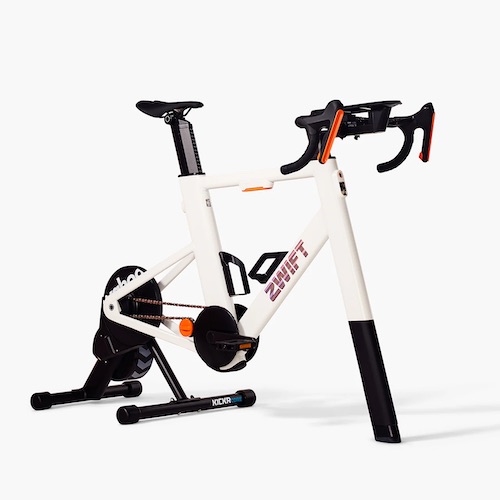
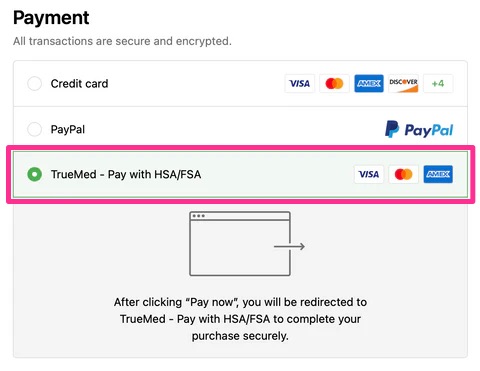
While shopping for a Zwift smart trainer bike, I came across a new checkout option called TrueMed that lets you “pay with HSA/FSA”. TrueMed claims to “unlock tax-free HSA/FSA spending for the leading exercise, healthy food and supplement companies”.

In order to use your HSA/FSA funds on these types of things, you need a Letter of Medical Necessity (LMN) – a signed document from a licensed healthcare provider that asserts that a product, treatment, or device is medically necessary for a patient. The LMN is valid for one year from the date it’s signed.

Check out this IRS alert: Beware of companies misrepresenting nutrition, wellness and general health expenses as medical care for FSAs, HSAs, HRAs and MSAs. For exercise equipment, you must be treating a specific medical condition (like a knee injury vs. general health):

Exercise equipment must be used to treat a specific medical condition in order to be considered eligible for reimbursement. Exercise equipment used for general health and wellbeing is not eligible for reimbursement.

It appears TrueMed provides the LMN after you fill out their online questionnaire. In some cases, I notice that they will charge you a fee like $15 to take the online questionnaire.

There is a movement redefining healthcare, focusing on proactive, root-cause solutions like fitness, nutrition, and innovative health technology. When you shop with Truemed merchants, you can seamlessly qualify for a Letter of Medical Necessity (LMN), enabling you to use pre-tax HSA/FSA funds for these transformative health interventions—saving you an average of 30%.

I’m not affiliated with TrueMed. I have not tried TrueMed and I have not submitted a claim for any exercise equipment using their Letter of Medical Necessity. In the end, it is still dependent on your specific claims administrator to approve the claim and accept the documentation you provide. I’ve come across a few examples of rejections, but also other reports that TrueMed later adjusted their practices in order to qualify. They appear to work with you:

My Claim Was Denied… Now What?

If you receive an alert of a denied claim, we are here to help! To best support you, please compile the following information.

– Denied Claim Information
– A screenshot or copy of the denial notice. This should include the denial reason clearly stated and also the denial code, if provided.
– The name of your HSA/FSA administrator, if not clearly shown on the denial notice.

Once you have this information compiled, please email support@truemed.com and include this information in the email body.

This may be worth further investigation if you are already committed to a specific exercise program or equipment as treatment. I’d prefer a bike as treatment for joint issues, hypertension, or obesity over more pills. As a checkout option, I like that it should come into play after you grab any other available discounts. I’ve historically had bad experiences with FSA claims administrators, so I would tread carefully.

Best Interest Rates Survey: Savings Accounts, Treasuries, CDs, ETFs – December 2024

Here’s my monthly roundup of the best interest rates on cash as of December 2024, roughly sorted from shortest to longest maturities. There are lesser-known opportunities available to individual investors, often earning more money while keeping the same level of safety by moving to another FDIC-insured bank or NCUA-insured credit union. Check out my Ultimate Rate-Chaser Calculator to see how much extra interest you could earn from switching. Rates listed are available to everyone nationwide. Rates checked as of 12/15/2024.

TL;DR: Slightly lower overall in the short-term. Only a few around 5% APY now. Still some 4%+ APY 5-year CDs. Compare against Treasury bills and bonds at every maturity, taking into account state tax exemption. I no longer recommend fintech companies due to the possibility of loss due to poor recordkeeping and/or fraud.

High-yield savings accounts
Since the huge megabanks still pay essentially no interest, everyone should at least have a separate, no-fee online savings account to piggy-back onto your existing checking account. The interest rates on savings accounts can drop at any time, so I list the top rates as well as competitive rates from banks with a history of competitive rates and solid user experience. Some banks will bait you with a temporary top rate and then lower the rates in the hopes that you are too lazy to leave.

  • The top rates at the moment are from newcomers TIMBR at 5.05% APY and Pibank at 5.00% APY. I have no personal experience with either, but they are the top rates at the moment. Most others have dropped at least a little. For example, CIT Platinum Savings is now at 4.55% APY with $5,000+ balance.
  • SoFi Bank is at 4.00% APY + up to $325 new account bonus with direct deposit. You must maintain a direct deposit of any amount (even $1) each month for the higher APY. SoFi has historically competitive rates and full banking features. See details at $25 + $300 SoFi Money new account and deposit bonus.
  • Here is a limited survey of high-yield savings accounts. They aren’t the top rates, but a group that have historically kept it relatively competitive such that I like to track their history.

Short-term guaranteed rates (1 year and under)
A common question is what to do with a big pile of cash that you’re waiting to deploy shortly (plan to buy a house soon, just sold your house, just sold your business, legal settlement, inheritance). My usual advice is to keep things simple and take your time. If not a savings account, then put it in a flexible short-term CD under the FDIC limits until you have a plan.

  • No Penalty CDs offer a fixed interest rate that can never go down, but you can still take out your money (once) without any fees if you want to use it elsewhere. Marcus has a 7mo/9mo/11mo No Penalty CD at 4.00% APY with a $500 minimum deposit. Farmer’s Insurance FCU has 9-month No Penalty CD at 4.50% APY with a $1,000 minimum deposit. Consider opening multiple CDs in smaller increments for more flexibility.
  • Langley Federal Credit Union has a 10-month certificate special at 5.25% APY ($500 min, $50,000 max). This is a promo for new members only. Anyone can join this credit union nationwide; you must maintain $5 in their share savings account. Early withdrawal penalty is 90 days of interest.

Money market mutual funds
Many brokerage firms that pay out very little interest on their default cash sweep funds (and keep the difference for themselves). Note: Money market mutual funds are highly-regulated, but ultimately not FDIC-insured, so I would still stick with highly reputable firms.

  • Vanguard Federal Money Market Fund (VMFXX) is the default sweep option for Vanguard brokerage accounts, which has an SEC yield of 4.54% (changes daily, but also works out to a compound yield of 4.64%, which is better for comparing against APY). Odds are this is much higher than your own broker’s default cash sweep interest rate.
  • Vanguard Treasury Money Market Fund (VUSXX) is an alternative money market fund which you must manually purchase, but the interest will be mostly (80% for 2023 tax year) exempt from state and local income taxes because it comes from qualifying US government obligations. Current SEC yield of 4.49% (compound yield of 4.58%).

Treasury Bills and Ultra-short Treasury ETFs
Another option is to buy individual Treasury bills which come in a variety of maturities from 4-weeks to 52-weeks and are fully backed by the US government. You can also invest in ETFs that hold a rotating basket of short-term Treasury Bills for you, while charging a small management fee for doing so. T-bill interest is exempt from state and local income taxes, which can make a significant difference in your effective yield.

  • You can build your own T-Bill ladder at TreasuryDirect.gov or via a brokerage account with a bond desk like Vanguard and Fidelity. Here are the current Treasury Bill rates. As of 12/13/24, a new 4-week T-Bill had the equivalent of 4.31% annualized interest and a 52-week T-Bill had the equivalent of 4.24% annualized interest.
  • The iShares 0-3 Month Treasury Bond ETF (SGOV) has a 4.88% SEC yield (this looks old) and effective duration of 0.10 years. SPDR Bloomberg Barclays 1-3 Month T-Bill ETF (BIL) has a 4.42% SEC yield and effective duration of 0.08 years.

US Savings Bonds
Series I Savings Bonds offer rates that are linked to inflation and backed by the US government. You must hold them for at least a year. If you redeem them within 5 years there is a penalty of the last 3 months of interest. The annual purchase limit for electronic I bonds is $10,000 per Social Security Number, available online at TreasuryDirect.gov.

  • “I Bonds” bought between November 2024 and April 2025 will earn a 3.11% rate for the first six months. The rate of the subsequent 6-month period will be based on inflation again. More on Savings Bonds here.
  • In mid-April 2025, the CPI will be announced and you will have a short period where you will have a very close estimate of the rate for the next 12 months. I will have another post up at that time.

Rewards checking accounts
These unique checking accounts pay above-average interest rates, but with unique risks. You have to jump through certain hoops which usually involve 10+ debit card purchases each cycle, a certain number of ACH/direct deposits, and/or a certain number of logins per month. If you make a mistake (or they judge that you did) you risk earning zero interest for that month. Some folks don’t mind the extra work and attention required, while others would rather not bother. Rates can also drop suddenly, leaving a “bait-and-switch” feeling.

  • OnPath Federal Credit Union (my review) pays 7.00% APY on up to $10,000 if you make 15 debit card purchases, opt into online statements, and login to online or mobile banking once per statement cycle. Anyone can join this credit union via $5 membership fee to join partner organization. You can also get a $100 Visa Reward card when you open a new account and make qualifying transactions.
  • Genisys Credit Union pays 6.75% APY on up to $7,500 if you make 10 debit card purchases of $5+ each per statement cycle, and opt into online statements. Anyone can join this credit union via $5 membership fee to join partner organization.
  • La Capitol Federal Credit Union pays 6.25% APY on up to $10,000 if you make 15 debit card purchases of at least $5 each per statement cycle. Anyone can join this credit union via partner organization, Louisiana Association for Personal Financial Achievement ($20).
  • NEW: Falcon National Bank pays 6.00% APY on up to $25,000 if you make at least 15 debit card purchases, 1 direct deposit OR ACH credit transaction, and enroll in online statements.
  • Credit Union of New Jersey pays 6.00% APY on up to $25,000 if you make 12 debit card purchases, opt into online statements, and make at least 1 direct deposit, online bill payment, or automatic payment (ACH) per statement cycle. Anyone can join this credit union via $5 membership fee to join partner organization.
  • Andrews Federal Credit Union pays 6.00% APY on up to $25,000 if you make 15 debit card purchases, opt into online statements, and make at least 1 direct deposit or ACH transaction per statement cycle. Anyone can join this credit union via partner organization.
  • Find a locally-restricted rewards checking account at DepositAccounts.

Certificates of deposit (greater than 1 year)
CDs offer higher rates, but come with an early withdrawal penalty. By finding a bank CD with a reasonable early withdrawal penalty, you can enjoy higher rates but maintain access in a true emergency. Alternatively, consider building a CD ladder of different maturity lengths (ex. 1/2/3/4/5-years) such that you have access to part of the ladder each year, but your blended interest rate is higher than a savings account. When one CD matures, use that money to buy another 5-year CD to keep the ladder going. Some CDs also offer “add-ons” where you can deposit more funds if rates drop.

  • Credit Human has a 59-month CD at 4.11% APY. 48-month at 4.11% APY. 35-month at 4.25% APY. 23-month at 4.30% APY. 1-year at 4.40% APY. $500 minimum. The early withdrawal penalty (EWP) for CD maturities of 36 months or more is 365 days of interest. For CD maturity of 1 year, the EWP is 270 days of interest. This is actually a credit union, but is open nationwide with a American Consumer Council (ACC) membership. Try promo code “consumer” when signing up at ACC for a free membership.
  • Synchrony Bank has a 5-year certificate at 4.00% APY (no minimum), 4-year at 3.50% APY, 3-year at 3.75% APY, 2-year at 3.50% APY, and 1-year at 4.00% APY. Early withdrawal penalty for the 4-year and 5-year is 365 days of interest.
  • BMO Alto has a 5-year CD at 3.90% APY. 4-year at 3.80% APY. 3-year at 3.80% APY. 2-year at 3.80% APY. 1-year at 4.20% APY. No minimum. The early withdrawal penalty (EWP) for CD maturities of 1 year or more is 180 days of interest. For CD maturities of 11 months or less, the EWP is 90 days of interest. However, note that they reserve the right to prohibit early withdrawals entirely (!). Online-only subsidiary of BMO Bank.
  • You can buy certificates of deposit via the bond desks of Vanguard and Fidelity. You may need an account to see the rates. These “brokered CDs” offer FDIC insurance and easy laddering, but they don’t come with predictable early withdrawal penalties. Right now, I see a 5-year non-callable CD at 3.90% APY (callable: no, call protection: yes). Be warned that both Vanguard and Fidelity will list higher rates from callable CDs, which importantly means they can call back your CD if rates drop later. (Issuers have indeed started calling some of their old 5%+ CDs during 2024.)

Longer-term Instruments
I’d use these with caution due to increased interest rate risk (tbh, I don’t use them at all), but I still track them to see the rest of the current yield curve.

  • Willing to lock up your money for 10 years? You can buy long-term certificates of deposit via the bond desks of Vanguard and Fidelity. These “brokered CDs” offer FDIC insurance, but they don’t come with predictable early withdrawal penalties. You might find something that pays more than your other brokerage cash and Treasury options. Right now, I see a 10-year CDs at [n/a] (non-callable) vs. 4.40% for a 10-year Treasury. Watch out for higher rates from callable CDs where they can call your CD back if interest rates drop.

All rates were checked as of 12/15/2024.

Photo by Giorgio Trovato on Unsplash

Mary Buffett & The Difference Between Gifting Cash and Stocks

In a recent Fortune article, which in turn referenced an older ThinkAdvisor interview, Mary Buffett shared an anecdote about how her former father-in-law Warren Buffett changed the way he gifted his family $10,000 every year, from cash to shares of stock:

He would always give each of us $10,000 in hundred-dollar bills. As soon as we got home, we’d spend it — whooo! Then, one Christmas there was an envelope with a letter from him. Instead of cash, he’d given us $10,000 worth of shares in a company he’d recently bought, a trust Coca-Cola had. He said to either cash them in or keep them. I thought, “Well, [this stock] is worth more than $10,000. So I kept it, and it kept going up. Then, every year when he’d give us stock — Wells Fargo being one of them — I would just buy more of it because I knew it was going to go up.

Giving shares of stock instead of cash was small nudge that made a difference. A little bit of added friction. A little hint from the giver that you might want to keep it, but you aren’t forced to keep it.

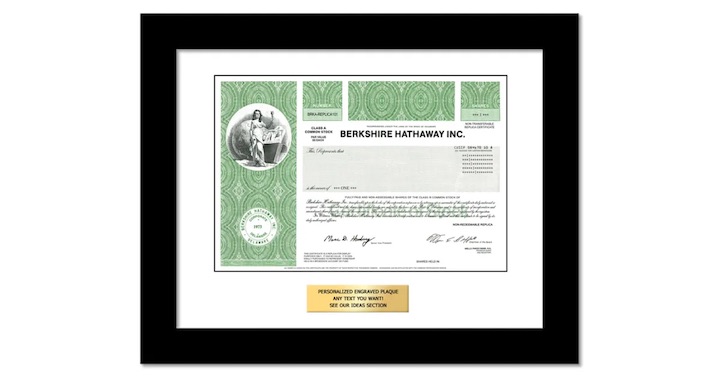
I haven’t given my children any stock yet, but am starting to think they are ready. It won’t be a lot, but I’ll tell them about it and they can look at the custodial account statements each year. I’ll show them what paper stock certificates look like. I’m hoping that they’ll also see the growth from the investment, and then that’ll make them even less likely to sell the shares. But they’ll technically be free to sell them once they turn 18 (or up to 25 in some states).

Mint Mobile Holiday Deal: 12-Months of Unlimited Plan at $15/Month (50% Off, $180 Savings)

This year will make it six years with Mint Mobile cellular service. They have provided reliable service at a low cost, and it fits my needs. They use the T-Mobile GSM 4G LTE and 5G networks, which means most phones are compatible and switching just requires swapping in a new SIM card (more recently I just use eSIM for instant over-the-air switching). (Mint was so successful that T-Mobile bought them.) I am an affiliate for them, but I’m also a loyal user.

This is their best deal in recent memory: New customers can get 12-Month Unlimited Plan for only $15/month. This is 50% off their normal low pricing of $30 a month for 12 months ($360 a year), for a savings of $180. Usually they only offer this discount for 3 months, so make sure you don’t buy the 3-month plan by accident! Offer ends January 2nd, 2025.

Want a new phone too?

Note: “Unlimited” data still means speeds are throttled after 40 GB per month. Video streams at 480p. My personal primary complaint is that as an MVNO they are lower data priority, so at concerts or large public events, I feel my cellular data is slower than others. But I can’t bring myself to pay the full price of regular T-Mobile over that.

Use their phone compatibility checker first to see if you can bring your current phone over. All of their plans offer the slower 128 kbps speeds after you use up your LTE data, which is nice as you can still check your email and access basic services. (New customer means your phone hasn’t been on Mint within the past 90 days.)

7-Day “No Questions Asked Money Back Guarantee” (starts upon SIM activation) so you can test them out before making any commitment.

All of our full phone plans and See for Yourself Kits feature a 7-Day Money Back Guarantee for all purchases made on mintmobile.com or using the app. You can cancel your wireless phone plan service for any reason within 7 days of activation and we will refund you 100% of the purchase price, including any fees and taxes. Shipping is not refunded.

Disclosure: This post includes affiliate links. If you make a purchase through the links above, I may be compensated.

Alaska Airlines Premium Credit Card: 500 Mile Bonus For Joining Waitlist (No Commitment)

Alaska Airlines is teasing a new credit card, currently called the “Alaska Airlines Premium Credit Card”, and you can get 500 free Alaska miles just for joining their waitlist by December 31st, 2024 with your name and MileagePlan number. There is no commitment, so I’ll take the free miles. If you later apply and get approved, they will also add on another 5,000 bonus miles. The application is not set to open until “Summer 2025”.

1 – Register your interest in the Alaska Airlines Premium Credit Card by Dec 31, 2024, and you will receive 500 miles for registration and, upon approval of your application for the Alaska Airlines Premium Credit Card, 5,000 miles in addition to any other new account bonus offer you may qualify for. To qualify, applicants must apply via a link that will be emailed to them using the email address provided in their offer registration within 14 days of receiving the exclusive application link. Must provide valid Mileage Plan account information to be eligible. Limit of one registration offer per valid Mileage Plan account. By registering for this offer you agree to receive communications from Alaska Airlines about, and how to apply for, the Alaska Airlines Premium Credit Card. Communications sent and managed by Alaska Airlines. You may opt out at any time.

There are a bunch of features and perks teased, but a lot of this stuff ends up being changed before launch.

Sam’s Club New Membership Discount: $30 Off Club, $50 off Plus

sams200bSam’s Club has a new discount offer on new memberships. This is slightly cheaper than the previous Sam’s Club Groupon deal. Each includes a Household member card. Expires 1/31/25.

Fine print on the Club offer:

Join now and receive $30 off a $50 Club membership for a final price of $20. Must join as a new Sam’s Club or Sam’s Plus member through the link provided to qualify for this Offer. Offer is valid for new Sam’s Club members only; and is not valid for (i) membership renewals, those with a current membership, those who were Sam’s Club members less than six (6) months prior to joining, or Walmart and Sam’s Club associates.

Fine print on the Plus offer:

Join now and receive $50 off a $110 Plus membership for a total of $60. Must join as a new Sam’s Plus member through the link provided to qualify for this Offer. Offer is valid for new Sam’s Club members only; and is not valid for (i) membership renewals, those with a current membership, those who were Sam’s Club members less than six (6) months prior to joining, or Walmart and Sam’s Club associates.

Upgrading from Club to Plus will get you:

  • Free curbside pickup of club order with no minimum. (Club members have a $50 minimum pre-tax.)
  • Free delivery from your local club warehouse on order of $50+. Works within 15-mile radius of a participating warehouse. (Club member have $8 fee per order.)
  • Free shipping on eligible online orders of $50+.
  • 2% Sam’s Cash back on in-club purchases, up to $500 a year. (Nothing with Club)
  • 3% back on Sam’s Club purchases with the Sam’s Club Mastercard (1% with Club).
  • Extended early shopping hours at some warehouses.
  • Early access to select online deals.

You may also wish to try to stack your Sam’s Club purchase with a cashback shopping portal. I’m not sure if it will work with all of them, but maybe. Many offer new customers bonuses if you make a qualifying purchase, including Swagbucks ($10 bonus), MyPoints ($10 bonus), Rakuten (formerly eBates) ($40 bonus currently, varies), TopCashBack (varies), and BeFrugal ($10 bonus). So you could sign-up and stack this deal to trigger the bonus. I have cashed out of all of these in the past.

Rakuten Cashback Portal: $40 New Member Bonus via Referral

$40 offer is back through 12/16. Rakuten (formerly eBates) is one of the biggest cashback shopping portals, where you earn a rebates on your online (and possibly in-store, see below) purchases. Right now, they have an limited-time $40 new user bonus via referral when you make your first purchase of $40+ through any participating Rakuten retailer within 90 days of joining. The standard non-referral bonus is only $10.

Some popular examples of retailers that could trigger the bonus include Sam’s Club, eBay, Lowe’s, Apple, Samsung, Chewy, and Temu.

Many retailers also have extra cashback percentages during this Holiday time period, so be sure to use some sort of cashback portal if you can.

Finally, note that many travel sites participate, including Booking.com, Expedia.com, VRBO, Hawaiian Airlines (direct), Marriott.com (direct), IHG Hotels (direct), Priceline, Orbitz, Hotels.com.

Rakuten is also somewhat unique in that they offer in-store cashback as well at a variety of physical stores like Macy’s, Mattress Warehouse, Staples, Neiman Marcus, Petsmart, Nordstrom Rack, Food Lion, Sephora, and more.

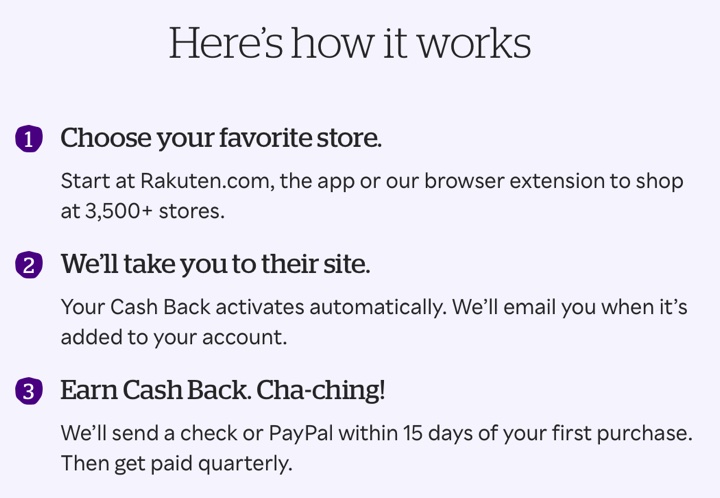
Here’s an overview of the process:

  • You must first link your debit or credit card and provide eBates with your credit card information. Works with Visa, Mastercard, and American Express.
  • Then, you must manually add a specific store. You can use their smartphone app (iOS/Android) for convenience. Be aware of some exclusions like gift card purchases.
  • Shop at the store register with that specific credit card. Debit cards must be run as “credit” purchases where you sign (no PIN). It’s very discreet. You don’t need to say anything, show a membership card, provide a coupon, etc. You don’t need to keep the receipt.
  • After you shop, the store will be unlinked automatically. If you want to shop at that store again, you must remember to manually re-link the offer again to your card.
  • You may not get instant confirmation. Look for a confirmation within a week or so.