Update: This offer is now expired and not currently available. I am leaving up the details for those that did the deal previously.
Expired offer:
$100 offer is back. You must sign up by 1/31/23 and have your meeting by 2/28/2023. Personal Capital is an investment advisory service that offers several free online financial tools as a way to introduce themselves to potential clients. I mention them once a quarter, as I use them to track my Humble Portfolio performance and asset allocation across various brokerage and 401k accounts. They also have various retirement planning tools for projecting required savings rates and future income. Below is a screenshot from my own account. (Morningstar recently started charging for their Portfolio X-ray service, leaving Personal Capital as one of the few such services left.)


After you sign up for their free tools, Personal Capital will usually call you once and introduce themselves and their services. They want to help you manage your portfolio for a management fee that is somewhere between the cost of the average 100% digital robo-advisor and a traditional human advisor from a Big Firm. If you politely decline, as I did, they won’t hard-sell and won’t call you again. (Much more pleasant than trying to cancel my cable service!) You can keep using their free software after that without hassle.
Now through 1/31/2023, Personal Capital will explicitly pay you a $100 Visa gift card if you sign up for their free tools and receive a financial advisory analysis and sales call from them. You will need to sync up your investments accounts showing total investable assets of at least $250,000. You do not need to accept the proposal or pay for financial advice, but you do need to listen to their presentation.
The next conversation you have could come with $100. Here’s how:
– Sign up for our free, easy-to-use financial tools including our Retirement Planner
– Link your bank and investment accounts
– Receive your free financial analysis after talking with an expert
– Treat yourself with your FREE $100 Visa® gift card**
Offer fine print:
Offer available through Feb 28, 2023. If you schedule an appointment with a Personal Capital Advisor and participate in both an initial call and a second call in which you receive a recommendation and proposal for paid investment advisory services by Feb 28, 2023 (a “Recommendation”), then you will receive receive a $100 Visa®* Gift Card (the “Gift Card”). The Gift Card will be provided via email no later than Mar 31, 2023 through Thnks.com (“Thnks”), an independent third-party gifting platform. By participating in this promotion, you are agreeing to allow Personal Capital to share your email address with Thnks for Gift Card fulfillment purposes and agreeing that information collected from promotion participants may be used by PCAC or affiliates for marketing or solicitation of paid products or services.
The Gift Card is only available to prospective clients who receive a promotional offer. To qualify as a prospective client, you must: (1) have a minimum of $250,000 in investable assets, (2) not have redeemed a Personal Capital promotion in the previous 24 months, and (3) answer a suitability survey posed at the beginning of the initial call with a Personal Capital Advisor at which time the Advisor (at his or her sole discretion) will make a determination as to whether you qualify as a prospective client for paid advisory services offered by Personal Capital Advisors Corporation. Using an ad blocker may adversely affect our ability to determine your account eligibility in the program. This offer is not transferable and cannot be redeemed in any other manner. Final determination of eligibility is at Personal Capital’s sole discretion.
I am now an affiliate of Personal Capital Advisors Corporation (“PCAC”) and will be compensated if you sign up for this offer though my link above. To be blunt, if you don’t want to listen to a full presentation, I would just sign up for the free tools and skip the advisor call. The free tools are truly useful just on their own and Personal Capital has never bothered me again after their initial call. But if you do want to hear what they have to say and maybe get a little free advice, then right now you can get a $100 gift card on top (instead of nothing).
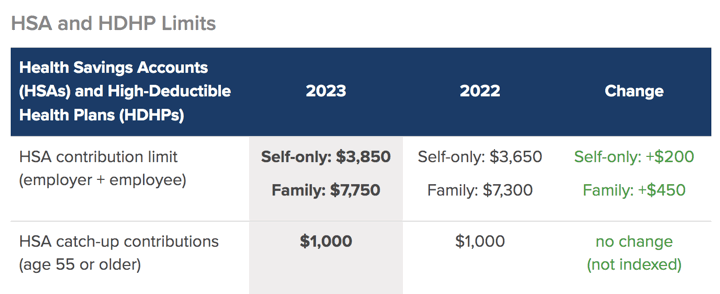
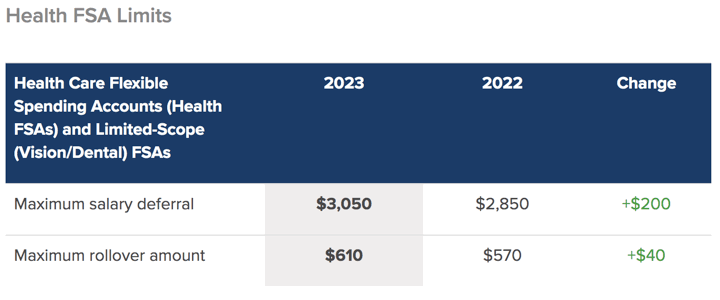
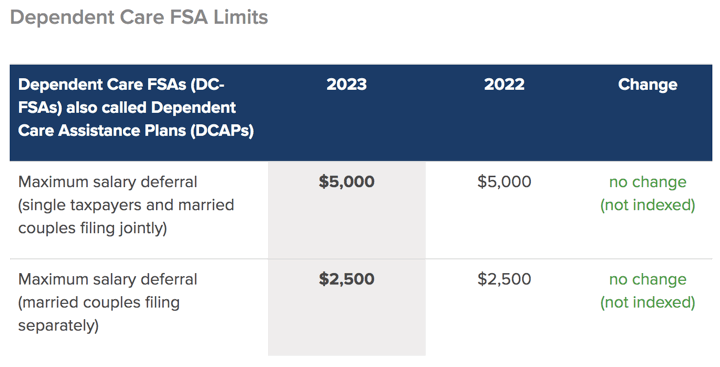
 The beginning of the year is also a good time to check on the new annual contribution limits for retirement and benefit accounts, many of which are indexed to inflation. Our income has been quite variable these last few years, so I regularly adjust our paycheck deferral percentages based on expected income for the year. I still try to max things out if I can, or at least stay on pace to do so. This


 The Best Credit Card Bonus Offers – 2026
 Big List of Free Stocks from Brokerage Apps
 Best Interest Rates on Cash - 2026
 Free Credit Scores x 3 + Free Credit Monitoring
 Best No Fee 0% APR Balance Transfer Offers
 Little-Known Cellular Data Plans That Can Save Big Money
 How To Haggle Your Cable or Direct TV Bill
 Big List of Free Consumer Data Reports (Credit, Rent, Work)