Archives for February 2021

Charlie Munger Daily Journal Annual Meeting 2021 Full Video, Full Transcript, and Highlights

It seems that every year, Charlie Munger and the Daily Journal Annual Shareholder Meeting gets more and more media attention. Which is great, as Munger is now 97 years old. Yahoo Finance livestreamed the event, and you can view the full two-hour recording on YouTube. It’s much faster to read the entire transcript, kindly provided at sites like Latticework Investing and Junto Investments. Munger covered a lot of ground, and it’s nice to see he hasn’t lost his edge. I’ve edited things down to my personal highlights below.

On the popularity of the short-term trading of stocks like Gamestop. It is nothing fancier than gambling.

…that’s the kind of thing that can happen when you get a whole lot of people who are using liquid stock markets to gamble the way they would in betting on racehorses. And that’s what we have going in the in the stock market. And the frenzy is fed by people who are getting commissions and other revenues out of this new bunch of gamblers.

A few shots at Robinhood.

I have a very simple idea on the subject. I think you should try and make your money in this world by selling other people things that are good for them. And if you’re selling them gambling services where you make profits off of the top, like many of these new brokers who specialize in luring the amateurs in, I think it’s a dirty way to make money. And I think that we’re crazy to allow it. […] Well, it’s most egregious in the momentum trading by novice investors lured in by new types of brokerage operations like Robinhood. I think all of this activity is regrettable. I think civilization would do better without it.

Nope, Robinhood is not free.

Robinhood trades are not free. When you pay for order flow, you’re probably charging your customers more and pretending to be free. It’s a very dishonorable low-grade way to talk. Nobody should believe that Robinhood’s trades are free.

On SPACs:

Well, I don’t participate at all. And I think the world would be better off without them. I think this kind of crazy speculation in enterprises not even found or picked out yet is a sign of an irritating bubble. It’s just that the investment banking profession will sell shit as long as shit can be sold.

On Treasury bonds, government stimulus, and low rates:

Well no, I don’t think we have a bubble in Treasury securities. I think they’re a bad investment when interest rates are this low. I never buy any and neither does Daily Journal. But, no, I don’t think Treasury securities are a big problem.

I do think that we don’t know what these artificially low interest rates are going to do or how the economy is going to work in the future as governments print all this extra money. The only opinion I have there is that I don’t think anybody knows what’s going to happen for sure. Larry Summers has recently been quoted as being worried that we’re having too much stimulus. And I don’t know whether he’s right or not.

On higher stock prices due to low rates:

I think everybody is willing to hold stocks at higher price-earnings multiples when interest rates are as low as they are now. And so I don’t think it’s necessarily crazy that good companies sell at way higher multiples than they used to.

On the other hand, as you say, I didn’t get rich by buying stocks at high price-earnings multiples in the midst of crazy speculative booms. I’m not going to change. I am more willing to hold stocks at high multiples than I would be if interest rates were a lot lower. Everybody is.

On why DJCO kept its Wells Fargo shares when Berkshire Hathaway sold them all off:

Well, I don’t think it’s required that we be exactly the same on everything. We have different tax considerations. […] So, you can understand why Warren got disenchanted with Wells Fargo. I think I’m a little more lenient. I expect less out of bankers than he does.

On Bitcoin:

So, I don’t think Bitcoin is going to end up as the medium of exchange for the world. It’s too volatile to serve well as a medium of exchange. It’s really kind of an artificial substitute for gold, and since I never buy any gold, I never buy any Bitcoin. I recommend that other people follow my practice.

On Costco. Munger has said in the past that 1/3rd of his net worth is in Costco.

Costco I do think has one thing that Amazon does not. People really trust Costco will be delivering enormous value. And that is why Costco presents some danger to Amazon. They’ve got a better reputation for providing value than practically anybody, including Amazon.

How do you know you really understand something? Avoid confirmation bias.

Well, I do have a tip. At times in my life, I have put myself to a standard that I think has helped me: I think I’m not really equipped to comment on this subject until I can state the arguments against my conclusion better than the people on the other side. If you do that all the time; if you’re looking for disconfirming evidence and putting yourself on a grill, that’s a good way to help remove ignorance.

Can anyone become a great investor? Bad news.

I think people have the theory that any intelligent hardworking person can get to be a great investor. I think any intelligent person can get to be pretty good as an investor and avoid certain obvious traps. But I don’t think everybody can be a great investor or a great chess player. […] I don’t think it’s easy for ordinary people to become great investors.

What does Munger advise his charitable institutions to hold as assets? Munger also has 1/3rd of his assets run by Li Lu, and the final 1/3rd is Berkshire Hathaway shares.

Well, the one charitable institution where I have had some influence for a very long time has a whole bunch of hotshot financiers in every branch of wealth management there is on the board. And that institution has two assets in its endowment account. One is a big interest in Li Lu’s China fund, which is a limited partnership, and the other is a Vanguard index fund. As a result of holding those two positions, we have a lower cost than anybody else and we make more money than practically everybody else. So you now know what I do in charitable institutions.

Most people have “happiness thermostats”:

I think most people who are assuming tolerable success in life are about as happy as they were ordained to be. They wouldn’t be a lot happier if they were richer or a lot less happy if they’d been poor. I think most people are born with a happystat. That happystat has more to do with their happiness and their outcomes in life.

More on happiness:

The first rule of a happy life is low expectations. That’s one you can easily arrange. If you have unrealistic expectations, you’re going to be miserable all your life. I was good at having low expectations and that helped me.

On choosing a spouse:

A little wisdom in spouse selection is very desirable. You can hardly think of a decision that matters more to human felicity than who you marry. […] Well, you know, I had a failed marriage, so I don’t think I’m in the perfect position to advise the young about marriage.

Here are last year’s 2020 Daily Journal meeting video, transcript, and notes. Here are links to past Daily Journal meeting transcripts and lots of additional Munger material.


Scott Galloway’s Algebra of Wealth (or: How To Become Rich)

Scott Galloway shares in The Algebra of Wealth his thoughts on how to achieve financial security (be rich). You should read the entire thing, but the ingredients in his formula are Focus, Stoicism, Time, and Diversification. I’m only including a few notes and personal interpretations here.

Focus. If you want to get rich, you have consciously take action to make it happen. It rarely happens by accident. Look for a good wave to ride when you are young. Look carefully for the right life partner.

Successful people often unwittingly head fake young people with the humblebrags of “follow your passion” and “don’t think about money.” This is (mostly) bullshit. Achieving economic security requires hard work, talent, and a tremendous amount of focus on . . . money. Yes, some people’s genius will be a tsunami that overwhelms a lack of focus and discipline. Assume you are not that person.

Stoicism. Develop some self-discipline and character. Be generous and helpful to others. This will help you spend less money.

Determine what you can and can’t control. You can control your reactions to temptation — a lack of discipline is the antichrist to economic security. Our society of superabundance makes this difficult. Billions of dollars are spent every year on schemes to manipulate our natural impulses into spending more money, consuming more fat, and believing everyone around us is more successful than we are. The upgrade from economy to premium to business to first class to private jet can seem like an investment in yourself — it’s not. The most powerful forward-looking indicator of your financial freedom is not how much you earn, but how much you save.

Time. Steady improvements over time can supercharge your results. Don’t focus only on the short-term. As the saying goes, “Time in the market is more important than timing the market.”

Compounding is not just a financial thing. The most important returns in life come from the compounded effects of our investments over time, whether in our finances, careers, hobbies, or relationships.

Diversification. Never expose yourself to a fully catastrophic loss. Make sure you can walk away to fight another day. If you do it right, you only need to get rich once.

Diversification is the kevlar that protects you — with it, bad decisions will still hurt, but they won’t prove fatal. Diversification, in other words, is your bulletproof vest. […] That doesn’t mean I don’t look for opportunities that offer asymmetric upside — I do. I just don’t ever take off my kevlar. You don’t need to be a hero to get to economic security.

There is no simple step-by-step plan to become financially independent, otherwise everyone would be rich. Luck matters too, but working on all of these factors helps maintain maximum exposure to good luck.

PPP Updates For Self-Employed and Independent Contractors: Single-Page Forgiveness Form, 2nd Draw Applications Open

Updated. There are many people who are eligible for 100% forgivable federal assistance from the Paycheck Protection Program, but aren’t applying for it, either due to misinformation or being discourage by all the bureacracy. Many PPP loan recipients are self-employed workers, sole proprietors, freelancers and/or independent contractors that file a Schedule C who may be eligible only for a modest amount, but that amount can still make a big difference. I am not an accountant nor a lawyer, but I encourage the (really) small businesses out there to get help if impacted by COVID. It’s not too late, and COVID isn’t over!

New focus on business with LESS than 20 employees. The Treasury Department just announced that businesses with more than 20 employees will be shut out of the PPP for a two-week period starting Wednesday, 2/24. In other words, only businesses with less than 20 employees can apply for PPP loans during the next two weeks. From ABC News:

In an attempt to improve equitable distribution of loans, administration officials said changes would also be aimed at helping sole proprietors, independent contractors and self-employed individuals to receive more financial support by revising the program’s funding formula.

PPP Round 2 loan applications now open. First of all, if you never took a PPP loan, you can still apply for a first-draw PPP loans under the more lenient first-draw eligibility rules. Second-draw PPP loans have a different set of eligibility rules, notably you need to show a reduction in revenue. If you are a self-employed worker with no other employees and have higher than a $100,000 net income (2019 IRS Form 1040 Schedule C line 31 or equivalent), then you must reduce it to $100,000. Here are the full SBA 2nd Draw guidelines. In terms of loan size, you can still get 2.5 times your average monthly net profit from 2019.

The next general hurdle is that you must show a 25% drop in income when comparing the same quarter in 2019 and 2020:

Applicant must demonstrate that gross receipts in any calendar quarter of 2020 were at least 25 percent lower than the same quarter of 2019. Alternatively, Applicants may compare annual gross receipts in 2020 with annual gross receipts in 2019 if they were in business in 2019.

Looking for a PPP lender? One problem is that most banks are restricting PPP applications to those with existing business credit relationships. Many freelancer and independent contractors don’t have that. The small-business fintech Fundera has an open PPP loan application (both for first and second-draw loans) to help freelancers and independent contractors find a lender without any no prior relationship.

Single-page form for PPP Round 1 loan forgiveness now available. If you have an existing loan under $150,000, there is now a single-page form that requires you to submit no additional documentation (it must still exist, of course, and they may ask you for it later if audited). That form, called the PPP Loan Forgiveness Application Form 3508S, has been released and lenders are starting to accept them. You may even be able to use the longer 24-week covered period and get more of your loan forgiven than with the previous 8-week period. (I haven’t heard of widespread final forgiveness being granted by the SBA yet.)

Looking for a self-employed or small business payroll provider? I want to mention Gusto here, as I use them for payroll and saw them create many tools this year to help their users satisfy the PPP documentation requirements and help them take advantage of this relief. If you are a single-person company, they have a basic tier that costs only $25 per month, which is much less than the major payroll providers. (You can also split up your direct deposit however you like, handy for various banking promotions.) Right now, referred user can get a $100 Visa gift card after running your first payroll with Gusto (my referral link).

What Percentage of Income Do People Really Donate to Charity?

Giving to charity has the double taboo of being both about money and your generosity to others. Double the chance for judgment, at least!

“And once again, tithing is 10 percent off the top, that’s gross income, not net. Please people, don’t force us to audit.” -Rev. Lovejoy, The Simpsons

How much do people really give to charity? Since nobody talks about it, I had no idea until I read this NBER paper Generosity Across the Income and Wealth Distributions by Meer and Priday. The authors examined the Panel Study of Income Dynamics, the “longest running longitudinal household survey in the world” with data from over 10,000 US households between 2001 and 2017. This Economist article summarized the results into a nice chart (click to enlarge):

The general conclusions:

  • The higher the income, the more likely you are to donate at all.
  • The higher the income, the higher the amount given (total dollars).
  • The higher the income, the amount given as a proportion of income (percentage) tends to stay roughly the same.

People across all income levels gave between 1% and 2% of their incomes to charity on average, after adjusting for effect of outliers. This is not to say that this number is the “right” amount to give for any specific household. The paper argues that previous studies which found lower-income households gave a higher percentage than higher-income households were skewed due to outliers (older households with temporarily low incomes but high net worth), and so they used the statistical method of “windsoring” to adjust for extreme outliers.

Found via Abnormal Returns and Benningfield Advisors.

Vanguard – How The Boring, Long-Term Focused Part of America Invests

Vanguard recently released a report on “How America Invests”, based on the 5 million households with Vanguard retail accounts (taxable and IRAs, not 401ks). It looked at investor behavior from 2015 through 2019, along with the first quarter of 2020, when there was a sharp market decline due to the COVID-19 pandemic. There is a lot of information packed inside, but here are a few quick takeaways.

The average portfolio of a Vanguard household. The averages seem reasonable, but I was a bit surprised that 16% of households are 100% bonds. Even if I was extremely conservative, I would still own something like 20% stocks to hedge against the risk of inflation and rising rates.

The typical Vanguard household holds a long-term, risk-taking portfolio that’s both diversified and balanced. The average portfolio consists of 63% equities (stocks), 16% fixed income (bonds), and 21% cash (short-term reserves). However, there are substantial differences in risk-taking across investors, with equity risk ranging from conservative to aggressive for investors with otherwise similar asset levels or ages. At the extremes, 16% of households hold no equities, while 22% hold very risky portfolios containing at least 98% equities.

Self-directed investor glide path vs. what Vanguard thinks is best. It is interesting to see what people actually own when they are self-directed, as compared to what Vanguard recommends in their Target-date Retirement Fund and their Vanguard Personal Advisory Services (VPAS) that charges an 0.30% annual fee.

This chart compares the asset allocation (% in stocks) of self-directed investors (blue line is median) against that of Vanguard target-date funds (red line). We see that there is a lot of variation amongst self-directed investors, but overall they do decrease their exposure over time like nearly all target-date funds. However, they don’t decrease it nearly as much as Vanguard’s target-date funds past the age of 65. (Click to enlarge.)

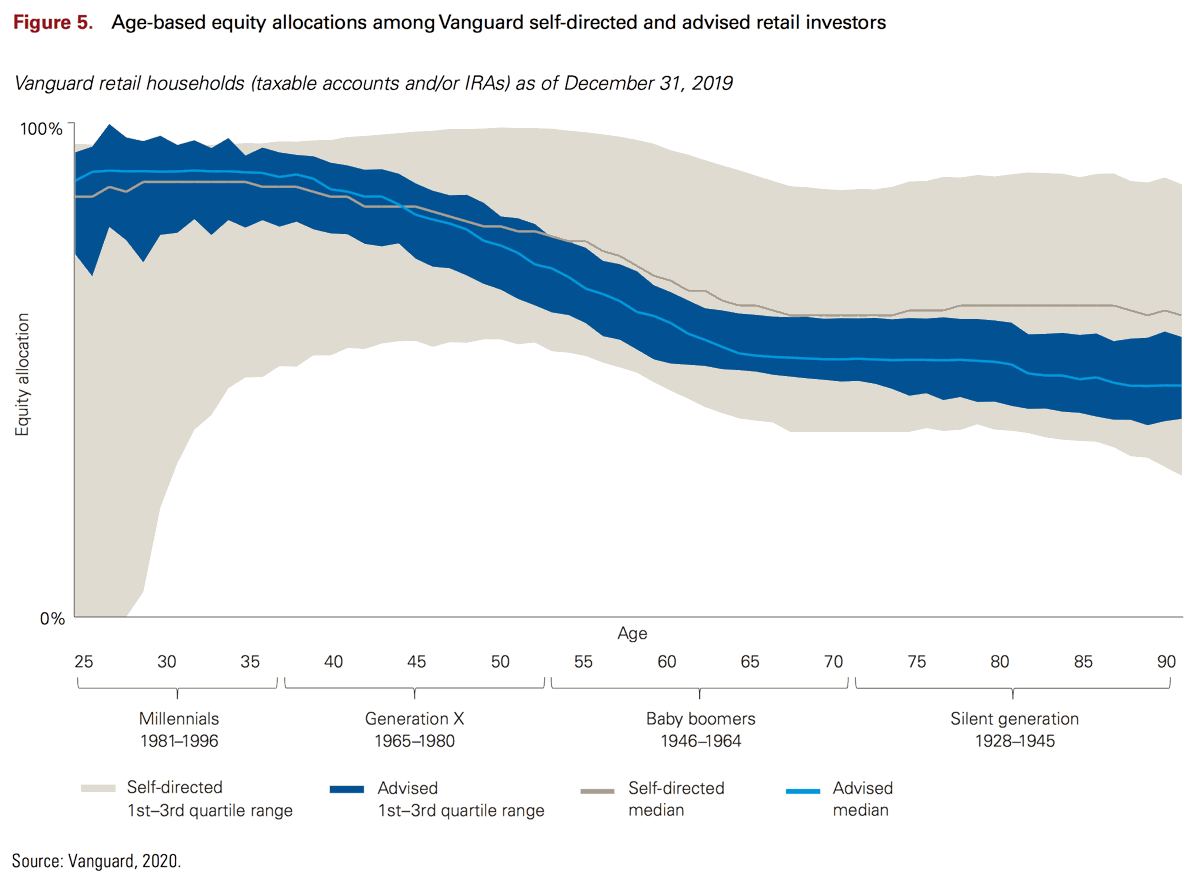
This chart compares the asset allocation (% in stocks) of self-directed investors (dark beige is median) against that of those being advised by Vanguard Personal Advisory Services (light blue line is median). Here, the recommended median asset allocation is much closer to that of the self-directed median. Comparing with the chart above, we see a gap betwewn VPAS and their own Target Retirement funds. Why are their target-date funds so much more conservative? (Click to enlarge.)

Mutual funds are still the most popular, but ETFs are gaining. Only 13% of Vanguard households hold any ETFs at all as of 2019, but that number is double that of 2015.

Younger investors tend to own index funds, while older investors still hold a lot of actively-managed funds. This chart tracks the usage of index funds/actively-managed funds/cash vs. age. I’m actually a little surprised at how much actively-managed funds are held by the older cohorts. Contrast this with the fact that roughly 2/3rd of Vanguard’s global assets under management are in their index funds/ETFs. (Click to enlarge.)

Vanguard account owners are not active traders! Over 75% of Vanguard households place zero trades per year. The Vanguard stereotype would probably be the polar opposite of the Robinhood stereotype. (As someone with the majority of their assets at Vanguard and only a small percentage in trading apps, I’m quite fine with that!) Check out this quote (emphasis mine):

Fewer than one-quarter of Vanguard households trade in any given year, and those that do typically only trade twice. Most traders’ behavior is consistent with rebalancing or is professionally advised.

During the COVID-19 market volatility, Vanguard households stayed boring and long-term focused. The quote below essentially says “they did nothing different”.

Twenty-two percent of households traded in the first half of 2020—a rate typical of trading for a full calendar year. Despite the increase in trading, less than 1% of households abandoned equities completely during the downturn, while just over 1% traded to extremely aggressive portfolios. The net result of the portfolio and market changes was a modest reduction in the average household equity allocation, from 63% to 62%.

Mint Mobile Review: Now $15 a Month for 4 GB, $20 a Month for 10 GB 5G/LTE Data

Update 2021: I just renewed with Mint Mobile again. I’m still happy with the service, including the new faster 5G speeds and increased data limits (added automatically without raising the price). I now pay $20/month for 10 GB 5G/LTE data (up from 8 GB). I also consolidated all the important info from my previous Mint Mobile posts into the full review below.

Full review:

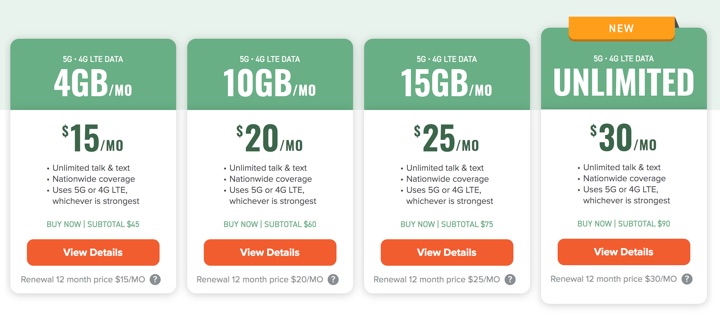
Mint Mobile is a prepaid cellular MVNO which runs on the T-Mobile network. They offer very competitive pricing on 5G/LTE data plans, as long as you “buy in bulk”. To switch, they will send you a SIM card to place in your existing phone. New customers can get the lowest price for the first 3 months for a lower upfront commitment. After that, you’ll need to renew for 12 months. Here are the current plan options:

  • 4 GB 5G/LTE Data + Unlimited Talk/Text for $15/month
  • 10 GB 5G/LTE Data + Unlimited Talk/Text for $20/month
  • 15 GB 5G/LTE Data + Unlimited Talk/Text for $25/month
  • Unlimited* 5G/LTE Data + Unlimited Talk/Text for $30/month (*Throttled after 35 GB)

I like that Mint Mobile acts like Vanguard in that I keep automatically getting more for my money without me having to be a new customer. $15 a month used to get me 2 GB of data, then 3 GB, and now 4 GB. $20 a month used to get me 5 GB of data, then 8 GB, and now 10 GB.

After you run out of 5G/LTE high-speed data, Mint Mobile plans still include “unlimited” slow data at 2G speeds (128kbps). This is nice to keep your messages and e-mail even if you accidentally binge-watch something on Netflix over cellular. All plans also include free international calls to Mexico and Canada.

Bring your own phone. You can bring your own unlocked GSM phone including both Android and Apple iPhones. Input your zip code first and then they will help you check your phone compatibilty. The most reliable way is to look up your IMEI number in your phone settings. Alternatively, they are offering the new iPhone SE for $15 a month, which means you can get a new phone + service for $30 a month total.

eSim now available. If have an iPhone that supports eSim (iPhone XS, iPhone XS Max, iPhone XR to the current iPhone 12 line-up), you can now switch to Mint without even waiting for a physical SIM card. Look for the eSim option during the sign-up process. Android support is supposed to come mid-2021, but unfortunately there are currently no plans to support the Apple Watch.

Number porting tip. Don’t forget to collect the following info from your existing carrier before starting the transfer process: Account number, Account PIN/password, and zip code on bill. Other than that, I was able to swap SIM cards and activate everything in under 10 minutes.

Upgrade to a higher data plan later and only pay the difference. During the pandemic, I found myself eating through a lot more cellular data. After I bumped into my data cap (3 GB at the time for $15/month) for the second time, I contacted Mint to upgrade to their next tier (8 GB at the time for $20/month). They allowed me to upgrade to the higher data plan for the rest of my 12-month term by only paying for the future difference. I did not have to retroactively pay to upgrade the entire term, or even renew for a new term.

What’s the catch? Any drawbacks? I did not experience any “catch”. Otherwise, I wouldn’t have kept renewing with Mint for three years in a row. If I’m being picky, here are potential drawbacks:

  • As with all MVNOs, you don’t get the roaming that you get when you pay full price from the Big 3 carriers of Verizon, AT&T, or T-Mobile. However, I never noticed any ongoing issues with cell coverage. The only time that I remember lacking service was during a large public event (remember those?) – a music concert in a stadium.
  • As with any time you switch carriers, the porting process can sometimes be a hassle. You’ll need to call your existing carrier and get a secret passphrase, which might involve a phone call and some hold time. Mint tries to do everything online, but does have a phone number and human reps if needed.

How’s the 5G data speed? If you have a 5G-capable phone and 5G towers around, you can get download speeds that rival or perhaps exceed your home internet connection. I did various tests with the SpeedTest app and sometimes had blazing 5G speeds (200 Mbps+), while sometimes the 5G with only one bar was slower than normal LTE (50 Mbps). Supposedly, Mint will automatically allow to connect to whichever is faster, 5G or LTE.

Can I use my phone as a WiFi hotspot? All Mint plans include free hotspot tethering up to your data allotment (5 GB hotspot on unlimited plan).

7-day money back guarantee details. It is important to note that their “7-Day Money Back Guarantee” starts at activation, not order date or ship date. So activate, and make sure the coverage works for you within those 7 days. If not, you can request a full refund online (minus shipping if any). You don’t even need to ship back your SIM card.

Bottom line. Mint Mobile works best for my needs, as I get unlimited talk, text, and 10 GB of 5G/LTE data for $20 a month. Other recs? If you want to unlimited talk and text only, you can find from Tello for only $8 a month (now a T-Mobile MVNO). If you want unlimited data on Verizon towers, look into Visible Wireless at $25 to $40 a month.

Also see:

Disclosure: This post includes affiliate links. If you make a purchase through the links above, I may be compensated.

Peerstreet Case Study #4: The Perpetually-Late $10M Beverly Hills Estate

I’ve invested over $50,000 of my “alternative” money into PeerStreet real estate notes because of the ability to diversify into 50+ different high-interest loans backed by physical real estate. Here is a case study of a $10 million mansion that bounced in and out of late status for years, only to suddenly get paid back in full. You can find additional case study links and the most recent update to my overall portfolio performance in my Peerstreet review.

I called this property “90210” as it was located in a prime spot in Beverly Hills. The loan photo on the Peerstreet listing was quite drab:

Here’s what it looked like on the MLS page when they listed it for over $10 million:

Initial investment details.

  • Property: Single-family residential property in California.
  • Target Net Investor Rate/Term: 8.25% APR for 31 months.
  • Appraised at $8.75M = 60% LTV.
  • Cash-out/Bridge loan secured by the property in first position.
  • Loan originator retained 13% “skin in the game”.

Timeline.

  • June 2018. Loan originated. Original maturity date was January 2020.
  • June 2019. Payments are now late.
  • August to September 2019. Payments are still late. Demand letters are sent.
  • October 2019 to January 2020. Intermittent payments are made, but still behind and late.
  • February 2020. Peerstreet approves a loan extension to April 2020.
  • April 2020. Late again.
  • May 2020. Loan brought current!
  • July 2020. Guess whose late again?
  • August 2020. Another extension is approved, but does it really matter?
  • September 2020 to January 2021. Still… late.
  • February 2021. Loan is suddenly paid off in full.

Final numbers. As the loan was paid off in full, I earned the full promised 8.25% annualized return but for 31 months instead of the original 18 months. I guess that worked out to my benefit, given the current low interest rate environment. My overall annualized return across my entire Peerstreet portfolio is currently 6.9%. These numbers are net of all PeerStreet fees.

My commentary. This loan is an example where for nearly three years, I stared at the same loan that with a late/default status every time I logged into Peerstreet. It spent more time late than current, yet one day it suddenly became paid off in full and actually improved my overall return numbers. The originator appears to be juggling many different loans, but the property remained valuable enough that they really had to eventually pay off this loan despite having to pay me 8.25% interest while I waited.

It was good to see (and rare these days) to see the originator keep an interest in the loan, as that is usually taken as a sign of confidence. I wish I could only invest in loans with such “skin in the game”, but the reality is that Peerstreet inventory is currently in such great demand that nearly all of their notes sell out instantly to automated investors.

Again, the lesson is to diversify, ignore the late status, and invest money with which you can be patient. Let Peerstreet do the due diligence and manage the late payments and possibly the foreclosure process.

Bottom line. At the moment, out of the $50,000+ I’ve now invested into 66 loans at PeerStreet over 4+ years, 55 were paid back, 8 are current, and 3 are late. However, many of those paid-off loans were late at some point in time. This is one example of a single-family residential loan that was constantly late for years, but ended up being paid in full. The annualized return for this loan was 8.25%, while my overall annualized return across my entire portfolio is 6.9%.

If you are interested, you can sign up and browse investments at PeerStreet for free before depositing any funds or making any investments. You must qualify as an accredited investor (either via income or net worth) to invest. If you already invest with them, they now sync with Mint.com.

Asset Class Correlations Infographic: Large Cap vs. Small Cap Stocks, Stocks vs. Bonds

When talking about constructing an investment portfolio, you’ll often hear about diversification and buying low-correlation or non-correlated assets.

  • A positive correlation means that the assets tended to move in the same direction. A value of 1 is perfect positive correlation.
  • A negative correlation means that they tended to move in opposite directions. A value of -1 is perfect negative correlation.
  • A zero correlation means that they had no relationship.

Visual Capitalist has a nice infographic of a few asset class correlation combinations from the last 25 Years (1996-2020). Specifically, they charted the 1-year correlation based on monthly returns.

We see that US Large Cap and US Small Cap stocks are highly correlated historically, as are Developed and Emerging Market stocks. Even though each basket may contain completely different businesses doing different things and even located in different parts of the world, they still contain businesses and thus tend to move together in the same direction. Of course, a Nobel Prize-winning discovery was that as long as assets aren’t perfectly correlated (a value of 1), you still get some amount of diversification benefit from owning different asset classes. For example, owning both US and International stocks still helps diversify your portfolio even if they tend to go up or down together.

Meanwhile, the relationship between US stocks and US bonds have a low correlation. Although it’s not always negative, it has been negative 14 out of the last 25 years. As stocks and bonds don’t reliably move together, this offers a more impactful diversification benefit to your portfolio. In addition, investment-grade bonds tend not to move as much in general and thus can serve as a stable ballast to your portfolio. (Note that the last chart is Gold vs. US dollar, not US stocks.)

Here is another post on asset class correlations with data from Morningstar.

Debit Card Arbitrage: $4.7M Tax Payment Results in $47,000 Cash Back

An under-the-radar loophole is now out in the open, thanks to fintech app Jiko* publishing a PR release bragging about their $4.7 million debit card charge, which led to Axios writing about it as quite likely the “largest consumer debit transaction ever”. In a nutshell: Someone made a $4.7 million tax payment to the IRS using a Jiko debit card, paying less than $4 in fees while earning $47,000 in cash back!

As noted in my post on How Fintech Bank Apps like Chime Make Money, a significant portion of fintech revenue comes from debit card fees. Large banks have their debit card interchange fees regulated, as Durbin fee limits only apply to large banks with $10 billion in assets and above. But smaller banks are classified as exempt, and the Federal Reserve shows the average intercharge fee is 1.4% for exempt transactions. This is why small fintech banks can offer 1% cash back on debit card purchases.

Meanwhile, it appears that the fee that the IRS payment processors charge is based on the regulated interchange fee of 0.05% (yes, 1/20th of 1%!) plus 21 cents per debit card transaction. That means even a $10,000 tax payment would result in a regulated interchange fee of $5.21, and the vast majority of tax payments are much less than $10,000. Perhaps they have some sort of special agreement? Either way, they all charge a flat fee ranging from $2.55 to $3.95 on any payment amount.

This creates an arbitrage opportunity between the fees paid and cash back earned for those can that justify really large tax payments (usually those with really large incomes). On a $10,000 payment, your net profit would be about $96. Meanwhile, making an unnecessarily high payment might encourage an audit or raise other flags. You’ll also need to fund and use an appropriate fintech bank that offers 1% cash back with no limits. I’m not sure if this was a smart move by Jiko, as the added spotlight may also end this important source of revenue for all fintech banks.

* The Jiko app doesn’t act as a bank as they hold your money in a brokerage account and invest your money in US Treasury bills (essentially equally safe, but not the same). However, they do have their own bank charter, apparently to process debit card charges – Jiko Bank, a division of Mid-Central National Bank, Member FDIC. I’m confused too! But interestingly since funds are backed by T-Bills, it made it safer to hold $4.7 million at Jiko, as that huge balance would have exceeded the FDIC insurance limits.

My Money Blog Portfolio Income Update – February 2021

dividendmono225

While my February 2021 portfolio is designed for total return, I also track the income produced. Stock dividends are the portion of profits that businesses have decided they don’t need to reinvest into their business. The dividends may suffer some short-term drops, but over the long run they have grown faster than inflation. Interest from bonds and bank deposits are steadier, but these days it actually lags inflation a bit.

I track the “TTM” or “12-Month Yield” from Morningstar, which is the sum of the trailing 12 months of interest and dividend payments divided by the last month’s ending share price (NAV) plus any capital gains distributed over the same period. I prefer this measure because it is based on historical distributions and not a forecast. Below is a close approximation of my portfolio (2/3rd stocks and 1/3rd bonds).

Asset Class / Fund % of Portfolio Trailing 12-Month Yield (Taken 2/10/21) Yield Contribution
US Total Stock
Vanguard Total Stock Market Fund (VTI, VTSAX)
25% 1.43% 0.36%
US Small Value
Vanguard Small-Cap Value ETF (VBR)
5% 1.65% 0.08%
International Total Stock
Vanguard Total International Stock Market Fund (VXUS, VTIAX)
25% 2.13% 0.53%
Emerging Markets
Vanguard Emerging Markets ETF (VWO)
5% 1.85% 0.09%
US Real Estate
Vanguard REIT Index Fund (VNQ, VGSLX)
6% 3.92% 0.24%
Intermediate-Term High Quality Bonds
Vanguard Intermediate-Term Treasury ETF (VGIT)
17% 1.53% 0.26%
Inflation-Linked Treasury Bonds
Vanguard Short-Term Inflation-Protected Securities ETF (VTIP)
17% 1.19% 0.20%
Totals 100% 1.76%


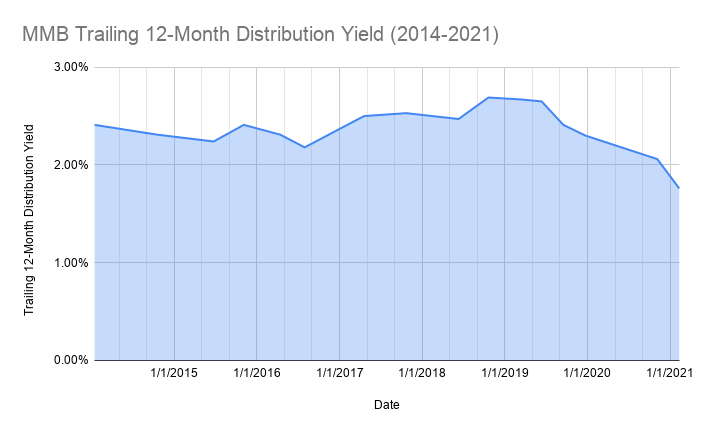
Trailing 12-month yield history. Here is a chart showing how this 12-month trailing income rate has varied since I started tracking it in 2014.

Portfolio value reality check. One of the things I like about using this number is that when stock prices drop, this percentage metric usually goes up – which makes me feel better in a bear market. When stock prices go up, this percentage metric usually goes down, which keeps me from getting too euphoric during a bull market.

This quarter’s trailing income yield of 1.74% is the lowest ever since 2014. At the same time, my portfolio value is also bigger than ever. This just confirms that much of the recent US stock market price rise has been due to P/E ratio expansion, as opposed to higher earnings and profits. Either prices will drop quickly and then the future will look brighter, or prices won’t drop and the future will simply hold lower returns.

I choose to treat this income as a “no-stress, perpetual withdrawal rate”. There are countless articles debating this topic, but I support a 3% withdrawal rate as a reasonable target for planning purposes if you want to retire young (before age 50) and a 4% withdrawal rate as a reasonable target if retiring at a more traditional age (closer to 65). If you are not close to retirement, your time is better spent focusing on earning potential via better career moves, investing in your skillset, and/or looking for entrepreneurial opportunities where you own equity in a business asset.)

How we handle this income. Our dividends and interest income are not automatically reinvested. I treat this money as part of our “paycheck”. Then, as with a real paycheck, we can choose to either spend it or reinvest in more stocks and bonds.

Although we are not retired, this portfolio income does enable us to have more flexible working hours as parents of three young kids. If we’re being honest, I don’t think either of us truly wants to be a full-time stay-at-home parent while the other works for money full-time. Nor do we want to be the sole full-time worker while the other stays at home. This works best for us.

We are very thankful for this financial flexibility (always, but especially during this pandemic), which has been both a result of conscious preparation over 15+ years and good fortune. Others may use their portfolio income to pursue new interests, start a new business, sit on a beach, do charity or volunteer work, and so on.

MMB Portfolio Asset Allocation Update, February 2021

portpie_blank200

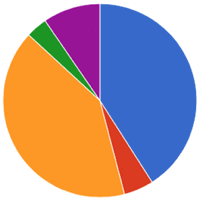
A central idea here is skin in the game, showing what someone really does with their own money. Too often, what the “experts” tell you to do is quite different than what they own themselves. Here’s my current portfolio as of February 2021, including our 401k/403b/IRAs, taxable brokerage accounts, and savings bonds but excluding our house, cash reserves, and a few side investments. I use these updates to help determine where to invest new cash to rebalance back towards our target asset allocation.

Actual Asset Allocation and Holdings

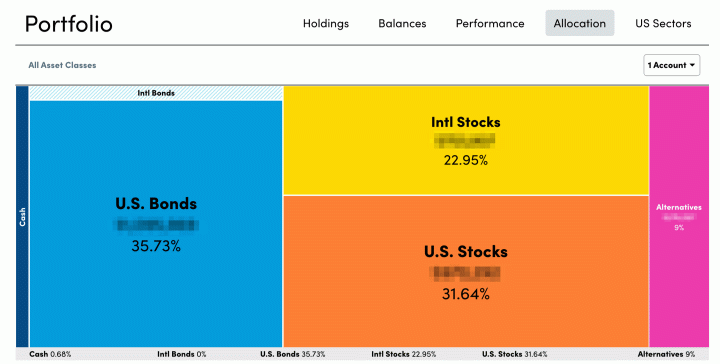
I use both Personal Capital and a custom Google Spreadsheet to track my investment holdings. The Personal Capital financial tracking app (free, my review) automatically logs into my different accounts, adds up my various balances, tracks my performance, and calculates my overall asset allocation. Once a quarter, I also update my manual Google Spreadsheet (free, instructions) because it helps me calculate how much I need in each asset class to rebalance back towards my target asset allocation.

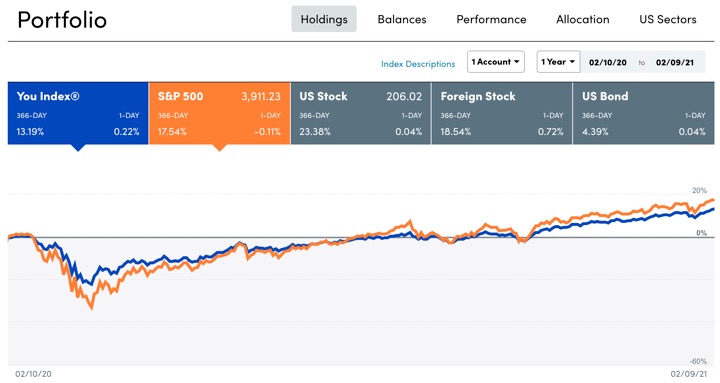
Here are some performance and asset allocation charts, per the “Allocation” and “Holdings” tabs of my Personal Capital account, respectively:

Stock Holdings
Vanguard Total Stock Market (VTI, VTSAX)
Vanguard Total International Stock Market (VXUS, VTIAX)
Vanguard Small Value (VBR)
Vanguard Emerging Markets (VWO)
Vanguard REIT Index (VNQ, VGSLX)

Bond Holdings
Vanguard Limited-Term Tax-Exempt (VMLTX, VMLUX)
Vanguard Intermediate-Term Tax-Exempt (VWITX, VWIUX)
Vanguard Intermediate-Term Treasury (VFITX, VFIUX)
Vanguard Inflation-Protected Securities (VIPSX, VAIPX)
Fidelity Inflation-Protected Bond Index (FIPDX)
iShares Barclays TIPS Bond (TIP)
Individual TIPS securities
U.S. Savings Bonds (Series I)

Target Asset Allocation. I do not spend a lot of time backtesting various model portfolios, as I don’t think picking through the details of the recent past will necessarily create superior future returns. I mainly make sure that I own asset classes that will provide long-term returns above inflation, distribute income via dividends and interest, and finally offer some historical tendencies to balance each other out. I make a small bet that US Small Value and Emerging Markets will have higher future long-term returns (along with some higher volatility) than the more large and broad indexes, although I could be wrong.

While you could argue for various other asset classes, I believe that it is important to imagine an asset class doing poorly for a long time, with bad news constantly surrounding it, and only hold the ones where you still think you can maintain faith through those fearful times. I simply don’t have strong faith in the long-term results of commodities, gold, or bitcoin. (In the interest of full disclosure, I do own tiny bits of gold and BTC, but at less than 1% of net worth.)

My US/international ratio floats with the total world market cap breakdown, currently at ~57% US and 43% ex-US. I think it’s okay to have a slight home bias (owning more US stocks than the overall world market cap), but I want to avoid having an international bias.

Stocks Breakdown

  • 43% US Total Market
  • 7% US Small-Cap Value
  • 33% International Total Market
  • 7% Emerging Markets
  • 10% US Real Estate (REIT)

Bonds Breakdown

  • 33% US Treasury Bonds, intermediate (or FDIC-insured)
  • 33% High-Quality Municipal Bonds (taxable)
  • 33% US Treasury Inflation-Protected Bonds (tax-deferred)

I have settled into a long-term target ratio of 67% stocks and 33% bonds (2:1 ratio) within our investment strategy of buy, hold, and occasionally rebalance. I will use the dividends and interest to rebalance whenever possible in order to avoid taxable gains. I plan to only manually rebalance past that if the stock/bond ratio is still off by more than 5% (i.e. less than 62% stocks, greater than 72% stocks). With a self-managed, simple portfolio of low-cost funds, we minimize management fees, commissions, and taxes.

Holdings commentary. I should be happy that my portfolio numbers seem to keep going up and up after the March 2020 scare, but instead I am mentally preparing myself for some low future returns over the next decade or so. I’m not making any big moves, but in keeping with my investment plan, I will be selling some US stocks this month as part of normal rebalancing. I remain optimistic that capitalism, human ingenuity, human resilience, and our system of laws will continue to improve things over time.

I’ve been seeing various articles about how to adjust your investing after the Gamestop short squeeze. Given that my holding strategy doesn’t require me to follow any market news at all, I don’t need to do any adjusting! 🙂

Performance numbers. According to Personal Capital, my portfolio ended up about 14% over all of 2020. An alternative benchmark for my portfolio is 50% Vanguard LifeStrategy Growth Fund and 50% Vanguard LifeStrategy Moderate Growth Fund – one is 60/40 and the other is 80/20 so it also works out to 70% stocks and 30% bonds. That benchmark would have a total return of +14.5% for 2020 YTD as of 11/3/2020.

The goal of this portfolio is to create sustainable income that keeps up with inflation to cover our household expenses. I’ll share about more about the income aspect in a separate post.

Eat and Run: On Moving Forward and Taking True Risks

Scott Jurek is a well-known ultramarathoner that I first learned about in the book Born to Run (my highlights) by Christopher McDougall. Jurek later wrote his own memoir, titled Eat and Run: My Unlikely Journey to Ultramarathon Greatness. I’ll probably never have the physical and mental endurance to run 100 miles in a day. But perhaps I could learn how to push myself farther outside of my comfort zone?

As the title suggests, Jurek attributes much of his racing success to his plant-based diet. Some folks still claim that it’s too hard to get excellent nutrition just from plants, but Jurek’s performance is the perfect counterpoint. However, he isn’t overly preachy on the subject, and I appreciated that he sprinkled his favorite vegan recipes throughout the book. The few that I tried tasted pretty good.

He shares about his challenges as a child and teenager, and how that really shaped him. His mother was diagnosed with multiple sclerosis when he was very young, and he had to juggle the responsibilities of being head of his household by the time he was a teenager. In addition to schoolwork and sports, he had parenting and housework duties as well. Yet, he still managed to graduate as the valedictorian of his high school.

In my valedictory speech I said, “I would like to leave you with four messages to help you and others benefit from life.” (I still have the speech.) “First of all, I ask you to be different. “Second, find a way to help others rather than thinking solely of yourself. “Third, everyone is capable of achieving. Never let anyone discourage you when trying to pursue a goal or a dream. “And finally, do things while you’re young. Be sure to pursue your dreams and goals even if they seem impossible.”

He also learned that being physically able should not be taken for granted. He provides some simple, practical advice about taking up running as a beginner:

Running efficiently demands good technique, and running efficiently for 100 miles demands great technique. But the wonderful paradox of running is that getting started requires no technique. None at all. If you want to become a runner, get onto a trail, into the woods, or on a sidewalk or street and run. Go 50 yards if that’s all you can handle. Tomorrow, you can go farther. The activity itself will reconnect you with the joy and instinctual pleasure of moving. It will feel like child’s play, which it should be. Don’t worry about speed at first or even distance. In fact, go slow. That means 50 to 70 percent of your maximum effort. The best way to find that zone is to run with a friend and talk while you’re doing so. If you can’t talk, you’re running too fast and too hard.

On the importance of the journey:

We focus on something external to motivate us, but we need to remember that it’s the process of reaching for that prize—not the prize itself—that can bring us peace and joy. Life, as countless posters and bumper stickers rightly attest, is a journey, not a destination.

On finding your path over time:

It’s easy to get wrapped up in deadlines and debt, victory and loss. Friends squabble. Loved ones leave. People suffer. A 100-mile race—or a 5K, or a run around the block—won’t cure pain. A plate filled with guacamole and dinosaur kale will not deliver anyone from sorrow. But you can be transformed. Not overnight, but over time. Life is not a race. Neither is an ultramarathon, not really, even though it looks like one. There is no finish line. We strive toward a goal, and whether we achieve it or not is important, but it’s not what’s most important. What matters is how we move toward that goal. What’s crucial is the step we’re taking now, the step you’re taking now. Everyone follows a different path. Eating well and running free helped me find mine. It can help you find yours. You never know where that path might take you.

My favorite highlight – On paying respect to the true risk-takers. Jurek is known for staying at the finish line after winning an ultramarathon and cheering on every other single runner until the last one has crossed. Every single one! For an ultramarathon, this could be another several hours or longer. Here is part of his reasoning:

Every single one of us possesses the strength to attempt something he isn’t sure he can accomplish. It can be running a mile, or a 10K race, or 100 miles. It can be changing a career, losing 5 pounds, or telling someone you love her (or him). I can guarantee that no one at the Western States knew they were going to finish, much less win (including me). A lot of people never do something great with their lives. A lot of people never attempt it. Everyone here had done both. Staying at the finish line and greeting those runners, I could pay tribute to the pain and doubt, fatigue and hopelessness, that I imagined they had pushed through.