Archives for November 2009

Prosper P2P: $50 For New Lenders + Up to 2% Rebate Bonus

Prosper.com was the first big name in the person-to-person lending space. Things have been quiet recently, as they took a while getting SEC approval for their investment notes. In addition, the problems with “old” Prosper included the fact that they let just about anyone apply for a loan in the beginning, including people with horrible credit who had been basically turned down everywhere else. Many lenders thought charging a 35% interest rate was enough – it wasn’t. But as this recent Washington Post article outlines, things are picking up in the P2P space.

The way I see it, LendingClub (review, $25 bonus, performance update) basically looked at all the problems that Prosper had and tried their best to fix them. So now, Prosper is back, and in turn looks a lot like LendingClub. For example, LC requires a 660 minimum credit score to qualify for their lowest grade loan (amongst other things), and now Prosper requires a new borrower to have at least a 640 credit score with their new ratings system. With both, you can have them automatically construct a portfolio for you based on your risk/return preference, and you can buy/sell notes before maturity on a open trading market.

Prosper still has their “reverse auction” eBay-style method of determining the interest rate, but lenders are now are restricted to a specific range of interest rates. (LendingClub simply sets the interest rates for you.)

In order to stimulate lending activity, they have a few incentives going on. If you sign up as a lender and bid on two loans (minimum total investment of $50), they will provide you a free $50 bonus. Click here and on the orange “Invest Now” button and you’ll see it. You must reinvest this $50 by the end of 2009. On top of that, Prosper is also offering a 1% or 2% “rebate” back if you invest at least $1,000 or $5,000, which would help juice your returns. Details:

Starting on October 12 if you invest $1,000 – $4,999 you will receive a 1% cash rebate into your Prosper account or, invest $5,000 or more and receive a 2% cash rebate into your Prosper account. Lenders must invest the funds during the promotional period of October 12 through November 15 by being a winning bidder on loan listings that result in funded loans. Notes purchased through the trading platform are excluded from the promotion. Once you have bid and invested on the loan listings your 1% or 2% cash rebate will be deposited into your Prosper account by December 4.

Savings I-Bonds November 2009 Fixed Rate: 0.3%

The new fixed rate for Series I Savings Bonds (“I Bonds”) was announced on Monday to be 0.3%. This is a follow-up to the ~3.07% inflation rate previously calculated based on CPI-U data.
As a long-term investment, a 0.3% real yield makes I-Bonds a slightly worse choice than Inflation-Protected Treasury Bonds (TIPS). As of yesterday, a 5-year TIPS had a 0.73% real yield.

As a short-term investment, it depends on how you think inflation will turn out in the near future. If you buy a new I-Bond in November, you will earn 0.3% fixed + 3.06% based on inflation = 3.36% for the first 6 months. The second 6-month rate will be 0.3% + a variable rate based on inflation from September 2009 to March 2010.

(Savings Bond Reminders: You must hold for at least a year (or 11 months and a day if you buy on the last day of the month). If you hold for less than 5 years, there is a penalty of the last 3-months interest. Savings bond interest is exempt from state income taxes, and all taxes can be deferred until the time of bond redemption.)

Worst case scenario, there is deflation of worse than 0.3% which makes the total rate zero for the 2nd six months. Earning 3.36% for 6 months with an 11-month holding period gives you an effective rate of approximately 1.83% APY. This is only slightly lower than the top yields for a 12-month CD. If the annualized inflation rate over the 2nd 6 months is just 1%, your effective rate after the 3-month interest penalty rises to 2.00%. It’s not a screaming buy, but if you are looking for 1+ year safe investment and haven’t exceed your annual purchase limits, I would personally buy them over a bank CD since you do well in cases of rising inflation and okay otherwise.

For more background, see the rest of my posts on savings bonds.

New Schwab ETFs: Indexed, Low Cost, & No Commission With Schwab Account

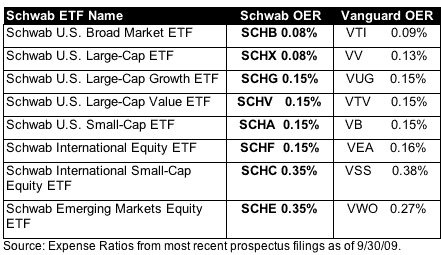
Schwab just sent me a press release announcing their new series of exchange-traded funds (ETFs) that have low operating expense ratios and passively track indexes.

The most commonly-noted drawback of ETFs is that you must buy them like a stock and thus pay trade commissions. However, if you buy these within a Schwab brokerage account, there are no commissions charged. Here is a chart comparing the new Schwab ETFs and their corresponding competitor from Vanguard. The ETFs don’t necessarily track the exact same index, but they are pretty similar.

This is definitely worth a second look. A possible criticism is that Schwab may increase expenses and reinstate trading fees in the future, which may lead to tax hits if you wish to switch back to other ETFs. Meanwhile, Vanguard has a long track record of rock-bottom expense ratios. However, it may also be that increased competition in this area by others like Fidelity and E-Trade will prevent this from happening.

Monthly Net Worth & Goals Update – November 2009

Net Worth Chart 2009

Credit Card Debt
In the past, I have taken money from credit cards at 0% APR and placed it into online savings accounts, bank CDs, or savings bonds that earn 4-5% interest (much less recently), and keeping the difference as profit. I even put together a series of step-by-step posts on how to make money off of credit cards in this way.

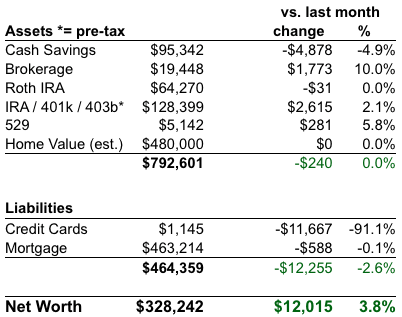
However, given the current lack of great no fee 0% APR balance transfer offers, I am no longer playing this “game” and have just paid off my last 0% offer for now. This makes the net worth chart a bit funny, but it should clear up next month.

Retirement and Brokerage accounts
Our total investment portfolio increased by a few thousand dollars since last month. DW’s 401k was already maxed out at $16,500. I made another $1,000 contribution to my Solo 401k, for a total of $16,500 contributed in 2009 as well. (I forgot the limit was $16,500 and not $15,500 last month…) This makes us done with our goal of maxing out both our 401k salary contributions for 2009.

I am starting to build up too much cash, and have started investing for retirement in a taxable brokerage account as well. In the interest of tax efficiency, I’ll have to move around some investments in order to keep bonds in the tax-advantaged IRAs/401k and the “extra” stocks in taxable. I expect to finish investing $20,000 this week.

Taking that additional 20k into account, our total retirement portfolio is now $211,095, or on an estimated after-tax basis, $170,047. At a 4% withdrawal rate, this would provide $567 per month in tax-free retirement income, which brings me to 23% of my long-term goal of $2,500 per month.

Cash Savings and Emergency Funds
We keep a year’s worth of expenses in our emergency fund. Another $10,000 is earmarked for upcoming home improvement projects that I keep putting off (minor roof repair and solar water heating).

Home Value
I am no longer using any internet home valuation tools to track home value. Some people have suggested using my tax assessed value, but I also think that is too high. I simply picked what I felt is a conservative number based on recent comparables, $480,000, and keep it for at least 6 months if not a year. (Currently on month 2 out of 6.) For the most part I am concerned about mortgage payoff, which I still plan to accomplish in 20 years at most.

You can view previous net worth updates here.