Archives for June 2007

Zecco Now Has No Minimum Balance: How To Buy The World For Just $319

It appears that Zecco brokerage has now removed their minimum opening requirements, on top of their 40 free trades a month. I’m guessing this means you can start trading with any amount of money, which is nice because you can try them out with minimal commitment. You still need $2,000 to open a margin account, though. See my Zecco review for more information, and how to maximize the interest on your idle cash.

This got me to thinking – someone could now build the world’s tiniest diversified stock portfolio which tracks the entire world by buying:

  1. Vanguard FTSE All-World ex-US ETF (VEU) at ~$56 per share. This ETF essentially tracks the entire world’s publicly traded companies, minus that of the US, and holds over 1,500 representative stocks from 47 countries.
  2. Vanguard Total Stock Market ETF (VTI) at ~$151 per share. This ETF tracks the total US market via the Wilshire 5000 index and includes over 3,600 stocks.

To got the respective ratios approximately correct, you’d have to buy 3 shares of VEU and 1 share of VTI, for a total of only $319. This gives you 53% International/47% US, which is very close to how the market capitalization of the world is currently split up, which if I recall correctly is about 55%/45%.

I find it very cool that you can now track the world via over 5,000 stocks for about $300. With the free trades, the total cost to maintain this $319 portfolio would be just the slim expense ratios, which add up to… 53 cents a year!

…or you could just trade a bunch of stocks and do your best Warren Buffett imitation like everyone else is thinking. πŸ˜€

CNBC’s The Millionaire Inside: Battle Of The Get-Rich Guru Soundbites

altext

Is it just me, or is CNBC TV becoming the financial network for those with 18-second attention spans? (Not that I’m not in their target audience!) Last night, I happened to catch their new series called The Millionaire Inside, which is supposed to bring together today’s “top money mentors” and share their secrets to success. The first episode, Your Guide To Wealth, included the following guests:

Even though I’ve never even heard of the last two, I actually had some hopes for this show… but after watching it I was completely underwhelmed. It was 30 minutes of each guru taking turns rehashing their same, old, vague sound-bites as to how to become a millionaire. In fact, the only amusing part was when Phil Town bashed real estate as a stupid investment compared to stocks, and the real estate folks started to get whipped in a tizzy. Here’s are the rest of my episode notes:

David Bach says:
– You can’t get rich with a budget. (How helpful!)
– Pay yourself first, make it automaticTM
– Buy a home as soon as possible, don’t rent.

Phil Town says:
– 15% annual return in stocks can be achieved with 15 minutes of research a week.
– Buy companies you know, when they are “on sale”.
– Rule #1 is “Don’t lose money”
– Don’t buy real estate, buy REITs instead

Loral Langemeier says:
– Be your own boss
– Make your own “cash machine” by starting your own business
– It’s okay to straddle, or keep your own job for a while.

Barbara Corcoran says:
– The shortcut to wealth is real estate
– Now is the perfect time to buy real estate, when everyone is unsure
– Set a goal to buy your 1st investment property in 6 months

Motivational? A little bit. Good advice? Some of it is, some of it is highly questionable. Vague? Nebulous? Oversimplified? YES.

Maybe the next few episodes will actually provide something actually practical or actionable, but I’m not holding my breath. If you don’t get CNBC, you can also download it for free on iTunes (search for “Millionaire Inside” or try this link.).

Should I Invest In Everbank’s Foreign Currency CDs?

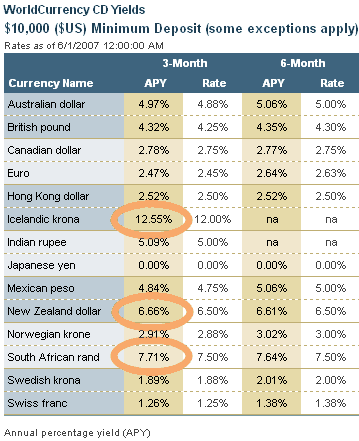
While we’re on the topic of international banks, US-based Everbank does offer FDIC-Insured Certificates of Deposit denominated in various world currencies:

altext

The three that stand out in interest rate perspective are the Icelandic krona, the New Zealand dollar, and the South African rand. But as I’ve said before, you are at the mercy of the future exchange rates on these currencies, so these should not be considered the equivalent of a dollar-denominated bank CD. FDIC only insures against bank failure – there is still the risk of loss of principal in these investments. According to Oanda, the exchange rates of the US dollar to the krona (USD:ISK) has varied by 23.4% within the last year, the New Zealand dollar (USD:NZD) has varied by 23.7%, and the South African rand (USD:ZAR) has varied by 19.3%.

From Wikipedia entry for the Icelandic krona:

As it stands, the Icelandic currency is a fully convertible but low-volume world currency, strongly managed by its central bank, with a high degree of volatility not only against the US and Canadian dollars, but also against the currencies of the other Nordic countries (Swedish krona, Norwegian krone, Danish krone and the euro). For example, during the first half of 2006, the Icelandic kr?na has ranged between 50 to 80 per US$.

If you bought US$100 of Icelandic Krona at 1:50, have it earn 15% in a year, but then exchange it back to US dollars at 1:80, you’d still be left with only US$72. Not so hot. Of course, if the opposite happened you could end up with $184! So really this seems like a way to make a bet against the dollar with a little bit of appreciation mixed in, if you feel so inclined. I’m amused by this option, but I think I’ll leave the gambling to Vegas for now. (The minimum investment is also $10,000.) I do want to visit Iceland though – perhaps for “investment research”? πŸ˜‰

Added
Commenter Andy astutely points out that you’ll essentially be charged 1% in and out for a currency exchange fee as well – “The currency conversion rate will be within 1% of the wholesale spot price EverBank pays for the currency.” This will especially hurt the shorter-term CDs.

If you would like some more background on why interest rates in Iceland are so high, check out this NY Times article on Iceland’s fizzy economy. They are trying to tame inflation fueled by a hot stock market and housing boom, and definitely gives the vibe of a potentially volatile situation.

Millennium Bank: Perhaps Not A Scam, But Not Safe Either

You have seen via Google Ads on my or other financial sites advertising 8% CD rates from Millennium Bank. Wow, sounds great! But given the internet age, when you see “bank”, it could be from any corner of the world. The terms “certificate of deposit” or “savings account” may imply security here, but don’t necessarily mean anything internationally. The FDIC website gives some good guidance on Safe Internet Banking:

Read key information about the bank posted on its Web site.
Although it tries to distract you by saying it is owned by some Swiss trust company, if you read further it you find that Millennium Bank is located in the Caribbean nation of St. Vincent and the Grenadines (SVG). So, it’s not even located in the United States. From Wikipedia, St. Vincent has a population of just 119,000, it’s main industry is banana production, and has an unemployment rate of about 22%. Also of interest:

There is […] a small offshore financial sector whose particularly restrictive secrecy laws have caused some international concern.

Does this sound like a place that you would want to keep your money? Maybe if you were trying to hide it! If something goes wrong, do you want to navigate a foreign system to get your money back?

Verify the bank’s insurance status.
This bank isn’t even located in the United States, so there’s no point in even running a bank search to see if it is FDIC insured. It doesn’t even appear to insure its deposits by any private or public agency. If a bank claims to be a subsidiary of a bank that is FDIC-insured, call the parent bank. If they’ve never heard of it, run away.

Gut check: Is it too good to be true?
Finally, risk and return are closely linked in legitimate bank products. If the best any other bank can do is barely 6%, there’s virtually no way a bank offering 8% return with the same level of risk. They have to be doing something riskier, whether it is making some currency bets or investing in lower-quality debt. Given the lack of disclosure of what these risks are, you might as well buy some junk bonds, which are at least rated by reputable independent companies.

Bottom line, I hope you’ll agree there’s absolutely no reason to put your money anywhere near this institution.

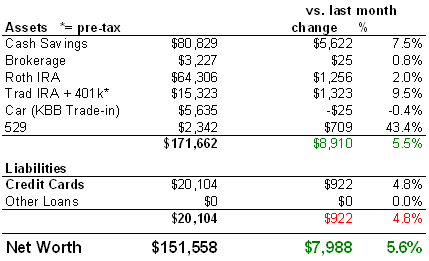
June 2007 Financial Status / Net Worth Update

Net Worth Chart June 2007

About My Credit Card Debt
As usual, let me prevent any scathing e-mails by first explaining my high levels of credit card debt. In short, I’m borrowing money for free and keeping it in safe investments while earning me 5-6% interest. Along with other things, this helps me earn extra side income of thousands of dollars a year. Recently I wrote up a series of step-by-step posts on how I do this. Please do check it out if you are curious. This is why, although I have the ability to pay the balances off, I choose not too.

Commentary

  • IRAs/401ks: The Dow breaks some arbitrary number!! Wee. While the CNBC shows have more things to chatter about, I continue to make my monthly $500 401(k) contributions.
  • Brokerage: This consists of $2,173 in Bridgeway funds (BRSIX) and $1,054 of currently idle cash in my Zecco account.
  • 529: This pops up because I ended up not using a portion of my 529 for tuition as intended. I guess the rest of this 529 will be left to grow for another 20 years until our kids need it.
  • Good clean living (not really) gets us to $71,929 of non-retirement funds, reaching 67% of our midterm goal of house downpayment. Total cash is now $60,725.

You can see all my previous net worth updates here. Looking ahead to future expenses, we may buy some new furniture.

Future FICO Scores Won’t Consider Authorized Users

I had written previously about renting out your credit score, which takes advantage of a loophole in the credit score formula and allows people with poor credit scores to pay others with excellent credit so as to be added as an authorized user. This currently legal act can boosts a poor credit score as much as 200 points, and is most commonly used to obtain a lower rate on their mortgage loans. As you might expect, lenders aren’t too happy about this.

According this AP article ‘Piggybacking’ Roils Credit Industry, this has led to some potential significant upcoming changes in the FICO scoring process:

Ninety percent of the largest U.S. banks base their loan decisions on FICO scores, which currently includes authorized user accounts. However, after discussions with lenders and industry officials, Fair Isaac said it intends to announce this week that all future versions of its FICO score methodology will no longer consider authorized user accounts, said Tom Quinn, Fair Isaac’s vice president of scoring solutions.

The next version is slated to roll out in September to one of the three main credit reporting agencies — Equifax Inc., Experian Information Solutions Inc. or TransUnion LLC — with the other two agencies receiving the new version some time in 2008.

Quinn also noted that some lenders generate their own scores using authorized user accounts in their calculations, so the practice may not be easily negated.

Other consumers besides credit renters stand to lose with the change, namely those for whom authorized user accounts were designed: college students on their parents’ cards and spouses with little to no credit of their own.

That’s too bad, I would think that there would be a better way to close the loophole. Perhaps simply make it illegal for one to accept money for adding an authorized user? That would at least shut down the websites running openly.

Random Thrift Store Shopping Discoveries

I mentioned before that we were involved in a volunteer trip to Haiti, and part of it simply involved donating a bunch of unwanted clothing. We also went to a bunch of different Salvation Army’s and Goodwills to find some additional cheap clothing to give away. While doing so, I noticed something that in retrospect is obvious – the stores next to the country-club type neighborhoods have the nicest stuff. There was name-brand clothing and shoes everywhere. We picked up some like-new Polo jeans for $6 – it was like shopping at Buffalo Exchange but 75% off. I’m sure the more fashion-savvy could probably pick some stuff up and re-sell it on eBay for a profit.

Another less-exciting discovery? You can buy used underwear at some stores. We’re talking tightie-whities here! πŸ˜• I suppose they serve a need, but who donates lightly-used underwear anyways? I don’t think I can bear to do so myself, but next time I do a donation run I will be sure to throw in a new pack of Hanes.

GrandCentral: Free Local Number, Rings Any Phone, Lots Of Features

Tired of juggling multiple phone numbers? Or just need an extra one? You should check out GrandCentral Beta, which offers all kinds of new tricks with phone calls by utilizing VoIP and the internet. First and foremost, they offer you a free local phone number from 47 states.
One Number For Everything
I think the main idea behind the name is that this free phone number will become your only phone number. This way, if you move or change jobs you can keep the same number forever, or at least for as long as you like. To entice you to do so, they add in some cool features. For example, when a person calls your GrandCentral number, you can:

  1. Have them call different phone numbers in order, for example home, then work, then cell phone. So people only need to know one number to reach you anywhere.
  2. Immediately redirect them by Caller ID to a specific phone number. Maybe certain friends just go straight to cell phone?
  3. If they are a known telemarketer, you can set the spam filter to not ring your phone at all.

An Extra Number For Personal or Business
The way I’ve been using the free number is as my new business phone number. This way, you have a separate business number to give out to customers, but it can ring your regular cell phone. You can know that it is a business call by setting the caller ID to display your “Biz” GrandCentral number, and answer professionally.

They even have a cool WebCall button where a customer can click on your webpage and call directly you for free.

Avoid Long Distance Charges
Added: I haven’t worried about long distance for a while now, but you could also use it to avoid long distance charges for your friends (or yourself), by getting a number in one area code and forwarding it as needed to another area code. Thanks to commenter Ross below for the tip.

Get More Free Minutes With T-Mobile MyFaves or AllTel Circle
Both T-Mobile and AllTel have plans where you get unlimited calls to and from a few select numbers. So here, you would set your “Personal” GrandCentral number as one of your favorites. Then, just tell everyone to call the GrandCentral number instead, which will redirect to your cell phone, giving you unlimited minutes! It would seem that you would lose the ability to see who’s calling, however.

They also offer store your voicemail all in one place with unlimited storage, and have a ton of other features that I’ve never used yet. You can record phone calls, switch seamlessly between your home phone and cell phone to save more minutes, screen calls by name, and more.

Will This Stay Free?
It seems like unlimited inbound calling will remain free, but I’m sure they will start charging for some of their premium features, like calling outbound. From their FAQ:

Will GrandCentral always be free?

Yes, we’re excited to say that we will always offer a free version of GrandCentral, even after beta. Our free version will include unlimited inbound minutes, unlimited voicemail (up to 30 days old), and access to all of our core features.

During beta, we’re giving everyone unlimited access to our premium features. In exchange, all we ask is that you send us your feedback (good or bad) to beta@grandcentral.com. We’ll read every comment.

Got a better idea of how to take advantage of this service? Please share in the comments.

What Does Jack Bogle, Founder Of Vanguard, Invest In?

John (Jack) Bogle is both the founder of the low-cost mutual fund company Vanguard and the creator of the first index fund available to the public. These days he spends his time speaking about corporate ethics and how index funds are great investments for the vast majority of people. But what does he invest in?

According to this Morningstar article An Inside Look at Jack Bogle’s Portfolio, the answers may surprise you.

Overall Asset Allocation?

“My current asset allocation overall is about 60% bonds and 40% stocks. There’s a fair amount of money involved here, and I feel no need whatsoever to overdo equities. After all, if stocks (surprisingly) soar–I’ll do just fine, not in percentage terms but in dollar terms.”

Stocks – Active or Passive? Value or Growth?
The article is a bit cryptic, but by how I interpret it he seems to be split down the middle:

50% Passive – Total Market Index Funds
50% Active – Vanguard Explorer, Wellington, Wellesley Income, and Windsor Funds

So Jack tilts his portfolio to the value side of the style box. That style tends to be more conservative and puts more emphasis on stocks paying dividends.

Bonds
The bonds portion seems to be conservatively invested in 50% Short-Term Bonds and 50% Intermediate-Term Bonds.

Last time we talked to Jack, he had shifted away from long-term bonds and GNMAs. This time, we see that Jack is moving into TIPS (Treasury Inflation Protected Securities). “In fact, the only investment change I’ve made in the past few years is a move of about 6% of combined assets from Vanguard Intermediate-Term Bond Index VBILX to Vanguard Inflation-Protected Securities VAIPX . The latter is essentially a similar index fund, but with a possible advantage if inflation heats up more than the present discount suggests. I probably should have added to my holdings in the inflation-protected fund earlier.”

Even though this article isn’t the reason, I am starting to rethink my bond allocation to add exposure to inflation-indexed bonds. This would provide an additional hedge against some unexpected inflation.

Before anyone uses his portfolio as a model, consider the following:

  1. He’s 78 years old (76 at the time of this article), and even though he had a heart transplant, is still working. This guy likes his job.
  2. He has enough money that he doesn’t even need to withdraw anything to maintain his lifestyle. I would imagine he’s probably just trying preserve wealth as much as achieve growth.
  3. Since he’s the founder of Vanguard, he may have some sentimental or loyalty reasons to hold certain funds, and states as much.

I doubt many people reading this are in a similar situation πŸ˜‰ Really, the only thing that I can take away from this is that there really is no “perfect” portfolio for everyone. But it certainly satisfied my curiosity; I wish more investment personalities would share their actual portfolios. You can see my imperfect portfolio here. I’m going to attempt to simplify it a bit sometime in the coming months as well.