Archives for March 2007

Stressed About Your Tax Return? Get an Automatic Filing Extension

If April 17th seems like it is approaching faster than ever this year, perhaps it is time to consider filing an extension. I myself am still waiting on several 1099 forms, some of which had to be corrected. Here’s what I dug up for us procrastinators πŸ˜‰

What exactly does filing an extension get me and how do I do it?
Sending in IRS Form 4868 by April 17th will land you an automatic six-month extension until October 15, 2007 to file your tax return. You can either mail in the paper form or use a tax software package. If you are eligible for Free File, you may be able to e-file for free as well. However, it is important to note that filing the form does not change the due date for when you have to pay any owed taxes.

How much do I need to pay to avoid late-payment penalties?
You must still pay at least 90% of your total tax due by April 17th in order to avoid penalties for late payment. However, you will still be liable for any interest accrued on any balance due when you file your return. Therefore, it’s a good idea to overestimate your taxes owed initially, and then plan on receiving a small refund when you officially file.

What I intend to do is just run a quick online tax return that pads my income a bit and also neglects any itemized deductions or business expenses. If you stop before actually filing, you can get a quick and dirty number without having to pay anything.

If it looks like you are getting a refund already, then you don’t need to do anything more. Otherwise, any tax owed can be paid via regular employer withholding, estimated tax payments, or you can simply attach a check along with Form 4868. If you e-file, you can also pay via an electronic withdrawal from your bank account or with a credit card (subject to an additional fee).

Don’t forget to also file an extension for your state taxes!
Every state has their own rules and forms, but generally they give you same deal: you can easily get a extension to file, but any taxes owed are still due by April 17th.

March 2007 Financial Status / Net Worth Update

Net Worth Chart March 2007

About My Credit Card Debt
Newer readers may be alarmed by my high levels of credit card debt. In short, I’m borrowing money for free and keeping it in safe investments while earning me 5-6% interest. Along with other things, this helps me earn extra side income of thousands of dollars a year. Recently I put up a series of step-by-step posts on how I do this. Please check it out first if you have any questions.

Commentary

  • The stock market stalled a bit this month, as should be expected given its healthy run for the last two years.
  • The big drop in cash reserves and credit card debt is due to the ending of one of my 0% balance transfer cards in February (Discover Miles Card). Everything went smoothly and it was paid off without a hitch.
  • Our combined incomes continue to far exceed our spending, which is great. I still need to finish tallying up last month’s budget results.
  • We still haven’t done our taxes, as I am still waiting on some corrected 1099s and trying to organize my business records. I have a feeling we might have to file an extension this year.
  • I know this is poor form, but I have mentioned previously that I keep forgetting to include a $2,000 taxable investment I made in a micro-cap mutual fund (BRSIX) several months ago. If it doesn’t show up in Yodlee, it’s almost like it isn’t there πŸ˜‰ Anyhow, I’ve finally accounted for it and it’s helped the numbers a bit.
  • We are now at $48,167 in net cash and $57,288 in total non-retirement assets. That’s 57% of our mid-term goal, and 96% of our (much easier) May goals regarding saving up for a house down payment. I remain completely confused about housing prices…

You can see all my previous net worth updates here.

$100 TradeKing and TD Ameritrade Signup Bonuses

TD Ameritrade is offering $100 bonus (expired) for opening a non-retirement brokerage account funded by 12 monthly consecutive automatic electronic deposits of $50 or more. First $50 must be deposited within 30 days of opening account. This is called the “Save Yourself Plan” in Suze Orman’s new book Women & Money. The offer code is 701. New accounts only. Trades are $9.99.

TradeKing is offering $100 bonus (expired) for opening a non-retirement account with $1,000 minimum and making one trade within 30 days. A minimum balance of $100 is required in the account for the first six months. The offer codes is ACCESS100 expired!. One offer per household. Trades are $4.95.

Reasons To Watch Out For Stock Newsletters

Now and then, I get asked if I recommend any specific stock newsletters. I usually assume these people haven’t read much of my blog πŸ˜‰ I’m often given specific examples, like one that touts a 145% supposed return last year, or another one run by a group of Harvard MBA graduates. My reply is always the same: I don’t recommend any stock newsletters. There are a couple of reasons why:

First of all, the ones that you can go back and check on reliably haven’t done so hot. The Hulbert Financial Digest has been tracking the recommendations of investment newsletters for over 25 years. It’s research shows that 80% of these professional stock pickers can’t beat the market indexes.

According to this FundAdvice article, chasing last year’s hot newsletter is a very bad idea. From 1981-2002, if every year an investor put his or her money into the prior year?s top performing newsletter, the result would have been an annualized loss of 31.4 percent a year. That?s the same as starting with $10,000 and ending up 21 years later with $2.32. Ironically, most people that subscribe to Hulbert’s are looking to buy a stock newsletter!

Don’t forget the Motley Fool’s 100% failure rate for their 2006 predictions. Better luck this year, Fools!

As for the rest, how do you know if they are lying? Recently, FundAlarm caught one of these newsletters in the act of changing their historical trade data after a dismal year:

Using the market-timing system from Intelli-Timer, my return for the year came in at less than 2%, and I wondered how Intelli-Timer was going to update its Web site, and continue selling its system, after such a dismal performance. Now we have the answer: My year never happened. With no explanation, the Intelli-Timer Web site has completely revised its historical performance information… Faced with a system that was failing, it looks like Intelli-Timer has simply backtested a new system that produces dramatically better — and totally fictitious — results.

Nothing like making up crap when all else fails. Since there is essentially nobody policing these newsletters and websites, why not? Link via Diehards Forum.

I’ll say it again – commentary from stock analysts always sounds great and logical. They can throw out nice figures like rising margins, economic statistics, or fancy PQI ratios. If they are right, the can toot their own horn. If they aren’t, they can either ignore it or even lie! I really think most of you don’t need to hear all this, but it’s always good to have some links to help convince others.

Emigrant Direct Signup Bonus Update – January Payouts

Payouts for my Emigrant Direct Referral Bonus went out this week for those that sent me their final form in January.

Emigrant Direct offers an online savings account paying 5.05% APY with no minimum balance. It only takes $1 to open, and you can make another $10-20 just for signing up through me.

Prosper.com Person-to-Person Lending Review, Part 2: The Numbers

To recap the first half of this review, my initial impression of Prosper was that is a somewhat risky investment opportunity with poor liquidity. However, along with the risk of loss comes the potential for a healthy return. Each of us can decide the rates that we wish to lend at. The question is, can I get a return that compensates me adequately for the risk I’m taking? Let’s dig into the numbers and see.

What kind of data do we get? What are the fees?
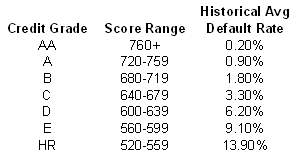
Again, I will focus only on the lender perspective here. My previous conclusion is that I would rely primarily on the credit information given. This turns out to be a letter credit grade (A,AA,B,C,D,E, or HR) derived from the Experian ScoreX PLUS credit score, not a FICO score. They are similar, but the range for a FICO score is 300-850 and the Experian ScoreX is from 300-900. Here are the relationships, as well as the corresponding historical default rates for borrowers with debt to income ratios of less than 20%.

Scores

As for lender fees, it’s pretty straightforward. You are charged an annual servicing fee of 0.5% for AA/A borrowers, and 1.0% for B-HR borrowers. So whatever your final lender interest rate is, 0.5-1.0% is automatically taken off the top. This was raised recently from the old rate of 0.5% across all loans.

How are the outstanding loans doing so far?
One of the reasons I didn’t loan any money on Prosper initially is because I simply didn’t trust myself or others to set the correct interest rates. All I had was the Experian chart above to try and estimate defaults, and that just didn’t seem enough. Would borrowers treat Prosper with the same respect as Citibank or Bank of America? Would the rates be too low due to an excess of lender money?

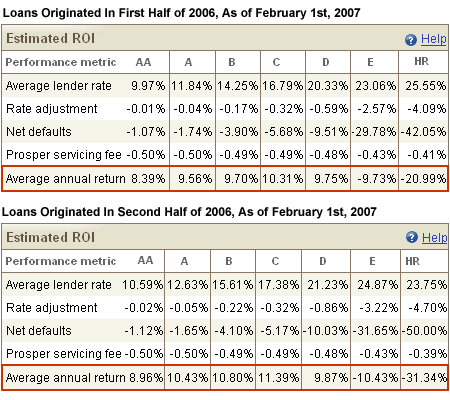
The bad news is that Prosper is barely one year old, still too young to make reliable judgments in my opinion. The good news is that Prosper does release what data it has. One thing you have to watch out when looking at the numbers is that many of the loans are so new that there simply hasn’t been time for them to default. A loan originated on January 1st won’t have its first payment due until February 1st, and it won’t be able to be considered late until March 1st. For an official default, it has to be 4 months late, or June 1st! And that’s only if not one single payment is ever made.

Therefore, I want to look at loans that are at least a few months old. I choose two periods to look at – loans originated in the 1st half of 2006, and loans from the 2nd half of 2006. Let’s see how those loans have done as of February 1st, 2007.

Historical Performance Chart
See here for definitions.

[Read more…]

Prosper.com Person-to-Person Lending Review, Part 1: First Looks

Prosper.com is a person-to-person lending service where you can lend out money to complete strangers. My first and only post about Prosper was back on February 13, 2006, when it was first released to the public. Since then, I haven’t written a peep about them. An online service that offers high interest rates for my cash? Why haven’t I written about them? The simplest answer is that I’ve been waiting for more information to review.

Here is a first look at Prosper from a potential lender perspective.

This is not a short-term, safe investment.

You may have seen this ad, it says something to the effect of “Why settle for 5% APY from banks? Get 15%+ interest from Prosper”. Comparing itself to an online savings account is misleading for a couple of reasons:

Your money is not 100% liquid. The loan term is three years. All loans on Prosper are lent for 3 years. In a bank account, I can just walk over and take my money out. You will gradually get your principal back and might have some pre-payments, but your money is pretty much locked up for the short term.

Your money is now unsecured debt, which carries the possibility of loss of principal. Bank accounts are FDIC-insured. Your Prosper loan is not backed up by anything except for the word of the borrower. The only thing keeping them paying is either a sense of personal responsibility, or the threat of a black mark on their credit report. What happens when their credit is already bad? Will they view Prosper as a serious lender on par with credit card companies? What happens if Prosper goes out of business?

There are a variety of ways you can get higher interest for extra risk. Look at some Canadian Oil Trusts like PGH (15% yield), or high-yielding REIT stocks like LUM (13% yield). I don’t recommend these either, but my point is that you should compare apples to apples.

Prosper is an intermediate-term investment opportunity with lots of inherent risk. In addition, not everyone will get the same results. While one person may get 16% annual return, another person with a similar loan portfolio may have low or even negative returns.

What am I basing my decisions on?

Let’s look at the three major pieces of information you get when you are deciding on which loan to fund:

The Story. This is coming from the cynic inside me, but how accurate are these? I do believe most of them to be truthful, perhaps with a little positive glow on things. But how do I know if it’s not? Do I really need to read “I am very dependable and promise to pay you back”? Some group leaders will vouch for borrowers, but in the end, I put very little weight on this area.

Besides, which is better? The business start-up loan? The “fresh start” loan? The credit card consolidation loan? The I-want-a-new-Lexus loan? Here we might also be mixing emotion and business, which is fine if you want, but I’d personally rather not be emotionally invested in my lending.

Credit Profile. This is actually very useful. In addition to the credit grade which essentially gives you a range for their credit score, you can find out some details on the credit report. These include the number of delinquent accounts, how much was delinquent, negative public records, and their current revolving credit balance. More information here.

Employment Data. This includes both whether they are employed or not, how long they’ve been employed, and their income. This gives you their current debt-to-income ratio. Again, this is all self-reported by the borrower. I believe it would be far too costly for Prosper to actually verify this data, but it would be nice.

Of course, Prosper says that it is a crime to lie on a lending application, but my question is how many people have they caught and prosecuted for this crime? My guess is zero. In June 2006, in response to this criticism they started performing spot-checks for the “identity, address and income of a select number of borrowers.” They do not release the frequency or passing rate of these checks. Therefore, I also put relatively little weight on this area. I treat it like a very rough estimate.

In the end, all I am comfortable relying upon is the credit report, just like the credit card companies. I think the card companies are pretty good at what they do, so the only way us individuals are going to make money is to be satisfied with thinner margins than them (lend at cheaper rates), while at the same time trying to achieve close the same level of diversification.

Is this possible? Is it worth the effort needed? Check out Part 2, where I dig into the numbers.