
Archives for January 2007

Free International Phone Calls By Calling Iowa

AllFreeCalls Logo

AllFreeCalls.net is offering free international calls to select countries. All you have to do is call this Iowa phone number: (712) 858-8094, and then enter the usual 011 + Country Code + Phone Number. How do they make money? Via TechCrunch:

Iowa is apparently the only state taking advantage of an FCC kickback scheme that gives telco?s a portion of the fees generated from every inbound call to an Iowa number. So when you call the AllFreeCalls phone number, a portion of any long distance fees you are paying go to the company. The kickback is apparently authorized via the Universal Service Fund. These kickbacks are enough on average to more than cover the international outbound calling fees.
Nothing Down For the 2000s: Real Estate Book Review

I’m naturally skeptical of most real estate gurus, with all that feel-good “You too can be rich!” talk and very little substance. Still, I was curious to see what was inside Robert Allen’s best-selling book Nothing Down for the 2000s: Dynamic New Wealth Strategies in Real Estate. As you’ve probably guessed, it’s supposed to be about getting rich by investing in real estate with none of your own money.

If you cut out the copious amounts of go-change-your-life fluff in this book, it boils down to two main ideas:

Buy below market price by finding a “don’t-wanter” seller. A “don’t wanter” is someone who is going through some sort of trouble so that they don’t have the time or ability (or intelligence) to get market value for their property. Maybe they can no longer support the payments and are almost in foreclosure. Or they are tired of property management headaches.

Use creative mortgages to buy the property with little or no down payment. Then sell for a profit. Lending ideas included:

  1. Getting the owner to finance the house, so you pay them a mortgage each month instead of the bank.
  2. Using interest-only mortgages to minimize the monthly payment while you try to flip the house.
  3. Do 110% financing where you borrow more than the value of the house, and take the rest out in cash to cover the down payment (or buy another property)
  4. Use a loan backed by Property #1 to buy Property #2.
  5. Use credit cards or signature loans from the bank as a down payment.
  6. Buy an apartment complex right before rent is due, and use the rent and security deposits as a down payment.

[Read more…]

A Quick Lesson In Wall Street Lingo

It can be tough watching CNBC and reading stock market articles without knowing the proper terms. Here are some helpful pointers:

  • Profit-taking: All-purpose explanation for why the market went down.
  • Correction: A major market crash made to sound like a minor mistake.
  • Momentum investor: Buyer of stuff that’s already gone up.
  • Value investor: Buyer of stuff that looks like it’ll never go up.
  • Broker: What you’ll be, if you follow their advice.
  • Financial consultant: Broker trying to appear respectable.
  • Financial planner: Financial consultant who might actually be respectable.
  • The smart money: Owners of whatever has lately performed well. No permanent members.
  • Federal Reserve: Extremely powerful, like God, and also moves in strange and mysterious ways.
  • Warren Buffett: Widely admired investor who is often quoted by lesser mortals seeking to buttress their arguments.
  • Futures: Trade these too much, and you won’t have one.
  • Collectibles: Justification for buying things that will never appreciate in value, but you really, really want.
  • Stock options: A way for senior executives to get rich.
  • Hedge funds: Like mutual funds, except with much higher fees. But the bragging rights are priceless.
  • Cash-value life insurance: Great strategy for retirement, assuming you’re an insurance agent and you can sell enough of these policies.
  • Variable annuities: Chance for ordinary investors to pay hedge-fund-like fees.
  • Commodities: Pigs with lipstick.

Excerpted from Jonathan Clements in the Wall Street Journal (subscription required), found via No Money In Poetry.

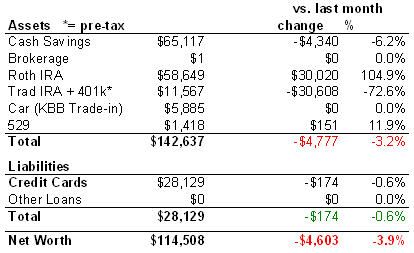
January 2007 Financial Status / Net Worth Update

Net Worth Chart January 2007

About My Credit Card Debt
Newer readers may be alarmed by my high levels of credit card debt. In short, I’m borrowing money for free and keeping it in safe investments while earning me interest. Along with other things, this helps me earn extra side income of thousands of dollars a year. Recently I put up a detailed series of posts on this 0% game. Please check it out first if you are curious!

I like to think of it as similar to what banks do. For example, Capital One 360 is paying people 0.75% interest to hold their cash, and then going out and lending that cash as mortgages to other people at 6-8%. My rate spread is even a bit better than Capital One 360, although they do have a slight edge in volume… a mere $50 Billion or so ๐Ÿ˜‰

Thoughts
[Read more…]

Dollar Cost Averaging: A Poor Way To Reduce Risk?

Dollar Cost Averaging (DCA) involves investing a fixed amount at a regular interval. Lump-Sum Investing (LSI) involves putting in all the money you have available to invest at once. These are not mutually exclusive! If you are investing a portion of your paycheck every month, you are both Dollar Cost Averaging and Lump Sum Investing. The following is not about such habitual savings.

However, a different situation arises if you have a larger amount of money. Maybe you received an inheritance, an early retirement payout, or you just sold your house. Do you invest the entire amount immediately, or buy a little at a time? Due to the overall upward trend of the markets, lump-sum investing outperforms DCA about 2/3rd of the time. The argument then, is that DCA is a risk-reduction mechanism; You get less performance, but also less exposure to those ups and downs. But is DCA the best way to lower risk?

This question was examined in this academic paper titled Nobody Gains from Dollar Cost Averaging by Knight and Mandell. Here’s a sample of their results. Let’s say you have $100,000 to invest, and you want to achieve a portfolio of 90% stocks (modeled as the S&P 500) and 10% bonds (T-Bills). But that sounds risky to you. You decide to instead invest gradually over 10 years, every month putting a little bit more in, until you finally put $90,000 into stocks.

But what if you instead put everything at once into 50% stocks and 50% bonds, and kept those 50/50 proportions for the entire 10 years instead? That would also reduce your risk. You may be surprised to find out that historically the 50/50 rebalanced portfolio actually had the same amount of volatility than the 90/10 dollar cost averaged portfolio, but with a higher average return (8.37% vs. 8.05%).

So if you are keeping money out of the market because you don’t want to be exposed to a crash, it may simply be better to invest in a less aggressive investment mix. But if you are already regularly investing what you can each month, keep it up! This doesn’t apply to you.

For more academic papers on why DCA is not the best way to reduce risk, see this AltruistFA reading list. Thanks to reader Craig for sending me this article.

For my overall thoughts on investing for beginners, please see my Rough Guide to Investing.

Do You Have A Water Leak?

Is your water bill higher than it should be? Toilet leaks may be silent, but account for about 95% of increased water use that shows up on bills. How to tell if you have a leak in your plumbing:

  1. Turn off all the water inside and outside the house, including showers, sinks, washing machines, and anything else that uses fresh water.
  2. Take the lid off the water meter box. Be careful – lids can be heavy and bugs or small animals can hide inside.
  3. Watch the meter. If the hand is moving, you have a leak. If the hand is not moving, note the position of the meter and check again in 10 minutes. If it moved, you have a slow leak. If it didn’t, no leak!
  4. Got a leak? For how to determine if the leak is inside or outside and tips on how to fix it, continue reading here.

Not only will fixing a leak save you money on future water bills, but you may receive a partial refund on your previous water bills if you discover a leak and then fix it? Contact your water department for more information. I think this is a very fair way to help encourage water conservation. You must usually take action soon after finding out about the leak and prove that they were fixed.
[Read more…]

Emigrant Direct Signup Bonus Update – November Payouts

Everyone who sent me their Form #2 in November for my Emigrant Direct Signup Bonus Promotion was paid this week. If you’re interested in opening an account with Emigrant Direct’s 5.05% APY with no minimums, why not get yourself an extra $20 out of it?

Free 8-Week Membership At Bally’s Gym

As I sign of my psychic genius, I will predict your New Year’s Resolutions. They are:

1. I will save or earn more money.
2. I will become more healthy.
3. I will be less cluttered and more organized.

Hopefully I can help with the first one (subscribe to updates!). And here’s something for the second – Discovery Health is offering a free 8-week membership at Bally’s for registering for their Body Challenge:

All registered National Body Challenge participants will receive FREE access to our online customized meal plan, a personalized weight tracker, extensive information from doctors and health & fitness experts, a free 8-week membership to Bally Total Fitness?, online recipes, special savings from Discovery Channel Stores and more. The 8-week Bally Total Fitness? pass is only available until January 16, 2007 at 11:59 PM (ET) and is effective from January 13, 2007 through March 10, 2007.

You must register, print out the pass, and bring it to Bally’s starting on the the 13th. I just read somewhere that out of the huge amount of gym sign-ups in January, the majority are canceled by April. This is a great way to try using a gym (if you have a Bally’s nearby) without any commitment.

Oh, you’re on your own for the third one. Getting organizational advice from me is like asking Britney Spears how to be a good mom.

Update: I still think this is potentially a great deal, although you may need to endure a sales pitch. Some Bally’s may use lame sales tactics, but all gyms in a nationwide chain are not created equal. They should give you the passes without requiring your credit card information. If not, fight back!

If Real Estate Prices Are Cyclic, Where Are We Now?

altext

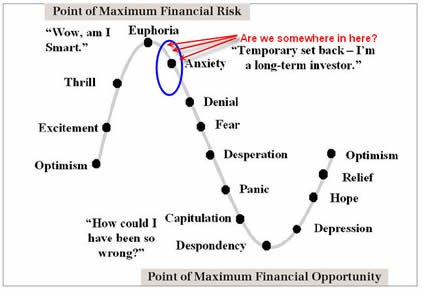
I’d say I’m somewhere between anxiety and denial now. If you can’t tell, I’m thinking of buying a house in a large West Coast city sometime late in 2007. Hurry up despondency! ๐Ÿ™‚

This chart would be funnier if it didn’t hit so close to home. “Temporary set back, I’m a long-term investor”. That’s me! Image via Mish’s Economic Analysis.

Controversial Rent vs. Own Housing Calculator

The Center for Economic and Policy Research (CEPR), a non-governmental economic think-tank, is very upfront about its views on the housing bubble. For a clue as to what they are, check out this article titled “The Menace of an Unchecked Housing Bubble”. They draw several parallels with the tech stock market crash of the late 90s. While there is a lot of other articles of note, I was drawn in by their Housing Cost Calculator:

This calculator compares the cost of owning a home relative to renting for a potential new homeowner. The Housing Cost Calculator reports the “Net Cost of Owning” — the expected amount of additional cash available to a renter compared to the amount available to a homebuyer who buys a home today and sells the home at a specified time in the future. The calculator takes into account the unprecedented run-up in real home prices since 1997.

In other words, it says that housing prices will revert back to its historical tendency to keep in step with inflation. Remember this chart?

altext

[Read more…]

Does Your Income Vary? Get Around Roth IRA Income Limits

In my post about Roth IRA conversions, commenter JT pointed out a good way to get around the Roth IRA income limits if your income varies from year to year. Simply put contribute to a non-deductible Traditional IRA, and wait until your modified AGI drops below the $100,000 limit to do the conversion into a Roth. Maybe you plan on going back to school or are cutting back your hours to stay home with the kids? Although the limits go away in 2010 anyways, it’s something to consider.

For example, in 2005 I made too much to fully fund my Roth (phase out) but I?d be making less than $100K MAGI (salary – 401k) in 2006, so before April 15th in 2006 I put the excess contribution (4000 – what I was able to contribute directly to my Roth) into a Non-Deductible IRA then did an immediate Roth Conversion (no taxes since there was no gain). Full Roth Contribution even though I was in the phase-out range?

An important note – when you do a Roth Conversion the IRS sees all of your traditional IRAs as a pool, so if you have a traditional IRA from a 401(k) rollover then the above trick doesn?t work since you will owe taxes on a portion of the money?

Redeemed Savings Bond Online

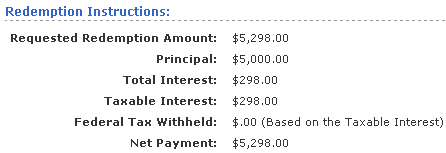
As suggested by my When Should You Redeem I Savings Bonds Calculator, I redeemed a $5,000 I-Bond purchased in October 2005 on Tuesday. I ended up receiving $298 in interest over a holding period of 14 months (I bought at the very end of October). Since the interest is exempt from state-income taxes, my effective interest rate was around 5.8%. I did it all online at TreasuryDirect.gov and the money should be in my bank account within two days.

Screenshot Saving Bond Website