Archives for August 2024

Morningstar Target Date Retirement Fund Report 2024: Highlights for DIY Investors

Morningstar recently released its 2024 Target-Date Strategy Landscape Report (free download with e-mail address). This is mostly targeted at industry professionals as opposed to individual investors, but I still like to read through it each year. Here are a few selected charts and quick takeaways from the report.

Our annual report on target-date strategies delves into the landscape by analyzing target-date flows, asset composition, fees, strategy performance, and more.

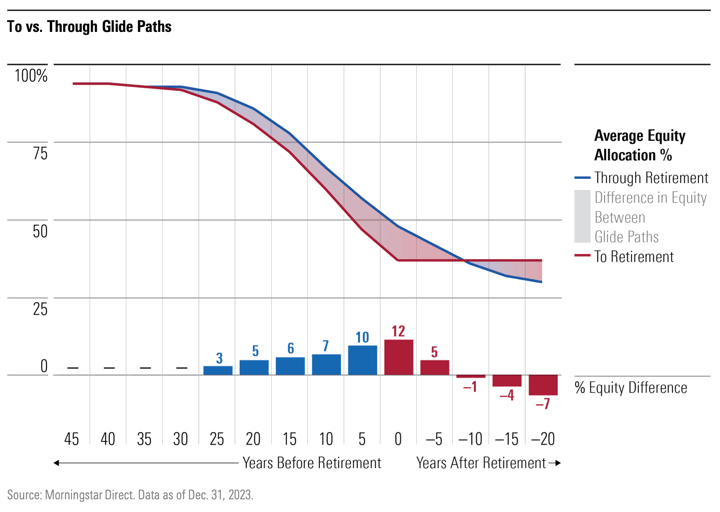
Average Asset Allocation Glide Paths. I always like to look at the average asset allocation glide path across all of the different TDFs. Morningstar now separates the them into “To Retirement” and “Through Retirement” types, depending on if they stop changing right at the retirement date or not. On average, most TDFs have an asset allocation close to 90% equity and 10% bonds in the early years, with the equity percentage dropping (and bond percentage rising) as time goes on. At the year of retirement, the average asset allocation is roughly 40% to 50% equity.
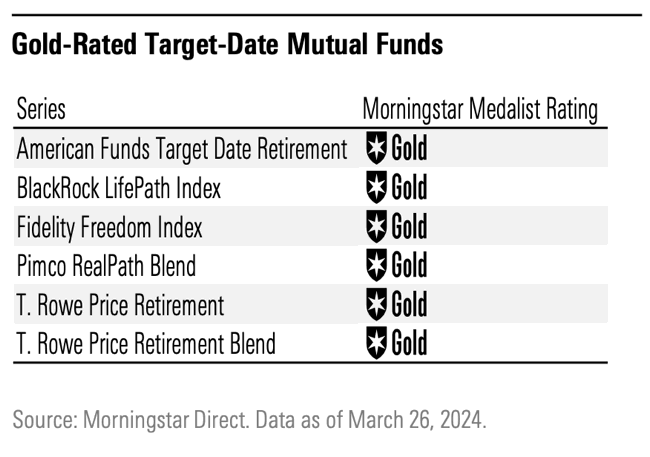
Here are all of the TDFs rated Gold by Morningstar. Vanguard, which is the largest by asset size, was rated Silver. Morningstar didn’t really explain very clearly why Vanguard only got Silver alongside some pretty mediocre funds like the original Fidelity Freedom series (not Freedom Index).
But really, the most important factor is whether you are invested and “in the game” or not. The differences between different TDFs are relatively small these days. Most of us can’t change the TDF series that is offered in our 401k plan. We can’t control the returns of those TDFs, either.

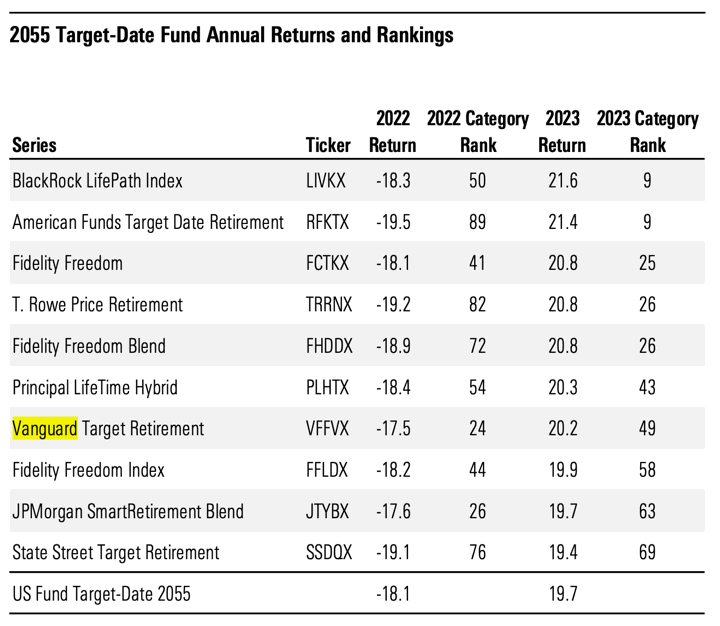
Here is a comparison of the returns from 2055 Target Date Funds (younger investors that have 30 years until retirement). I don’t see a huge dispersion in the returns. Higher is always preferred of course, but the same TDF that had returns ranked 89th one year was then ranked 9th the next year.
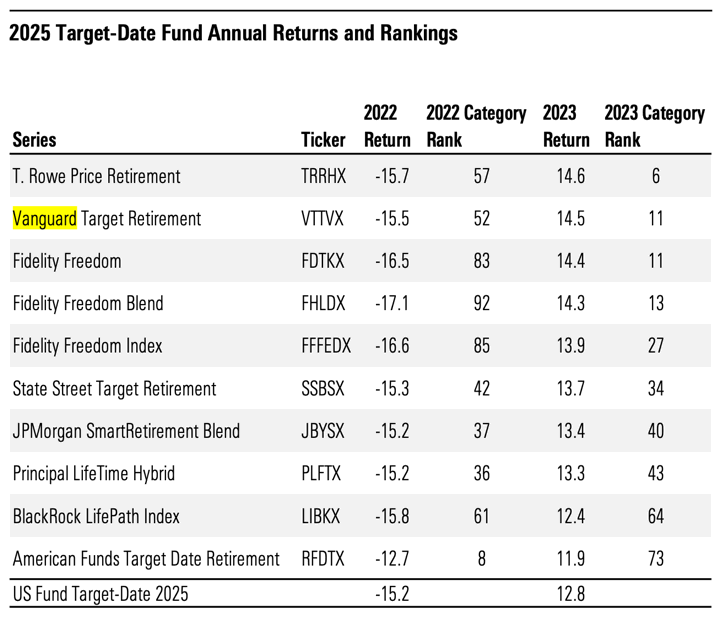
Here is a comparison of the returns from 2025 Target Date Funds (older investors very close to retirement). The same TDF that had returns ranked 83rd one year was ranked 11th the next year.
I remain a fan of TDFs in general. Most are good nowadays. As DIY investors, the most important decision is to participate in the stock market returns and try to maximize our contributions. The rest is much less important. Over the long run, TDFs have created a lot of wealth for consistent savers.

Ink Business Preferred® Credit Card Review: 90,000 Bonus Points worth $1,125 Towards Travel

Business credit cards can be used by self-employed or side-gig workers with eBay, Amazon, Etsy, Uber/Lyft, DoorDash/Grubhub, Adsense or other 1099 income that make you a sole proprietorship. The Ink Business Preferred® Credit Card has an improved 90,000 point bonus for new cardholders, worth at least $1,125 towards travel when redeemed through Chase TravelSM and potentially more via points transfer to United miles, Hyatt hotels, etc. This is their premium business travel card with 3X points on travel purchases and the ability to transfer points to airline miles or redeem at a 25% premium through Chase TravelSM. Here are the details:

  • 90,000 bonus points after you spend $8,000 on purchases in the first 3 months from account opening. That’s worth $900 cash back or $1,125 toward any airfare or hotels booked through the Chase TravelSM portal (works similarly to Expedia or Travelocity).
  • 3X points per $1 on the first $150,000 spent on travel, shipping purchases, internet/cable/phone services, and advertising purchases with social media sites and search engines.
  • 1X point per $1 on all other purchases with no limit.
  • Ability to transfer points directly to airline mile partners.
  • Points are worth 25% more when you redeem for travel through Chase TravelSM.
  • No foreign transaction fees.
  • Free additional cards for employees.
  • Primary rental car coverage when renting for business purposes.
  • Member FDIC
  • $95 annual fee.

Ultimate Rewards points. This card offers a 25% bonus on travel bookings made through the Chase TravelSM website. For example, 100,000 Ultimate Rewards = $1,250 in travel. Similar to Expedia or Travelocity, you can book flights on Chase Travel at most major airlines, hotel chains, and car rental companies. This makes it much more flexible to spend your points. You can even buy something more expensive and pay the difference.

If you have other Chase cards that earn Ultimate Rewards points like the Ink Business Cash or Ink Business Unlimited, you can transfer points into this card account and take advantage of the 25% premium. However, if you happen to have the Chase Sapphire Reserve card, you could transfer your points over to that card and grab the better 50% premium.

You could think of this card as the small business version of the Chase Sapphire Preferred card.

Prefer airline and/or hotel points? This card also allows you to transfer Ultimate Rewards points into hotel and/or airline miles. Transfer to United Airlines, British Airways, Singapore Airlines, Korean Air, Southwest, Hyatt Hotels, IHG Hotels, and Marriott Hotels at a ratio of 1 Ultimate Rewards point = 1 mile/hotel point. Miles redemption continue to offer great value for savvy travelers, especially for last-minute travel and business class seats.

For example, I could definitely get more than $1,250 in value by converting into 100,000 World of Hyatt points.

Many people aren’t aware of the fact that they can apply for business credit cards, even if they are not a corporation or LLC. The business type is called a sole proprietorship, and these days many people are full-time or part-time consultants, freelancers, eBay/Amazon/Etsy sellers, Uber/Lyft drivers, or other one-person business owners. This is the simplest business entity, but it is fully legit and recognized by the IRS. On a business credit card application, you should use your own legal name as the business name, and your Social Security Number as the Tax ID.

Note that Chase has an unofficial rule that they will most likely deny approval on new credit cards if you have 5 or more new credit cards from any issuer on your credit report within the past 2 years (aka the 5/24 rule). This rule is designed to discourage folks that apply for high numbers of sign-up bonuses. This rule applies on a per-person basis, so in our household one applies to Chase while the other applies at other card issuers.

The good news is that small business cards from Chase don’t show up on personal credit reports, so getting this card in itself won’t affect your future 5/24 eligibility.

Bottom line. The Ink Business Preferred® Credit Card is a business card with a big sign-up bonus along with premium travel features included with the $95 annual fee. You can transfer Ultimate Rewards points from other Chase cards to increase your value. If you’d rather have a more simple cash-focused rewards structure and no annual fee, be sure to compare with the Ink Business Unlimited and Ink Business Cash.

I will be adding this to Top 10 Best Small Business Card Bonus Offers.

Berkshire Hathaway Asset Allocation: What’s Inside a Share of BRK.B?

Whether you are a Berkshire Hathaway shareholder or just curious about what Warren Buffett’s “masterpiece” looks like today, here is an interesting graphic from Sherwood News. Essentially, this is the asset allocation of BRK.B, broken down into wholly-owned operating businesses, shares of other publicly-traded companies, and cash (mostly Treasury Bills).

Some may be surprised to find that for every dollar you invest, this asset allocation is 70% into owning businesses and 30% into cash. Those that have tracked its history know that BRK has often had a significant cash pile relative to it’s total market cap. From Bloomberg (paywall):

There is also a bit of fuzziness as they own insurance companies and those insurance companies have roughly between $150 billion and $200 billion of float which can be invested (and considered an interest-free loan if the underwriting breaks even). Of course, this also means that Berkshire must be always be ready to pay out huge claims if certain events unfold.

The most recent discussion has focused on Buffett’s sale of half his Apple shares. I’m not really worried about it. As a shareholder, I have chosen to trust his management. When Buffett bought Apple stock, the P/E ratio was about 16. Today, Apple’s P/E ratio is over 32. Overall, the S&P 500 is also at higher P/E ratios relatively to historical averages. That makes these moves quite reasonable in terms of value investing.

Berkshire Hathaway makes up a very small percentage of my net worth, but remains a pseudo-actively-managed balanced fund with zero expense ratio that I love to watch. There are wholly-owned solid cash-spewing businesses. Shares of other solid cash-spewing businesses bought at fair prices. And just plain cash.

Why I Finally Froze All of My Credit Reports

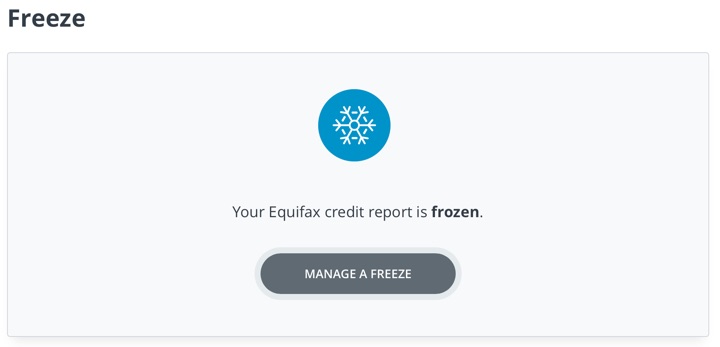
For the first time in forever, I have frozen all of my credit reports at the three major credit bureaus (Equifax Freeze, Experian Freeze, TransUnion Freeze). The balance between the guaranteed hassle of maintaining a credit freeze and the potential hassle of dealing with an identity theft attempt has finally shifted enough towards just having them frozen as a default position.

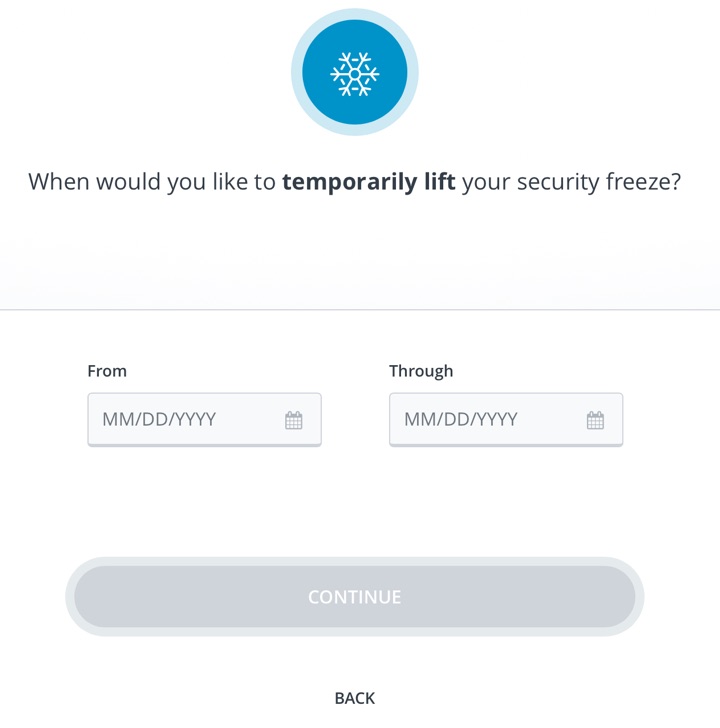
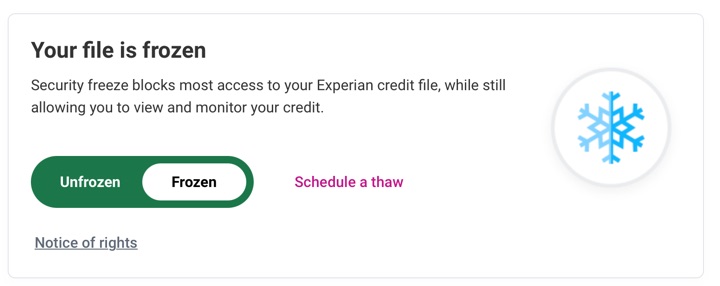
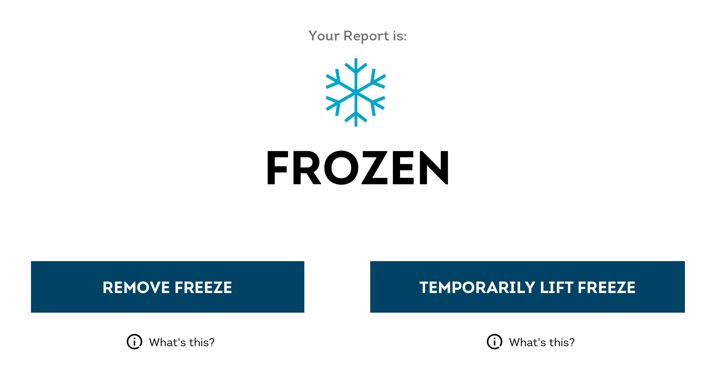
Luckily, it has become even easier than I remembered. These days, you no longer need to call in or provide a special PIN to unfreeze your credit reports. You can freeze and thaw your credit reports using an online account at each bureau (secured by text 2FA) within minutes, and set the thaw to only last just a day or week. I like that it will automatically re-freeze your report. Just make sure you have a good password manager.

The most annoying bureau was probably Experian, which always seems to ask for an upsell to their paid monitoring service at every login attempt, and also suggests their “CreditLock” service when you try to add a freeze – a paid service which I bet tricks a certain percentage of visitors. Credit Freezes are regulated and should be completely free and never require a credit card nor trial agreement.

Equifax

Experian

TransUnion

I also looked into freeze the credit reports for all three of my kids, but it does seem to require much more physical paperwork and multiple identification documents to be mailed in.

Savings Bonds: Converting Paper to Electronic at TreasuryDirect (My Experience)

After dealing with the estate of a family member, I saw firsthand the benefits of simplifying my financial situation. (They need a better term than “death cleaning“.) If not for me as I get older, definitely for my wife and/or kids in the future. This conflicts with my constant desire to try out new stuff and chase rates, but I’m working on it. Paper savings bonds are definitely something that could easily be lost or forgotten.

Even if they are found, there are vanishingly few banks that will redeem paper bonds anymore. Another option is to physically mail them in with FS Form 1522 and cash them out directly, but that requires a signature guarantee or notary. All more potential work for others.

My ultimate goal is to liquidate all of my savings bonds at TreasuryDirect and replace them with cash or TIPS (thus removing an account to track) in an existing brokerage account, but ideally in a manner sensitive to both the current interest rates being paid and my marginal income tax rate. It is also possible that I may use them for higher education expenses, which would be within the next 6 years.

Therefore, the best option seems to be to convert these paper bonds into electronic format at TreasuryDirect.gov, combining them with my existing electronic savings bonds, and then liquidating them as needed. The conversion process does not require a signature guarantee nor notary. Electronic bonds also provide the option of partial redemptions. The main risk is the hassle of lost paper bonds if something goes wrong in transit.

General conversion directions. Here are the conversion instructions directly from TreasuryDirect:

  1. Go to your TreasuryDirect account.
  2. Select ManageDirect.
  3. In the Manage My Linked Accounts menu, select Establish a Conversion Linked Account. If this option doesn’t appear, you have a Conversion Linked Account already. Skip to step 6 below.
  4. Review the information about conversion linked accounts.
  5. Select Create Account.
  6. In the Manage My Conversions menu, select How to Convert My Paper Bonds.
  7. Follow the instructions there.
  8. When you prepare your paper bonds to submit for conversion, do NOT sign the back of the bonds.

Basically, you have to enter the information on each of your paper savings bonds and they will create a numbered manifest with all of the bond data. You must send in your original paper savings bonds along with this signed manifest. Here is what you must certify with your signature:

By signing below:
1. I certify that I am requesting conversion of the listed savings bonds. I further certify that any bond not registered in my name was purchased by me as a gift to the bond’s registered owner.
2. I acknowledge and accept the terms and conditions set out in the regulations for TreasuryDirect at 31 CFR Part 363.
3. I understand that converted bonds are automatically redeemed upon final maturity and the interest reported to the IRS. I also understand that a Zero-Percent Certificate of Indebtedness (C of I) is
purchased with the redemption proceeds of the bonds.
4. I certify that all information provided is true, correct, and complete.

They state that you will not receive any notifications on the process, but you can check the status online:

You will not receive a notification when we receive the bonds or when the conversion process is complete. However, you may check the status of your bonds at any time, through your TreasuryDirect Conversion linked account. Click ManageDirect, then “View my manifests.” Select the manifest you wish to view and click the Select button. You will see one of the following notations in the Status column next to the bonds on your manifest:

In Progress – processing in progress;
Pending – Customer Service needs additional information;
Returned – Bond returned to you as ineligible for conversion;
Not received – Treasury did not receive the bond listed on the manifest;
Canceled – Bond closed in previous transaction. For example, a replacement bond was issued after being reported lost, stolen, or destroyed; or
Converted – Bond converted. Check your Current Holdings or Gift Box in My Converted Bonds Linked Account, or your Minor Linked Account.

My paper bond conversion timeline. I mailed them both in on July 17th, 2024 using USPS Priority and the default tracking number. . As they were titled in two different names, I sent them in two separate envelopes with two separate manifests. The tracking number confirmed basic delivery.

Roughly two weeks later on July 30th, 2024, I received the following e-mail confirmation, only for one of us (my wife). Apparently there are notifications after all? However, I never received any e-mail confirmation for myself for my own customer number. It’s possible that I overlooked it, but I did search my Junk and Spam folders. Here is the text of the e-mail.

Customer Number: XXXXXXX
Customer Name: Mrs. MMB
Case Number: 1-XXXXXXX

Dear Customer,

This is a system generated email to communicate we received your Savings Bonds/Treasury Marketable Securities materials.

Cases are worked in the order they are received in our office. Your request is important to us and will receive attention as soon as possible. Please be aware of our estimated processing times to process your case which are based on the case type:

Cases requesting to cash Series EE and/or Series I paper savings bonds held in your name, at least 4 weeks.
Cases requesting to cash Series HH savings bonds held in your name, at least 3 months.
Unlocking your TreasuryDirect account, updating bank information in that account, or converting your paper savings bonds into electronic bonds in TreasuryDirect, at least 4 weeks.
Claims for missing, lost, or stolen bonds, at least 6 months.
All other cases, at least 20 weeks.
If we require additional information to process your case, we will contact you. Thank you for your patience.

Please retain the Customer Number and Case Number referenced above to streamline any future actions associated with this request. Also note, you may receive multiple email notifications and Case Numbers depending on the type of transaction(s) you have requested.

If you have additional questions, please use the Contact Us link on TreasuryDirect.gov.

We appreciate your interest in U.S. Treasury securities.

Sincerely,
Treasury Services

Initially, I was a little concerned about my missing confirmation e-mail, but I figured there was nothing I could do until it was either processed or enough time had passed that I could claim it as lost. I told myself that there is a clear process to claim lost or stolen paper savings bonds using FS Form 1048, in case it came to that. I had made copies of everything in order to maintain a record of the serial numbers.

On August 14th, 2024 (two weeks later), I decided to log into my TreasuryDirect account to check on things. Given they stated “at least 4 weeks” above, I was surprised to find that all of the paper bonds (both my and my wife’s) showed in our respective “My Converted Bonds” account. You can also check the status of existing manifests under “ManageDirect” and then “Manifest Information” (screenshot at top of post).

So there you have it. As of later 2024, it took roughly two weeks to get receipt confirmation (maybe) and another two weeks (maybe) to process. Everything worked out in the end, and hopefully this information will help set some reasonable expectations for others.

p.s. I was able to add a new linked bank account using routing and account numbers with no additional security steps. Not even microdeposits. I don’t know if this is a good move overall, but I am personally glad to not have to hunt down a local bank branch that will grant me a medallion signature guarantee like they were requiring several years ago.

Huge NPD Data Breach: Check If Your Social Security Number is Leaked

Could this be the biggest data breach ever? National Public Data (NPD), a background check company, was hacked in December 2023 and they finally admitted to have exposed the full Social Security Numbers from nearly everyone in the United States (gift article). Atlas Data Privacy found 272 million unique SSNs in the database of 2.7 billion records. The entire US population is only about 330 million. 😡

This LA Times article adds more detail about how NPD has delayed and withheld information about this huge hack. Unfortunately, our knowledge of their ineptitude keeps growing: National Public Data Published Its Own Passwords The best title goes to Wired (paywall) with The Slow-Burn Nightmare of the National Public Data Breach.

Cybersecurity firm Pentester has released this NPD Breach Check Tool that lets you enter just your name and birth year to see if your data is included. With just this little bit of information, the tool was able to provide evidence that they knew my historical addresses, phone number, full Social Security Number, and date of birth. 🤬

We’re getting close to the point where Social Security numbers will not be secret enough to provide any assurance for identity verification. I believe that these data brokers should each first have to pay us a subscription fee for the right to store and resell our personal data, on top of being financially liable if they lose it. 300 years of “free credit monitoring” is not adequate.

These media articles recommend the following actions:

  • Freeze your credit reports. Also consider freezing the reports for your minor children. Experian is the most annoying. Don’t fall for their upsells and “Experian CreditLock”, which is not the same as a free Freeze!
  • Use multi-factor authentication whenever possible. Hardware keys, authenticator apps, or at the minimum SMS texts.
  • Set up account alerts. Just be sure those alerts aren’t phishing attempts themselves. Don’t click on vague links. Visit sites directly.
  • Harden your personal e-mail address. The e-mail where your password resets arrive is one of the most valuable targets for criminals.

Fidelity Adds Multi-Factor Authentication with Authenticator Apps

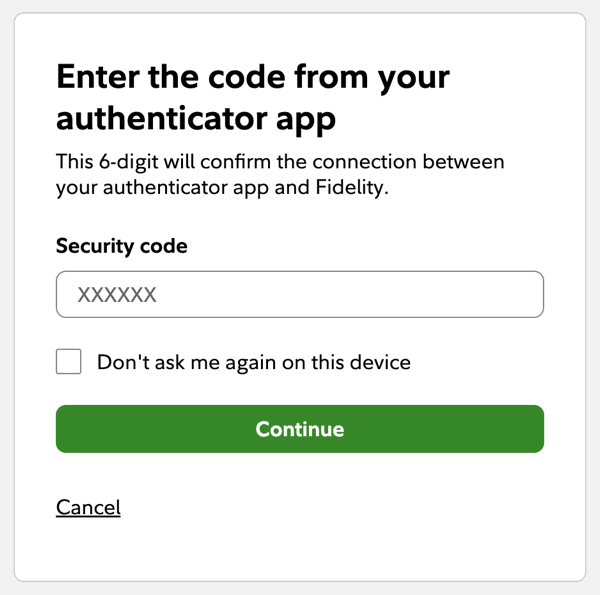
Fidelity just added the ability to use any Authenticator app with standard TOTP multi-factor support. TOTP stands for Time-based One-Time Password. This includes Google Authenticator, Microsoft Authenticator, Duo, and 1Password. Previously, you were limited to the non-standard Symantic VIP app. This was announced on the Fidelity subreddit from an official moderator.

I’m not a security expert, but view this is a positive development since Authenticator apps are considered a better form of multi-factor authentication (MFA) than SMS text messages, as your text messages can be intercepted within the mobile networks via “SIM swap” or other method. (This why you should also add a password to your cellular provider to authorize any porting, and a SIM PIN (iPhone) or SIM Lock (Android) on your actual phone.) Authenticator apps are more securely linked a specific device as the number resets every 30 seconds and doesn’t travel over the internet or any other network (unless your phone is hacked with malware). Directions:

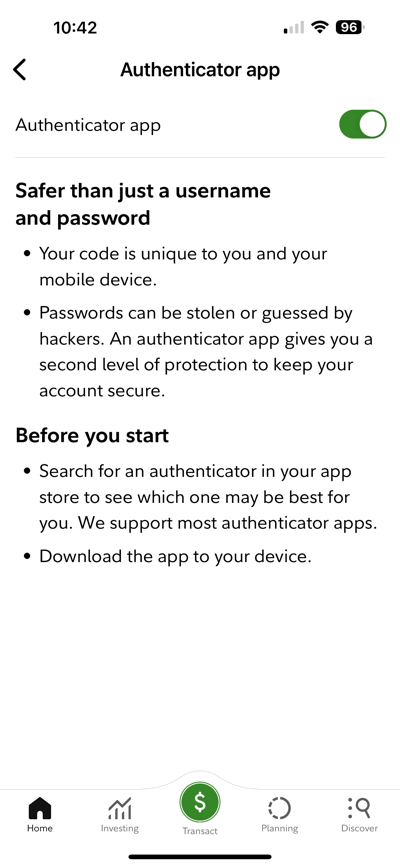
Here’s how to enroll an authenticator app through the Fidelity mobile app:

Open the Fidelity mobile app and select the Profile icon.
Select General settings and then Authenticator app.
Toggle Authenticator app on.
Copy the secret key.
Follow your authenticator app’s instructions to connect it to your Fidelity account using the secret key.
Go back to the Fidelity mobile app and select Next. Paste in the 6-digit code from the authenticator app to complete the enrollment.
Once you’re enrolled, you’ll get an authenticator-app challenge at any Fidelity login unless you already indicated that your device is a trusted one.

You must first enable the Authenticator option via your Fidelity app on smartphone. (Enrollment on desktop is coming.) After that, you can use Authenticator apps on your desktop browser logins as well. If you had Symantec VIP enabled previously, enabling the Authenticator option will automatically deactivate the Symantec VIP and use your designated Authenticator app instead.

The gold standard of MFA remains a physical device like a YubiKey, but that is more expensive and less convenient. As of this writing (August 2024), Fidelity does not officially support any third-party hardware authentication devices like Yubikey.

A brief MFA definition from PC World:

What Is Multi-Factor Authentication?
As the name implies, MFA means you use more than one type of authentication to unlock an online account or app. Usually, the first factor is your password. MFA means you add another factor in addition to that password. Experts classify authentication factors into three groups:

Something you know (a password, for example).
Something you have (a physical object).
Something you are (a fingerprint or other biometric trait).
When you use an authenticator app, you bolster the password you know with your token, smartphone, or smartwatch.

As a side note, Vanguard does not support standard Authenticator apps, but it does support FIDO2-certified physical security keys like Yubikey. Most newer Android phones can also be set up as a FIDO2 key. Vanguard has also starting using their smartphone app as another factor.

Capital One Spark Cash Plus Review: $2,000+ Cash Bonus + 2% Cash Back

card_name

Updated with new big bonus for big spenders. The card_name is a rewards business charge card offering a big early spend bonus offer in addition to ongoing unlimited 2% cash back on all purchases (or better). Instead of a standard credit card where you can carry a balance and pay interest, this is a charge card where the balance is due in full every month. Here are the highlights:

  • One-time cash bonus of $2,000 once you spend $30,000 in the first 3 months of account opening. You’ll also earn 2% cash back, which means you’ll earn a total of $600 + $2,000 = $2,600 in cash rewards on that $30,000 of spending. That’s a total of 8.6%!
  • Additional $2,000 cash bonus for every $500K spent during the first year. You can earn this bonus multiple times over the course of year 1.
  • Unlimited 2% cash back on every purchase, everywhere with no limits or category restrictions.
  • 5% Cash Back on hotels and rental cars booked through Capital One’s travel booking site.
  • Comes with no preset spending limit, so it can adapt to your needs based on your spending behavior, payment history and credit profile.
  • Add employee cards for free, and earn unlimited 2% cash back from their purchases
  • Spark Cash Plus has no APR because your balance is due in full every month.
  • $150 annual fee; Spend $150,000 annually and Capital One will refund this fee every year.

Consider that if you exactly meet both of the spending requirements above ($30,000 within first 3 months), you will end up with the $2,000 cash bonus plus $600 from 2% cash back = $2,600 cash total. That’s effectively 8.66% back on $30,000 of card spending!

This card does have a $150 annual fee, which makes it best suited for businesses with significant spending needs. NEW: Spend $150,000 annually and Capital One will refund this fee every year.

That may all seem like a lot, but many businesses make a lot of purchases for raw materials and/or inventory. If you pay estimated taxes each quarter, you can also pay the IRS via credit card with a 1.82% fee and still come out ahead.

This card does not have all of the bells and whistles like top-level rewards, transferrable airline miles, or airport lounge access. For that, look into the Capital One Venture X Business Card and its higher annual fee.

If you also hold the Spark Miles, Capital One Venture, or the Capital One Venture X rewards cards, you can convert your cash back rewards into their “miles”, which are then transferrable to various airline miles programs including British Airways Avios. With the right companion card, $2,000 in cash rewards could be converted to 200,000 miles.

Many people aren’t aware of the fact that they can apply for business credit cards, even if they are not a corporation or LLC. The business type is called a sole proprietorship, and these days many people are full-time or part-time consultants, freelancers, eBay/Amazon/Etsy sellers, Uber/Lyft drivers, or other one-person business owners. This is the simplest business entity, but it is fully legit and recognized by the IRS. On a business credit card application, you should use your own legal name as the business name, and your Social Security Number as the Tax ID.

Bottom line. The card_name is a rewards business card where you pay in full each month. If you put a lot of purchases on a card, this card is offering a big early spend bonus offer in addition to ongoing 2% cash back on all purchases (or better).

Due to the high first-year value, I will be adding this to my Top 10 Best Small Business Card Bonus Offers.

Vanguard How America Saves 2024: 401(k) Retirement Plan Stats

Vanguard recently released the 2024 edition of their annual How America Saves report, a detailed, 113-page report targeted at industry professionals which looks across millions of their 401k, 403b, and similar defined-contribution retirement plans. Personal finance geeks rejoice! Here are a few select bits that caught my eye.

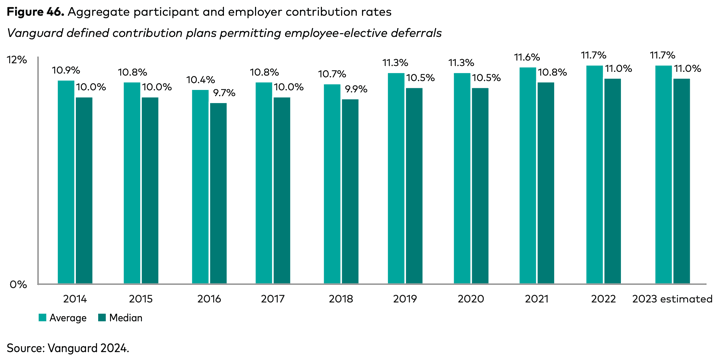
Median employee contribution rate was 6.2%. Median means that half of people were saving more, while half were saving less. This out of all participants. Average is weighted more by absolute dollar savings. The overall historical trend is rising slowly.

Median total contribution rate was 11%, which includes employer match. Nearly everyone gets some sort of employer match The overall historical trend is also rising slowly.

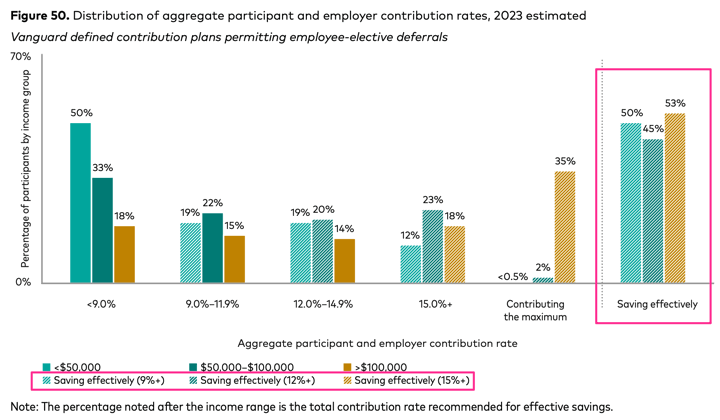
How much does Vanguard think we should be saving? Vanguard believes that if your income is under $50,000, you should be saving at least 9% total. If your income is $50k to $100k, you should be saving at least 12% total. If your income is over $100k, you should be saving at least 15% total.

About half of workers are “saving effectively” according this definition.

What about the “Super Savers”? Overall, 14% of participants saved the maximum allowed tax-advantaged amount in 2023. Maxing it out was very rare at less than 100k income levels. 53% of those with incomes of $150,000+ maxed out their contributions. Here is the full breakdown by income:

More are going beyond the traditional “maxing out the 401k. Interestingly, 9% of participants used the after-tax contribution option if it was available. 23% of those with incomes of $150,000+ maxed out used this option. I am assuming that many of these people are going for the “Mega Backdoor Roth”.

Asset allocation. This chart shows the trends in asset allocation as the participants age. The increased use of Target-Date Funds (TDFs) and other professional management options has changed it so that young people are less and less likely to hold cash. Asset allocations are becoming more uniform and aligned with TDFs in general.

A Wider View of the Long-Term Returns of Stocks (Different Countries and Time Periods)

Professor Edward McQuarrie has recently published the final part in his 3-part series about long-term stock returns at the CFA Institute:

He spends a lot of time fighting back against other people putting words in his mouth, so I’ll try to be extra careful in my own interpretation of his articles.

“One country, one century”. If you look at the returns of the S&P 500 from 1926-2024, as is the widely-available dataset, then yes, US stocks look pretty great for the long run. But this is “one country, one century”. If you look at other countries and other centuries, the returns can look different.

Countries other than the US. If you look at other countries, you will find multiple historical examples of negative average returns even over a 20-year period.

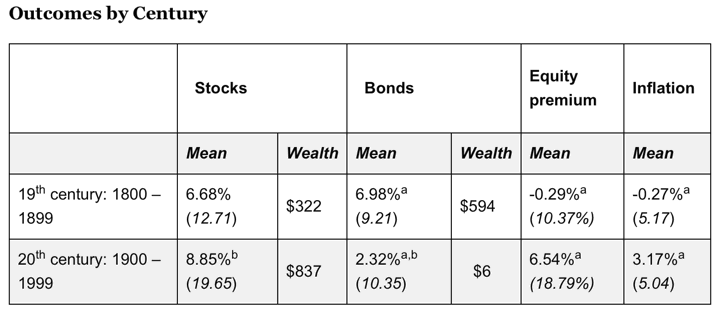
19th century US returns. If you stay with US stocks but change the century, you’ll also discover different results. In the 1800s, the long-term average returns between stocks and bonds were much closer, with bonds even winning by a hair:

I don’t know if this wider set of data will make anyone change their minds, but perhaps it’ll add a little more context to the argument.

To be clear, McQuarrie still states that owning a good chunk of stocks remains the best bet available. It’s not just a sure thing. At the minimum, consider the possibility that the difference in future returns between stocks and bonds may not be as wide as in the past 10-20 years.

Because stocks remain risky regardless of the holding period, stocks often outperform, because investors get compensated for taking that risk. Stocks are a good wager over the long term, on favorable odds. But stocks remain a bet, one that can go bad for any randomly selected investor over their personal time horizon.

S&P 500 Stocks: Are Long-Term Returns Always Above Inflation?

If you’d like a little bit of comfort as a long-term owner of stocks, check out this chart from Ben Carlson at A Wealth of Common Sense. He looks at every rolling 22-year period (based on a reader request) between 1926 to 2023, and finds that the minimum return during any 22-year period is still 1.4% above inflation. The average is a pretty impressive 7.2% above inflation.

Another interesting takeaway from this chart is that the enemy of after-inflation returns is not necessarily an intensely traumatic event like the Great Depression or World War II or the Great Financial/Housing Crisis, but also an extended period of high inflation. The worst real return period was around the 1970s:

Surprisingly, the worst 22 year period for real returns was not in the aftermath of the Great Depression but rather in the 1970s. The two-plus decade real return ending in the summer of 1982 was just 1.4% per year. That time frame featured an annual inflation rate of nearly 6% which is a high hurdle rate to beat.

Here is the a similar chart, but not adjusted for inflation.

Fidelity Treasury Only Money Market (FDLXX) as Fidelity Core Position Workaround

While it was welcome news that Fidelity now allows the Fidelity Government Money Market Fund (SPAXX) as a core position for their Cash Management Account as of June 2024, for many of us that reside in states with high state income tax rates, our net after-tax yield would still be much better if we were allowed to use the Fidelity Treasury Only Money Market Fund (FDLXX) as our core position instead.

This is because the interest from US government obligations like Treasury bills are exempt from state income taxes. (The Constitution declares that states are not allowed tax the Federal government.)

Many states have an income tax, but if you live in California, Connecticut, and New York, you should know that in 2023 neither Fidelity Government Money Market Fund (SPAXX) nor Fidelity® Treasury Money Market Fund (FZFXX) met the minimum investment in U.S. government securities required to exempt the distribution from tax in California, Connecticut, and New York. (Despite having Treasury in the name, FZFXX only had about 20% in eligible Treasury interest.) These are the core positions available in the standard Fidelity Account. Meanwhile, Fidelity Treasury Only Money Market Fund (FDLXX) did meet those requirements in 2023 with roughly 90% of interest eligible for exemption. (Source)

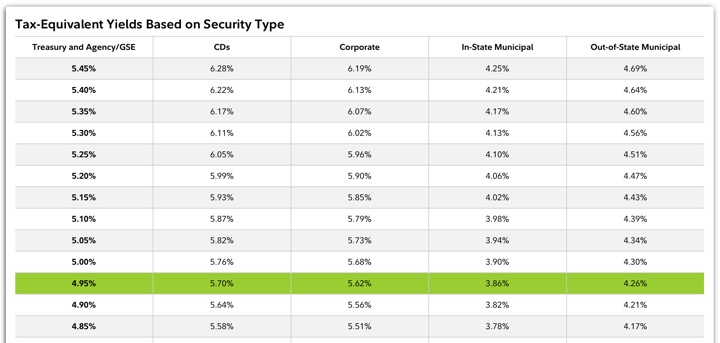
As of 8/4/24, the SEC yield of SPAXX was 4.98% and FDLXX was 4.95%. Pretty close. But if you assume a 10% state income tax rate, SPAXX would have to yield at least about 5.50% to equal the after-tax yield of FDLXX. This is just a ballmark estimate, and you can use Fidelity’s Tax-Equivalent Yield Calculator to get a more accurate number for your specific household.

Now, you can manually purchase FDLXX at any time with your SPAXX balance with no transaction fees. Then, whenever your SPAXX is zero and you still need cash, Fidelity will sell FDLXX on demand to fund any cash needs (Billpay, ACH withdrawal, debit card purchase, stock purchase, etc). However, if you get any new money like a paycheck direct deposit or dividend payment, it will automatically be used to purchase the core position (i.e. SPAXX). You’ll then have to make another manual purchase of FDLXX to convert that SPAXX to FDLXX. This is tedious and easy to forget about.

A workaround to this solution is to set up an automatic recurring purchase of FDLXX. Thanks to a comment from reader Henry and also this r\Fidelity post (actually multiple posts) where an official Fidelity rep confirmed that the mechanics work.

You’re on the right track; auto-liquidation of the Fidelity Treasury Only Money Market Fund (FDLXX) will occur to fund your recurring investment plan in this situation. Fidelity will attempt to cover debit balances created, whether through trades, direct debits, checkwriting, or even BillPay, by first using funds in your core balance. Once the core balance is depleted, the system will turn to any eligible secondary money market funds to cover the transaction.

As a recurring investment plan falls under the blanket of trades, auto liquidation will still be at play.

It’s important to note that not all non-core money markets are eligible for automatic liquidation to cover purchases. It is best practice to sell non-core money markets in advance of expected purchases, but you can also ask us about specific money markets to confirm their eligibility. As I alluded to above, FDLXX is eligible for auto-liquidation.

The mechanics. Depending on your cashflow patterns, you might set up a $1,000 weekly recurring purchase of FDLXX. If you have $1,000 in SPAXX (core), that will be used to purchase $1,000 of FDLXX. If you only have $150 of SPAXX, then $150 of SPAXX will be sold first AND $850 of FDLXX will be sold, and that will be used to purchase $1,000 of FDLXX. This is because FDLXX is classified as an “eligible secondary money market fund” and will auto-liquidate to satisfy your $1,000 purchase request, even though it’s effectively “buying itself”. If you don’t have enough FDLXX or other funds available, your scheduled purchase will be skipped that instance, but the recurring purchase plan will stay in place. Importantly, things like your stock holdings are NOT eligible for such auto-liquidation.

(Note: If you hold multiple money market funds, there is an order in which Fidelity will liquidate your money markets will liquidate. First the core position, next any taxable money markets, then any tax-exempt money markets (munis). Within each category, Fidelity draw from the fund with the highest balance first. Not all non-core money markets are eligible for automatic liquidation to cover purchases. Source.)

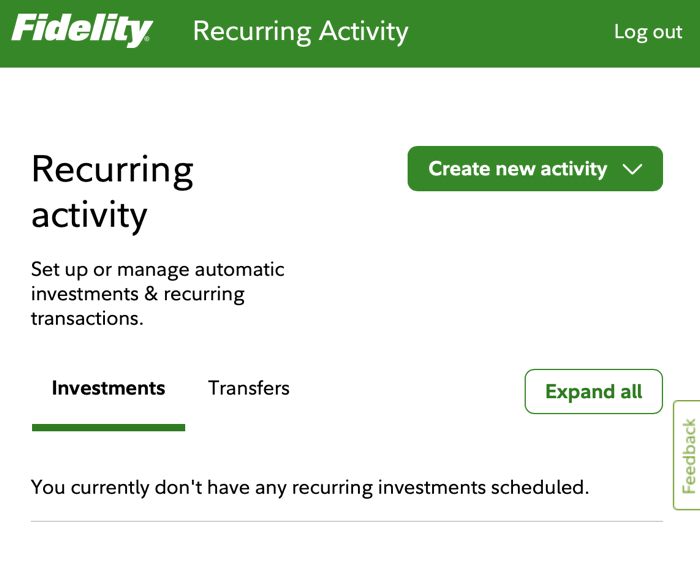
Here’s how to set up a recurring investment at Fidelity.

If you decide to proceed, you can set up a recurring investment by following the steps below after logging in on the website:

Expand the “Accounts & Trade” tab
Choose “Account Features”
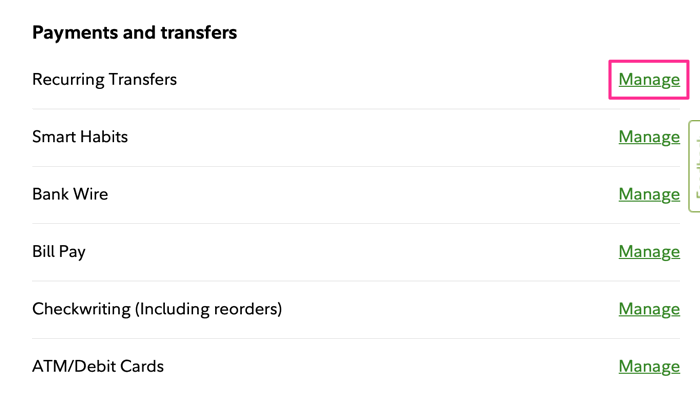
Click “Manage” next to Recurring Transfers
You can set up recurring investments on a weekly, biweekly, or monthly basis.

A few screenshots:

Set up properly, this should keep your SPAXX balance at a minimum and regularly shoveled into FDLXX. It’s still a little messy but it’s the best workaround currently available. I have been using my Fidelity CMA as my new primary checking account and it has been working out pretty well so far.