Archives for June 2010

Free Identity Theft Protection from SuzeOrman.com

SuzeOrman.com and TrustedID are offering 12 months of free identity theft protection valid through Thursday, June 10, 2010. (update: looks like it ended update2: back up with new link). It appears help you place fraud alerts on your credit files, monitor for signs of your personal data on the internet, and offer some monetary compensation in case you are a victim.

I’m having some server problems and also being hit with some sort of spambot, so sorry for the lack of details and a better post. Please leave a comment about any relevant details I am missing. You’ll need to provide your Social Security number for the ID protection.

Here is the press release. Thanks to reader Elin for the tip!

Betterment.com Review: Investing Made Simple, But Is It Worth The Cost?

New start-up website Betterment.com wants to make investing more easy… imagine something as simple as your existing savings account but with higher returns. Too good to be true?

How does it work?

At it’s very core, Betterment is a standard brokerage account, like E*Trade or Scottrade, which holds stocks and bonds in the form of exchange-traded funds (ETFs). On top of this, Betterment provides a lot of automation and simplification so that a user’s required day-to-day involvement is minimized.

Using a short questionnaire or a simple slider bar, you can choose a basic asset allocation (AA) of, say, 80% stocks and 20% bonds. After that, you just link a checking account and transfer money in and out as you please. When you move money into Betterment, they’ll buy ETFs automatically for you according to your chose asset allocation. If you want to withdraw, they’ll make the needed sell trades for you. Dividends are reinvested automatically, and your portfolio is rebalanced quarterly if off by more than 5%.

Asset Allocation Tools

For me, the part I played with the most was the interactive demo that illustrated potential returns based on past results. The dark blue line shows the historical average, dark blue bands indicate where 80% of outcomes have fallen, and the light blue bands show where 95% of outcomes have fallen. Here are some screenshots for a $50,000 portfolio of 85% stocks/15% bonds over 1 year and 10 years (click to enlarge).

(Past performance does not guarantee future results…)

Replace your savings account?

Betterment.com has been getting some heat – in my opinion rightfully so – for some of it’s marketing slogans as a “savings account replacement” or “better than a bank”. This is not a bank. You are buying stocks and bonds. You can lose a lot of money. Even their most conservative option of inflation-linked bonds can lose money in the short-term due to interest rate fluctuations. Yes, they admit this all somewhere, but it should be clearer. You just can’t compare yourself even indirectly with a savings account when the risk levels are so different.

Another example is this quote in their “Safe and Secure” section on the front page:

We are a member of the Securities Investor Protection Corporation (SIPC), which means the securities in your account are protected up to $500,000.

SIPC-insured is not the same as FDIC-insured. SIPC only covers restoring assets to investors if your firm goes bankrupt. It does not insure the value of those assets. It does not cover investment fraud. Will people get confused? I think there is a good likelihood that some will.

Portfolio

So what are you actually buying? For the stock portion of your account, you are buying a basket of ETFs broken down as follows:

  • 10% SPDR Dow Jones Industrial Average ETF
  • 20% iShares S&P 500 Value Index ETF
  • 20% iShares S&P 1000 Value Index ETF
  • 15% iShares Russell 2000 Value Index ETF
  • 15% iShares Russell Midcap Value Index ETF
  • 20% Vanguard Total Stock Market ETF

In my opinion, there is a lot of unnecessary overlap here. Of course, they’re paying for the trades, so maybe that in itself doesn’t matter that much. But more importantly, where’s the international exposure? I’d rather be invested in something as simple as 50% Vanguard Total Stock Market (VTI) and 50% Vanguard FTSE All-World ex-US ETF (VEU). You’d own fewer ETFs but more different companies and be globally diversified.

As for the bond portion, that’s 100% Treasury Inflation-Protected bonds via the iShares Barclays TIPS Bond ETF (TIP). Here, I’d rather see a 50% split between TIP and some nominal Treasuries bonds like IEF or SHY. (As recommended by David Swensen.) More diversification, same high credit quality.

Fees

There are currently no minimum balances required to invest. You don’t pay commissions per trade, but instead are charged a flat 0.9% annual management fee on top of the ETF management fees of about 0.20%. Just for their fees, that’s $45 a year on a $5,000 account, and $450 a year on a $50,000 account. So what you have here is a really simple wrap account. (Compare with Fidelity Portfolio Advisory Services.) In exchange, you get a lot of automation. No manually placing trades or remembering to rebalance.

If you have a low-balance account, this works out to be a pretty good deal *if* you like their portfolio above. Even a discount brokerages range from $7/trade at Scottrade to $3.95/trade at OptionsHouse. If you have only a couple thousand dollars to invest, Betterment can be very economical. (Though I suspect that they will have to change their pricing structure at some point for small accounts that trade a lot.) If you have $25,000 or more in assets, you can do much better on your own, and it’s more likely to be worth your time to expand your investment mix.

Reinventing the wheel?

Time to compare this with existing alternatives. You can already buy a nice all-in-one mutual fund from Vanguard like the Vanguard 2045 Target Retirement Fund (VTIVX) with a $3,000 now $1,000 minimum investment. In a similar manner, you can choose your general asset allocation and they’ll maintain and rebalance for you as well, gradually becoming more conservative as time goes on. International stock exposure including emerging markets is included. They’ll let you transfer funds to/from a bank account in $100 increments. Those trades are also free when you hold them at Vanguard.com, and all this costs just 0.20% annually including all fees. Compare this to 1.1% in total expenses you’ll pay at Betterment.

Finally, a quick note about tax efficient placement of assets. When possible, it’s usually better to place less tax-efficient assets like bonds into tax-sheltered accounts like IRAs and 401k plans. You can’t do this easily with such all-in-one systems.

Tracking Inflation: Consumer Price Index Explained – Infographic

The U.S. government tracks inflation in many ways, and one popular way is the Consumer Price Index (CPI). This index is then used to adjust everything from income tax brackets to Roth IRA contributions limits to pension payouts to the return on inflation-linked bonds (TIPS). There are then sub-indices for different groups and regions.

Each month, the Bureau of Labor Statistics gathers 84,000 prices in about 200 categories — like gasoline, bananas, dresses and garbage collection — to form the Consumer Price Index, one measure of inflation. […] The categories are weighted according to an estimate of what the average American spends, as shown below.

The NY Times put together a nice interactive infographic that helps explain the ingredients of the CPI and their relative importance:

You can hover your mouse, and zoom in/out as you like. Does it match your personal spending and inflation rates? Probably not, so it’s good to note the differences. For instance, actual housing prices are not included in the CPI, but instead “owner’s equivalent rent” (24% of CPI) is tracked which is defined as what homeowner’s would pay to rent their home. And once I get my mortgage paid off, I’ll be more worried about other things like health insurance (only 6% of CPI).

Link via the Betterment Blog (Betterment review upcoming).

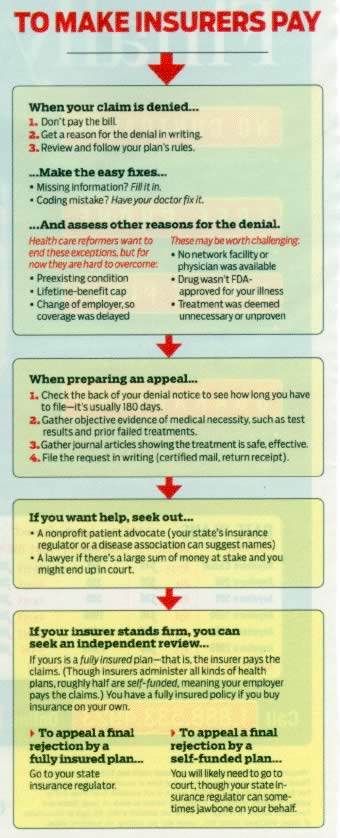
How To Appeal Health Insurance Claim Denials – Flowchart

The US Department of Labor estimates that about 1 in 7 claims to employer health insurance plans are initially denied. A patient advocate says that she wins 80% of appeals. Yet only 4% of denials are appealed. These stats are taken from the AARP article The Health Claim Game. Are insurance companies relying on the “hassle factor” to help their bottom line? (…reminds me of The Incredibles and Insuricare)

Whether you think so or not, dealing with health insurance claims can be a nightmare. At the end of this article, a handy flowchart is provided which walks you through the “claim game”. Here’s the text:

To Make Insurers Pay

WHEN YOUR CLAIM IS DENIED…

1. Don’t pay the bill.
2. Get a reason for the denial in writing.
3. Review and follow your plan’s rules.

…Make the easy fixes…
• Missing information? Fill it in.
• Coding mistake? Have your doctor fix it.

…And assess other reasons for the denial.
Health care reformers want to end these exceptions, but for now they are hard to overcome:
• Preexisting condition
• Lifetime-benefit cap
• Change of employer, so coverage was delayed

These may be worth challenging:
• No network facility or physician was available
• Drug wasn’t FDA-approved for your illness
• Treatment was deemed unnecessary or unproven

WHEN PREPARING AN APPEAL…

1. Check the back of your denial notice to see how long you have to file—it’s usually 180 days.
2. Gather objective evidence of medical necessity, such as test results and prior failed treatments.
3. Gather journal articles showing the treatment is safe, effective.
4. File the request in writing (certified mail, return receipt).

IF YOU WANT HELP, SEEK OUT…

• A nonprofit patient advocate (your state’s insurance regulator or a disease association can suggest names)
• A lawyer if there’s a large sum of money at stake and you might end up in court.

IF YOUR INSURER STANDS FIRM, YOU CAN SEEK AN INDEPENDENT REVIEW…

If yours is a fully insured plan—that is, the insurer pays the claims. (Though insurers administer all kinds of health plans, roughly half are self-funded, meaning your employer pays the claims.) You have a fully insured policy if you buy insurance on your own.

To appeal a final rejection by a fully insured plan…
Go to your state insurance regulator.

To appeal a final rejection by a self-funded plan…
You will likely need to go to court, though your state insurance regulator can sometimes jawbone on your behalf.

The article also mentions a few potentially helpful groups to ask for further assistance – the Medicare Rights Center, the Patient Advocate Foundation, and Advocacy for Patients with Chronic Illness.