
Archives for October 2007

Fidelity Self-Employed 401k Account Review

I’ve mentioned several times I have a Self-Employed 401k account. It’s a somewhat unique thing, so here’s a little bit more about it.

What’s a Self-Employed 401(k) and who’s eligible?
A Self-Employed 401(k) is a tax-advantaged 401(k) retirement account that is available to self-employed individuals or business owners with no employees other than a spouse, including sole proprietors, partnerships, corporations, and S-corporations. It is also referred to as an Individual 401(k) or a Solo 401(k). You can even get them in Traditional or Roth versions.

For more details, see these other posts:

I chose a Solo 401k over other options like SEP-IRA due to the increased contribution limits for those with relatively low self-employed incomes. I ended up picking Fidelity Investments as my plan administrator, and here are my experiences after using it for the last year:

Application Process
It’s been a while, so I don’t have a rundown of dates or anything, but I remember the application being a bit long, but very straightforward. You can either print the forms out online, or have them mail you a nicely bound copy. I mailed it in, they set it up, and I had my own Solo 401k. No hassles.

Account Fees
There were no setup fees, no maintenance fees, no minimum balance requirements, no annual fees. I only thing I’ve ever paid is for the expense ratios in the mutual funds I bought. As you’ll see below, that’s barely added up to $20 so far!

[Read more…]

Tips On How To Cancel A Credit Card… Profitably!

You may have already heard from me and other articles that canceling a credit card does not help your credit score. But sometimes, you just have to do it. For example, you may have an annual fee or some ongoing customer service nightmare.
What’s happens to my credit score if I cancel? While it won’t help my credit score, it likely also won’t hurt it very much either. As explored previously, the two factors that matter are credit limit utilization and average age of accounts. As long as this card doesn’t comprise a huge chunk of your total available credit limits, it shouldn’t affect your utilization ratio very much. In my case, this AmEx Gold card is a charge card and doesn’t even have a credit limit, so it won’t matter at all. As for the average age of accounts – your account is already opened! Closing it won’t make it any older.

Still want to cancel? Here are some tips to keep in mind:

#1 Consider simply switching to another type of card with better features or annual fees.
If the reason for closing the card is to avoid paying an annual fee, perhaps try to simply convert the card to another style offered by the same issuer. For example, I could ask to be transferred to a card which has no annual fee. They might say yes, they might say no, but it’s worth a try.

For example, the more heavily-pushed Citi Platinum American Airlines Card has an annual fee of $50, but the lesser-known Citi Bronze American Airlines Card has no annual fee (albeit with less rewards). So instead of canceling your platinum card, you could just convert it to a less valuable metal but still be able to earn a few quick miles when needed.

#2 Combine the credit limits with another existing credit card.
Similar to above, you can simply try to “move” your credit limit from the card you want to cancel onto another existing card you want to keep (within the same issuer.) This way, you can get rid of one card while keeping your nice credit limit and maintaining your credit score.

#3 Go fishing for some financial encouragement to stay
When you call to cancel, you will usually be transferred to a special person trained to handle cancellations. This may also be referred to as the “Retention”, “Loyalty”, or “Member Relations” department. The primary goal of this person is to keep you a customer, using whatever means at their disposal.

Accordingly, your goal here is to find out what they have to offer you. First of all, be nice! Help them to help you. Instead of asking sternly to cancel, you might say something like “I am thinking of canceling because my interest rate is too high.” This would encourage the rep to offer you a lower interest rate. For my situation, I might say something like “I don’t like this card enough to pay $125 next year, it seems a bit steep”. Ideally, this would lead to something like a $100 credit to stay, another annual fee waiver, or some other financial incentive. They may have a variety of things in their goodie bag, and it may change from time-to-time due to quotas or whatever.

I usually call early, usually as soon as I get the sign-up bonus and I know there are no other redeeming features. For example, I have been offered a $25 gift card to stay another 3 months by Discover. After that time period passes, I can call again.

#4 Sometimes you’ll just get lucky
One time while canceling another American Express credit card, I just didn’t like what they had to offer and simply canceled. To my surprise, I got a pro-rated refund of the remaining part of my waived annual fee with my final statement! Out of the $90 fee which I didn’t have to pay, I got a $63 credit. The only takeaway here is that if you really want to cancel, just go ahead and do it. If I had waited until the last moment, my prorated annual fee would have been just a few dollars.

Choosing Between Limited 401(k) Investment Options

Many of us are faced with the dilemma of putting money into a 401k due to the tax-advantages, but only being presented with limited investment options. Personally, up until now to have 401k’s all run by the giant Fidelity, but this time around we were faced with smaller company. I’ve never heard of them before, so I’ll just call them “In House” funds.

Here’s how I systematically picked out the best funds from my menu of choices. It follows my investment belief that the best long-term performance can be gained with primarily passive, low-cost, and asset-allocated portfolios.

As a preface, I should say that I treat all my accounts as one – 401ks, 403bs, Traditional IRAs, Roth IRAs, SEP-IRAs, and any taxable accounts meant for retirement. Even between my wife and I, all of it is taken together. I then try to make them follow the asset allocation I chose.

I’m not a financial professional, so don’t take this as financial advice, ya hear? It’s just what I did:

1) Make a list of each mutual fund, including the name, the asset class it represents, any front-end or back-end loads, and the net annual expense ratio. You may need to read the prospectus for each fund, or at least grab the ticker symbol and use the quote from Morningstar.com to determine these values. Here’s my list, luckily all of them were no-load funds:

 
Available 401(k) Options
Fund Name Asset Class Expense Ratio
Guaranteed Pooled Fund
(Fixed Interest Rate of 4.65%)
Stable Value 0.60%
PIMCO Total Return Admin (PTRAX) Intermediate-Term Bond 0.68%
Dodge & Cox Stock (DODGX) US Large Cap Value 0.52%
In-House S&P 500 Index Fund S&P 500 / Large Cap Blend 0.30%
In-House Equity Growth Fund US Large Cap Growth 0.90%
Lazard Mid Cap Open (LZMOX) Mid Cap Blend 1.18%
Columbia Small Cap Value II
(NSVAX)
Small Cap Value 0.97%
Baron Small Cap (BSCFX) Small Cap Growth 1.33%
In-House International Equity Fund International Stock 1.15%
5 Different Asset
Allocation Funds
Varying Fixed Asset Allocations, from 90% Bonds/10% Stocks to 10% Bonds/90% Stocks 0.79-0.99%

2) Throw out any asset classes that aren’t included in your chosen asset allocation. For example, I am not interested in any stable value/money market funds, or any Small Cap Growth funds for my retirement portfolio right now.

[Read more…]

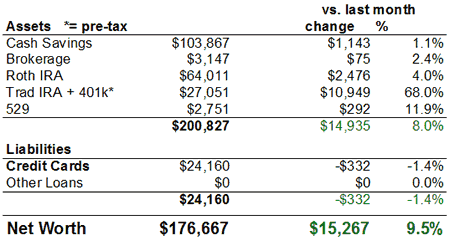
October 2007 Financial Status / Net Worth Update

Net Worth Chart October 2007

About My Credit Card Debt
If you’re a newer reader, you may have some concerns about my high levels of credit card debt. I’m actually borrowing money for free at 0% interest, putting it in high yield savings accounts that earn me 5% interest or more, and keeping the difference as profit. Along with other things, this helps me earn extra side income of thousands of dollars a year. Recently I put up a series of step-by-step posts on how I do this. Please check it out first if you have any questions. This is why, although I have the ability to pay the balances off, I choose not to.

Commentary

Retirement and Brokerage accounts. Last month’s update was right before the drop in the Fed Funds rate, which resulted in another big jump in our account values this time around. In addition, I made a large $10,000 contribution to my Self-Employed 401k at Fidelity.

I’m glad to get our retirement contributions back on track since we haven’t done very much in that department this year. I still have to figure out how much more I want contribute this year, as I do have a some flexibility with the account due to the ability to add profit-sharing contributions. Another thing on my mind is whether to contribute to a Non-deductible IRA this year.

Cash Savings. This actually didn’t go up as much, due to the big contribution to our 401k.

Quick summary. Our non-retirement funds went up slightly to $85,605, which puts us at almost 86% of our mid-term goal of $100,000 towards a house downpayment. Total net cash is at $79,707 (+$1,475 from last month). Take a look back at our previous net worth updates here.

Zecco Trading Changes Free Stocks Trades Offer

Zecco Trading has just changed their pricing for new accounts from 40 free trades/month to 10 trades/month, and there is a new requirement that you must have $2,500 in account equity (cash + value of stocks). If you have less than $2,500, then trades cost $4.50. However, existing customers and anyone who applied before 10/1 will keep the old pricing until the beginning of 2008. After that, everyone will be at 10 free trades/month.

Instead of paying for free trades you may not use, we’re investing that money in the tools and functionality that you will. Over the coming months you can expect:

* Significant investments in the number of service representatives and training.
* Addition of 3 and 4 legged options strategies so you can trade butterflies, condors, and more.
* Release of a sophisticated options analytics platform.
* Access to ZeccoShare, the ground-breaking investor social network at zecco.com.

Zecco is still the cheapest place for my “fun money” account and 10 trades is enough for me, although I’ll have to add some more money into my account in a couple of months to reach $2,500. If you already have an account, log into your trading account for more info; there is also a new offer FAQ. If you are researching Zecco, be sure to check out my Zecco Review (two parts) for some tips to maximize your account. Thanks to Wes for the tip.