This week’s Carnival of Investing is up at My Money Forest. I like that he picked some of his favorites. For more information on participating and the hosting schedule, please check out the main Carnival of Investing page. I’ve been slacking on scheduling new hosts, but I am always looking for volunteers. It’s a great way to introduce your blog to new readers.
Archives for August 2006
How Much Of Your Salary Should You Save For Retirement?
Posted on August 7, 2006 // 25 Comments
This is a difficult question to ask, but this paper I ran across entitled ‘Savings Rates and “Economic Security” in Retirement’ tries to take a stab at it. Here is the abstract:
Some simple number crunching using historical market return data for retirement planning. How much do we need to save to provide for a comfortable and secure retirement?
Here are some of his initial assumptions:
[Read more…]
Introduction and Warnings About 0% Balance Transfer Offers
Posted on August 7, 2006 // 44 Comments
[This is Part 1 of an ongoing series. I am going to break it up into several smaller segments due to time constraints, and keep track of them in this index of posts.]
Most likely you have seen these offers shower your mailboxes, credit card companies enticing you to use their cards with incredibly low interest rates, many even as low as 0% APR. Borrow money for free? Too good to be true. Must be a catch. Well, yes and no. It’s like cooking outdoors over an open flame. If you understand the hazards take the proper precautions, you won’t get burnt and you can get some tasty results.
What tasty result? Simply put – Free Money. You can make major bucks off of other people’s money. So that’s what this series of posts is going to be about. Sure, you can get $100 for a quickie signup bonus, and I do that too. But with this strategy, you can make hundreds if not over a thousand dollars with just one card. I am personally going to make over a thousand dollars this year.
What? Huh? Give me the Big Picture.
There are plenty of reasons for borrowing money for free. The most obvious is to pay down debts with high interest rates – car loans, home-equity loans, even other credit cards. In each case, you would be saving the interest you would be otherwise paying on those loans. That saved interest is money in your pocket.
But what if you don’t have any debt? Well, these days even big banks like Washington Mutual are paying you 5% a year or more on your idle cash. If you were to get your hands on a $10,000 free loan for a year, that’d be roughly $500 at the end. You borrow $10k, keep the $500 interest, and then repay the $10,000 back. Nothing to buy, nothing to sell, just shuffling money around between the credit card company and a bank. You don’t even need to use any of your own money.
I currently have almost $30,000 of borrowed money sitting in the bank right now. I don’t know about you, but making more than an extra grand a year for paying some bills sounds good to me!
What’s the Catch?
Borrowing money from credit card companies is not for everyone. As I’ve been told many many times, credit card companies aren’t stupid. They aren’t highly profitable corporations because of their love of philanthropy. They are enticing you with easy credit for the sole reason that if you don’t pay off your balance in time, they will start charging interest. And lots of it.
Therefore, there are mainly three types of people I’d recommend staying away from credit card companies:
#1 – You Have Poor Credit and/or Carry Balances Regularly – First of all, if you have poor credit, you probably can’t get a really low interest rate anyways. Second, you probably have shown that you can’t handle credit responsibly and very likely may just pile on additional debt by doing these activities.
Then there are people with great credit, but carry balances. Here’s a straightforward rule: If you don’t pay off all your statement in full every month and regularly pay credit card interest, this may not be for you. Check out my Frugal Living section and pay off that debt first. Now, you may consider a 0% balance transfer to lower your interest rate on that debt – that’s probably okay. But I wouldn’t recommend getting any more than that; You might just accumulating more debt.
#2 – You Need A Top Credit Score Soon – These there are some things that require a decent credit score, and some things you want a tip-top credit score for. The best example of this is if you are shopping for a mortgage. Having some balance transfers will not necessarily hurt your credit significantly, but in order to get the best loan rate you’ll want to keep your credit score as high as possible. I am going to probably shop for a mortgage in about a year, so I plan on paying off all my balances a couple months before then. That will give my credit score time to bounce back and peak.
#3 – You Forget To Pay Bills. Here’s another easy rule: If you’ve paid more than one bill late within the last year, this may not be right for you. Credit card companies love when you pay late. They get to charge you late fees and jack up that nice 0% rate to 20%+ instead. You can probably get one late payment forgiven once in a while, but I wouldn’t push it. Now, there are lots of tools to remind you about payments and such which I will cover later, but some people just don’t keep up with their bills all that well. And some people are pretty militant about it, like me.
Going back to my fire analogy, if you’re a pyromaniac or really clumsy, maybe cooking over an open flame isn’t the best idea. Stick with Outback Steakhouse 🙂
Now, I do not claim to be the inventor of this activity, in fact my own mother used low-interest credit cards to help finance my education before I even knew what a credit card was. I will try my best to present helpful and accurate information possible based on my own experiences and research, but I am not perfect.
For those ready to break out the charcoal, the next step is Scouting For 0% Balance Transfer Offers, including how to read the fine print to find a truly good offer. Read on!
—
Skip To Another Part
I. Introduction and Warnings About 0% Balance Transfer Offers
II. Scouting For 0% Balance Transfer Offers
III. Application Tips and Getting Cash From 0% Balance Transfers
IV. Setup And Management of 0% APR Balance Transfers
V. Best Pre-Screened No Fee 0% APR Balance Transfer Offers
0% APR Balance Transfers Index Page
Posted on August 6, 2006 // Leave a Comment
I apologize for not following up with a nice big page on the 0% balance transfer game after asking for requests. I’ve gotten almost 100 questions and just haven’t had time to organize my thoughts while trying to upgrade this site. It is definitely next in my queue.
For now I’ve composed an central page that lists most of my current posts on the topic. As you can see it’s very patchwork, but there is lots of information in there. Please look around, and questions are still welcome.
Save Towards House Down Payment or Retirement?
Posted on August 6, 2006 // 42 Comments
If you know you need a big house downpayment in a year for a $500,000 house, do you:
A) Totally minimize your retirement contributions (just get your 401k match if any), and save everything else towards that downpayment, knowing at best you’ll get about 20% down?
B) Plan to save enough so that you’ll get at least 10% down (enough for a 80/10/10 loan), but put the rest away in tax-deferred accounts?
I’m shifting towards B, as I just don’t know if I want to have so much of our net worth tied up in a house. This way, I have a more balanced distribution as well as more money tucked away to grow until retirement. But then again, I’ll probably have to pay a higher rate for the piggyback loan or PMI. Thoughts?
Converting From Movable Type 3.1x to WordPress 2.0
Posted on August 5, 2006 // 24 Comments
I am in the process of migrating this blog from Movable Type to WordPress. If you see any errors or missing pages, please leave a comment. Thanks! The rest of this entry is not money related.
August 2006 Retirement Portfolio / Cash Snapshot
Posted on August 4, 2006 // 18 Comments
Here is another snapshot of my retirement portfolio as of market close 8/3. I haven’t bought or sold any funds since my last update. I hope to use this data later to better track my overall investment returns.
Free Home Valuation and How To Do Your Own Comps
Posted on August 3, 2006 // 13 Comments
 The house search continues as we try to see how much our parents’ house is really worth and if we can afford to live near them. Besides Zillow.com, I also like the home valuation tool from HomeGain, where you can get a real estimate from a local real estate agent for your house. It’s low pressure, they just e-mail you their estimate and ask if you are looking to buy or sell right now. We were definitely surprised by the number – Zillow was off a lot, mostly due to wrong square footage.
What I really like is that you also get a listing of actual houses that sold recently in the area, with all the stats like address, sale date, square footage, bedrooms, year built, and of course price. And you can keep getting updates every month for free. That way, you can do your own comps and try to spot trends. Burst, bubble, burst!
Why I Use Yodlee Account Aggregation
Posted on August 3, 2006 // 53 Comments
 As I’ve mentioned before, I use Yodlee, an account aggregation service, to track all my numerous accounts on a daily basis. You give them all the logins and passwords of your individual financial accounts, and it logs into all the sites for you. In the end you have a real-time view of all your balances and recent transactions, all neatly on one page.
Of course, many people are rightfully afraid that this leads to one point of access. If somehow Yodlee is hacked, they get all your information instead of just that of one bank. This is true, but I look at it a little differently because I have a lot of accounts.
[Read more…]
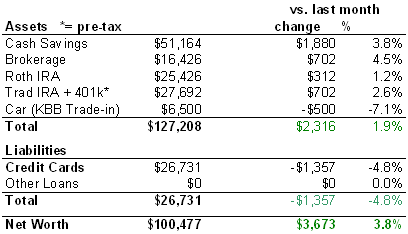
August 2006 Financial Status / Net Worth Update
Posted on August 2, 2006 // 18 Comments
Carnival of Investing
Posted on August 1, 2006 // Leave a Comment
This week’s Carnival of Investing is up at 1stmillionat33. For more information on participating and the hosting schedule, please check out the main Carnival of Investing page. I’m going to line up more hosts this week, so please let me know if you’re interested.
 The Best Credit Card Bonus Offers – 2026
 Big List of Free Stocks from Brokerage Apps
 Best Interest Rates on Cash - 2026
 Free Credit Scores x 3 + Free Credit Monitoring
 Best No Fee 0% APR Balance Transfer Offers
 Little-Known Cellular Data Plans That Can Save Big Money
 How To Haggle Your Cable or Direct TV Bill
 Big List of Free Consumer Data Reports (Credit, Rent, Work)