Archives for January 2006

Motley Fool Interviews Vanguard Founder John Bogle

Speaking of being a BogleHead, I just finished listening to an interview of Bogle on NPR’s Motley Fool radio show, available online here. Thanks to reader Jonathan for sending it to me. John (Jack) Bogle, if you don’t know, is the founder of The Vanguard Group, and is known as the father of index funds.

My favorite part was where the Motley Fool asks him about picking individual stocks. Remember, Motley Fool makes their money by selling their stock picks. You can just feel Bogle trying not to rip them. He holds back and just says “the odds are against you”. Hah. To satisfy the stock-picking urge that many of us suffer from, he recommends a “funny money” account, much like my play money portfolio.
[Read more…]
My 2006 Financial Goals

I dislike resolutions, mostly because I am horrible at keeping them. I tend to look backwards at them, as in “Oh, I resolved to do X back then, but I haven’t. Oh well.” Goals are better for me, because it’s something to focus on with a date attached. I need deadlines! Here’s what I came up with:

Q1 2006

Separate business and personal financial worlds.

Open a SEP IRA for 2005 business income at Vanguard.

Do my taxes and research to maximize tax return.

Roll over Traditional IRA to Roth IRA.
[Read more…]

Maxed Out Both Roth IRAs, New Goal

This last week I maxed out the 2006 Roth IRAs for both my wife and I, a $4,000 contribution for each. I kept it simple and bought Vanguard’s Target Retirement 2045 Fund (VTIVX) for both, tilting our retirement portfolio asset allocation more towards 90% equities.

My new goal is to get $50,000 in total assets at Vanguard. I am at about $37,000 right now. The reason is that once I get to that level Vanguard will waive the $10 annual fee for each IRA mutual fund with less than $5,000 in it. I can then buy lots of specific funds separately and fine-tune my desired asset allocation. I may open up a taxable account and/or a SEP IRA with them to achieve this. Does this make me a Boglehead?

Is HBSC Taking Advantage Of The Float? An Experiment

So apparently from the comments on my last post, I am wrong about all banks taking 2 business days to do a transfer. I thought taking the money out on a Monday and depositing it on Wednesday was about normal for online savings accounts? All this time I’ve never paid attention. So it’s time to set up more experiments. Hey, my classes haven’t started yet, so why not.

I’m going to set up the following transfers on 9-10am Pacific on Monday, and see how long they take. The bolded bank is the one initiating the ACH push or pull.

HSBC -> Presidential Checking
HSBC Emigrant Direct -> Presidential
Emigrant Direct Capital One 360 -> Presidential
Capital One 360 VirtualBank -> Presidential
VirtualBank E*Trade Bank -> Presidential
E*Trade Bank CashEdge as the backend to their funds transfer service. This way we can see if the hold times is solely an HSBC thing, or a CashEdge-wide occurrence.

HSBC Direct Bank-to-Bank Funds Transfer Schedules

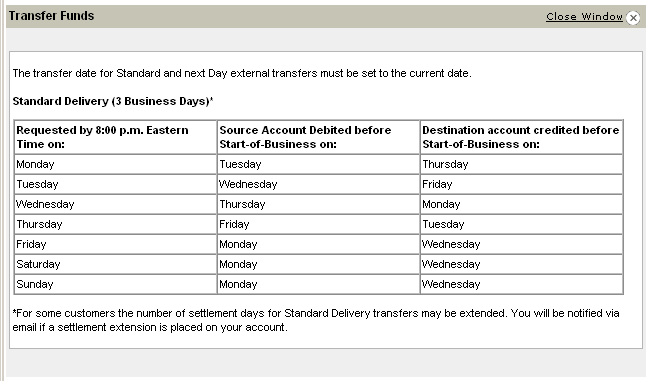
I must admit, after opening up my HSBC Direct account I went ahead and linked all of my numerous other bank accounts (except ING). Other than racking up over $6 in trial deposits, I envisioned having HSBC be my hub for all my interbank transfers. But then I heard some rumblings about how HSBC Direct is really slow with their online bank-to-bank transfers. During the last week, I’ve been shooting various amounts of money around my different accounts, and they have all been following the schedule that HSBC openly discloses. I couldn’t get a link to it as it only works when I sign in, but here is a screenshot of it (click to enlarge):

It’s true, it can take a while if you miss their 8pm Eastern deadline. For example, if you did it on late Wednesday night, it would count as a Thursday submission, and the money would be taken out of the initial account on Friday and wouldn’t be put in the receiving account until Tuesday. That’s almost a week, sort of, and you’d lose 4 days of interest.

But overall, it takes 2-3 business days, which I thought was about industry standard. Sunday through Tuesday are the best days to initiate transfers in order to minimize transfer time and lost interest. Next week I’ll try the other online banks and see how they compare.

Smoothing Out The Cashflow

Even though I track our net worth monthly, it can be difficult to determine exactly how well we are building our wealth due to large recurring expenses we have that do not bill on a monthly basis. For example, we may have saved up $1,000, but if it happens to be time to pay our insurance dues then all that may be gone. Also, our savings in later months will then be inflated. So I am going to try and smooth out these bumps by creating an account to send monthly payments too in preparation for an upcoming bill. So instead of a $600 bill in 6 months, I will put away $100 a month into a high-yield savings account and pay off the bill when it comes due with no spikes in our net worth.

First, I need to make a list of all the expenses and their billing interval:
[Read more…]

Equivalent Interest Rate For T-Bills / Savings Bonds Calculator

I whipped out my ancient how-to-make-a-website book, and made a simple but handy JavaScript calculator for calculating the equivalent bank CD rate for a given T-Bill or Savings Bond rate, as the interest from them are exempt from local and state taxes. This uses the rate conversion formula previously given. Remember, marginal means the tax rate at which your last earned dollar is taxed. Please try it out and let me know if something’s broken:

Calculator:


Enter your marginal federal income tax rate:
%
Enter your marginal state/local income tax rate:
%
Enter the T-Bill or Savings Bond interest rate:
%

The approximate equivalent bank rate is:
%

For example, at my 25% Fed and 9% State tax rates, the current 4.14% rate for a 4-week T-Bill is the equivalent of a 1-month bank CD earning 4.70% annualized.

Note: The above calculator does not assume that you will itemize deductions and deduct your state taxes from your federal taxes. Even if you do itemize, I would note that everyone gets the standard deduction, so it’s not necessarily fully deductible.

Useful Resources:
Recent T-Bill auction results
2006 Federal Tax Rates
State Income Tax Rates

Look At Me, I’m a Sole Proprietorship!

2005 has come and gone, and it’s about time to worry about income taxes again. I had various 1099 income in 2005 from consulting, this blog, and freelancing activities. I’m very green to all of this self-employment stuff, so it’s all a bit overwhelming. Apparently, by default, I am in business as a sole proprietorship. Because I am running a business, I can get tax deductions from business expenses. This will help alleviate the 50% self-employment tax-bite I was pondering earlier. But my recordkeeping was so shabby I won’t get everything I could have. For example, I can deduct the cost of webhosting for this blog, but not any of the mileage driven to my consulting gigs.

I plan on being much more organized this year. For example, all mileage that I drive for freelancing will be logged carefully on a clipboard in my car. Also, I plan on opening business checking accounts to track self-employment income and business credit cards to track expenses.

Carnivals

Don’t got ’nuff money writings to read? Check these Carnivals out:
Carnival of Personal Finance #30
Carnival of Debt Reduction #17
Festival of Frugality #5
Carnival of Investing #4

$100 in Free Target Gift Cards Coming My Way

Target LogoMy first statement for my Citi Professional Card closed recently, and I just checked my rewards balance for the promised free $100 gift card. To my delight, my 10,000 free ThankYou Points have already been deposited! I swiftly went to the ThankYou Rewards site and traded them in for two $50 Target Gift Cards. I shop regularly at Target, so it’s basically the same as cash for me.

It seems that once you get to the $50 range, 1 point = 1 cent in gift cards. It was hard to find the Target reward option, but the search function saved me. Other good rewards options I found were Shell and Exxon/Mobil Gas Cards or Gap/Banana Republic/Old Navy Gift Cards. For those with student loans, you can even get a $100 loan payment for the 10,000 points. Here’s a screenshot of my points:
[Read more…]

Book Review: Yes, You Can Time The Market!

Yes You Can Time the MarketThe predominant investing mantra nowadays is to pick some nice index funds and stick with them, since you can’t know when the market is going to go up or down. In this appropriately titled book Yes, You Can Time The Market!, Ben Stein and Phil DeMuth argue against that. Instead of using fundamental valuation, where someone tries to analyze a company and find it’s “true” value vs. market value, they argue that a market index as a whole, such as the S&P 500, can be viewed as cheap or expensive by comparing it against it’s 15-year moving historical average.

For example, you can take the average of the P/E ratio of the S&P 500 for the last 15 years. If the current P/E ratio is greater than that average, then it is overvalued. If the current P/E ratio is less, then it is undervalued, a signal to buy. (Right now it’s 25 vs. 19, undervalued.)
[Read more…]

Discover Miles Card: How I Got My Free Money

Please also see my updated guide on
How To Make Money From 0% APR Balance Transfers

I just finished setting up my free money from my recent Discover Miles Card application. As mentioned in my best 0% APR offers list, it offers 0% APR for 12 months on both purchases and balance transfers, no balance transfer fee, and 5,000 (now they offer 12,000!) free miles after the first purchase. Here is a real-life example of my post on how to do these deals.

1) Applied online, and requested a $7,500 balance transfer (BT) to a Citi card, and a $7,500 BT to an American Express card on the third page after the 7 steps. (It’s there, you can put in junk to test if you want) I always ask for more than I think they’ll give me. They ended up giving me a $11,000 credit limit, with a $5,000 BT to each card ($10k total). Not bad as I already have balances elsewhere. It took some time for the application to go through, but it went through smoothly.

(Note: I would usually just send it to one card, but I wanted to make sure American Express still worked for negative balances.)

(Note 2: Per the Terms and Conditions, you need to request the balance transfer with the application in order to have no balance transfer fee. If you wait until you already have the card, there may be fees.)

2) I got the card, and activated it. One day after getting my card, the two $5,000 balance transfers showed up in both of my Citi and AmEx accounts.

3) I secure messaged Discover to make triple-sure that I had no balance transfer fee to pay, and that I could make both purchases and balance transfers at 0% APR for a year. I got a message back in 24 hours that confirmed it. Gonna keep a copy of that message just in case, but I’m just paranoid like that.

4) I went online to Citibank and requested a credit balance refund as shown in this post. They had to “verify the payment was legit”, but approved my check in a couple days. No humans, easy as pie.

5) I called American Express and said I had an overpayment and asked for a check be sent to me for the overpayment amount. They approved it over the phone without any trouble at all. Two $5,000 checks coming my way in about 5 business days!

6) I paid my cell phone bill with the Discover, so I’d get the 5,000 miles for the 1st purchase. These are Discover-specific “miles”, so I’ll need to figure out the best way to cash these out. It seems 10,000 miles give you a $100 credit on a plane ticket, but there are other non-travel rewards too. Therefore, I estimate the bonus 5,000 miles to be worth $30-$50. I can do this without worrying about interest because the purchases are also at 0% APR for this offer.

7) Once the first statement closes, I’ll set up my automatic online billpay as described here, and I’ll be pretty much set. Even though Discover uses two-cycle billing, as long as I pay it all off before the 0% period ends I’ll be safe.

(Although two-cycle billing is less desirable than other billing methods, it shouldn’t matter here as long as I pay off the balance within the correct deadline. What two-cycle billing does is eliminate your grace period, but balance transfers have no grace period anyways.)

Total time spent: About 20 minutes
Total potential money earned before taxes: ~$490

~4.5% interest x $10,000 x ~12 months = ~$450
5,000 bonus miles = ~$40

This is a rough estimate, but interest rates will also rise as the year goes on, so it should balance out. Typing this post took longer than it took to do the deal, so I hope it helps some people out 😉