Search Results for: feed

Cook It Yourself: Learn a Skill, Save Money, Improve Your Health

I’m still into the “Cook It Yourself” movement/meme/trend/whatever. If you’re looking for a new year’s resolution and consider yourself a DIY person, why not CIY in 2015? Knowing how to cook simple, delicious food is a great skill to have and it can’t be bought with money. Here is a collection of articles and quotes related to this idea.

Corporations cook differently than humans. The New York Times has a neat article called What 2,000 Calories Looks Like. Basically, industrial food is made to be cheap but tasty. That usually involves adding a bunch of salt, fat, and sugar. So, you could have a single peanut-butter milkshake (2,090 calories):

200cala

Or you could cook yourself a feast including pasta, potatoes, eggs, chicken wings, turkey chili, coffee, and even beer and stay within 2,000 calories:

200calb

Writers, nutritionists, doctors, chefs and Michelle Obama have all been promoting a hot new diet: home-cooked food. “People who cook eat a healthier diet without giving it a thought,” Michael Pollan recently told Mark Bittman, both authors and advocates of the cook-it-yourself diet. “It’s the collapse of home cooking that led directly to the obesity epidemic.” The magic of the diet, its advocates say, is that it doesn’t mean skimping on portions or going without meat, eggs, cheese, alcohol or dessert.

This is Michael Pollan’s position of Eat Anything You Want, Just Cook It Yourself, as put into a short 2-minute video:

Well-known food writer Mark Bittman has a new book called How to Cook Everything Fast which mixes the right recipes with time-management tips to bring homemade food to tired weekday cooks. You can find a long list of reviews for it here. I enjoyed his quote that “the most radical thing that you can do for your health, if not the world at large, is cook.”

Here’s another good 2-minute video with Mark Bittman taken from the Time article The Truth about Home Cooking that explains some of his philosophy.

When I talk about cooking, something I’ve been doing for the better part of five decades, I’m not talking about creating elaborate dinner parties or three-day science projects. I’m taking about simple, easy, everyday meals. My mission is to encourage novices and the time- and cash-strapped to feed themselves. Which means we need modest, realistic expectations, and we need to teach people to cook food that’s good enough to share with family, friends and, if you must, your Instagram account.

Because not cooking is a big mistake—and it’s one that’s costing us money, good times, control, serenity and, yes, vastly better health.

Don’t let the corporations convince you that cooking is too hard; it really is doable if you avoid the common pitfalls and plan ahead. I agree with Bittman in that you should learn to make food you really want to eat, first and foremost. See if these Bittman recipes excite you: quick spaghetti squash or quick chicken parmesan.

Want more recipe ideas? Skip the poorly-chosen recipe from Sam Sifton’s Home Cooking Manifesto and try these 10 realistic recipes from Megan McArdle instead. Also see the links inside my Dinner A Love Story book review.

Feel free to share your own links and thoughts in the comments.

Season’s Greetings!

fam2014a

Thank you very much for reading My Money Blog this year. It’s now been over 10 years… where has the time gone! I still look forward to learning and sharing something new every day. Here’s hoping that you are happy, healthy, and moving ever closer toward your goals.

Remember that you can follow updates via RSS feed, daily e-mail subscription, following me on Twitter, or liking my Facebook page.

True Meaning of Christmas: Making a Charitable Giving Plan

giftbox2If you celebrate Christmas, you may have seen this quote about keeping with true values behind the holiday:

Want to keep Christ in Christmas? Feed the hungry, clothe the naked, forgive the guilty, welcome the unwanted, care for the ill, love your enemies, and do unto others as you would have done unto you. – Steve Maraboli

Along those lines, now is the time that many people donate to the charities of their choice (plus it’s the end of the tax year). Carl Richards of the NY Times makes a good point it that you should create a charitable giving plan and then stop feeling guilty all those other times you get asked for money.

Whether you donate time, money, or whatever, make a conscious choice as to where to give. Use the best charity comparison websites to find those that are financially healthy, committed to accountability and transparency, and creating measurable results. I wish there was an option for charities that promise not to bombard you with future letters asking for more money. Arrgh.

We created our first charitable giving plan in 2010 and have been doing it every year since. It definitely helps to sit down with each other and discuss our priorities. Some of the charities have changed, but I’m happy to say the total amount donated has grown.

I won’t lie, it also makes me feel better about the huge pile of presents our two little girls have from our generous friends and family!

State-by-State Guide to Pregnancy and Work

babygate2The laws regarding pregnancy and employment can be confusing and are often misunderstood. Via the NYT, the group A Better Balance has put together Babygate, a free, easy-to-use, state-by-state online resource for working parents and soon-to-be parents.

Know your rights regarding pregnancy discrimination, paid and unpaid family leave, temporary disability insurance, breastfeeding, and more. The guide also breaks things down into the periods when you are pregnant, leaving work, and returning to work.

There is also a book which helps with “managing the realities of parenthood at work, from handling morning sickness, to figuring out maternity leave, to securing time and space to pump breast milk.”

Zmodo All-in-One sPoE DIY Security Camera System Review

I’ve always been intrigued by those multi-camera home security systems that you see walking around Costco and Sam’s Club, so when I was asked to review a similar unit I took the opportunity. Here is my review of the Zmodo 4 Channel Complete sPoE NVR Surveillance System w/ 1TB HDD, done from the perspective of a mainstream consumer who wants an affordable, DIY-installed security camera setup at home. I will not be nitpicking camera specs or exploring hacking options.

Cost

My specific package model is ZP-KE1H04-S-1TB, which currently has a list price of $349.99 with free shipping on Amazon. Note that this package comes with a 1 TB hard drive pre-installed, whereas other Zmodo packages do not include a hard drive so that you can size it as you like. (There are many grouchy online reviewers who didn’t notice this fact.) This budget-friendly version has 4 channels (4 cameras recording at once), while more expensive models come with 8 channels or more.

What’s In The Box

zmodo1

  • 4-channel security NVR with a 1TB hard drive (ZP-NE14-S) with USB mouse
  • 4 720p bullet IP network cameras (ZP-IBH15-S)
  • 19V 3A power adapter, 3′ CAT5e network cable, two 50′ camera sPoE cables, two 80′ camera sPoE cables

What You Need To Supply Yourself

  • External display with VGA input and VGA cable.
  • A wireless router with one empty port (for remote viewing).
  • Always-on High-speed internet connection with minimum upload speed of >256kbps (for remote viewing).
  • Android (v.2.3 and up) or iOS (v.5 and up) mobile device (for smartphone app viewing)
  • Windows XP, Vista, or 7 + Internet Explorer 6 thru 11 (for desktop viewing).

Setup & Installation

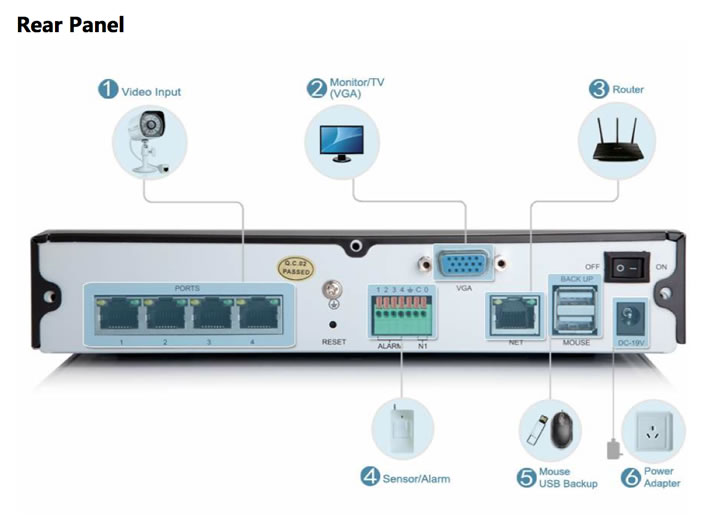
If you buy this unit with the hard drive pre-installed, setting everything up is literally plug-and-play. (Of course, installing the hard drive just takes a screwdriver.) You simply connect everything according to the diagram below. Make sure everything is connected first and then turn on the unit, and the unit will automatically recognize the cameras and display them on your monitor. I was up and running (with the cameras on my coffee table) in under 10 minutes.

zmodo2

sPoE stands for simplified power over ethernet, which means that both power and video signal travel through one cable to the camera. You’ll still need to drill holes and such for cable installation, but you don’t need to route an additional power cord to every camera. Definitely easier, and many budget systems don’t have this feature. Included are two 50 ft cables and two 80 ft cables. If you need more, you can use standard Cat5 ethernet cable. The only hard part is deciding where to position your cameras and installing the cables, which for me required crawling through the attic. I am also simply pointing one out the window.

The NVR (network video recorder) is like a simplified computer with a hard drive, mouse, ethernet port, and monitor port. You view live streaming video on your connected monitor, desktop computer over internet, or smartphone app via internet. You can only view stored video when on your home network. You can make backup copies to a USB flash drive. The NVR must connect physically to your router via ethernet cable.

More Impressions

I personally barely met the minimum requirements as the only VGA-capable monitor I have currently is our living room HDTV bought in 2007. Also, I have no Windows computers either, so I am restricted to either viewing on my home’s only TV or via smartphone app. I wish they allowed more control via web browser.

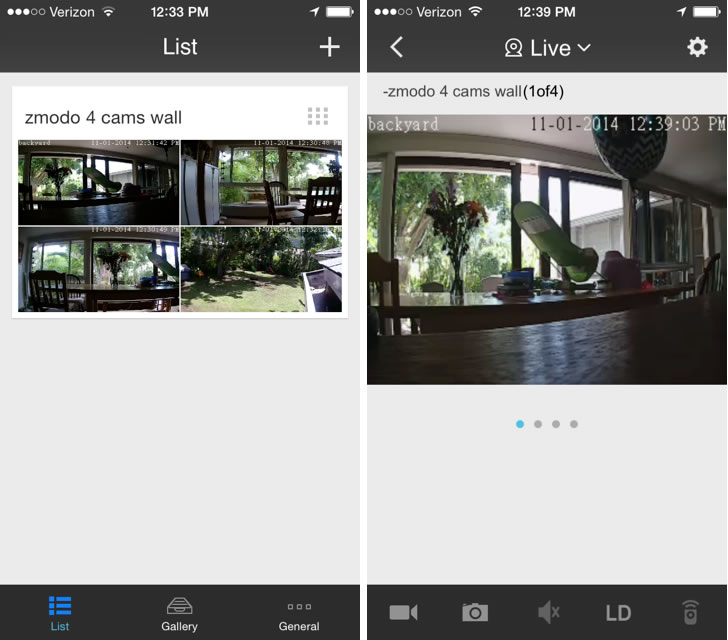
I primarily use their iPhone app, which thankfully works fine on work WiFi or cellular 3G/4G data. You can link up your app via a quick QR code scan, but if your smartphone is already on the same WiFi network it also finds your cams automatically. Both are simpler than the traditional method of setting up port forwarding. I can enable motion detector alerts via the app as well as through e-mail. The motion detection is rather sensitive, and you’ll get a lot of alerts if you aim it at windy trees. You can adjust the sensitivity on the main box, but not via app.

The 720p camera video quality is significantly better than my previous Samsung Smartcam indoor WiFi cameras. Daytime video has good colors and night video is crisp. Each camera as 24 infrared LEDs which improves illumination and are quite noticeable at night with a red glow (good for scaring off criminals?). Again, I can’t compare directly with other HD cams but the picture is more than satisfactory. You can also toggle between high and low definition streaming.

zmodo3

The IP cameras have an outdoor “weatherproof” casing that feels durable and high quality. They are IP-rated 65, which means it is dust-tight and can withstand low-pressure water jets from any direction. The box says the camera’s rated operating temperature is 14 F to 122 F so I’m not sure about extremely cold climates. You mount the cameras with screws, so the only real tool you need is a drill and screwdriver.

With a 1 TB hard drive, I can keep 30+ days of past footage from all 4 cameras using their “intelligent” setting which increases the video quality when motion is detected but maintains a lower quality when there is no motion detected. The recorded footage is marked with times of motion detection, so that you can go directly there without viewing the entire thing.

If you compare this with the popular Dropcam Pro, that only comes with one indoor camera and costs $200. Dropcam also has easy installation and live streaming to smartphone, but no storage option unless you pay at least $10 a month for cloud storage. The video data travels via WiFi, but you still need a power cable so that’s still one cable going to the camera. So the Dropcam offers cloud storage capability and easier portability, but this Zmodo package offers four indoor/outdoor cameras and 30 days of hard drive storage for no ongoing cost. I think the Zmodo is ideal for small business owners that want an affordable security option and the ability to review lots of past video, and also for homeowners who want permanent, outdoor surveillance and are willing to perform a DIY installation.

Pros

  • Quick setup and easier installation with power through ethernet cable.
  • Past 30+ days of video stored on included 1 TB hard drive.
  • Access live video feed from PC or smartphone.
  • Free in-app motion alerts.
  • Can connect with traditional alarm system.
  • Competitive pricing.
  • No ongoing monthly fees which add up to $100+ a year with other cameras.

Cons

  • Doesn’t interact with other home automation protocols.
  • Can’t remotely reposition cameras.
  • No Mac OS X support (iOS app available).
  • No cloud storage option.

I received this unit for free to review with no editorial restrictions and no other compensation. All opinions expressed are my own. You can interact with Zmodo and enter periodic contests via their Facebook page.

Baby Gear Reviews: Baby Bottles and Accessories (Part 3)

azbottlesHere is Part 3 of my series on baby gear, organized in the order of Amazon’s Baby Registry. The entire multi-part series can be found with the Baby Gear tag here. This time I’ll talk about our experiences with baby bottles.

Our first baby was colicky and not a great eater, and that is really where these bottle companies make their money. Design a bottle nipple that reduces the unstoppable crying of colic, and we’ll gladly pay upwards of $6 per bottle. Heck, if it really worked I’d pay $50 a bottle without blinking an eye. The basic idea is that air is being swallowed when air backflows into the nipple during drinking, which supposedly causes colic. So the fancier bottles all have some mechanism to alleviate that vacuum.

Our babies were breastfed, so we got a “free” Medela breast pump (it was covered by our health insurance). Thus, we started out with a few Medela brand bottles. Baby didn’t like it. Between purchasing and borrowing from friends, we ended up trying most of the brands: Medela, Born Free, Playtex, Tommee Tippee, AVENT, and Dr. Browns Natural Flow. We tried the last three because they were the most recommended by the Baby Bargains book.

The two that ended up working best for us were:

tippee

  • Tommee Tippee – The silicone nipple does look most like a human nipple with a wide base, the construction felt of high quality, and the wider bottle was easier to hold in my palm. Keep the air vent hole facing upwards so milk doesn’t block it. On the expensive side.
  • Playtex Drop-Ins with the Latex Nipple – I bought this when desperate in a drugstore after reading a recommendation from a parenting forum. Latex is softer than silicone and thus feel more natural, although silicone is more durable and some babies are allergic to latex. The collapsible liners are convenient and eliminate vacuum but are not eco-friendly. Really, it was all about the soft latex nipple.

All bottles sold today should be BPA-free, I would check if you are using hand-me-downs. I would also note that you can buy nipples with different-sized holes that change the flowrate, your baby may prefer one to another and that could make a big difference in itself.

Other things to buy. As for accessories, a simple dishwasher basket was a very good buy; we’ve used it daily for 2 years now for all kinds of small kiddie things, even after we stopped using bottles. A good bottle brush is also helpful for thorough cleaning.

Other things we didn’t buy. We did not buy any bottle sterilizers or bottle warmers. When we had our first child, I think the first two weeks we boiled water and manually sterilized the bottles every time. What a pain. After that, we only sterilize them before the first use. Now we just wash them with warm, soapy water or use the dishwasher and rinse them well. Hot tap water works fine for warming milk or formula. When eating out, we simply ask for some hot water like they would serve for tea. If you formula-feed, the advice is to start them at room temperature and your baby will be fine with it. Our pediatrician agreed these were unnecessary. Perhaps they are wonderful inventions, but I don’t feel like I’ve missed out.

  • Verdict: There are endless combinations of nipple shapes and bottle designs. I’m sure some babies will drink from anything. For us, there really wasn’t a huge difference between any of the bottles, but I listed our two favorites above. If possible, try to borrow different bottle brands from friends to try out.

New Phased Retirement Program Details For Federal Workers

opmI’m always interested in non-traditional retirement stories, and saw that the US government just released their final regulations on Phased Retirement for federal workers. Phased retirement in general refers to transitioning from full-time to part-time work for a period of time before a traditional full retirement.

Participants will be able to start working half-time while collecting half of the pension they would get if they were to fully retire at that date. Then, when they fully retire, they’ll get the other half of their pension, adjusted for the additional work they did while being part-time. At least that’s my version of their lengthy explanation:

At entry into Phased Retirement, the employee’s annuity will be completed as if fully retired and then divided by two. That annuity would be paid while the individual worked a half time schedule receiving half pay. […] When the Phased Retiree fully retires, there will be a computation of the annuity that would be payable if the employee had been employed full time and then divided by two prior to adjustment for survivor benefits. That amount would then be added to the original Phased Retirement Annuity, and that combined amount would then provide the basis for survivor annuity adjustment and benefits.

Participants will also get to keep their health and dental insurance, access to Thrift Savings Plan, and many other benefits. Fedweek has created a Federal Employee’s Guide to Phased Retirement [pdf], which is a lot easier to read than the actual regulations.

According to this Reuters article, the program should both save money and retain talent:

For the government, the program is expected to be a money saver. The Congressional Budget Office estimated recently that 1,000 employees might take advantage of phased retirement annually, and would continue work for three years. That would cut required contributions to the government’s pension system by $427 million from 2013 to 2022, and boost worker contributions by $24 million.

But phased retirement also will help the government retain talent and expertise at a time when the “brain drain” from an aging workforce is a major concern. About 600,000 people, or 31 percent of the federal civilian workforce, will be eligible for retirement by September 2017, according to the U.S. Government Accountability Office. Phased retirees will be required to spend at least 20 percent of their time mentoring younger employees.

Employess under the legacy Civil Service Retirement System (CSRS) will be eligible for phased retirement at age 55 with 30 years of service, or at 60 with 20 years of service. Federal Employees Retirement System (FERS) employees must be age 60 with 20 years of service, or have 30 years of service and have reached their minimum retirement-eligible age. Agencies can send their Phased Retirement applications to OPM for processing starting November 6, 2014.

I think this is a neat idea and it looks like there will be strong interest. I hope the idea spreads. Even if your employer doesn’t offer an official policy on phased retirement, I know of several folks who have made their own custom arrangements.

Early Retirement Lesson #3: Home-Buying and Mortgage Advice

housemoneyHere’s another installment of what I would tell my kids about pursuing financial freedom (if they weren’t still in diapers). Previous topics have included the importance of savings rate and whether to focus on earning more or spending less. This time, I wanted to talk about buying a home and mortgages.

Should you buy or rent? Now, there are many buy vs. rent calculators. Here is the best one in my opinion. But as they say garbage in, garbage out, so be careful. Your answer will strongly depend on unpredictable things like future investment performance and/or home price appreciation. In general, the longer you plan on staying in a geographical location (say at least 5-7 years), the better it is to buy your own place. But if you are the nomadic type and want to travel the world, then renting can work out to be much better. In my experience, buying a house often ends up a lifestyle-based decision and not just about the numbers.

If you decide to buy, my opinion is that you should adjust your mortgage size and term to coincide with the date of retirement. I define retirement as when your expenses are exceeded by your non-work income like pensions, Social Security, annuity payments, stock dividends, rental income, or other investment income. Example scenarios:

  • If you love your job and plan on working for the next 30+ years, then go ahead and get a 30 year mortgage. Maybe you have a job that you could work part-time or isn’t very stressful. In this case you have lots of human capital and a long stream of future work income. Take on the 4% interest rate fixed for 30 years, and over time your salary will rise with inflation while your payment stays the same. Be sure to buy a house that you can afford while still investing for retirement. If anything, you could do a DIY biweekly payment plan and pay off that 30-year mortgage in under 24 years.
  • If you have the early retirement bug and want to retire in 15 years, then you should find a home that you can afford with a 15-year mortgage. The interest rate will be lower and as long as you can swing the payments in the beginning, you’ll quickly get used to it. The hard part is to find an affordable home with those higher monthly payments. The hardest part is to be satisfied with it as you’ll have the option and expectation from others to spend more. This is why I think the 15-year mortgage is a powerful tool for aspiring early retirees. It forces you to commit to a long-term lifestyle that fits your goals. Buy a house at age 25, and you’ll be done by 40.
  • Let’s say you receive a monetary windfall (inheritance, huge raise, IPO) and all of a sudden an early retirement is on the table. I wouldn’t necessarily pay off the mortgage completely if you aren’t ready to retire yet. You’ll want to balance the opportunity to invest in potentially higher-returning investments (stock mutual funds, dividend-paying stocks, other real estate) with pursuing the benefits of having a fully-owned house (less stress, less leverage, lower required monthly expenses). My solution would be to pay enough of the mortgage down such that with your usual monthly payments it advances your mortgage payoff date to match your retirement date. If you won the lottery and that date is tomorrow, then yes pay it all off!

One of my reasons for matching mortgage payoff with retirement date is psychological. When you are working, your paycheck is the same every month. This matches well with a fixed mortgage payment. But investment income is often variable. If the tenant in your investment property decides to squat and you have to spend months going through eviction proceedings, your rental income may drop to zero for a while. Many experts now recommend a dynamic withdrawal strategy from your investment portfolio, which would also result in a variable income. But mortgages are like an alligator. You must feed it; if you don’t then it eats you. Other expenses like travel and dining out, those can be adjusted. So I don’t like the idea of having a mortgage in retirement, especially if it is a large percentage of your overall expenses.

However, paying off the mortgage too early can also cause regret if the stock market is rising while you’re piling money into a 4% mortgage. If you are still in the accumulation phase, at times like now you’ll be reminded that you could be investing your paycheck in the market generating higher returns. But if you’re retired, that meant your nest egg was already big enough. If the market goes up, your next egg goes up and you are happier. If the market drops, hey, you already have a paid-off house. So that is why I don’t recommend paying off the mortgage too early, either.

Finally, early retirement with a paid-off house is great because lower expenses means smaller withdrawals from your portfolio, which also means a lower overall tax rate. In fact, with a mix of Traditional and Roth IRAs, we’ve seen that a couple could withdraw over $50,000 a year and still pay zero taxes on retirement. A lower income can also help you qualify for things like health insurance subsidies.

Short version to my kids: If you want to retire early and don’t move around much, buy a modest home where you can afford a 15-year mortgage payment and save at least 25% of your income. If your lifestyle entails lots of moving around, rent and save 50% of your income.

(Related: Pay Off Mortgage Early vs. Save More For Retirement? Digging Deep Into The Details)

Financial Literacy Cartoon for Kids Starring Warren Buffett

smcSecret Millionaires Club (SMC) is an animated series about a group of kids learning how to make good financial decisions and solve business problems. Episodes are available online for free. Their mentor is none other than Warren Buffett! Here’s part of a Reuters interview with Buffett regarding his involvement.

Q. How do financial literacy and entrepreneurship fit together?

A. Not everybody’s going to be an entrepreneur, but everybody should be financially literate. Financial literacy is a base requirement like spelling or reading or something of the sort that everybody should acquire at any early age. The financial habits you develop when you are young are going to go with you into your adulthood. But you can’t be an entrepreneur unless you’re financially literate.

They also run the annual Grow Your Own Business Challenge (GYOB), a nationwide contest for entrepreneurial kids aged 7 to 14. This year’s finalists included an intergenerational online community, a custom bow tie business, a worm composting kit, and a community garden that also helps feed hungry children. You can watch their pitch videos on YouTube.

After watching a few episodes, they are actually pretty good. The concepts are short (~5 minutes long) and digestible. Here’s the first one:

 
Starting a tiny business may be the funnest and thus most effective way to teach kids about money. As a parent, I’d much rather do that than give them an allowance and then force them to “save” a certain percentage. (Is it really saving if it’s not optional? Sounds more like a tax.)

Reader Story: Early Retirement by Age 40 with Income-Focused Portfolio

The following is a guest post contributed by reader Bob, who started getting serious about financial freedom about 10 years ago and plans to reach early retirement next year at age 40. Thanks Bob for candidly sharing about your personal experiences and income-oriented portfolio.

monodiv_220I started following Jonathan’s blog about five years ago because I shared the same interest in personal finance and the goal of early retirement. I’ve made a lot of investing mistakes over the years, but with my 40th birthday coming up later this month I thought I’d share my approach which had the primary goal of income generation and capital preservation.

My initial goal was to cover my fixed expenses each month (housing, transportation, utilities, etc) from investment income. Once I had covered my fixed costs I expanded the goal to full income substitution for an extended period of unemployment (24 months), and later to full income substitution for 10-15 years. I’d like to say I was focused on a fixed target, but as with everything targets changed based on circumstances.

I started focusing on saving in the summer of 2005. I had graduated with an MBA and took a position at an Investment Bank in New York. I completed my MBA at the University of Texas at Austin largely because the tuition was low and I could graduate debt free. Looking back, this decision turned out be a very good one as I was able to secure a high paying job while investing relatively little in my education. In my view, maximizing revenue and minimizing costs is what personal finance is all about. However in life’s little ironies, I ended up paying through the nose for my wife’s graduate degree at UT in 2013-2014 but at this point we are far more capable of supporting this investment.

One thing I learned early on was that I did not want to be working in investment banking beyond ten years. The job takes a lot out of you and while the money is good and you learn a lot, it can be a very volatile business. Given the volatility in the markets and our annual bonus I decided I’d invest largely in fixed income and as a single guy in New York it made sense to look at tax-free munis. I don’t pretend that I had the foresight into the real-estate and financial crisis of 2008-2009 but I did witness a lot of risk taking and leverage deployed in the pursuit of returns.

I will not go into all details of my portfolio rather I’ll just go over the highlights.

$800,000 in taxable accounts which generate about 6.5% yield through investments in closed-end funds, utilities, and REITs. The vast majority is in muni bond funds as I’d prefer tax free income but qualified dividends also enjoy a lower tax rate. REIT income offers no tax advantage but I hold them as until recently we always rented our home. There is obviously a high degree of interest rate risk in my portfolio, but given I have deployed leverage in other part of my portfolio I’m comfortable with it. Overall I think taxes will go higher and so I’d much prefer munis to treasuries. I also hedge my bond holding by selling naked puts on the TBT (leveraged short treasury ETF). This has the positive impact of boosting my cash returns and hedging my long bond position.

$100,000 in LendingClub which generates a 7-8% return inclusive of defaults. I was hoping for a returns closer to 9% but given the institutional money chasing loans and tepid demand for loans it is not a surprise returns are lower than expected. Hopefully LendingClub does not relax underwriting standards in pursuit of loan growth. I still like this asset as the loans are short-term, payments include interest and principle, and you can invest as little as $25 at a time but I’ll moderate my contributions in the future.

$200,000 in direct real-estate investments through RealtyMogul and Fundrise. I only started investing nine months ago, but I have aggressively added to this asset class. I get geographic diversification across the country and by assets class (residential, commercial, debt, equity) and you essentially cut out the fees paid to fund managers and REITs so I see this as a win-win. It is still too early to estimate returns, but I’m hoping tohttps://fundrise.com generate 7.5% on a cash on cash basis and any capital appreciation would be a bonus. Most of the investment promise IRR’s north of 10% so I think the 7.5% is reasonable. I also think this asset class will prove to be better than LendingClub given these are secured investments and debt financing is cheap. On the downside there is zero liquidity, lead times are very long, and the minimum investments are very high.

Overall I’m generating about $6200/month in tax advantaged income and my goal is to eventually get this up to $7000. My savings suffered over the last 12 month as we incurred costs for my wife’s graduate degree, we relocated from Berkeley, CA to Austin, TX and we purchased our first house. I feel confident in ramping up savings over the next months and hitting full income substation before my 41st birthday next year.
I’m sure other will ask how I intend to offset the impact of inflation I also have $500K in tax deferred retirement (IRA, 401K) accounts but these are broadly diversified across domestics and international index funds so not much to say. I think continuing to invest in tax deferred accounts along with real estate investments will help offset the impact of inflation.

If you have constructive questions or feedback, please leave them in the comments. Please remember to be respectful! If you’d like to share your own story, please contact me.

Early Retirement Lesson #2: Earn More vs. Spend Less

Here’s more of my “old man wisdom” about early retirement. I call it that because the lessons that I learned may or may not fully apply to you, but they worked for me and that is why I’m sharing them. Last time I talked about savings rates and how you need to save between 30-50% of your income in order to retire early. That’s a lot, and it leads to another long-running debate: Should you spend your energy trying to earn more money, or spend less money?

The “Earn More” or Capitalist argument is that you can’t save your way to being financially free. You need more money. You need a positive attitude, the willingness to work hard, and a desire to be rich. Capitalists tend to talk about things like entrepreneurialism, multiple streams of income, passive income, leverage, real estate opportunities, and occasionally some sort of multi-level marketing program like Amway or Herbalife.

The “Spend Less” or Frugalist argument is that unnecessary spending is the core problem. You don’t need all that stuff. You just need more spending discipline. Most American households have an amazing, luxurious lifestyle with huge houses, more than one car per person, and enough calories to feed a football team. People who earn more, just spend more. It is amazingly common to earn $250,000 a year and still live paycheck-to-paycheck. Look at athletes like Antoine Walker and Vince Young who have each earned over $100 million and $30 million respectively but still filed for bankruptcy shortly after they lost their jobs.

The easy answer – which I have used myself – is to do both. What a cop-out answer! 🙂 Let’s try harder.

Studies have found that happiness is doesn’t go up after $60-$75k of annual income. Why is that? Perhaps it is because $60k will get you all the you need to be physically and socially comfortable. A house that isn’t embarrassing, reliable transportation, the ability to enjoy a dinner at Applebee’s with friends, the ability to travel occasionally. The median household income in the U.S. is roughly $51,000 a year. $60,000 is roughly 20% higher than that, making you “above average”. If you were to upgrade to a gated community, a Bentley, eating at 3-star Michelin restaurants, flying only on full-fare business class tickets, that won’t get you any better-quality friends. If you already make $200k and aren’t happy, then making $400k or $800k won’t make much difference.

Back to that 50% savings rate. If you’re happy with spending $60k (on average people spend 97% of their income), then you’d need to earn roughly $120k in order to save half. That seems like a good upper bound. If I already earned $120k or more, I’d probably focus on adjusting my spending to the 60k level instead of trying to make more.

On the flip side, as your income drops far below the median you start feeling the pinch more and more. A family of three that earns under $25,000 a year can be eligible for food stamps and other government subsidies. Earning $50k and saving 50% of that means living on $25k a year without being eligible for most government subsidies. Now, some people do live on less than 25k, but is rarely by choice (extreme counterexample). If I earned $50k and really wanted financial freedom, I would focus my energy on earning more money.

Now these numbers should probably be adjusted for the cost-of-living in your area. Look up the median income in your city or county; start here and here).

If your household income is less than 150% of the median income in your area, I would focus on earning more money. Start your own business. Invest in yourself through career advancement or a job change. For example if it is $60k, I would try to get to a household income of at least $90k. (That could be two people earning $45k each.) You could do a little frugalizing and spend $45k to get to a 50% savings rate.

If your household income is more than 200% of the median income in your area, I would focus on managing your expenses. If median income is $75k and your household income is $150k, then try and see if you can get to the spending level of a $75k household. Examine all of your expenses one-by-one. You will need to prioritize and probably cut back on areas that are less important to you. Early retirement is a big goal; you might need to make some big changes like moving to cheaper housing or dropping a car payment.

If you are in between 150% and 200% of the median income in your area, that is more of a gray area, and you may just need to do a little of both.

You can argue about the exact percentage cutoffs, but the basic idea is that I want a rule of thumb that accounts for the tendency of most people to maintain their social relationships (which are closely linked to happiness). At very low spending levels, it gets harder to maintain your social relationships and the self-discipline and energy needed can be better spent making more money. At a certain point, spending more money does not improve your relationships.

Flickr Photo App: 1,000 GB Storage Free + iCloud Replacement

flickrapp2Photo site Flickr recently updated their iPhone and Android apps. This just happened to coincide with me running out of space both on my Apple iCloud and Dropbox accounts, so I took another look at the Yahoo-owned site and found it actually fit my needs at a great price point – free!

As they say, the best camera is the one that you have with you. Since the birth of our first child, we’ve quickly racked up over 20 GB of pics on our phones alone, and much more from our point-and-shoot. iCloud only gives iPhone users 5 GB of free storage, so I found myself paying $40 a year for the 25 GB upgrade (with a discounted iTunes gift card of course) but ate through that as well. Since I keep both USB hard drive and online cloud backups, I was also running out of room even on my free Dropbox account. I used to pay for an unlimited photo service called Everpix, but they shut down last year.

In comparison, Flickr offers everyone 1,000 GB of free photo and video storage at full resolution with no caps or image compression. (I figure that should last us until kindergarten…) 100 GB of space runs $100 a year on both Dropbox and iCloud – I know there are cheaper options but these have the most convenient sync software.

flickrapp4My favorite iCloud feature was the ability to automatically and continuously backup the photos on my phone. Nothing to remember, just take pictures. With their updated free app, Flickr can also auto-upload and sync your iPhone photos taken with the default Camera app. (I’m assuming the Android app has a similar feature.) It doesn’t appear to upload any of your old pictures automatically, just the ones taken after you install the app and enable the Auto Sync feature (see screenshot). Auto-uploaded pictures are always set to Private by default (viewable by you only).

The new Flickr app also has several new features like an in-app camera with Instagram-like filters, sharing feeds, and better photo editing tools. After I manually back up the old photos, I plan to downgrade my iCloud account back to the free 5 GB level.