Search Results

What? Kiva Is Not Really Person-to-Person Lending

Tuesday, November 17th, 2009

I’ve written about Kiva before - They allows individuals to make loans starting at $25 to low-income entrepreneurs in the developing world, also known as microcredit. By doing so, you can provide affordable working capital for the poor (money to buy a sewing machine, livestock, etc.), hopefully empowering them to earn their way out of poverty.

However, Kiva may not work exactly like it suggests on their website. You’ll notice that they post up pictures and stories of people needing loans, and you get to pick the exact person you want to lend to. Back in 2007, I thought I loaned $25 to Vitolina:

Vitolina owns a set of beach fales that she rents out to back-packers or picnickers passing through the village and works hard to keep the structures in good condition. Fales are simple, small open huts with thatched roofs built in the style of the traditional Samoan house. Vitolina?s fales are situated on a white sandy beach on the Samoan coast. She readily welcomes guests and provides them with a simple roof, unbeatable views, and home-cooked meals. She will use the loan to renovate the beach fales.

However, chances are that the person you clicked on already got the loan months ago. Your money is simply going to the microfinance institution (MFI) who already lent to that person, and will use that money to lend to another future person or general project. The direct “person-to-person” link does not exist like it does, for example, at LendingClub.

There is a lot of recent discussion on the web on this issue. Thanks to the commenter who made me aware of it. Check out this NY Times article and the blog post by David Roodman that started it all.

After reading the posts and several follow-ups, it does make practical sense that Kiva can’t actually match a lender to a specific borrower - it would take too long for the borrower to get the loan. However, it does show that “good stories” do matter. Remember those “Save The Children” commercials where you’d get a letter from the child you helped? Same deal. Your money goes to the general organization, not any specific child.

As a result, Kiva has changed how it explains their loans and their homepage tagline went from “Kiva lets you lend to a specific entrepreneur, empowering them to lift themselves out of poverty.” to the more generalized “Kiva connects people through lending to alleviate poverty.”

The other common variable that is somewhat hidden away to new visitors is that while you loan money at 0%, the actual MFI will likely go on to loan money to the entrepreneur at around 30% APR. The difference pays the operational expenses of the MFI and may partially subsidize defaults in order to maintain the advertised tiny 0-2% default rates.

None of this means Kiva or microcredit is bad. Sure, it’d be nice if I could lend at 0% instantly to a borrower in Cambodia who could pay 0% interest too, but right now that’s not possible. I still plan on lending at both Kiva, but will no longer get the “warm fuzzy connection” feeling from Kiva and may direct more funds towards Microplace or Grameen Foundation.

MicroPlace: Buy a $20 Gift Certificate, Get One Free

Friday, November 6th, 2009

Just got an e-mail from MicroPlace that they are running a gift certificate promotion where if you buy a $20 GC, you get another $20 GC free. The gift recipient can then lend out the money to a poor entrepreneur and receive interest + $20 back later. Since the person actually gets the money back (or at least most of it assuming some defaults), and thus isn’t the same as a “$XX has been donated in your name” gift, I think it’s a cool twist on gift cards.

Give a Gift that Keeps on Giving
Give a unique and special gift this holiday season. It is a gift of connection, a gift of hope, and a gift that believes that poor people can use their ingenuity and hard work to break out of the cycle of poverty.

Your gift can help fund loans to poor people who could start a business, save, and work their way out of poverty. And when you purchase a gift certificate of $20 or more on MicroPlace, we’ll give you a free gift certificate of $20 to send to someone else on your shopping list!

To learn more about Microplace check out these posts, including my last microlending update.

Microlending Update: Kiva and MicroPlace Loan Performance

Friday, August 21st, 2009

I saw some ads for Microplace today (probably targeted due to my internet browsing habits) and decided to check on my Microlending portfolio. If you’re not familiar, microlending tries to alleviate global poverty by offering small loans to entrepreneurs in developing countries who would otherwise not have access to credit.

MicroPlace
Microplace is actually a for-profit site owned by eBay that packages microloans into investments with varying risks, focuses, and returns. Some people think that “for-profit” equates to evil, but I don’t agree. Here’s a link to a recent newscast done by CBS News.

I currently have $1,200 invested there, ranging from a 100% liquid note paying 1.75% interest to a 3-year note paying 5% interest. Payments are made quarterly, and I haven’t gotten my first interest payment yet. You can even fund using your credit card via PayPal.

Here are my previous posts on Microplace.

Kiva
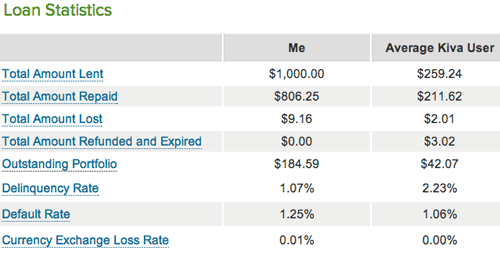
Kiva is a non-profit site where you can match up your contributions to a specific individual, starting with as little as $25. The entrepreneur is still charged a certain interest rate, but you don’t get any interest. I have lent out $350 to 14 loans, and all have paid back my principal so far except for one which paid back 92% total. Still, my overall default rate is only 1.32%.

Here are my previous posts on Kiva.

I am still very intrigued by the idea of setting up a pseudo-”foundation” to which I can contribute money and have it perpetually reinvest the principal and any interest earned into future microloans. It would be really cool to have something like $100,000 constantly being lent out to entrepreneurs around the globe.

Microplace Review: Investments, Application, Funding Methods, Bonus

Tuesday, June 9th, 2009

I finally got around to looking closer at Microplace, a site owned by eBay that tries to alleviate global poverty by offering investments that enable loans to hardworking poor people. I wrote about them previously in Earn a 5% Return and Help Fight Poverty Too? but never ended up investing.

These microlending investments offered do carry risk to principal, although historical repayment rates have averaged 97%. I have just finished putting in $1,200 across three different loans of different maturities and interest rates. This a decent chunk of money, but again this is both an investment and a charitable gift. As you’ll see below, I have the potential to earn some interest and/or maintain liquidity. I like the idea of this money being repayed and then loaned out again later, ideally over and over again. My own little mini-foundation. ;)

My Investments
This is an experiment for me, so I wanted to try a variety of investments. I believe that if microlending can be both profitable and successful in reducing poverty, it will really take off. I went with some of the higher-yielding notes and also one with high liquidity. We’ll see how the repayment rates are.

Investment #1: Helping Poor Women in Nicaragua, Earns 4% interest per year, Principal repayment on 12/31/2010.

Investment #2: Help Nicaraguan farmers, Earns 5% interest per year, Principal repayment on 12/31/2011.

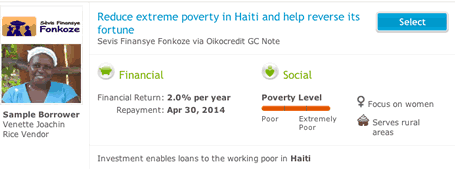
Investment #3: Called the Oikocredit Global Community Note, this investment enables loans to the working poor in several developing countries. 1.75% return per year, can redeem anytime. This last one is interesting because you can withdraw your principal at any time. I can already redeem only a day later:

Application and Funding Methods
The application process is very similar to signing up for a stock brokerage account. They will ask you identity information as well questions about your income and investment experience because they are selling securities that carry risk of loss. As for funding the loan, you can either use PayPal or a bank transfer:

Since eBay owns PayPal and Microplace, there are no fees for using PayPal. That means you can switch to a rewards credit card and earn some points or cash along with your investment. Why not? Just be sure to change your PayPal funding source. My credit card charge went through fine.

Got Bonus?
You know me and freebies. After signing up I received another e-mail about a Father’s Day promotion where you can even get a free solar-powered flashlight:

Invest as little as $20 in honor of Dad and MicroPlace will send a free solar-powered flashlight, to Dad. This eco-friendly flashlight will remind Dad how grateful you are for his caring and love. And your investment will help fathers and families work themselves out of poverty so their children can get an education.

(You don’t have to send the flashlight to dad if that’s not his thing. Send it to anyone.) If you are thinking about putting some money into Microplace, it would be neat if you clicked on this friends link first, signed up for an account, and then went for the flashlight. I don’t get money or anything like that, but it does track your loans so I can see how many new loans were funded by friends and friend’s friends… How many can we get?

MicroPlace Review: Earn a 5% Return and Help Fight Poverty Too?

Tuesday, March 10th, 2009

“A billion people around the world work hard every day to lift themselves out of poverty. They don’t want your charity. They want your investment. Invest today, earn a return, provide them with a livelihood.” - Microplace.com homepage.

Sounds pretty good, huh? Microplace is owned by Ebay, and is an SEC-registered broker of microfinance securities to individual investors. Loans are classified by level of poverty, financial return, length of investment, and geographical location. Recently, they got my attention by offering a 2-year loan with a promised interest rate of 5% per year, and a 4-year loan at 6%.

What is microfinance?
Microfinance is the supply of loans, savings, insurance and other basic financial services to low-income households and businesses, usually in areas where people don’t have access to formal banks. Microcredit is the extension of very small loans (microloans) to these poor entrepreneurs. A big name in this arena is the Grameen Foundation.

Tell me more about this 5% return…
Here is the loan listing page, and here is a link to the long 63-page prospectus for these Global Poverty Alleviation Notes (how’s that for an investment title?). I have looked through it, but haven’t digested it all. They are offered by Micro Credit Enterprises (MCE), a 501(c)(3) nonprofit organization. MCE seems to focus on women entrepreneurs, which have made up about 90% of their borrowers. They seem to participate in a variety of countries on 4 continents, from Armenia to Bolivia to Cambodia.

These notes are not a mutual fund, and is not FDIC or SIPC insured. These are unsecured debt obligations, with partial backing of “philanthropic guarantors”. Basically, wealthy individuals and/or groups promise to repay parts of this loan if there are enough defaults. The details are a bit vague, but there seems to be a networked agreement across multiple guarantors. However, risks definitely remain.

The actual interest charged to local microfinance institutions (MFIs) are stated to be from 8-10%. The rates paid by actual individuals are not stated, but can be as high as 30%. But these are often short-term loans to people with no collateral and few alternatives. The historical repayment rate is listed to be 96%.

What about MicroPlace vs. Kiva.org?
Kiva.org also lends small amounts to low-income entrepreneurs in the developing world. However, Kiva currently does not offer interest to lenders since it is a non-profit organization and is not registered with the SEC. Also, it has more of a person-to-person lending structure where you can choose the specific person you wish to lend to. However, I have read that Kiva is trying to offer interest in the near future.

Are you going to invest?
I’ve put some money to “work” at Kiva already, and my personal repayment rate on my completed loans from Kiva has been 98% so far. Given that I am still not very familiar with these investments, I still can’t treat the 5% Microplace note as a reliable investment. However, I am still leaning towards putting a chunk of money into it, because I do think significant principal loss is unlikely, and I want to give them a chance. If it works out, I think microfinance would really take off if there was also a financial benefit to investors.

net worth progress bar